
Article archive

Moelven’s Norsälven sawmill might be closed

The Chairman of the company, Division Manager Anders Lindh of Moelven Timber, says that even with extensive investment it will be difficult to achieve a future-oriented and profitable plant.

Considering closing a company is never easy. Unfortunately, Moelven Norsälven currently has a very low technical status and requires extensive ongoing maintenance to keep up operations,” Lindh says.

The company has annual revenues of just below SEK 200 million and Lindh says that attempts have been made to continue operations at Moelven Norsälven for as long as possible.

We now recognize that it is a question of time with regard to how long operations can continue in a proper manner without implementing improvement measures in the shape of major investments,” Lindh explains.

So far this year, results at the company have however been relatively positive. “However, this must be viewed in the context of the economic situation for Swedish sawmills being the best in 10 years. Overall, the company has posted a loss in the five-year period from 2012 to 2016”, Lindh says.

Lindh says that overall investment needs will total at least SEK 70 million in the next three years in order to provide hope for justifiable operations. “We nevertheless believe that this will not result in sufficient long-term profitability.”

Two other large sawmills in Sweden – Moelven Valåsen AB and Moelven Notnäs AB – are in the midst of a development programme involving methodology, investments and organizational development.

These two companies will have increased production capacity that can compensate for the reduction in production that an eventual closure of Moelven Norsälven will entail,” Lindh says.

According to Lindh, Moelven's overall production of sawn timber can be maintained at the same level, while efficiency and profitability is strengthened. “Customers and suppliers will therefore not be affected by an eventual closure of Moelven Norsälven and restructuring of operations,” Lindh says.


Proteak new MDF plant ramp up according to plan

Tecnotabla, Proteak’s new MDF plant, produced over 53,000m3 of MDF during the 2Q-2017, 5% more than the 1Q-2017 and 29% over 4Q-2016.

The company reports that after one year, the production ramp-up is running according to plan.

During 2Q-2017 MDF sales reached a total of MXP 202 million, 115.6% over those registered during 2Q-2016. Compared to 1Q-2017 sales decreased MXP 41 million due to lower sales volume reflecting the seasonality of the industry and the growth of imported MDF supply. In the first semester 2017 Proteak reached sales of MXP 473MM, 181% over 6M-2016.

For Proteak 2Q-2017 continues to reflect the transition from a company that spent 15 years building a solid balance sheet to an operating company. The plant continues expanding the manufacturing of value added products, with high quality melamine boards as well as MDF boards of all thicknesses.

Proteak is the largest forestry-industrial company in Mexico and Central America. With over 20,000 hectares of forestry plantations, it exports to over 15 destinations in America, Europe and Asia. Proteak developed Mexico’s largest forestry-industrial project. The company operates under the international standards of the Forest Stewardship Council® (FSC®).

Japan: Production of wood pellets in 2018 is expected to reach record-high

Japan shut down all of its nuclear power reactors following the Great East Japan Earthquake in March 2011. As of June 2017, only five reactors have resumed operation, and of Japan’s 57 nuclear power plants, 14 are slated for decommissioning due to their age. Continue reading "Japan: Production of wood pellets in 2018 is expected to reach record-high"

Central/West Africa: Logs and sawnwood order books looking good for 2 months

Log and sawnwood FOB prices in Central/West Africa remained unchanged through into early August and producers appear confident that the current market stability will continue for the time being.
Demand for logs and sawnwood is forecast to remain at the present level allowing millers to balance log availability with shipments. Many sawmills report satisfactory forward order books equivalent to two months of full production.
Business for the Chinese market is steady and producers report regular but modest increases in the volumes being ordered, especially for the most favoured species.
While some forecasters are suggesting the Chinese economy may slow, this does not fit with the mood of buyers for this market who seem to be convinced the economic prospects for the country are sound.
One year ban on bubinga export mooted
The Gabon Minister of Forests, now on a visit to China, has appointed new senior forestry officials. The Director General for Industry in the ministry is said to be considering a one year ban on the felling of bubinga/kevazino.
This is in order to secure time to bring in regulations aimed to allowing only large sawmill operators to be involved in bubinga export. It is anticipated that the new regulations would allow only export of sawn and further processed bubinga.
Owendo Port open for business
The new port in Owendo built by OLAM is operational and it has been reported that Maersk shipping line will focus on the port to take advantage of the lower cost handling charges.
Stories are circulating that OLAM is negotiating to take over management of Société Nationale Des Bois Du Gabon (SNBG), the government timber company.
Such a deal would add a considerable area of forest concession to OLAM’s already significant forest holdings.
With sound management, analysts say this may open the way for other timber companies to invest in manufacturing operations within SNBG.

Log Export Prices

West Africa logs, FOB € per m³
Asian market
LM
B
BC/C
Acajou/ Khaya/N’Gollon
245
240
160
Ayous/Obéché/Wawa
240
240
190
Azobe & Ekki
230
230
160
Belli
250
250
Bibolo/Dibétou
180
170
Bilinga
230
230
-
Iroko 325
300
265
Okoume (60% CI, 40% CE, 20% CS) (China only) 245 240 185
Moabi 330 300 235
Movingui 210
210
160
Niove
175
160
Okan
230
205
Padouk
300
280
230
Sapele 290 280 220
Sipo/Utile
310
290
255
Tali 330 320

 
Sawnwood Export Prices

West Africa sawnwood, FOB
€ per m³
Ayous FAS GMS 430
Bilinga FAS GMS 530
Okoumé FAS GMS
430
Merchantable 300
Std/Btr GMS 350
Sipo FAS GMS
540
FAS fixed sizes 555
FAS scantlings 560
Padouk FAS GMS 870
FAS scantlings 990
Strips 645
Sapele FAS Spanish sizes 505
FAS scantlings 510
Iroko FAS GMS 630
Scantlings 710
Strips
410
Khaya FAS GMS
450
FAS fixed
470
Maobi FAS GMS
620
Scantlings
630
Movingui FAS GMS
430

Global cross laminated timber market to exceed USD 2 billion by 2025

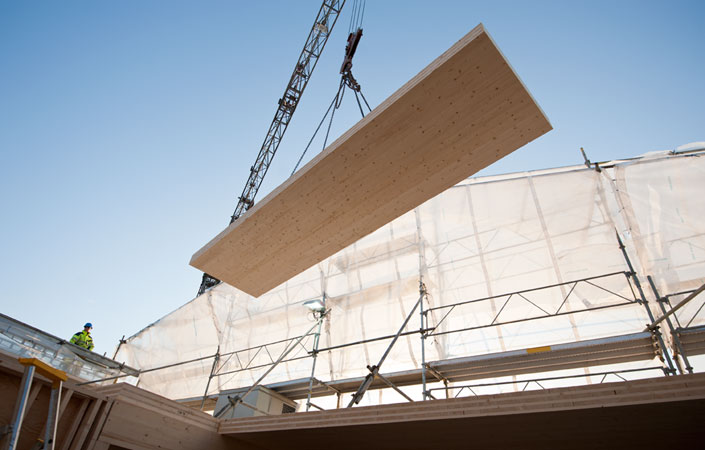
The global cross laminated timber market is expected to be valued at USD 2.07 billion by 2025. Rising awareness about the environmental hazards caused by the use of cement concrete in infrastructure construction coupled with rising number of cross laminated timber manufacturers and increasing demand for green homes are factors propelling the market growth.

The shift from concrete-based construction to wood-based construction along with supportive government initiatives around the world are positively influencing the market. In addition, decreasing overall cost of CLT construction owing to the increasing number of suppliers and shorter construction time is responsible for rise in demand, , according to a new report by Grand View Research, Inc.

The demand for wooden residential buildings, such as single-family homes and multifamily apartments, is increasing due to their aesthetic appeal and design flexibility. The improved fire resistance quality and earthquake-proof offered by cross laminated timber structure are expected to augment the market growth over the forecast period.

Institutional and commercial segments are expected to collectively account for 46.9% of the global market in 2025. The demand for these segments is attributed to low cost of construction and easy maintenance of cross laminated timber structures. Innovations in building and designing technologies are projected to boost the demand for cross laminated timber products over the forecast period.

Europe is the leading region owing to the early adoption of cross laminated timber and research & development on CLT technologies by countries such as Austria and Germany. The availability of timber from the forests of central European countries and advanced timber processing industries are the leading cause for market growth in the region. Countries like Canada, the U.S., New Zealand, Japan, and China in the North American and Asia Pacific regions are also rapidly developing markets for cross laminated timber.

Further key findings from the report suggest:

  • In terms of volume, the market is expected to grow at a CAGR of 15.1% from 2017 to 2025 on account of increasing awareness about sustainable housing. Residential segment is expected to witness the fastest growth rate of 15.4%, in terms of revenue, from 2017 to 2025 owing to high product demand in developed countries.
  • North America was valued at USD 65 million in 2016 and is expected to witness significant development on account of rising demand from educational institutions and residential builders Key participants include Stora Enso, Mayr-Melnhof Holz, Binderholz, XLam Ltd., Sterling Lumber, Schilliger Holz AG, KLH Massivholz GmbH, B & K Structures, Eugen Decker Holzindustrie KG, Structurlam, SmartLam, and Meiken Lamwood Corp. These companies are focused on increasing their production capacity to fulfill the worldwide massive product demand.
  • In 2016, Stora Enso invested approximately USD 900 million to setup a plant in Guanxi, China, to strengthen its presence in the Asia Pacific region.

Södra invests in new CLT facility at Värö

Södra is investing in a small facility for cross-laminated timber (CLT) adjacent to Södra’s sawmill at Värö. The plans include a future investment in a larger facility.

“Södra is focused on increasing the use of sustainable timber construction and wants to take part, and to stake out a position, in this growing market. Production is scheduled to commence in early 2019. The facility will have an annual capacity of about 5,000 m³ per shift,” said Jörgen Lindquist, President of the Södra Wood business area.

The investment is an important part of Södra’s strategic process of building long-term relationships across the value chain.

High-rise construction with timber is a growing market and demand is driven by both economics and sustainability. Demand is strong across all of northern Europe – in countries where Södra already holds a leading market position. CLT is a flexible material and particularly competitive in major cities, where the aim is to densify and construct high-rise buildings. Compared with other materials, CLT is transport-efficient, light and maintains high environmental integrity.

An extensive project has been ongoing for 12 months to improve and develop the profitability of Södra’s existing sawmills. At the same time, the best type of timber engineering for Södra’s structure, position and various markets has been under assessment.

“We have identified CLT as an interesting product and want to take part, and to stake out a position, in a growing market. But we are also aware that this will require heavy investment, take time to position ourselves in the market and is associated with business risks. That is why we are starting out small,” said Lars Idermark, CEO of Södra.

The location at Värö has been strategically chosen for its proximity to several Nordic high-growth regions, and the ease of shipping to both the UK and other international destinations. The facility will be co-located with Södra’s pulp mills and sawmills for access to green electricity and completed infrastructure. The investment is expected to require several new recruitments.

IKEA in talks with several Indian states to source wood

IKEA announced that is currently in talks with some state governments in India for sourcing wood for furniture as it sets up a large facility in Pune, for goods stocking. Continue reading "IKEA in talks with several Indian states to source wood"

Russian exports of softwood lumber to the US on a booming trend due to dispute with Canada

One of the results of the softwood lumber trade dispute between Canada and the US is that Russia has emerged as one of the winners. Continue reading "Russian exports of softwood lumber to the US on a booming trend due to dispute with Canada"

Metsä Wood’s new LVL line started production

Production at Metsä Wood's new LVL line in Lohja has started. The construction project has progressed according to plan and in schedule.

The investment is part of Metsä Wood's EUR 100 million investment program for LVL and plywood, and it supports the company’s industrial efficiency strategy.

At the Lohja mill, three LVL production lines were operating until the end of last year. With the investment, one of the old lines has been dismantled and another old line is being run down by the end of 2017.

The new  LVL line increases the mill’s production capacity by 20,000 m3 per year. The mill has a total capacity of 120,000 m3. The new line will reach full capacity within one year.

Largest CLT plant in Scandinavia to be built in Norway

Splitkon AS invests into a new 60,000 m3 Cross Laminated Timber (CLT) production line in Åmot, Norway.

According to the announcement, the new line is expected to be the largest CLT plant in Scandinavia, and the only one in Norway.

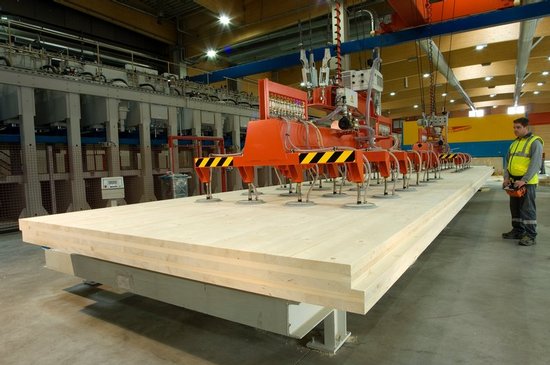
The new factory will produce solid wood elements up to 3.6 meters wide, 16 meters long and 30 centimeters thick. Splitkon AS has calculated that the need for raw material's first operating year is approx. 50 cubic meters of timber per day.

If the market is as expected, the need will increase over four years to 150-200 cubic meters per day.

The project involves Limtre Holding, Ski Bygg Gruppen AS, Holdit AS, Sparebank 1 Ringerike Hadeland, Innovation Norway and Siva.

IKEA to use India as hub for furniture

IKEA will use India as a hub for making sofas and furniture for the company's global stores, a move which is expected to increase volumes for the Swedish furniture retailer and thus reducing the prices of its products in India. Continue reading "IKEA to use India as hub for furniture"

China: Wood-based panel mills in Shandong province told to cease operations

It has been reported that most wood-based panel enterprises in Linyi City, Shandong Province have been told to cease operation as they do not meet environmental protection and safety regulations.

The authorities will stop water and power supplies to the mills and for those mills that cannot upgrade to meet the new standards the machinery in the factories will be removed.

Teams from the Environmental Protection Bureau conducted surveys in Linyi City for one month to identify non-compliant factories. The impact on plywood prices in the local market was immediate.

All wood-based panel markets in China have been affected by investigations conducted by the Environmental Protection Bureau and there has been a steep decline in panel output from mills in Hebei and Shandong Provinces.

However, Guangdong wood-based panel manufacturing enterprises have not been affected because they have a strong awareness of environmental issues and have been able to satisfy the new requirements. In the first half of 2017 the volume of laminate decoration panel of one company rose more than 40% from the same period of last year.

According to the latest statistics, in the first half of 2017 the output value of wood-based panel in Guangdong province rose 1.45% to RMB21.43 billion from the same period of last year.

Brazilian timber exports benefiting from steady growth of the US economy

In the first six months of 2017, logs and primary products accounted for most of Brazil’s timber exports and the tonnage exported was some 38% higher than in the same period last year, according to the Ministry of Development, Industry and Foreign Trade (MDIC).

The United States is the largest single buyer of pine plywood produced in Brazil accounting for 34% of exports of this product followed by Europe (30%).

The US is also the main market for wooden doors manufactured in Brazil, accounting for over 70% of all wooden door exports.

The largest buyer of tropical plywood produced in Brazil is Argentina (45%) followed by the US (10%), Mexico (8%) and France (7%). As for pine veneer, South Korea, at 42% of all veneer exports, is the major buyer followed by Malaysia at 30%.

The Brazilian timber industry is benefitting from steady growth in US economy. However, recent export data published by the Brazilian Association of MechanicallyProcessed Timber Industry (ABIMCI) shows that, while export volumes are rising on the back of firmer demand, prices are not.

Changes in export destinations appear to be having an influence on the phenomenon of higher volumes but flat prices.

Pine plywood exports totalled 934,682 cu.m in the first half of this year against 835,841 cu.m in the same period last year but companies have been unable to secure better prices.

Last year pine sawnwood was exported mainly to the US, China and Saudi Arabia but this year Mexico became the second ranked market destination taking 22% of all sawnwood exports.

Latest trends in North American softwood lumber markets

The softwood lumber demand in North America has increased steadily in 2016 and continued through the first half of 2017, while the US housing continued to be the first driver of consumption. Continue reading "Latest trends in North American softwood lumber markets"

US postpones final duties on Canadian lumber

Wilbur Ross, the US Commerce Secretary, announced on the 28th of August a 2-1/2 month delay in determining final anti-dumping and anti-subsidy duties on Canadian softwood lumber

The decision was taken as to buy more time to negotiate a settlement of the trade dispute.

According to Reuters, the Commerce Department had previously been scheduled to announce final lumber duties on Sept. 6, a step that would have ended the current negotiating process with Canada's government. Ross set a new deadline of no later than November 14.

"I remain hopeful that we can reach a negotiated solution that satisfies the concerns of all parties," Ross said. "This extension could provide the time needed to address the complex issues at hand and to reach an equitable and durable suspension agreement."

Softwood lumber producers both in the US and Canada said that they want to reach a fair arrangement as to calm down the US claims over the unfairly subsidized Canadian lumber.

But both sides say they are unwilling to settle for a "bad deal," pushing the talks past the start of negotiations to modernize the North American Free Trade Agreement. As long as the Commerce Department is negotiating on behalf of the United States, the lumber talks can continue on a separate track to the NAFTA talks, which are being handled by the U.S. Trade Representative's office, as reported by Reuters.

The dispute between the two countries is decades old and is centered on the fees paid by the lumber mills in Canada for timber cut largely from government-owned land. These fees are lower than the fees paid on US timber, which mostly comes from private land. Thus, the Canadian government argues that its fees are fair and is prepared to litigate the matter if a settlement cannot be reached.

The lumber producers in the US wish for a system of "clean quota", which would limit Canadian mills to a certain share of the US market.

Last week, in a joint statement, Canada's ambassador to the United States and envoys from major lumber-producing provinces, said that the coming weeks "will be critical to determine whether we have a partner in the United States prepared to advance our shared interests."

The U.S. Commerce Department is collecting preliminary duties of 17 percent to 31 percent on Canadian softwood lumber.

Lemeks to build EUR 30 million veneer and plywood plant in Estonia

AS Lemeks, the Estonian forest and wood processing company, plans to build a birch veneer and plywood factory in Viruvere, Jogeva County. Continue reading "Lemeks to build EUR 30 million veneer and plywood plant in Estonia"

Lumber markets in the US went down towards the end of August

The framing lumber markets in the US have experienced a recent stillness during last week, which led producers to explore more aggressively for orders. Yet, prices remained uneven, due to the selectively order process. Continue reading "Lumber markets in the US went down towards the end of August"

Wood pellets' price in Germany register slight decrease in August

During August 2017, the price of wood pellets in Germany has already risen slightly in the south, but registered a 0.4% drop against July. One tonne of wood pellets currently costs 230.46 EUR on average.
Compared to August 2016, the price has risen by 3.6%. One kilogram of pellets costs 23.05 cents and one kilowatt hour (kWh) heat from pellets costs 4.61 cents. The price advantage for heating oil is about 10%, and 20% to natural gas.
"This year, wood pellets are again showing the typical seasonal price trend. The summer prices have nevertheless reached their lowest point in August", explains Martin Bentele, Managing Director of the Pelletverband DEPV.
The price of German wood pellets in August 2017 has the following regional differences (with a 6-tonne decrease): In northern Germany, the price of wood pellets currently stands at 226.72 EUR/t. In central Germany, the same amount costs 228.17 EUR/t, while in northern Germany 231.24 EUR/t.
Larger quantities were traded at the following rates in August 2017: South: 217.64 EUR/t, Center: 215.04 EUR/t; North/East: 211.53 EUR/t (all including VAT).

Wood pellets’ price in Germany register slight decrease in August

During August 2017, the price of wood pellets in Germany has already risen slightly in the south, but registered a 0.4% drop against July. One tonne of wood pellets currently costs 230.46 EUR on average.

Compared to August 2016, the price has risen by 3.6%. One kilogram of pellets costs 23.05 cents and one kilowatt hour (kWh) heat from pellets costs 4.61 cents. The price advantage for heating oil is about 10%, and 20% to natural gas.

"This year, wood pellets are again showing the typical seasonal price trend. The summer prices have nevertheless reached their lowest point in August", explains Martin Bentele, Managing Director of the Pelletverband DEPV.

The price of German wood pellets in August 2017 has the following regional differences (with a 6-tonne decrease): In northern Germany, the price of wood pellets currently stands at 226.72 EUR/t. In central Germany, the same amount costs 228.17 EUR/t, while in northern Germany 231.24 EUR/t.

Larger quantities were traded at the following rates in August 2017: South: 217.64 EUR/t, Center: 215.04 EUR/t; North/East: 211.53 EUR/t (all including VAT).

Newsletter

Subscribe to our digital newsletter for your daily digest of essential news, views and analysis from the international wood industry delivered directly to your inbox.


0