Article archive

US lumber prices jump through the end of August

Framing lumber trading opened the week with a head of steam following a strong round of purchasing the previous week. However, momentum faded as the week progressed, and prices of most dimension and stud items finished the week at or slightly above midweek levels. A downturn in futures Tuesday through Thursday turned buyers cautious. Warning signs in the U.S. housing market, including a soft new-home sales report for July, concerned traders. Early gains lifted some prices by double digits, and the Framing Lumber Composite Price posted a $10 gain.

This Week
Aug 24
Last Week
Aug 17
Year Ago
2017
Random Lengths Framing Lumber Composite Price* $451 $441 $405
KD Western S-P-F #2&Btr 2x4 R/L Mill Price 480 462 385
KD Eastern S-P-F #1&2 2x4 R/L, delivered Great Lakes 580 573 482
Green Douglas Fir Std&Btr 2x4 R/L (Portland) 447 440 460
Southern Pine (Westside) #2 2x4 R/L 440 427 363
KD Coast Hem-Fir #2&Btr 2x4 R/L 457 447 425
Ponderosa Pine (Inland) #2&Btr 1x12 R/L 775 775 680
* Weighted average of 15 key items

Random Lengths Panel Market Report

Structural panel sales were measured, but prices posted modest gains nonetheless. Prices of OSB were firm to higher, although the pace of sales tapered as the week progressed. Small increases were posted at midweek in most producing regions, and prices flattened at those levels. Southern Pine plywood trading was up and down. Demand for rated sheathing sustained modest upward momentum. A quieter sales week in western Fir plywood still generated enough orders for most mills to sell close to the week’s production.

(f.o.b. mill prices) This Week
Aug 24
Last Week
Aug 17
Year Ago
2017
Random Lengths Structural Panel Composite Price* $470 $466 $450
Southern (west-east) 15/32-inch 3-ply rated sheathing plywood 435-475 425-465 370-390
Southern (west-east) 15/32-inch 4-ply rated sheathing plywood 440-480 430-470 375-395
Western 1/2-inch 4-ply rated sheathing plywood 495 490 468
North Central 7/16-inch Oriented Strand Board 345 345 414
*Weighted average of 11 key items


Sharp drop in Chinese demand causes big drop in New Zealand’s log export prices

The dramatic drop in August At-Wharf-Gate (AWG) prices for logs delivered to ports around New Zealand is the main talking point in the current market.

According to interest.co.nz, the predominant reason for this drop in AWG prices has been the depreciation of the Chinese Yuan Renminbi (CNY) against the US Dollar (USD). In mid-April the Chinese log buyers required ¥940.75 CNY to buy a cubic metre of log at a sale price of 150 USD/JASm3. In mid-July the buyers had to pay ¥1,1003.61 CNY for the same volume at the same price. This severely reduced their buying power and sales prices dropped accordingly.

The drop in CFR log sale prices in China has been ameliorated somewhat by the weakening NZD against the USD and an easing in freight rates by 1-2 USD/JASm3.

The final result is that AWG prices for un-pruned sawlogs have dropped an average of 12-13 NZD /JASm3. Pruned logs have dropped on average 18 NZD /JASm3 as the clearwood products manufactured from these logs have also been hit with trade tariffs imposed by the USA.

The metrics still show the China log market to be buoyant. Total softwood log inventory has reduced to approximately 3.2 mln m3, and daily port off-take is still very healthy for this time of year at over 70,000m3/day. Demand for logs in China should increase in September as the weather cools.

The recent drop in log sale prices in China have predominantly been caused by the depreciation of the CNY against the USD as graphed below. While one of the two main log exporters is trying to hold CFR prices in the 136-138 USD range/JASm3 for A grade, the other main exporter has already offered some early August shipments at 130 USD/JASm3. This price of $130 USD/JASm3 however is more a basket deal for buyers also buying vessels above market price, so it is hard to say this is the normal price. Most exporters think prices for A grade in the mid USD $130’s would work for all parties. While it was clear the Chinese log buyers needed some relief from the weakening CNY, everybody now seeks stability in the market.

Total softwood logs stocks in China have dropped to approximately 3.2 mln m3 and demand is still strong. Current daily port off-take is over 70,000m3 and demand is expected to increase as temperatures cool across China. We have also seen less softwood volume arriving from South America and the South East of the USA. There is talk of China imposing a 5-20% tariff on log imports from the US, and US log cargo already incurs costs due to time delays. Any log cargo from the US now even suspected of carrying pests is not allowed to pass through customs until samples have been inspected by laboratories. Previously, customs officers in China let shipments through while samples were being analysed. I am sure the samples are processed at ‘Trump Speed’.

This reduction in supply will assist with keeping inventory down, which in turn will reduce the likelihood of the price drops continuing. Most exporters forecast a stabilising in sale prices.

It is interesting to note the strengthening of the CNY against the USD over 2017, and in particular the second half of the year from the longer-term currency chart below. The recent depreciation of the CNY against the USD has negated these gains though.

European African timber operations transferred to Asian companies

A major structural change is underway in the African timber industry as operations are reoriented away from the European market towards Asian markets.

These issues are explored in one recent trade articles by Alain Karsenty, the Research Director of CIRAD. The article refers respectively to the “crises” and “brutal weakening” of European-owned forest and timber operations in Africa in recent years.

According to M. Karsenty, “European dealers, formerly essential in the African timber industry, are gradually giving up their assets to Asian investors. Malaysian operators have been present in Central Africa since the mid-1990s.

Chinese companies have entered the industry since the 2000s and, more recently, Indian investors, including the multinational Olam, have made their mark in Gabon and Congo”.

The process of transferring European-owned industry assets in Africa to Asian firms has been on-going now for some time, but there is a feeling that the withdrawal of Rougier, a company with such long and deep links to Africa, may mark a turning point.

The share of African timber exports to Europe increased slightly in 2015 and 2016, due both to a slight uptick in European consumption and a big fall in exports to China (mainly due to bursting of the speculative bubble in rosewood). However, Europe’s share of African exports slumped again in 2017 and appears to be falling fast in 2018.

The on-going trade dispute between China and the United States might strengthen these trends. On 2nd August, the Trump Administration announced a new round of tariffs on $200 billion in Chinese goods, due to be implemented from 1st October.

In retaliation, the Chinese government announced that if the US goes ahead, it will impose a wide-ranging package of sanctions on imports of US products, including a 25% tariff on American hardwood.

Such measures are likely to enhance China’s demand for hardwood products from other regions, including Africa.

And as around 50% of all American hardwood exports are currently destined for China, it’s also likely to encourage US hardwood exporters to focus more heavily on the European market, further increasing competition for tropical timber.

China: Wood-based panels manufacturers to cease production due to new ‘green’ protection policy

According to the Chinese government’s environmental policy called the “Three-Year Plan on Defending the Blue Sky” industrial enterprises in Beijing, Tianjin and Hebei Provinces will be required to present plans to ‘green’ production lines by the end of September 2018.

High risk enterprises including foundries, home furnishing producers, woodbased panel producers, paper makers, and chemical plants in 28 cities will be required to stop production to undertake refurbishment between 1 October 2018 and 31 March 2019.

Forest industry enterprises will be affected by this new policy of environmental protection and face huge challenges.

Last year, it has been reported that nearly 3,000 wood-based panel enterprises in Wen’an County, Langfang City, Hebei province have been told to cease production.

Some enterprises have been required to re-tool to meet environmental requirements and some have been encouraged to relocate to their original home provinces, such as to Shandong Linqing, Liaoning Benxi, Xinjiang Yanqi and Hebei Xunxi.

A series of workshops on ‘Returning to Hometown to Invest’ have been held to encourage wood-based panel enterprises to return to their hometown and invest there. .

The affected enterprises were found to be generating and emitting pollutants which had contaminated surrounding farmland. It has been estimated that when these enterprises stop production or relocate it will be possible to rehabilitate around 2,700 hectares of farmland.

Russian wood pellets exports up by 34%

The Russian Customs Service reports exports of wood pellets from Russia in CY2017, at 1.44 MMT, or more than 34 percent higher than in CY2016. The leading export destination for these products was Denmark at 615,117 MT, followed by South Korea at 127,519 MT, and Belgium at 123,435 MT and Sweden at 120,142 MT. These four destinations account for almost 70 percent of total Russian exports of wood pellets. Europe will continue to be the largest importer of Russian wood pellets. Continue reading "Russian wood pellets exports up by 34%"

Reasons for declining European tropical wood consumption

The reasons for declining consumption of tropical timbers in Europe are now well understood. The logistical problems of supplying consistent commercial timber volumes from Africa into the European market are compounded by strong EU trends to favour engineered timber products which in turn require just-intime delivery of wood in standardised grades and dimensions which tropical suppliers are not well placed to provide. Continue reading "Reasons for declining European tropical wood consumption"

China: Rising redwood market

The average growth in the value of retail sales of commodities in 2017 was 8.2% but sales of furniture exceeded the average rate and sales of ‘redwood’ furniture represented the fastest growth.

Chinese ‘redwood’ log imports totaled 990,000 cubic metres valued at US$914 million in 2017, up 24% in volume and 12% in value. Around 45% of Chinese ‘redwood’ log imports were from Nigeria in 2017 despite the log export ban and were worth US$329 million. Continue reading "China: Rising redwood market"

Drax completed fourth biomass unit conversion

Drax has switched on its fourth biomass generating unit—taking the power station in North Yorkshire a step closer to achieving its coal-free ambitions.

Work got under way on the conversion as part of a planned maintenance program in June, with Drax’s team of engineers completing the work required, on schedule, in just over two months.

Having upgraded three of its coal units to use biomass, Drax is already the biggest decarbonization project in Europe. The conversion of a fourth unit means it is on course to be off coal before the government’s 2025 deadline.

To convert the unit the project team has re-used some redundant infrastructure left from when the company was first cofiring biomass with coal on a large scale, around eight years ago.

A trial last year confirmed that by modifying the old cofiring fuel transportation system, compressed wood pellets can be delivered in the quantities required to fully convert the fourth generating unit.

Andy Koss, Drax Power CEO, said, “This is another major milestone in the transformation of the power station. It will extend the life of the plant, protecting jobs, whilst delivering cleaner, reliable power for millions of homes and businesses.

“It is testament to the engineering expertise, skill and ingenuity we have at Drax. The team has developed some very innovative solutions for this upgrade, using all the knowledge we’ve gained throughout the work we have done so far to transform the business using sustainable biomass.”

The cost of conversion of the fourth generating unit is significantly below the level of previous conversions, at around £30 million.

Drax has already invested around £700 million in upgrading the first three units and associated supply chain infrastructure to use sustainable biomass instead of coal.

Nigel Adams MP for Selby said, “I’m delighted to see Unit 4 in operation as a biomass unit, continuing the good work Drax is doing with its Beyond Coal strategy, protecting jobs and ensuring it continues to play a vital role in the Northern Powerhouse economy.”

The fourth unit will help the power station, at Selby in North Yorkshire, to deliver vital reliable and flexible power needed by the grid to maintain secure supplies as more renewables come online and the sector continues to decarbonize.

Japanese Sumitomo expands in US

Sumitomo Forestry has acquired a 60% equity interest in the United States Mark III Properties.

The Sumitomo Forestry Group cited diversifying revenue sources in the global market as a basic policy in its Medium-term Management Plan 2018. The present initiative is part of that plan.

The housing construction and sales businesses are steadily expanding in the United States and Australia, with sales of approximately 10,000 homes planned for the fiscal year ending March 2019.

Mark III is a land development company that was established in 1974. It engages in the development and sale of completed housing lots (for detached houses and townhouses) in Greenville and the Spartanburg areas in Northwestern South Carolina, situated in the southern part of the United States.

Revenue growth of Russia’s largest sawmills up sharply in 2017

In 2017, the total revenue of the 10 biggest forest products companies in Russia amounted 339.4 billion rubles ($5.1 billion). The top three leaders of the rating have not changed: Ilim Group, Mondi Syktyvkar, Segezha Group.

According to the annual Top 50 Russian forest-based sector companies rating published by Lesnaya Industriya Magazine, the Ilim Group reported FY 2017 revenues decreased by 1.1 per cent to 110.4 billion rubles, net profit down 27.7 per cent to 18.956 billion rubles. Mondi Syktyvkar got the second place in ranking. In 2017, Mondi Syktyvkar’s revenues were flat compared to the previous year — 54.944 billion rubles (+ 0.03 per cent).

The third company of the rating was Segezha Group (part of AFK Sistema). The company's revenue increased by 1.63 per cent to 43.7 billion rubles in 2017. Segezha Group increased paper production by 11.5 per cent, to 319 thousand tons, consumer packaging - by 15.6 per cent to 37 million units, and the production of paper bags decreased by 6.2 per cent to 1,172 million units.

The fastest-growing company of the year was the Troitsk Paper Mill (25th in the rating), which revenue increased by 62.72 per cent. The company earned 3.71 billion rubles in last year.

Back in 2016, the revenues of the 100 largest timber industry companies of Russia for the year increased by 13.2% to 918.6 billion rubles. The remaining participants of the timber industry in the country are medium and small businesses with annual revenues up to 1.6 billion rubles. The economy of Russia declined for two consecutive years: -3.7% (y / y) in 2015 and -0.2% (y / y) in 2016. After a severe shock experienced by Russian businesses and the entire economy in 2014, 2015 and 2016 again presented challenges to Russian timber industry workers.

Roundwood prices in Finland on an upward trend

Roundwood prices in Finland have mostly increased in May, both as compared to April as well as compared to the same month of 2017. Pine sawlogs' price is higher by almost EUR 0.50/cbm while spruce sawlogs are more expensive by EUR 0.46/cbm. Continue reading "Roundwood prices in Finland on an upward trend"

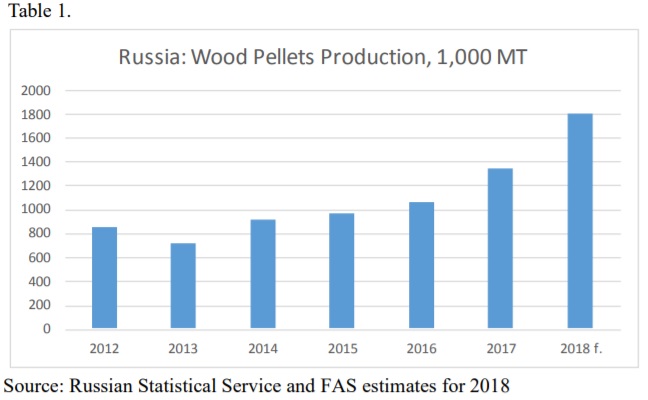
Russia: Production of wood pellets expected to rise more than 6 times by 2025

While Russia’s wood pellet production is relatively young, it accounts for a six percent share of world wood pellet exports. Russia ranks 8th in the world for total wood pellet production, with three percent of total world wood pellet production. According to FAOSTAT, production of wood pellets in Russia is forecast to increase significantly by 5 MMT by 2020, and by 8 MMT by 2025.

However, Russian Ministry of Energy and Industry analysts forecast that production will increase at a slower pace, between 10 and 12 percent annually. Stabilization of world prices for wood pellets in CY 2018, after a downward trend in 2015 due to a drop in oil prices, will also be a driver for stimulating exports from the Russian producers.

The growing interest from the European Union for biofuels, particularly wood pellets, will continue to be a major incentive for Russia to increase production of wood pellets. Also, recently Asian countries, such as Japan and South Korea, have become more interested in Russian wood pellets and as this interest grows it will also contribute to an expansion of Russian wood pellet production. Currently, Russia is the third largest exporter of wood pellets to the EU, after the United States and Canada.

Production

According to Rosstat (Russian Federal Statistical Service), Russia produced 1.34 MMT of wood pellets in CY2017, more than 30 percent increase from CY 2016. However, sources report that production statistics for wood pellets are incomplete. The statistics primarily capture large-capacity factories, and mid-sized and smaller facilities which operate as part of larger wood processing plants, do not report their production. Inaccurate wood pellet production statistics also could contribute to the high difference in production in CY2013 and CY 2014. As a result, it is believed the actual wood pellet production is underreported by Rosstat.

Some estimate production of wood pellets in Russia in CY 2017 at 1.75 MMT, an increase of 32 percent over production in CY 2016. Such a significant increase in production is attributed to launching new production facilities and continued strong demand from the European Union and new markets in Asia, such as Japan and China. In addition, the government initiative to provide compensation to wood pellet exporters up to 80 percent to cover transportation and certification expenses, as well as participation in the exhibitions and fairs. However, the lack of a domestic standard for pellets, poor transport infrastructure, a lack of warehouses, and the product’s seasonality are challenges to further growth of the wood pellet sector in Russia. Industry sources believe that Russia will require large investments in order to upgrade its facilities and expand its production capacity. Domestic demand can also absorb some of the increased, near-term production; however, experts do not forecast further development of local market in the near-term.

Analysts estimate that currently 10 large wood pellet producers manufacture more than 60 percent of total Russian wood pellet production about 60 percent of total production of wood pellets in Russia. In 2017, the North Western Federal District and Siberian Federal District accounted for almost 70 percent of total production of wood pellets in Russia. The provinces located in these federal districts are situated in proximity to the borders of EU and Asian markets.

According to experts from the Lesonline.ru portal, there are about 20 wood pellet facilities in Russia with production capacity from 30,000 to 70,000 MT that have had stable operations since 2010. Reportedly, in CY2017 these larger facilities reached operation capacity between 90 to 95 percent. However, analysts project a trend away from large facilities with an increasing number of facilities with smaller capacity, up to 20,000 MT. However, the share in overall pellet production from the smaller facilities accounts for only 14 percent. Given the current economic situation, the number of smaller-capacity facilities is forecast to increase because they have more mobility in sourcing raw materials and can easily market their production locally. In addition, recent government initiatives to support exporters and call for improving ecology and environments are likely to stimulate producers of forestry processing industries to construction wood pellet production facilities.

There are a number of projects for building wood pellet facilities, mostly with foreign investments, that are under way or have recently started operations. For example, Japanese company Shinnen Corporation Ltd. is planning to invest into wood pellet production facility Republic of Buryatiya in 2018, with annual potential production capacity of 300,000 MT of wood pellets. The pellets will be exported to Japan. Since 2017, another pellet production facility with annual capacity of 70,000 MT launched its operation in Khabarovsk province, BM Group, Italian industrial group of companies, invested 9.5 billion rubles into the project. Verkhnepashinsky Forestry Complex-JSC “Sibles Project” completed renovation of its forestry facility in Krasnoyarsk province. Reportedly, production of wood pellets is estimated at 170,000 MT in 2017. Most of the products will be destined to the Asian markets.

Wood pellets in Germany still available at low prices this summer

Wood pellets in Germany are still available at low prices this summer. As compared to July, the wood pellet prices remained constant in August.
The average price for a tonne of wood pellets (for 6 t purchases) in Germany is €237.49, 0.5 percent more than in the previous month. The price is 3.1 percent higher as compared to the same month of 2017.  Accordingly, one kilogram of pellets costs 23.75 cents and one kilowatt hour (kWh) of heat from pellets 4.75 cents. The price advantage of wood pellets against fuel oil is around 31 percent, and 20 percent as compared to natural gas. 
"The pellet price remains in the national average still at its low summer level. The first signs that this could soon be over, however, are already evident in the north and south, where prices for some purchase quantities have already increased slightly. Now the heating operators should take action; those who have not yet filled their warehouses for the winter, advises DEPV (the Germany Wood Pellet Association) Managing Director Martin Bentele. In winter, the association expects the usual seasonal price increase, however the amount depends on the weather conditions. In addition, delays in delivery may occur if the winter weather complicates transportation or if many customers will fill their warehouses "overnight" at the same time.

The price for wood pellets varies regionally in August 2018 (purchase amount 6 t): The cheapest price is currently in central Germany (234.87 EUR / t). In the north and south of the republic, the price has already picked up slightly. In South Germany it stands at 237.99 EUR / t and in North and East Germany at 238.54 EUR / t.
Larger quantities (26 t) were traded in August 2018 at the following conditions: South: EUR 224.30 / t, Center: EUR 217.89 / t, North / East: EUR 219.85 / t (all incl. VAT).

Latvian plywood exports drop sharply

A total of 72,900 m³ of plywood was exported from Latvia in the first quarter, a decrease of 24.6% compared to the same period last year.

The value of goods decreased by 17.7% to € 51.9m. The downward trend that began last year has thus continued, according to the foreign trade statistics published by the Forest Department in the Latvian Ministry of Agriculture.

Deliveries to Germany fell by more than half to 9,900 m³. Nevertheless, Germany remained the largest customer for Latvian plywood in the first quarter. Exports to Great Britain also fell significantly by 29.2% to 7,700 m³. In contrast, the export volume to Turkey increased by 32.4% to 9,800 m³ of plywood. In terms of volume, Turkey has thus taken second place among the most important sales markets.

Plywood imports rose again in the first quarter by 29.5% to 33,900 m³. The import value even increased by 47.2% to €15.4 million. From Russia, by far the largest supplier country, around 28,400 m³ of plywood was imported into Latvia, an increase of 28%.

Record profits for many lumber companies in North America and Europe in 2018

Sawlog costs, the largest cost component when manufacturing lumber, have gone up much more slowly than lumber prices in many countries during the past year, resulting in substantial increases in earnings for the international lumber industry.
Lumber prices in the US have experienced a spectacular surge in 2017 and the first half of 2018. By the end of the 2Q/18, the benchmark lumber price index reported by the market report Random Lengths reached its highest level in at least 30 years. From January 2017 to June 2018, average prices for commonly traded lumber in the US increased by 40%. During the same period, sawlog prices were practically unchanged in the US South and rose about 28% in Western US, resulting in higher gross margins in 2018 for sawmills in both regions. Similar developments have occurred in Canada, leading to record high profitability for many of the country’s sawmills thanks to the high lumber prices in the US.
In the 2Q/18, profits for sawmills in North America reached their highest levels since at least 2005, primarily because lumber prices have risen faster than sawlog prices. In Europe, the gross margins in early 2018 were close to the highest they have been in four years in the Nordic countries, while they reached levels not seen in over a decade in other parts of the continent.
However, not all countries have experienced positive earning trends the past few years.
Sawmills in Eastern Russia, New Zealand and Brazil saw their gross margins decline from 2015 to early 2018 as sawlog prices rose faster than lumber prices. In Siberia, the gross margin has fallen 21% in three years with the 2Q/18 levels being the lowest since 2013. Most of the decline has been the result of higher costs for sawlogs for a growing sawmilling sector in Eastern Russia.

US lumber prices pick up slightly

Framing lumber trading in US hit its fastest stride in more than two months, and the market finished the week with a firm tone. Wildfires in Western Canada and the West were a catalyst sparking sales, firming mill quotes, and lifting futures prices through the week. Buyers needing to replenish — but assurance that downside risk was minimal — stepped in, if more cautiously than earlier in the year. The Random Lengths Framing Lumber Composite Price ticked up $1.

This Week
Aug 17
Last Week
Aug 10
Year Ago
2017
Random Lengths Framing Lumber Composite Price* $441 $440 $414
KD Western S-P-F #2&Btr 2x4 R/L Mill Price 462 442 387
KD Eastern S-P-F #1&2 2x4 R/L, delivered Great Lakes 573 569 489
Green Douglas Fir Std&Btr 2x4 R/L (Portland) 440 435 475
Southern Pine (Westside) #2 2x4 R/L 427 420 373
KD Coast Hem-Fir #2&Btr 2x4 R/L 447 450 430
Ponderosa Pine (Inland) #2&Btr 1x12 R/L 775 775 680
* Weighted average of 15 key items

Random Lengths Panel Market Report

Structural panel prices posted moderate gains amid slower trading. Prices of OSB continued to trend higher in most regions, although the pace of sales moderated. Western Canada was among the most active regions. Southern Pine plywood prices pushed higher throughout the week amid steady sales. Buyers covered their most pressing needs last week at a more frenetic pace, but many returned this week to bolster inventories. In western Fir plywood, a sales turnaround evident last week carried through.

(f.o.b. mill prices) This Week
Aug 17
Last Week
Aug 10
Year Ago
2017
Random Lengths Structural Panel Composite Price* $466 $461 $453
Southern (west-east) 15/32-inch 3-ply rated sheathing plywood 425-465 415-455 375-395
Southern (west-east) 15/32-inch 4-ply rated sheathing plywood 430-470 420-460 380-400
Western 1/2-inch 4-ply rated sheathing plywood 490 482 485
North Central 7/16-inch Oriented Strand Board 345 345 414
*Weighted average of 11 key items

Certified sustainable timber business model in Africa challenged by structural change

A major structural change is underway in the African timber industry as operations are reoriented away from the European market towards Asian markets.

This change is driven by factors both on the supply-side, particularly declining availability of timber species of interest to the European market; and on the demand-side as consumption is weakening in Europe at a time when demand in Asia is rising rapidly.

Although this shift has been going on now for over a decade, the full implications were laid bare in March this year with the announcement that the Rougier holding company was to be placed under court-ordered receivership proceedings in France with a view to rolling out extensive restructuring actions. Continue reading "Certified sustainable timber business model in Africa challenged by structural change"

Transformation of China’s wood-based panel companies

China’s production of wood products, especially wood-based panels, has increased rapidly in recent years.

According to statistics from the China Timber and Wood Products Distribution Association (CTWPDA) output of wood-based panels rose 5% to 315 million cubic metres in 2017.

Of the total, output of plywood, fibreboard and particleboard was 182 million cubic metres, 67 million cubic metres and 35 million cubic metres respectively.

2017 output of particleboard surged over 30%.

However, most of wood-based panel enterprises are facing huge challenges resulting from their low level technology, overcapacity, inadequate raw material supply, environmental restrictions and fierce competition not to mention rising tariff barriers.

Because of this the sector is undergoing a transformation. For example, in Zhanghzou City of Fujian province, gas is replacing coal for energy generation and around 1,000 coal fired boilers have been replaced.

Softwood lumber from Belarus becoming more attractive on the European market

The European countries softwood lumber imports from Belarus have went up during January - September 2017 by 51%, to a total of 1,085,749 m3.

The EU top importer was Germany, which increased its softwood lumber imports from Belarus by 33%, to a total volume of 315,041 m3, during the mentioned period. Latvia, the second importing company, also increased its imports, by 33%, to 235,970 m3, followed by Lithuania, where the softwood lumber imports from Belarus went up by 42%, to 245,085 m3.

Starting January 1st 2015, Belarus has banned the exports of unprocessed wood, so the logs deliveries to Europe have stopped ever since. The decision was made by the Belarusian president, Aleksandr Lukashenko, as to raise the volumes of wood processed within the country.

Softwood lumber imported by EU  from Belarus (in m3 )

Importing Country January-May 2017 January-May 2018 Change in %
EUROPEAN Union
719,676 1,085,749 51 %
Germany
236,986 315,041 33 %
Latvia
156,669 235,970 51 %
Lithuania
142,783 202,417 42 %
Poland
48,773 82,151 68 %
Netherlands
48,588 77,613 60 %
Others
85,877 172,557 101 %
TOTAL 719,676 1,085,749 51 %

Metsä’s bioproduct mill reached nominal pulp capacity

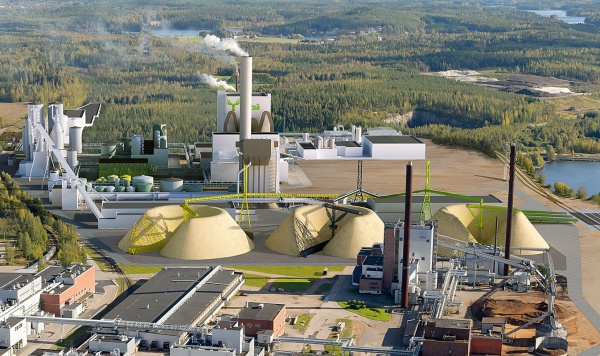
Metsä Group has announced that its next-generation, bioproduct mill in Aanekoski, Finland, has reached its nominal capacity in August 2018, according to plan. The bioproduct mill produced its millionth tonne of pulp on August 8, 2018. This makes Metsä Group the world’s largest producer of softwood market pulp.

The bioproduct mill was started production on August 15, 2017, on schedule and within budget. The start-up phase progressed in line with the target curve.

The bioproduct mill produces 1.3 million tonnes of high-quality softwood and birch pulp annually, in addition to other bioproducts, such as tall oil, turpentine, and bioenergy. New bioproducts that already complement the product portfolio include product gas from bark, sulphuric acid from the mill’s odorous gases and biogas from the sludge from its wastewater treatment plant, as well as biofuel pellets, according to a press release.

The mill serves as a platform for the production of new bioproducts, as well as further developing and expanding the industrial ecosystem in Aanekoski. Metsä Group is actively exploring various processes and product paths. Key bioproduct development projects include pulp-based lignin products and textile fibres.

Newsletter

Subscribe to our digital newsletter for your daily digest of essential news, views and analysis from the international wood industry delivered directly to your inbox.


0