Article archive

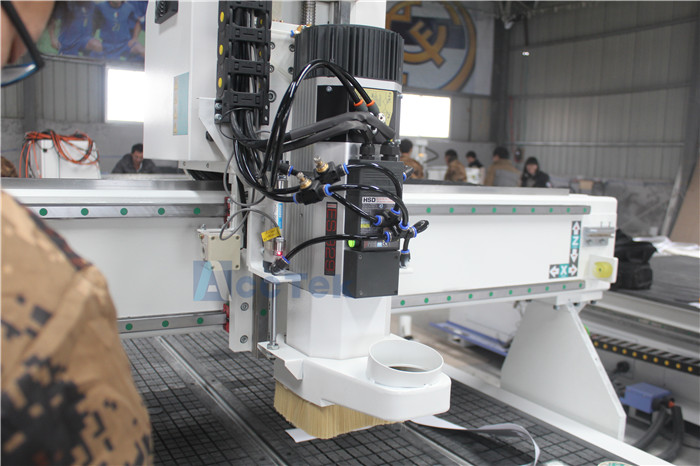
Italian woodworking machinery industry falls sharply due to lower exports

The orders for Italian woodworking machines and tools in Q2 2018 decreased 9.9% y-o-y due to orders from abroad dropped 15.5%. This figures are balanced by the positive results in domestic market increased by 29.4%.

As the reason of dropping exports in the April-June 2018 Acimall (the Italian woodworking machinery and tools manufacturers' association) notes the new customs duties on a global scale, the increase of energy products and the financial instability in some emerging countries.

The orders book has gone down to 3.1 months (from 3.4 in the previous quarter), while prices as of January 1st have slightly increased (0.4%).

The quality survey for the April-June quarter indicates that, according to 39% of the sample, the expected production trend is positive (stationary according to 56%, decreasing according to 5%). Employment will be stable according to 67% of the sample, increasing for 33%: no one seems to fear a reduction of employment. Available stocks will remain stable according to 72% of interviewed companies, while 6% expect a decrease and 22% an increase.

According to Acimall survey, 17% of the sample expects an increase of foreign orders, while they will be stable for 72% and decreasing for 11% (the balance is plus 6, versus plus 29 in the previous quarter). Similar caution on the domestic market: 83% predict a period of substantial stability, 6% bet on growth and the remaining 11% fear a reduction (the balance is negative at minus 5, versus plus 11 in the previous quarter).
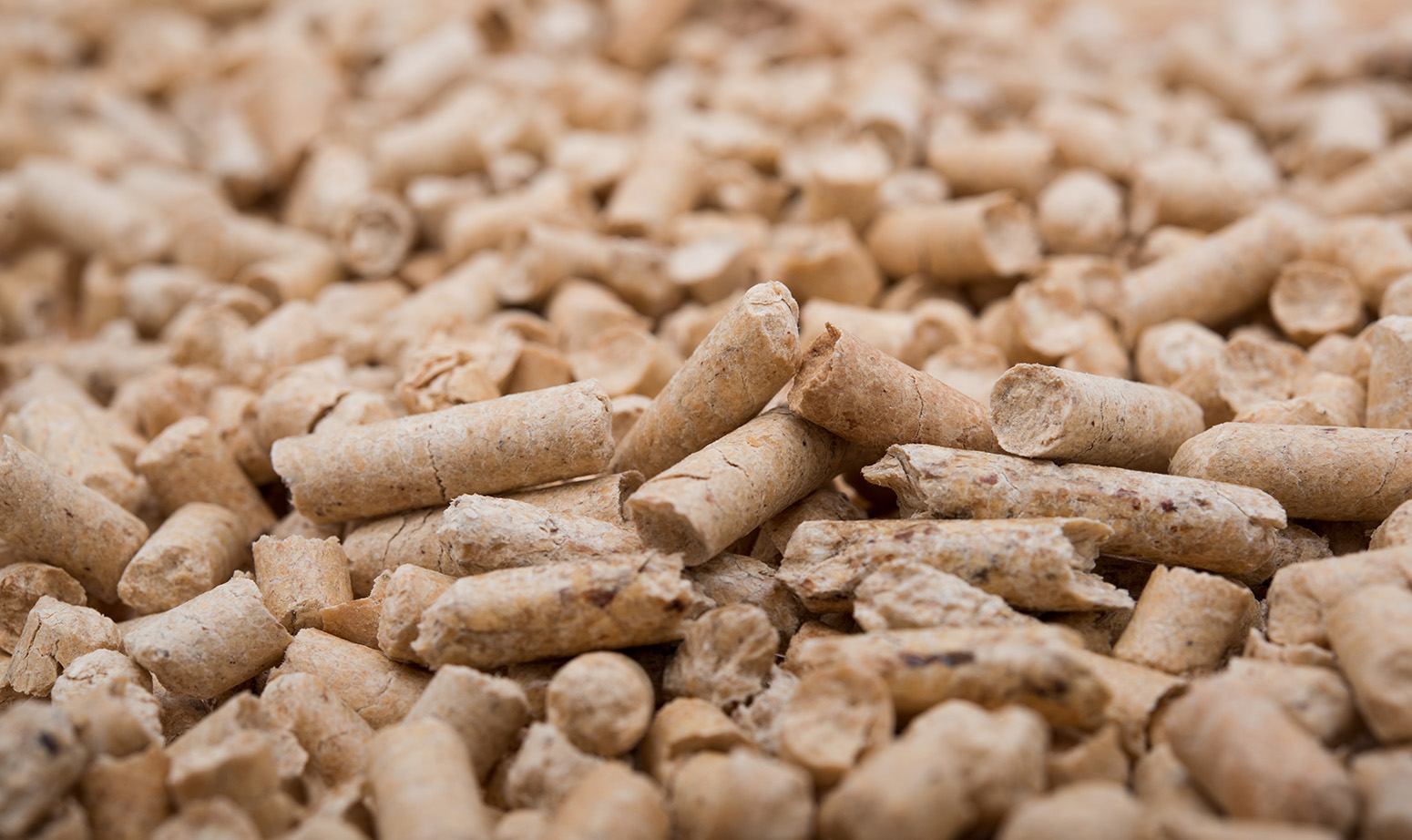
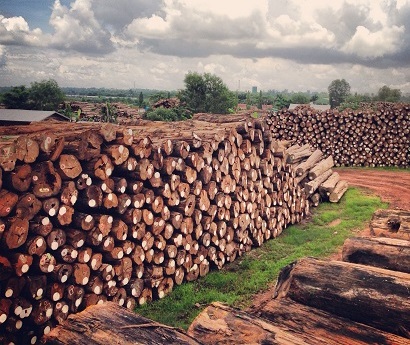
Vietnam: New wood pellet plant to produce 160.000 t/yr

Biomass Fuel Vietnam Co placed an order with Hekotek for a new complete plant of wooden pellets. According the announcement, the plant will be constructed in the Nghe An province of Vietnam.

Initial planning and construction works have already been started on the erection site. The transportation of the equipment should be started in spring of 2019 and the term for performing of the full complex is at the end of 2019.

The annual production capacity of the plant will be ca 160 000 tons of wooden pellets. Raw material of the plant will be from low quality pulplogs, chips and sawdust of eucalyptus, acacia and pine. For debarking and chippering of the logs Hekotek will deliver to the customer a respective line. For drying of sawdust will be used drum dryers and the wooden pellets will be pressed with 6 CPM pellet presses. The capacity of storages of ready wooden pellets will be 20 000 tons, with output of pellets to the lorry loading silos.

The target market for the ready production will be mostly Japan.

European importers discouraged from importing Myanmar teak

Given continuing controversy in the EU over whether Myanmar teak can be traded in compliance with EUTR requirements, importers were surprised by EU import statistics showing a 46% increase in sawn hardwood trade with Myanmar in the first five months of this year. The statistics indicate that much of the rise in trade was destined for Italy, Belgium, Germany, and the Netherlands.

Some NGOs claim that it is not possible, under the existing regulatory framework in Myanmar, for EU importers to gather information sufficient to ensure a negligible risk of teak being from an illegal source in line with EUTR requirements.

As things stand, this position is effectively endorsed by the Competent Authorities (CAs) responsible for enforcement of EUTR at national level in the EU.

At their meeting in November 2017, the European Commission’s Expert Group on the EUTR and FLEGT Regulation which provides a forum for member state CAs, reviewed a statement issued by the Ministry of Natural Resources and Environmental Conservation (MONREC) in Myanmar regarding improvements in traceability and transparency. The Expert Group agreed that this still falls short of what is needed to demonstrate the origin of the timber and so ensure full due diligence from an EU perspective.

A Myanmar delegation recently met with EU officials, trade bodies, NGOs and CAs, but the outcome was reported to be ‘status quo’ with the CA’s assessment of risk on Myanmar imports unchanged.

Until the matter is resolved, several timber trade bodies, including Le Commerce du Bois in France and the UK TTF, are advising members not to import Myanmar teak.

Changes to US GSP could distrupt Indonesian and Brazilian wood products exports

In a recent statement the Ministry of Environment and Forestry (KLHK) said it believes the wood products export target for this year can be achieved. However, there are some serious challenges ahead according to the KLHK Director of Processing and Marketing, Rufi'ie.

One such challenge is the current review of the Generalised System of Preference (GSP) being undertaken by the US government as it appears there are plans to remove woodbased panel products from the GSP list.

Rufi'ie said if that happens it will disrupt Indonesian panel exports to the US because they will be subject to high import duties.

In the first half of 2018 the value of Indonesian processed wood product exports was about US$6 billion or 50% of the 2018 export target.

Trade Minister, Enggartiasto Lukita, has indicated that the government intends to dispatch a negotiating team to the US to discuss the importance of the GSP to Indonesia. The US has indicated it plans to review tariffs on over 120 Indonesian products, including textiles, plywood, and marine products.

Defending the interests of timber industry

The Brazilian Mechanically Processed Timber Industry Association (ABIMCI) recently participated in a meeting of the US-Brazil Business Council which aims to assist Brazilian companies expand business in the United States.

At the meeting the activities of the Council in defence of the commercial interests of Brazilian and North American companies were discussed.

At the meeting with the Brazilian Industries Coalition (BIC) in Washington, information on possible changes to the US Generalised System of Preferences programme was provided. Discussions centred on how to protect Brazilian wood products from disruptions in GSP allocations.

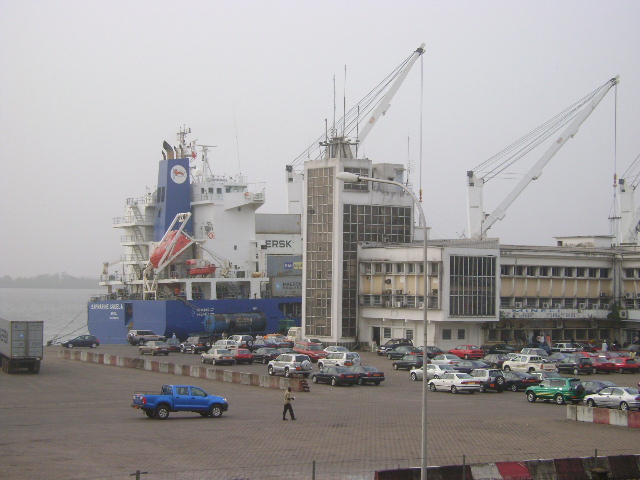
Timber backlogs grow at Douala Port

One factor in the contraction in Cameroon’s EU exports, which started in 2016, cited by a number of EU importers, was the continuing deterioration of operations at the port of Douala, the key timber trade export hub for much of Central and West Africa.

The government has now appointed a commission to investigate the ‘failed operations’ at the facility. But importers don’t expect rapid improvement to the rate of throughput and reductions in backlogs at the port any time soon.

“It’s a combination of poor management, old and unreliable equipment and silting up of access channels, which means that larger, deep-draft vessels can’t dock,” said an continental EU importer. “Some shippers are exploring the possibility of using the new, Chinesefunded, deep-water port at Kribi, but this still has teething problems, and the only other real alternative is Pointe Noire in the Republic of Congo.”

According to latest reports the backlog of timber for shipment to China alone at Douala has now reached 60,000cu.m. Continue reading "Timber backlogs grow at Douala Port"

Germany: Rising prices for wood products; hardwood lumber more expensive

In July a slightly upward trend for the German wood products price index could be noticed. As compared to the previous month, only the index values for boards, planed softwood and pellets have decreased minorly.
The value of battens, wood chips and particleboard remained unchanged over June. The value of other products has increased slightly, with the strongest increase in hardwood lumber assortments.
Also year on year, the index is in uptrend. Only five index values ​​show an opposite trend. Again, the increase is more pronounced in hardwood lumber assortments. In addition, wood chips have clearly risen.

Germany's Producer Price Index Commercial Products
(2000=100)

July 2017

June
2018

July 2018

Change 
July 2017/2018

Spruce and Fir lumber (Picea abies Karst.)

116,6

114,4

114,7

-1,62%

Lumber according to DIN 4074/S10

116,5

116,5

117,1

+0,51%

Finger-jointed squares and beams (KVH)

104,8

98,9

99,3

-5,24%

Boards, width over 16 cm

122,6

122,0

123,0

+0,32%

Boards, width from 8 to 16 cm, size from 15 to 24 mm

110,6

111,3

111,1

+0,45%

Roof battens according to DIN 4074/S10

122,2

118,7

118,7

-2,86%

Stock squared timber, A/B, 10X10 - 12X12

114,3

115,4

115,8

+1,31%

Softwood, size>6mm, planed, sanded, finger-jointed

112,8

111,3

111,2

-1,41%

Wood chips from softwood

96,8

99,8

99,8

+3,09%

Pellets and Briquets, compressed

118,4

119,4

118,9

+0,42%

Hardwood lumber

108,9

110,5

111,7

+2,57%

Beech blocks, A/B, size 50-60 mm, length 3m, damped

102,3

106,5

106,8

+4,39%

Beech frames, size 26-32 mm, length  3m, undamped

109,6

110,9

112,2

+2,37%

Particle boards, raw or sanded

114,8

114,5

114,5

-0,26%

Particle boards, laminated with decor

114,8

115,2

115,2

+0,34%

HDF panels, size > 800 kg/m³, raw/sanded

112,4

114,3

114,4

+1,77%

Laminate floorings, density > 800 kg/m³

109,1

110,0

110,2

+1,00%

Homag Group sees dropping incoming orders due to lower Chinese demand

In the first half of 2018 (1H-2018), the Homag Group recorded an increase in sales over the previous year and once again achieved a high level of incoming orders.

Sales in 1H-2018 were up 1.3% and reached € 606 million (1H-2017: € 598 million), while incoming orders reached € 701 million, a 4.4 percent drop against the first half of 2017 when incoming orders reached an all-time high of € 734 million.

As of June 30, 2018 the Homag Group's order backlog was worth € 658 million (1H-2017: € 556 million). While operating EBIT, at € 41.5 million fell from € 48.1 million reached in 1H-2017. This drop was influenced by various factors, among them the introduction of a new ERP software and the associated delivery bottlenecks, a sustained high level of investment in digitization, the launch of new branding for the entire product range, a management fee paid to Dürr (the holding comany), and negative exchange-rate effects particularly from North America. As at June 30, 2018, the Homag Group had 6,567 employees (1H-2017: 6,149 employees).

With capacity utilization remaining high, Homag Group expects a positive development in the second half of the year and anticipates a rise in sales and earnings.

“Due to a temporary lower demand in the Chinese market, we remained in the first six months of 2018 significantly behind the exceptionally high level of incoming orders we had seen in the 1st half of 2017. In the other regions, however, we performed well, as anticipated. It is particularly in our project business where we expect the positive development to continue”, explains CEO Pekka Paasivaara.

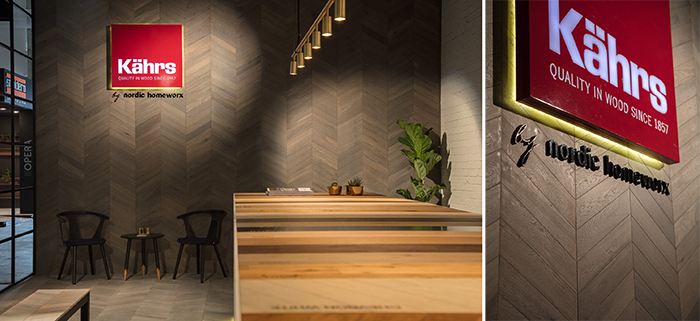
Kährs Group to acquire Swedish flooring distributor

Kährs Group has acquired Swedish flooring distributor Ehrenborg & Co. The takeover has been carried out with immediate effect.

Ehrenborg is a leader in the Swedish flooring market for public areas. The company also operates in the rest of the Nordic countries as well as in several export markets.

Through the acquisition of Ehrenborg, Kährs Group is expected to strengthen its sales and distribution to customers in commercial projects and broadens its product portfolio with new products in project sales.

The companies have been cooperating for a long time as Ehrenborg is responsible for the sales of Upofloor, Kährs Group’s brand for resilient flooring, in the Scandinavian market.

Christer Persson, President and CEO of Kährs Group, commented:

“We are very pleased that Ehrenborg now becomes part of Kährs Group. By integrating distribution, we add valuable expertise and experience as well as new interesting product groups, all in line with our aim to develop project sales.”

About Kährs Holding:

The company is a leading flooring manufacturer in hardwood and resilient flooring with a number of strong brands in its product portfolio, including Kährs, Karelia and Upofloor. Kährs Group, which delivers products to more than 70 countries, is a market leader in Sweden, Finland, Norway and Russia and holds a strong position in other key markets, such as the UK and Germany. The Group has approximately 1,600 employees and annual sales of EUR 300 million.

U.S. softwood lumber production on the rise, while Candian output falls

U.S. sawmills produced 14.752 billion board ft. (bbf) of softwood lumber in the first five months of 2018, a 5.9% increase from output of 13.937 bbf in the same period last year.

Western U.S. sawmills accounted for 6.180 bbf to the five-month total, up 8.9% from 5.677 bbf a year earlier, while output at southern U.S. sawmills Continue reading "U.S. softwood lumber production on the rise, while Candian output falls"

Downward trend in Latvian sawn softwood exports

Sawn and planed sawn softwood exports from Latvia went down by 15% during the Q1/2018, to 603,000 m3, reaching a value of EUR 127.3 million.

Compared to 2017, the exports' decline intensified. During the previous year, the exports fell 5% during the Q1, while the Q2 and Q3 brought another 1% decline each, and the Q4 registered a 4% drop.

During January-March 2017, the shipments of sawn softwood from Latvia to all relevant export markets have decreased. Exports to Great Britain (-12% to 209,100 m³), Estonia (-30% to 51,900 m³) and South Korea (-8% to 34,500 m³) went down.

The country imported 241,000 m3 of sawn softwood, which is 5% more than in the corresponding period of 2017. The total value of the imports rose by 7%, to EUR 35.4 million. Imports from Belarus (+49% to 128,800 m³) and Russia (-10% to 57,300 m³) accounted for more than two thirds of total imports.

China introduces FSC national forest stewardship standard

China launches FSC national forest stewardship standard, reports FSC in its press release. Thus, China is the second country in the Asia Pacific region to publish a national forest stewardship standard based on the latest version of the FSC Principles & Criteria.

FSC-certified forests in China

China imports more wood than any other country in the world. The forests that are FSC-certified in the country are mainly for production and contain monoculture plantations such as poplar and eucalyptus trees with short rotation periods of five to seven years. There are also FSC-certified Chinese fir and pine trees with more extended rotation up to 25 years. In China on average smallholders manage about 2 hectares of forests, with some manage less than 0.1 hectares and some up to 160 hectares.

Chinese national forest stewardship standard

The new national standard set clear targets for forest managers towards sustainable intensification and proactive management of environmental values. Experts in natural conservation, worker's rights, forest carbon management, poverty alleviation, international trade, and law and legislation helped to write the standard.

Global, national forest stewardship standards in development

Over 80 countries are working to transfer their national standards from version 4 of the Principles and Criteria to version 5. 70 countries are developing national-level standards around the world and usually include representation of social, environmental, and economic stakeholders. FSC-accredited certification bodies are developing interim national standards in countries where we don’t have an FSC representative.

EU tropical importers face rising competition for supplies

EU timber traders cited a number of factors shaping tropical import trends. These included intensifying competition for material from Chinese and other Asian buyers, which was driving up prices for tropical and temperate hardwood alike, as well as resulting in short supply in some species.

But logistical problems, the ‘deterrent effect’ of the EUTR in the tropical market on both suppliers and buyers, as one importer described it, and ever intensifying competition from rival products, including temperate hardwoods, modified timber and wood composites, also had an influence.

The restructuring of the African operations of the Frenchbased Rougier Group, one of the EU’s key tropical producers and importers, was also felt to have impacted the market. And some companies also believe there is an underlying long term ‘slow but discernible’ decline in the EU tropical trade, although this is not a view shared by everyone. Continue reading "EU tropical importers face rising competition for supplies"

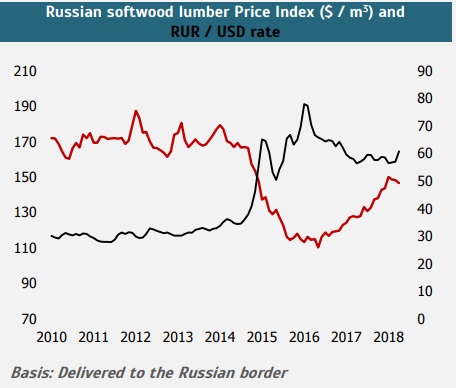
Growth of Russian sawnwood exports negatively impacted by slowing Chinese demand

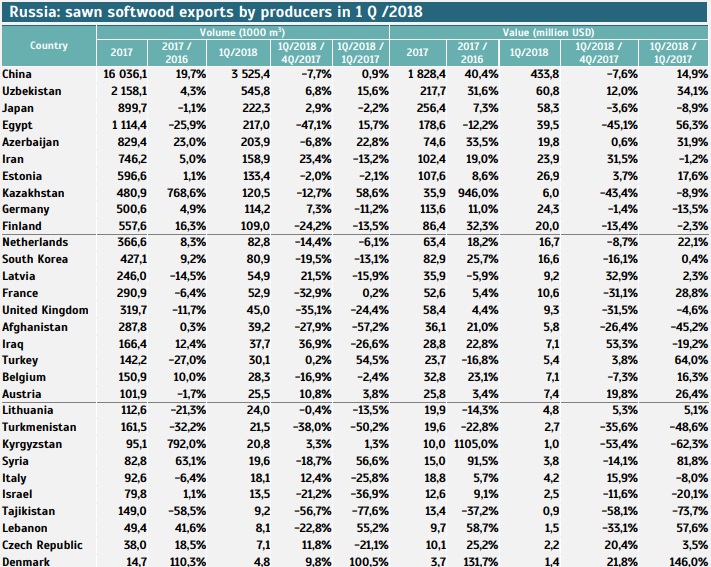
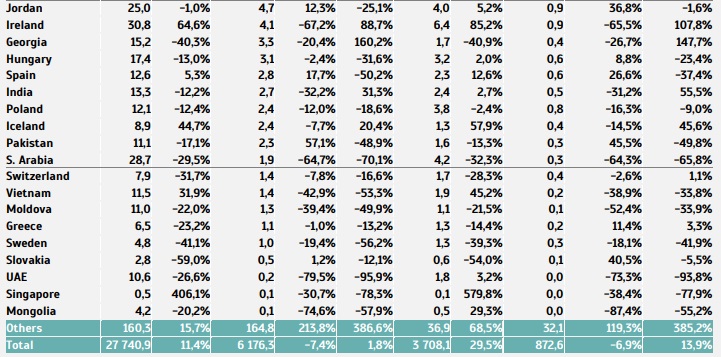
In the first quarter of 2018, the supply of sawn softwood from Russia increased by 1.8% (YoY) to 6.2 million m3, which is the minimum growth rate in the first quarter of an annual basis from 2012 (in the first quarter of 2012, there was a decrease of 5.2% YoY).

The decline was influenced by the slowdown of sales to China. Deliveries to China have practically not grown in comparison with the first quarter of 2017 (+0.9% YoY, this is the worst figure since 2013). Ecological inspections of woodworking companies from the side of supervisory and controlling state departments of China were made. The tax on "environmental protection" was introduced on April 1, 2018, as reported by WhatWood.
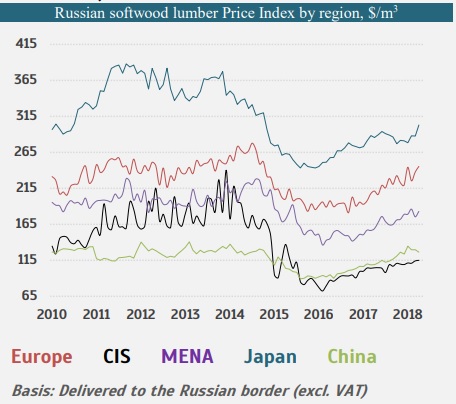
Russian spruce sawnwood from the Northwest reached a price of $280-285/m3, pine sawnwood from the Northwest of Russia - $265/m3; pine sawnwood from Siberia - $270-280/m3 in the port of Shanghai. Growth for the year amounted to approximately $30-30/m3. Spruce sawnwood from Finland was sold at a price of $285-290/m3.
The selling price of Russian pine sawnwood (Pinus Sylvestris # 1-4 SF) on the domestic market of China (Taicang) was 2,100-2,200 yuan/m3. The average profitability of sales of traders was 30-50 yuan/m3. Since early 2018, the yuan has weakened against the US dollar by 8%.
According to WhatWood, deliveries of sawn softwood from Russia to Japan in the first quarter of 2018 amounted to 222,000 m3 (-2.2% YoY).
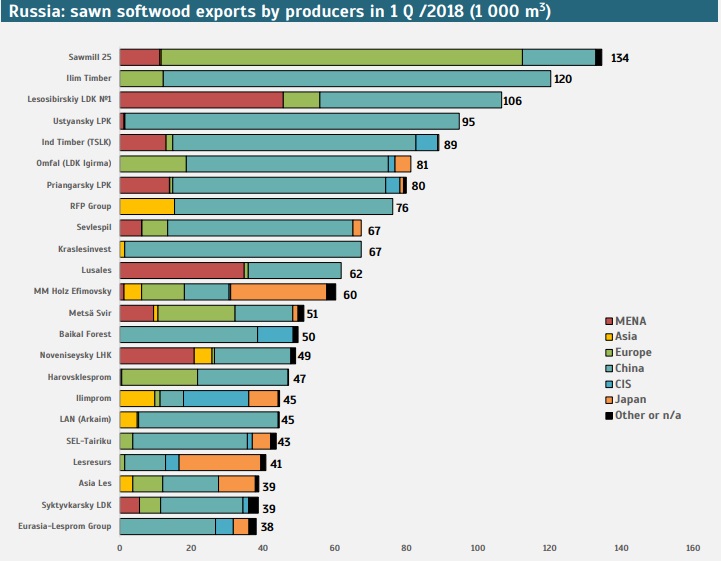
Sales in Egypt grew significantly in the first quarter of 2018 compared with the first quarter of 2017: +16% to 217,000 m3. The share of sawnwood of Lesosibirsky LDK No. 1 (the Krasnoyarsk region, Lesosibirsk) was 22% of the total sales volume of sawn softwood from Russia to Egypt in the first quarter of 2018.
In Europe, supplies from Russia decreased by 10.7% (YoY) to 702,000 m3. The largest importer of Russian sawn timber in the first quarter of 2018 was Estonia: 133,000 m3.
The average price of Russian sawnwood producers was 11,042 rubles/m3 (+12% to the first quarter of 2017) or about $194/m3. When sold on the domestic market: 8,556 rubles/m3 (+7.7% YoY, $150/m3) and 11,645 rubles/m3 (+13% YoY, $205/m3) for export sales, WhatWood reported.
In the first quarter of 2018, the third site (Aekhangelsky LDK No. 3) of Lesozavod-25 JSC reached the design capacity. Since April 1, 2018, the new sawmilling workshop has been operating in two shifts, the drying kilns have been running at full load. Since the beginning of May, the line for sorting dry sawnwood has been put into a three-shift modes. The annual production of sawnwood in the third section of the sawmill will reach 250,000 m3, and the company as a whole - 750,000 m3. Export of sawn softwood of Lesozavod-25 in the first quarter 2018 amounted to 134,000 m3, of which 74% was sold to Europe.


Vietnam aims to more than double its wood products exports by 2025

Vietnam's government is very positive regarding the wood and woodworking industry, as earning export revenues of $18-20 billion are forecast by 2025.

Prime Minister Nguyen Xuan Phuc asked the public ministries to help wood businesses overcome difficulties and boost their performance, during the recent “Sustainable Development for Wood Exports” conference held in Saigon.

As reported by VN Express, listing challenges facing the industry, the conference heard that wood logged from local plantations was of low quality because the trees were young, while material imports were getting thinner as many countries tightened export controls to limit deforestation.

At the moment, the country is importing approximately 20-21% of the wood material that it needs for its domestic production. Moreover, local businesses earned low profits due to the fact that they mostly exported raw materials or implemented subcontracts for foreign partners.

Vietnam annually ships 8 million tons of wood chips, mainly to China and Japan, for pulp production, and the demand for woodwork products in the domestic and international markets has been increasing in recent years due to rapid urbanization and potential recovery of the local real estate market, VN Express reported.

Vietnam, the world’s 5th biggest wood exporter, earned $4.8 billion from exporting woodwork products in the first seven months of this year, a year-on-year increase of 13.4%. Also, Vietnam is expected to record wood and woodwork export turnover of $9 billion in 2018, up from nearly $8 billion in 2017.

Its major export markets include the U.S., Japan, China and the European Union. Vietnam’s exports account for six percent of the global timber and wooden furniture market which is estimated at $120 billion.

It now is home to nearly 4,000 wood processing enterprises, mainly in the southern region, of which around 1,500 specialize in making products for export.

Lumber prices in the US keep on going down through August

The plunge in framing lumber prices in the US was unabated, but another round of steep discounting drew in more inquiries and orders compared with recent weeks.
Traders sensed that customers were more comfortable with lower prices, while the need for some buyers to replenish was evident after weeks on the sidelines. The Random Lengths Framing Lumber Composite Price fell for a ninth consecutive week.

Week
Aug 10
Week
Aug 3
Year Ago
2017
Random Lengths Framing Lumber Composite Price* $440 $463 $423
KD Western S-P-F #2&Btr 2x4 R/L Mill Price 442 477 397
KD Eastern S-P-F #1&2 2x4 R/L, delivered Great Lakes 569 588 497
Green Douglas Fir Std&Btr 2x4 R/L (Portland) 435 450 485
Southern Pine (Westside) #2 2x4 R/L 420 433 380
KD Coast Hem-Fir #2&Btr 2x4 R/L 450 485 437
Ponderosa Pine (Inland) #2&Btr 1x12 R/L 775 775 680
* Weighted average of 15 key items

Random Lengths Panel Market Report

Structural panel markets generated more energy as buyers stepped in with more confidence to cover near-term needs. OSB rebounded in most producing regions, and reversed the summer slide that saw prices of sheathing plunge $200 or more since early June. In Southern Pine plywood, remaining softness in prices of rated sheathing dissipated by Wednesday, and buyers stepped back into the market. After two months of measured trading and price cuts in western Fir plywood, inquiries and sales picked up at midweek.

(f.o.b. mill prices) Week
Aug 10
Week
Aug 3
Year Ago
2017
Random Lengths Structural Panel Composite Price* $461 $462 $455
Southern (west-east) 15/32-inch 3-ply rated sheathing plywood 415-455 415-455 382-405
Southern (west-east) 15/32-inch 4-ply rated sheathing plywood 420-460 420-460 387-410
Western 1/2-inch 4-ply rated sheathing plywood 482 480 495
North Central 7/16-inch Oriented Strand Board 345 355 410
*Weighted average of 11 key items

Pfeifer Group to invest EUR 100 million in German and Czech plants

By autumn 2020, the Pfeifer Group plans to massively expand existing and new production facilities in Chanovice, Schlitz and Lauterbach. Pfeifer takes about 100 million euros for this purpose.

60 million euros will flow into the expansion of the site in Chanovice in the Czech Republic alone. In 2016, Pfeifer took over the plant from the Haas Group.  Continue reading "Pfeifer Group to invest EUR 100 million in German and Czech plants"

Finnish softwood lumber exports to China collapse

The Finnish softwood lumber exports to the world decreased by -4% during January - May 2018, as compared to the same period of 2017. The softwood lumber volumes exported reached almost 3 million m3 during the mentioned period.

The softwood lumber exports to the European Union stagnated at 1,16 million m3 during January-May 2018. Traditionally, the United Kingdom was still the biggest European softwood lumber importer from Finland, despite the -7% drop in purchases, down to a volume of 287 thousand m3.

Moreover, despite expectations and despite the booming trend in recent years, Finnish softwood lumber exports to China dropped yoy by 25% (or 156 thousand m3), down to only 470 thousand m3. Despite the sharp drop, China is still the number 1 destination for Finnish exports.

A positive tendency can be noticed in deliveries to North Africa, with exports rising to Morocco and Algeria, by 15% and 21% respectively.

Finland exports of softwood lumber to the world (in cubic meters); HS Codes: 440710,440711,440712,440719.

Destination January-May 2017 January-May 2018 Change in %
EUROPEAN Union
1,165,719 1,160,669 0 %
United Kingdom
308,526 287,846 -7 %
France
179,689 178,749 -1 %
Germany
168,111 163,588 -3 %
Estonia
120,850 138,384 15 %
Netherlands
95,376 96,700 1 %
Others
293,167 295,402 1 %
OTHER European Countries
42,212 39,458 -7 %
Turkey
13,900 14,950 8 %
Switzerland
14,537 13,394 -8 %
Norway
8,924 6,962 -22 %
Cyprus
2,119 1,664 -21 %
Iceland
989 1,141 15 %
Others
1,743 1,347 -23 %
NORTH Africa
574,840 654,576 14 %
Egypt
321,127 368,562 15 %
Algeria
149,219 180,144 21 %
Morocco
77,801 79,675 2 %
Tunisia
26,693 26,195 -2 %
OTHER African Countries
4,482 6,447 44 %
Sudan
4,181 5,907 41 %
Cape Verde
246 477 94 %
South Africa
12 63 425 %
Gambia
43 - -100 %
NORTH America
3,920 4,472 14 %
USA
3,910 4,331 11 %
Canada
10 141 1,310 %
SOUTH America
- 1 %
Colombia
- 1 %
NEAR and MIDDLE East
315,765 245,443 -22 %
Israel
154,110 156,093 1 %
Saudi Arabia
140,382 71,405 -49 %
Jordan
16,156 15,542 -4 %
Iran
1,462 1,040 -29 %
Iraq
188 504 168 %
Others
3,467 859 -75 %
OTHER Asian countries
994,560 872,132 -12 %
  China
626,462 470,357 -25 %
Japan
296,131 319,704 8 %
South Korea
28,929 26,407 -9 %
Vietnam
14,579 16,658 14 %
Philippines
9,369 14,885 59 %
Others
19,090 24,121 26 %
Taiwan
9,798 11,210 14 %
Malaysia
4,561 4,496 -1 %
India
916 4,194 358 %
Pakistan
1,117 1,771 59 %
Indonesia
512 1,240 142 %
Thailand
157 481 206 %
Hong Kong
1,526 393 -74 %
Sri Lanka
254 242 -5 %
Maldives
165 45 -73 %
Macao
84 45 -46 %
Singapore
- 4 %
OCEANIA and Polar region
7,117 15,815 122 %
Australia
7,076 15,815 124 %
New Zealand
41 - -100 %
REST of the world
931 699 -25 %
Kuwait
931 699 -25 %
TOTAL 3,109,546 2,999,712 -4

Switzerland: Wood pellets prices increase despite the summer heat

Curiously, despite the wave of heat that came across Europe these weeks, the prices of wood pellets in Switzerland increased slightly.
Continue reading "Switzerland: Wood pellets prices increase despite the summer heat"

Ghana’s wood products exports up 24% in January-April 2018

In the first four months of 2018 Ghana’s wood product exports totalled 115,225 cu.m compared to 92,937 cu.m during the same period in 2017, an increase of almost 24%.

In eight of the 18 categories of wood products exported during the period significant increases in export volumes were observed as shown in table in the second picture.

The leading species used for the production and subsequent export shipments were teak (35%), rosewood (14%), wawa (9.5%), ceiba (8%) and papao/apa (8%).

As has been the case for several years, markets in Asia continue to consume most of Ghana’s wood products with lesser volumes being shipped to European markets and the US.

The regional ECOWAS market accounts for a significant part of Ghana’s total exports but in the first four months of this year the volume shipped to ECOWAS markets dropped to 6,956 cu.m from the 7,192 cu.m in the same period in 2017. This was despite a slight increase in exports overland to Nigeria.

While volume sales to ECOWAS countries were down prices improved. The average unit price for regional sales between January and April 2018 was Euro 370 per cu.m up from Euro 332 per cu.m last year. Analysts point out that the increase was most likely due to the rise in demand in Togo, Niger, Burkina Faso, Benin, Senegal, Nigeria and Cote d’Iviore.

Maibec sells two sawmills to Group Lebel

Maibec announced that it concluded a transaction with Groupe Lebel of Rivière-du-Loup for their acquisition of the Maibec lumber mills located in St-Pamphile, Quebec and Masardis, ME.

The 315 employees of Maibec that are concerned by this transaction will maintain their employment with Groupe Lebel. The details of this transaction have not been made public.

''Maibec will now focus on growing its pre-stained exterior siding's systems based on lap sidings and shingles manufactured with solid wood or wood-based engineered material. Maibec recently announced the launching of the Maibec Resistech® siding systems manufactured on LP SmartSide® from Louisiana-Pacific. '', said François Tardif, president of Maibec.

About Maibec Inc.

Maibec inc. is a family owned company from Quebec which has been involved in wood products manufacturing since 1946. Maibec manufactures of genuine wood sidings and also white cedar shinglesa.

About Group Lebel inc.

Group Lebel is a family business that has been working in forestry for over 60 years. Headquartered in Rivière-du-Loup in Lower St. Lawrence, it is deeply rooted regionally in 13 municipalities in Quebec and 2 in Ontario. Once the transaction is complete, the company will employ approximately 950 people through first, second and third transformation activities.

Newsletter

Subscribe to our digital newsletter for your daily digest of essential news, views and analysis from the international wood industry delivered directly to your inbox.


0