Article archive

Wood has a positive role of in construction, EU Commission report says

On 4th March, the  EU Commission published  a comprehensive report on the implementation of the Circular Economy Action Plan, adopted in December 2015. The report presents the main results of implementing the action plan and sketches out open challenges to paving the way towards a climate-neutral, competitive circular economy where pressure on natural and freshwater resources as well as ecosystems is minimized.

The findings of the report were discussed on occasion of the annual Circular Economy Stakeholder Conference held in Brussels on 6 and 7 March and attended by EOS.

The annual Circular Economy Stakeholder Conference, hosted by the European Commission and opened by First Vice-President Timmermans, and by Commissioner Bienkowska (via a video message), explored the Circular Economy Action Plan, taking stock of its implementation.

The Commission Vice-President MrTimmermans, the Socialist candidate for the European Commission presidency, stated that the EU must urgently adopt progressive carbon pricing in order to tackle climate change. The tax system should be used in a way that demonstrates the low-carbon transition is being rolled out fairly. We need to urgently look at taxation, how taxation is supporting our efforts to go into a circular economy is a big question. Do we need a CO2 tax at European level? I think we probably do.

The EESC President Mr Luca Jahier said that "the Circular Economy Platform and the ambitious initiatives emerging from it are again proof that Europe is at its best when it works together, when it pools the skills and know-how of its different stakeholders - EU institutions, organized civil society and European citizens.The Sustainable Development Goals, ambitious though they may be, are a necessity rather than goals, and they can only be achieved by working together. And while we must embrace them, we should also see the many opportunities they offer."

In its report the EU Commission recognize that the circular economy is now an irreversible, global trend. Yet, much is still needed to scale up action at EU level and globally, fully close the loop and secure the competitive advantage it brings to EU businesses. Increased efforts will be needed to implement the revised waste legislation and develop markets for secondary raw materials.

POSITIVE ROLE OF WOOD IN CONSTRUCTION. In the accompanying “Staff working document on Sustainable Products in a Circular Economy”, the EU Commission states “National legislation on building codes is sometimes silent on materials, or not up to date with the development of building products which could increase the energy efficiency and performance of buildings from a sustainability perspective as well as replace energy intensive materials e.g. also in tall buildings. An example is the permitting use under these codes of wood-based products, in particular so-called engineered wood products (EWP) such as cross-laminated timber (CLT), laminated veneer lumber (LVL) and glued-laminated timber (glu-lam), which can efficiently retain a long-term carbon pool - especially in wooden buildings. It is therefore vital to raise awareness on these aspects.

For further information:

Report on the implementation of the Circular Economy Action Plan

Staff working document with details and references for the 54 actions that were listed in the action plan

Staff working document on Sustainable Products in a Circular Economy
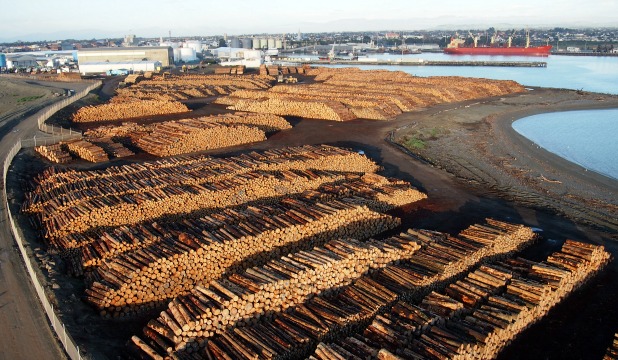
New Zealand sawmill shuts down, due to skyrocketing log prices paid by the Chinese

New Zealand's Waverley Sawmill based in South Taranaki, which has traded since at least 1932, has been sold and the new owner has decided it is no longer viable.

The sawmill has now been bought by Spectrum Group, which owns mills in Gisborne and Te Kuiti and several forests, including one in Whanganui.

The chief executive of New Zealand's Wood Processing and Manufacturing Association (WPMA), Dr Jon Tanner, has been lobbying the Government to improve conditions for wood processors since March last year, the Whanganui Chronicle reported.

 He heard about the closure of Waverley Sawmills  and said the main problem was the high prices China was paying for logs.

“One of those ships can carry 200,000 tonnes of logs, enough to keep a medium-sized sawmill employing 35 people working for a year,” he said, as quoted by Whanganui Chronicle. He heard about the closure of Waverley Sawmills and loss of 65 jobs, and said the main problem was the high prices China was paying for logs. Log prices usually go up and down, but are increasing in “a very unusual and long-lasting cycle” at present, he statede.

Wood processing is very highly subsidised across the world, he said. It’s prohibited under international trade law, but lots of countries do it.

A double trouble can happen for New Zealand, when finished products, with artificially low prices due to the subsidies, are imported and further undermine products made here.

China is one of the countries subsidising wood processing, Tanner said, despite the free trade agreement it has with New Zealand. The World Trade Organisation should be able to police this, but was hamstrung by the way the United States was treating it, Tanner said, as reported by Whanganui Chronicle.

The only way the New Zealand's Government could help struggling sawmills was by reducing their other expenses to compensate for high log prices. It could reduce taxes or depreciation costs, for example.

Government could also limit log export and keep the ownership of forests in New Zealand hands, he said.

But Tanner said log exports can’t be stopped, and the Overseas Investment Office had failed to ensure overseas owners of forests commit to supplying local mills — “a missed opportunity”.

Wood pellet prices in the Batic states in free fall

On February 27th and 28th, 2019, the European Pellets Conference which took place in Wels, Austria gathered around 660 participants. As always, there was an overview of the global pellet markets. Europe is characterized by rising production and a simultaneous fear of supply shortages. North America is focusing more on East Asia's export of pellets.
Didzis Palejs from the Latvian Biomass Association gave an overview of the Baltic wood pellet markets. The past two years have been very volatile, and the development is very hard to predict.  Continue reading "Wood pellet prices in the Batic states in free fall"

US softwood lumber prices fall at the beginning of March, but rising trade gives encouraging signals

Winter kept a grip on many regions and key markets, but sales of framing lumber in US picked up in some species nonetheless. A sense that winter’s days were numbered among traders of western species and Canadian S-P-F fueled wholesaler short covering in both cash and futures.
Gains on the board Wednesday and Thursday helped bolster confidence among some buyers, but not all, particularly those still struggling with the weather. Firming in prices late in the week failed to offset early losses, and the Random Lengths Framing Lumber Composite Price fell $7, to $364.

 Week
Mar 8
Week
Mar 1
Year Ago
2018
Random Lengths Framing Lumber Composite Price* $364 $371 $511
KD Western S-P-F #2&Btr 2x4 R/L Mill Price 376 378 539
KD Eastern S-P-F #1&2 2x4 R/L, delivered Great Lakes 445 457 625
Green Douglas Fir Std&Btr 2x4 R/L (Portland) 293 290 580
Southern Pine (Westside) #2 2x4 R/L 412 424 587
KD Coast Hem-Fir #2&Btr 2x4 R/L 385 398 555
Ponderosa Pine (Inland) #2&Btr 1x12 R/L 835 825 740
* Weighted average of 15 key items


Random Lengths Panel Market Report

Adverse weather conditions caused another week of stagnant trading in structural panels. Snow and frigid temperatures kept OSB shipments to job sites at a near-standstill in northern markets. Wet weather continued to blunt demand across the South. Southern Pine plywood sales were inconsistent during an overall slow week of trading, but mills were hesitant to alter their approach to the market. Western Fir plywood sales were quiet to start the week, but the tone improved in late trading.

(f.o.b. mill prices) Week
Mar 8
 Week
Mar 1
Year Ago
2018
Random Lengths Structural Panel Composite Price* $378 $378 $541
Southern (west-east) 15/32-inch 3-ply rated sheathing plywood 392-407 390-407 530-575
Southern (west-east) 15/32-inch 4-ply rated sheathing plywood 397-417 395-417 535-580
Western 1/2-inch 4-ply rated sheathing plywood 365 372 550
North Central 7/16-inch Oriented Strand Board 215 215 405
*Weighted average of 11 key items


Italian Imal-Pal supplies equipment for 320,000 t pellet plant in South Korea

At the beginning of 2019, the Italian machine and plant manufacturer Imal-Pal signed an important project with the Korean Client Hanwha for a new pellet plant of 40 t/h capacity, a production of approx. 320,000 t/year.

As fabricant of machinery for the wood preparation since 1978, PAL is to supply: Continue reading "Italian Imal-Pal supplies equipment for 320,000 t pellet plant in South Korea"

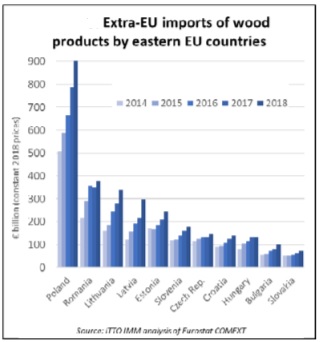
Eastern Europen countries boost timber imports from outside the EU

While there was some increase in imports by a few western European countries in 2018, eastern EU countries recorded much larger and more consistent gains in imports from non-EU countries last year.

Large increases were recorded in Poland, Romania, Lithuania, Latvia, Estonia, Slovenia, Czech Republic, Croatia, Hungary, Bulgaria, and Slovakia.

This is a reflection both of their proximity to Russia, Ukraine and Belarus, the source of most of the rising imports, relatively higher rates of economic growth and construction sector growth in Eastern Europe, and the establishment of new wood processing and manufacturing capacity in the region.

EU wood products imports continue to improve in 2018

Growth in EU imports of sawn wood resumed in 2018 after flat-lining the previous year. The total value of EU imports of sawnwood (including both softwood and hardwood) in 2018 was 3.59 billion euro, nearly 10% more than in 2017.

There was a particularly significant 21% increase in the value of EU sawnwood imports from the CIS countries in 2018, building on an 11% increase the previous year. Most of the increase in sawnwood imports from CIS countries in 2018 came from Ukraine, Belarus and Russia and is due both to currency weakness and increasing controls on log exports from these countries.

EU imports of sawnwood, both softwood and hardwood, increased sharply from Brazil in 2018. Imports of tropical sawn wood from both South East Asia (most notably from Malaysia and Myanmar) and Africa (mainly Cameroon, Gabon and Congo) regained some ground in 2018 after a sharp fall the previous year. EU imports of sawnwood from North America slowed a little in 2018.

EU imports of panels (mainly plywood) increased 8% to Euro 3.06 billion in 2018. This follows a 9% rise in 2017 and is the fifth consecutive year of import growth of this commodity.

As for other wood commodities, much of the gain was due to a rise in plywood imports from Russia, Ukraine and Belarus, however plywood imports from China, Brazil and Indonesia also increased in 2018.

Imports of plywood and veneer from Gabon slowed in 2018, being affected by the financial problems of the Rougier group. There was a partial recovery in veneer imports from Cote d’Ivoire in 2018. EU imports of composite panels increased from Turkey.

The long-term rise in EU imports of energy wood accelerated in 2018 with annual import value rising over 20% to 2.47 billion euro. This followed a slowdown to only 3% growth in 2017 after average annual growth of 11% in the previous five years.

There was another sharp increase in EU imports of energy wood from the United States in 2018 (now dominated by pellets), to reach over 1 billion euro for the first time, with most destined for the UK. Imports of energy wood also increased sharply from Russia, Belarus and Ukraine, mainly destined for continental EU. Import growth also resumed from Brazil and Uruguay.

EU imports of other joinery products (mainly doors and laminated wood for window frames and kitchen tops) increased 1% to Euro 710 million in 2018, recovering from a 1% fall the previous year.

Imports of joinery products from Russia, Ukraine and Belarus continued to rise last year, with gains also made by Indonesia, Vietnam, Bosnia, and Turkey.

China continued to lose ground, although it maintained its position as the single largest external supplier of this commodity group in the EU market, just ahead of Indonesia. EU imports of joinery products were stable from Malaysia in 2018.

After falling back 9% in 2016 and staying flat in 2017, EU imports of wood flooring increased 2.6% to 580 million in 2018.

Flooring imports from China, by far the largest external supplier accounting for around two thirds of the total, recovered ground in 2018, while imports from Ukraine increased sharply, helping to offset a decline in imports from Indonesia, Malaysia, Brazil and Switzerland.

DelhiWood 2019 opens its gates this week

The sixth edition of the woodworking industry’s eagerly anticipated biennial event, DelhiWood 2019 is all set to be put up.

The exhibition this time will witness a huge participation from Madhya Pradesh.

It will be held from March 13 to 16, at the India Expo Centre and Mart in Greater Noida, India.

More than 550 exhibitors from over 35 countries will showcase modern cutting-edge technologies, machinery, tools, fittings, accessories, raw materials and products for furniture production and wood-based manufacturing.

DelhiWood 2019, is the biggest ever woodworking industry show in India. The show is expecting the large business enquires from the market of Indore, Bhopal and Madhya Pradesh Region.

It may be noted that the woodworking industry is one of the fastest growing sector of the Indian economy.

DelhiWood 2019 is expected to provide a big fillip to this growth by showcasing the latest innovations and world class products at the much awaited event.

The fair is expected to result in huge trade outcomes and business tie-ups.

Organised by NuernbergMesse, in cooperation with PDA Trade Fairs and supported by Eumabois, the 14-country federation of European woodworking machinery manufacturers, DelhiWood has, over the last 5 editions, evolved to be one of the largest industry-specific events, offering a 360-degree experience for furniture and wood-based manufacturing industries.

Global sawlog prices reach highest level in 4 years

In early 2018, the Global Sawlog Price Index (GSPI) reached $80.73/m3, its highest level since 2014. Sawlog prices generally increased in local currencies during 2018, but with a stronger US dollar, the dollar-denominated GSPI index fell by about five percent during the year.
Mixed price movements in Europe resulted in fairly small changes in the European Sawlog Price Index (ESPI-€). In the 4Q/18, the index was up 1.8% q-o-q, but was practically unchanged from the 4Q/17.
Global Pulpwood Prices
Prices for softwood pulplogs and softwood chips rose in most markets worldwide in the 4Q/18. The biggest increases occurred in Chile, Brazil, New Zealand and Australia, while prices fell the most in France, Japan and Germany.
WRI’s Softwood Fiber Price Index (SFPI) moved up by 0.5% from the 3Q/18 to the 4Q/18. The Hardwood Fiber Price Index (HFPI) increased 1.9% quarterover-quarter to in the 4Q/18, driven mainly by higher costs for hardwood pulplogs in the US South, Brazil and Indonesia. Hardwood fiber prices fell in Europe in both the local currencies and in US dollars.
Global Pulp Markets
NBSK and HBKP prices fell in all major regions in the 4Q/18 and early 2019. The biggest price declines were in pulp destined for China.
The NBSK price in Europe has fallen from a record high of $1300/ton in October last year to $1180/ton in early 2019.

Higher prices for Russian wood pellets exported to the European Union

The average price of Russian wood pellets sent to the European Union countries in 2018 has increased by almost 20% as compared to the previous year. The most expensive Russian wood pellets were sent to the United Kingdom (an average of €152/ton), also a 20% increase as compared to 2017.
Russian pellets sent to Denmark in 2018 had an average price of €134/tons, a +26% increase over 2017, while pellets exported to Sweden were priced at €135 (a 19% growth yoy).
According to the latest Eurostat data, the pace of wood pellets exported from Russia to the European Union has decreased in 2018. After a 45% increase in 2017, Russian exports reported only a 4% rise in 2018, up to 1.2 million tons of pellets, worth €169 million.
During the mentioned period, Denmark received the highest quantity of wood pellets from Russia. The country received 374 thousand tons of wood pellets, worth at € 50 million, which represents a 0% increase in terms of volume, but a 24% increase in terms of value.
UK's imports from Russia increased by 34%, to 159 thousand tons, from the 118 thousand tons imported during January-December 2017.
Table 1

Average price of imported wood pellets from Russia by European Union countries in EUR 2017 2018 Change in %
EUROPEAN Union €116 €138 19%
Denmark €108 €134 26%
United Kingdom €127 €152 20%
Sweden €113 €135 19%
Italy €150 €170 13%
Belgium €118 €145 23%
Others €114 €127 11%
TOTAL €116 €138 19%

Table 2

Wood pellets imported from Russia by European Union countries in tons 2017 2018 Change in %
EUROPEAN Union
1,185,270 1,227,475 4 %
Denmark
372,972 374,030 0 %
Sweden
120,743 173,254 43 %
United Kingdom
118,807 159,178 34 %
Italy
60,844 94,357 55 %
Belgium
197,620 91,174 -54 %
Others
314,284 335,483 7 %
OTHER European Countries
9 - -100 %
TOTAL 1,185,279 1,227,475 4 %

Table 3

Wood pellets imported from Russia by European Union countries in EUR 2017 2018 Change in %
EUROPEAN Union
€137,287,360 €169,791,085 24 %
Denmark
€40,172,379 €50,231,867 25 %
United Kingdom
€15,117,550 €24,163,413 60 %
Sweden
€13,638,757 €23,400,527 72 %
Italy
€9,126,551 €16,075,378 76 %
Belgium
€23,355,717 €13,257,736 -43 %
Others
€35,876,406 €42,662,164 19 %
OTHER European Countries
€1,875 - -100 %
TOTAL €137,289,235 €169,791,085 24 %

The American Kitchen Cabinet Alliance requests anti-dumping duties on imports from China

The American Kitchen Cabinet Alliance has filed an anti-dumping petition against their competitors in China, claiming the Chinese government's "manipulation and unfair trade practices" have led to a more than 75 per cent rise in Chinese imports of kitchen and bath cabinetry since 2015, creating a threat to the $9.5 billion (SGD 12.9 billion) American industry. According to the petition, the industry claims that it is slowly being wiped out by competitor companies like Panda Kitchen and Golden Home.

Papers were filed with the Department of Commerce and the International Trade Commission by Wiley Rein LLP on behalf of the AKCA. The coalition, made up of more than 25 companies, says it is standing up for more than 250,000 American workers in the cabinetry industry impacted by the low-cost imports.

"China has manipulated global production and captured a large and growing portion of the market, manufacturing dumped and subsidised products, and has taken jobs away from hardworking Americans," said Tim Brightbill, chief counsel for the AKCA and partner at Wiley Rein. "Today's filing at Commerce and the ITC demonstrates an important first step in stopping the surge of dumped and subsidized Chinese cabinet products coming into the United States."

The petition alleges dumping margins of more than 200 per cent, with Brightbill estimating there are more than 35 government subsidy programmes in China that benefit the country's cabinet industry. Both face-frame and frameless cabinetry designed for permanent installation are included in the petition.

"Our cases aim to stand up to China's cheating and level the playing field for American workers and their families, as we fight to protect an iconic American industry," said Stephen Wellborn, director of Product and Research Development at Wellborn Cabinet Inc. "Now is the time to stand up for American kitchen cabinet workers."

Notice of the petition comes roughly two weeks after the Kitchen & Bath Industry Show, where a large number of Chinese-based manufacturers — as well as U.S. assemblers of Chinese branded cabinetry — exhibited their wares. Brightbill noted that Chinese cabinetry imports account for more than $2 billion (SGD 2.7 billion) of the U.S. market.

The cabinet industry is not the only one impacted by Chinese imports. A number of anti-dumping claims related to the wood industry have been filed against China, including duties assessed on wooden bedroom furniture imports, in place since 2004, and more recently, Chinese imports of multi-layered wood flooring and decorative hardwood plywood; the latter two cases were also handled by the Wiley Rein firm.

"The United States has lost much of its furniture and textile industries, and China is now targeting American kitchen cabinets in the same way," said Mark Trexler, president and CEO of Master Woodcraft Cabinetry, and executive vice president and chief operations officer of AC Products (ACPI) Inc. "China's illegal trade practices like dumping and subsidies are hurting American workers and consumers, and today's historic filing by the AKCA is the first step in standing up to China."

Anti-dumping occurs when imported products are sold, i.e., "dumped" into the U.S. market at prices below cost. The duties are assessed by the Department of Commerce and collected by the U.S. Department of Homeland Security’s Customs and Border Protection (CBP) in order to protect U.S. businesses and level the playing field for domestic products.

The alliance must now await a preliminary determination by the DOC and ITA.

Established in 2019, AKCA says it is "standing up for American workers and supporting the actions of those who oppose China's cheating of America's kitchen cabinet industry. We are proud to support one of the largest trade cases in history filed against China at the Department of Commerce and the International Trade Commission (ITC)."

Members of the alliance include: ACProducts, Inc., American Woodmark Corp., Bellmont Cabinet Co., Bertch Cabinet Manufacturing, The Corsi Group, Crystal Cabinet Works, Inc., Dura Supreme Cabinetry, Jim Bishop Cabinets, Inc., Kitchen Kompact, Inc., Koch & Co. Inc., Kountry Wood Products LLC, Lanz Cabinets Inc., Leedo Cabinetry, Marsh Furniture Co., Master WoodCraft Cabinetry LLC, MasterBrand Cabinets Inc., Nation’s Cabinetry, Showplace Wood Products, Inc., Smart Cabinetry, Tru Cabinetry, Wellborn Cabinet, Inc., Wellborn Forest Products Inc., Woodland Cabinetry Inc., Woodmont Cabinetry, and W. W. Wood Products Inc.

Swanson Group to permanently close its Glendale sawmill in Oregon

Swanson Group has announced that it will permanently close its Glendale, Oregon, sawmill, which has been operated by the Swanson family since 1951.

Back in October 2018, the company said that the mill would be down for one week from March 4, citing log and market conditions.

According to a Random Lengths' report, Swanson said the closure was necessitated by log supply constraints forced on the company by federal timber policy.

Swanson plans to add capacity at its Glendale plywood facility and Roseburg stud mill, and will reassign all affected employees at the Glendale sawmill to local operations. The company's Springfield plywood facility is not impacted by the decision.

About Swanson Group

Swanson Group Inc., along with its subsidiaries, is engaged in manufacturing, marketing, and selling forest products for residential and industrial applications. It offers various wood products, including Doug Fir dimension lumber products, structural plywood panels and specialty plywood products, veneer and residual products, and green and dry studs. The company also engages in various facets of heavy-lift helicopter operations on a worldwide basis with missions ranging from heli-logging and environmental thinning to wildland firefighting and construction lift operations under various conditions. It offers its products to dealers and builders primarily in the West Coast.

Lawsuit against the EU questions the inclusion of wood biomass as ‘renewable energy’

A group of plaintiffs from Estonia, France, Ireland, Romania, Slovakia, Sweden, and the US are filing a lawsuit against the European Union on Monday (4 March) to challenge the inclusion of forest biomass in the bloc’s renewable energy directive. If the case is won, wood biomass will no longer be counted in the EU’s 2030 target for renewables.

If they get their way, this could deprive the EU of an energy source which currently makes up close to 60% of the bloc’s renewables, more than solar and wind power combined. Continue reading "Lawsuit against the EU questions the inclusion of wood biomass as ‘renewable energy’"

Canada: Sawmill production falls into a lower gear

The recent lumber curtailments of major Canadian lumber producers, announced back in the fall and winter of 2018, have seriously impacted the overall Canadian lumber production. Thus, production of lumber in Canada has dipped by -18.4% in December 2018, as compared to November, down to 4 319.2 thousand cubic metres. Production was also lower by 10.8% as compared to December 2017.

Exports of lumber have also seriously shifted downwards. Canadian sawmills shipped 4 294.1 thousand cubic metres of lumber in December, down 18.2% from November and 10.0% lower than in December 2017. Continue reading "Canada: Sawmill production falls into a lower gear"

China: Timber prices falling sharply due to high stocks and weak demand

Timber stock levels in Zhangjiagang markets remained high throughout 2018. In November, stocks of okan, a main species imported, reached almost 60,000 cubic metres, a volume sufficient to supply downstream industries for up to six months.
Timber prices at Zhangjiagang markets fell sharply in 2018 due to high stocks and weak demand, it was only merbau and sapelli for which prices remained more resilient.
Prices for ebony logs with a diameter of 50-70 cm fell to RMB2500-2600 per cubic metre in 2018 from RMB4000 per cubic meter in 2017. African rosewood prices dipped to RMB2300-2500 per cubic metre in 2018 from RMB3800 per cubic metre in 2017. Continue reading "China: Timber prices falling sharply due to high stocks and weak demand"

Sliding importance of the UK in the EU market for timber products

There are significant shifts on-going in destinations for EU imports of timber products. After emerging as by the largest single market in the EU for timber products from outside the bloc between 2011 and 2015, the relative importance of the UK eased a little in the 2016 to 2018 period.

The UK’s share of total EU imports of timber products from outside the region declined from a peak of 27.6% in 2015 to 25.0% in 2018.

The UK’s emergence as the leading EU market for external timber suppliers between 2011 and 2015 coincided with relatively strong economic growth in the country and rising consumer demand. This drove a strong increase in imports from outside the EU, particularly wood furniture and plywood from China, and wood furniture from Vietnam. Continue reading "Sliding importance of the UK in the EU market for timber products"

Estonia: Sawlog prices continue to rise at the beginning of the year

Roundwood prices in Estonia rose further in January 2019 from an already high level reported throughout 2018. Pine and spruce sawlog price varies by between 78 and 79 EUR per cubic meter, a rise of around 2% as compared to a year ago. Continue reading "Estonia: Sawlog prices continue to rise at the beginning of the year"

Finland: Exports of softwood lumber in 2018 negatively impacted by slow Chinese demand

The Finnish softwood lumber exports to the world dropped by -6% during January - December 2018, as compared to the same period of 2017. The softwood lumber volumes reached 8,0 million m3 during the mentioned period, a drop by more than 630,000 m3 as compared to 2017. 

The softwood lumber exports to the European Union grew slightly by 1%, reaching 3,2 million during January-December 2018, as compared to the 3,1 million exported in 2017. Continue reading "Finland: Exports of softwood lumber in 2018 negatively impacted by slow Chinese demand"

Canfor completes acquisition of major stake in Swedish Vida Group

Canfor has completed its purchase of 70% of the Vida Group. The Vida Group is Sweden’s largest privately-owned sawmill operation with an annual capacity of 1.1. billion board feet per year. This deal includes a purchase price of about 580 million Canadian dollars (US$440 million).

Additional assets operated by the Vida Group include 9 additional facilities that produce premium packaging, modular housing, industrial products, and energy.

“We are excited to welcome the Vida team to Canfor and we are looking forward to working with Vida to develop our business on a global scale,” said Don Kayne, president and Chief Executive Officer of Canfor. “We respect VIDA’s team, the quality of the wood products they produce, their strong customer relationships, and most importantly the value of the VIDA brand worldwide.”

Canfor recently reported that a sluggish U.S. housing market lessened demand for lumber, resulting in production at several facilities being curtailed and a 10% drop in fourth quarter sales. Sales for the year increased 10.5%, however.

Canfor’s operations include facilities in British Columbia, Alberta, North Carolina, South Carolina, Alabama, Georgia, Arkansas, and Mississippi. The company primarily produces softwood lumber and also owns a 54.8% share of Canfor Pulp Products, Inc.

Weather conditions weaken the US lumber market

Weather conditions continued to thwart the US softwood lumber trading. Buyers and sellers in US acknowledged that they were tiring of blaming the weather for the market’s weak showing in February.
However, the negative effects on the market from persistent wet and wintry conditions were undeniable. Even in areas that were warming and drying, buyers kept replenishment to a minimum, as they needed time to move sold but undelivered inventories to their customers. The Random Lengths Framing Lumber Composite Price fell $6.

This Week
Mar 1
Last Week
Feb 22
Year Ago
2018
Random Lengths Framing Lumber Composite Price* $371 $377 $512
KD Western S-P-F #2&Btr 2x4 R/L Mill Price 378 398 542
KD Eastern S-P-F #1&2 2x4 R/L, delivered Great Lakes 457 469 625
Green Douglas Fir Std&Btr 2x4 R/L (Portland) 290 297 595
Southern Pine (Westside) #2 2x4 R/L 424 429 578
KD Coast Hem-Fir #2&Btr 2x4 R/L 398 405 560
Ponderosa Pine (Inland) #2&Btr 1x12 R/L 825 820 740
* Weighted average of 15 key items

Random Lengths Panel Market Report

Winter weather kept a tight grip on structural panel trading. OSB sales were quiet across North America, and prices held to last week’s published levels. Some buyers reported occasional cracks in some producing regions, but volume trading was nonexistent. In Southern Pine plywood, supply-side disruptions supported incremental price increases amid lethargic trading. Rain saturated job sites in most consuming regions. Western Fir plywood trading slowed. Wintry weather across many regions slowed consumption.

(f.o.b. mill prices) This Week
Mar 1
Last Week
Feb 22
Year Ago
2018
Random Lengths Structural Panel Composite Price* $378 $378 $540
Southern (west-east) 15/32-inch 3-ply rated sheathing plywood 390-407 385-407 530-575
Southern (west-east) 15/32-inch 4-ply rated sheathing plywood 395-417 390-417 535-580
Western 1/2-inch 4-ply rated sheathing plywood 372 379 550
North Central 7/16-inch Oriented Strand Board 215 215 405
*Weighted average of 11 key items


Sweden’s tallest timber building completed

C.F. Møller Architects have completed Sweden’s tallest timber building, which is now accepting its first tenants. Situated in Västerås, one hour from Stockholm, the building is constructed from solid timber in order to radically reduce CO2 emissions, positively affect the indoor climate, and enhance the interior quality of life.

The 8.5-story-high tower features an elevated ground floor and double-height top floor, with all walls, beams, balconies, lifts, and stairwells made from cross-laminated timber. The use of CNC-milled solid timber and glulam allows for an airtight, energy-efficient structure without the need for additional cladding.

Each floor of the scheme has four flats, with each floor taking three craftsmen an average of three days to construct. The use of mechanical joints and screws allows for the future dismantling of the building, so as to allow for materials to be reused.

''The building in Kajstaden constitutes a new chapter in the history of construction, as it is currently Sweden's tallest solid-timber building. Through research projects and our other timber projects, we have focused on innovation and contributed towards developing ways of realizing high-rise buildings made of timber. Industrial timber technology also provides architects with better tools for designing beautiful houses that boast a high degree of detail,'' said Ola Jonsson, associate partner at C.F. Møller Architects

The scheme was developed in collaboration with Martinsons, Bjerking and Consto AB, with Slättö Förvaltning as the client.

Newsletter

Subscribe to our digital newsletter for your daily digest of essential news, views and analysis from the international wood industry delivered directly to your inbox.


0