
Article archive

Schweighofer expects an 8% turnover increase in Romania

The Austrians from Holzindustrie Schweighofer, owned by Gerald Schweighofer, expect a turnover rise of 8% in 2014, up to EUR 550 million, for their business in Romania. The company has ended the financial year 2013 with a turnover of EUR 507 million.

''We estimate a turnover of EUR 550 million for 2014. Moreover, we expect that by the end of this year we will have an extra 250 employees in our four units of production in Romania'' a spokesperson of the company said to the Romanian financial daily Ziarul Financiarul.

Schweighofer owns in Romania four plants: two sawmills at Rădăuți and Sebeș; one plant at Siret (for the production of edge glued panels) and one at Comăneşti (with its production targeted for DIY stores).

Holzindustrie Schweighofer exports its products in 67 countries, with main destinations in 2013 such as Asia and America (44% of the total volume); Middle East (21%); Europe (20%) and Romania (15%). Regarding the production capacity of the company, last year, Schweighofer has cut 2,9 million cubic metres of logs, and produced 254.000 tonnes of pellets, 66.000 cubic metres of edge glued panels, 95,000 cubic metres of panels and 153,000 cubic metres of laminated lumber.

For 2014, the company announced that it will invest EUR 166 million in a new BSH unit of production at Rădăuţi, as well as in upgrading the current wood pellets production (2013: 125.000 tonnes). Last spring, the Austrian company took everybody by surprise when it announced the construction of the fifth plant in Romania in Reci, Covasna county. The sawmill will have an annual cutting capacity of 800,000 m³ and 80% of the produced lumber will be exported to markets in Asia (mostly Japan).

Gerald Schweighofer started its business in Romania 12 years ago and now the company is the most important player in the Romanian forest industry.

Sweden: Roundwood prices dropped in 2013

Roundwood prices in Sweden have continuously declined throughout the first three quarters of 2013. Moreover, as compared to the third quarter of 2012, all ranges of logs and pulpwood have become significantly cheaper.
Pine logs were priced in Q3/2013 at EUR 48,75/m³: stable over the second quarter, but -6,53% less than in Q3/2012). The price for spruce logs currently stands at EUR 50,11/.
Pulpwood prices are also on a downward trend: year-on-year, in Q3/2013 the overall decline is of almost 6%, with pine and spruce pulpwood being the most affected.

Roadside prices of roundwood in Sweden EUR/ (Conversion rate EUR/SEK = 0.11363)

 Q3 2012 Q2 2013 Q3 2013 Change
Q3/2012
to Q3/2013
LOGS
Pine 52,16 48,75 48,75 -6,53%
Spruce 52,72 53,38 50,91 -3,43%
Pine&Spruce 52,50 50,91 50,11 -4,55%
PULPWOOD
Pine 32,38 31,02 29,66 -8,40%
Spruce 33,52 32,04 31,02 -7,45%
Birch 37,38 37,84 36,59 -2,11%
Pulpwood Total 33,75 32,61 31,82 -5,71%

The above results are collected from metla.fi

Sustainable competitive EU hardwood sector

An EC/Indufor study comments on the relative international competitiveness of EU wood processing industries. In the sawmilling and veneer sectors, the low price of sawn wood in comparison with the relatively high price of logs is a major factor constraining margins and reducing competitiveness.
Increasing demand for by-products, particularly from the energy sector, is only partly compensating for this. In addition, labour and raw material costs are much higher in the EU than in many other global regions.
Europe's competitiveness in these sectors has depended partly on higher productivity through efficient processing, but suppliers in other regions are now closing the productivity gap. More positively for European wood processors, the EC/Indufor study argues that they maintain a strong competitive position from a sustainability perspective. This conclusion was based on analysis of four indices: Environmental Performance Index (Yale University), Corruption Perception Index (Transparency International), Ease of Doing Business (The World Bank) and Human Development Index (The United Nations Development Programme).
The study notes that that, across the full range of wood product groups, production in Europe is either declining or static, very rarely increasing. However, indications are that Europe's hardwood sawmilling sector has remained reasonably competitive relative to other regions of supply. Since the start of the economic downturn in 2007, imports have fallen more dramatically than domestic production while exports have been rising in importance.
EU's annual sawn hardwood production has been fairly stable over the last decade at around 10 million cubic metres. While domestic consumption has fallen, the EU is now exporting significant volumes of sawn hardwood to a widening range of countries, notably in Asia, North Africa and the Middle East.
The EU has traditionally been a large net importer of hardwood sawnwood but this situation is now changing. In 2011, the net import volume of sawn hardwood fell to less than 1 million cubic metres.

India might become a major lumber export market for Canada

Canada sees India as a potential market for its lumber exports: “This is the fourth-largest consumer market in the world. For us to ignore that would make no sense and we’re not and we see enormous potential,” the Canadian Minister of Natural Resources, Joe Oliver, said in an interview during a trade visit in India.

The Canadian government announced an additional CA$ 600,000 investment to back up efforts to boost lumber exports to one of the world's largest markets, with a population of 1,2 billion. The minister added that India's demand for imports is one decade behind China. Canadian lumber exports to China have increased 1000% from 2007 to 2012, while those to India declined to only 53,000 cubic metres or CA$ 8,7 million. Moreover, India's share in Canadian lumber exports was only 0.15% in January-October 2013, with China accounting for 32% and the US for 53%.

“China was very small too 10 years ago and yet the Chinese market was crucial in helping our forestry industry emerge from the recession when residential construction in United States basically collapsed,” said Mr. Oliver.

Some analysts support the minister's statement: Paul Quinn of RBC Capital Markets said to 570news.com that Indian lumber imports will gradually increase, although transportation and infrastructure pose big problems in getting materials to local markets. “I think it’s going to be a slower growth story than what we’ve seen with China but I think it’s going to be yet another place to put lumber which continues to tighten the market,” he further commented.

Wood pellets cheaper in Germany

At the beginning of the year the average price of wood pellets in Germany has slightly decreased, the German Energy Wood and Pellet Association (DEPV) reported. Thus, a tonne of pellets costs in average EUR 284.93. This is 0.2% less than in December. However, as compared to January 2013, the price is 8,8% higher. The price advantage of pellets over fuel oil is currently at 28.6%.
"The wood supply is currently very high and for the year 2014, we can expect a high domestic pellet production," explains Martin Bentele, Executive Chairman of DEPV. If the winter still holds in the next few weeks with temperatures below the freezing level, the pellet supply is well prepared, he added.
The best price for pellets can be found in northern and eastern German: EUR 273.96/t at a quantity of 6t. In the center of Germany, the price is on average EUR 285.84/t, while in southern Germany the average price is EUR 286.78/t.
Larger quantities (26t) were traded in January 2014 at the following rates: North / East : EUR 254.35/t; Center: EUR 267.05/t , South : EUR 271.94/t (all including VAT).

Significant rise in logs&sawnwood imports

In the first three quarters of 2014 China's log imports totaled 48,359,000 cubic metres valued at USD9.34 billion, a year on year increase of 19% in volume and 37% in value. Softwood log imports rose 15% to 27,809,000 cubic metres, temperate hardwood log imports grew 28% to 11,618,000 cubic metres and tropical log imports increased 26% to 8,932,000 cubic metres.
The main suppliers of logs to China in the period of January to September 2014 were in Asia (1,961,000 cubic metres, up 46%), Africa (2,736,000 cubic metres, up 6%), Europe (3,622,000 cubic metres, up 34%), Australia (14,953,000 cubic metres, up 15%), North America (7,145,000 cubic metres, up 17%) and Russia (8,564,000 cubic metres, up 10%).
The pace of growth of log imports from Asia was the highest and growth of log imports from Laos, Japan, Vietnam and Cambodia all exceeded 200% in the first three quarters of this year.
During January to September 2014 sawnwood imports were 19,123,000 cubic metres valued at USD604 billion, a year on year increase of 9% in volume and 24% in value.
Softwood sawnwood imports rose 7% to 13,235,000 cubic metres, hardwood sawnwood imports grew 14% to 5,888,000 cubic metres and tropical sawnwood imports increased 12% to 3,524,000 cubic metres.
The main suppliers of sawnwood imports to China were Asia (2,800,000 cubic metres, up 6%), Europe (1,548,000 cubic metres, up 21%), North America (7,145,000 cubic metres, up 17%) and Russia (16,990,000 cubic metres, up 1.5%).
The pace of growth in imports of sawnwood from Europe was the highest with China's sawnwood imports from Germany increasing 42%.

Significant rise in logs&sawnwood imports

In the first three quarters of 2014 China's log imports totaled 48,359,000 cubic metres valued at USD9.34 billion, a year on year increase of 19% in volume and 37% in value. Softwood log imports rose 15% to 27,809,000 cubic metres, temperate hardwood log imports grew 28% to 11,618,000 cubic metres and tropical log imports increased 26% to 8,932,000 cubic metres.

The main suppliers of logs to China in the period of January to September 2014 were in Asia (1,961,000 cubic metres, up 46%), Africa (2,736,000 cubic metres, up 6%), Europe (3,622,000 cubic metres, up 34%), Australia (14,953,000 cubic metres, up 15%), North America (7,145,000 cubic metres, up 17%) and Russia (8,564,000 cubic metres, up 10%).

The pace of growth of log imports from Asia was the highest and growth of log imports from Laos, Japan, Vietnam and Cambodia all exceeded 200% in the first three quarters of this year.

During January to September 2014 sawnwood imports were 19,123,000 cubic metres valued at USD604 billion, a year on year increase of 9% in volume and 24% in value.

Softwood sawnwood imports rose 7% to 13,235,000 cubic metres, hardwood sawnwood imports grew 14% to 5,888,000 cubic metres and tropical sawnwood imports increased 12% to 3,524,000 cubic metres.

The main suppliers of sawnwood imports to China were Asia (2,800,000 cubic metres, up 6%), Europe (1,548,000 cubic metres, up 21%), North America (7,145,000 cubic metres, up 17%) and Russia (16,990,000 cubic metres, up 1.5%).

The pace of growth in imports of sawnwood from Europe was the highest with China's sawnwood imports from Germany increasing 42%.

Weak year for the Italian woodworking industry

''We still have to wait for coveted recovery: as a matter of fact, 2013 has been poor of satisfaction''

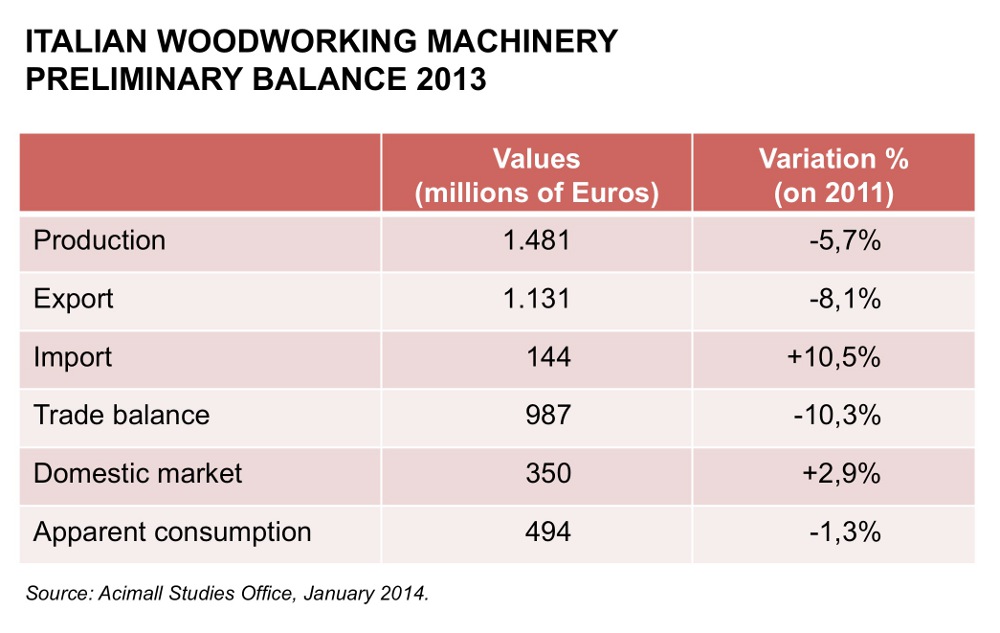
The preliminary balance about the trend of Italian technology for wood and wood-based materials, processed by Acimall's (the Italian woodworking machinery and tools manufacturers’ association) Studies Office, is quite clear. The analysis by the Confindustria member association, unfortunately, highlights the signs of a tough economic season for an industry that, in the past six years, has suffered from 30 percent turnover reduction.

Italian Woodworking Industry in 2013

Acimall production, amounting to 1,481 million Euros, recorded a drop from the previous year, mainly caused by a domestic market that – though far from the minus 15 percent result in 2012 – is not showing signs of a rally or reasons for satisfaction.

Italian export lost another 8.1 percent compared to 2012 (while 2012 vs. 2011 recorded 8 percent shrinkage), as a result of decreasing interest for Italian products in neighbor markets, first of all Germany, France, Spain and Portugal. In general terms, Europe has always been a key partner for Italian suppliers, but its relevance has strongly faded in recent years. This trend was not compensated by the “satisfactory” results recorded in emerging markets: China, Brazil, Canada, United States and Mexico have emerged as good destinations for Italian technology.

Import increased by 10.5 percent (up by 144 million Euros in value), mainly resulting from sales by German and Chinese competitors in Italy. The former have a 50 share on total import, mostly concentrated in the high-end of the market, while “made in China” supplies (accounting for 25 percent of Italian import approximately) include low-tech solutions or components and solutions in-transit to other destinations.

2014 Forecasts

“As usual, it is very difficult to predict what is going to happen in the next twelve months”, said Dario Corbetta, newly-appointed Acimall director, who guided the Studies Office for many years. “Several factors can have an impact on the trends of an industry, even a small one like ours. We expect a slight rally of all indexes, though we cannot say there will be real recovery.

Again, export flows will play a key role for an industry where export propensity is now beyond 80 percent. If Italian companies have the capacity to approach some markets aggressively with innovative globalization initiatives, looking for technical and commercial cooperation agreements, then we will see business expansion.  However, it will take more time to see a real "growth" of the domestic market.

“We are still struggling with a demand crisis that can only be solved with strong actions at macro-economic level,” Corbetta added.  “Another key element – added the manager – is the upcoming Xylexpo, the biennial international exhibition organized by our association in even-numbered years, that will be a valuable observatory to identify the most active markets and future decisions by big international customers”.

European construction hits bottom and is expected to grow

European construction hit bottom in 2013 and should grow slowly in 2014. This new forecast was issued in on 28th November 2013 at the 76th Euroconstruct Conference in Prague.

Euroconstruct's new projection for 2013 represents a slight upgrade on their earlier forecast issued at the 75th Conference in June 2013. This is due to rising confidence and strong growth in Scandinavia and Poland.

The latest Eurocontruct construction output expectations point to a 3% dip overall in 2013 across the 19 Euroconstruct countries - 15 in Western Europe and four in Central and Eastern Europe. The decline is a slowing of the 5.2% cent fall seen in 2012, attributed largely to a sharp reduction in Spanish output but also the UK and Italy.

The forecasts for 2014 and 2015 are also marginal upgrade on the forum's June predictions, and now show growth of 0.9% in 2014 and 1.8% in 2015.

November's publication also forecasts a 2.2% growth in 2016. Although quite small, the recent upgrades in forecasts are the first for several years. Euroconstruct forecasts issued every 6 months during the previous three years have typically been downgraded as construction activity consistently failed to live up to expectations.

Germany, the continent's largest country for construction output, is forecast for flat growth this year before a 2.7% rise in 2014, with an 8% increase in residential construction. After declining 7.8% in 2012, UK construction weakened a further 1.1% in 2013. However construction in the UK is forecast to rise 2.4% in 2014 and 3.1% in 2015.

In France, construction output was quite stable in 2012, but is estimated to have fallen 2.8% in 2013. A further 1.5% decline in French construction is expected in 2014. The largest falls in European construction output in recent times have been in southern Europe.

Construction value in Spain fell 32% in 2012 and then by 23% in 2013. In total, Spanish construction output fell nearly 80% between 2007 and 2013. Euroconstruct reckons Spanish construction is likely to fall a further 6.7% in 2014. Spain's construction sector output is now little more than that of relatively smaller countries like Switzerland and Norway.

The decline in Italian construction, while much less dramatic than in Spain, is nevertheless severe. Italian construction output fell 6.3% in 2012 and 3.3% in 2013. Euroconstruct forecast a further decline of 0.3% in 2014 before a slow recovery of 1.1% in 2015.

Construction in the Netherlands, after declining 7.2% in 2012 and a further 5% in 2013, is expected to stabilize and recover by 0.4% in 2014 and 3.4%, in 2015.

Euroconstruct identify Ireland, Norway, Poland and Denmark as potentially strong performers over the 2014- 2016 period. Ireland has the largest forecast growth, at 9.8% in 2014 followed by 8.2% and 10.6% in the next two years. However this follows a dramatic downturn and the country will still fall short of 2010 output levels in 2016. Poland's forecast growth, totaling 13.5% between 2014 and 2016, is largely attributed to civil engineering. The 2014-20 budget plans for Poland are particularly expected to benefit infrastructure.

Residential construction across Europe has seen the strongest growth, and will account for 45.4% of European construction in 2013, according to Euroconstruct. This proportion is set to grow at the expense of the slowermoving non-residential construction market, following the pattern seen in previous recessions of housing becoming one of the first recovery sectors. January 2014 European residential construction is forecast to grow by 2.4% in 2014 and 4% in 2015.

Trouble for the European tropical wood trade

Reviewing the position of the tropical wood trade in Europe at the turn of the year is a sobering experience. Following the all-time low in EU tropical hardwood imports in 2012, all the signs are that imports in 2013 fell even further. In addition to low demand, an emerging problem has been the progressive erosion of the infra-structure to supply tropical hardwoods into Europe.

Looking ahead, prospects for tropical wood in the European market do not look good. However, an increased focus on marketing and communication offers some grounds for optimism. Some encouraging reports have also emerged of improving market conditions in Europe from the third quarter of 2013 onwards. The economic situation in Europe seems to have stabilised for the time being as the worst fears of currency collapse in the euro-zone have waned.

The European construction sector also appears to have hit bottom and is poised once again for growth, albeit slow and still uncertain.

However, the end of 2013 was also marked by very troubling reports from the supply side. After such a long period of low and sluggish demand, tropical hardwood producers have inevitably looked elsewhere to sell their products and a significant proportion of the processing capacity and infra-structure to supply the European market has been dismantled.

Unilin buys Czech parquet manufacturer

Unilin, part of the American company Mohawk Industries Inc., has recently announced that it has agreed in principle to acquire the Czech parquet company Magnum Parket.

Magnum Parket is the biggest Czech producer and exporter of three-layer wooden parquets, and supplies floors to more than 25 countries in the world - across Europe, Russia, on the eastern markets such as Ukaine and Moldova, and also in the United Arab Emirates, South Africa and the USA.

Unilin produces laminate, engineered wood and vinyl floors under the Quick-Step and Pergo brand, as well as wood-based panels (particleboard, MDF), decorative panels, roofing elements and insulation panels.

Unilin sees the acquisition of Magnum as an important step to support the company's further growth for the years to come.

This cooperation, which brings together Magnum’s world class manufacturing for engineered wood with Unilin’s state of art technology in wood, laminate and vinyl products will create a business with unique focus on design, innovation, quality and service that will enable Unilin to deliver an unrivalled flooring experience to its customers, the company stated in a press release.

This is the 4th acquisition for Unilin /Mohawk over the last year – after closing on Pergo, Spano and Marazzi.

Finland: Timber prices up 18% in 2013

In 2013, the Finnish Forest Industries Federation’s (FFIF) member companies procured 33.4 million cubic metres of wood from private forests. This represents an increase of 10 per cent compared to the average procurement volume over the past ten years. Wood stumpage prices increased from the previous year and high roundwood costs weakened industry’s competitiveness on the international market, thus reducing opportunities for additional timber use, says FFIF.
Last year, timber sales got off to a stronger start than in previous years. The pace of trading picked up as summer approached and peaked in May. After a quiet summer holiday season, sales gathered pace again and were steadier than usual for the rest of the year. Thus, the storms in December did not substantially increase timber trade volumes.
Roundwood costs increased from the previous year 
In 2013, timber sales volumes were 18 per cent higher than in 2012. Log procurement volumes increased 26 per cent and pulpwood volumes 12 per cent compared to the previous year. Industry procurements amounted to a total of 15.1 million cubic metres of log and 17.1 million cubic metres of pulpwood. The stumpage prices of softwood logs increased 3-4 per cent on average, birch log prices fell one per cent while pine and birch pulpwood prices went up 1-2 per cent. Spruce pulpwood prices remained unchanged.
In December 2013, pine logs fetched on average EUR 55 per cubic metre, but prices varied between EUR 45 and EUR 58 depending on the region and logging method. The average price of spruce logs was EUR 56 per cubic metre but ranged between EUR 46 and EUR 58. The average price of birch log was EUR 40 per cubic metre with prices varying between EUR 29 and EUR 43. The average stumpage price of pine and birch pulpwood was EUR 16 while spruce pulpwood fetched on average EUR 17 per cubic metre. Pulpwood prices varied between EUR 13 and EUR 19.
Delivery contracts in 2013 accounted for a total of 5 million cubic metres of timber and their share fell from 18 per cent of total timber sales in 2012 to 15 per cent in 2013. About three quarters of delivery contract procurements were pulpwood. In delivery contracts, forest owners deliver timber to the side of the road.
Structural reforms needed to boost activity on the timber market 
Finland cannot afford to not make the most of its forests, says FFIFIts growing stock almost doubles every year compared to logging volumes, and as much as a quarter of sustainable logging opportunities go unused each year. 
“The problem is that a great deal of Finland’s forest is not in the sphere of market activity and forests are left unmanaged. The short supply keeps costs high, weakens investment conditions that are based on domestic wood, and does not support the growth of the national economy. The functioning of the timber markets must be improved with structural reforms that revive the forest economy, and tax solutions are a key element in this respect,” says Forests Director Tomi Salo of the Finnish Forest Industries Federation.

Wood auctions in Romania reveal a 30% price increase

In the fall of 2013, Romsilva, the Romanian Forestry Agency, organized auctions in different parts of Romania for approximately 4,3 million m³ of wood (43% of the annual production). From the total volume auctioned 3,7 million m³ were purchased. The average auction starting price was 112 lei/m³ (EUR 24,76) and the final average purchase price was 159 lei/m³ (EUR 35,15). This represents a 30% price increase over the same auctions held in 2012.
The lowest average purchase price was registered in Caraș-Severin county (South-West Romania)- 358,000 m³ sold; 110 lei/m³ (EUR 24,31) and in the Bacău county (East)- 248,000 m³ sold; price: 119 lei/m³ (EUR 26,30).
The highest prices were recorded in Neamț (N-E)- 281,000 m³ sold, average purchase price: 202 lei/m³ (EUR 44,65); Suceava (N-E)- 373,000 m³ sold, price: 202 lei/m³ (EUR 44,65) and Mureș- 243,000 m³ sold at an average price of 176 lei/m³ (EUR 38,90).
The largest volumes were acquired by the two major players on the Romanian wood market: Schweighofer and Kronospan. For example, at the auction held in Suceava county (November 2013) from the overall volume auctioned (373,000 m³ ), Schweighofer purchased 43,100 m³. In Mureș, from the entire volume auctioned (243,000 m³), Schweighofer bought 60,000 m³ and Kronospan 50,000 m³.
Some Romanian forestry media blame the two companies of putting high pressure on the local forestry companies and that the large volumes that these two companies acquired are one of the reasons for the recent 30% price increase.

Wood fiber costs have fallen 17%

The wood costs for the global pulp industry have trended downward in a majority of the pulp-producing regions of the world the past two years, according to the Wood Resource Quarterly (WRQ). This has mainly been the result of lower prices for market pulp but also because of reduced pulp production and increased supply of wood fiber in some regional markets.
As the costs of energy, labor and chemicals have changed relatively less than those of wood fiber the past year, the wood cost as a percentage of the production costs when manufacturing pulp have fallen. In the 2Q/13, wood fiber costs accounted for just over 59% of the production costs on a worldwide basis, down from approximately 63% in the 2Q/12 but up from 51% in 2006, according to Fisher International.
Although wood fiber prices have trended downward for most of the past few years, softwood fiber prices were actually up from the previous quarter in the 3Q/13 in most countries worldwide with just a few exceptions including Sweden, Brazil, and Australia. The largest price increases were seen in the US South, Germany, France and Spain.
The Softwood Fiber Price Index (SFPI) edged up to $97.94/odmt in the 3Q/13, as reported by the WRQ. This was $0.19/odmt higher than in the previous quarter but over 10% lower than two years ago.
The Hardwood Fiber Price Index (HFPI) fell for the fourth consecutive quarter to $98.15/odmt in the 3Q/13. This was down 2.3 % from the previous quarter and the lowest level since the 2Q/09. The biggest price declines have been in Asia and Latin America, while wood costs in Europe, Russia and North America have continued to be relatively stable the past year. In just two years, the HFPI has fallen by almost 17%.

Swiss Krono Group produces laminate flooring for Villeroy & Boch

Villeroy & Boch, which offers a complete range of products for kitchens, bathrooms and tabletops, is now extending its home portfolio to include high-quality flooring. It has cooperated with the Swiss Krono Group to create the first Villeroy & Boch Flooring Line, which will be unveiled for the first time to a trade audience at the Domotex flooring fair in Hanover in January 2014. The Villeroy & Boch Flooring Line will be available worldwide from the 1st quarter of 2014.

The first Villeroy & Boch Flooring Line comprises a total of 22 newly developed decors grouped into four collections: Cosmopolitan, Country, Contemporary and Heritage. All four collections include both natural-looking decors and urbane designs. This first Villeroy & Boch Flooring Line addresses a target group consisting mainly of style- and brand-conscious consumers who value a personalised touch and high standards of quality. All of the products fall into the premium segment. Sales territories have been defined for the overall flooring line. The available decors of the Cosmopolitan collection will vary in the territories depending on regional requirements

The internationally active Swiss Krono Group possesses proven expertise in designing and producing innovative laminate floors that unite the attributes of aesthetics, functionality and environmental friendliness. The Swiss Krono Group shares Villeroy & Boch’s highly professional approach, international market position and goal of designing attractive products to enhance home living culture, thus making the two firms ideal partners. Their alliance is being set up for the long term and is the first of its kind for both enterprises.

Global laminate flooring markets inched up in 2013

Although the financial crisis does not appear to be completely over yet, the international laminate flooring market is recovering. Growth has been seen particularly in Eastern Europe, as well as in exports to Asia and North America. The upward trend for EPLF producers that began to emerge in the previous year has stabilised. Even though slight sales declines continued to be observed in Western Europe, 2013 remained a good year for the EPLF (Association of European Producers of Laminate Flooring) thanks to gains in the other regional markets.

In 2013, the EPLF’s 21 ordinary member companies (manufacturers of laminate flooring) sold 463m m² of the European-produced laminate around the globe (previous year: 460m m²), representing a global market share increase of approx. 0.7%.

In 2013, the western European core markets in the European laminate flooring industry experienced a slight decline of just under 3% overall. In absolute figures, western European sales fell from 298m m² in 2012 to 290m m² in 2013.

Germany saw a decline with approx. 72m m² (previous year: 76m m²), yet remained the largest single market, leading the ranking of western European markets. Turkey occupied second place with over 65m m² (previous year: 66m m²). This slightly lower but still satisfactory result was achieved partly thanks to the Turkish member companies of the EPLF, and partly due to economic growth in this country. France saw a slight decline with 39m m² (previous year: 40m m²) and continued to hold third place within Europe. The United Kingdom was stable with 29m m² (previous year: 29m m²) and held fourth place, while the Netherlands occupied fifth place with 19m m² (previous year: just under 19m m²). Spain remained in sixth place with 14m m² (previous year: 15m m²).

European laminate flooring manufacturers sold 103m m² (previous year: 99m m²) in Eastern Europe in 2013, an increase of 4% compared with the previous year. Poland once again came top with approx. 25m m² (previous year: 24m m²). With 23.9m m² (previous year: 23.7m m²), Russia held a strong second place in the sales ranking, and promises further growth rates in the future. Romania occupied third place with 10m m² (previous year: 9.8m m²), while Ukraine maintained its fourth place with a rise to 9 million (previous year: 8m m²). Hungary remained in fifth place with 4.6m m² (previous year: 4.2m m²).

As recently as 2011, North America experienced a dramatic slump: sales dropped from 41m m² in 2010 to 27m m² in 2011, while only 23m m² was achieved in 2012. This was caused by the challenging economic situation in the USA. In 2013, North American sales picked up once more, with 28m m². The USA in particular showed an encouraging result for European laminate flooring manufacturers, with 16m m² (previous year: 12m m²). Canada remained stable in 2013 with 11m m² (previous year: 11m m²).

In Asia-Pacific, the total sales of European manufacturers for 2013 stood at approx. 13m m² (previous year: 12m m²), representing a slight increase. The Chinese market, including Hong Kong, showed particularly clear growth due to exports from European producers in the premium sector – this market achieved sales of over 4m m² (previous year: 3m m²) in 2013. The Iranian market fell even further in 2013, achieving less than half of its already rather poor 2012 sales figure of 1.6m m².

South America remained stable in 2013 with 17m m² (previous year: 17m m²). The Chilean market showed a somewhat disappointing result compared with the previous year, with sales of 6m m² (previous year: 6.5m m²), while sales in Mexico shaped up better, rising to 5m m² (previous year: 4.3m m²).

New Zealand becomes world’s third largest log exporter-on booming Chinese demand

In the last two decades, the value of New Zealand's forest products exports has more than doubled, mainly driven by log shipments to China, Statistics New Zealand reported. In 2012, exports reached US$ 3,75 billion as compared to only US$ 1,58 billion in 1992, making forestry products third largest New Zealand's goods export, after dairy and meat.

In 1992, logs accounted for less than a quarter of New Zealand's total forestry exports, but overseas demand, particularly from China, saw this jump to 35 percent by 2012,prices manager Chris Pike said.

The value of log exports has more than tripled from 1992 to 2012: from US$368.89 million up to US$1.33 billion. Since 2008, the export value had increased by an average 22% per year.

This rise was due mainly to the volume of log exports tripling. Prices have increased by a smaller 16 percent,” Mr Pike added.

The major influence for this fabulous increase was the demand from China, which rose from US$ 49,13 million in 1992 to US$ 832,92 million in 2012. China thus became the top destination for New Zealand's log shipments, surpassing both South Korea and Japan.

New Zealand is now the third-largest exporter of logs in the world, after Russia and the United States. In 2012, we supplied 8 percent of the total value of the world's export logs, Pike said.

Sawn timber is the country's second-largest forest product exported, followed by manufactured wood products, pulp and paper products and wood pulp.

Between 1992 and 2012 New Zealand has become more reliant on log exports. China is now a key market for our forestry products, taking 34 percent of the total value of our forestry-product exports in 2012, compared with 4 percent in 1992,” Mr Pike concluded.

Furniture production down 3% in Germany

According to provisional data, the value of furniture produced in Germany in 2013 amounted to about 16.2 billion euros. The Federal Statistical Office (Destatis) also reports on the occasion of the international furniture fair “imm cologne“ (13 to 19 January 2014) that this is a nominal decline of 3.0% on 2012. After the value of the furniture produced had in part gone up markedly from 2006 to 2008, it dropped by 12% during the economic crisis of 2009 and has not yet reached its pre-crisis level of 2008 again despite some large increases in subsequent years.

The production decline in 2013 can be observed in almost all areas of the German industry. The production of office and shop furniture fell by 2.5 %; seating furniture by -3.9 % and the mattresses by -9.6 %. In addition, the production of "other furniture", which includes, among other things, sleeping, dining and living room furniture made ​​of wood, metal and plastic also declined. Only the production of wooden kitchen furniture has increased slightly (+1.0%).

Of the total value of the furniture produced in 2013, seats had a share of 29%, while wooden kitchen furniture had 27%. The share of office and shop furniture was 16%. Other types of furniture accounted for 27% of the total production.

Production of furniture in Germany

Year Overall Seats Other a) Wooden Kitchen furniture Office and shop furniture Mattresses
Change from previous year in%
2005 0,2 – 1,6 – 2,9 3,2 6,5 0,8
2006 7,4 5,1 4,9 11,6 12,8 4,5
2007 4,5 6,5 3,6 2,9 5,9 0,4
2008 1,8 – 0,2 – 0,1 4,4 6,5 – 0,1
2009 – 12,1 – 15,2 – 6,1 – 12,8 – 20,2 1,3
2010 2,0 5,0 – 1,4 2,8 2,2 2,4
2011 6,3 6,1 3,8 3,8 18,2 1,1
2012 0,6 0,2 – 1,5 4,3 1,5 – 3,0
2013 b) – 3,0 – 3,9 – 4,5 1,0 – 2,5 – 9,6
 

a) Among other things, sleeping, dining and living room furniture made ​​of wood, metal and plastic furniture.
b) Data for 2013 estimated.

Source: Destatis

Koskisen to offer fire-resistant sawn timber

At the end of November, Koskisen became the third sawn timber manufacturer in Finland to be granted fire-retardant certification for its products. In line with the new certification, Koskisen now manufactures for the Finnish market wood panels and exterior cladding boards that have been treated with a fire-retardant coating.

In order to achieve an end result that meets the requirements, the sawn timber is treated several times with Teknosafe 2407-00, a fire-retardant coating which guarantees the highest possible fire class – P1 – for wood products. End-use applications for the fire-resistant products include particularly exterior cladding and ventilation gap surfaces. The protected products are classified according to Bs-1, d0 EN 13501-1.

The exterior cladding of apartment buildings and care facility buildings in Finland requires structural fire protection or a separate sprinkler system to prevent the spread of fire. Koskisen’s fire-retardant coating system for wood can replace these methods.

“All in all, sawn timber treated with a fire-retardant coating can resist fire for longer than ordinary timber, and furthermore it does not catch on fire very easily. The treated timber is also weatherproof,” says Vesa Saarelainen, Sales Manager for Koskisen Houses, explaining the advantages of fire-protected timber products for the customer.

The German furniture industry in a difficult situation

Before the International Furniture Fair in Cologne, Germany (January 13 to 19, 2014), Mr. Dirk-Uwe Klaas, Chief Executive of the German Furniture Industry (VDM), sees Germany’s furniture industry in difficult situation. The traditional German export markets continue to weaken and domestically, it is becoming increasingly more difficult to attract the disposable income of customers towards furniture. Therefore in 2014, the VDM expects only stability as compared to 2013.

Smartphones, tablets, PCs, flat TVs, travels, leisure spending- these are the areas in which people are curently willing to spend money. These market segments are obviously waking desires and address to the consumers emotionally, while furniture trade doesn’t succeed sufficiently. This is due to the fact that in recent years the furniture offer has been unimaginative and was primarily concentrated on price. The furniture offer has a lack of substance in communicating values. Consumers’ emotional desires are not awakened, says Klaas. On the contrary: the excessive concern over pricing creates no confidence and rather stops customers from buying.

This why 2014 is crucially dependent on the marketing of furniture. If this manages to stimulate desires, then the turnover and trade of the industry will rise again. Faced with a growing economy and an increasing consumer confidence the opportunities are as never before. This is also urgently necessary, because in the last year the revenue of the German furniture industry decreased by about -3.5%, down to EUR 16,1 billion from EUR 16,6 billion in 2012.

The decline in 2013 resulted partially from the difficulties in the traditional European markets. For example, exports to France in the first ten months of 2013, decreased by -10.6% and those to the Netherlands by almost -16%. Shipments to Austria with a -6% decline remained well below expectations, while those to Switzerland were -0.3% under 2012.

Even if furniture exports to the US increased 18.5% and those to China by 16.7%, they can’t compensate the losses in Europe. Overall, furniture exports fell in January to October 2013 by 4.1%, down to EUR 7.6 billion.

In Germany, manufacturers sold by the end of October 2013 3.8% less than in the same period of 2012. The largest revenue decreases were in the living room (-7.1%) and mattress manufacturers (-12.9%). The kitchen furniture manufacturers however, were able to maintain their revenues rather stable, with only a -0.2% decline.

The weakness of the German market is reflected also by the import figures. From January to October 2013 furniture imports reached EUR 8.2 billion, thus 3.6% less than in the previous year. The central problem is in the German market, said Klaas. The weak import numbers made this fact clear. Surprisingly, the furniture industry could not profit from the booming housing industry.

Foreign suppliers, mainly from Poland, make life difficult for the German manufacturers. Polish furniture manufacturers managed to hold their revenues to the levels of 2012. But the Polish furniture industry is promoted in addition substantially by the European Union. That leads to competitive disadvantages for the German manufacturers. VDM has therefore asked the European Commission to investigate the funding. The Polish furniture industry is strong enough and doesn’t need support from public tax funds .

The 528 companies of the German furniture industry currently are employing 86 080. Last year there were 86 940 employees in 531 companies.

Newsletter

Subscribe to our digital newsletter for your daily digest of essential news, views and analysis from the international wood industry delivered directly to your inbox.


0