
Article archive

Norbord delivers good performance on higher OSB prices and US demand

For the full year 2013, Norbord Inc. reported EBITDA of $287 million in 2013 compared to $188 million in 2012. The year-over-year improvement was driven by higher North American OSB prices and shipment volumes. With lower North American OSB prices in the fourth quarter, Norbord delivered EBITDA of $29 million versus $45 million in the previous quarter and $70 million in the fourth quarter of 2012.

“2013 was an excellent year for Norbord on several fronts,” said Peter Wijnbergen, Norbord’s recently appointed President and CEO. “The US housing recovery continued to gain traction, which positively impacted our OSB market through increased customer demand. This enabled us to run more of our capacity, including our Jefferson, Texas mill which safely resumed operations mid-year.  In Europe, our panel business benefited as the UK housing sector rebounded strongly.”

“Looking ahead, I remain positive about the unfolding housing recoveries in all our core markets. In North America, we expect new home construction activity to support further OSB demand growth, keeping pace with the additional capacity that was brought back on-line in 2013.  Meanwhile, our European business is poised for another year of improved earnings.”

Norbord generated earnings of $149 million for the full year 2013 compared to $71 million in 2012. The company recorded earnings of $2 million in the fourth quarter of 2013 versus in the same quarter of 2012.

Norbord's North American OSB shipments for the full year increased 7% compared to the prior year.  Fourth quarter shipments were in line with the third quarter and 14% higher than the same quarter in 2012 as the company ran more of its North American capacity to meet increased OSB demand from Norbord’s existing customers. For the full year, Norbord’s OSB mills produced at approximately 75% of installed capacity, compared to 70% in 2012.

In Europe, all of Norbord’s panel mills continued to run on full operating schedules and produced at approximately 95% of capacity in 2013.  Shipments were flat year-over-year.
The number of forwarders sold in Sweden dropped in 2013

Forwarder_Schweden1

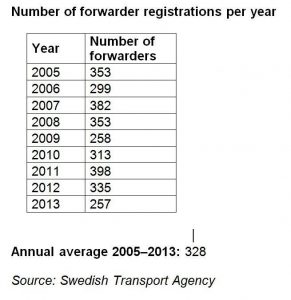
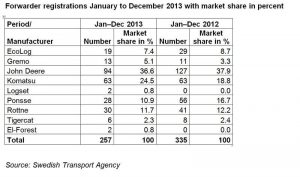
In Sweden, the number of forwarders registered in 2013 ended up at a record low. As few machines were registered last year as in the crisis year of 2009. The market shrank by 23 percent, or almost a quarter, compared with 2012. But many people are now seeing signs that a brighter future is on the horizon.

Komatsu and Gremo are the only companies that did not have fewer registered machines in 2013 than in 2012. Komatsu thereby increased its market share in Sweden to 24.5 percent. All other manufacturers lost market share. Ponsse experienced the biggest decline, with a drop to 10.9 percent.

The manufacturers say that the decline had already begun in the autumn of 2012 with a fall in orders but this first became visible at the beginning of 2013 when their machines were delivered and registered. After Elmia Wood 2013 registrations increased for a few months but then declined again to the crisis levels.

This is the lowest registration number we’ve measured in the nine years we’ve been compiling registration statistics for forwarders. The total is one machine less than in the crisis year of 2009, says Torbjörn Johnsen, Marketing Director at Elmia.

Komatsu, which defied the trend and retained its sales level, launched its new Comfort Ride cab suspension last year, an option with widespread appeal.

Forwarder_Schweden2

Nine of ten forwarders sold in Sweden are equipped with Comfort Ride, explains Peter Hasselryd, Sales Manager for Komatsu Forest in Sweden. We also launched a totally new complete forwarder programme during the year and we upgraded the engines for lower fuel consumption, which in turn leads to considerably better fuel economy.” He adds that Elmia Wood had a direct and visible impact on Komatsu’s sales: “Yes, we were extremely pleased. It was especially in the second half of the year that we had orders and deliveries. This trend continued all autumn.

He also believes that the future will see more of the same.

I believe we have the bottom behind us now. There’s no doubt that 2014 will be a better year.”  Rolf Andersson, CEO of Rottne Industri AB, shares this belief in improved sales this year. “The overall economic situation for both pulp and sawn timber has been very depressed and that leads to lower investments in both forwarders and harvesters, he says. Things are now looking brighter and if the forest industry can pick up a bit of momentum then it’s also easier to invest.

Ponsse is also noticing increased interest.

The order situation is much better now than this time last year,” says Eero Lukkarinen, Managing Director, Ponsse AB Sweden.  He points to the uncertain situation for contractors as a factor that caused the lull in forwarder sales in 2013.  “The forestry companies have short contracts, which leads to delayed investments,” he says. “But now we’re seeing that things are starting to move in the market for used machines, and then sales of new machines also tend to follow along and increase. We’re seeing a clear demand both in Sweden and abroad, so we hope that 2014 will be better.

The parquet market in Europe dropped by 5%

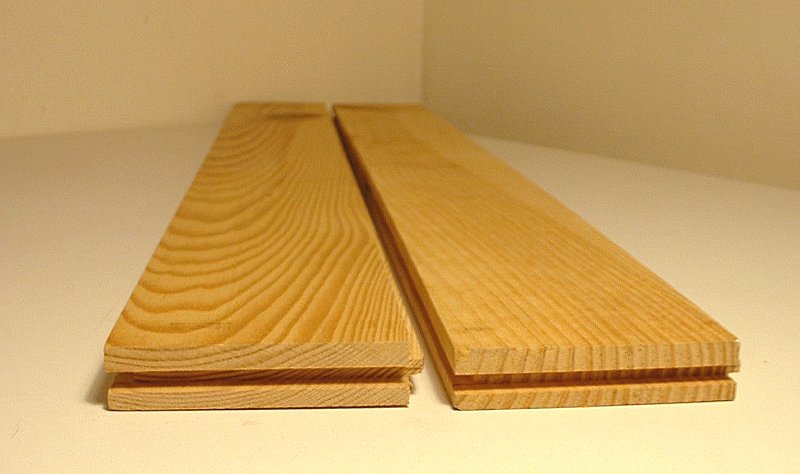
After a year in which the overall consumption figures of the European parquet Industry contracted by 5.88%, the first forecasts for 2013 seem to follow a similar trend. Indeed FEP’s (European Federation of the Parquet Industry) preliminary forecast for the year which just ended indicates a similar scenario of a further contraction in the order of 5%. This percentage is based on best estimates received from member country representatives at the recent Board meeting held at the DOMOTEX fair in Hannover. It should be seen as a first prognosis subject to variations, in anticipation of the complete data to be communicated at FEP’s annual General Assembly at the beginning of June in Malaga.

As was witnessed in the past few years, the results show some variation from country to country and even from quarter to quarter. However, the overall picture does not seem as polarized as it once was. Indeed, countries which were performing rather well and driving the markets upwards also seem to lose momentum.

From a regional perspective, it can be stated that markets in the south of the EU (e.g. Spain, Italy, and France) still face serious difficulties, with losses which could reach double digits. In the north, the situation is somewhat better but developments are still slightly negative or, in the best case, stable (e.g. in Sweden). Central Europe remains the best performing region, where Switzerland confirms its status of steady “parquet country” with an expected growth of 6%. Both Austria and Germany should however also see a consumption evolution for 2013 just below zero. These figures and tendencies have to be seen in the light of the major challenges which the sector faced in 2013 and still faces today, notably the continuously stiff competition, extremely high unemployment rates in some important EU regions and the never certain exchange rates, especially the EUR/USD ratio.

Though the ongoing struggle confronting parquet producers in certain regions gives reason for concern, the latest economic forecasts of the EC gave more optimistic expectations for the year to come. This should give a boost to overall consumer confidence throughout Europe. All Board members moreover strongly stress the conclusions of the FEP consumers’ perception studies, which confirm that

parquet is a great natural product, very much valued and desired by consumers, who see real wood parquet as an indispensable element of interior decoration of the future.

In this context, FEP Chairman Lars Gunnar Andersen commented:

We have all the reasons to believe that the current trend is a cyclic evolution but not a structural change. We are witnessing a downsizing of the market, which does not mean that it is altogether absent. Even if the exponential growth witnessed between 1991 and 2007 has seen downward corrections in the recent past, there is no doubt that better days are ahead of us.

As announced at last year’s meeting in Brussels, FEP’s 58th General Assembly and 39th Parquet Congress will be held on 5 & 6 June in Malaga, Spain.

Ikea posts 3.1% increase in net profit

The Ikea Group's net income increased by 3.1% to €3.3 billion for the financial year 2013 (ended 31st August 2013), and market conditions continued to improve, the company reported, with strong growth in China, Russia and the US.

“Consumer spending is improving in many countries," says president and CEO Peter Agnefjäll.

While the challenging economic situation may not be over, there are positive signs. Important consumer markets such as the US are coming back and Europe in general is starting to recover. Even some of the challenging markets in Southern Europe are showing good signs of activity.

Ikea's sales increased by 3.1% from last year to €27.9 billion, and the Ikea Group gained market share in almost all markets. Together with the rental income from shopping centres, the total revenues amounted to €28.5 billion (+3.2%). The largest markets were Germany, the US, France, Russia and Sweden.

This indicates that value for money is increasingly important," Peter Agnefjäll added. "I’m especially happy to see customers embracing our range of products designed to help them live a more sustainable life at home.

The Ikea Group has an ambitious growth agenda, aiming for €50 billion in sales by 2020. It states that the large emerging markets are important sources of future growth. In the fiscal year 2013, the Ikea Group opened two more stores in China – another step in expansion in the Chinese market.

We have a long-term focus. We’ll keep developing better products at lower prices, improving the shopping experience and becoming more accessible to our customers, for example through an improved service offer, e-commerce and continued expansion. Our ownership structure and sound financial principles give us independence and the possibility to grow in a balanced and sustainable way, Ikea's CEO concluded.

Sweden: decreasing prices for sawlog and pulpwood prices in 2013

Statistics for the 4th quarter 2013 shows a small increase in prices compared to previous quarter, but annual prices for 2013 decreased compared to 2012, the Swedish Forest Agency reported.
Sawlog prices decreased by 6 percent in 2013 compared to 2012. The fall in prices were relatively even between region South, Middle and North and between the tree species pine and spruce.
Pulpwood prices decreased by 8 percent during 2013. The biggest fall was in region South and Middle, with 8 and 9 percent respectively.
Between the fourth and third quarter of 2013 sawlog prices rose, in particular in region North and South. Prices of pulpwood were unchanged with the exception of pulpwood of birch which fell by 6 percent.

Setra sees strong earnings improvement

Setra reports an operating profit for 2013 of SEK 107 million (EUR 12,1 million) as compared to SEK -80 million in 2012  (EUR 9,09 million), an earnings improvement of SEK 187 million (EUR 21,2 million) over 2012. Net sales for the full year were unchanged and amounted to SEK 4,068 million (EUR 462 million).

I am pleased to note that the positive earnings trend shown by Setra during the year continued in the fourth quarter with a reported operating profit of SEK 47 million, says Hannele Arvonen, President and CEO of Setra.

She further added that the improved earnings compared with the previous year are mainly explained by a higher gross profit margin. Aggressive marketing combined with an internal efficiency improvement programme designed to reduce costs and limit tied-up capital are ongoing activities for Setra. The investment in automated sorting carried out at the Skinnskatteberg sawmill had a good effect during the year and several similar efficiency improvement investments are planned.

The UK and Japan were the export markets which showed the strongest growth during the year, Ms. Arvonen explained. The markets in the Middle East and North Africa, which account for approximately 20% of Setra’s total sales, were stable. A marketing drive was conducted in Southeast Asia during the year and Setra has had its own sales representative on site in China since December.

We have a good position to build on as we move into 2014. Focusing on our customers, we will continue our internal improvement programme to achieve long-term profitability at Setra, the CEO concluded.

Key figures, SEKm Oct-Dec   (3 mths)   Jan-Dec (full year)
 EUR/SEK: 0,113 2013 2012 2013 2012
Net sales 1,005 951 4,068 4,069
Operating profit 47 -56 107 -80
Profit/loss after tax 35 -72 60 -116

Danzer may re-associate with FSC

Key documents in the context of the potential re-association of Danzer with FSC are now available on the FSC website.

The conflict sensitivity due diligence manual is made public together with an action plan by which Danzer shows how the Group is implementing the manual. The swisspeace final report of its mission to assist Danzer and Siforco in meeting their obligations towards the Congolese communities of Bumba is also available. Finally, a progress report by Danzer can be downloaded from the FSC website.

The publication of the conflict sensitivity due diligence manual is a step towards fulfilling the second condition for re-association that is the development of a comprehensive conflict prevention and mitigation framework which will be applicable primarily to Danzer’s activities in the Congo Basin. Through the action plan that will be updated regularly, Danzer has committed to a roadmap of implementation.

The swisspeace report of its mission in Bumba marks progress towards fulfilling the first condition: Danzer meeting its commitments to the Yalisika community. Fulfilment of the conditions will be verified on the ground by the Forest Peoples Program. Depending on the decision by the FSC Board of Directors, Danzer may apply for re-association subsequently.

FSC disassociated from Danzer on 21 May 2013 as the result of a complaint filed by Greenpeace against Siforco, Danzer’s former subsidiary in the Democratic Republic of Congo. Swisspeace is supporting Danzer in meeting the conditions for re-association.

Sawmills' sales in Germany dropped in November

The turnover of the German sawmills fell in November 2013 as compared to October. The decrease of the total turnover was over 8.5%: from just under EUR 400 million in October to EUR 365.5 million in November.
Compared with November 2012, sales increased by 6.15%. Particularly, international sales grew, and especially the sales outside the Euro zone by 33,6%.

Revenue

(.000 EUR)
Nov.  '12 Oct. '13 Nov.  '13 Change
Nov. '12
to '13
Sales 344.307 399.946 365.499 6,15%
Domestic sales 241.220 273.363 248.638 3,08%
Foreign sales 103.087 126.583 116.861 13,36%
Foreign sales in Euro zone 79.229 92.434 84.992 7,27%
Foreign sales with the rest 23.858 34.148 31.869 33,58%

Pöyry issues warning on extra panel capacity in EU wood industry

Today, Pöyry Management Consulting has issued a warning about the additional panel capacity planned by the European wood panel industry, questioning whether it is being built in the right place, at the right time or even to produce the right products.

Dr Cormac O’Carroll, Global Head of Pöyry’s Wood Products Practice said:

Our new market model, Zeno has identified a mismatch between industry investment plans and market requirements which will lead to declining prices for some panels and markets but rising prices for others. Whilst the planned new investments all make economic sense individually, generating at least 9% IRR, their overall impact will be to reduce industry profitability.

Pöyry’s new report, “The future of the Wood Based Panels Industry in Europe” predicts that European demand for panels will grow by 3% per annum to 2020 under a “Central” demand scenario. However, growth could be as low as 1% per annum under a “Stagnant” scenario or as high as 5% per annum under a “Dynamic” scenario.

Furthermore, the shift in demand from Western Europe to Eastern Europe will continue with 55% of all wood based panels being consumed in Eastern Europe by 2020 compared to 49% at present. Between 2007 and 2012 the average return on invested capital achieved by the European panel industry was 5% which is well below the risk adjusted return required by financial markets.

Industry profitability will improve if Pöyry’s Central or Dynamic demand scenario prevail, but with very big differences between the worst and best performers. Pöyry’s Operational Excellence practice has identified average savings opportunities of 20 EUR /m 3 across a wide range of European panel mills.

Dr O’Carroll added:

The continued expansion of the bioenergy sector is another potential threat to the European panel industry. As EU countries strive to reach their 2020 renewable energy targets, significant wood shortages for wood based panel production in some Western European markets may emerge.

A closer look at Pöyry’s scenarios:

  • The geographic distribution of planned new capacity for particleboard is not optimal from an industry perspective. It would be better if announced and ongoing replacement investments in Germany were to result in a lower net capacity for the region. Pöyry’s Central and Stagnant demand scenarios predict periods of overcapacity and depressed pricing in some regions.
  • Planned investment in new MDF capacity is roughly in line with what is economically feasible under Pöyry’s Stagnant demand scenario for Europe, so there will be room for further new capacity if demand growth moves towards the Central or Dynamic scenarios.
  • The location and timing of the announced new capacity investments for OSB are economically feasible only under Zeno’s Dynamic demand scenario. If all the planned mills are commissioned under a Central or Stagnant market scenario the profitability of existing OSB production in Central Europe will be threatened.

Pöyry is an international consulting and engineering company. Pöyry has an extensive local office network employing about 6,500 experts. Pöyry's net sales in 2012 were EUR 775 million and the company's shares are quoted on NASDAQ OMX Helsinki (Pöyry PLC: POY1V)

Canfor upgrades Elko mill

Canfor Corporation is continuing its commitment to upgrading the Elko sawmill (British Columbia) with a capital investment of CA$10 million. The funds will go towards the installation of a wood biomass-fired energy system to improve efficiency at the mill.

“This capital project will improve cost and environmental efficiency at our Elko mill by utilizing sawmill residuals as an energy source in place of natural gas,” stated Canfor Corporation President and CEO Don Kayne. “Our fibre position in the Kootenays is strong, and this investment reflects our continued commitment to operating world-class facilities and making the most of our high-quality fibre in this region,” he added.

Canfor currently operates three sawmills throughout the Kootenays.

Debate over log exports after ban in Indonesia

The suggestion that limited log exports could be resumed has generated considerable debate. The idea was first made by the Association of Indonesian Forest Concessionaires (APHI) who said such a change in the ban on log exports would generate better prices and offer opportunities for market diversification.

It was suggested by the Ministry of Forestry that logs from either community plantation forests (HTR) or industrial forest plantation concessions could be exported provided they come from areas covered by SVLK certificates.

Hadi Daryanto, the Forestry Ministry's secretary-general said “exports would be limited to companies fulfilling the SVLK certification requirements so exports would not be on a massive scale and so quota would be imposed and the log trading would be mainly driven by market demand”.

Leading by example – government agencies to use only SVLK certified products

The government has said it would require government institutions to use only timber and timber products that have been certified through the timber legality verification system (SVLK). Forestry Minister Zulkifli Hasan said that his ministry, along with the Government Procurement Regulatory Body (LKPP), the National Development Planning Board (Bappenas), the Public Works Ministry and the Environment Ministry were drafting a regulation on the use of wood products by government agencies.

Forestry Ministry director general for forestry business development, Bambang Hendroyono, said the new regulation would help to boost the domestic use of SVLK certified products. The number of companies that had secured SVLK certification stood at 632 at the end of December.

Imported wood should comply with RI certification

The Indonesian government intends to limit wood product imports to products which comply with domestic certification standards so that manufacturers using imported raw materials will no longer need pre-export inspection.

Bachrul Chairi, the Trade Ministry Director General said where the export country had a certification system comparable to that in Indonesia the mutual recognition agreements would be concluded.

Through such agreements Indonesia would be acknowledging the legality system in its trading partners and vice versa. Arrangements for this scheme are expected to be in place this year according to Bachrul Chairi.

VPA implementation advances

The EU and Indonesia recently agreed a draft action plan for the ongoing implementation of the VPA according to the EU FLEGT Facility Newsletter of Nov/Dec 2013.

The action plan is based on findings from the first phase of an independent evaluation of Indonesia‟s timber legality assurance system conducted in 2013. The action plan describes planned improvements to SVLK regulations, amendments to VPA annexes, development of new legislation and capacity building. Preparations to ratify the Indonesian–EU VPA are ongoing.

The International Trade Committee of the EU Parliament is reviewing the treaty while the Indonesian President‟s office is preparing for its ratification by the national legislature.

Domestic Log Prices

Indonesia logs, domestic prices US$ per m³
Plywood logs

    core logs
195-220
Sawlogs (Meranti) 200-220
Falcata logs 170-190
Rubberwood 95-110
Pine 125-140
Mahoni (plantation mahogany) 130-150


Domestic Ex-mill Sawnwood Prices

Indonesia, construction material, domestic US$ per m³
Kampar (Ex-mill)

AD 3x12-15x400cm
KD
AD 3x20x400cm
KD
390-410
-
565-600
-
Keruing (Ex-mill)

AD 3x12-15x400cm
AD 2x20x400cm
AD 3x30x400cm
345-370
455-500
390-420 

Export Plywood Prices

Indonesia ply MR BB/CC, export FOB US$ per m³
2.7mm 620-650
3mm 650-670
6mm -


Domestic Plywood Prices

MR Plywood (Jakarta), domestic US$ per m³
9mm
370-390
12mm
345-360
15mm
285-315


Export and Domestic Other Panel Prices

Indonesia, Other Panels, FOB US$ per m³
Particleboard

Export 9-18mm
Domestic 9mm

12-15mm
18mm
680-720
960-1020
585-610
400-450
MDF

Export 12-18mm
Domestic 12-18mm
720-755
325-450

Dieffenbacher to build drum dryer for Asia Dekor

After commissioning almost 500 dryers and air graders for the production of wood panels, the company Dieffenbacher has recently received a new order for a drum dryer for drying particles in the Asia Dekor plant. This company has ordered for their particle board line in Huizhou City a complete new drum dryer installation to replace the existing second hand dryer.

Dieffenbacher describes the product as follows: ''the drum is manufactured with high capacity internals. These internals guarantee a gentle drying of the material at lower outlet temperatures. This ensures the realisation of equal final moisture of the particles under the best possible utilisation of the used heat. At the end of the drum-cycle the material is separated from the airflow in the discharge box with annex cyclone battery. For optimal energy utilisation the gases are then partly redirected to the mixing chamber. A comprehensive control system facilitates consistent final moistures, and concurrently, a user friendly and optimised operation of the installation''.

Dieffenbacher sold 12 drum dryers for different projects in China in the past two years.

Housing starts in Japan rise more than expected

Housing starts in November 2013 beat analysts expectations and were higher than forecast according to data from the Ministry of Land, Infrastructure, Transport and Tourism, compiled by ITTO.
The November 2013 14% year-on-year rise in housing starts comes after the 7% increase in October. Analysts had expected a gain of just under 10%. As of November 2013 annualised housing starts were set to total 1.033 million, slightly down from 1.037 million anticipated in October but still well ahead of the 990,000 figure which was forecast at the beginning of 2013.
Order books for major construction companies are firm but grew by only 2.2% in November 2013, a significant decline from the 6% rise in orders reported in October. The November expansion of new orders was the lowest in seven months.

Softwood lumber prices decline in Austria

As in Germany, prices for softwood lumber in Austria have declined at the end of the last year. The price drop in December, compared with November, hit almost all assortments and fluctuated around EUR 1-5/m³. This corresponds to a decline of 0.5-3%. Most boards in standard thickness were affected. Only rough boards could keep the price level of November.
However, as compared to December 2012, the prices have increased by about 1-3% in general. This is far less than the increase registered in roundwood prices in the same period.

Softwood Lumber Spruce/Fir December 2012 November 2013 December 2013 Change December 2012 to 2013
€/m³ EXW
Edged Boards, 0-IIIa, 23 mm + 229-244 232-244 231-243 +2 / -1
Rough boards in fixed dimensions, 18-22 mm 227-240 231-240 231-240 +4 / -
Squared timber, standard dimensions, I/II, 4-6 m 206-215 212-217 209-216 +3 / +1
Reserve squared timber, II/III 150-158 156-162 153-160 +3 / +2
Boards, III-IV, 8-16 cm, 4-6 m 144-150 149-155 146-150 +2 / -
Boards, III-IV, 8-16 cm, just 4 m 146-152 150-156 147-154 +1 / +2
Boards, III/IV, 23 mm, 4-6 m 145-152 151-156 149-154 +5 / +2
Boards, III/IV, 28 mm +, 3-6 m 153-159 159-167 157-164 +4 / +5

Norway: Roundwood volumes rise, prices decline

A total of 9 million cubic metres of industrial roundwood were cut in Norway for sale in 2013; an increase of 230 000 cubic metres from 2012. This is the highest quantity of timber that has been cut since the early 1990s. The average price per cubic metre of timber fell by 7 per cent.

The aggregated gross value of roundwood sold to the manufacturing industry was NOK 2.8 billion (EUR 335 million) in 2013 - a decrease of 2 per cent compared with the corresponding quarter in 2012. The county of Hedmark had the highest decrease with 190 000 cubic metres.
According to preliminary calculations, forest owners obtained an average price of NOK 305 (EUR 36.55) per cubic metre sold in 2013, compared with NOK 328 (EUR 39.31) in 2012. The average price per cubic metre of saw logs of spruce and pine decreased by NOK 10 (EUR 1.2) and NOK 6 (EUR 0.72) respectively. In the same period, the average price of pulpwood of spruce and pine decreased by NOK 43 (EUR 5.15) and NOK 39 (EUR 4.67) respectively.
Commercial roundwood removals

  2013 Price change, per cent
1000 cubic metres NOK per cubic metre (conversion rate: EUR/NOK = 0.11985) 2012 - 2013 2008 - 2013
Total 9 019 305 -7 -16
Spruce        
Saw logs 3 478 387 -3 -16
Pulpwood 3 249 213 -17 -23
Unsorted saw logs 166 285 -8 -19
Pine        
Saw logs 1 154 400 -1 -12
Pulpwood 808 205 -16 -21
Unsorted saw logs 19 294 -10 -22
Broad-leaved        
Saw logs 3 362 -9 -9
Pulpwood 142 227 0 -2
Unsorted saw logs .. .. .. ..

Estonia: Higher roundwood prices

Nearly all assortments of roundwood in Estonia have become more expensive in November 2013 on a yearly basis, except birch. Pine logs were traded at EUR 67.54/m³ (more than 12% over November 2012). Spruce logs price has increased 16,5% yoy, but it is slightly cheaper than October 2013.
Small diameter logs (d<18) price rose by about EUR 8/m³ over November 2012. Pulpwood (spruce&logs) price also surged with an average of EUR 5/m³.
However, birch has become cheaper: birch logs by more than -4%, while birch pulpwood's price declined by -14,5%.

Roadside prices of roundwood in state forests of Estonia (EUR/m³ u.b.)

 November 2012 October 2013 November 2013 Change
Nov.'12
to '13
Logs
Pine 60.23 67.18 67.54  12.13%
Spruce 56.03 65.49 65.31 16.56%
Birch 60.18 57.98 57.49 -4.46%
Birch veneer 104.41 102.67 99.75 -4.46%
Aspen 31.59 32.87 32.87 4.05%
Small logs  (d<18 cm)
Pine 48.19 55.59 56.76 17.78%
Spruce 43.60 52.00 51.66 18.48%
Birch - - -  
Pulpwood
Pine 26.08 29.70 30.35 16.37%
Spruce 25.99 29.42 30.09 15.77%
Coniferous - - -
Birch 31.57 26.12 26.99  -14.5%
Aspen 14.14 20.31 16.51  16.76%

Fuelwood

19.13 20.02 19.98  4.44%

The above results are collected from metla.fi

Price for spruce in Tyrol continues to rise

The price for spruce sawlogs in Tyrol continued to increase in December. As compared to November the increase is just over 1%. However, compared to the same month of 2012, prices have surged by almost 8%.
The current costs for BC-sections 2a+ are almost EUR 105/m³. Spruce sawlogs (B class) are now offered at EUR 112/m³. Fir is about EUR 10/m³ more expensive than these prices.
Cx-class sawlog price rose by almost 1% in December and now cost around EUR 79.39/m³. Prices for small diameter logs increased over November by 1.5% and 2.5%.

Tyrolean Sawlog Price Index

[€/m³]

December

November

December

Change

2012

2013

2013

Dec. '12 to '13

Sawlogs - Quality Class B/C; 2a-3b

97,34

103,77

104,99

7,86%

Spruce Sawlogs B

103,82

110,81

112,07

7,95%

Sawlogs - Quality Class Cx; 2a-3b

-

78,64

79,39

-

Spruce (small diameters) B/C

-

80,3

81,53

-

Spruce (small diameters) B

-

85,14

87,14

-

Spruce Pulpwood

-

38,21

38,49

-

Price of pellets in Austria keeps stable in January

The price of pellets in Austria seems to be stable in January. One tonne of pellets is more expensive than in December 2013 with only 0.1%. The price currently stands at 26.59 €-Cents/kg for a purchase of 6 tonnes. As compared to January 2013, the price rose by 1.6 €/kg or 6.4%
Wood pellets in bags cost an average of 4.32 € per 15 kg sack (when ordered by the pallet), an increase of 0.7% as compared to December and 6.4% over January 2013.
Propellets Austria calculates an annual average price advantage of pellets over fuel oil of about 45%. The kilowatt-hour of fuel oil had an average cost of 9.5 €-Cents in 2013, while pellets about 5.25 €-Cents.

Siempelkamp: orders of wood-based panel plants drive up turnover in 2013

For the Siempelkamp Group, the 2013 fiscal year was good despite the difficult market environment. With orders up to EUR 590 million and a turnover of EUR 710 million, Siempelkamp achieved the third best result in its history.

In the machinery and plants area, the Group reached orders of EUR 405 million. Crucial to this result were the orders for wood-based panel plants. In 2013, six board manufacturers ordered MDF plants from Siempelkamp, including Homanit, for its site in Krosno, Poland. Furthermore, the company sold four particleboard plants.

In the area of short-cycle presses, Siempelkamp recorded four orders, including one for Egger in St. Johann/AT, a KT in the dimensions 2070 x 5610 mm.

In addition, various plant operators ordered the innovative MDF gluing system Ecoresinator, so since its launch in 2011 already 18 systems have been sold. In the area of ​​used equipment, demand has significantly enhanced, both on the sellers and the buyers side. In 2013, a total of three particleboard plants, an MDF plant and seven KT- systems were offered.

RusForest opens sawmill in Arkhangelsk

RusForest AB, a Swedish forestry company with operations in Russia, today announced the start of wood pellet production at the Company’s LDK-3 sawmill in Arkhangelsk.

The construction of the pellet mill at RusForest’s LDK-3 sawmill in Arkhangelsk is close to completion, and the plant is now in the test-production phase, with full capacity expected by the end of March 2014.

As previously disclosed, RusForest engaged AS Hekotek, a mechanical engineering company, to build the wood pellet production facility. The pellet mill will have an annual capacity of up to 100,000 tons and will allow RusForest to monetize its sawmill by-products by exporting wood pellets to Europe.

Matti Lehtipuu, the Group CEO, commented, “I congratulate our project team on starting the pellet mill ahead of schedule. The successful pellet production launch accelerates our path to profitability and gives us solid ground to further develop our core Arkhangelsk assets, including reviewing options for the sawmill itself.”

Total investment for the pellet plant is approximately EUR 12 million, including value added tax (“VAT”), with approximately 70 percent financed by local bank facilities.

Newsletter

Subscribe to our digital newsletter for your daily digest of essential news, views and analysis from the international wood industry delivered directly to your inbox.


0