Article archive

Central/West Africa: Hints of softening prices for some timbers

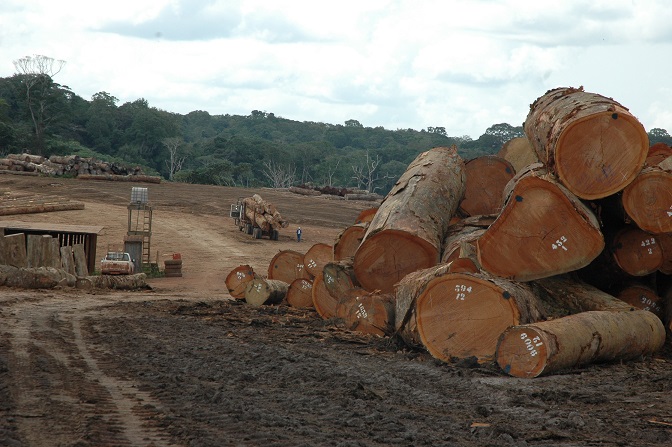
There are some signs of a slight weakening in prices for a few of the less popular species and sipo and doussie seem to have fallen out of favour with buyers. However, for the main species (log and sawnwood) FOB prices remain unchanged from the beginning of August.
Reports from European importers mention that stocks of padouk are building up and this may result in some slowdown in orders and a possible downward pressure on FOB prices.
Efforts to secure jobs at WIJMA mills
Heavy rains affected operations in Cameroon in August. The issue of WIJMA, a major producer in the country, being outbid in a tender for a forest concessions continues to evolve.
Reports suggest that, in order to secure the significant number of jobs at WIJMA mills, negotiations between the government and the company have begun to resolve this situation. The government clearly does not wish to see massive job losses which would be inevitable if WIJMA pulls out.
World Bank and IMF in talks with government of Congo
The economy in the Republic of Congo is in serious trouble and the government is in discussion with the World Bank and IMF to resolve its financial difficulties which have resulted in most government infrastructure projects being suspended with resultant job losses.
The country's export revenues have dropped and public debt is rising dramatically. Inflation is now around 50% and the Congolese franc has lost 30% against the dollar making it one of the world's worst performers this year. In addition, the Central Bank is reportedly low on foreign exchange having just three weeks of import cover remaining.
All change once more in Gabon
News is circulating that Gabon has a new forestry minister and that there have been more changes in senior staff at the forestry department. Analysts write that this seems likely to further delay signing of pending proposals for compulsory kiln drying of export sawnwood and the new Forest Code. The proposal for a temporary halt in harvesting and milling of kevazingo is said to be under reconsideration by the new minister.
As an interim measure, to allow the new minster and staff to be briefed fully on current issues, it appears as if all forests related proposals, agreements and authorisations will now have to be approved by the Minister of Economy, Régis Immongault.

Log Export Prices

West Africa logs, FOB € per m³
Asian market
LM
B
BC/C
Acajou/ Khaya/N’Gollon
245
240
160
Ayous/Obéché/Wawa
240
240
190
Azobe & Ekki
230
230
160
Belli
250
250
Bibolo/Dibétou
180
170
Bilinga
230
230
-
Iroko 325
300
265
Okoume (60% CI, 40% CE, 20% CS) (China only) 245 240 185
Moabi 330 300 235
Movingui 210
210
160
Niove
175
160
Okan
230
205
Padouk
300
280
230
Sapele 290 280 220
Sipo/Utile
310
290
255
Tali 330 320

 
Sawnwood Export Prices

West Africa sawnwood, FOB
€ per m³
Ayous FAS GMS 430
Bilinga FAS GMS 530
Okoumé FAS GMS
430
Merchantable 300
Std/Btr GMS 350
Sipo FAS GMS
540
FAS fixed sizes 555
FAS scantlings 560
Padouk FAS GMS 870
FAS scantlings 990
Strips 645
Sapele FAS Spanish sizes 505
FAS scantlings 510
Iroko FAS GMS 630
Scantlings 710
Strips
410
Khaya FAS GMS
450
FAS fixed
470
Maobi FAS GMS
620
Scantlings
630
Movingui FAS GMS
430

US sawmills increased softwood lumber production by 2.5% during 1H/2017

During the first half of 2017, sawmills in the U.S. produced 16.954 billion board ft. (bbf) of softwood lumber. This represents a 2.5% gain, from output in the same period last year of 16.541 bbf.

According to data from the Western Wood Products Assn. of Portland, Oregon, of the six-month total, western U.S. sawmills accounted for 7.015 bbf, an increase of 1.1% from 6.939 bbf a year earlier, while southern mills produced 9.141 bbf, up 3.6% from 8.823 bbf.

In June, production was 2.950 bbf, a year-over-year gain of 0.9% from 2.925 bbf, but down 0.7% from 2.972 bbf in the previous month.

Western U.S. sawmills contributed 1.257 bbf to June’s production volume, up 4.2% from 1.206 bbf a year earlier, and 1.4% higher than output in May 2017 of 1.240 bbf.

Production by sawmills in the South declined in June to 1.554 bbf – down 1.7% from 1.581 bbf last year and down 2.4% from the previous month’s output of 1.592 bbf.

Apparent U.S. softwood lumber consumption in the first half of 2017 was 24.160 bbf, a gain of 1.8% from 2.724 bbf in the first six months of 2016. Consumption in June was 3.980 bbf, a drop of 3.9% from 4.143 bbf in June 2016, and down 3.3% from 4.115 bbf in May 2017.

Canadian softwood lumber production/consumption

In the first six months of 2017, Canadian sawmills produced 14.560 bbf of softwood lumber, an increase of 1.8% from 14.308 bbf in the previous year, reported WWPA.

Sawmills in British Columbia contributed 6.705 bbf to the six-month total, a 2.8% year-over-year decline from 6.895 bbf, while sawmills east of the Rockies produced 7.856 bbf – up 6.0% from 7.413 bbf in the first half of 2016.

In June, Canadian softwood production was 2.378 bbf – down 2.3% from the 2.434 bbf produced in June 2016 and a 6.0% decline from 2.531 bbf in May, 2017.

Sawmills in British Columbia accounted for 1.093 bbf of June’s total, down 6.0% from production of 1.163 bbf a year earlier, and a 5.7% drop from 1.160 bbf in the month before. Sawmills east of the Rockies produced 1.285 bbf in June, up 1.1% year-over-year from 1.271 bbf in June 2016, but down from output in May 2016 of 1.371 bbf by 6.3%.

Apparent Canadian softwood lumber consumption was 4.901 bbf in the six-month period, up 4.7% from 4.683 bbf in the same period a year earlier. Consumption in June was 965 million board ft. (mmbf) – up 5.7% year-over-year from 913 mmbf, and up 1.9% from, 947 mmbf in the previous month.

U.S. and Canada utilization/inventories

U.S. production as a percent of practical capacity averaged 85% in the first six months of 2017, down from 86% in the same period last year, while in Canada, the percentage dipped to 90% from 91%.

U.S. inventories fell 1.1% to 2.874 bbf in June from 2.905 bbf in June last year, while Canadian inventories were up 4.1% to 3.167 bbf from 3.042 bbf.

Swiss wood pellets price starts to grow in September; still lower than last year

Wood pellets price in Switzerland went down by -1.12% during September 2017, as compared to the same period in 2016. Thus, the average price for wood pellets amounted to CHF 360.5/t (EUR 313.68/t).
However, the price in September has increased, as compared to August 2017, by 0.47%, from CHF 358.8/t.
Prices vary depending on the delivery quantity between 349.41 CHF / t (304.03 EUR / t) for an 8-tonne purchase to 373.62 CHF / t (325.1 EUR / t) for a 3-tonne purchase.
Larger quantities for commercial customers currently cost 335.11 CHF / t (291.59 EUR / t) for a 17-tonne purchase.
353.52

Price of wood pellets in SwitzerlandCHF/tonne September 2016 August 2017 September 2017
3 tonnes purchase quantity 377.03 349.41 373.62
5 tonnes purchase quantity 363.2 357.37 358.6
8 tonnes purchase quantity 347.38 349.41
Average price 364.6 358.8 360.5

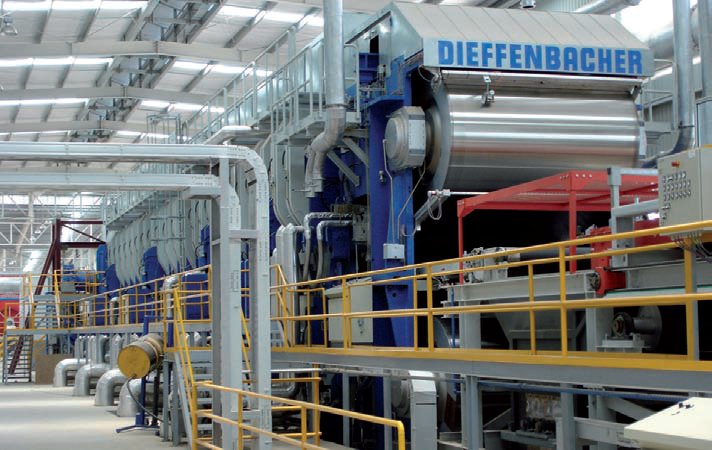
Dieffenbacher receives orders for particleboard and OSB plants in China

Dieffenbacher has recently received its third order from Wanhua, while Guangxi Hengxian Xin Weilin has ordered an OSB plant.

The Chinese Wanhua Industrial Group is one of the world's largest manufacturers of MDI resin. Since 2006, the Group has also devoted itself to developing and producing formaldehyde-free panels made of wood and straw and founded the subsidiary Wanhua Ecoboard for this purpose.

In 2015, Wanhua Ecoboard signed its first contract with Dieffenbacher for a straw-based particleboard plant, taking advantage of the German manufacturer’s expertise in developing equipment to process alternative raw materials, specifically annual plants and fast-growing woods. A second order followed about a year later. Now, one year later, Wanhua and Dieffenbacher are working on the third project.

The new order includes the core package of a straw particleboard plant, from the forming station and the 8.5-ft wide and 28-m long CPS through to the raw board handling and extraction system. The plant will be installed at Wanhua's site in Jingmen in the Chinese province of Hubei. Commissioning is planned for mid-2018.

Dieffenbacher also received an order for a new plant in China from Guangxi Hengxian Xin Weilin Panel Industry. An OSB plant with a capacity of 220,000 m³ per year will be constructed in Nanning. Construction will begin in November 2017, with production of the first board scheduled for April 2018. Dieffenbacher is supplying the gluing system, the forming station, the CPS with a width of 8.5 ft and a length of 22.5 m, the raw board handling and the extraction system and is also responsible for the entire electrical system and plant automation.

The Chinese market continues to be a success story for Dieffenbacher. Eleven new plants were sold in 2016 alone. In total, Dieffenbacher has delivered nearly 50 CPS plants to China. More than 30 4ft ContiPlus press lines join approximately 80 continuous plants for the production of wood-based panels. This makes Dieffenbacher the clear market leader in the world's most populous country.


Södra invests SEK 25 million in planing operations; co-locates units in Ronneby and Kallinge

Södra plans to strengthen the long-term competitiveness of its planing operations and to co-locate the units in Ronneby and Kallinge.

The new proposed location will be in Kallinge, where SEK 25 million is to be invested in upgrading to a paint system that is more environmentally sustainable, in new machinery and in improvements to the logistics centre.

These measures will lead to efficiency enhancements and trade union negotiations in accordance with the Co-Determination in the Workplace Act (MBL) will start immediately.

Market conditions have changed considerably for interior wood products in recent years. Södra has implemented many adjustments to the production structure in response to the changes in conditions. The next step is now being taken by co-locating units in Kallinge and Ronneby to achieve synergies.

We are now planning to invest in line-based production in Kallinge to strengthen competitiveness and are moving the warehouse in Ronneby to Kallinge in autumn/winter 2017, which will also improve the work environment. We will then move production in summer 2018 and cease production and logistics in Ronneby. Processes in marketing, logistics, order handling and general administration will also be streamlined. There is strong demand for interior wood products, with growth in the building materials trade of more than 4 percent for the first six months of 2017. The proposed changes will improve conditions to establish competitive interior wood operations,” said Peter Karlsson, segment manager for Interior Wood.

Slightly more than 55 employees of the total 142 employees in Ronneby and Kallinge will be affected by the restructuringMBL negotiations will begin immediately. Kallinge and Ronneby have joint priority rules for the order of termination and the two facilities are only three kilometres apart, which makes commuting to a new unit easier.

Unfortunately, employees will have to leave Södra, and we are doing everything we can to act responsibly and offer career transition and relocation support,” said Jörgen Lindquist, President of the Södra Wood business area.

Over the past year, Södra has worked intensively with restructuring to increase the profitability of its interior products business. In June 2016, Södra Wood Rottne was divested to Ess-Enn Timber. In early October, Nordingrå Trä was sold to Pro Unica AB and Södra Wood Föllinge to Rickard Eriksson. On 1 November, Södra Wood Grimslöv was divested to the German company Sörnsen Holzleisten and Sörnsen also acquired UAB SIWood in Lithuania on 1 July this year.

Increased global softwood lumber demand has pushed lumber prices upward

International trade of softwood lumber is on pace to a new record high in 2017 if the trend from the first six months of 2017 continues in the second half of the year.
Of the ten largest lumber-exporting countries in the world, Russia, Finland, Austria and Ukraine increased shipments the most year-over-year during the first half of 2017.
Russia alone, has accounted for 22% of global lumber trade so far in 2017, which is up from 15% ten years ago, according to the WRQ. Canada’s seven consecutive years of expanding shipments may reach an end this year with export volumes having declined 2.2% during the 1H/17.
Lumber markets – North America
During the first five months of 2017, lumber production in the US South bounced back after having declined during the second half of 2016. The total production output from January through May was 7.3% higher this year as compared to the same period in 2016, according to the WWPA.
In Canada, lumber production was up seven percent in the Eastern provinces during the first five months of 2017, while it fell 2.1% in British Columbia. The decline in BC occurred mostly because of a reduction in lumber exports to China by 10% year-overyear.
Lumber prices in both the US and Canada have trended upward for almost two years and reached 13-year highs in July. One exception has been pine lumber prices in the US South, which have fallen the past few months to the lowest level seen in almost a year.
Lumber markets – Northern Europe
Lumber production in the Nordic countries has increased faster than the rest of the continent the past five years. The sawmilling industry in Finland has grown more than in any other country in Europe the past few years, with production in 2016 being 21% higher than in 2012.
This can be compared to increase of 12% during the same period in all of Europe. Lumber prices in the Nordic countries continue to be depressed in US dollar terms, although they have moved up slightly during the 2Q/17.
Current price levels are close to the lowest they have been in eight years. Lumber markets – China Demand for softwood lumber has picked up in China in 2017 with import volumes during the first seven months being 16% higher than during the same period in 2016.
By far, the biggest jump in supply sources has been from Russia, which increased shipments by 24% y-o-y to 7.1 million m3 from January to July. Russian sawmills also increased their market share from 42% of total Chinese imports in 2014 to 62% in 2017.
Despite a substantial decline in the cost of Canadian lumber delivered to China from the record highs in 2013 and 2014, Canadian sawmills have lost market share substantially, dropping from a 40% share in 2013, when it was the largest supplier of softwood lumber to the Chinese market, to a current 22%.
Lumber market – Japan
Japan has increased importation of softwood lumber by two percent during the first half of 2017 as compared to the 1H/16. Total import volume in the 2Q/17 was 1.6 million m3, the highest level in two years.
The biggest changes on the supply side this year compared to 2016 has been an increase in imports from Canada and Sweden, and a decline from Russia. In Yen terms, domestic lumber prices have moved up slightly in 2017, while import prices have remained practically unchanged.
Lumber market – Russia
Russian sawmills have increased production by an estimated 14% the past five years, mainly driven by a rise in demand for wood in China. Although domestic softwood lumber demand was up three percent in 2016 from the previous year, domestic consumption has fallen 12 percent the past five years.
Russia has become a major player in the global lumber market the past ten years, but exported a surprisingly small share to Europe or the US. Instead a majority of the Russian lumber has been shipped to China, Japan, Iran and the CIS countries (see detailed export data in the latest WRQ Trade Snapshot).
Export prices have trended upward for more than a year, and in June 2017, reached their highest levels since February of 2015.

Sweden: Wood prices reach record year; investors seek for returns

Swedish forests prices reach record year as all-time low interest rates are driving investors to look returns for alternative assets and as owners use low borrowing costs to expand their holdings.

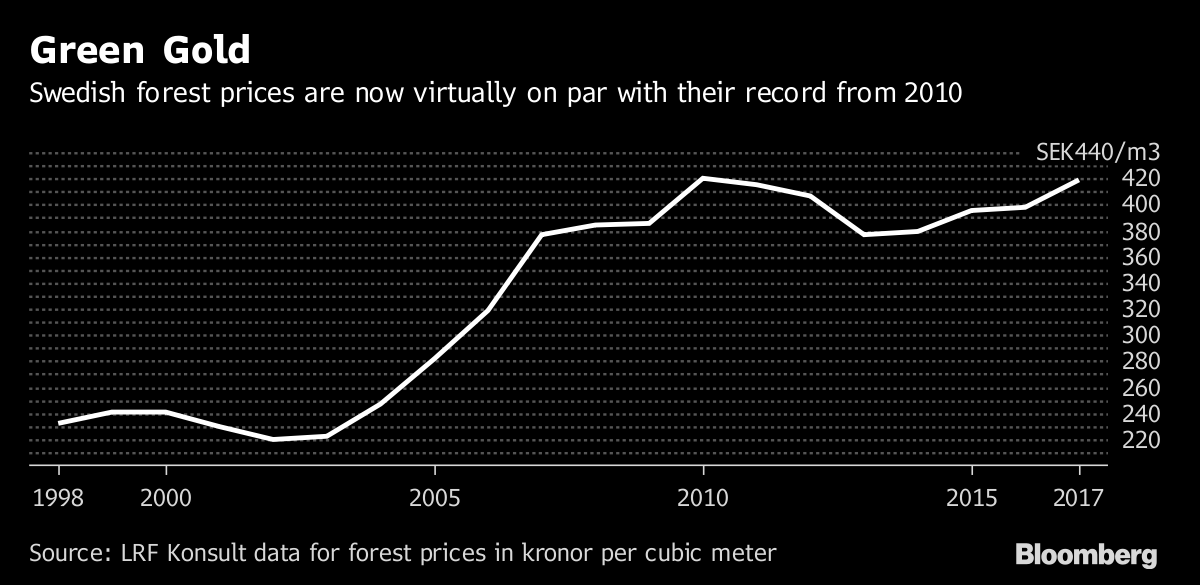
Thus, the negative interest rates are making some Swedish forest owners very happy, as the prices rose to 419 kronor per cubic meter in the first half of 2017, from 398 kronor last year, according to Bloomberg Markets, following data from the Federation of Swedish Farmers’ advisory business LRF Konsult.

Prices are now on par with the record of 420 kronor set in 2010 and are likely to continue rising, the federation said.

Everybody wants more forestland -- both private owners and companies,” LRF Konsult’s head of real estate Markus Helin said in a telephone interview. “The interest in buying forest is increasing from all directions, and I think that trend will continue.”

Forest prices are booming along with the Swedish economy, which is being fueled by record low interest rates and unprecedented stimulus from the central bank. The Swedish Riksbank has cut rates deep below zero and also pumped almost 300 billion kronor ($38 billion) into the economy through bond purchases, Bloomberg Markets reported.

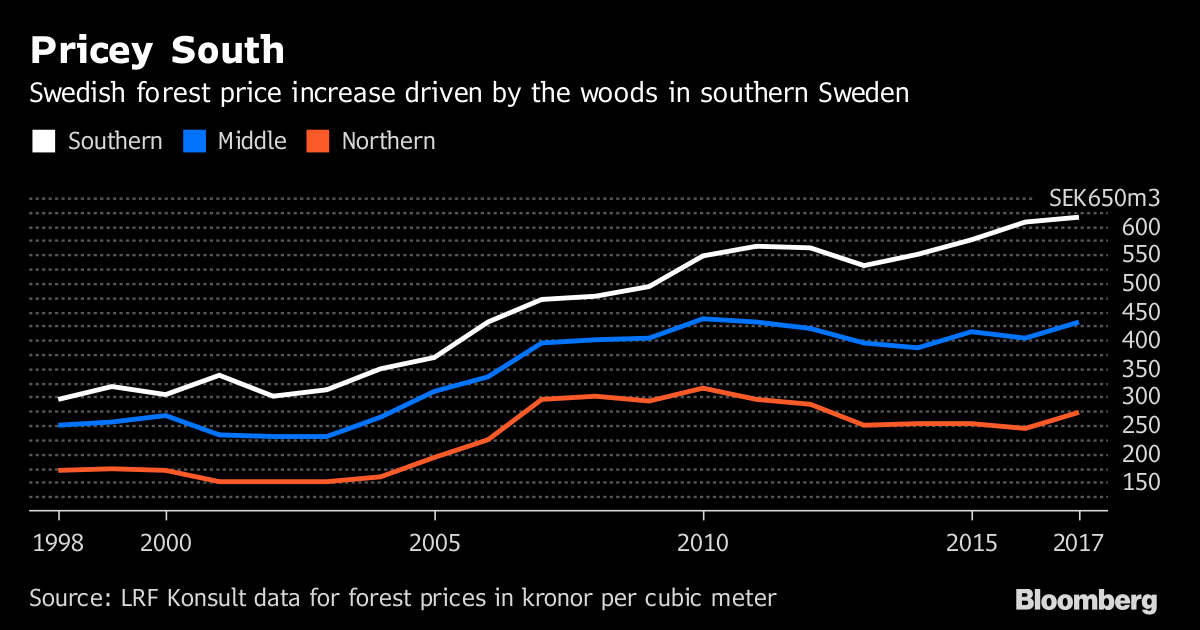
Southern Sweden drives the development, where prices per cubic meter are already at a new high and more than twice as high as in northern Sweden. The ultra-low interest rates are one of the main reasons for the soaring prices, which according to Helin, creates incentives for making investments in assets such as forests. What’s more, forest owners “generally have low debt ratios” and are taking advantage of low borrowing costs to buy more, he said.

In its Forest Barometer 2016 report, LRF Konsult estimated that forest for 86 billion kronor would change owners in the coming five years. The largest owners in Sweden are Sveaskog AB, which sells sawlogs, pulpwood and biofuel, and Svenska Cellulosa AB, which produces paper, pulp and wood. In addition, there are some 330,000 individual forest owners.

We do see an interest from investors outside of Sweden, but it’s mostly Swedish investors, and especially investors who want to increase their forest areal,” Helin said.

US hardwood flooring imports significantly up from 2016

US hardwood flooring and assembled flooring panel imports increased in June to US$5.4 million and US$13.3 million, respectively.

Year-to-date hardwood floor imports grew 23% compared to the same time last year.

Year-to-date imports of assembled flooring panels (engineered wood flooring) was only slightly higher than in June 2016.

Hardwood flooring imports from Malaysia more than doubled from May to US$413,458, but year-to-date imports are still less than half compared to June last year. Indonesian shipments increased to US$766,634 in June, but the largest month-over-month growth was in imports from China. Hardwood flooring from China was worth US$1.9 million in June.

In assembled flooring panels, both China and Indonesia exported less to the US than in May. Canada was the largest import source of assembled flooring in June, but in year-to-date imports China is still slightly ahead of Canada. Assembled flooring imports from Thailand increased significantly in June (US$692,010).

Turnover of the German wood industry on a upward trend this year

The German wood industry has recorded 1.7% sales increase during the first half of 2017, reaching its fourth year of continuous growth.

The sales during the mentioned period amounted to EUR 17.7 billion, while in the same period in 2016, there was a 4.4% increase, to EUR 17.4 billion, from the previous year.

Even though the wood industry is currently growing at a slower pace, the HDH (the Association of the German Wood Industry) is overall satisfied with the half-year result. In view of the stable industry situation, the association expects a growth of 1-2% for the German timber industry for the entire year 2017.

The turnover for the German wood industry in the first half of 2017 rose by 3.2% to EUR 8.1 billion. The furniture industry grew by an average of 0.5% to around EUR 9 billion, due to the successful export business. Now, the domestic market stabilized after three years of growth.

Despite the recent slowdown in construction activity, the construction sector in the wood industry continues to show robust growth. In the first half-year of 2017, prefabricated timber construction registered a building permit of 4.1%. Since the total single- and double-family home construction also fell by 8.8%, the prefabricated timber construction segment in this segment was able to gain a significant market share.

The nationwide prefabricated construction rate rose to a new half-yearly record value of 19.3%. Overall, the construction sector in the wood industry grew by 7.8% to around € 2.7 billion. The producers of windows, doors, stairs and other wood-based building components also contributed to this.

The industrial sectors wood materials, wood packaging and sawmilling have grown less strongly than the construction sector. HPE, for example, is assuming a slightly positive development in wood packaging. However, the current very good volume development is being overshadowed by extreme price pressure both for pallets and export packaging.

The export business of the entire wood industry developed above average in the period from January to June 2017. Overall, foreign sales rose by 2.2% compared to the first half of 2016. In the first half of 2017, the industrial export quota - this is the share of turnover generated by companies producing in Germany - rose to 29.4% (previous year: 28.9%). The furniture industry in particular, with an industry export rate of 32.2%, played a major role in this positive overall result. The export rate in the wood industry is at a lower level of 24.9%.

US housing market steady despite lower July starts

US housing starts decreased 4.8% in July to a seasonally adjusted annual rate of 1,155,000, according to the US Department of Housing and Urban Development and the Commerce Department. July starts were 5.6% lower than in July 2016.

The largest decline was in the more volatile multi-family construction sector, while single-family starts were nearly unchanged from June. Multi-family construction was at its highest in 2015 and has since declined as more Americans are looking to purchase single-family houses.

The number of building permits issues for single-family homes, which indicates future building activity, were unchanged from June at a seasonally adjusted annual rate.

The size of new single-family homes has decreased during the second quarter of 2017, according to US Census Bureau data. This is a good sign for the housing market, according to the National Home Builders Association.

Directly after the recession home sizes rose because highend wealthy buyers returned to buying homes sooner. A decline in home sizes indicates that more households including first-time buyers are now investing in housing.

Builders’ confidence in the market for new single-family homes gained in August, according to the National Association of Home Builders/Wells Fargo Housing Market Index. The cost of building lots, labour and building materials remain a concern.

Total sawn softwood imports and imports from Canada have declined since the US imposed preliminary countervailing duties on most Canadian softwood in April.

The US has increased softwood imports from Europe, while purchasing from Brazil has remained steady and imports from Chile have even declined in the first half of 2017.

Masisa sold Brazil wood-based panel operations plant to Arauco

Masisa announced the sale of its manufacturing operations in Brazil to Arauco (Chile), for USD 102.8 million, on the 8th of September.

As reported by Notifix, this operation is in tow with the company’s announced divestment plan in Brazil, as well as in Argentina and Mexico. In that regards, Masisa recently sold its assets in Argentina to Austrian Egger.  The transaction will allow Masisa to focus its commercial activity on higher value-added businesses in the Andean Region, Central America, the United States, Canada and other export markets, maintaining its productive capacity to supply the region from Chile and Venezuela and also maintaining its forestry business.

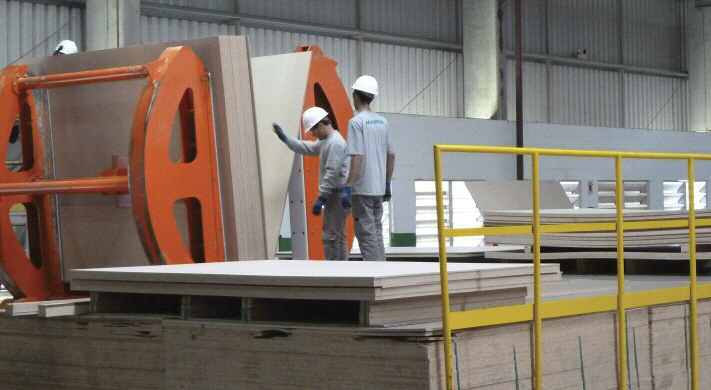
Masisa Brazil consists of two main manufacturing assets, which are two industrial complexes located in Ponta Grossa (Paraná) and Montenegro (Rio Grande do Sul), that include a line of MDF panels with an installed capacity of 300,000 m3 per year, a line of MDP panels with an installed capacity of 650,000 m3 per year and four melamine coating lines with a total installed capacity of 660,000 m3 per year.

Arauco will assume debt of Masisa Brazil for USD 44,7 million, and Masisa will receive USD 58,100,094 from Arauco Brazil. This transaction does not include Masisa Brazil’s cash, which is estimated at USD 11,2 million. With this operation Masisa is one step closer to reaching its goal of raising USD 500 million in order make a significant difference on its debt ratio.

Danzer to upgrade sliced flooring wear layers unit in France

Danzer, a leading producer of decorative hardwood products, re-opened its location in Souvans, France on September 7, 2017.

According to the announcement, the unit was re-opened after EUR 13 million investment made in responds to the ever-increasing demand for sliced wear layers in engineered hardwood flooring.

From the beginning of 2018, the full capacity of about 20,000 m3 log volume will be processed in Souvans resource efficiently.

Hans-Joachim Danzer, CEO of Danzer Holding AG, commented: “In addition to the many years of experience and the great know-how of our local employees, this was an important factor for the Souvans location. Due to our slicing technology and our proximity to the resource we work exceptionally efficiently. Additionally, thanks to our industrial approach, we are able to offer a high production volume of consistent quality and with short reaction times.”

Preceding the construction, the Danzer Supervisory Board approved a EUR 15 million investment plan for the thick-cut veneer expansion for the factories of Souvans, Melnik (Czech Republic) and Darlington (USA) in 2015. Prior to this, solely the plant in Melnik produced thick-cut veneers.

Earlier Danzer reported a minor decrease of sales in 2016.

Danzer is a leading quality hardwood supplier. It owns and manages forests sustainably and produces veneer, timber and innovative value-added wood products for decorative purposes. The company owns 21 sales offices worldwide.

Chinese Fenglin Group might face supply problems for its new giant sawmill in New Zealand

New Zealand Trade and Enterprise is worried about the wood fibre supply available for the $180 million wood processing plant in the Central North Island.

NZTE had encouraged a Chinese company to buy the plant as to boost regional development, but following some concerns from the local industry, the plant might not benefit enough supply.

As NZ Herald reported, China's Guangxi Fenglin Wood Industry Group announced plans earlier this year to establish a plant in Kawerau by 2020 to produce 600,000 cubic metres of panel boards a year and generate 100 new jobs, at an expected cost of $180 million.

On the other hand, the Wood Processors & Manufacturers Association of New Zealand raised some concerns regarding the fact that the timber mills in the region don't produce enough wood fibre to supply the proposed plant as well as existing big pulp mills of Kinleith in Tokoroa and Tasman in Kawerau, which are owned by Japan's Oji Fibre Solutions.

Thus, Fenglin's proposed plant is expected to initially produce particle board and later expand to medium-density fibre board (MDF).

Jon Tanner, chief executive of the WPMA, said that the association "very much welcomes" overseas investment in the New Zealand wood processing sector. However, he noted "it is important that this investment is directed to regions where there is not an already constrained wood fibre supply."

NZTE confirmed that it has commissioned Finland forestry consultancy Indufor to provide baseline data on levels of wood fibre available for processing in the region for industry stakeholders.

NZTE general manager of investment Dylan Lawrence said the report will investigate the current and planned harvest levels of timber, the current annual volumes of pulpwood and residues, as well as planned production and consumption levels in the industry, NZ Herald reported.

"Fibre supply for the new particle board mill in the immediate term will come from existing under-utilised wood fibre resources and from the rapidly expanding forest harvest in the wider region," said Fenglin Wood Industry (New Zealand) director John Galbraith. "The plant will complement existing wood manufacturing, providing alternative markets for existing byproducts and our expectation is this will support further investment in new primary processing ventures in the region, utilising fibre that is currently being exported as whole logs."

Founded in 2000, Fenglin and was one of the earliest engineering board manufacturers in China and the first in Guangxi Province, according to its website. Listed on the Shanghai Stock Exchange, Fenglin has three MDF plants and one particle board plant in China with total capacity of 810,000 cubic metres a year, and also owns about 14,000 hectares of forests to secure wood supply.

With plants in China's Guangxi and Guangdon provinces, the company said it began to explore more international opportunities from 2015.

Byko-Lat to increase planing capacity at sawmill in Valmiera

Byko-Lat has acquired from Bergs Timber the planing line from the Myresjö Sawmill that stopped production this summer.

The line is being moved to Valmiera in Latvia and is expected to start production end of Q2 2018. The line will be 5th planing line in Valmiera and will increase the planing capacity to 200 000 m3 annually.

The reason for the new production line is to reduce delivery lead-times and increase capacity to our customers, says Valts Kurpnieks, Managing Director of Byko-Lat.

Byko-Lat has at its Valmiera site a timber planing & further processing factory including impregnation, a window and door factory and a prefabricated house factory. Byko-Lat’s garden furniture production is located at the Cesis factory. The production is sold to more than 25 countries worldwide.

Byko-Lat is part of Norvik Timber Industries.

Poland: Sawmill industry representatives ask for fair terms on the sale of the 10 mil. m3 of wood resulted from storms

After the storm that devastated forests in Northern and Central Poland on August 11 and 12, the Polish Chamber of Commerce of the Wood Industry (PIGPD) met representatives of the Polish sawmill industry in Fojutovo, in northern Poland, on August 29th, to submit a list of claims for the utilization of the wood resulted from storms. 

According to recent estimates, about 10 million cubic meters of wood were thrown and broken.

The central demand of the sawmill industry representatives is that storm wood quantities should not be allowed to be counted on the so-called shopping history of the companies, in order to avoid disadvantages for the companies.

For small and medium-sized enterprises in the storm area, companies are calling for special solutions for the coming 10 years, because they have been deprived of their raw material base for a long time.

The possibility of purchasing storm timber should not be restricted to certain, previously authorized, companies, but should be open to all interested companies. In addition, companies are calling for support in the financing of timber purchases from the storm area through price reductions, generous billing periods and special loans.

Finally, the wood industry companies are calling for an intensified research on the exploitation of stormy woods and the prevention of future storm damage in the forest.

We remind you that storm on 11 and 12 August 2017 in western Poland causing a damage of 9.8 million thrown and broken wood on an area of 80,000 hectares. Particularly the regions of Pomerania and Kuwajy have been affected from the storm. According to general director Konrad Tomaszewski this is the biggest catastrophy in the 90 year history of the Polish state forest. The clearance works are expected to last until the end of 2019. Afterwards the reforestation can start, says Tomaszewski

The storm had wind speeds from 100 to 150 km/h and reached from the Baltic Sea coast to Lower Silesia. More the 60 counties have been affected. The region around Toruń and Gdansk has taken the worst damages, especially the counties Lipusz (up to 2.3 mill. m3), Rytel (2 mill. m3), Czersk (0.9 mill. m3), Bytów (0.65 mill. m3), Runowo (0.66 mill. m3) and Gniezno (0.8 mill. m3). Alone in Toruń 5.5 million m3 have been thrown. Besides spruce and pine also broad leaved trees have been affected, particularly oak and birch

22 nature reserves and 134 Natura 2000 habitats have been damaged and valuable seed stocks have been destroyed. Besides that infrastructure was destroyed or damaged, like forest streets, bridges, power lines and buildings in the forests.


Overview of the European parquet market in H1/2017: moderate growth on rising economy

The Board of Directors of the European Federation of the Parquet Industry met on 1 September 2017 and discussed amongst others both the parquet situation and recent economic indicators on the European market.

In general, the parquet business keeps on experiencing a moderate growth and benefiting from the encouraging developments of the economy, especially of the construction activity. When compared to the same period of last year, the provisional results observed for the first half of 2017 point to a continuation of the positive parquet consumption trends observed in 2016 and during the first quarter of 2017. These relatively promising developments are registered in all the countries where

FEP members are present including in Nordic countries. No decrease of consumption is reported. A brief per country recap is provided in the table below.

Market overview

Austria The Austrian parquet sales increased by 2% during the first semester 2017 compared to the same period last year. Nevertheless, the competition from other flooring solutions remains harsh

Belgium The indications available point towards a growth of 2.5% of the parquet consumption during the first three months of 2017.

Denmark The Danish parquet market keeps on growing by 1 to 2%, reflecting the performance of the Danish construction activity, especially for projects and ready-made houses.

Finland Parquet sales remain stable on the Finnish market, confirming that Finland is getting out of the red zone after several years of negative developments.

France The French market continues to experience positive trends. Parquet sales grew by an estimated 3% during the first semester 2017.

Germany Data indicate that parquet sales increased by 2% during the first semester of the current year, reflecting the very good performance of the construction sector. On the other hand, there are shortages of craftsmen and the competition with other flooring solutions remains harsh.

Italy Parquet sales rose by 1.5% during the first half of the year 2017, reflecting the positive economic developments observed in Italy.

Netherlands The information received points to further significant improvements on the Dutch market – parquet sales rose by an estimated 7% during the first semester 2017, reflecting the performance of the housing sector. The affordability of wood raw material and the availability of some species are problematic.

Norway Compiled data indicate that the Norwegian market remains stable during the first half of 2017. Prices of apartments increased further during this period.

Poland The information gathered points to a moderate increase by 2 to 3% of the parquet sales on the Polish market.

Spain The Spanish market remains stable. All indicators are positive and the expectations for the rest of the year 2017 point to a continuation or an improvement of this trend.

Sweden Compiled data point to a further significant increase by 3 to 4% of the parquet sales in Sweden during the first six months of 2017. This trend is supported by the stable development of construction projects.

Switzerland Parquet consumption remains flat in Switzerland during the first semester of 2017. No significant increase or decrease of the market is expected during the second half of the year.


EU tropical timber imports drop by 8% in H1/2017

In the first half of 2017 compared to the same period in 2016, total EU imports of tropical timber products declined 8% to 1.12 million metric tonnes (MT).

There was an 18% decline in EU imports of tropical sawn to 349,000 MT, a 13% decline in imports of tropical charcoal to 199,000 MT, a 33% decline in imports of tropical logs to 54,000 MT, and an 11% decline in imports of tropical flooring to 19,000 MT.

These losses were only partly offset by a 31% rise in imports of tropical plywood to 171,000 MT and a 3% rise in imports of tropical veneer to 78,000 MT.

The EU imported 168,000 MT of tropical timber products from Indonesia in the first 6 months of 2017, exactly equivalent to the same period in 2016. This is much less than hoped since Indonesia became the first country to issue FLEGT licenses in November 2016. However, Indonesia has performed better than nearly all other tropical timber supplying countries in the EU market this year.

EU imports declined from all other major tropical supplying countries in the first half 2017, with the lone exception of Brazil. Imports from Brazil were 95,000 MT during the period, a slight (2%) increase compared to the first half of 2016.

EU imports of tropical products (nearly all plywood) also increased 60% from China to 56,000 MT in the first half of 2017.

In contrast, direct EU imports of tropical products from Cameroon declined 20% to 145,000 MT, Malaysia declined 4% to 128,000 MT, Gabon declined 8% to 102,000 MT, Nigeria declined 27% to 75,000 MT (mainly charcoal), Congo declined 24% to 40,000 MT, Côte d'Ivoire declined 27% to 32,000 MT and DRC declined 43% to 19,000 MT.

After rising strongly in 2016, imports of tropical timber products in Belgium declined 21% to 212,000 MT in the first half of 2017. Imports in France, Germany and Italy, which were sliding in 2016, declined further in the first half of 2017.

Imports fell 16% to 146,000 MT in France, 5% to 122,000 MT in Germany and 16% to 95,000 MT in Italy. After showing signs of recovery last year, imports in the Netherlands weakened in the first half of 2017, falling 8% to 131,000 MT.

German furniture industry reports growth for the first half on booming exports to China and India

The German furniture industry reaches its fourth year of growth in 2017. During the first half of the year, the sales in the furniture industry amounted to nearly EUR 9 billion, a 0.5% increase from the previous year.

After a successful year 2016, with a turnover plus of 3.2%, the good results of the previous year could be slightly exceeded, the Association of the German Furniture Industry, VDM, reports.

The main contributor to this results is the foreign turnover of German furniture manufacturers, which rose by 1.7% in the first half of the year, while domestic sales stagnated compared with the previous year.

The export sector was able to make an important contribution to the growth of the industry, through the demand in important European sales markets and the positive economic development in the largest growth markets outside the EU, such as China and India. Nearly a third of German furniture exports are sold to non-EU countries.

The individual segments of the German furniture industry developed unevenly in the first half of 2017.

The kitchen furniture manufacturers reported a drop in turnover of 2.4% to around € 2.4 billion. The office furniture industry reported a slightly negative result (-1.5%) with sales of around € 1bn. The manufacturers of upholstery furniture recorded a noticeable decline, with sales falling by 5.3% from January to June 2017 to around € 510 million. The smallest segment in the industry - the mattress industry - stagnated with a slight sales decline of 0.1% to around € 460 million.

On the other hand, manufacturers of shop and other furniture products were 7.5% higher than in the previous year and generated sales of around € 860 million. The increase in sales of other furniture and furniture items was slightly higher than the branch average: 2.4% to € 3.8 billion.

Sales in the EU countries showed a markedly weaker decline than the total exports, with a drop of 1.7%. Exports to the most important export market of the German furniture industry, France, increased by 1.6%, including the Polish (+ 9%), the Czech (+ 2.9%) and the Danish market (+ 5.4% developed positively from the perspective of the German furniture industry. However, furniture exports declined to important markets, as Austria (-3.7%), the Netherlands (-3.5%) and Belgium (-1.3%).

The furniture industry was already feeling the negative effects of the Brexit in the past year, as the furniture exports to Great Britain fell by 2% between January and May. Also, exports to the US declined again (-1.3%), following strong growth in recent years. This is due to the increasingly protectionist trade policy of the USA.

However, Germany was able to supply more furniture to China (+ 27.6%) and India (+ 32%), which is a positive signal for the future.

The industrial export rate - this is the share of the total turnover of the industry delivered directly by domestic furniture manufacturers - climbed to 32.2% in the first half of the year, reaching a new record. In the first half of 2016, the corresponding figure was still 31.7 percent. Since the turn of the century, the export quota in the furniture industry has more than doubled.

Imports

In the first five months of 2017, German furniture manufacturers were again able to gain considerable market shares against foreign competitors. After rising by 2.2% to € 12.4 billion in the full year 2016, German furniture imports fell by 2.4% to € 5.4 billion between January and May. The foreign trade deficit decreased by 0.6% in the same period to around € 1.1 billion.

Imports from the EU countries (-4.9%) and above all from Italy (-8.8%), Austria (-9.8%) and France (-10.2%) declined sharply. Poland lost 3.8 percent, but remains the most important furniture country after the significant growth in recent years.

Every fourth furniture imported to Germany is currently coming from their eastern neighbor. By contrast, imports from Asia rose by 6.1%. China is the second most important import country after Poland with an increase of 6.4%. Imports from China declined slightly last year. Imports from Vietnam, the second most important supplier from Asia, are also gaining in importance (+ 1.6%).

The VDM forecasts the signs for the further development of the sector in the second half of the year as cautiously positive.

German consumers remain in a positive mood and expect that the domestic economy will be able to go up a gear in the further course of the year. The economic and income expectations measured by the GfK rose once more in July 2017, while the tendency to buy was on a historically very high level with slight reductions.

On the other hand, construction activity slowed again in the course of the year. The decline in construction activity is likely to have an increasingly dampening effect on furniture demand in the coming months. The contribution of the foreign markets to the turnover of the German furniture industry should remain positive in the second half of the year. Against this backdrop, the association expects a turnover of up to 1% for the year as a whole.

Newsletter

Subscribe to our digital newsletter for your daily digest of essential news, views and analysis from the international wood industry delivered directly to your inbox.


0