Article archive

Sawmill production costs in Brazil, Russia and Finland on the rise

Production cost margins for sawmills in Brazil, Russia and Finland have fallen during the first half of 2017, while they increased to their second highest level in 13 years in the US South in the 2Q/17.

The sawmill margins to cover non-wood costs and profits have been squeezed in a number of countries in the first half of 2017 because of relatively higher raw-material costs and lower lumber prices.

Since the wood costs account for about two-thirds of the production costs when manufacturing softwood lumber, it is essential for sawmills to control the wood cost/lumber price ratio. Wood costs are by far the largest and most important cost component when manufacturing softwood lumber.

The costs for sawlogs when manufacturing lumber accounts for 65-70% of the production costs and is the factor that often determines a lumber company’s competitiveness. The sawmill cost margin, defined as the difference between the cost of wood raw material and the revenue from lumber and sawmill residues, is a reliable indicator of the changing trend of the profitability of a region’s sawmill sector.

Production cost margins for sawmills in the US South, Finland, Brazil and Eastern Russia are reported for the period 1Q/05 to 2Q/17. Additional regions of North America, Europe, Latin America and Asia-Pacific will be added in the upcoming issues in 2017 and 2018.

The average production cost margin for sawmills in the US South increased during much of 2016 and 2017 and reached its second highest level in 13 years in the 2Q/17. The higher margins have been the result of slightly declining sawlog costs and increasing lumber prices thanks to higher wood demand in the domestic housing sector.

In Finland, lumber prices and income from residues have fallen faster than the log costs during 2014 to 2017, which has resulted in a decline in the cost margin by 25% in US dollar terms. In the local currency, the decline has been a more modest 8% over the past three years.

Wood raw-material costs for sawmills in Eastern Russia have gone up faster than lumber prices the past 18 months, which has resulted in declining cost margins in the region. However, the current margins are still higher than the average for the past 13 years, according to the latest issue of the WRQ.

The income from lumber and sawmill residues have declined more than costs for sawlogs for sawmills in Brazil the past three years. Consequently, the cost margin in the 2Q/17 was 26% lower than in the 2Q/14 (in US dollar terms). In the local currency, the cost margin has fallen dramatically the past two years after reaching a record high in late 2015.

IKEA Industry started wood pellet production in Poland

IKEA started wood pellets production at the beginning of September 2017, in the Eastern Polish sawmill Stalowa Wola. The newly pellet plant has a 60,000 tonnes capacity per year.

The sawmill started operation in 2014 and has a cut-off capacity of 400,000 cubic meters of pine logs.

Successful tests made on the plant have already lead to regular production and the products are currently certified according to the ENplus standard. The pellets produced by IKEA Industry's plant are to be sold to Italy, Germany and Denmark.

In addition to Stalowa Wola, IKEA Industry also produces wood pellets in the Polish plants Resko and Wielbark.

Europe’s timber giants investing heavily in CLT business

The global cross-laminated timber market experiences continuous growth, due to market advances from mechanical properties, which make the product suitable for use in residential and commercial spaces.

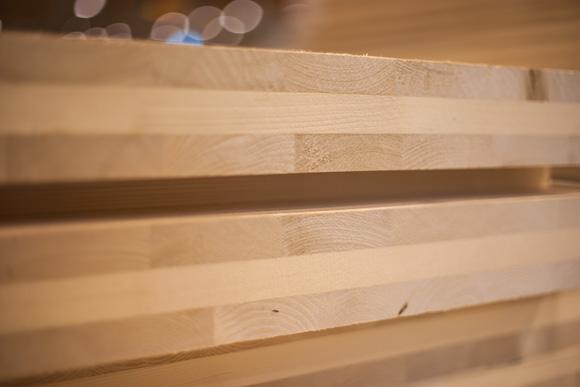
Cross-laminated timber, or CLT, is a wood panel typically consisting of three, five, or seven layers of dimension lumber oriented at right angles to one another and then glued to form structural panels with exceptional strength, dimensional stability and rigidity.

The use of CLT has increased sharply over the past year because it meets the growing need for time-efficient and simple building processes.

In 2016, the global cross-laminated timber market reached a value of $470 Million, growing annually at a rate of more than 16 percent from 2009-16. The market is expected to reach a value of $880 million by 2022.

At the moment, Europe represents the largest producer of cross-laminated timber, accounting for the majority of the global production, and more and more companies worldwide are investing in the production lines for CLT.

Companies investing in CLT production lines

At the beginning of the year, Swedish Martinson launched its new production line for CLT, which increased the company's capacity of 6000-7000 cubic meter of CLT per year, to 22 000 cubic meters. Martinsons has been manufacturing CLT since 2003 and is still the only Swedish producer of the material.

This year, Holmen started to investigate the possibilities of building a factory to manufacture CLT at one of its large sawmills.

Stora Enso has decided to invest EUR 45 million in a new production unit for cross laminated timber (CLT) in connection with its Gruvön Mill in Sweden. The production is scheduled to begin during the first quarter of 2019. The estimated yearly capacity of the production line will be approximately 100 000 m³ after ramp-up, subject to required approvals being in place. The investment is expected to generate annual sales of approximately EUR 50 million when run at full capacity.

Moreover, in June, the German sawmilling group Pfeifer announced that it will invest EUR 30 million in a new CLT plant at its German location, Lauterbach.  The new CLT plant will reach a production capacity of 100,000 cubic meters per year and the investment volume is estimated at EUR 30 million. The construction is set to begin in autumn 2017.

Swedish Södra has also decided to invest in a small facility for cross-laminated timber (CLT) adjacent to Södra’s sawmill at Värö, becuase demand for construction materials is strong across all of northern Europe – in countries where Södra already holds a leading market position.

CLT is a flexible material and particularly competitive in major cities, where the aim is to densify and construct high-rise buildings. Compared with other materials, CLT is transport-efficient, light and maintains high environmental integrity.

At the end of August 2017, Splitkon AS  announced that it would invests into a new 60,000 m3 Cross Laminated Timber (CLT) production line in Åmot, Norway. The new line is expected to be the largest CLT plant in Scandinavia, and the only one in Norway.

Efficiency and sustainability of CLT

CLT promoters have stated that the material is capable of providing the same fire-resistance and strength concrete and steel offer for buildings.

CLT has been touted by builders and designers for its configuration that improves the mechanical properties of the wood panels and makes them suitable for use in external and internal walls, floors, ceilings and roofs. As a result, CLT panels are extensively being used in the construction of mid and high-rise buildings worldwide, either as a solitary system or in combination with other construction materials such as concrete, masonry and steel.

Because it lowers the carbon dioxide emissions in construction and is able to capture carbon, CLT has gained a large following around the world; projects include a 100-storey tower in London, in the United Kingdom (UK), a 40-storey high-rise in Stockholm, Sweden, and a residential compound in Vancouver, Canada. In the University of British Columbia (UBC), Canada, an 18-storey student dormitory made of CLT is almost completed.

Chinese furniture maker SciSky is entering particleboard production

Chinese company Nanning Shuixin Ketien (SciSky) has recently ordered a particleboard plant from Siempelkamp as to open new business in the production of wood-based materials. The plant will be located at the company's Wuming site in Guangxi.

The order includes a particleboard line, including forming and pressing lines, with generation 9 ContiRoll® press, in 8 'x 30.5m format. The plant also contains the new ContiRoll drive Ecodrive, along with cooling and stacking units and a storage system.

According to Siempelkamp, ​​the new system offers at least 7% energy savings potential in full load operation and up to 14% energy savings in partial load operation. SciSky wants to process formaldehyde-free glues at the plant.

Headquartered in Lanzhou, North-West China, SciSky is a global supplier of home decorations and furniture and also produces water-based paints and paints.

The installation of the plant is to start in May 2018, with commissioning in October 2018.

Classen subsidiary files US patent infringement action against Mohawk’s IVC company

Akzenta Paneele + Profile GmbH, a subsidiary company of the Classen Group,  filed a patent infringement action against Mohawk Industries' companies IVC US, Inc. and IVC N.V. (collectively, "IVC") in the United States District Court for the Northern District of Georgia asserting United States Patent Nos. 7,146,772, 8,544,231, 9,175,475, and 9,695,851.

The complaint alleges that IVC's line of luxury vinyl tiles, marketed under the brand name Moduleo®, infringes Akzenta's patents. The complaint further alleges that IVC knowingly infringed Akzenta's patents, and attempted to obtain a sub-license to Akzenta's patents to escape liability.

The alleged IVC sub-license came from Välinge Innovations AB and Välinge Innovation Belgium BVBA (collectively "Välinge"), and was invalid because, among other things, Välinge did not have the authority to grant a sub-license to IVC.

This lawsuit is a necessary step to protect Akzenta's innovative intellectual property. Akzenta is continuing to investigate IVC's conduct.

The Czech Republic bans pine and spruce logs harvesting

On September 14th, 2017, the Czech Ministry of Agriculture has banned the harvesting of spruce and pine which doesn't come from storm felling or from beetle infestation.

The measure is applied until December 2017 and concerns all forest possessions in the Czech Republic.

The Ministry thus hopes to rapidly clear all the wood resulted from natural disasters, a process which it is hoped to end by end of March 2018. According to the state's forestry authorities, the center of the bark beetle infestation in the Czech republic lies near the cities of Krnov and Jesenik, both located on the Polish border in the eastern part of the country.

South of it, in the Olomouc region, it is the center of the damage caused by a storm in mid-August. Overall, the amount of wood is estimated to be around 100,000 m3, including 50,000 - 60,000 in the Olomouc region.

In addition, there are about 25,000 m3 resulted from winds  at the west of Brno. 20,000 m3 were felled, according to estimates, in the East Bohemia region near Náchod and Trutnov. The region is connected to the Polish Lower Silesia, which was also affected by the storm.

Indonesia: Furniture exporters face tough competition in international markets

The President/Director of PT Integra Indocabinet, Halim Rusli, has said, while it is now easier to secure verified legal raw materials, the Indonesian furniture industry is no more competitive than other Asian countries in the main international markets.

In addition, said Halim, only a handful on Indonesian companies are serious exporters shipping a mere 50-60 containers per month to the US market. This is because most companies are constrained by government regulations related to timber legality verification system (SVLK).

According to Halim, competition in the US furniture market is fierce with China accounting for around 50% of US imports and Vietnam also capturing a large slice of the market.

This is unfortunate, said Halim, as Indonesia has the raw materials and human resources for a vibrant furniture export sector.

According to Gati Wibawaningsih, Director General, Small and Medium Industry Sector in the Ministry of Industry, the government plans to help small and medium industries, especially those in the furniture sector to market their products online.

She said, data is showing that online sales are outpacing conventional marketing options. It appears that growth of conventionally marketed furniture has been growing by about 1% per year while online market growth is around 5%. The government plans to work with the private sector and provide training on on-line selling techniques.

China: Log imports up 8% in the first half of year

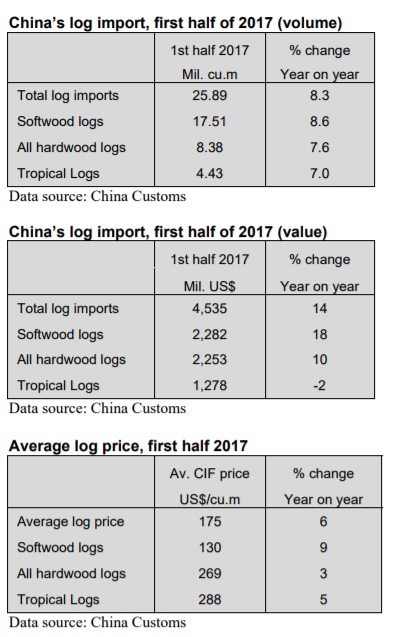
Log imports up 8% in the first half of year China’s log imports in the first half of 2017 totalled 25.89 million cubic metres valued at US$4.535 billion, a year on year increase of 8.3% in volume and 14% in value.

The average price for imported logs was US$175 per cubic metre, a year on year increase of 6%.

Of total log imports, softwood log imports rose 8.6% to 17.51 million cubic metres, accounting for 68% of the national total. The average price for imported softwood logs was US$130 per cubic metre, up 9% on the same period of 2016.

Hardwood log imports grew 7.6% to 8.38 million cubic metres (32% of the national total log imports). The average price for imported hardwood logs in the first half of 2017 was US$269 per cubic metre, up 3% on the same period of 2016.

Of total hardwood log imports, tropical log imports were 4.43 million cubic metres valued at US$1.278 billion, up 7% in volume but down 2% in value on the same period of 2016.

Finnish sawmills: All eyes on the Chinese market

Finland now ranks among the top five global exporters of softwood lumber. The Finnish Sawmills Industries association forecasts that production will increase significantly during 2016-2025.

With resource efficiency and by using high-tech systems, Finnish sawmills are able to use everything they take from the forests. The Finnish Sawmill Industries, an association that represents 35 private sawmills, is responsible for 60% of  the Finland's softwood production.

There is more wood in our forest than ever. Wood is renewable. It is a great argument for its use these days,” CEO of the association, Kai Merivuori, says.

Finland is covered by forests on approximately 70% of its land (pine, 50%; spruce, 30%; birch, 16%). The country has an annual forest growth of 104 Mn cbm, and 60% of this resource is utilized for industries. Also, consumption can still be increased by another 15 Mn cbm.

Finland ranks among the top five exporters of softwood lumber, behind Canada Russia and Sweden. (Germany is in fifth place.) Although USA, Canada, Russia, China, Germany are the world’s top five sawn wood producers, Merivuori estimates that his country’s production is projected to go up between 2016 and 2025.

Eyes on the Chinese market

Finland first exported wood to Japan in 1993. After that, Japan became a market that only bought wood products at European dimensions. As a result, all European companies are now producing wood according to Japanese specifications.

The annual export figures have recently stabilized at 1 million m3.

Five years ago, China wouldn't have made it to the top five list of importing countries, but now, the country is the third largest market for Finnish sawmills. In 2016, the main export countries were Egypt, Jpana, China, UK and France.

In 2010, exports to the Mainland reached 68,000 cbm, while in 2016 it amounted to 1 million m3. Now, this figure is expected to rise up to 1.5 million m3. Furthermore, sawn softwood exports to China increased by 20% year-on-year, during the Q1/2017.

Overall, demand for softwood sawn lumber will increase globally, as well as the demand for renewable certified, sustainable wood.

Merivuori also added that, although demand from the Middle East is growing fast, there is also a lot of political instability in the region that hampers smooth development.

Other factors that would likely impede growth are: volatile exchange rates, logistics market, political instability, as well as the global availability and cost of raw material.

Ziegler Holzindustrie orders new continuous kiln from Valutec

German Ziegler Holzindustrie, Europe’s largest privately owned sawmill, has placed an order from Valutec. 

Valutec’s TC continuous kiln is an excellent choice for us, as this solution meets our high demand for capacity combined with flexibility. We have also had very good experiences working with Valutec in recent years,” said Kai Matthies, head of wood drying at Ziegler Holzindustrie.

The TC kiln to be delivered is currently the largest that Valutec has built in central Europe, and one of the largest in the company’s history. Its capacity totals 110,000 cubic meters (46 600 MBF) of lumber per year.

This is our third order from Ziegler Holzindustrie. Renewed trust is a great acknowledgment for us and it's pleasing that they’ve chosen to invest in a TC continuous kiln. This shows they really believe in our solutions,” says Robert Larsson, CEO at Valutec.

Valutec has previously supplier two continuous kilns to Ziegler Holzindustrie. The first delivery was ten years ago and was followed up in 2014 with an OTC continuous kiln, boasting a capacity of around 50,000 cubic meters (21 200 MBF).

There is huge market potential for timber drying in central Europe, where there has been a high proportion of timber that does not have a long drying phase, when compared to places such as the Scandinavian countries.

The kiln is being made from stainless steel and will be equipped with Valutec’s Valmatics control system. It will be put into operation in February 2018 and will then be the second TC continuous kiln in Germany. Over the year, Valutec has supplied and put into operation a kiln for Egger Brilon.

Wood pellets price in Germany on the rise in September

The price for wood pellets in Germany rose to an average of EUR 232.69/tonne during September 2017. 
This represents a 1% increase over the previous month, while in September 2016, the average price was EUR 227.96/tonne, 2% lower.
The price of German wood pellets in September 2017 has the following regional differences (for 6-tonne purchases): In southern Germany, the price is the most favorable, at 231.85 EUR/t. In central Germany, the same amount costs 232.28 EUR/t, while in northern and eastern Germany the price is 233.70 EUR/t.
Larger quantities were traded at the following rates in September 2017: South: 218.31 EUR/t, Center: 215.70 EUR/t; North/East: 217.38 EUR/t (all including VAT).

US: Compliance dates extended for new formaldehyde emissions standards

The US Environmental Protection Agency (EPA) is extending the compliance dates for the formaldehyde emission standards for composite wood products.

The wood products industry and trade associations had expressed concerns about meeting the compliance dates set out in EPA’s rule from December 2016.

A prepublication version of the final rule on formaldehyde emission standards was published online on September 1, 2017. According to this prepublication rule the following compliance dates will be extended:

  • Manufactured-by date for emission standards, recordkeeping, and labeling provisions: by one year to December 12, 2018
  • Import certification provisions: by more than one year to March 22, 2019
  • Provisions applicable to producers of laminated products: by more than three months to March 22, 2024

The “manufactured-by date” of composite wood products is the reference date for the compliance date for the emission standards, recordkeeping, and labeling provisions. Beginning December 12, 2018 all imported panels and component parts or finished goods subject to the rule must comply with the emissions standards.

Existing stock of non-certified panels imported into the US and existing stock of component parts and finished goods that contain non-certified panels manufactured internationally may continue to be distributed in commerce and assembled into products until that stock is depleted, providing documentation is kept regarding the date of manufacture or import.

Additionally, composite wood products may be certified by California Air Resources Board Third Party Certifiers until March 22, 2019, so long as all aspects of the EPA final rule on formaldehyde emissions are complied with.

The EPA extended the compliance dates and the transitional period for California Air Resources Board Third Party Certifiers to add flexibility for organizations, reduce compliance burdens, and prevent supply chain disruptions.

EU imports of tropical logs continue to slide

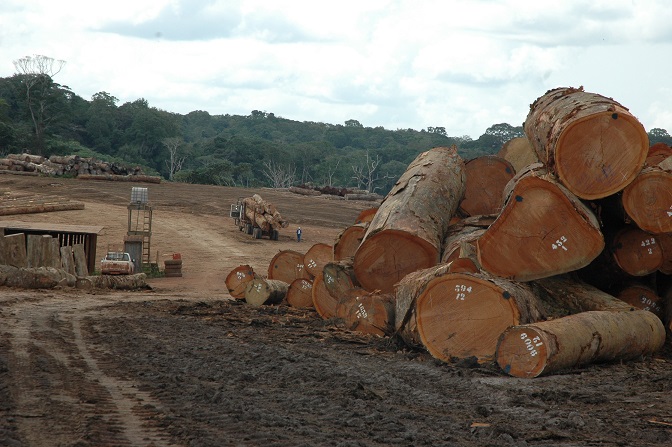
Tropical log imports into the EU fell in 2016 and this decline continued in the first half of 2017. EU tropical log imports declined 33% to 53,630 MT in the first half of 2017.

Imports declined from the four leading supply countries; Congo (-42% to 12,760 MT), Cameroon (-37% to 9,150 MT), DRC (-46% to 8,530 MT), and the Central African Republic (-45% to 6,400 MT).

These declines were partly offset by rising EU imports of tropical logs from Equatorial Guinea (+10% to 5510 MT), Angola (4420 MT from a negligible level in 2017), and Liberia (+65% to 2730 MT).

The EU trade in tropical logs is now concentrated in France, Portugal and Belgium.

Imports into all three countries fell sharply in the first 6 months of 2017, down 62% to 18,700 MT in France, down 11% to 11,100 MT in Portugal, and down 43% to 11,800 MT in Belgium.

Sweden: Stock volumes of softwood sawlogs drop by 21%

Swedish softwood sawlogs stock volumes are estimated at about 2.1 million m3 in the Q2 of 2017. This represents a 21% decline, as compared to the same period last year.

Also, the total stocks of coniferous sawlogs, pulpwood and wood chips is estimated at 7.3 million m3 (cubic meter solid volume excluding bark) as of 30 June 2017, a 12% decrease, as compared to the Q2/2016.

The total stocks of pulpwood amounted to 4,4 million m3, a decline by 8%, as compared to the second quarter  of 2016. Though, there were huge regional differences.

Pulpwood stocks were distributed on 65 % of mixed softwood pulpwood, around 14% of spruce pulpwood and around 21% of broadleaved pulpwood.

The stock volumes of wood chips is estimated at 0.8 million m3, a 10% decline, as compared to 30 June 2016.

Georgia-Pacific makes $100m investment in new lumber mill in Alabama

Georgia-Pacific announced a new lumber production facility in Talladega, Alabama. Construction on the $100 million, 300,000-square-foot, technologically advanced plant is scheduled to begin immediately with an anticipated startup in late 2018.

Once it is fully operational, the plant will employ more than 100 full-time employees and generate an estimated $5 million in annual payroll.

The location for the state-of-the-art facility will be Georgia-Pacific’s former plywood plant that closed in 2008 after more than 30 years of operation.

Once in production, the new facility will receive about 150 log trucks a day and produce approximately 230 million board-feet of lumber a year, with plans to expand production to 300 million board-feet per year in the future.

The project will provide jobs for approximately 120 workers a day at the peak of the 12-month construction period. And according to the University of Alabama’s economic modeling, the project will have an estimated economic impact of more than $26 million on the city and county during construction.

Finnish sawn timber production forecast to rise by 1 mil. m3 in 2017 on booming Chinese demand

Finland’s sawn timber production is projected to reach 12.4 million m3 in 2017 (compared to 11.4 million m3 a year ago), driven by increasing demand in China and rise in European construction activity.

According to the Natural Resources Institute Finland (Luke), the recovering global economy and new domestic investments will boost the forest sector in Finland in 2017.

Increasing demand in China is boosting Finland’s exports of pine and spruce sawn timber. Demand is also rising in Europe and in the domestic Finnish market. Exports of sawn timber from Finland are forecast to increase to 9.3 million m3 in 2017; export prices are expected to rise slightly.

Log imports are forecast to decrease somehow from 2016, while domestic demand will also push up stumpage prices of softwood logs by 2-3%.

Stod LLC to build new OSB and LVL mills in the Ural region

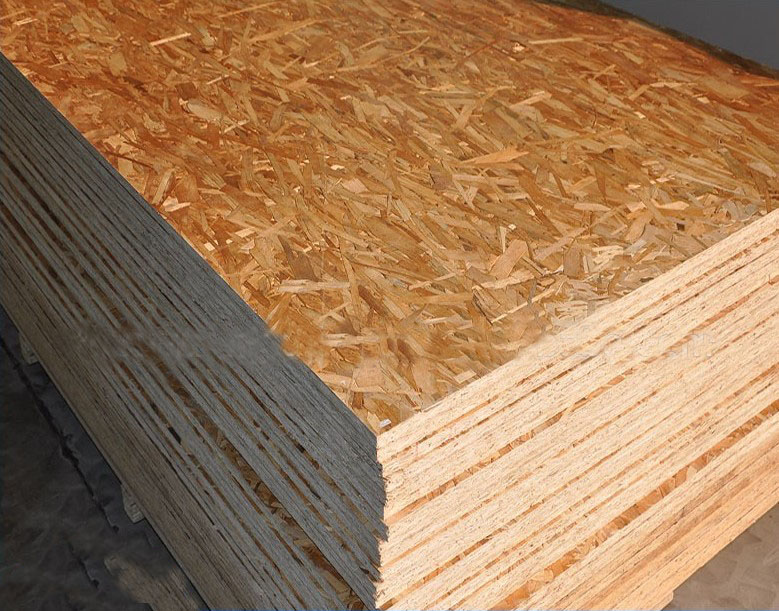
STOD LLC will build in the Titanium Valley (the Sverdlovsk region) factories to produce 300,000 m3 of OSB and 80,000 m3 of LVL beams.

According to Whatwood Weekly, the volume of investments in the first phase of the project (the OSB plant) will amount to 10 billion rubles. The plant will use softwood, birch and aspen pulpwood. Amount of investment into the LVL beams plant will be 5 billion rubles.

The investor chose the Titanium Valley because this special economic zone is located in close proximity to the forest raw material base and has a readily available engineering infrastructure. The plant was approved by the regional expert council and became a resident of the SEZ.

STOD will begin construction in the autumn of 2017. STOD already produces LVL beams in the Tver region and delivers this product to the European countries, USA, Australia and UAE, Whatwood Weekly reported.

Due to the fact that wooden housing construction is included in the priorities of the Development Strategy of the timber industry in Russia, the company also forecasts a growth in demand for glued laminated timber in the domestic market.

LVL load-bearing structures compete with metals according to their characteristics, the company said. STOD plants in the Sverdlovsk region will be oriented to the markets of Russia and Central Asia.

Lumber prices in the US continued to rise last week

Sales of framing lumber in the US slowed down last week, but the demand outstripped production in most species and prices continued to rise.
Effects from hurricanes in the South and fire danger in the West remained factors, as did a steady-to-strong overall flow of lumber through the distribution system that kept buyers replenishing inventories.
Southern Pine sales surged, setting the tone for an $11 jump in the Random Lengths Framing Lumber Composite Price, which finished at $421.

Week
Sep 15
Week
Sep 8
Year Ago
2016
Random Lengths Framing Lumber Composite Price* $421 $410 $350
KD Western S-P-F #2&Btr 2x4 R/L Mill Price 416 406 310
KD Eastern S-P-F #1&2 2x4 R/L, delivered Great Lakes 512 496 415
Green Douglas Fir Std&Btr 2x4 R/L (Portland) 467 460 332
Southern Pine (Westside) #2 2x4 R/L 386 370 403
KD Coast Hem-Fir #2&Btr 2x4 R/L 440 430 330
Ponderosa Pine (Inland) #2&Btr 1x12 R/L 675 675 685
* Weighted average of 15 key items
Random Lengths Panel Market Report
Structural panel prices jumped sharply, due to scarce supplies. In the aftermath of Hurricane Irma, OSB markets remained in disarray.
Mill quotes covered wide ranges in some producing regions, and buyers struggled to find producers on the market in the South. Southern Pine plywood buyers scrambled to cover near-term needs amid strong demand that allowed mills to extend order files into mid- to late October.
The pace was active in western Fir plywood, although a tick slower than the previous week for most traders.

(f.o.b. mill prices) Week
Sep 15
Week
Sep 8
Year Ago
2016
Random Lengths Structural Panel Composite Price* $504 $483 $390
Southern (west-east) 15/32-inch 3-ply rated sheathing plywood 480-495 450-475 365-382
Southern (west-east) 15/32-inch 4-ply rated sheathing plywood 485-500 455-480 365-382
Western 1/2-inch 4-ply rated sheathing plywood 515 509 420
North Central 7/16-inch Oriented Strand Board 435 419 304
*Weighted average of 11 key items

Softwood lumber more expensive in Austria

In August, softwood lumber assortments have become more expensive in Austria. As compared to July, boards and reserve squared timber prices are higher by 1-2 EUR/ cbm.
From August 2016, the increase is usually between three and six euros per cubic meter.
The prices for edged and rough boards, squared timber are unchanged from July, but edged and rough boards are slightly more expensive than the same month of 2016.

Softwood Lumber Spruce/Fir Aug. 2016 July 2017 Aug. 2017 Change Aug. '16 to '17
€ / cbm EXW
Edged Boards, 0-IIIa, 23 mm + 229-243 231-245 231-245 +2 / +2
Rough boards in fixed dimensions, 18-22 mm 229-240 229-239 230-239 +1 / -1
Squared timber, standard dimensions, I/II, 4-6 m 206-215 210-218 210-218 +4 / +3
Reserve squared timber, II/III 148-156 152-160 154-161 +6 / +5
Boards, III-IV, 8-16 cm, 4-6 m 143-149 145-152 146-153 +3 / +4
Boards, III-IV, 8-16 cm, just 4 m 145-152 147-153 148-154 +3 / +2
Boards, III/IV, 23 mm, 4-6 m 144-151 148-154 149-155 +5 / +4
Boards, III/IV, 28 mm +, 3-6 m 154-162 153-160 155-162 +1 / -


Newsletter

Subscribe to our digital newsletter for your daily digest of essential news, views and analysis from the international wood industry delivered directly to your inbox.


0