Article archive

US hardwood exports to China and South-East Asia register 5 months of continuous growth

US hardwood exports were on upward track for a fifth consecutive month of gains from Jan to May in 2017, with South-East Asia & China markets up 25.7% when compared to the same period of time in 2016 and reached $996 million, which accounted for 60.2% of all global exports.

Greater China market grew at 29.1% to $859 million. SEA markets continued to grow healthily in the past 5 months at 7.6% to $137million compared to the same period of 2016. The global exports value of American hardwood reached $1.6 billion, up 10.7% (YoY).

Mainland China market still played an important role in the outer performance. The exports value of hardwood lumber, logs and veneer to China totaled $605 million (up 25% YoY), $229 million (up 46% YoY) and $3.6 million (down 14% YoY) respectively. The exports value of hardwood plywood exceed $3 million, soared up 19.5 times compare to the first 5 months of 2016. China accounted for 56.2% of US global exports of lumber, 62.3% of US global exports of log, 8.9% of US global exports of plywood, 3.2% of US global exports of veneer and 7.8% of US global exports of plywood.

Performance among Southeast Asia markets were various, overall grew at 7.6% in the first 5 months of 2017 versus same period of time in 2016. Vietnam, the second largest market, rose moderately at 12.4% (YoY) to $98.9 million (YoY). The hardwood lumber exports to Vietnam increased 15% (YoY) which helped to pull up the overall performance. Other markets such as Malaysia and Philippines also recorded a positive growth at 12% and 25.3% respectively. The remaining markets in SEA, Indonesia, Thailand and Singapore declined from 5% to 45.3%.

Mohawk Industries’ plans investments of up to US$ 850 million

Mohawk Industries’ second quarter results benefited from the ongoing growth of its recycled SmartStrand fiber-made products.

Jeffrey S. Lorberbaum, chairman and ceo, noted the company’s Flooring North America segment – which includes Mohawk Home – experienced a 6% sales increase and a 12% operating margin in the period, ended July 1.

But these increases were driven mainly by the segment’s hard surface sales, which outpaced carpet. Still, residential sales proved stronger than commercial, he added.

“We have implemented price increases and improved our product mix, which together have offset material and other inflation. We are executing productivity initiatives across our operations, resulting in improved efficiencies and yields,” Lorberbaum elaborated. “Our premium residential carpet collections are growing faster than the market due to increasing consumer preference for the superior softness and performance of our exclusive SmartStrand franchise.”

To that end, Mohawk Inds. has begun shipping SmartStrand Silk Reserve, the fourth generation of the proprietary fiber and made to be even softer than its predecessors.

Company-wide, Mohawk Ind. said it posted “record results, generating the highest sales, adjusted operating income and adjusted [earnings per share] in the company's history.”

Net earnings rose 2.3% to $261 million, or $3.48 per diluted share, versus $255 million, or $3.42 per diluted share. Net sales increased 6% to $2.5 billion from $2.3 billion. And operating income was up 1.4% to $356 million from $351 million a year ago.

Year to date, net earnings jumped 8% to $61 million, or $6.17 per diluted share, from $427 million, or $5.73 per diluted share. Net sales increased 4% to $4.7 billion versus prior year $4.5 billion.

Looking ahead, Mohawk Inds. is looking to build its momentum with several new initiatives – some already in place.

Lorberbaum cited “price increases to offset inflation, introducing innovative products and improving our productivity,”

The company is also increasing its internal investments this year to more than $850 million, he added, “to capitalize on innovative new products, increased automation and greater efficiencies, as well as to enhance the four acquisitions.”

He continued: "To enhance our long-term performance, we are investing at record levels this year to expand our product offering and capacity, improve our efficiencies and extend our geographic reach…

We are expanding our sales capacity by approximately $1.4 billion. This production will come online over the next twelve months, and our start-up costs will be higher until we have optimized all our new manufacturing operations later in 2018. These initiatives will increase our sales and profitability, maximizing the long-term value of our business.”

France: Softwood and hardwood lumber prices for Q2/2017

FRANCE LUMBER PRICES for the 2nd quarter 2017

Prices 2017-Q2 Prices2016-Q2 € Prices2017-Q1€ Prices2017-Q2€ Index Change 2017-Q2/2017-Q1 Change 2017 Q2-2016-Q2
OAK Lumber                                                                       Index base 100 : Oct 2006 S20
UNEDGED LOGS  - QBA - Logs, joinery, (KD), length 3 m +
Diameter 40 to 49cm (thickness 34mm)    m3
1083 1112 1 147 132,5 3,2% 6,0%
Diameter 50cm et + (thickness 50mm)    m3
1206 1 244 1 252 129,1 0,6% 3,9%
LOGS  - QB1 - High-value joinery work, 6 months open air drying, length 3 m +
Diameter 40 to 49cm (thickness 27/34mm)    m3
830 843 867 124,0 2,8% 4,5%
Diameter 50 to 80cm (thickness 54mm)      m3 971 1021 1017 131,6 -0,4% 4,8%
SELECTED LOGS  - QSA/QS1-  (KD)
Thickness 27 to 54mm - length 2m +
Bare 18cm (tolerance 10cm +)     m3
877 878 897 134,5 2,2% 2,2%
SELECTED LOGS  - QS2 - 6 months open air drying
Thickness 27 to 54mm - length 2m +
Bare 18cm (tolerance 10cm +)     m3
632 624 638 141,1 2,2% 1,0%
STRIPS (80x27) OR EDGED (100x27) QF1a - 3 months AD
Length 30 to 50cm     m3 610 631 627 106,9 -0,7% 2,8%
Length 60 to 90cm     m3 877 892 869 125,6 -2,6% -0,9%
Length 1m + m3 942 1027 1028 129,9 0,1% 9,1%
STRIPS (80x27) OR EDGED (100x27) QF1b  - 3 months open air drying
Length 1,50m +    m3 705 723 721 116,1 -0,2% 2,3%
EDGED QF2- Thickness 27 mm - length 1,50 m +
Width 100 to 150mm     m3 766 770 759 127,1 -1,4% -0,9%
Width 160mm +     m3 824 892 855 140,4 -4,1% 3,8%
EDGED QF2/QF3 X – Thickness 27 mm, length 1,50 m +, 3 months AD
Width 160mm +     m3 647 689 668 132,1 -3,0% 3,3%
EDGED BEAMS QP1 - Standard beams (fresh)
Camber to max. two edges, red core and sap tolerance
Measure 15x15 - length 4 to 5m     m3 527 541 524 128,7 -3,2% -0,5%
Measure 25x25 - length 4 to 5m     m3 581 588 571 125,1 -2,9% -1,8%
SPRUCE Lumber (fresh)                                                        Index base 100 : July 1990 S30
Quality 0 - Edged, in all widths
Thickness 27mm     m3 292 294 291 103,5 -1,1% -0,4%
Quality 1 - Edged, in all widths
Boards 2 to 5,50m - thickness 27mm     m3 251 251 246 111,3 -1,9% -1,9%
Quality 2
Scantlings
75x225 or 63x160 - length 3 to 5m     m3
189 188 192 163,9 1,8% 1,6%
Beams 63x75 or 50x75 - length 3 to 4,50m     m3 197 197 200 107,4 1,3% 1,3%
Mouldings 27x27 - length 2 to 5m m3 226 224 229 112,1 2,1% 1,1%
Quality 3 - Boards edged timber all width
Unedged beams
Thickness 18/27mm     m3
142 147 143 104,8 3,4% - 1,2%
Quality 4
Scantlings     m3
141 138 143 104,8 3,4% 1,2%
Boards any widths    Thickness 27mm     m3 130 124 131 105,0 6,2% 0,7%
Value added for extra-lengths 5 to 8 m 10 10 10 - 1,3% 3,1%
  €/m
MARITIME PINE Lumber (fresh)                                            Index base 100 : July 1990 S50
Quality 0A - edged, in all widths, lengths 2 to 2,70m
3/4 Sidings     Thickness 27/32mm    m3 326 338 333 109,8 -1,5% 2,2%
Quality 0 - edged, in all widths, lengths 2 to 2,70m
Thickness 27mm     m3 244 246 247 119,3 0,4% 1,0%
Thickness 32mm     m3 266 267 268 126,4 0,4% 0,8%
Quality 1 - edged, in all widths, lengths 2 to 2,70m
Thickness 27mm     m3 199 197 198 126,9 0,5% -0,6%
Thickness 32mm     m3 240 244 245 147,6 0,4% 2,1%
Quality 2
Scantlings - length 3 to 5m m3 240 238 239 144,0 0,4% -0,4%
Quality 3 - Boards thickness 27 mm - all widths
length 2 to 5m m3 152 154 153 124,3 -0,7% 0,5%
Beams     m3 142 142 142 111,7 -0,2% -0,1%
Quality 4
Boards 27mm     m3 121 119 118 126,0 -0,3% -2,0%
PINE Lumber(fresh)                                                              Index base 100 : July 1990 S40
Quality 0A
Logs All thicknesss     m3 320 322 330 125,8 2,4% 3,0%
Quality OB
Logs All thicknesss     m3 290 287 286 124,3 -0,3% -1,5%
Quality OA
Edged Thickness 18, 27mm +, Width 100mm + m3
290 290 292 98,3 0,7% 0,7%
Quality 0
Edged Thickness 18, 27mm +, Width 100mm +   m3 290 295 295 123,4 0,0% 1,7%
Quality 1
Edged
Thickness 18, 27mm +, Width 100mm + m3
242 255 256 129,3 0,4% 5,8%
Quality 2
Scantlings 63x163 or 175, 65x175 or 180, 75x165, 80x230 Length 3 to 5m     m3
196 199 198 115,1 -0,6% 0,9%
Beams : 76x76, 80x80 Length 3 to 5m m3
201 204 202 113,5 -1,0% 0,6%
Wood frame construction and glulam Price for drying and planning not included, length 2 to 4m m3 217 220 219 109,5 -0,5% 0,8%
Quality 3
Boards - Thickness 27 mm - length up to 3 m All widths     m3
128 126 128 97,7 1,7% 0,0%
Scantlings : 65x165 or 80x230 m3
154 145 146 102,1 1,0% -4,9%
Quality 4
Boards 27mm     m3 140 138 138 112,2 0,0% -1,1%
Scantlings     m3 151 145 145 112,4 0,0% -4,1%
BEECH Lumber                                                                    Index base 100 : July 1990 S70
Logs (3 months drying)
Thickness 27/54mm , diameter 40cm +, length 3m + Quality FB1     m3 312 300 300 103,3 -0,2% -3,9%
Quality FB2     m3 208 200 208 95,9 4,2% -0,1%
POPLAR Lumber                                                                  Index base 100 : July 1990 S80
Edged
Thickness : 18, 22, 27mm, length : 1 to 2,67m (10% de 1 to 1,33m), Width : 10 to 25cm (average 17/18cm)
Grade 1 (choice and wood quality) open air drying m3 298 289 299 131,3 3,6% 0,5%
Grade 2 (bedding quality) open air drying     m3 216 250 265 115,9 6,2% 22,8%
Grade 3 (packaging-pallets quality) fresh m3 160 163 166 116,0 1,7% 3,8%
DOUGLAS FIR Lumber (fresh)                                                Index base 100 : Jan. 2005 S60
Grade 1 - Edged - length 3 to 5m
42 or 52x150 to 230 m3 248 252 256 136,1 1,4% 3,1%
Grade 2 - Scantlings - length 3 to 5m
63x150 or 63x175     m3 203 209 210 128,5 0,3% 3,1%
63 or 75x200 to 225 m3 210 217 222 132,2 2,2% 5,8%
63 or 75x250 to 300 m3 248 254 250 130,0 -1,6% 0,6%
Value added for extra-lengths 5 to 8 m 16 13 13 - 6,8% -13,5%
  €/m
PALLET LUMBER (fresh)                                                        Index base 100 : Jan. 2005
All hard- and softwood species - all quality grades
Boards in fixed width – solid wood Frame timber – longitudinally sawn All thicknesss 18/27mm     m3       120,6 0,9% 1,7%
except for maritime pine     m3       - 0,5% 1,5%

Austrian wood industry reaches satisfying results for 1H/2017

During the first half of 2017, the Austrian sawmill industry was able to close the cut-off markets with a slight increase, as compared to the same period last year.

Germany's economy continues to have a positive effect on the wood demand from neighboring countries, after the good results from 2016. There is also a satisfying increase in timber demand for the construction sector.

Yet, Italy remained the main market for Austrian sawmills. The first half of 2017 shows an increase wood exports. Moreover, the domestic sales are very good and the processing industry has reported stable capacity utilization.

In the first half of 2017, the roundwood supply was different for various sawmills throughout Austria. This is also the case for this year's summer and the beginning of autumn. Due to the stable demand in key markets, fresh timber is being sought and thus, almost all product ranges showed rising trends.

Herbert Jöbstl, Chairman of the Austrian Sawing Industry, and Dr. Carl-Eric Torgersen, chairman of the Wood Trade Chamber showed their concern regarding the latest beetle infestation and storm calamities, not only in Austria, but also in Germany, Poland and the Czech Republic.

Due to the rapid increase in the amount of felling in Upper and Lower Austria, as well as in neighboring Lower Bavaria, however, much more timber was recently harvested than it could have been transported at short notice.


Metsä Wood plans new Kerto LVL line in Finland

Metsä Wood is considering the construction of a new, 65,000 m3 Kerto LVL line to its mill in Punkaharju, Finland.

The value of the potential investment would be approximately EUR 52 million. The company is now negotiating with the town of Savonlinna and the mill’s personnel to create the conditions for the investment.

The final investment decision will be made by the end of the year. If the investment is carried out as planned, the line will start up during the first half of 2019.

The new line would bring approximately 35 new jobs to Punkaharju. In addition, the new line would add some 40 person-years to the subcontractors’ chain. If the investment is carried out, it will increase demand for logs by 160,000 m3 a year.

The demand for Kerto LVL is driven by urbanisation, which is creating new, specialised needs for construction products. We believe in the further growth of wood construction, which has gathered momentum over the past few years. Building with wood is fast, light and green. We want to develop partnerships in construction so that we can work with our partnership networks to offer increasingly effective solutions for our customers. The exceptional strength properties of Kerto LVL coupled with its lightness make it an excellent product for this type of construction,” says Esa Kaikkonen, Executive Vice President, Metsä Wood.

Metsä Group’s sales totalled EUR 4.7 billion in 2016, and it employs approximately 9,300 people. The Group operates in some 30 countries. Metsäliitto Cooperative is the parent company of Metsä Group and is owned by approximately 104,000 Finnish forest owners. Metsä Wood, part of Metsä Group, provides wood products for construction, industrial customers and distributor partners.

Lumber prices in the US impacted by natural disasters

Trading in framing lumber in the US recovered last week, after a slow pace at the beginning of September.
Forest fires and logging restrictions in B.C. and the Pacific Northwest tightened supplies, while extended mill order files made it difficult for buyers to cover needs promptly. Meanwhile, flooding and damage from Hurricane Harvey disrupted demand in Texas, while Florida braced for Hurricane Irma’s expected landfall this weekend.
However, trading in Southern Pine picked up, as Irma’s potential path was aimed at sawmills in the Southeast.

Week
Sep 8
Week
Sep 1
Year Ago
2016
Random Lengths Framing Lumber Composite Price* $410 $403 $351
KD Western S-P-F #2&Btr 2x4 R/L Mill Price 406 395 314
KD Eastern S-P-F #1&2 2x4 R/L, delivered Great Lakes 496 485 420
Green Douglas Fir Std&Btr 2x4 R/L (Portland) 460 455 332
Southern Pine (Westside) #2 2x4 R/L 370 360 402
KD Coast Hem-Fir #2&Btr 2x4 R/L 430 420 330
Ponderosa Pine (Inland) #2&Btr 1x12 R/L 675 675 690
* Weighted average of 15 key items

 
Random Lengths Panel Market Report
Structural panel markets buzzed with energy in response to Hurricanes Harvey and Irma in the South and extensive wildfires in the Northwest.
OSB sheathing sales spanned a range of $30-40 or more in the South amid chaotic trading. Another potentially devastating hurricane fueled upward price pressure and widespread demand in Southern Pine plywood markets.
Some of the surge in western Fir plywood markets was spillover from Southern Pine plywood, but ongoing wildfires in the West were a bigger factor.

(f.o.b. mill prices) Week
Sep 8
Week
Sep 1
Year Ago
2016
Random Lengths Structural Panel Composite Price* $483 $461 $392
Southern (west-east) 15/32-inch 3-ply rated sheathing plywood 450-475 400-420 370-389
Southern (west-east) 15/32-inch 4-ply rated sheathing plywood 455-480 405-425 372-390
Western 1/2-inch 4-ply rated sheathing plywood 509 482 422
North Central 7/16-inch Oriented Strand Board 419 414 304
*Weighted average of 11 key items

New timber risk assessments will help companies source legal wood

NEPCon released the NEPCon Sourcing Hub, which is the biggest and most detailed collection of forest-related risk assessments that have ever been published.

The Sourcing Hub is to companies meet due diligence requirements of market regulation such as the EU Timber Regulation (EUTR). The Hub contains assessments of the risks of illegal timber production and trade in 62 countries, covering 87% of global timber production.

While most data is available for timber, the Sourcing Hub also contains risk assessments for palm oil, soy and beef that address environmental, social and legality risks in 10 countries. The risk assessments cover 82% of global palm oil production.

In the risk assessments NEPCon identifies all legislation applicable to harvesting, transport and trade in each country, divided up into 21 different areas of law that are applicable to the EU Timber Regulation.

The documents that are legally required for harvesting, transport and trade in each country, such as harvest permits, transport permits and business licences, are listed. For some countries, for example China, NEPCon also translates the most common legally-required documents to show where to find the key information that companies need to know.

All information on the Sourcing Hub is free for anyone to use and to download.

Where the risks of illegality vary for different types of forest, NEPCon gives a separate risk conclusion. For example, if timber from one geographical area of a country has fewer risks than another, or if timber from plantations has fewer risks than timber from natural forests, this is identified.

NEPCon is holding free training workshops on the EU Timber Regulation and the NEPCon Sourcing Hub in 12 EU countries in autumn.

The NEPCon Sourcing Hub is funded by the European Commission; the UK Department for International Development; Danida, part of the Danish Ministry of Foreign Affairs; the Forest Stewardship CouncilTM; and NEPCon. Companies in the EU, US and Australia are required by law to minimise the risk of placing timber on the market that was illegal in its country of harvest [6]. This is important given that illegal logging is estimated to make up 15%-30% of the global timber trade [7].

Swanson Group to curtail operations at Oregon sawmills

Swanson Group announced that it will curtail operations at two sawmills, in Glendale, Oregon and its stud mill in Roseburg, Oregon.

The company will begin to close the sawmills at both sawmills on Friday, 8th of September, as Random Lenghts reported.

Swanson attributed the curtailments to low log inventories, which have been caused by fire restrictions that have reduced logging. The curtailments will remain in place at both plants until normal log flows resume.

Japan’s wood pellets imports up by almost 50%

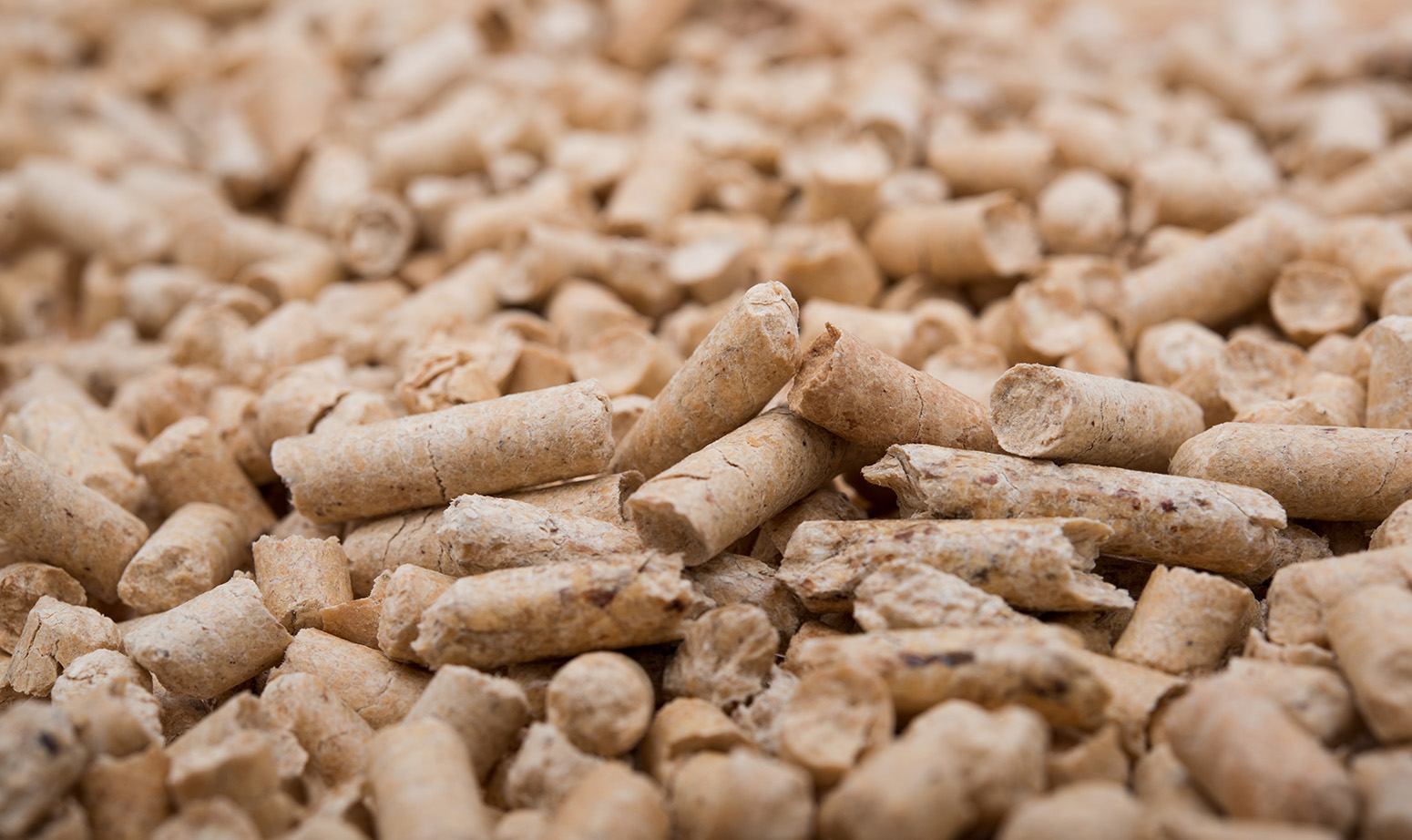
In 2016, Japan’s imports of wood pellets increased 49 percent from the previous year to 347 thousand MT.

Of these, 261,000 MT, or 75 percent, were imported from Canada, followed by Vietnam (18 percent) and China (6 percent).

According to industry sources, Canada is the leading supplier due to its competitive prices and quality. Imports of wood pellets are likely to increase in the coming years because the trend of mixing wood pellets with coal for thermal power generation is expected to continue, and the number of small and medium-scale biomass power facilities (below 10,000 kW), which use wood materials (including wood pellets and PKS) is increasing under the FIT system.

Japan has a zero import tariff for both wood pellets (HS4401.31) and palm kernel shells (HS2306.60.000).

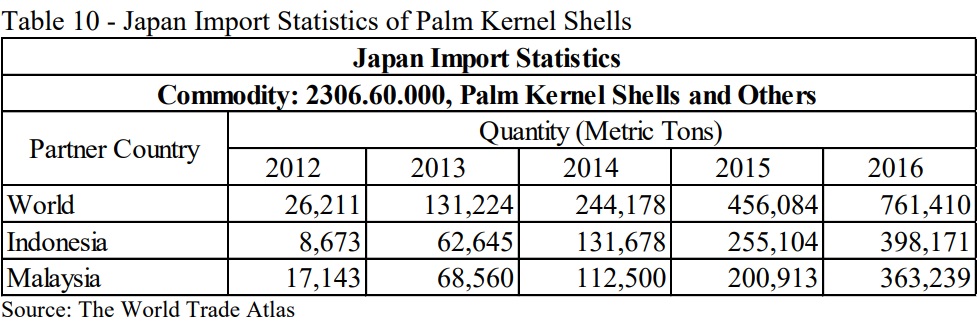
Japan’s imports of PKS are also increasing as a source for biomass power generation. In 2016, imports of PKS increased by 67 percent from the previous year to 761,410 MT, most of which came from Indonesia and Malaysia.

Japan has a zero import tariff for PKS. Imports of PKS as well as wood pellets are expected to increase for years to come.

Wood Pellet Production and Consumption

Since the GOJ’s “Biomass Nippon Strategy” was unveiled in 2002, the introduction of pellet boilers and stoves for heating in public facilities and ordinary households has expanded.

Accordingly, the number of plants and the production of pellets have increased significantly. In 2015, Japan’s production of wood pellets was 120,000 MT, and there were 142 plants.

The production of wood pellets in 2015 decreased by 4.8 percent from the previous year as demands for heating decreased mainly due to a mild winter. According to an industry source, production of wood pellets in 2018 is expected to recover to record-high 2014 levels as the use of cogeneration units running on wood pellets has started to spread across Japan.

Accordingly, moving forward, domestic wood pellet suppliers are forecasting an increase in demand. The production scale of wood pellet plants in Japan is very small compared to modern commercial plants in the United States and Europe.

About 60 percent of the plants in Japan produce a mere 100 – 1,000 MT each year. Among the 142 plants, only three plants have production capacity of more than 10,000 MT per year, and two of the three plants are producing wood pellets mainly for coal-fired power plants for mixed combustion.

In Japan, demand for wood pellets by coal-fired power plant operators is strong. The power operators rely on imported wood pellets mainly due to their price competiveness and availability.

As noted in the FY2016 Annual Report on Forest and Forestry in Japan, in order to increase competitiveness of domestically produced wood pellets, MAFF states that the production scale of the wood pellets plants must increase.

Japan is considering establishing its own standards to address concerns about environmental sustainability criteria for biomass products. Accordingly, post will continue to monitor the development of this policy plan.

Roundwood prices in Lithuania increased during May

Roundwood prices in Lithuania increased during May 2017 as compared to the corresponding period of last year.
Among the sawlogs assortments, the only price drop was for pine, that could be bought for EUR 53/m3, instead of EUR 55/m3, which was the price in May 2016. All other assortments reported price increases, especially alder, whose value went up by 9.43%, to EUR 58/m3.
Spruce and birch sawlogs increased their price in May by 3.33% and 4.34%, respectively, reaching a value of EUR 62/m3 and EUR 72/m3, respectively.
Also, the pulpwood prices followed an upward trend. Pulpwood pine increased its value by 4.16%, reaching a price of EUR 25/m3, while spruce and birch could be bought for EUR 25/m3 and EUR 27/m3 (13.61% and 8% increases, respectively).

Roadside prices of roundwood in state forests of Lithuania EUR/m³ under bark

May 2016 April 2017 May 2017 Change
May/ 2016 to May/ 2017
SAWLOGS
Pine 55 57 53 -3.63%
Spruce 60 63 62 +3.33%
Birch 69 73 72 +4.34%
Alder 53 58 58 +9.43%
Small-sized softwood 36 37 36 0%
PULPWOOD
Pine 24 26 25 +4.16%
Spruce 22 26 25 +13.63%
Birch 25 27 27 +8%

Improving Euro zone economies not lifting tropical imports

The decline in tropical wood imports into eurozone countries is surprising given evidence of improving economic conditions in the region. Growth in the eurozone picked up to its fastest pace since 2011 in the second quarter of this year, with GDP in the past 12 months rising by 2.2%.

In the three months to June the eurozone economy grew by 0.6%, matching the same healthy number from the first quarter of the year. German GDP grew by 0.6% in the quarter, Spain’s by 0.9%, France’s by 0.5% and the Netherlands by an unexpectedly strong 1.5%.

This positive trend has contributed to a sharp increase in the euro-dollar rate, from 1.05 in early January 2017 to nearly 1.20 by the end of August. It’s possible that this rise in rates is acting temporarily to discourage imports. EU buyers are often unwilling to build stock at a time when euro import prices are falling and they anticipate further price decreases in the future.

It is significant that the UK is the only major EU market where tropical wood imports held up well in the first half of 2017. UK imports increased 21% to 90,000 MT during the period.

Again, this seems to conflict with underlying economic trends. The UK grew by 0.3% in the second quarter of 2017, a significantly slower rate of increase than the major eurozone economies. Much of this growth was driven by the service sector. Industrial output shrank by 0.4% and construction contracted by 0.9% during the same period as uncertainty has mounted since the Brexit vote.

This uncertainty is also reflected in exchange rates. The British pound has weakened sharply against the euro and stayed quite flat against the dollar this year. In contrast to eurozone importers, those in the UK had an incentive to build stock in the first half of 2017 in expectation of a further weakening in the exchange rate and rising import prices later in the year. If the divergent trend in UK and eurozone imports of tropical timber in the first half of 2017 is driven mainly by short-term changes in exchange rates, then a reversal may be expected in the second half of the year - UK imports are likely to slow and eurozone imports to rebound again. However, if the downward trend in the EU tropical timber trade continues, even as economic activity recovers in the eurozone, then it will be necessary to look to more fundamental causes.

It is possible, for example, that the combined effect of increased EUTR enforcement, limited availability of independently certified or legally verified tropical timber, the difficulty of demonstrating negligible legality risk in the absence of such certification, the existence of large alternative markets where there is still little demand for such assurances, and the further development of wood and non-wood substitutes, will be a long-term and ever deepening slump in the EU market for tropical timber products.

India plans to become more self-sufficient in timber

The Indian Prime Minister is pursuing an expansion of domestic industrial wood production with the aim of raising the income of farmers and of making the country less dependent on wood imports. To achieve this he plans to coordinate the efforts of all State Forest Departments and private sector organisations.

The plan calls for the cultivation of industrial wood lots and plantations along farm boundaries as well as within the farm.

In addition to expanded farm forests the Prime Minister wants to see large scale plantations on rural nonagricultural land for example alongside roads, along railway lines and along canal banks.

The main purpose of this plan is to allow India to be more self-sufficient in wood products which will ease the import burden which today runs into billions of dollars. It is estimated that approximately 5 million hectares of lands is available for this project.

Along with encouraging planting, the government will remove current regulations that restrict felling, transport and sale of trees grown on private land.

This issue was discussed with representatives of states in a national consultation held last month. Though some States expressed reservations, citing limits on available land, most agreed to address changes to regulations and come up with plans to encourage planting.

China: Prices of main imported wood products as of June 2016

This index contains the most update prices of logs and lumbers from the two major timber distribution markets in China: 
Shanghai Furen Timber Market and Guangzhou Yuzhu Timber Market
Price information in Shanghai Furen Timber Market(source: China Timber Information Magazine) Exchange rate:1Euro=7.40 CNY
1. Imported sawntimber

 
Standard name
Local name
Specification
Grade
Origin
Prices range (Euro/m3)
 
Price range (RMB/m3)
 
Against June 2017
June price
Min
Max
Min
Max
Trend
Range
Okume
Okume
A(KD)
Africa
432.43
567.57
3200
4200
Same
3200/4200
Ebiara
Ebiara
A(KD)
945.95
1148.65
7000
8500
Same
7000/8500
Sapeli
Sapeli
A(KD)
648.65
878.38
4800
6500
Same
4800/6500
Zingana
Zingana
A(KD)
743.24
1148.65
5500
8500
Same
5500/8500
Bubinga
Bubinga
A(High mountains)
1891.89
2162.16
14000
16000
Same
14000/16000
Bubinga
Bubinga
A(Zambia)
1216.22
1351.35
9000
10000
Same
9000/10000
African Mahogany
African Mahogany
A
608.11
1013.51
4500
7500
Same
4500/7500
Makore
Makore
A
1013.51
1283.78
7500
9500
Same
7500/9500
Ayous Wawa
Wawa
FAS
486.49
581.08
3600
4300
Same
3600/4300
Ayous
FAS
540.54
608.11
4000
4500
Same
4000/4500
Beli
Beli
A(KD)
540.54
716.22
4000
5300
Same
4000/5300
Oak
Red oak
2"
FAS
N.America
1054.05
1189.19
7800
8800
Same
7800/8800
1"
FAS
702.70
878.38
5200
6500
Down
5200/6800
2"
1 com
675.68
878.38
5000
6500
Same
5000/6500
1"
1 com
540.54
662.16
4000
4900
Same
4000/4900
White oak
2"
FAS
1324.32
1621.62
9800
12000
Same
9800/12000
1"
FAS
945.95
1189.19
7000
8800
Same
7000/8800
2"
1 com
918.92
1081.08
6800
8000
Same
6800/8000
1"
1 com
608.11
810.81
4500
6000
Same
4500/6000
White Ash
White Ash
2"
FAS
945.95
1108.11
7000
8200
Same
7000/8200
1"
FAS
810.81
945.95
6000
7000
Same
6000/7000
2"
1 com
743.24
824.32
5500
6100
Same
5500/6100
1"
1 com
635.14
689.19
4700
5100
Same
4700/5100
Hard Maple
Hard maple
2"
FAS
945.95
1148.65
7000
8500
Same
7000/8500
1"
FAS
918.92
1054.05
6800
7800
Same
6800/7800
Soft Maple
Soft Maple
1"
1 com
810.81
878.38
6000
6500
Same
6000/6500
Cherry
Cherry
2"
FAS
1054.05
1283.78
7800
9500
Same
7800/9500
1"
FAS
878.38
1081.08
6500
8000
Same
6500/8000
Black Walnut
Black Walnut
2"
FAS
1891.89
2297.30
14000
17000
Down
14500/17000
1"
FAS
1486.49
1783.78
11000
13200
Same
11000/13200
Red Alder
Red Alder
JB
324.32
432.43
2400
3200
Same
2400/3200
CUS
527.03
581.08
3900
4300
Same
3900/4300
SUP
648.65
702.70
4800
5200
Same
4800/5200
Yellow Poplar
Yellow Poplar
1"
FAS
540.54
581.08
4000
4300
Same
4000/4300
2"
FAS
567.57
648.65
4200
4800
Same
4200/4800
Yellow Meranti
Yellow Meranti
A
Southeast Asia
486.49
527.03
3600
3900
Same
3600/3900
Red Meranti
Red Meranti
A
513.51
554.05
3800
4100
Same
3800/4100
Champaka
Golden teak
Assorted
Yunnan/Mynmar
945.95
1148.65
7000
8500
Same
7000/8500
Merbau
Merbau
2"
Assorted
Indonesia
945.95
1283.78
7000
9500
Same
7000/9500
Beech
Beech
AA
Europe
554.05
635.14
4100
4700
Same
4100/4700
heartwood
472.97
540.54
3500
4000
Same
3500/4000
Ash
Ash
A
Russia
702.70
878.38
5200
6500
Same
5200/6500
Elmwood
Elmwood
A
608.11
810.81
4500
6000
Same
4500/6000
Myanmar
Teak
Wooden door timber
Myanmar
4256.76
4864.86
31500
36000
Same
31500/36000
Decorative wood moulding timber
2432.43
2567.57
18000
19000
Same
18000/19000
staircase timber
2405.41
2675.68
17800
19800
Same
17800/19800
Kitchen cabinet timber
1824.32
2162.16
13500
16000
Same
13500/16000
Outdoor furniture timber
1554.05
1756.76
11500
13000
Same
11500/13000

 
Price information in Guangdong Yuzhu Timber Market

Imported sawn timber
Species
Grades
Prices range (Euro/m3)
Price range (RMB/m3)
Against June
June price
Origin
Min
Max
Min
Max
Trend
Range
North America
Cherry
FAS-2"
1351.35
1554.05
10000
11500
Up
9000/11000
FAS-1"
1216.22
1351.35
9000
10000
Up
8500/10000
White Ash
A
878.38
1013.51
6500
7500
Up
5800/7000
Black Walnut
FAS-2"
2027.03
2432.43
15000
18000
same
15000/18000
FAS-1"
1621.62
1959.46
12000
14500
same
12000/145000
AB(1"-2")
1013.51
1148.65
7500
8500
Up
7000/8000
Hard Maple
FAS
1283.78
1418.92
9500
10500
Up
9000/10000
Soft Maple
FAS
1148.65
1216.22
8500
9000
Up
8000/8500
White Oak
FAS
1081.08
1756.76
8000
13000
Up
7500/13000
Red Oak
FAS
945.95
1175.68
7000
8700
Up
6500/8300
SPF
B
243.24
256.76
1800
1900
Down
2000/2100
Pine Finland
A
378.38
405.41
2800
3000
Up
2600/2900
Africa
Makore
A (imported with original packing)
837.84
6200
Down
7000
Zingana
A
1283.78
1689.19
9500
12500
Down
10000/12500
Awora
A
783.78
878.38
5800
6500
Down
6000/6700
Mezali (big)
A
1621.62
2027.03
12000
15000
same
12000/15000
Keruing (Africa)
A
608.11
770.27
4500
5700
same
4500/5700
Sapelli
A(imported with original packing)
810.81
851.35
6000
6300
Down
6300/6500
Okume
A
500.00
567.57
3700
4200
Up
3600/4200
Ebiara
A
837.84
905.41
6200
6700
Up
5500/6000
Bubinga
A
1891.89
2094.59
14000
15500
Down
15000/16000
Acajou
A (imported with original packing)
878.38
918.92
6500
6800
Up
6300/6500
Adouk d'afric
A
810.81
878.38
6000
6500
same
6000/6500
Samba
A
608.11
675.68
4500
5000
Down
4800/5300
Europe
European Maple
A
1216.22
1283.78
9000
9500
same
9000/9500
Beech
Super class
716.22
5300
Up
5200
Southeast Asia
Nyatoh
No knot
567.57
594.59
4200
4400
Up
3600/4200
Pontianak wood
Assorted
1283.78
1418.92
9500
10500
same
9500/10500
Merbau
Super class
878.38
1013.51
6500
7500
same
6500/7500
Lauan
Super class
608.11
635.14
4500
4700
same
4500/4700
Camphorwood
Super class
675.68
810.81
5000
6000
same
5000/6000
Camphorwood
A
608.11
675.68
4500
5000
same
4500/5000
Ramin
No knot
810.81
891.89
6000
6600
same
6000/6600
Yunnan/Myanmar
Golden Teak
Super class
918.92
972.97
6800
7200
same
6800/7200
Red Cherry
Super class
810.81
851.35
6000
6300
same
6000/6300
Toon
Super class
513.51
540.54
3800
4000
same
4000/4300
Teak
Super class
1891.89
2702.70
14000
20000
same
14000/20000
Keruing
Super class
554.05
581.08
4100
4300
same
4100/4300

Italy’s use of wood pellets is forecast to reach 5 million tons by 2020

Italy is a leading European consumer of wood pellets (approximately 3 million metric tons per year), with domestic consumption representing 96 percent of total use.

According to the Italian heating market growth expectations and the national Renewable Energy Action Plan, Italy’s use of wood pellets is forecast to reach 5million metric tons (MMT) in 2020.

However, only 15 percent of domestic demand is met by domestic production, with the remaining 85 percent being covered by imports. Lombardia is the main production area, accounting for 45 percent of total supply, followed by Veneto (18 percent), Friuli Venezia Giulia (16 percent), and Trentino Alto Adige (8 percent).

In Italy, wood pellets are mainly used in small-scale private residential and industrial boilers for heating. According to the Italian Association of Wood Energy Chain (AIEL), bagged pellet (15 kilograms) represents almost the total consumption. Bulk pellet transported with silo trucks is no more than 20,000 metric tons (MT).

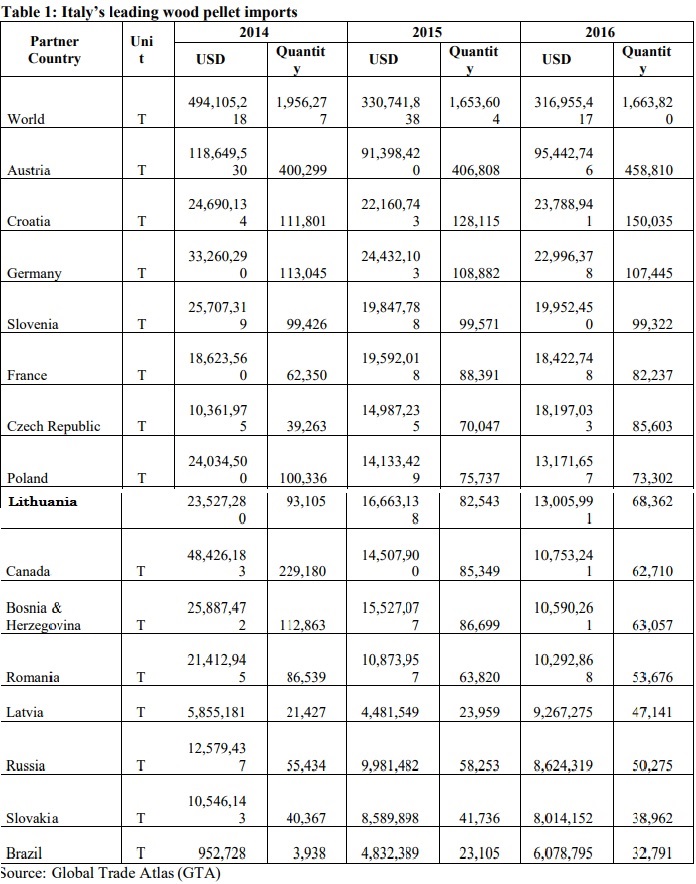
Wood pellets are mainly distributed through retail shops (i.e. hardware stores) and fossil fuel retailers. On-line sales account for only 6 percent of all retail sales. Italy is a net importer of wood pellets, with 1.6 MMT imported in 2016, mainly from Austria, Croatia, Germany, Slovenia, France, and Czech Republic.


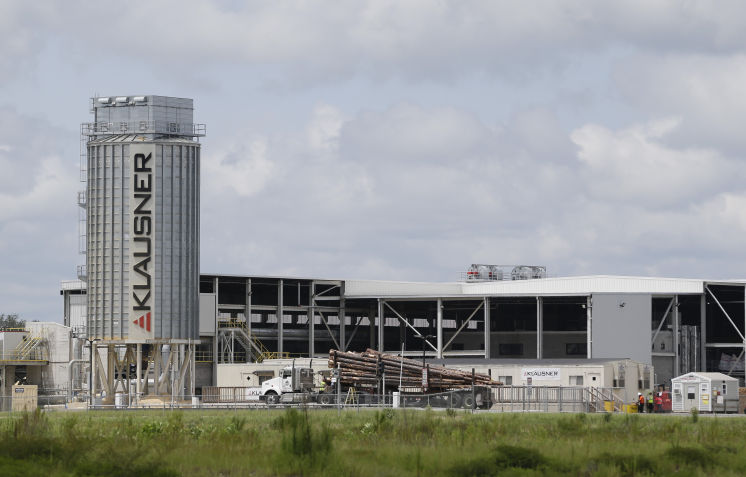
Klausner postpones opening of second lumber mill in the US

Klausner Lumber Two mill was set to open in July, but due to some programming at the machinery, that has taken longer than expected, the opening will be postponed.

Moreover, the Lumber Two mill was initially supposed to be operational by the end of the first quarter of 2017 in Enfield, but the company postponed the opening for July. At the moment, some contractors Klausner worked with were close to bankruptcy, so the company had to work something out.

President Thomas Mende, who said he visited the Enfield site on Wednesday, said the lumber mill is still finishing up. Besides the programming, Mende said the site still needs more paving and a backup boiler, The Daily Herald reported.

“We’re working very hard to get some operation going,” he said. He added he would like to have Klausner Lumber Two up and operational “ASAP.”

Once the mill becomes operational, it will start with logging, by debarking and trimming the logs, as well as sorting the pieces by diameter and length.

The first step in getting the Enfield site fully operational is setting up the log yard. The yard is where Klausner will cut and debark the logs before sorting the pieces in about 70 different diameters. Running the log yard well is important because it is the bottleneck for production.

Mende said previously the plan is to have at least 350 full-time employees. He also added that Klausner is seeking experienced electricians, mechanics and fork lift drivers, noting more and more employees will be hired just before the lumber mill begins operations.


Eacom installs continuous dry kiln at Timmins; increases annual production

Eacom Timber Corporation announced that it has successfully completed the installation of a Continuous Dry Kiln at its Timmins sawmill.

This new system is designed to accelerate the wood drying process by continuously cycling lumber through the kiln with significant energy efficiency gains. The annual capacity of the sawmill will increase to 160 million board feet because of this technological upgrade.

"Eacom has been consistent in its strategy of growth and continuous improvement. This investment demonstrates our commitment to the Timmins sawmill," said Kevin Edgson, President and CEO of Eacom.

Eacom rebuilt the Timmins sawmill with 20% more capacity and state-of-the-art technology following a 2012 fire. Again in 2015 and 2016, the company invested in the installation of a new lumber grading system and planer mill enhancements.

Eacom Timber Corporation is a major Eastern Canadian wood products company. Operations include the manufacturing, marketing, and distribution of lumber and wood-based value-added products, and the management of forest resources. The company currently owns seven sawmills (five in Ontario, two in Quebec), a remanufacturing facility (Quebec), and an engineered I-joist plant (Ontario).

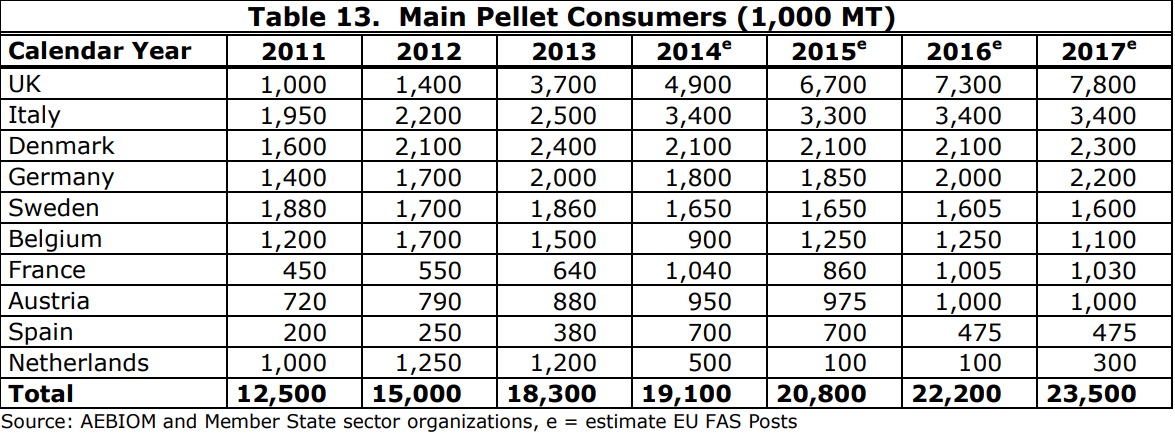
European Union wood pellets consumption reached 22.2 MMT in 2016

The European Union countries produce approximately 50% of the wood pellets worldwide. Yet, the EU demand represents about 75% of the market.

In 2016, total EU consumption was 22.2 MMT of which about 65 percent was used for heating and 35 percent for power. The major users of wood pellets in the EU are the United Kingdom, Italy, Denmark, Germany, Sweden, Belgium, France and Austria.

Residential Use of Pellets

Residential use for heating, about 40 percent of the total pellet market, is a relatively stable market compared to industrial heat and power generation.

However, the past four winters have been relatively mild and coupled with the low prices for fossil inputs, tempered the use of pellets for residential heating. In Italy, Germany, France and Austria pellets are mainly used in small-scale private residential and medium-sized industrial boilers for heating.

In some MSs, such as Sweden, Germany, Austria, France and Spain, household heating with biomass as input receives subsidies or tax deductions by the federal and local governments. In most countries, however, government funding is limited.

Italy is forecast to be the largest European market for the household use of pellets. According to the National Renewable Energy Action Plan statement, the use of pellets will increase further to 5 MMT in 2020.

However, only 15 percent of the demand is met by domestic production, with the remaining 85 percent being covered by increasing imports. Currently, Italy sources pellets mainly from Austria, Croatia and Germany. Since 2015, imports from the United States have fallen significantly, due in part to a warm winter and the higher price of U.S. wood pellets over European competitors. But market logistics and economics indicate that in the close future imports from North America will recover.

Industrial Use of Pellets

Use of pellets for energy generation by medium-sized industries or public buildings such as hospitals and swimming pools is generally less dependent on weather conditions. Demand for industrial pellets depends primarily on EU MS mandates and incentives.

In markets such as the United Kingdom, Belgium, and the Netherlands residential use is negligible and the demand is dominated by large scale power plants. The large scale use of wood pellets by power plants is driven by the EU mandates for renewable energy use in 2020.

The governments of these countries opted to fulfill their obligations mainly by the use of biomass for the generation of electricity. As these countries lack a sufficient domestic production of pellets they largely dependent on imports.

The UK Government enforced the EU Industrial Emissions Directive, by requiring major electricity suppliers to convert from coal to renewable feedstock by 2015. This boosted consumption from 1.4 MMT in 2012 to 7.3 MMT in 2016. The market will continue to increase for wood pellets in the near-term. The conversion of an additional large electricity generator capable of using 1.5 MMT of wood pellets in the place of coal is set to be completed by the end of 2017. Existing capacity is expected to reach full operation in the next year. Another plant with a capacity of 1.0 MMT is expected to be operational in 2019.

Sweden and Denmark have a high target for renewable energy use in 2020, 49 and 30 percent respectively. Both goals have already been reached, with a major part obtained from biomass. In Sweden pellet consumption declined during the past four years. Explanations are relatively warm winters and the declining prices of fossil inputs. During 2012 – 2016, Danish consumption of pellets stagnated around 2.1 MMT but as another CHP plant has been converted to using pellets, use is expected to grow in 2017.

Finland has a target of 38 percent for renewable energy use in 2020. A large share is covered by the use of wood chips, but only a limited portion is wood pellets.

Current Belgian industrial use is estimated at about 1 MMT to 1.3 MMT per year. However, the closing of a power plant in Ghent scheduled for 2018 would imply a reduction in imports into Belgium of between 500,000 MT and 600,000 MT annually. A recovery of pellet consumption is unlikely as the Belgian government retracted funding for two new plants. In addition, the license of a power plant in Wallonia, which uses between 400,000 MT and 500,000 MT of wood pellets annually, will expire in 2017.

In the Netherlands, demand for industrial pellets has been uncertain due to stringent Dutch sustainability requirements. In the Dutch Energy Accord co-firing of biomass is capped annually at about 3.5 MMT of wood pellets. In the Accord it was furthermore decided that biomass will be subject to specific sustainability criteria. It is still uncertain what the implications of this will be for the sourcing of pellets. Apart from the Dutch power sector, the Dutch chemical sector is planning to use wood pellets on the longer term. The Dutch use of pellets is expected to gradually increase as of mid-2017.

Also in France, there is a potential for industrial use of pellets. There is pressure from the local forest sectors to use local wood, but demand is gradually outpacing domestic supply. Some new bioenergy projects are located close to harbors and are already using imported pellets.

Besides wood pellets, large quantities of wood chips and briquettes are used. The EU sector estimates the current EU consumption of wood chips at 15-20 MMT and expects it to grow to 28 MMT in 2020. Growth in demand is supported by increased investments in medium sized combined heat and power (CHP) plants. The main wood chips consuming EU MSs are: Germany, Finland, France, Sweden and Poland. Most chips are sourced locally, but Scandinavia is regarded as a potential growth market for imports from non-EU destinations.

The International Hardwood Conference to be organized in Venice; 15-17 November

After the success of the last edition, the International Hardwood Conference 2017 will be organized from 15 to 17 November in Venice, one of the most fascinating cities in the world.

The International Hardwood Conference, which is jointly co-organized by the European Timber Trade Federation (ETTF)and the European Organization of the Sawmill Industry (EOS), is the only international event which provides a global and exclusive vision of the production and trade of hardwood lumber; the Conference attracts the industry's most significant key stakeholders, thus providing a unique opportunity to network with a vast and high-level audience.

A large attendance of delegates from over 20 countries - representing businesses, NGOs, industry media and the most important international associations - is expected to participate in the Conference.

On November 16, 2017, in the charming venue of the Molino Stucky Hilton Venice, several qualified speakers will provide in-depth analyses of the most relevant international trends in the hardwood sector. The Conference will be divided into two sessions: the first one will zoom in on sector figures, analyzing the market in detail, while the second one will give suggestions and food for thought to entrepreneurs who are confronted with the issues of sustainability, legality, technology and innovation.

Courtesy of this outstanding programme, Venice will become for some days the capital of wood, emphasizing the strong connection between the city and this precious material.

Newsletter

Subscribe to our digital newsletter for your daily digest of essential news, views and analysis from the international wood industry delivered directly to your inbox.


0