Article archive

This year’s ISC forecasts softwood lumber market growth throughout 2018

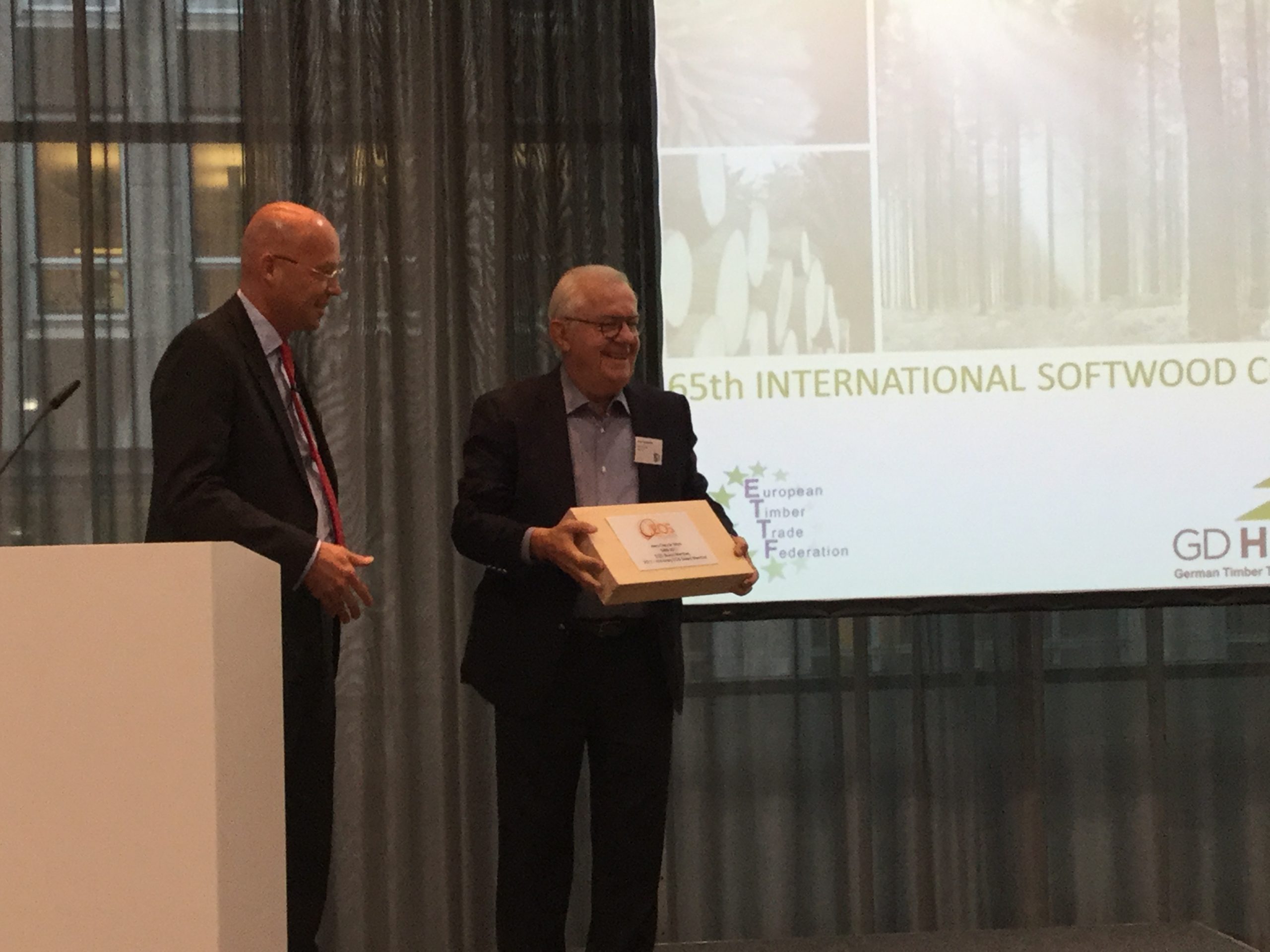
On the 5th and 6th October 2017 the 65th edition of the International Softwood Conference was held in the facilities of the hotel Sofitel Hamburg Alter Wall.

This year's conference was attended by about 150 participants from all over the world and it was hosted by the GD Holz/German Timber Trade Federation, and by the European Organization of the Sawmill Industries (EOS) and the European Timber Trade Federation (ETTF).

The Conference opened with the traditional market analyses provided by authoritative experts in the sector. The development of production and consumption suggests that the moderate growth which was observed in 2017 is expected to continue into 2018.

In Europe, the situation can be described as positive with most markets on the rise.

Mr Andreas von Möller, President of ETTF, provided a comprehensive overview of the construction activity in Europe, showing that the confidence index is going up and the production index has reached the highest levels since 2010.

The European markets are solid and reliable. Mr Sampsa Auvinen, President of EOS, underlined in his presentation that the European demand is expected to continue to increase. A buoyant construction activity, along with a growing awareness of the benefits of using wood in construction, is indeed pushing up European demand to the highest levels of this decade.

While the European markets remain the traditional destination of European production, a promising trend is the increasingly important role played by extra-European exports for the European industry.

The area of the world which stands out is Asia, particularly China, which is booming. Japan as well remains an important export destination for many European sawmills. The US market is also dynamic as housing starts reached their highest level for some years.

Therefore, the picture at global level is quite rosy. The long-term potential of the market is impressive as per capita consumption in some of the fastest growing countries in the world is still very low compared to North America and North European countries.

However, a possible source of instability is the British market. The uncertainty around Brexit could take its toll on the British economy, which could result in decreasing import volumes. But stakeholders emphasized that the high demand of other regions would be able to make up for a possible drop of exports to the UK.

Another important challenge is connected to raw material availability: in the medium-term there could be some more significant shortages which could negatively impact on the industry. Raw material mobilization will thus play an increasingly relevant role.

These themes were thoroughly discussed also during the panel discussion in which high-level stakeholders coming from different countries - such as Denmark, Austria, the United Kingdom, the Netherlands, France, and Latvia - also emphasized the growing importance of education: the enormous potential of wood in construction will be fully tapped if awareness of the properties of timber will be spread among architects and builders. To this end, targeted promotional campaigns are important.

In sum, the moderate economic growth which is taking place in Europe is expected to continue into 2018 and will have a positive impact on the timber market in the EU. Dynamic export markets are also a cause for optimism. However, the industry needs to remain vigilant in a competitive landscape characterized by growing complexity.

The next edition of the International Softwood conference will take place in Latvia’s capital Riga in October 2018.
Polish furniture exports up by 7.7%

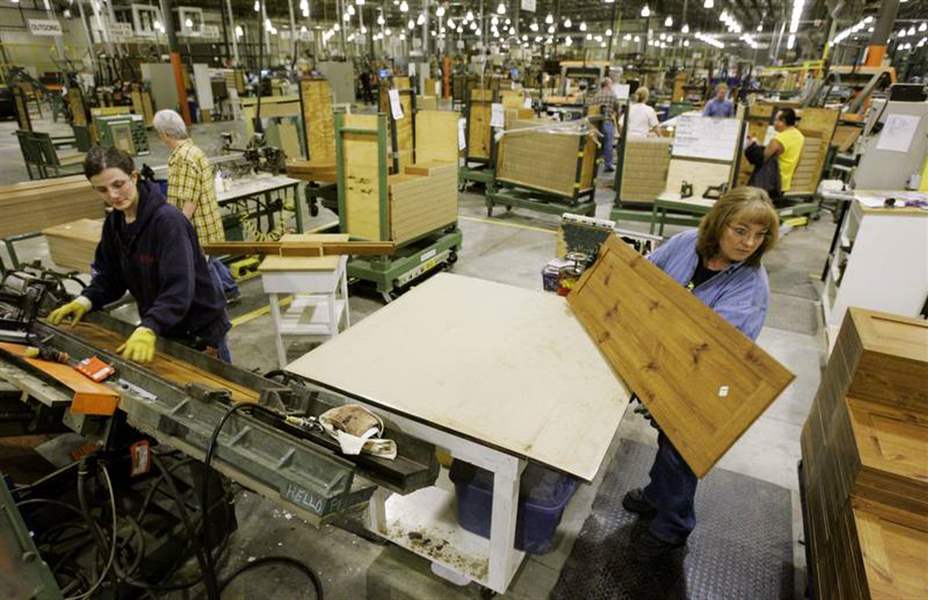
During the first half of 2017, Polish furniture exports rose by 7.7%, to 1.72 million tonnes, as compared to the same period last year.

According to a survey conducted by the market research institute CAB, the export of bedroom furniture increased the most, by 15.9%, while the value of it went up by 12.7%.

All of the exported furniture's value rose by 6.4%, over the same period and all of the nine sectors in the furniture industry reported increase in the value of exports. Eight of the sectors also reported increase in volume.

The bedroom furniture is followed by upholstered furniture, as well as living and dining room furniture. For both, the export value rose by almost 7.5% and the export volume by about 12%.

Polish furniture manufacturers export to more than 160 countries. In 68 countries, sales exceed one million euros and most of the furniture is exported to the EU. The main destination of Polish furniture is Germany, with a turnover of 1.4 billion euros or 36.6% of all exports. Exports to Germany increased by 4% in the first half of 2017.

France comes in second place (EUR 263 million, + 1.3%), followed by the United Kingdom (EUR 252 million, + 0.7%) and the Netherlands (EUR 231 million, + 7.1%).

European softwood lumber exports to China see 43% increase during 1H/2017

The value of the European softwood lumber exports to China has increased by 43% during the first half of 2017, as compared to the same period last year. 

Europe has thus exported 1,77 million m3 worth of softwood lumber, to China, as compared to 1,23 million m3 in 2016. The biggest exporter was Finland, with 953,697 m3 worth of lumber, followed by Sweden and Germany.

All the exports have increased in value, as following: Finland - 66%, Sweden - 20%, Germany - 20%, Austria - 93%, Latvia - 168%, while other EU countries increased their softwood lumber exports to China by 5%.

EU- Softwood lumber exports to China in cbm January-August 2016 January-August 2017 Change in %
EU-Total 1,238,185 1,775,167 43%
Finland
574,045 953,697 66 %
Sweden
405,111 485,037 20 %
Germany
84,762 101,889 20 %
Austria
28,233 54,524 93 %
Latvia
16,160 43,250 168 %
Others
129,874 136,214 5 %
OTHER European Countries
- 556  %
Source: Eurostat (HS 440710)

Chinese company to build office furniture component plant in Michigan

A Chinese office furniture manufacturer has announced an investment of US$4.9 million in Michigan to build a new plant. J-Star Motion Corp. will produce linear motion and lifting systems for the office furniture industry.

The company already opened office and warehouse facilities in Michigan earlier this year. Its parent company is Jiecang Linear Motion Technology Co. in Xinchang, China.

Another notable recent investment was a plant in Oregon for custom cabinet boxes. Cabinotch Innovative Solutions, owned by Columbia Forest Products, opened a new factory in August that produces custom frameless cabinet boxes for custom cabinet shops. US-made hardwood plywood is utilized for the cabinets.

Cabinotch plans to eventually have ten regional factories across the US. According to the company, their fast custom production process help small cabinet shops compete with mass produced and low-cost cabinet imports.

European Organisation of the Sawmill Industry held its GA in Hamburg

On 4 October 2017, the EOS General Assembly was held in the framework of the International Softwood conference (2017 ISC) in the city of Hamburg.

On this occasion, the EOS Members unanimously elected Mr Jean-Claude Sève, Honorary Board Member after he has been an active EOS Board Member since 1989.

EOS Members lively discussed the aspects related to the Proposal for a Regulation of the European Parliament and of the Council on the inclusion of greenhouse gas emissions and removals from land use, land use change and forestry into the 2030 climate and energy framework.

The EU Parliament’s recognition of harvested wood products as a beneficial material for the environment was welcomed by the EOS general Assembly.  It is of utmost importance that the amendment adopted by the Parliament “HWPs can substantially limit emissions by the substitution effect (considering the energy and CO2 intensity of other sectors, e.g. cement production accounts for roughly 8% of global CO2 emissions), and enhance removals of greenhouse gases from the atmosphere. The accounting rules should ensure that Member States accurately reflect in accounts the changes in the harvested wood products pool when they take place, in order to recognise and incentivise the enhanced use of HWPs with long life cycles rather than the use of harvested wood products for energy purposes” will remain in the final text of the legislation that will be discussed in the following weeks during the interinstitutional negotiations. Moreover, the EOS Members emphasized once more that forest reference levels should be aligned with continuation of sustainable forest management as defined and commonly agreed by European countries and the European Union within the Forest Europe process.

Looking at the market, the EOS Members underlined the negative economic impact (-90% in Q2 2017 vs Q1 2017) caused by the licence system introduced in April 2017 by the Algerian Government for all wood products covered in the HS code from 4407 to 4412. They called for a lift of the system and if this is not possible in the short-term they hope to have more clarity and a swift allocation of the licenses. The outcome of the Economic Partnership Agreement with Japan was considered positive thanks to the progressive phasing-out of tariffs over a 7 year-period.

Discussing the revision of the renewable energy Directive and the correlated sustainability criteria for solid biomass, the Members emphasised that the production of bio-energy is definitely an integrated part of the sawmill business although regional differences entail specific considerations depending on the Country.

A buoyant market raises medium-term questions in terms of raw material availability, which is one of the reasons why the EOS Secretariat will actively participate in a conference on the SIMWOOD project dedicated to wood mobilisation, that will be organised in Paris on 12 and 13 October. Reaching the small forest owners results as essential aspect on wood mobilisation.

The next EOS General Assembly will be held on 15 June 2018, in the city of Oslo and hosted by the EOS member Treindustrien.

Biggest gains in EU imports of wooden furniture are from temperate countries

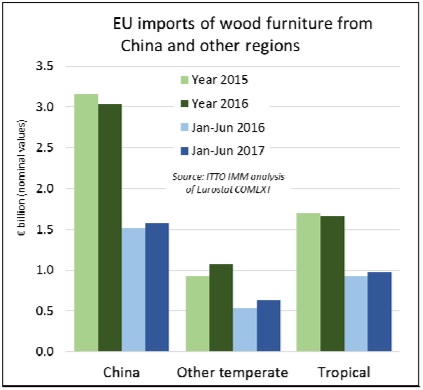
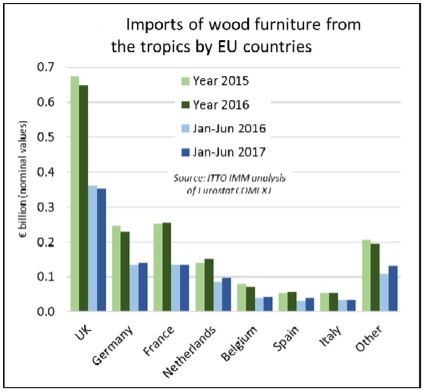
After slipping back last year, EU wood furniture imports from tropical countries and China recovered some lost ground in the first 6 months of 2017. EU imports from tropical countries increased 4.5% to Euro970 million, while imports from China increased nearly 5% to Euro1.58 billion.

However, the biggest gains in EU imports of wood furniture this year are from other temperate countries, mainly bordering the EU such as Bosnia, Turkey, Switzerland and Ukraine. EU imports from these countries increased 20% to Euro630 million in the first 6 months of 2017, building on a 14% gain recorded the previous year. (Chart 4).

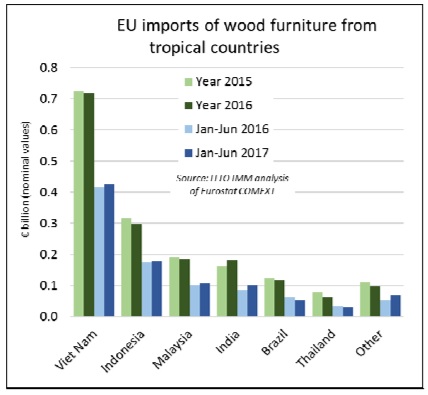
The share of the various tropical countries in supply of wood furniture to the EU has varied quite widely this year. After falling 2% to Euro716 million in 2016, EU imports from Viet Nam rebounded 3% to Euro427 million in the first six months of 2017.

Imports from Indonesia also increased during the period, but by only 1% to 178 million m3, not sufficient to recover ground lost in 2016. Imports from Malaysia recovered more strongly in the first half of this year, rising nearly 8% to Euro108 million.

Imports from India have also continued to rise, up 18% to Euro103 million during the six-month period. (Chart 5). There were also significant shifts in the destinations for furniture exported into the EU from tropical countries in the first half of 2017. The UK imported Euro353 million of wood furniture from tropical countries between January and June 2017, 2% less than the same period in 2016.

Imports of tropical wood furniture in Italy also declined, by 4% to just Euro33 million, a sign that the recent surge in Italian furniture consumption has not been to the benefit of tropical suppliers.

However, all other leading EU furniture markets imported more furniture from tropical countries in the first 6 months of 2017 compared to the same period the previous year. Imports increased 3% to Euro139 million in Germany, 1% to Euro134 million in France, 16% to Euro99 million in the Netherlands, 4% to Euro43 million in Belgium, and 30% to Euro42 million in Spain.

European destinations for wood furniture imported from individual tropical countries have shifted this year. A significant decline in UK trade with Viet Nam in the first half of 2017 was offset by rising Viet Nam trade with a wide range of other EU markets including Sweden, Spain, France, Poland, Denmark, Ireland, Greece and Austria.

A decline in UK, French and Swedish imports from Indonesia, was compensated by a rise in Indonesian trade with Spain, Netherlands and Ireland during the six-month period. Malaysia exported less to Sweden and Germany, but increased sales to the UK, Poland and Ireland. The rise in EU imports from India this year is mainly concentrated in the UK, Netherlands and Germany.

Softwood lumber more expensive in Austria this fall

In September, softwood lumber has become again more expensive in Austria by about EUR 1-2 cbmCompared to the previous year, mainly reserved squared timber is much more expensive.
Conversley, edged and rough boards are on a downward trend. For edged boards, the upper price limit has decreased, meanwhile for rough boards, the upper price limit has remained constant, but the lower limit has declined EUR 1 / cbm.

Softwood Lumber Spruce/Fir Sep. '16 Aug. '17 Sep. '17 Change Sep. '16 to '17
€ / cbm EXW
Edged Boards, 0-IIIa, 23 mm + 229-244 231-245 231-243 +2 / -1
Rough boards in fixed dimensions, 18-22 mm 229-241 230-239 229-239 - / -2
Squared timber, standard dimensions, I/II, 4-6 m 207-216 210-218 211-218 +4 / +2
Reserve squared timber, II/III 149-157 154-161 155-162 +6 / +5
Boards, III-IV, 8-16 cm, 4-6 m 144-151 146-153 147-154 +3 / +3
Boards, III-IV, 8-16 cm, just 4 m 146-152 148-154 149-155 +3 / +3
Boards, III/IV, 23 mm, 4-6 m 146-152 149-155 150-155 +4 / +3
Boards, III/IV, 28 mm +, 3-6 m 155-163 155-162 156-164 +1 / +1

Vietnam’s timber product exports might hit $8 billion in 2017

Vietnam's exports of wood and timber products is forecast to reach US$8 billion in 2017, representing a 17% y-o-y increase and surpassing the target of $7-7.5 billion set earlier this year.

Nguyen Ton Quyen, vice chairman and General Secretary of Viet Nam Timber and Forest Product Association (VIFORES), said the impressive growth rate in the first nine months boosts prospects of the wood sector achieving its target.

According to Vietnam Net, the sector earned $5.9 billion in export revenue from January to September, increasing 11 per cent from the same period last year. The wood export turnover reached some $700 million a month

Particle boards, artificial wood boards, melamine-faced chipboards (MDF) and wood pellets were the most exported wood products from Vietnam, until now.

The $8 billion industry target might be achieved by the end of 2017, as the last three months of the year are generally the peak season for wood and wood product exports. Wood exports grew in most traditional and key markets, such as the US, Japan, the EU, China and South Korea. The value of exports to the five markets makes up nearly 90 per cent of the total, said Quyen.

In May 2017, after a six-year negotiation process, Vietnam initiated the Vietnam-EU Voluntary Partnership Agreement (VPA) on the EU Forest Law Enforcement, Governance and Trade (FLEGT).

As reported by Vietnam Net, Quyen said that the implementation of this agreement in Vietnam will ensure all wood products on the agreed list are legal. The document could create fundamental changes for Vietnam’s wood processing sector, as well as domestic and export markets, including nations supplying wood material to Vietnam and those buying wood and timber products from Vietnam.

Yet, the country is now facing some challenges, as the short supply of raw wood. Vietnam imports $1.7-$1.8 billion worth of wood material, which is equivalent to about 20-30% of the export turnover.

Xuan Phuc, an expert from Forest Trends, said Vietnam’s export turnover of wooden products has been stable since 2015. However, Phuc said, the biggest challenge for the expansion of the wood sector was competition in raw wood purchase. China’s ban on natural forest logging, and restrictions imposed by Vietnam and other countries on the trade, exploitation and export of raw wood have limited supply globally.

He added that some of Vietnam’s major wood and wood product importers such as the US, Australia and the EU demand to know the legal origin of wood. This means wood must come from forests grown under sustainable forest management standards of the Forest Stewardship Council (FSC) and must be imported from non-risk sources, Vietnam Net reported.

Also, because South Korea and Japan are also planning to tighten the management of imported wood products, this would directly impact the country's exports to those markets.

The South Korean government will require importers to declare the legality and origin of wood and wood products imported into the country starting in late 2017, while Japan will do the same in March 2018.

Vietnamese wood processors and exporters must therefore devise solutions and long-term strategies to reduce risks and boost export growth. Local processors should choose clean raw wood to meet importers’ requirements, he said.

Binderholz on the road to becoming Europe’s largest lumber producers

Recently, Austrian Binderholz Group located in Fügen has closed an agreement with The Carlyle Group to take over the German sawmill- and wood processing company Klenk Holz AG located in Oberrot.

Binderholz acquired Klenk Holz AG on 28 September 2017 and plans to expand and modernize the three Klenk locations Oberrot, Baruth and Wolfegg in the short term.

In Oberrot, Klenk Holz AG was producing lumber, solid wood panels, softwood lumber, multi-purpose panels, garden wood, solid construction timber, moulded pallet blocks, moulded wood pallets and waste timber, exporting about 30% of its products.

With this acquisition, the Binderholz Group will become one of largest producers of lumber in Europe, with seven sawmills in Austria, Germany and Finland, producing over 2 million m3 of solid wood products produced from 3 million m3 of lumber.

Now, Binderholz has 12 locations. 5 in Austria: Fügen, Jenbach, St. Georgen, Hallein and Unternberg - five in Germany: Kösching, Burgbernheim, Oberrot, Baruth and Wolfegg and 2 in Finland: Lieksa and Nurmes. Over all, around 2,530 people work in the company.

Besides Klenk Holz AG, this year, Binderholz bought Anaika Wood Group’s assets in Lieksa / Kevätniemi, whose acquisition was closed in March. The company bought  the entire machine park of Anaika consisting of 2 machine lines, a finger-jointing machine, a band saw, a press brake, a stacking machine and drying chambers.

The planing mill has a production capacity of 220,000 m³, and 50,000 m³ of laminated beech in three-shift operation per year and this represents a processing quantity of planed and glued solid wood products in the binder group of approx. 1.2 million m³ per year.

Also, last year, Binderholz bought 100% of shares in Vapo Timber Oy from Vapo Oy and the two sawmills operated by the company in Lieksa and Nurmes. The two sawmills produced 400,000 m³ of dimension lumber per year and had sufficient room for expansion with future investments.

Binderholz thus became a leading European timber materials producer. At its 5 Austrian sites and the two Bavarian sites (Koesching/Interpark and Burgbernheim/Neustadt an der Aisch) it employes around 1200 people.

The company’s range of solid wood products includes dimension lumber, surfaced lumber, solid wood panels edge glued and 3-ply, glulam beams, binderholz CLT BBS and pellet and briquet.


Lumber prices in the US on an upward trend

Many framing lumber prices in the US kept a steady growth during the end of September and the first week of October 2017. 
Some prices gained more sharply, with 2x6 in any grade of dimension and in studs often leading the way. Notable laggards were 2x4 studs, with prices of some species and trims holding at best.
Low grade also lagged, with spreads between Utility/#3 and #2/#2&Btr widening. With #2/#2&Btr dimension setting the pace, the Random Lengths Framing Lumber Composite rose to $440.

Week
Oct 6
Week
Sep 29
Year Ago
2016
Random Lengths Framing Lumber Composite Price* $440 $436 $358
KD Western S-P-F #2&Btr 2x4 R/L Mill Price 436 429 325
KD Eastern S-P-F #1&2 2x4 R/L, delivered Great Lakes 546 536 414
Green Douglas Fir Std&Btr 2x4 R/L (Portland) 472 472 332
Southern Pine (Westside) #2 2x4 R/L 427 418 431
KD Coast Hem-Fir #2&Btr 2x4 R/L 465 460 330
Ponderosa Pine (Inland) #2&Btr 1x12 R/L 690 685 670
* Weighted average of 15 key items

Random Lengths Panel Market Report
Structural panel prices continued to go up, while the demand for OSB was highly mixed across North America, with markets in the eastern half of the continent drawing much of the interest.
This led to loads from Western Canada shipping to non-traditional markets such as Eastern Canada and the Northeast. Despite a slower sales pace in Southern Pine plywood, steady demand supported firm to slightly higher prices of rated sheathing. Western Fir plywood sales were steady, but the pace dropped a notch.

(f.o.b. mill prices) Week
Oct 6
Week
Sep 29
Year Ago
2016
Random Lengths Structural Panel Composite Price* $536 $528 $375
Southern (west-east) 15/32-inch 3-ply rated sheathing plywood 507-528 507-525 355-380
Southern (west-east) 15/32-inch 4-ply rated sheathing plywood 512-530 512-527 360-390
Western 1/2-inch 4-ply rated sheathing plywood 525 525 385
North Central 7/16-inch Oriented Strand Board 452 448 287
*Weighted average of 11 key items

China now the first world buyer of Finnish softwood lumber

Finland’s softwood lumber exports grew by 7% during the first half of 2017, as compared to the same period last year. The Finnish sawmills exported a total of 4,83 million m3 of planed and sawn lumber, against 4,53 million m3 exported during the first half of 2016.

The main destinations for the Finnish softwood lumber were the European Union and Asian countries. Thus, exports to the EU amounted to 1,76 million m3, 7% more than in 2016, while the Asian countries imported 1,55 million m3, 40% more than in January-August 2016.

The main European buyer of Finland's lumber was the United Kingdom. Its imports grew by 8%, to 469,078 m3, against the 434,932 m3 imported back in the first 6 months of 2016. Among the EU countries, France was the only one to report a negative development, as its softwood lumber imports from Finland decreased by -4%.

The Asian market developed very well during the first half of the year, as exports to China grew by 66%, reaching 953,697 m3, from 574,045 m3 in January-August 2016. Also, exports to Japan increased by 4%, to 483,856 m3.

Egypt’s imports decreased by -21%, but the country was still Finland’s main softwood lumber buyer during January-August 2017.

Finland's exports of softwood lumber (in cbm); Top 10 Destinations
H1/2016 H1/2017 Change in %
China 574,045 953,697 66%
Egypt 761,541 604,604 -21%
Japan 464,739 483,856 4%
United Kingdom 434,932 469,078 8%
Germany 249,728 266,899 7%
France 275,683 264,531 -4%
Israel 239,302 230,645 -4%
Saudi Arabia 247,425 217,289 -12%
Estonia 131,070 178,609 36%
Algeria 242,415 151,041 -38%
Netherlands 138,109 145,698 5%
Total exports 4,533,362 4,837,274 7%

The statistics are based on the numbers published by Eurostat. HS Code: 440710.


Drop in US plywood imports from China

Hardwood plywood imports were almost unchanged in July at 207,604 cu.m. Year-to-date imports were 6% higher than in July 2016.

The value of plywood imported in July increased 5% from the previous month to US$146 million.

Plywood imports from China have tumbled since the US introduced preliminary antidumping duties on Chinese hardwood plywood. In July only 49,820 cu.m. of hardwood plywood were imported from China, down 41% from June. Year-to-date imports from China declined 5% compared to July 2016.

Plywood imports from Indonesia soared in July. Imports more than doubled from June to 49,904 cu.m. Malaysian plywood shipments to the US increased to 14,001 cu.m. in July.

Hardwood plywood imports from smaller suppliers such as Cambodia and Brazil also grew in July to help make up for drastically lower imports from China.

US home builders worried about effect of hurricanes on cost of building materials

Residential construction was almost unchanged in August at a seasonally adjusted annual rate of 1,180,000, according to the US Department of Housing and Urban Development and the Commerce Department.

Housing starts were 1.4% higher than in August 2016.

Single-family home construction was slightly up in August, while multi-family starts declined from July. In the next months the building market will be affected by rebuilding and repairing homes that were damaged by hurricanes.

Regionally home construction rose in the US Midwest and West in August. Housing starts fell in the South and Northeast.

Builders’ confidence in the market for new single-family homes fell in September, while the August reading was revised downward. According to the National Association of Home Builders, the hurricanes have deepened builders’ concerns about the cost of building materials and labour availability.

Once the rebuilding of homes begins confidence in the housing market is expected to go back up to the high levels seen earlier this year

‘Top 200’ account for nearly a quarter of world furniture production

Of the world’s 200 top furniture manufacturers, 40% are headquartered in the EU, 22% in North America, 31% in Asia Pacific, 2% in South America, and 2% in central Eastern Europe, Russia and Turkey.

The “Top 200” account for around 23% of total world furniture production, indicating a relatively low degree of concentration in a sector which continues to be dominated by smaller enterprises.

These are key conclusions of a new report on the Top 200 published by CSIL, the Italian furniture industry research organisation.

The report also highlights that around 65% of the Top 200 are involved only in manufacturing and the remaining 35% operate both as manufacturers and retailers.

The share of companies that directly manage retailing activities increases with the size of the company.

The share is highest in the upholstered market segment and lowest in the office and kitchen segments which tend to be more dependent on other channels such as contract sales and direct sales to building companies.

The Top 200 have an average turnover per employee of USD178,000 per year, with the larger companies generally having higher levels of productivity. This is due partly to their greater investment in R&D and production machinery, and a greater propensity to operate via subcontracting and specialist production units.

The report notes that total world furniture production was worth about USD 400 billion in 2016, a slight gain on 2015, but marginally down on 2014. However, in recent years, world furniture trade has been growing faster than production with greater concentration in low-cost manufacturing hub locations.

The Top 200 are gradually increasing their share of global production and sales. In 2016, the turnover of the Top 200 was 17% higher than in 2011, rising year-on-year more rapidly than the market as whole.

Advantage Trim & Lumber acquired new sawmill in Brazil

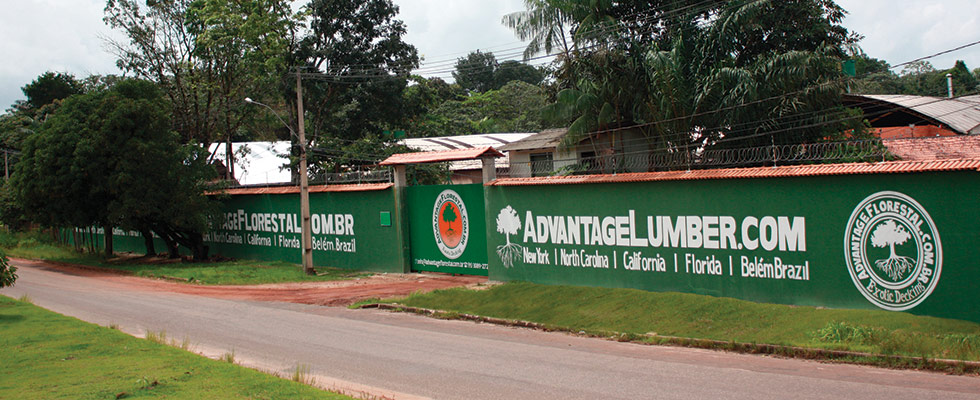
Advantage Trim & Lumber Company has recently purchased a new sawmill in Brazil, located just a few miles up the river from the company’s existing kiln-drying and processing plant.

As the company’s vice president, Betty Pelc, said, the new sawmill will be named Lumber Queens.

The facility will be overseen by the company’s South American division director Viviane Peixoto, and exports will be handled by the company’s US-based import/export manager Vanessa Carrano.

The new facility houses two separate sawmill lines that will process a combined 34,000 board feet of hardwood lumber per shift. There’s a port for receiving barges carrying up to 850,000 board feet of logs at a time. The grounds will include a 10-acre log yard that will stockpile up to 3 million board feet of logs, allowing production to continue throughout the rainy season.

The rough-sawing facility will employ 40 local workers in addition to the 120 employees at the company’s existing kiln-drying and finish mill. Advantage will also hire additional support staff in their US corporate office for handling the new sales and administration duties.

The company is working to obtain FSC certification for its new sawmill. This will complement the existing certification for all of Advantage’s other facilities.

The new sawmill will provide rough blanks for processing at the company’s kiln-drying facility, where it produces exotic decking, deck tiles, hardwood flooring, beams, live-edge slabs, turning blanks, industrial lumber, cabinet-grade hardwoods, and other FSC certified wood products.

All of the material processed at the facility is responsibly harvested from well-managed forests. Advantage works with hundreds of species. At this new facility, the company will process, jatoba (Brazilian Cherry), ipe, cumaru, massaranduba, angelim, lacewood, bloodwood, purpleheart, tigerwood, garapa,andiroba, taurai, tatajuba, itauba, quaruba, cambara and several other lesser-known species.

For stabilizing and drying this vast array of hardwoods, the company uses a combination of 15 different high-tech vacuum kilns, dehumidification kilns, and traditional steam kilns with a drying capacity of more than 600,000 board feet.

Advantage Trim & Lumber is the fastest-growing supplier of sustainable harvested hardwood decking, flooring, and lumber, and was one of the first to sell wood products online. Advantage is currently scouting sites for future locations in North America and Europe, and is considering various acquisitions of existing companies.

Finnish roundwood prices mostly up during August

The roundwood prices in Finland went up during August 2017, as compared to the same period last year.
The price for pine sawlogs amounted to EUR 57.84/m3, 1.52% more than in August 2016, while spruce could be bought for EUR 60.06/m3, 3.65% more than last year. At the same time, birch logs cost EUR 49.96/m3, a 8.89% increase as compared to August last year.
The only price to go down was for pine pulpwood, which decreased by -0.75%, to EUR 27.72/m3, while the prices for spruce and birch pulpwood increased by 1.18% and 0.42%, respectively.

August 2016 July 2017 August 2017 Change in % August 2016-August 2017
Pine logs 56.97 58.74 57.84 +1.52%
Spruce logs 57.94 61.19 60.06 +3.65%
Birch logs 45.88 47.22 49.96 +8.89%
Pine pulpwood 27.93 27.69 27.72 -0.75%
Spruce pulpwood 29.50 30.52 29.85 +1.18%
Birch pulpwood 28.11 27.71 27.99 +0.42%

Setra to sell sawmill in Sweden

Setra has set in motion the sale of its operation in Rolfs, Kalix. The mill has around 60 employees and produces sawn wood products such as construction timber, cladding and a range of other building products.

We are focusing on increasing the synergies within the Group as a means of improving our long-term competitiveness. The level of integration between Setra Rolfs and Setra’s other production units is low when it comes to raw material supply and marketing concepts, and it therefore makes sense for us to explore other ownership structures for the unit,” Hannele Arvonen, Setra’s President and CEO, said.

Setra has previously sold units that did not directly link up with or support its core business.

It is a case of making choices and setting priorities. We have a strong financial position and have created a platform for developing Setra and taking the next step. This move is entirely in line with Setra’s overall strategy of optimising our resources, such as raw material and production capacity, and exploiting market opportunities as best we can in order to meet customers’ needs and wishes,” says Hannele Arvonen.

Demand for sawn wood products remains very good in Sweden, the rest of Scandinavia and the world. Setra recently took on 19 new employees at its sawmill in Malå.

We have increased production of sawn wood products in Malå from 170,000 m3 per year to around 215,000 m3 per year. The planing mill has been refitted and updated to handle the higher production volume of interior products, including high-quality flooring and cladding. We also recently acquired a unit next to the mill that is ideal for our finishing work,” states Hannele Arvonen.

Setra’s mill in Rolfs, Kalix – one of the Group’s ten production units – manufactures sawn wood products such as construction timber, cladding and a range of other building products.

The production volume amounted to 73,000 m3 in 2016. The mill has around 60 employees, the majority of which work in production, alongside their colleagues in administration, finance and marketing. The main markets for the products are Scandinavia and Europe.

Finland: Roundwood purchases from forests up by 13%; prices remain stable

In January-August, the members of the Finnish Forest Industries Federation purchased 19.8 million cubic meters of roundwood from private forests, which was 11% more than the average of ten years in the corresponding period.
The volume of sawlogs purchased by the members of the Finnish Forest Industries Federation was about one per cent lower than the corresponding period last year and the average purchasing volume for the ten-year average has increased by 11 per cent.
"The wood trade has picked up a week after the holiday season and the pace is expected to continue well for the rest of the year. There is demand for all types of wood, "says Tomi Salo, Forest Director, Finnish Forest Industries Federation.
The volume of purchases of sawlogs was 8.8 million cubic meters, which is 13 per cent more than the average for January to August in the previous decade. The volume of purchased pulpwood, 10.3 million cubic meters, was 9 percent more than the average for ten years in the same period.
Stumpage prices remained stable In August. The average price of pine and spruce was EUR 54-57 per cubic meter, but the price varied between regions, by EUR 39 and EUR 59 per cubic meter. The average price of birch was 42 euros per cubic meter and varied between 32 and 46 euros. 

Egger receives permit for the construction of a new particleboard plant in Poland

Austrian company Egger wants to invest near Biskupec, Poland, in the Warmia and Mazury Economic Zone in a large particleboard plant.

The Polish government has issued this month a building a permit for Egger, and company has already completed all the preparatory work and is ready to start construction of production halls.

"The planned investment is  going to create 400 direct jobs and 600 indirect ones in subcontractors," said Waldemar Zawiślak, sales director of EGGER Polska, at a press conference.

The construction implies an investment worth about one billion zlotys (EUR 232 million.The plant will be one of the the most modern sites in Europe, producing 650,000 cubic meters of particleboard a year and represents the largest investment in the Warmińsko-Mazurskiej-SEZ (WMSSE) region, which has suffered a high unemployment rate for years.

Egger plans to start production at the turn of 2018/2019.

Newsletter

Subscribe to our digital newsletter for your daily digest of essential news, views and analysis from the international wood industry delivered directly to your inbox.


0