Article archive

Estonian roundwood prices went all up during July

Estonian roundwood prices have increased during July 2017, as compared both to the same period last year, but also compared with the previous month.
Sawlogs prices have increased at a rate of 3% to 10% during July 2017, when compared to July 2016. Pine sawlogs could be bought for EUR 65.21/m3 in 2017, from EUR 63.25/m3 a year earlier. Also, the small-sized sawlogs and other assortments prices have went up as compared to July 2016. 
When compared to June 2017, the prices also increased, at a rate from 2% to 10%. Spruce sawlogs could be bought for EUR 65.21/m3, from EUR 63.46/m3 last month.

  July 2016 €/m3 June 2017 €/m3 July 2017 €/m3 Change% July 2016-July 2017 Change% June/July 2017
Pine sawlogs

63.25

63.77

65.21

3.09%

2.25%

Pine sawlogs d<18cm

51.47

48.65

51.53

0.11%

5.91%

Spruce sawlogs

61.81

63.46

65.12

5.35%

2.61%

Spruce sawlogs d<18cm

47.52

46.70

51.72

8.83%

10.74%

Birch plywood

55.91

55.58

58.67

4.93%

5.55%

Birch veneer

93.63

96.80

103.10

10.11%

6.5%

Pulpwood          
Pine pulpwood

22.86

21.07

26.91

17.71%

27.71%

Spruce pulpwood

23.78

23.07

26.19

14%

13.52%

Birch pulpwood

23.65

22.57

24.14

2.07%

.6.95%

Aspen pulpwood

19.48

17.87

19.87

2%

11.19%

Firewood

19.24

18.19

19.22

-0.10%

5.66%

US hardwood exports to South-East Asia and China set new mid-year record

Strong performance in Mainland China and Vietnam markets drove 25.6% growth (YoY) of the US hardwood exports, setting a new second quarter record and resulting a sixth consecutive month of gains the first half year of 2017 compared to H1 2016.

The South-East Asia and Greater China markets reached $1.19 billion, which accounted for 60.3% of all global exports. Greater China market grew at 28.7% to over $1 billion. SEA markets continued to have a solid growth at 9.3% (YoY) to $166 million in the first half year of 2017.

The global exports value of American hardwood reached $1.98 billion, up 10.5% (YoY).

Vietnam and Malaysia were the only two markets achieved a solid growth at 14.9% (YoY) and 11.7% (YoY) to $120 million (YoY) and $15 million respectively. They also lifted up the overall SEA performance increased at 9.3% in the first half year of 2017 versus same period of time in 2016.

The remaining markets in SEA, Indonesia, Thailand, Philippines and Singapore declined from 6.2% to 42.3%.

Japan is expanding wood products exports

Japan's wood products export this year is increasing. During January and June this year, log export volume was 479,141 cbms, 51.2% more than the same period of last year and lumber export was 62,557 cbms, 58.6% more.

China is the largest buyer of Japanese logs and Philippines becomes one of major lumber buyers.

The Ministry of Agriculture, Forestry and Fisheries has set a target of one trillion yen of export of farm, marine and forest products by 2020. For forest products export, a target is 25 billion yen but 2016’s export was 27.4 billion yen, which is more than the target. Next target is to increase export of value added products like plywood and lumber from logs but for this, development of new markets is necessary.

The Ministry allocated some budget to develop new markets and main targets are China, Korea, Taiwan and Vietnam. In particular, it has been working to add Japanese wood species for Chinese wooden building standards to increase Japanese style wooden buildings.

The Japan Wood Products Export Promotion Council is promoting activities of construction of model houses, displaying wooden interior materials of condominiums and participation to exhibitions and holding seminars.

Export has started of kiln dries wood products, which have durability and dimensional stability and precut laminated lumber for temple construction.

On September 16, it opened model room of 65 square meters, which displays Japanese tea room with wellknown high grade lumber of cedar from Yoshino and Akita. There is demand for Japanese style relaxing room but in China, price is always priority matter so it is questionable if high priced Japanese products are selected easily.

Japanese cypress is very popular in Korea as it is believed to have sterilizing power so cypress furniture and interior materials are in high demand. Antenna shop was opened in last August in Seoul, where cypress bed and interior materials are displayed and sold. Export of Japanese style house to Korea is more than China and export of precut materials by Japanese builders is increasing.

Taiwan shows interest to Japanese wood products like plywood, LVL and CLT. Vietnam market is unknown yet but there are many furniture manufacturers exporting finished products to Europe so demand of furniture materials may be one of major business. For the U.S.A., Japanese cedar lumber is exported to substitute short supplied Western red cedar for fencing.

EU wooden furniture market more dependent on lower cost furniture produced in Eastern Europe

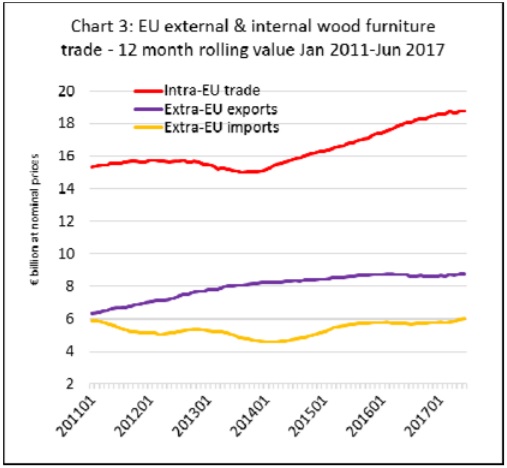
Analysis of Eurostat trade data reveals that internal EU trade in wood furniture, which increased 4% to Euro16.2 billion in 2016, continued to rise in 2017.

This trend is driven both by the slow rise in EU consumption and by rising dependence of the internal EU market on manufacturers located in lower cost member states of Eastern Europe, particularly Poland, Romania, and Lithuania.

The EU has maintained a trade surplus in wood furniture since 2011 when exports to non-EU countries overtook imports from outside the EU. This surplus remained broadly flat between the start of 2015 and the first quarter of 2016 (averaging close to Euro3 billion per annum), as both imports and exports were stable.

However, there were some early signs of a slight narrowing in the trade surplus in the second quarter of 2017 (to around Euro2.8 billion per annum) as imports began to pick up.

The value of EU wooden furniture production was around Euro 39.6 billion in 2016, 1% higher than the previous year, but still 20% down on the level prevailing before the financial crises in 2008. A slight slowdown in production in Italy and Germany, the two largest manufacturing countries offset gains in Poland, the UK, Spain, Romania and Lithuania.


Taken together these trends are indicative of intensifying competition in the EU wooden furniture market. EU manufacturers, particularly in Eastern Europe, are producing more at a time when domestic consumption is growing slowly and exports to other parts of the world are weakening.

Last year EU wooden furniture exports declined into the Middle East and Russia and were flat into North America, Switzerland, Norway, and Japan. Minor gains in China and a few other emerging markets were insufficient to offset declining demand elsewhere.

After making significant gains in the EU market in 2015, EU wood furniture imports from China and tropical countries slipped back last year. In 2016, import value declined 5% from China to Euro 3.01 billion and was down 3% from tropical countries to Euro 1.63 billion.

However, EU import value from non-EU temperate countries increased by 14% to Euro1.07 billion, with particularly large gains by Turkey, Bosnia, Serbia, Ukraine and Belarus.

Sweden: Softwood lumber exports stable; deliveries to China up by 20%

The Swedish sawmills have exported 6.72 million cubic meters of sawn and planed lumber during the first six months of 2017, -1% less than in the same period last year. Continue reading "Sweden: Softwood lumber exports stable; deliveries to China up by 20%"

US lumber prices still on an upward trend at the end of September

Trading in framing lumber in the US slowed down during the end of September. Yet, the decrease didn't register important changes in the upward trend in prices, for most species.
A number of species set or approached record highs. While that concerned buyers, strong mill order files eased their angst for the short term. However, securing shipments for sooner than the latter half of October was difficult and a primary source of frustration.
As prices marched higher in various species, the Random Lengths Framing Lumber Composite Price rose $7, to $436.

Week
Sep 29
Week
Sep 22
Year Ago
2016
Random Lengths Framing Lumber Composite Price* $436 $429 $356
KD Western S-P-F #2&Btr 2x4 R/L Mill Price 429 423 321
KD Eastern S-P-F #1&2 2x4 R/L, delivered Great Lakes 536 524 411
Green Douglas Fir Std&Btr 2x4 R/L (Portland) 472 472 332
Southern Pine (Westside) #2 2x4 R/L 418 403 424
KD Coast Hem-Fir #2&Btr 2x4 R/L 460 450 327
Ponderosa Pine (Inland) #2&Btr 1x12 R/L 685 675 675
* Weighted average of 15 key items

Random Lengths Panel Market Report
Structural panel trading moderated from the pace of recent weeks. The overall sales pace in OSB slowed, but activity still tilted more heavily to mills in the South.
Many mills stayed off the market for most or all of the week. Southern Pine plywood sales slowed from the frenetic pace earlier in the month, but mill order files and a dearth of inventory in the field supported price increases.
Western Fir plywood sales were steady. East Coast buyers stepped in for mixed-car purchases.

(f.o.b. mill prices) Week
Sep 29
Week
Sep 22
Year Ago
2016
Random Lengths Structural Panel Composite Price* $528 $521 $373
Southern (west-east) 15/32-inch 3-ply rated sheathing plywood 507-525 500-520 340-370
Southern (west-east) 15/32-inch 4-ply rated sheathing plywood 512-527 505-520 340-370
Western 1/2-inch 4-ply rated sheathing plywood 525 521 395
North Central 7/16-inch Oriented Strand Board 448 445 292
*Weighted average of 11 key items

Kastamonu’s Russian Alabuga site to reach full capacity in 2018

Kastamonu plans to reach full production capacity at the company’s  laminated flooring produced at the plant in the Alabuga SEZ of Tatarstan, Russia in 2018.

According to the announcement, after the launch of the second production line in 2016, the production capacity of MDF/HDF boards exceeded 1 million m3 per year, the designed capacity of laminate production is 35 million m².

The designed capacity of laminate production is 35 million m², and the company is planning to reach this capacity in 2018. Also, after the launch of the second production line in 2016, the production capacity of MDF/HDF boards exceeded 1 million m3 per year.

The company opened its first plant in Russia in the Alabuga Special Economic Zone (SEZ) in 2012. There it produces large volumes of MDF/HDF wood boards, based on which a wide range of laminate flooring collections are manufactured.

The plant is claimed to be Europe’s largest wood processing factory. The first stage of the Kastamonu wood processing plant was launched in 2014 with a capacity of 565,000 m³ of MDF and 20 million m² of laminate. At the moment, commissioning work is being performed on the second MDF line, and after its launch the projected capacity of the plant in the Alabuga SEZ will reach 1,050,000 m³ of MDF and 40 million m² of laminate flooring per year. The total investment in production facilities will reach EUR 400 million.

Brazilian wood products exports rise 6.1% in August

In August 2017, Brazilian exports of wood-based products (except pulp and paper) increased 6.1% in value compared to August 2016, from US$224.8 million to US$238.6 million.

The value of pine sawnwood exports increased 19% between August 2016 (US$35.5 million) and August 2017 (US$42.3 million). In terms of volume, exports increased 15% over the same period, from 178,500 cu.m to 205,100 cu.m.

The volume of tropical sawnwood exports increased 14%, from 30,900 cu.m in August 2016 to 35,200 cu.m in August 2017 at the same time the value of exports increased 10% from US$15.0 million to US$16.5 million.

Pine plywood exports increased 30% in value in August 2017 in comparison with August 2016; from US$38.9 million to US$50.6 million but there was only a 20% increase in the value of exports over the same period (from 148,000 cu.m to 177,600 cu.m).

Tropical plywood export volumes increased 17.5% and the value of exports rose by 16% from 14,300 cu.m (US$5.6 million) in August 2016 to 16,800 cu.m (US$6.5 million) in August 2017.

The positive news continued with wooden furniture exports which increased from US$37.2 million in August 2016 to US$44.9 million in August 2017, around a 21% increase.

Sawn softwood dominates Chinese sawnwood imports

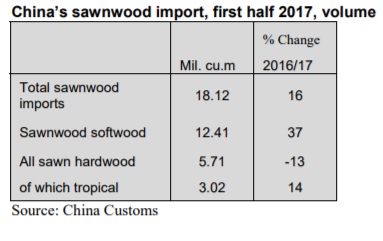
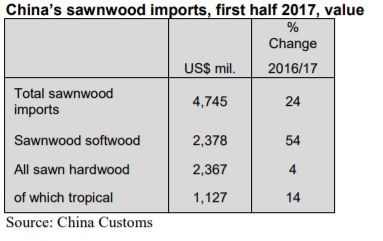
Data from China’s Customs shows there was a considerable expansion in the value of sawnwood imports in the first half of 2017.

China’s sawnwood imports totaled 18.12 million cubic metres valued at US$4.75 billion, a year on year increase of 16% in volume and 24% in value.

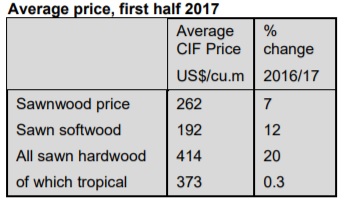
The average price for imported sawnwood in the first half of 2017 was US$262 per cubic metre, up 7% over the same period of 2016.

Of total sawnwood imports, sawn softwood imports rose 37% to 12.41 million cubic metres, accounting for 68% of the national total. The average price for imported sawn softwood in the first half of 2017 was US$192 per cubic metre, up 12% over the same period of 2016.

On the other hand, sawn hardwood imports fell 13% to 5.71 million cubic metres. The average price for imported sawn hardwoods in the first half of 2017 was US$414 per cubic metre, up 20% over the same period of 2016.

Of total sawn hardwood imports, sawnwood from tropical countries amounted to 3.02 million cubic metres valued at US$1.127 billion, up 14% both in volume and in value. Sawn hardwood imports from tropical countries accounted for 17% of the national total.

The average price for sawnwood imported from tropical countries was US$373 per cubic metre, a year on year slight increase of 0.3%.

Tropical and Chinese suppliers claw back EU furniture market share

European furniture manufacturers have been taking larger share of the internal EU market in recent years, gradually squeezing out overseas competitors.

This trend has been driven partly by increased price competitiveness at a time when the euro and other European currencies have been weak relative to the US dollar.

There are also more enduring factors, including the underlying strength of European furniture manufacturers and their brands in terms of innovation and design; the obstacles to overseas suppliers complying with complex EU technical and environmental standards; and the expansion of furniture manufacturing in Eastern Europe, a location which combines ready access to raw materials, relatively cheap labour, and the internal EU market.

The latest Eurostat data shows that European manufacturers share of the EU internal market increased even more sharply last year than indicated by preliminary estimates. However, there are also signs that suppliers in China and South-East Asia are clawing back some market share in 2017.

Analysis of official Eurostat manufacturing production data for 2016, just released in August, shows that wood furniture production value in the EU increased by 3.3% to Euro40.1 billion last year (Chart 1).

That is the highest level of production since 2008. It is also greater than preliminary estimate of 2016 production of Euro39.6 billion .

Austrian Binderholz takes over German Klenk

Austrian Binderholz Group located in Fügen has cloed an agreement with The Carlyle Group to take over the German sawmill- and wood processing company Klenk Holz AG located in Oberrot.

The contract was signed on 28 September 2017. The closing of the transaction is expected for beginning November 2017 and depends on the approval of antitrust authorities.

Binderholz plans to expand and modernize the three Klenk locations Oberrot, Baruth and Wolfegg in the short term. Through the acquisition, the steadily growing demand for sawn timber of the further processing sites of Binderholz shall be ensured.

Binderholz through the acquisition becomes one of the biggest sawmill companies in Europe. Seven sawmills in Austria, Germany and Finland process about 5 million cubic metres of logs. Of the 3 million cubic metres sawn timber 2 million cubic metres massvie wood products are manufactured.

Ian Jackson, CEO and Co-Head of CSP (Carlyle Strategic Partners) says: “We have significantly increased productivity and growth at Klenk and positioned the company for further growth under its new owner binderholz.”

After the acquisition Binderholz has 12 locations. 5 in Austria: Fügen, Jenbach, St. Georgen, Hallein and Unternberg - five in Germany: Kösching, Burgbernheim, Oberrot, Baruth and Wolfegg and 2 in Finland: Lieksa and Nurmes. Over all around 2,530 people work in the company.

EGGER completes acquisition of Masisa Argentina

The acquisition of the Masisa plant in Concordia, Argentina, from the Chilean Masisa S.A. is successfully completed upon closing of the contracts.

This will be the first time the wood-based material manufacturer EGGER is represented with a production site outside Europe. The Group, with headquarters in St. Johann in Tyrol, takes over the number 2 in Argentina for a purchasing price of USD 155 million debt-free.

The acquisition contracts between EGGER and Masisa were signed on the 17th of July 2017. In addition to the plant in Concordia, which has facilities for producing and coating chipboard and MDF board, EGGER also took over the retail network Masisa Placacentro in Argentina, Uruguay, and Paraguay that is run independently by 43 partners. The plant in Argentina employs 500 people, which the Austrian wood-based material manufacturer is taking over.

"With the acquisition of Masisa Argentina, we are continuing the internationalisation of the Group and continue to grow based on our own performance", says Thomas Leissing, spokesperson of the EGGER Group Management. "Our goal is to become a key market player in South America."

Australian log exports to China tripled over the last four years

Lucrative log markets in China have resulted in a tripling of softwood log export volumes from Australia the past four years.

Timberland owners in Australia are increasingly exploring opportunities for the exportation of logs as an alternative to selling logs in the domestic market. From 2012 to 2016, the export volume was up 300%, and 2017 is likely to set a new record high. Rising log prices in the export market have been the key drivers of the increase in exports. Conversely, prices in the domestic market have stagnated the past few years.

Australia has rapidly become a major exporter of softwood logs and was the world’s sixth largest log exporter in 2016. During the 1H/17, the upward trend continued with shipments being 17% higher than in the 1H/16. In 2012, Australia’s annual exports totaled only 1.2 million m3. Just four years later, in 2016, exports had tripled to a record high of 3.6 million m3, of which 96% was destined for China. If the upward trend seen this far in the first six months of 2017 continues, export volumes will end up totaling over four million m3 in 2017, which represents approximately 25% of the total softwood timber harvest in Australia.

Obviously, exportation of logs has become an attractive alternative to domestic sales for timberland owners in Australia. Wood Resource Quarterly reports that in 2012, there were minimal price premiums for exported logs over domestic logs, but by 2016 and 2017, premiums had surged to between A$35-50/m3. Despite these recent price increases, Australia is still considered to be a low-cost log supplier in the Chinese market as compared to other suppliers such as New Zealand, Russia and North America, mainly because of higher domestic sawlog prices in those markets.

Higher log export volumes have occurred at the same time as domestic log demand has gone up over 20% in four years, from 3.6 million m3 of lumber in 2012 to an estimated 4.4 million m3 in 2016. Although sawmill production fell slightly in 2016 from the previous year, the output from the Australian sawmill sector reached record high levels the past two years thanks to healthy domestic demand for softwood lumber.

China still leads as the world’s biggest furniture producer

The 100 countries covered in CSIL’s newly-released World Furniture Outlook 2017/2018 make up almost 90 per cent of world population and over 95 per cent of world GDP.

Production prices (excluding retail mark-up) currently stands at US$420 Bn. This means that these 100 countries in the survey are significant furniture producers.

China is the largest factory, accounting for 39 per cent of world furniture production. It is also a major exporter, followed at a distance by Germany, Italy, Poland and Vietnam. However in 2016, Chinese furniture exports have fallen while Vietnam picked up as the fastest growing furniture exporter (from a low base).

Other major furniture manufacturing countries are the US, Germany, Italy, India, Poland, Japan, Vietnam, the United Kingdom and Canada.

The leading importers of furniture are the United States, Germany, the United Kingdom, France and Canada.

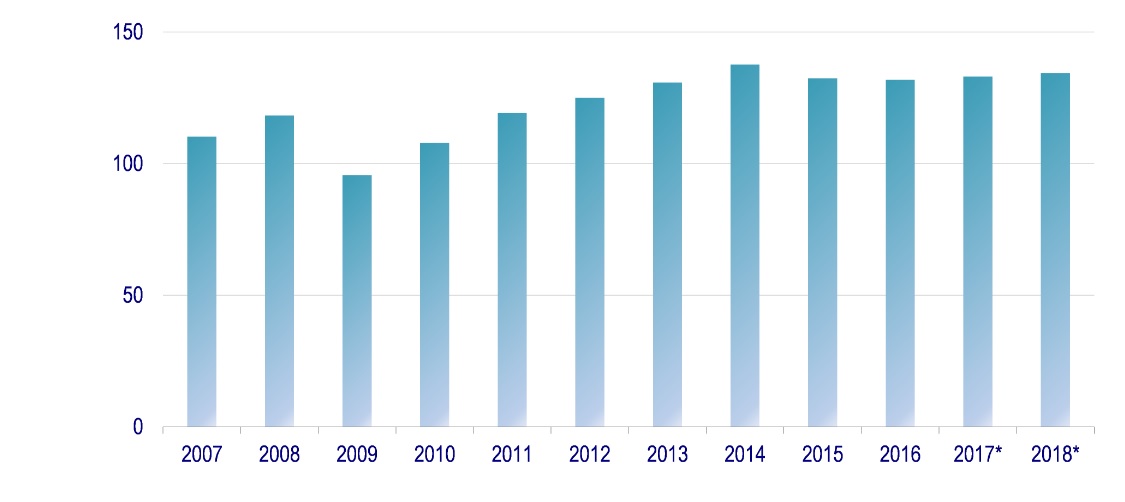
The international furniture trade of this group of 100 countries (which we shall refer to as the world), amounted to about US$ 132 billion in 2016. This corresponds to about one per cent of world trade.

In 2018 consumption is forecasted to grow by 3.5 per cent in real terms worldwide. The fastest growing region continues to be Asia with all other regions growing between one and three per cent in real terms.

Brazil: Rising economic importance of the planted forest industry

According to the Brazilian Tree Industry (IBA) 2017 report launched recently, in 2016 the Brazilian planted forest sector experienced a crisis stemming from the severe weakening of the national economy and forestry sector growth fell 3.3% compared to a year earlier.

Although this 3.3% decline was significant it was lower than seen in the overall economy (-3.6%), in the industry in general (-3.8%) and in agriculture (-6.6%). In 2016 the Brazilian planted forest sector contributed 1.1% to total GDP and 6.2% of the industry sector contribution to GDP.

The Brazilian planted forest sector was responsible for generating R$11.4 billion in federal, state, and municipal taxes throughout 2016, which corresponds to 0.9% of all taxes collected in the country. However, this was 5% down year on year due mostly to the drop in domestic sales of paper, wooden panels and solid wood products.

In 2016, export revenue from the Brazilian planted forest industry reached US$8.9 billion, a 1.1% decrease compared to 2015. A drop in export prices for these products was the main reason for the fall in revenue. In terms of volume there was a 14% increase compared to the previous year.

Austria: Slight increase in wood pellets prices this month

EN plus A1 wood pellets in Austria have reached the average price of EUR 228.2/tonne during September 2017.
As compared to the same period last year, the price went up by 2.6%. At the same time, when compared to August 2017, the price increased by a minor 0.2%.
Austrian wood pellets presently offer a price advantage of 46.6% as opposed to extra light heating oil and 76.7% as opposed to natural gas.
In September, wood pellets in bags cost an average of EUR 3.87 per 15 kg sack (when ordered by the pallet): +3.7% higher compared to the previous year and +2.3% lower from August 2017.

Tropical sawn wood imports decline in nearly all EU countries

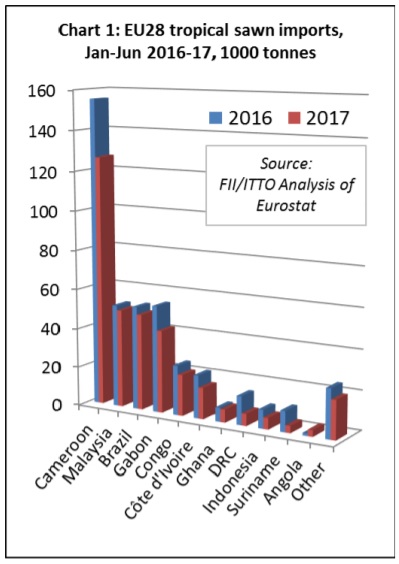
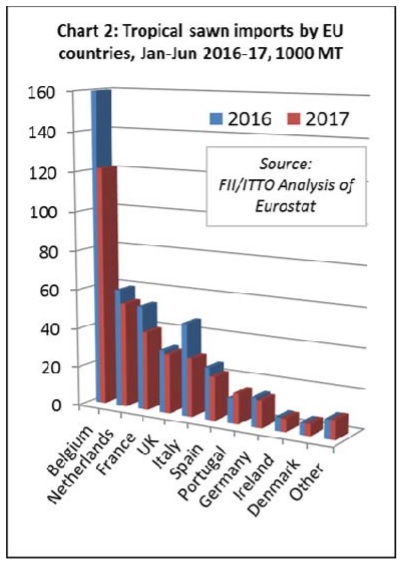
EU imports of tropical sawnwood in the first six months of 2017 were 348,600 metric tonnes (MT), 19% less than the same period in 2016.

The decline was particularly pronounced for trade between Cameroon and Belgium, following a surge last year, but also affected nearly all exporting countries and EU member states. The only minor exception was a slight upturn in imports from Angola, mainly destined for Portugal.

Imports were down from all the leading supply countries including:

  • Cameroon (-19% to 126,500 MT)
  • Malaysia (-4% to 49,500 MT)
  • Brazil (-7% to 48,500 MT)
  • Gabon (-22% to 42,000 MT)
  • Congo (-17% to 21,000 MT)
  • Cote d’Ivoire (-27% to 15,900 MT)
  • Ghana (-9% to 6,500 MT)
  • DRC (-58% to 6,100 MT)
  • Indonesia (-39% to 5,800 MT)
  • Suriname (56% to 10,000 MT).

EU imports of tropical sawnwood in the first half of 2017 fell:

  • Belgium (-24% to 121,300 MT)
  • Netherlands (-11% to 53,400 MT)
  • France (-24% to 40,100 MT)
  • UK (-5% to 30,400 MT)
  • Italy (-37% to 29,600 MT)
  • Spain (-16% to 22,100 MT)
  • Germany (-7% to 13,800 MT)
  • Ireland (-4% to 6,600 MT).

Imports in Portugal increased 20% to 15,500 MT during the period (Chart 2).

Weak consumption in the EU remains a factor behind the decline in EU imports of tropical sawn wood in some parts of Europe, notably Italy where the economy continues to struggle.

However, this factor alone cannot explain such a widespread downturn across the whole of the EU, particularly as economic activity in the region has been showing signs of improvement this year.

Some supply side issues have contributed to the decline in EU trade this year. European importers complained of long delays in shipment from Douala port during the first half of 2017, although this factor can only have had a short-term effect.

There are also indications that tropical exporters were concentrating on other more profitable and less demanding markets for sawn wood during the period. Malaysia is focusing less and less on the European sawnwood market these days, despite the country’s considerable efforts to meet the EU’s demanding green procurement requirements.

Malaysia’s exports of sawnwood have increased sharply to the Indian sub-continent and China this year. Brazil is exporting more to the US and India. Gabon’s exports of sawnwood to China increased 35% in the first 6 months of 2017. With good demand elsewhere, supplies restricted, the EU market still slow and difficult to satisfy as the EU Timber Regulation begins to bite, and with rising competition from modified temperate hardwoods, it’s almost inevitable that tropical sawn wood imports into the region will continue to fall.

Unusually long period of price stability for African hardwoods

For the past 2-3 months there has been little movement in the market and prices have been stable with no reports of significant changes in volumes or a decline in order levels. West and Central African producers still report good forward business and for now are working at full capacity.
Analysts say they cannot recall such an extended period of price stability for African hardwoods.
Producers report that demand in the UK and EU member states has not been affected by the impending departure of UK from the European Union.
So far building and construction activity appears largely unaffected and in France building activity has improved over the past quarter.
However, the sharp fall in the value of the UK pound may in time influence import volumes and certainly importers will be looking carefully for the best value-for-money species and products.
At the end of September indications of demand prospects in the European markets in the winter months may become clearer.
Demand from buyers for the Chinese market has expanded quite rapidly over the past 9 – 12 months but some producers now believe the rate of increase could slow marginally. On the other hand prices for the Chinese market, though stable for now, may come under pressure as stock levels in China are said to be rising.
Gabon timber sector featured by Oxfordeconomics
Producers in Gabon are awaiting news from the new Minister of Forests and the Forestry Department on the policy issues that were raised by the previous Minister.
A recent article by Oxfordeconomics has praised Gabon’s initiative to adopt satellite monitoring of forest activities and has highlighted the structural changes in the wood processing sector.
The Oxfordeconomics article says “In the first quarter of 2017 production of processed wood increased by 14.9% year-on-year (y-o-y) on the back of increased efficiency in the delivery of logs and the commissioning of new processing units.
The growth is notable given that timber processing activity in Gabon was relatively limited a decade ago. A 2010 ban on raw timber (log) exports forced logging companies to expand downstream operations, swelling the ranks of log transformation facilities by 36% to 130 during 2012-14 and creating more than 7,000 jobs in the process.”
Good prospects for andoung and gheombi in Middle East
Demand in Middle East markets is firm and prices are stable. Analysts write there are good prospects for andoung and gheombi that are fairly well known throughout the region.

Log Export Prices

West Africa logs, FOB € per m³
Asian market
LM
B
BC/C
Acajou/ Khaya/N’Gollon
245
240
160
Ayous/Obéché/Wawa
240
240
190
Azobe & Ekki
230
230
160
Belli
250
250
Bibolo/Dibétou
180
170
Bilinga
230
230
-
Iroko 325
300
265
Okoume (60% CI, 40% CE, 20% CS) (China only) 245 240 185
Moabi 330 300 235
Movingui 210
210
160
Niove
175
160
Okan
230
205
Padouk
300
280
230
Sapele 290 280 220
Sipo/Utile
310
290
255
Tali 330 320

 
Sawnwood Export Prices

West Africa sawnwood, FOB
€ per m³
Ayous FAS GMS 430
Bilinga FAS GMS 530
Okoumé FAS GMS
430
Merchantable 300
Std/Btr GMS 350
Sipo FAS GMS
540
FAS fixed sizes 555
FAS scantlings 560
Padouk FAS GMS 870
FAS scantlings 990
Strips 645
Sapele FAS Spanish sizes 505
FAS scantlings 510
Iroko FAS GMS 630
Scantlings 710
Strips
410
Khaya FAS GMS
450
FAS fixed
470
Maobi FAS GMS
620
Scantlings
630
Movingui FAS GMS
430

TowerBrook Capital Partners completes acquisition of Schweighofer’s fiber business in Austria

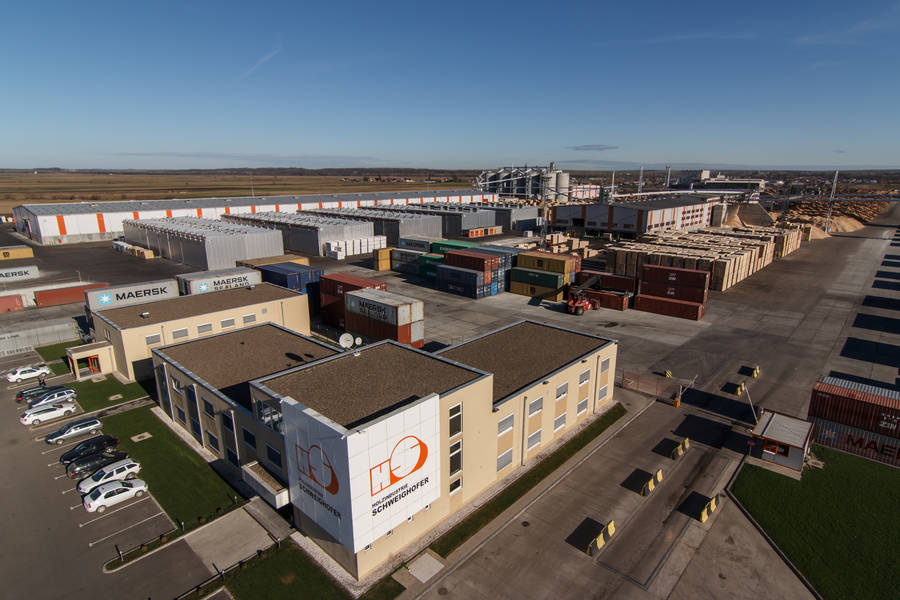
TowerBrook Capital Partners L.P. completed the recently announced acquisition of Schweighofer Fiber GmbH. Financial terms of the transaction were not disclosed.

Schweighofer Fiber is based in Hallein, Austria. It is specialised in the production of viscose pulp. The company employs 240 people at its site in Hallein near Salzburg and produces pulp and bio-energy from renewable energy sources. Schweighofer Fiber had a turnover of about EUR 143 million in 2016 and is one of the most profitable of the top 250 industrial companies in Austria. Jörg Harbring, who has been the Managing Director of the Company for 13 years, will become the CEO of the business.

Earlier Holzindustrie Schweighofer moved its headquarter in Romania to Bucharest.

About TowerBrook Capital Partners:

The company is focusing on investing in medium-sized enterprises with future-oriented products.

Katerra wants to open a new CLT facility

California-based Katerra plans to open a new factory in Spokane Valley, Washington, where it will produce mass timber products including cross-laminated timber (CLT) and glulam.

According to the company's press release, with its new 250K square foot mass timber manufacturing facility, Katerra is helping to scale the production of CLT in the U.S. so that the material can be more broadly adopted across the construction industry.

Through its end-to-end construction services model, Katerra will supply much of the CLT to projects where it will also serve as architect and contractor. One of Katerra’s first local Spokane-area CLT projects will be the construction of the new Hospitality Center in association with the Community Cancer Fund, Ronald McDonald House and Kootenai Health (Walden House).

The facility will house both Ronald McDonald House families while their children are hospitalized in a home-away-from-home environment, as well as provide lodging for the Walden House adult outpatients and their families while receiving treatment at the Kootenai Health facility. The Hospitality Center project is projected to be completed by 2019.

Construction of the factory will break ground later this fall, with production slated to begin by 1Q of 2018.

Newsletter

Subscribe to our digital newsletter for your daily digest of essential news, views and analysis from the international wood industry delivered directly to your inbox.


0