Article archive

Södra’s completes investment in Långasjö sawmill; production up by 30%

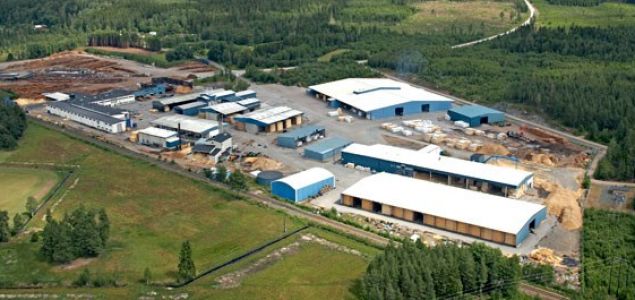
Södra’s investment of SEK 100 million in Långasjö has now been completed. The investment means that a totally new saw line will be in operation as of November.

Next year, production at the facility will increase by almost 30 percent.

The investment will increase the sawmill’s production capacity from 280,000 m³ to 360,000 m³, corresponding to 15 more logging trucks per day. To achieve this goal, the old small-diameter timber saw line has been replaced by a new profiling circular saw line, which means that sawing will be carried out with a circular blade instead of a band blade.

The new saw line will create a more efficient flow with higher precision. This will enable an even higher yield from the forest raw material in a shorter period of time,” said Magnus Algotsson, Mill Manager, Södra Wood Långasjö.

The facility produces panelling and cross beams, but also painted products, and demand in this product category has grown every year since 2013. Deliveries are mainly made to the Netherlands and Sweden, two markets where pressure on construction timber is high.

The high demand for Swedish construction timber is very positive. More and more people are seeing the advantages of using timber as a construction material.  Utilising wood’s ability to absorb CO₂ as both a raw material in the forest and as a finished product benefits all of society,” said Magnus Algotsson.

In addition to the new saw line, a new stacker, wood dryer and timber warehouse of 8,000 m² have been built. The investment will create 25 new jobs at Långasjö.

The value of Russian softwood lumber exports went up by 22.72%

Following the results of the first nine months of 2017, Russia again increased the export of softwood lumber, both in value and in volume. 

According to the statistics published by the Federal Customs Service of the Russian Federation, during January-September 2017, Russian enterprises exported 13.67 million tons of softwood lumber, which is 11.64% more than in the same period last year.

The exports of Russian softwood lumber in value terms also increased - by 22.72% to $2.92 billion.

In turn, exports of roundwood from Russia slightly decreased in volume. In January-September 2017, the volume of Russian logs exports amounted to 14.26 million m3, while in the same period last year this figure reached 14.92 million m3.

Thus, on an annualized basis, the decline was 4.44%. The total value of the forest products exported by Russia in January-September 2017 was $ 1,075 billion, which is 7.51% more than last year.

Indonesia: Bright prospects in furniture export markets

Panggah Susanto, Director General of Agro Industries within the Ministry of Industry (Kemenperin), is on record as saying within two years furniture exports could rise to US$5 billion as demand in the United States, Japan, and Western Europe picks up.

Currently the value of annual furniture exports is US$1.7 billion.

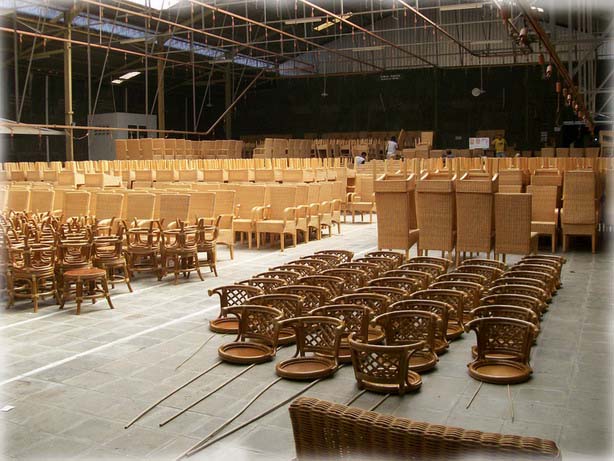
Much of the furniture exported from Indonesia is made from rattan and Paggah said rattan furniture production will be increased.

Kemenperin noted employment in the formal segment of the domestic furniture industry in 2016 was around 101,000 but this could double in a few years.

To boost rattan furniture production the Ministry of Industry is encouraging development of the furniture industry as it is a labour intensive sector and has decided to make Cirebon, a port city on the north coast of Java, one of the main centres for rattan supply and rattan furniture and handicraft production.

In contrast to the positive outlook from the Ministry of Industry, the Chairman of Association of Indonesian Furniture and Handicraft Industry (Asmindo) Mugiyanto said furniture manufacturers are facing challenges in international markets where sales of Indonesian furniture face tough competition and suffer from a poor image due to perceptions that illegal timber is being utilised.

Mugiyanto said to expand sales manufacturers need to be deliver innovative product designs and to expand outreach to address the negative perceptions of Indonesian wood products in international markets.

In the current trading environment Asmindo has suggested a focus on the domestic market as the building sector is very active with huge investments in family homes, apartments, hotels and office buildings where furniture will be needed.

UK sawn hardwood market holds up well despite Brexit concerns

While imports of tropical sawn hardwood into the eurozone countries have failed to live up to expectations in 2017, having declined as economic growth has revived, imports into the UK have followed the opposite trajectory.

UK imports of tropical sawn hardwood have held up well this year despite slowing economic growth. The UK imported 70,475 cu.m of sawn tropical hardwood in the first 8 months of 2017, marginally more than 70,322 cu.m imported in the same period in 2016.

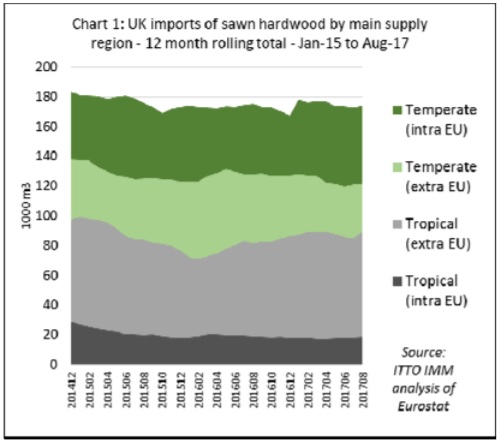
Chart 1 puts the UK’s relatively strong imports of tropical sawn hardwood in their wider market context. Total UK imports of sawn hardwood, both tropical and temperate, have been consistent at between 170,000 cu.m and 180,000 cu.m per year since the start of 2014.

The moderate growth in UK tropical sawn hardwood imports this year has come partly at the expense of temperate hardwood imports which have declined in 2017, particularly from the USA, Estonia and Italy.

African sapele is by far the dominant tropical hardwood imported into the UK, being strongly preferred for a wide range of joinery applications. UK importers report that sapele prices, which were stable in the first three quarters of 2017, are now beginning to rise.

They also report that supply of some other popular tropical hardwoods – such as iroko and meranti – has been limited this year. However, availability of idigbo and utile has been good, with stable prices.

This year, demand for sapele in the UK was boosted following the catastrophic fire at Grenfell Tower which led to at least 70 deaths in London in June this year. One outcome of the subsequent nationwide review of fire safety standards has been withdrawal of approval to use beech for manufacture of 60-minute fire doors and a partial switch to sapele in this application.

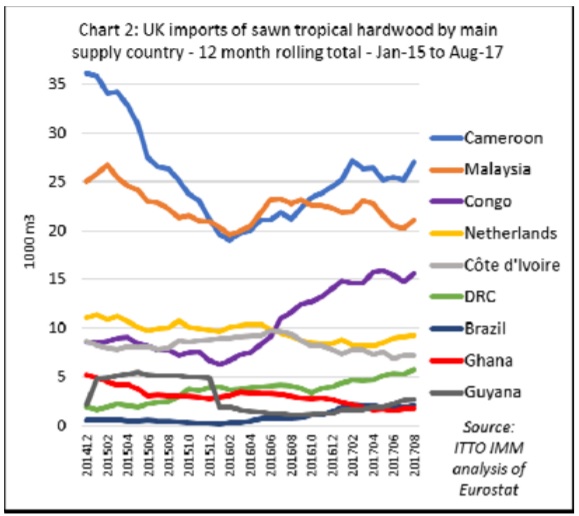
Chart 2 shows that UK imports of tropical sawn hardwood from Cameroon have recovered this year following a significant decline in 2015 and 2016. There has also been a notable rise in UK imports from the Congo Republic.

Imports from Ghana and Ivory Coast have been sliding this year.

Imports from Malaysia, mainly of meranti, recovered ground at the end of 2016, but have been declining in 2017. Imports from Brazil, which fell to negligible levels in 2014 and 2015, have been slowly recovering in the last two years.

The EU Timber Regulation has had a major impact on tropical timber procurement practices in recent years. It has focused supply on a much more limited range of companies in tropical countries for which UK importers are confident of assurances that timber is legally harvested. In practice this has meant increased demand for FSC and PEFC certified products.

The fact that UK imports of tropical sawn hardwood have been rising from DRC this year, and are still high from Ivory Coast, both countries with no certified forest area, indicates that other forms of legality assurance are still being accepted.

China: First half 2017 softwood log imports overview

In the first half of 2017 China’s softwood log imports were 17.51 million cubic metres.

The main imported softwood log species in the first half of 2017 were radiata pine (7.56 million cu.m, 43%), spruce and fir (2.51 million cu.m, 14%), Korean and Scots pine (2.04 million cu.m, 12%), larch (1.20 million cu.m, 7%) and douglas fir (0.88 million cu.m, 5%).

The volume of radiata pine and douglas fir imports rose 14% and 6%, but Korean pine and scots pine, spruce, fir and larch imports fell 18%, 5% and 2% respectively.

These species accounted for 81% of total softwood log imports.

China’s radiata pine log imports were from New Zealand (78%) and Australia (21%). Minor amounts were from South Africa and Chile. Over 90% of spruce and fir logs were imported from Russia (61%), Canada (16%) and the USA (15%) while pine logs (Korean and scots pine) were imported from Russia (86%) and Ukraine (6%).

China’s larch log imports were from Russia and New Zealand while douglas fir logs were imported from the USA (55%), Canada (28%) and New Zealand (17%). Small amounts were from France, Australia, Denmark and Russia.

Softwood lumber prices in the US nearly reach all-time high due to dispute with Canada

Softwood lumber prices in the US have boomed to near-records highs on the 15th of November. 
As reported by Financial Post, prices for KD Western S-P-F, a common benchmark for softwood lumber exported into the US, was trading above US$494, near its all-time high, that appear to neutralize any potential impact of increased duties placed on Canadian exporters.
That’s what’s really different this time, is you have fundamentally very tight building materials markets — both for lumber and structural panels. As a result, you’ve seen Canadian lumber producers passing off 100 per cent of these duties that they’ve faced so far in 2017 right onto the backs of the U.S. consumer,” said Daryl Swetlishoff, the head of equity research at Raymond James Ltd. in Vancouver.
The US Commerce Department has put a 20% duty on softwood lumber imports from Canada in November 2017. On the 14th of November, a lawyer representing Canada hand-delivered a letter to the American NAFTA secretariat in Washington calling for a review of the U.S. stance on softwood lumber duties. The challenge falls under section 19 of NAFTA, a key mechanism used by Canadian companies to appeal countervailing and anti-dumping duties.

Chapter 19 establishes a panel of five arbiters, agreed upon by both countries, who will decide if the duties meet U.S. law. Without that mechanism, Canada would have to use the U.S. court system to make such a challenge. Tariffs on Canadian lumber exports into the U.S. are not new.  Between 2006 and 2015, Canadian producers paid an average of about 11 per cent duties, compared to around 20 per cent today, Financial Post reported.

In a written statement, Foreign Affairs Minister Chrystia Freeland said Canada will “forcefully defend Canada’s softwood lumber industry.
The U.S. Department of Commerce’s decision on punitive countervailing and anti-dumping duties against Canada’s softwood lumber producers is unfair, unwarranted, and deeply troubling,” she said.
Canada's government states that the higher softwood lumber prices are a result of the tighter supplies caused by Canada's wildfires and the mountain pine beetle that had spread in the West. Meanwhile, the demand from the US has grown and the higher prices are very disturbing for some customers who face increased building demand after Miami, Houston.
Yet, analysts don't believe that the Trump administration would take back the duties on Canadian imports, even if the demand is rising.

UK wood pellets growing demand fuels rise in Canadian exports

Exports of Canadian wood pellets used as biomass fuel have increased by 46% in 2016, when the UK demand boomed, as the National Energy Board reported.

In 2016, Canada exported 2.4 billion kilograms of wood pellets and became the second-largest exporter by weight after the United States. About 70% was shipped to the U.K. and 11% to Japan.

According to The Globe and Mail, the Canadian industry has grown by 73% over the past four years. About 65% of Canada's pellets are produced in British Columbia.

In July, Tokyo-based Sumitomo Corp. paid an undisclosed amount to buy a 48% stake in B.C. pellet maker Pacific BioEnergy Corp. to ensure a supply for its power plants in Japan.

Wood pellets are made from forest industry waste such as bark and sawdust and are considered a renewable energy resource that's easier to burn than solid wood.

The NEB says the rise in demand is linked to decisions around the world to phase out coal.

Sweden leads in the prefabricated timber buildings market

Sweden has started to use its natural forests for prefabricating timber buildings of all types and sizes. One of the companies leading the cause is Swedish developer Folkhem, who already started illustrating the environmental advantages of wood construction.

As reported by Daily Commercial News, Folkhem's Strandparken, a 34-unit twin eight-storey housing complex just outside Stockholm, was built with cross-laminated timber (CLT) in seven months, largely because 80 per cent of the development was prefabricated — right down to the insulated walls and windows.

Sandra Frank, the company's marketing director, told delegates during a panel seminar recently at the Toronto Wood Solutions Fair, that the Swedish forests needs only about one minute to produce the wood (120 cubic metres) required to the build Strandparken.

To sustain Sweden's forests, government regulations stipulate that three trees be planted for every tree cut down, according to H.E. Per Sjogren, the Swedish Ambassador to Canada. Sjogren told the seminar that forestry products have a wide range of usage in Sweden, and "it is an important research area between Sweden and Canada in our universities."

"Today, we no longer have any height restrictions on wooden buildings," he added.

On the other hand, Mike Collins-Williams, a policy director with the Ontario Home Builders' Association (OHBA), said at the seminar, held at the Toronto Metro Convention Centre, that "the missing middle (mid-rise housing) that Sweden does so well we are just starting to figure out in Ontario and Toronto."

He said residents in fast-growing Canadian cities need a "greater diversity" of housing options.

"Many consumers currently see the choice as either a shoebox in the sky (condo tower)...or a single family home," he said.

While the Greater Toronto Area is investing about $30 billion in transit in the region, Collins-Williams said there is "a disconnect" between municipal land-use authorities and provincial transit agencies that prevents opportunities for wood mid-rise developments, Daily Commercial News reported.

Both these developments have to face similar hurdles and periods to get approval so it is no surprise developers often propose the more profitable option, highrise housing, Collins-Williams stated, adding that planners need to "up-zone" most areas in Toronto — particularly along transit corridors — to smooth the path to urban intensification.

A tool called the community planning permit system that combines the site plan approval, building permit and zoning — "a one-stop shop" that expedites the development process, is available to Ontario municipalities but most have not taken advantage of it, Collins-Williams told delegates.

Fellow panellist Tad Putyra, president and COO of Great Gulf Low Rise, said his takeaway from visits to wood manufacturing plants in Sweden and Germany is that new levels of automation are on the rise that incorporate robotics equipment that not long ago was the reserve of auto-making plants.

Among the most advanced factories in the world is one in northern Sweden that delivers modules for wood mid-rises to Stockholm and other cities in the nation.

Steven Street, technical director at Ontario Wood Works, said in the past eight to nine years the industry has "dramatically changed" its views of factory-built wood panels. The benefits of prefabrication are obvious, he said.

Bergs Timber to upgrade former Setra Vimmerby sawmill

Bergs Timber has recently announced it will invest SEK 27.5mn in reconstructing the sawline at the sawmill in Vimmerby.

The Swedish sawmill company has bought all the assets of the sawmill from Swedish wood industry group Setra. Machinery from the recently disused sawmill in Myresjö will be utilized in the reconstruction.

Setra and Bergs Timber reached an agreement over the acquisition of the Vimmerby sawmill back in 2016. At the time, the two companies discussed about Bergs Timber buying all fixed and current assets at Setra’s unit in Vimmerby, net of certain operating liabilities, primarily consisting of personnel-related liabilities.

Setra Vimmerby, which was one of Setra's twelve production units, is located only 40 kilometres from Bergs Timber's facility in Mörlunda, and has some 50 employees.


Central/West Africa A long stretch with few logs & sawnwood FOB price movements, why?

No changes in FOB prices for either logs or sawnwood have been reported during the second half of October so the slight downward pressure on prices in Asian markets has been arrested for now.
The European market for African logs is small and the previously reported drop in FOB prices for dousie and andoung is holding steady.
Sawnwood prices continued unchanged through to month end and exporters say that the rather dull market conditions still prevail in the main markets.
Such a long period of stable prices is rather unusual and when pressed analysts suggested that this is partly due to the consolidation that has occurred in the import businesses in the EU and to some extent in the US.
Many of the smaller importers have stopped direct imports citing the risks and costs/time involved in meeting due diligence requirements. With fewer buyers, exporters have less opportunity to “play the market’ to lift prices.
In todays’ trading environment importers are tending to stick with the one or two trusted suppliers not wanting to risk buying from sources they are not familiar with just to save a few dollars per cubic metre.
Add to these constraints the growing competition from alternatives, then opportunities for price increase are dependent on significant increases in consumption that is not yet happening despite an overall improvement in the global economy.
On/off news on Kevazingo exports
The new Minister for Water and Forests has announced that all exports of kevazingo are forbidden. This, say analysts, applies also to kevazingo sawnwood already loaded in the containers awaiting shipment.
It seems the government is reviving the previous proposal so it is anticipated that the temporary halt to exports may last for two to three months while the authorities devise a permit system for exports.
News is circulating that one of the largest producers will continue to expand stocks and will accept contracts for kevazingo in anticipation that they, along with other millers complying with the stringent investment rules on downstream processing, will eventually be allowed to resume exports.
Gabon peeler mills short of okoume
The new peeler mills in Gabon owned by Indian investors continue to face okoume log supply problems upon which their production is dependent. Their suppliers of okoume logs say they cannot always predict the proportion of peeler logs and sawlogs being extracted.
Reconstruction in Middle East to lift demand
Middle East buyers are perhaps more upbeat than those in other markets in anticipation of huge demand for construction timber when rebuilding begins in war ravaged regions.
Producers are not expecting any significant surge in buying by European importers and reports suggest buyers of tropical timber are becoming even more wary of failing to comply with the EUTR and the actions of nongovernmental agencies.
 

Log Export Prices

West Africa logs, FOB € per m³
Asian market
LM
B
BC/C
Acajou/ Khaya/N’Gollon
22
220
160
Ayous/Obéché/Wawa
245
240
190
Azobe & Ekki
230
230
160
Belli
250
250
Bibolo/Dibétou
180
170
Bilinga
230
230
-
Iroko 325
300
265
Okoume (60% CI, 40% CE, 20% CS) (China only) 240 240 190
Moabi 330 300 235
Movingui 210
200
160
Niove
175
160
Okan
230
205
Padouk
300
275
210
Sapele 270 275 210
Sipo/Utile
290
270
255
Tali 330 320

 
Sawnwood Export Prices

West Africa sawnwood, FOB
€ per m³
Ayous FAS GMS 430
Bilinga FAS GMS 530
Okoumé FAS GMS
430
Merchantable 300
Std/Btr GMS 350
Sipo FAS GMS
540
FAS fixed sizes 555
FAS scantlings 560
Padouk FAS GMS 870
FAS scantlings 990
Strips 645
Sapele FAS Spanish sizes 505
FAS scantlings 510
Iroko FAS GMS 630
Scantlings 710
Strips
410
Khaya FAS GMS
450
FAS fixed
470
Maobi FAS GMS
620
Scantlings
630
Movingui FAS GMS
430

Central/West Africa A long stretch with few logs & sawnwood FOB price movements, why?

No changes in FOB prices for either logs or sawnwood have been reported during the second half of October so the slight downward pressure on prices in Asian markets has been arrested for now.

The European market for African logs is small and the previously reported drop in FOB prices for dousie and andoung is holding steady.

Sawnwood prices continued unchanged through to month end and exporters say that the rather dull market conditions still prevail in the main markets.

Such a long period of stable prices is rather unusual and when pressed analysts suggested that this is partly due to the consolidation that has occurred in the import businesses in the EU and to some extent in the US.

Many of the smaller importers have stopped direct imports citing the risks and costs/time involved in meeting due diligence requirements. With fewer buyers, exporters have less opportunity to “play the market’ to lift prices.

In todays’ trading environment importers are tending to stick with the one or two trusted suppliers not wanting to risk buying from sources they are not familiar with just to save a few dollars per cubic metre.

Add to these constraints the growing competition from alternatives, then opportunities for price increase are dependent on significant increases in consumption that is not yet happening despite an overall improvement in the global economy.

On/off news on Kevazingo exports

The new Minister for Water and Forests has announced that all exports of kevazingo are forbidden. This, say analysts, applies also to kevazingo sawnwood already loaded in the containers awaiting shipment.

It seems the government is reviving the previous proposal so it is anticipated that the temporary halt to exports may last for two to three months while the authorities devise a permit system for exports.

News is circulating that one of the largest producers will continue to expand stocks and will accept contracts for kevazingo in anticipation that they, along with other millers complying with the stringent investment rules on downstream processing, will eventually be allowed to resume exports.

Gabon peeler mills short of okoume

The new peeler mills in Gabon owned by Indian investors continue to face okoume log supply problems upon which their production is dependent. Their suppliers of okoume logs say they cannot always predict the proportion of peeler logs and sawlogs being extracted.

Reconstruction in Middle East to lift demand

Middle East buyers are perhaps more upbeat than those in other markets in anticipation of huge demand for construction timber when rebuilding begins in war ravaged regions.

Producers are not expecting any significant surge in buying by European importers and reports suggest buyers of tropical timber are becoming even more wary of failing to comply with the EUTR and the actions of nongovernmental agencies.


Log Export Prices

West Africa logs, FOB € per m³
Asian market
LM
B
BC/C
Acajou/ Khaya/N’Gollon
22
220
160
Ayous/Obéché/Wawa
245
240
190
Azobe & Ekki
230
230
160
Belli
250
250
Bibolo/Dibétou
180
170
Bilinga
230
230
-
Iroko 325
300
265
Okoume (60% CI, 40% CE, 20% CS) (China only) 240 240 190
Moabi 330 300 235
Movingui 210
200
160
Niove
175
160
Okan
230
205
Padouk
300
275
210
Sapele 270 275 210
Sipo/Utile
290
270
255
Tali 330 320


Sawnwood Export Prices

West Africa sawnwood, FOB
€ per m³
Ayous FAS GMS 430
Bilinga FAS GMS 530
Okoumé FAS GMS
430
Merchantable 300
Std/Btr GMS 350
Sipo FAS GMS
540
FAS fixed sizes 555
FAS scantlings 560
Padouk FAS GMS 870
FAS scantlings 990
Strips 645
Sapele FAS Spanish sizes 505
FAS scantlings 510
Iroko FAS GMS 630
Scantlings 710
Strips
410
Khaya FAS GMS
450
FAS fixed
470
Maobi FAS GMS
620
Scantlings
630
Movingui FAS GMS
430

Interfor to rise lumber production by 50% at Meldrim mill

Interfor Corp. announced last month that it plans to invest $16.5 million to upgrade its sawmill in Meldrim.

The project, which is scheduled to be completed in December 2018, includes installation of a continuous lumber drying kiln and upgrades to the planer mill.

Lumber production is expected to increase by 50 percent in addition to improving product quality and mill efficiency.

Once the project is completed the facility will operate a full two shifts.

“Interfor is a long-time employer in the area, and today’s announcement shows they will continue to provide good jobs for the citizens while also benefiting landowners in the region,” said John Henry, CEO of the Effingham County Industrial Authority.

Ian Fillinger, senior vice president and head of operations of Interfor, said mill leadership, employee performance, the local timber supply and rising demand for lumber made the Meldrim investment a high priority.

“New logging employees, truck drivers and allied service industry professionals will be needed to meet demand,” said Gov. Nathan Deal. “With seven mills in Georgia, Interfor has direct access to a talented workforce and an abundant timber supply, both of which are essential to the company’s continued success.”

Interfor acquired the mill in 2015.

Roundwood prices in Lithuania up sharply in September

Prices of roundwood in Lithuania have significantly increased during September 2017, when compared to the same period in 2016.
All the prices for sawlogs went up at an average of extra 5% to 21%, as following: the price for pine reached EUR 58/m3, going 7.40% up from September 2016, while spruce could be bought for EUR 66/m3, which is 6,45% more than last year.
Moreover, the price for birch increased by 13.23%, to EUR 77/m3, from EUR 68/m3 in September 2016, while alder and small-sized softwood could be bought for EUR 63/m3 and EUR 37/m3, respectively.
The pulpwood prices also increased, with pine and spruce going both 12.5% up and birch reaching an average price of EUR 28/m3.

Roadside prices of roundwood in state forests of Lithuania EUR/m³ under bark

September 2016 August 2017 September 2017 Change
September/ 2016 to September/ 2017
SAWLOGS
Pine 54 57 58 +7.40%
Spruce 62 65 66 +6.45%
Birch 68 76 77 +13.23%
Alder 52 62 63 +21.15%
Small-sized softwood 35 37 37 +5.71%
PULPWOOD
Pine 24 27 27 +12.5%
Spruce 24 27 27 +12.5%
Birch 26 28 28 +7.69%

Prefabricated houses are on the fast track across Europe

The European prefabricated market continues its expansion. Last year, 8.3% more prefabricated houses were sold as compared to 2015. The market volume increased by 11.3%. This market volume is predicted to continue in the next few years. As a result, the prefabricated house market is steadily gaining market share in the entire Continue reading "Prefabricated houses are on the fast track across Europe"

Finnish softwood sawn timber and plywood production grew significantly during January-September

Finnish softwood sawn timber production in January-September increased by 5.9% compared to the year ago period and totalled 8.9 million cubic metres.

In recent years, China has become a significant export market especially for spruce sawn timber. In the third quarter, softwood sawn timber production in Finland remained at the same level as in the corresponding period last year, that is, 2.6 million cubic metres.

Plywood production increased by 10.3% in January-September to 0.9 million cubic metres. In July-September, the Finnish plywood production totalled 0.3 million cubic metres, which is 16% more than in the year ago period. Plywood is primarily used in construction, vehicle flooring, and LNG tankers. Growth in the European new construction and renovation markets had a positive impact on plywood production.

Pulp production in January-September amounted to 5.7 million tonnes, up by 2.3% from the same period last year. In recent years, Finnish forest industry companies have made significant investments into pulp production capacity but this is not yet fully reflected in production volumes. In July-September, 1.9 million tonnes of pulp was produced, an increase of 5% from the same period in 2016.

Finnish forest industry companies’ markets are mostly in Europe and Asia, depending on the product groups they focus on. Finnish producers’ competitiveness, especially in the paper industry, is strained by high production costs as well as long transport distances compared to our main competing countries Sweden and Germany.

Forest industry companies operating in Finland bring the country substantial economic wellbeing by paying taxes, offering employment, and by using domestic raw materials. Forest industry products account for over a fifth of Finland’s merchandise exports. Companies operating in Finland need symmetrical operating conditions compared to competing countries, so that Finland remains an attractive and competitive location for industrial production and investments,” says Timo Jaatinen, Director General of the Finnish Forest Industries Federation.

Wood pellets prices in Switzerland keep same levels in November

Wood pellets price in Switzerland reached an average of CHF 367.2/t (EUR 315.01/t) in November 2017, as compared to the CHF 367.1/t last year. Also, this is a 0.49% increase from October
Prices vary depending on the delivery quantity between 356.03 CHF / t (305.43 EUR / t) for an 8-tonne purchase to 380 CHF / t (325.99 EUR / t) for a 3-tonne purchase.
Larger quantities for commercial customers currently cost 340.78 CHF / t (292.35 EUR / t) for a 17-tonne purchase.

Price of wood pellets in SwitzerlandCHF/tonne November 2016 October 2017 November 2017
3 tonnes purchase quantity 379.66 379.31 380
5 tonnes purchase quantity 365.9 363.68 365.52
8 tonnes purchase quantity 355.66 353.29 356.03
Average price 367.1 365.4 367.2

Newsletter

Subscribe to our digital newsletter for your daily digest of essential news, views and analysis from the international wood industry delivered directly to your inbox.


0