Article archive

Nigeria rosewood crisis gets new control measures from CITES

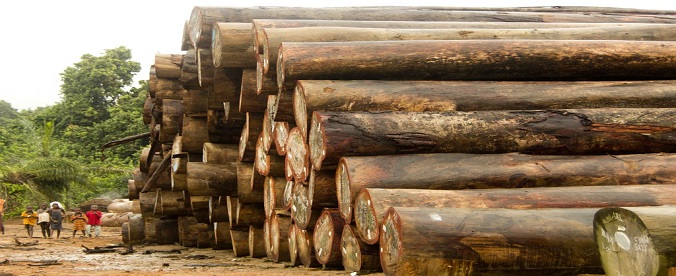
As a response to the acute rosewood crisis in West Africa and particularly in Nigeria, the Secretariat of the Convention on International Trade in Endangered Species of Wild Fauna and Flora (CITES) informed its 183 member countries of exceptional control measures.

Thus, all “kosso” rosewood permits issued by Nigeria, the world’s largest exporter of rosewood over the past years, will have to be verified by the Secretariat of the Convention and a special CITES mission will soon be sent to the country.

As reported by the Business Wire, in November 2017, the Washington, DC-based Environmental Investigation Agency (EIA) released the Rosewood Racket report, the result of a two-year undercover investigation following the corrupt timber trade from the fragile forests of Nigeria to high-end furniture boutiques in China. Triggered by skyrocketing Chinese demand, over a billion US dollars’ worth of rosewood has been illegally exported from Nigeria between 2015 and 2017. Part of it had been laundered by traffickers through a sophisticated scheme that involved approximately 3,000 questionable CITES permits officially issued by Nigerian authorities. With these permits in hand, traffickers smuggled over 1.5 million logs to the Chinese market – the equivalent of three Empire State buildings. This happened despite environmental protection policies adopted by Nigeria’s Federal Ministry of Environment.

Further on, the CITES Standing Committee brought up the discussion about the Nigerian rosewood trafficking crisis during its meeting in Geneva last month., alerted by EIA's report.

The Committee took a decision that was validated by the Secretariat and officially communicated to all Parties of the Convention – including almost all member states of the United Nations – on January 15, 2018, Business Wire reported.

While acknowledging the mechanism of cooperation established between Nigeria and China, the official notification formally requests that the Parties to the CITES Convention “not accept any CITES permit or certificate for Pterocarpus erinaceus issued by Nigeria unless its authenticity has been confirmed by the Secretariat.

Furthermore, in response to Nigeria’s invitation, the CITES Secretariat will conduct an official inquiry – a “technical mission” – in the country. The investigation will focus on the key elements of what has been a monumental laundering machine for illegally harvested or exported rosewood logs: suspect issuance of thousands of CITES permits, lack of coordination between the Ministry of Environment and Customs, and the general opacity of the process, according to the Business Wire.

EIA Executive Director Alexander von Bismarck said: “Now that the problem of the illegal rosewood trade between Nigeria and China has been formally acknowledged under CITES and exceptional measures have been agreed, we hope that all the parties involved will come together to end what is most likely one of the largest forest crimes of this century.”

Millions of rosewood logs were harvested and exported illegally from Nigeria when Amina J. Mohammed, the current Deputy Secretary-General of the United Nation, was Minister of Environment.

Drax plans to complete 4th biomass power plant conversion by 2H/2018

Drax, UK's power producer, announced on the 17th of January that it wanted to complete the conversion of its 4th biomass power plant during the second half of 2018, so it could start producing at the end of the year.

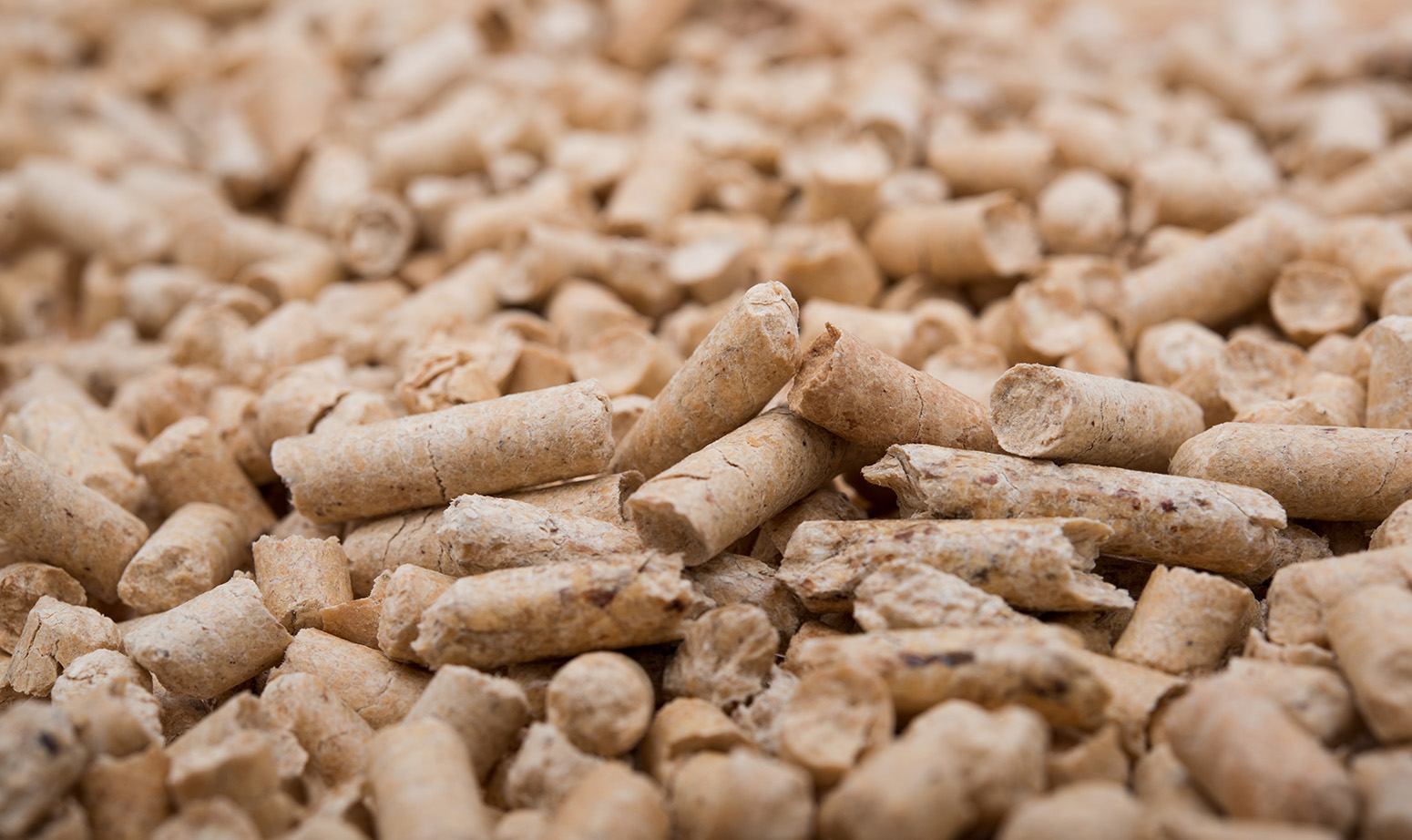
Drax has converted half its power plant in Yorkshire in the north of England that was once Europe's most polluting coal-fired power station to burn wood pellets, often made from sustainably sourced dry sawdust compressed under high pressure, Reuters reported.

The unit will likely operate with lower availability than the other three biomass units but would run at periods of high demand.

Swiss wood pellets price goes up in January

The Swiss wood pellets price got to an average of CHF 376/t (EUR 320.17/t) in January 2018, as compared to the CHF 375.1/t last year. 
Prices vary depending on the delivery quantity between 363.61 CHF / t (309.62 EUR / t) for an 8-tonne purchase to 389.78 CHF / t (331.91 EUR / t) for a 3-tonne purchase.
Larger quantities for commercial customers currently cost 347.29 CHF / t (295.73 EUR / t) for a 17-tonne purchase.

Price of wood pellets in SwitzerlandCHF/tonne January 2018 December 2017 January 2017
3 tonnes purchase quantity 389.78 385.69 388.25
5 tonnes purchase quantity 374.66 370.49 373.47
8 tonnes purchase quantity 363.61 359.93 363.44
Average price 376 372 375.1

The price for wood pellets in Germany on the rise due to low temperatures

Wood pellets price in Germany increased in January, due to the low temperatures. Thus, the national average for wood pellets has reached EUR 251.34/tonne, 2.4% more than in December 2017 and 3.8% more than in January last year.
A kilogram of wood pellets now costs 25.13 cents, while one kilowatt hour (kWh) of heat from wood pellets costs 5.03 cents. The price advantage for fuel oil is currently 18%, compared to 14% for natural gas, according to the German Energy Wood and Pellet Association e. V. (DEPV).
"During the winter season, the pellet price is always slightly higher than during the summer," explains Martin Bentele, Managing Director of the industry association DEPV. "Private customers should therefore order their annual demand outside the heating season."
Regional prices (for 6 tonnes purchases) in January: Central Germany: EUR 249.72 / t, Southern Germany: EUR 251.36 per tonne, Northern Germany: EUR 255.40/ t.
Larger quantities (26 t) could be bought for the following prices: South: 235.06 EUR / t, Middle: 230.39 EUR / t, North / East: 232.38 EUR / t (all incl. VAT).

Laminate flooring market in Europe kept stable sales in 2017

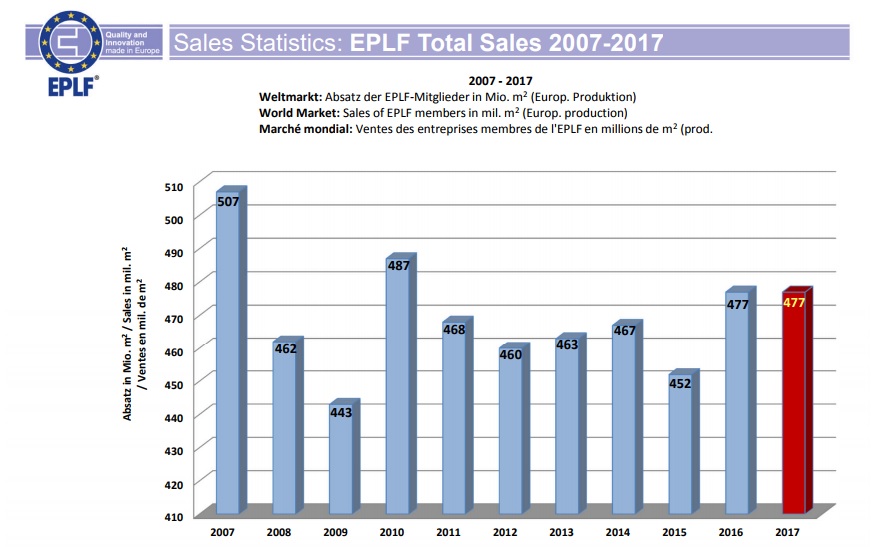
The EPLF association reported that their manufacturers achieved worldwide sales of laminate flooring made in Europe totalling 477 million m2 during 2017.

Thus, the global laminate market is maintaining its position at a high level.

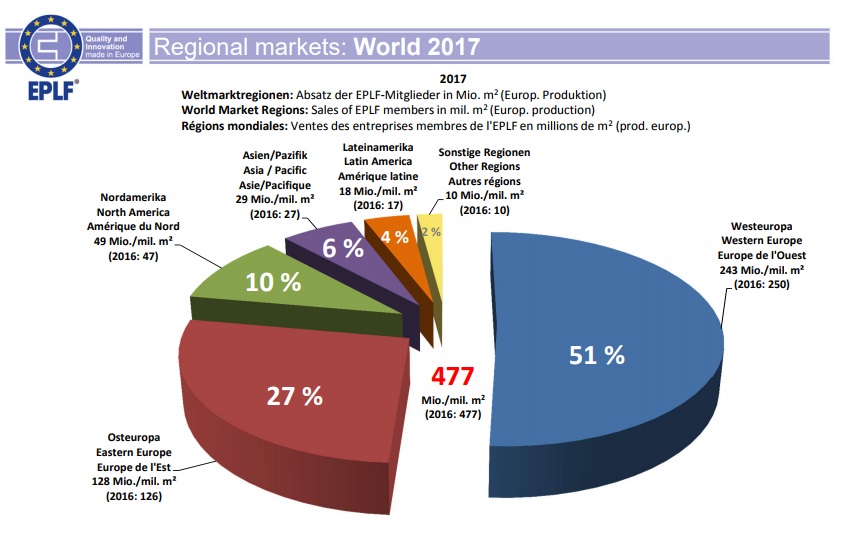
While Asia registered the biggest growth, the EPLF “home market” of Western Europe continued to decline in 2017. Still, North America and Latin America also showed an upward trend in 2017, and in Eastern Europe the Russian market in particular saw gains.

In Western Europe (including Turkey), total sales for 2017 reached 243 million m2 (Previous Year 250 million m2), which represents a drop of 2.9% compared to the previous year. Germany remains by far the major single market in Central Europe with 57 million m2 (PY 63 million m2) – albeit with a 10% decline caused by the continuing trend towards substitution with thermoplastic flooring.

France continues to occupy second place in Europe, demonstrating a slight improvement for 2017 with 37.6 million m2 (PY 37.4 million m2). The United Kingdom continued the positive trend for EPLF members: a figure of 33.8 million m2 (PY approx. 33 million m2) was recorded for 2017, an increase of 2.5%. This again puts the UK in third place ahead of Turkey, where association revenues continued to decline in 2017: sales figures for Turkey fell by 9.2% down to 24.9 million m² (PY 27.5 million m²). The Netherlands stands firmly in fifth place with slightly increased sales figures of 19.7 million m² (PY 19.3 million m²). Again, Spain follows on behind at a stable level of just under 17 million m² (PY 17 million m²).

For Eastern Europe, the increase in 2017 was slightly smaller than in the previous year. This region is nevertheless still a major growth market for EPLF manufacturers – at 128 million m2 (PY 126 million m2), European laminate manufacturers there achieved an increase of 1.9%. Since 2015, the EPLF has been aware that just under 20 million m² of laminate produced by Russian member companies have not been accounted for in the statistics for various reasons. In 2017, EPLF members in Russia reported sales of 35 million m² (PY 34 million m²), which corresponds to a growth rate of 5.2%. Poland achieved just under 31 million m² in 2017 (PY 31 million m²), a steady result. Romania exhibited a slightly weaker result with 13.2 million m2 (PY 13.6 million m²). Behind them, in the same order as before, are: Ukraine with 7.4 million m² (PY 6.2 million m²), a growth rate of 18.4%, Hungary at 6.5 million m² (PY 6.2 million m²) and Bulgaria with 5 million m² (PY 5 million m²).

North America continues to be a strong growth region for sales of European laminate flooring: at 49 million m2 (PY 47 million m2), around 4.7% more was sold there in 2017 than in the previous year. At around 32 million m2 for 2017 (PY 29 million m2), the USA saw a gain of 8.1%, whilst Canada recorded just under 18 million m² for 2017 (PY 18.1 million m²).

The biggest increase in 2017 was again achieved in the Asia Pacific region, where EPLF producers reached total sales for 2017 of over 29 million m² (PY 27 million m²), thereby gaining an increase over the previous year of around 8.7%. Undisputedly in first place again for Asia in 2017 was China (including Hong Kong) where 9.6 million m2 were sold (PY 8.6 million m²), representing an increase of approx. 10.8% over the previous year. The EPLF has seen very pleasing growth in Kazakhstan, where figures have only been gathered since 2016: 3.6 million m2 sold, an increase of over 39% (PY 2.8 million m2). Israel notched up 2.2 million m² (PY 2.4 million m2,), Saudi Arabia remains stable at 2.7 million m² (PY 2.7 million m2) and Taiwan reached just under 1.8 million m2 (PY 1.6 million m2), a rise of over 18%.

The Latin America region is again managing to increase its EPLF sales statistics: 2017 saw a 3% growth with sales of 17.7 million m2 (PY 17 million m2). Figures for Chile, the largest single market, rose by 4.6% compared with the previous year and came to 7.7 million m² (PY 7.3 million m²). Mexico recorded 4.3 million m² (PY 4.3 million m²), Columbia registered 1.6 million m² (PY 1.5 million m²), and figures for Argentina climbed to 2.1 million m² (PY 1.4 million m²).

UK’s woodworking industry forecasts that continuous investments may reduce Brexit effects

The investments in product improvement, along with the customer reach in the UK's woodworking industry is currently on the rise, despite the rising costs for raw materials and the slowing of the sales growth.

According to the British Woodworking Federation's (BWF) Joinery State of Trade Survey Q4 2017, a balance of 33% of respondents reported an increase in sales volumes over the last quarter, with 41% reporting an increase over the last year. This corresponds with the 44% of respondents reporting a quarterly increase in the previous survey.

Among the respondents at the trade survey, 68% felt that Brexit-related uncertainty had affected their business so far with 67% of those noting that the cost of raw materials was where it had impacted. Moreover, a balance of 32% felt that Brexit negotiations would have a negative impact on their business in the next 12 months.

When asked about the impact of Brexit over 5 years, respondents were split between whether it would be positive or negative (25% for each) with 40% unsure of the implications and 10% expecting no impact.

Manufacturers felt that sales volumes would improve in the next quarter, with a balance of 34% predicting an increase for Q1 2018, and a balance of 30% predicting an increase over the next year, while 19% of companies reported a current order book of future work extending beyond 3 months – down 7% from the previous quarter – with 53% saying that their order book extended to between 1 and 3 months.

The demand was listed as the most likely constraint on output over the next year by 37% of respondents. Labour availability and Capacity came next, with 24% and 20% of respondents feeling that they were most likely to constrain output.

32% of respondents on balance reported increasing their labour force in the previous year, with 44% of respondents anticipating an increased labour force over the next year.

Raw material costs were noted as a major inflationary factor for unit costs for 95% of respondents on balance, with wages/salaries increases pushing up unit costs for 67% of respondents on balance, while, over the previous year, a balance of 59% of respondents had invested in improving their products with 45% investing in their manufacturing equipment.

Investment in product improvement was set for the highest capital investment over the next year, with a balance of 67% planning to invest and with 48% set to invest in equipment.

Matt Mahony, BWF Policy and Communications Executive, commented:

Sales are still growing at a reasonable rate and there are no indications of a sudden decline for the British woodworking industry despite the pessimism around construction from some quarters. Slightly fewer order books extending beyond three months and consecutive quarters of lowered sales growth expectations conceal the reality which is that our members have been selling products and adapting to the higher costs that have now unfortunately become the new norm.

More than two-thirds of respondents noted that Brexit-related uncertainty has already affected their business, with two-thirds of those identifying the impact as being increased raw material costs. If we look to the longer term however, manufacturers are unsure as to what the effects of Brexit might be.

On the plus side, it’s hugely encouraging to see joinery manufacturers taking a proactive approach to growing their market. Investment in e-business is set to increase by half and customer research is anticipated to double. More than two-thirds of members will be investing more in product improvement.

With the innovation and initiative of our members reflected in the survey results, there are plenty of reasons why wood should be the material of the choice for 2018 and beyond. The irreparable damage of plastic pollution is never far from the news, with programmes such as Blue Planet 2 capturing the public imagination and the Wood Window Alliance’s Fake Facts campaign shining a spotlight on the PVC-u industry’s ‘plastic promises’. We will be building on existing resources to support members of all sizes in showcasing their products as beautiful and sustainable and illustrating the benefits to specifiers of building it with wood.

Global furniture production dominated by China

Total furniture production in the world’s 100 largest countries, by GDP, was valued at USUS$430 billion in 2017. This is a key conclusion of “World Furniture Outlook 2018”, the flagship publication of CSIL, the Italian furniture research organisation.

The report includes details of the furniture sector in 100 countries which account for 90% of world population and 95% of world GDP. The report considers furniture in all materials but excluding lamps and mattresses.

The CSIL report highlights the extent of China’s dominance as the world’s largest furniture manufacturer. Last year China alone accounted for nearly 40% of global production. USA, the second largest producer, accounted for 12%, followed some way behind by Germany (5%), Italy (4%), India (4%), Poland (3%), Japan (2%), Vietnam (2%), UK (2%) and Canada (2%).

The CSIL report shows that international trade in furniture was USUS$140 billion in 2017, corresponding to around 1% of total global trade in manufactured goods. After a sharp rise in the value of global furniture trade in the decade prior to 2012, trade has remained broadly flat in the past five years.

Furniture exports in China, the largest exporter, were around US$51 billion in 2017, a slight gain on the previous year but lower than in 2015.

Exports in Germany and Italy, the next largest, were both valued at around US$11 billion in 2017, a level that has hardly changed in the last 8 years. However, exports have been rising in Poland and Vietnam, reaching around US$10 billion and US$8 billion respectively in 2017.

The US is the world’s largest furniture importer, with imports of around US$34 billion in 2017 having risen continuously from only around US$24 billion in 2010. The value of imports in the next largest importing countries – Germany (around US$13 billion in 2017), the UK (US$7 billion), France (US$7 billion) and Canada (US$6 billion) – were broadly flat during the same seven-year period.

CSIL forecast that global consumption of furniture will rise by 3.5% in real terms in 2018. The fastest growing region continues to be Asia, with all other regions growing between 1% and 3% in real terms.

While China’s furniture production continues to rise rapidly, export growth is more subdued according to CSIL.

Drawing on commentary from Chinese manufacturers, CSIL reckons that Chinese furniture export growth is unlikely ever to return to levels seen earlier this decade for several reasons including: rising labour rates in China; the progressive appreciation of the Renminbi against the US dollar between 2003 and 2016; rising competition particularly from Vietnam; and the rapid growth in China’s internal demand.

Currently around 30% of China’s furniture production is exported, but this proportion is gradually declining as more product is sold into the domestic market.

French hardwood market: Auctions reveal booming oak prices and weak beech prices

In France, the end of 2017 brought a new wave of rising oak log prices in forests. This is the main conclusion drawn from the last auctions held in November and December. Over the past financial year, and at an annual rate, the price increases averaged by around 10%, with some regional disparities.
For French professionals, the main question now is whether the markets in France will support a new price increase in 2018. Indeed, after four years of uninterrupted increase, or about 50% over 2014-2017, the prices of the oak sawlogs seem to have reached a level such that it is difficult to imagine a new increase without adverse repercussions on the health of markets.
On the other hand, the other hardwood markets are moving in a much less dynamic context. That of beech - one of the cheapest hardwoods in the world today - is plagued by the slow markets for sawn timber in France and Europe, in general. In fact, logs of good quality, intended for niche markets such as cabinetry or staircase, find buyers in the Hexagon and the neighboring countries, but in confidential volumes. Continue reading "French hardwood market: Auctions reveal booming oak prices and weak beech prices"

Canada launches wide-ranging trade complaint against US

Canada has filed a WTO complaint over US antidumping and countervailing duty proceedings. In its complaint Canada says the US procedures are against international trade rules in six different aspects, including WTO’s AntiDumping Agreement, the Agreement on Subsidies and Countervailing Measures, the General Agreement on Tariffs and Trade and the Understanding on Rules and Procedures Governing the Settlement of Disputes.

The US Department of Commerce under the Trump administration launched more than eighty anti-dumping and countervailing trade investigations in 2017, almost 50% more than in 2016.

Canada’s complaint cites almost 200 examples dating back to 1996, with many involving countries other than Canada, including China, India and Brazil.

The US has 60 days to try to settle the complaint, or Canada could ask the WTO to adjudicate. The process could take years. The US has lost cases in the WTO before over its punitive duties system.

The Canadian Foreign Minister said the legal action was part of a broader litigation to defend forestry jobs in Canada.

In November 2017 Canada filed a complaint with the WTO regarding US antidumping and countervailing duties on Canadian sawn softwood. The US imposed preliminary countervailing duties on Canadian newsprint in January.

The filing comes shortly before the next round of negotiations between the US, Canada and Mexico for the North American Free Trade Agreement (NAFTA). The complaint might help Canada protect itself if the US withdraws from NAFTA. Canada’s complaint is available on the WTO website.

EU wood furniture surplus narrows as imports rise

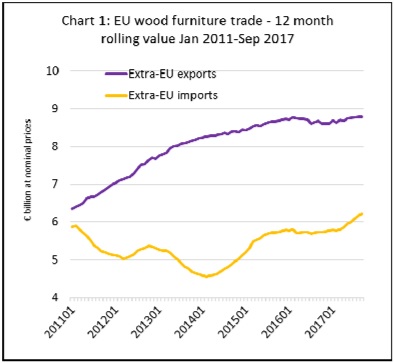
The EU has maintained a trade surplus in wood furniture since 2011 when exports to non-EU countries overtook imports from outside the EU. This surplus remained broadly flat between the start of 2015 and the first quarter of 2016 (averaging close to euro3 billion per annum), as both imports and exports were stable.

However, the trade surplus narrowed sharply in the second and third quarters of 2017 (to around euro2.6 billion per annum) as imports began to pick up.

The narrowing of the EU trade surplus is an encouraging sign for external suppliers of wood furniture into the EU that have struggled to compete in a market where domestic suppliers account for around 85% of total share.

The dominance of EU manufacturers in this sector is due to various factors including the strength of domestic brands in terms of innovation and design, the obstacles to overseas suppliers complying with complex EU technical and environmental standard, and the expansion of furniture manufacturing in Eastern Europe, a location which combines ready access to raw materials, relatively cheap labour, and the internal EU market.

Improved economic conditions in Europe have been driving a rise in wood furniture consumption in the last three years.

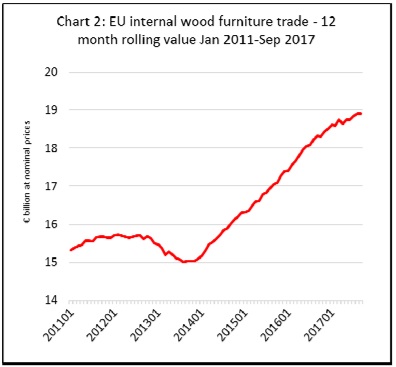
Rising consumption combined with the growth of manufacturing in Eastern Europe, particularly in Poland, Romania and Lithuania, is reflected in a rapid rise in EU internal wood furniture trade, from an annual level of euro15 billion at the start of 2014 to nearly euro19 billion by the end of 2017.

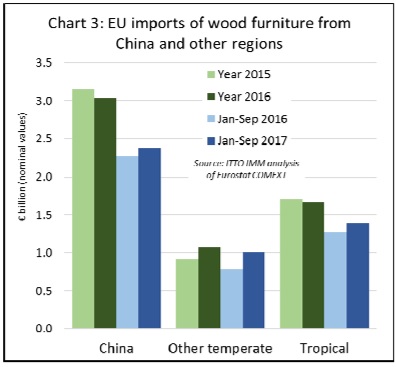
The pace of the rise in internal EU wood furniture trade tailed off a little during 2017. However, last year there was a rise in the pace of EU wood furniture imports from outside the region. Between January and September 2017, the EU imported euro1.39 billion of wood furniture from tropical countries, nearly 9% more than the same period the previous year. EU imports from China also increased, by 4% to euro2.38 billion in the same period.

However, the biggest gains in EU imports of wood furniture in 2017 were from other temperate countries, notably Bosnia, USA, and Ukraine. EU imports from these countries increased 28% to euro1.01 billion in the first 9 months of 2017, building on a 14% gain recorded the previous year.

Norske Skog goes bankrupt

Norske Skogindustrier AS was declared insolvent by the board of the parent company Norske Skog, at the end of 2017.

The company filed for bankruptcy in an Oslo court and is said that operations at the company’s seven paper mills would continue as usual.

According to the company, the paper mills are running well and have been generating profit, while the debt-laden remained the company’s greatest asset. Plans to sell them started moving forward last week after Norske Skog’s largest secured creditor, the Oceanwood Capital Management, withdrew support for any new recapitalization plan.

As reported, Oceanwood had instructed Citibank to begin the process for an auction of the plants. Around 100 potential bidders have already been identified.

It’s widely expected, though, that the plants will ultimately be bought up by Oceanwood and its new teammate Aker, the investment firm controlled by Norwegian industrialist Kjell Inge Røkke. They launched their own bid by teaming up last month, with a goal of acquiring the papermills cheaply and unburdened by debt, to eventually make up for their losses on loans to Norske Skog.

Christen Sveaas, Norske Skog’s largest shareholder, was said to be able to save the company from bankruptcy, but he had been advised to admitting defeat.

Now Oceanwood’s unlisted subsidiary, Norske Skog AS, will effectively become the new operating parent company of the Norske Skog group.

New Zealand softwood log exports reach new records for 2017

Log exports from New Zealand recorded hit volumes last year. This confirmed the local manufacturers' concerns regarding the fact that the country sends too many unprocessed logs overseas.

During the first 11 months of 2017, New Zealand exported $2.41 billion worth of softwood logs, surpassing all previous records for any full calendar year. Reports on the full year will be released on January 30, by Statistics New Zealand.

New Zealand is experiencing strong demand for logs from China, which has clamped down on harvesting its own forests and reduced tariffs on imported logs to meet demand in its local market. In the first 11 months of 2017, New Zealand exported $1.81b of logs to China, above the level for any full calendar year and accounting for 75 per cent of softwood exports, NZ Herald reported.

Successive governments have tried to add more value to commodities and riles the wood processing sector, but the shipments of raw logs have increased.

The WPMA (New Zealand's Wood Processors & Pine Manufacturers) says that countries such as Canada and Russia, which export wood, support their local industries while Chinese wood manufacturers benefit from subsidies, creating an uneven playing field for New Zealand processors. Thus, the associationwould like to see the government take a complaint to the World Trade Organisation.

Tanner said the WPMA was contacted by its counterparts in Australia late last year who were starting to experience a similar problem of increasing log exports to China.

Furniture industry in Germany stable in 2017; exports driven by Chinese demand

The furniture industry in Germany is expected to report generally stable sales for the whole year 2017, after three years of strong growth.

Volker Fasbender, Managing Director of the Association of the German Furniture Industry (VDMA), stated that after a sales increase of 3.2% in 2016, the industry was cautiously optimistic. During the IMM Cologne 2018, on January 10th, he added that during the Q1/2017, a plus of 3.1% was reached.

Continue reading "Furniture industry in Germany stable in 2017; exports driven by Chinese demand"

Lumber prices in the US hit record at the beginning of 2018

All framing lumber species in the US were reported good trading trend at the beginning of 2018. Even as wintry weather kept a grip on consumption in some markets, orders flowed back to the mills at a steady to active pace.
Many prices re-approached or even exceeded their highs set in 2017, some of which were at record levels. The January futures market surged to $500-plus in after-hours trading Thursday, just ahead of Friday’s January close.

Week
Jan 12
Week
Jan 5
Year Ago
2017
Random Lengths Framing Lumber Composite Price* $445 $436 $356
KD Western S-P-F #2&Btr 2x4 R/L Mill Price 486 472 308
KD Eastern S-P-F #1&2 2x4 R/L, delivered Great Lakes 557 536 406
Green Douglas Fir Std&Btr 2x4 R/L (Portland) 495 483 345
Southern Pine (Westside) #2 2x4 R/L 482 475 426
KD Coast Hem-Fir #2&Btr 2x4 R/L 495 488 350
Ponderosa Pine (Inland) #2&Btr 1x12 R/L 735 735 595
* Weighted average of 15 key items

Random Lengths Panel Market Report
Structural panel markets were active and prices firm to higher. Weather and transportation delays dominated conversations among OSB traders.
Producers, however, sold enough volume to keep prices on a firm to slightly higher track. Southern Pine plywood trading picked up for many suppliers amid steady demand.
Buyers who had held out for a price break reluctantly stepped in after mills extended order files through late January and early February. Western Fir plywood trading was busy, with widespread participation.

(f.o.b. mill prices) Week
Jan 12
Week
Jan 5
Year Ago
2017
Random Lengths Structural Panel Composite Price* $444 $437 $369
Southern (west-east) 15/32-inch 3-ply rated sheathing plywood 460-500 450-485 345-375
Southern (west-east) 15/32-inch 4-ply rated sheathing plywood 465-505 455-490 345-380
Western 1/2-inch 4-ply rated sheathing plywood 481 455 362
North Central 7/16-inch Oriented Strand Board 310 305 282
*Weighted average of 11 key items


Softwood lumber exports from Finland to China up by 75%

The Finnish softwood lumber exports to the world increased by 9% during January - October 2017, as compared to the same period of 2016. The softwood lumber volumes reached 6,9 million m3 during the mentioned period.

The softwood lumber exports to the European Union grew by 8%, reaching 2,5 million during January-October 2017, as compared to the 2,3 million exported in 2016. The United Kingdom was still the biggest European softwood lumber importer from Finland and increased the volumes by 5%, to 681,896 m3.

Finnish softwood lumber exports to China grew the most, by 75% and reached a volume of 1,3 million m3 during January-October 2017, as compared to the 749,300 m3 exported last year.

Egypt's imports of softwood lumber from Finland decreased by -13% during the mentioned period and reached a volume of 903,417 m3, as compared to the 1 million m3 imported in 2016, while

Exports to North Africa decreased by -19%, to 1,3 million, while the softwood lumber exports from Finland to other Asian countries increased by 45%, to almost 2,2 million m3 during January-October 2017.

Destination 2016 2017 Change in %
EUROPEAN UNION 2,370,228 2,551,073 8 %
United Kingdom
649,854 681,896 5 %
Germany
377,296 393,889 4 %
France
367,355 374,024 2 %
Estonia
191,716 264,569 38 %
Netherlands
197,817 208,152 5 %
OTHERS 586,190 628,543 7 %
OTHER EUROPEAN COUNTRIES 92,130 98,410 7 %
Turkey
27,738 35,573 28 %
Switzerland
33,514 32,249 -4 %
Norway
21,706 20,790 -4 %
Cyprus
4,868 4,309 -11 %
Albania
2,770 2,586 -7 %
OTHERS 1,534 2,903 89 %
NORTH AFRICA 1,611,318 1,309,040 -19 %
Egypt
1,032,497 903,417 -13 %
Morocco
184,573 190,184 3 %
Algeria
326,971 151,404 -54 %
Tunisia
67,277 64,035 -5 %
OTHER AFRICAN COUNTRIES 5,724 11,109 94 %
Sudan
5,081 9,945 96 %
Cape Verde
567 708 25 %
South Africa
22 365 1,559 %
Mauritius
53 48 -9 %
Gambia
- 43 %
OTHERS 1 - -100 %
NORTH AMERICA 2,399 9,736 306 %
USA
2,335 9,676 314 %
Canada
64 60 -6 %
CENTRAL AMERICA 4 88 2,100 %
British Virgin Islands
- 48 %
Trinidad and Tobago
- 40 %
Bahamas
4 - -100 %
SOUTH AMERICA - 179 %
Colombia
- 96 %
Ecuador
- 83 %
NEAR AND MIDDLE EAST 718,614 708,360 -1 %
Israel
338,003 355,578 5 %
Saudi Arabia
353,036 306,364 -13 %
Jordan
16,035 32,708 104 %
United Arab Emirates
4,259 4,294 1 %
Iran
3,987 4,251 7 %
OTHERS 3,294 5,165 57 %
OTHER ASIAN COUNTRIES 1,517,042 2,198,052 45 %
China
749,300 1,310,659 75 %
Japan
666,357 714,414 7 %
South Korea
47,082 73,350 56 %
Vietnam
26,054 31,197 20 %
Taiwan
12,237 26,995 121 %
OTHERS 16,012 41,437 159 %
OCEANIA AND POLAR REGION 16,450 19,375 18 %
Australia
16,338 19,334 18 %
New Zealand
40 41 3 %
French Southern Territories
43 - -100 %
French Polynesia
29 - -100 %
REST OF THE WORLD 145 1,077 643 %
Kuwait
77 1,077 1,299 %
Saint Barth�lemy
68 - -100 %
TOTAL 6,334,054 6,906,499 9 %

China unveils forestry investment goals for 2050

The forestry authority in China has recently released a plan to invest in the country's domestic forestry industry and increase the resources of the forest to the world's average by 2050.

The plan, unveiled by Zhang Jianlong, chief of State Forestry Administration, is the latest move taken by government sectors to implement the ruling party's modernization blueprint.

At its 19th National Congress in November, China's ruling party decided to make the country prosperous, strong, democratic, culturally advanced, harmonious and beautiful by 2050.

Zhang said that by 2050, China's forest stock will expand to 26.5 billion cubic meters, and 72 percent of the growth of forestry industry will come from technological advancement, according to Ecns.

Even if China's forest resources have been growing the fastest in the world in the last 5 years, the forestry sector is still weak for the country's modernization plan.

"Inadequate forestry resources were a significant cause of China's fragile ecology and the lack of ecological products," Zhang said.

To improve the situation, the administration has broke down the country's forestry modernization goals into different phases. In the first phase from now until 2020, China's forest coverage rate is expected to reach 23.04 percent from 21.66 percent, while the volume of forest resources will expand from 15.137 billion cubic meters to 16.5 billion cubic meters.

As reported by Ecns, from 2020 to 2035, the percentage of forest coverage will grow further to 26 percent while forest stock will rise to 21 billion cubic meters. Over the same period, the greening rate in the rural area will surge from 30 percent to 38 percent. By 2050, the figure will reach 43 percent.

Zhang said that in 2018, the afforested areas in both cities and counties would be 6.67 million hectares.

The aggregate output of the forestry industry will reach 7.5 trillion yuan in 2018 compared with 7 trillion yuan in 2017, while the imports and exports of forestry products will rise to 160 billion U.S. dollars from 150 billion U.S. dollars in 2017, he said.

Roundwood prices in Lithuania increased during October

Roundwood prices in Lithuania went up during October 2017, as compared to September and to the same month of 2016.
Thus, the prices for sawlogs increased at an average of 5% to 18%. Pine sawlogs could be bought for EUR 59/m3, 9.25% more than in October 2016, while the prices for spruce and birch went up by 8.06% and 13.23%, respectively.
The price for alder reached the highest increase, by 18.51%, to EUR 64/m3.
Among the pulpwood assortments, the price for pine went up by 17.39%, while spruce and birch increased by 12.5% and 12%, respectively.

Roadside prices of roundwood in state forests of Lithuania EUR/m³ under bark

October 2016 September 2017 October 2017 Change
October/ 2016 to October/ 2017
SAWLOGS
Pine 54 58 59 +9.25%
Spruce 62 66 67 +8.06%
Birch 68 77 77 +13.23%
Alder 54 63 64 +18.51%
Small-sized softwood 36 37 38 +5.55%
PULPWOOD
Pine 23 27 27 +17.39%
Spruce 24 27 27 +12.5%
Birch 25 28 28 +12%

EU tropical sawn timber imports fall 21%

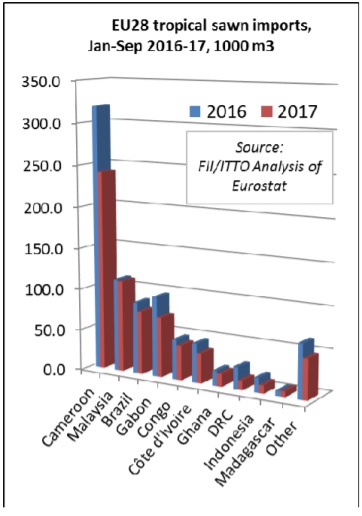
In volume terms, EU imports of tropical sawnwood were 670,500 cu.m in the first nine months of 2017, 21% less than the same period in 2016.

Although a large share of the decline was due to a 25% fall in imports from Cameroon (to 241,000 cu.m), there was a fall in trade with nearly all the main supply countries.

EU tropical sawnwood imports fell sharply from Brazil (declining 12% to 76,600 cu.m), Gabon (declining 25% to 72,500 cu.m), Congo (declining 13% to 42,100 cu.m), Cote d’Ivoire (declining 24% to 36,000 cu.m), Ghana (declining 14% to15,500 cu.m) and DRC (declining 57% to 11,300 cu.m). Of major suppliers, only Malaysia maintained a level (110,000 cu.m) close to that of the previous year.

In the first nine months of 2017, imports of tropical sawnwood declined into all the main EU markets, with the single exception of the UK.

Imports were down 29% in Belgium (202,600 cu.m), 6% in the Netherlands (103,100 cu.m), 26% in France (80,200 cu.m), 35% in Italy (73,100 cu.m), 21% in Spain (45,200 cu.m), 14% in Germany (31,700 cu.m), and 10% in Portugal (22,200 cu.m). Imports in the UK increased, but by only 2% to 67,600 cu.m.

Positive outlook for 2018 US hardwood flooring market

Hardwood flooring consumption increased 5.9% in 2016, according to a market research report released by Catalina Research.

Growth in laminate flooring was much lower at less than 1%. The US hardwood flooring market was worth US$3.64 billion in 2016.

In laminate flooring imports have grown, especially from Asia, but US producers hope that the new federal formaldehyde emission requirements will provide a competitive advantage to domestic manufacturers.

Competition from non-wood hard surface floors, especially luxury vinyl tile and wood plastic/polymer composites, is another concern for wood flooring producers.

The hardwood flooring market outlook for 2018 is positive. The National Hardwood Flooring Association carried out a survey among its members this year and more than 70% expect sales to grow at least 3% in 2018. One third of manufacturers, distributors, retailers, and contractors expect sales to grow 8% or more.

Germany: Wood products prices for December 2017

In December 2017, Germany's producer prices of wood products have hardly changed as compared to November. Boards, battens and squared timber have recorded a minimal decline of around 0.4-0.5%.
Hardwood lumber and beech frames have grown by about 0.36%. These were the strongest price movements. In sum, the price movements of last month are on a slight downward trend.
Compared to last year, a similar picture as in the previous months can be noticed. Especially pellets and wood chips are significant cheaper over the previous year. Also KVH is again on a negative trend after a high phase registered in the first half of 2017.
On the other hand, rawboards are still well above last year's level. In addition, hardwood lumber and beech frames are up, as well as wide boards and raw HDF boards.

Germany's Producer Price Index Commercial Products
(2000=100)
Dec.
2016
Nov.
2017
Dec.
2017
Change
Dec. '16
to '17
Spruce and Fir lumber (Picea abies Karst.) 113.6 114.0 113.7 +0,09%
Lumber according to DIN 4074/S10 117.5 115.2 115.0 -2,13%
Finger-jointed squares and beams (KVH) 106.9 100.3 100.6 -5,89%
Boards, width over 16 cm 117.2 121.7 121.7 +3,84%
Boards, width from 8 to 16 cm, size from 15 to 24 mm 111.8 110.1 109.6 -1,97%
Roof battens according to DIN 4074/S10 114.6 118.3 117.7 +2,71%
Reserve squared timber, A/B, 10X10 - 12X12 113.5 114.7 114.2 +0,62%
Softwood, size>6mm, planed, sanded, finger-jointed 113.9 110.9 111.0 -2,55%
Wood chips from softwood 117.3 98.4 98.0 -16,45%
Pellets and Briquets, compressed 136.0 120.5 120.6 -11,32%
Hardwood lumber 106.4 110.2 110.6 +3,95%
Beech blocks, A/B, size 50-60 mm, length 3m, damped 102.3 103.8 103.8 +1.47%
Beech frames, size 26-32 mm, length  3m, undamped 106.9 110.9 111.3 +4,12%
Particle boards, raw or sanded 105.7 118.1 118.0 +11,64%
Particle boards, laminated with decor 114.4 115.2 115.2 +0,70%
HDF panels, size > 800 kg/m³, raw/sanded 110.5 114.6 114.4 +3,53%
Laminate floorings, density > 800 kg/m³ 110.2 108.9 109.0 -1.09%

Newsletter

Subscribe to our digital newsletter for your daily digest of essential news, views and analysis from the international wood industry delivered directly to your inbox.


0