Article archive

Roundwood prices in Lithuania increased during October

Roundwood prices in Lithuania went up during October 2017, as compared to September and to the same month of 2016.
Thus, the prices for sawlogs increased at an average of 5% to 18%. Pine sawlogs could be bought for EUR 59/m3, 9.25% more than in October 2016, while the prices for spruce and birch went up by 8.06% and 13.23%, respectively.
The price for alder reached the highest increase, by 18.51%, to EUR 64/m3.
Among the pulpwood assortments, the price for pine went up by 17.39%, while spruce and birch increased by 12.5% and 12%, respectively.

Roadside prices of roundwood in state forests of Lithuania EUR/m³ under bark

October 2016 September 2017 October 2017 Change
October/ 2016 to October/ 2017
SAWLOGS
Pine 54 58 59 +9.25%
Spruce 62 66 67 +8.06%
Birch 68 77 77 +13.23%
Alder 54 63 64 +18.51%
Small-sized softwood 36 37 38 +5.55%
PULPWOOD
Pine 23 27 27 +17.39%
Spruce 24 27 27 +12.5%
Birch 25 28 28 +12%

EU tropical sawn timber imports fall 21%

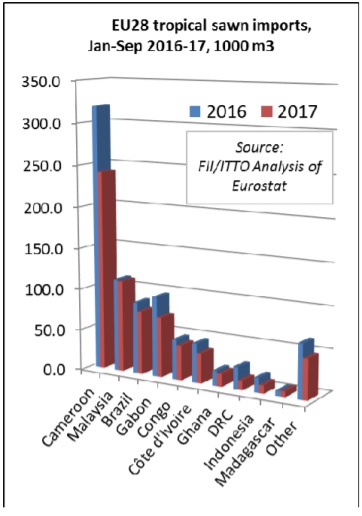
In volume terms, EU imports of tropical sawnwood were 670,500 cu.m in the first nine months of 2017, 21% less than the same period in 2016.

Although a large share of the decline was due to a 25% fall in imports from Cameroon (to 241,000 cu.m), there was a fall in trade with nearly all the main supply countries.

EU tropical sawnwood imports fell sharply from Brazil (declining 12% to 76,600 cu.m), Gabon (declining 25% to 72,500 cu.m), Congo (declining 13% to 42,100 cu.m), Cote d’Ivoire (declining 24% to 36,000 cu.m), Ghana (declining 14% to15,500 cu.m) and DRC (declining 57% to 11,300 cu.m). Of major suppliers, only Malaysia maintained a level (110,000 cu.m) close to that of the previous year.

In the first nine months of 2017, imports of tropical sawnwood declined into all the main EU markets, with the single exception of the UK.

Imports were down 29% in Belgium (202,600 cu.m), 6% in the Netherlands (103,100 cu.m), 26% in France (80,200 cu.m), 35% in Italy (73,100 cu.m), 21% in Spain (45,200 cu.m), 14% in Germany (31,700 cu.m), and 10% in Portugal (22,200 cu.m). Imports in the UK increased, but by only 2% to 67,600 cu.m.

Positive outlook for 2018 US hardwood flooring market

Hardwood flooring consumption increased 5.9% in 2016, according to a market research report released by Catalina Research.

Growth in laminate flooring was much lower at less than 1%. The US hardwood flooring market was worth US$3.64 billion in 2016.

In laminate flooring imports have grown, especially from Asia, but US producers hope that the new federal formaldehyde emission requirements will provide a competitive advantage to domestic manufacturers.

Competition from non-wood hard surface floors, especially luxury vinyl tile and wood plastic/polymer composites, is another concern for wood flooring producers.

The hardwood flooring market outlook for 2018 is positive. The National Hardwood Flooring Association carried out a survey among its members this year and more than 70% expect sales to grow at least 3% in 2018. One third of manufacturers, distributors, retailers, and contractors expect sales to grow 8% or more.

Germany: Wood products prices for December 2017

In December 2017, Germany's producer prices of wood products have hardly changed as compared to November. Boards, battens and squared timber have recorded a minimal decline of around 0.4-0.5%.
Hardwood lumber and beech frames have grown by about 0.36%. These were the strongest price movements. In sum, the price movements of last month are on a slight downward trend.
Compared to last year, a similar picture as in the previous months can be noticed. Especially pellets and wood chips are significant cheaper over the previous year. Also KVH is again on a negative trend after a high phase registered in the first half of 2017.
On the other hand, rawboards are still well above last year's level. In addition, hardwood lumber and beech frames are up, as well as wide boards and raw HDF boards.

Germany's Producer Price Index Commercial Products
(2000=100)
Dec.
2016
Nov.
2017
Dec.
2017
Change
Dec. '16
to '17
Spruce and Fir lumber (Picea abies Karst.) 113.6 114.0 113.7 +0,09%
Lumber according to DIN 4074/S10 117.5 115.2 115.0 -2,13%
Finger-jointed squares and beams (KVH) 106.9 100.3 100.6 -5,89%
Boards, width over 16 cm 117.2 121.7 121.7 +3,84%
Boards, width from 8 to 16 cm, size from 15 to 24 mm 111.8 110.1 109.6 -1,97%
Roof battens according to DIN 4074/S10 114.6 118.3 117.7 +2,71%
Reserve squared timber, A/B, 10X10 - 12X12 113.5 114.7 114.2 +0,62%
Softwood, size>6mm, planed, sanded, finger-jointed 113.9 110.9 111.0 -2,55%
Wood chips from softwood 117.3 98.4 98.0 -16,45%
Pellets and Briquets, compressed 136.0 120.5 120.6 -11,32%
Hardwood lumber 106.4 110.2 110.6 +3,95%
Beech blocks, A/B, size 50-60 mm, length 3m, damped 102.3 103.8 103.8 +1.47%
Beech frames, size 26-32 mm, length  3m, undamped 106.9 110.9 111.3 +4,12%
Particle boards, raw or sanded 105.7 118.1 118.0 +11,64%
Particle boards, laminated with decor 114.4 115.2 115.2 +0,70%
HDF panels, size > 800 kg/m³, raw/sanded 110.5 114.6 114.4 +3,53%
Laminate floorings, density > 800 kg/m³ 110.2 108.9 109.0 -1.09%

Rising US housing starts predicted this year

The newly enacted US tax law will create a more favorable tax climate for the business community, which should spur job and economic growth and keep single-family housing production on a gradual upward trajectory in 2018.

According to economists speaking at the NAHB International Builders' Show in Orlando, Fla., on the 9th of Junary, builders will continue to deal with ongoing supply-side headwinds this year that will dampen more robust growth. .

"We expect that tax reform will boost GDP growth to 2.6 per cent in 2018, and this added economic activity will also bode well for housing, although there will be some transition effects in high-tax jurisdictions," said NAHB chief economist Robert Dietz. "Ongoing job creation, expected wage increases and tight existing home inventory will also boost the housing market in the year ahead."

These factors include an increasing number of unfilled construction jobs, a shortage of buildable lots and a slow growth in acquisition, development and construction loan activity that is failing to keep pace with rising demand.

In addition, regulatory costs stemming from building codes, land use, environmental and other rules have jumped 29 per cent in the past five years, and this has had a significant impact on housing affordability.

The ongoing U.S.-Canada softwood lumber trade dispute is further exacerbating the situation, as the price of softwood lumber has increased 20 per cent from a year ago.

As the economy continues to strengthen, NAHB expects 30-year fixed-rate mortgages will average 4.31 per cent in 2018 and 4.82 per cent in 2019.

The agency is projecting 1.21 million total housing starts in 2017 and expects overall production to grow an additional 2.7 per cent this year to 1.25 million units.

Single-family starts are expected to rise five per cent in 2018 to 893,000 units and increase an additional five per cent to 940,000 next year.

Setting the 2000-2003 period as a benchmark for normal single-family housing activity when single-family production averaged 1.3 million units annually, single-family starts are expected to gradually rise from 63 per cent of what is considered a typical market in the third quarter of 2017 to 73 per cent of normal by the fourth quarter of 2019.

On the multifamily side, NAHB is expecting multifamily starts to edge 1.6 per cent lower this year to 354,000 units from a projected 360,000 total in 2017. This is a sustainable level due to demographics and the balance between supply and demand.

Meanwhile home remodeling is posting strong market conditions, due in part to strong demand in the wake of the terrible hurricane and wildfire season in 2017. Residential remodeling activity is expected to register a seven per cent gain in 2018 over last year.

Healthy Housing Markets
Delving beneath the national numbers, David Berson, senior vice-president and chief economist at Nationwide Insurance, said the vast majority of local housing markets are healthy and faring well.

Berson lists 324 markets as positive, 69 as neutral and just seven as negative. While job gains, household formations and mortgage markets still look good, he noted that rapid price increases are concerning.

Comparing current conditions with the housing boom a decade ago, Berson noted that the market is supply constrained today, but wasn't during the boom. And mortgage credit, while more readily available than just a few years ago, remains far limited relative to the market peak in 2007.

While he anticipates a slightly more rapid rise in mortgage interest rates this year, Berson said it should not hurt housing activity.

"Mortgage rates are expected to rise from four per cent to 4.5 per cent by the end of year," he said. "However, housing demand remains strong and wages are solid, and this will more than offset the negative effects from rising rates."

Home Prices Up, Affordability Down
CoreLogic chief economist Frank Nothaft also expects mortgage interest rates and home prices to post moderate increases in 2018, which in turn will lessen housing affordability.

Like Berson, Nothaft expects that the benchmark 30-year fixed-rate mortgage will average 4.5 per cent by the end of the year.

"Higher rates are not just a gradual erosion of affordability, but also impact owner mobility," said Nothaft. "That has implications on the overall inventory for sale. Supply has been tight and for-sale inventory will continue to remain tight."

The ongoing tight inventory in the housing market will cause home and rent price growth to outpace inflation, he added, with nationwide home prices rising an average five per cent and rental prices posting a three per cent increase.

The biggest growth for new home sales are occurring in the South and West, where many of these metro areas have good job growth, good affordability and good weather. Nothaft listed Houston, Dallas, San Antonio, Austin, Phoenix, Atlanta and Charlotte as the top seven major markets in terms of new home sales.

Meanwhile, he reported that overall mortgage delinquency and foreclosure rates are at their lowest levels in more than a decade, but that is a different story for markets pummeled by last year's devastating hurricanes.

"Houston's delinquencies almost doubled year-over-year and that is due almost entirely to Hurricane Harvey," said Nothaft.

Vietnam’s timber exports to the EU forecast to hit $1 billion yearly by 2020

With the new EU-Vietnam Free Trade Agreement (EVFTA), experts predict that about $1 billion worth of timber will be exported to the EU every year by 2020.

Nguyễn Tôn Quyền, vice-chairman and general secretary of the Vietnam Timber and Forest Association, said that, for many years, the export value of timber and wooden products from Vietnam to EU reached at annual average of about $650-700 million.

The EVFTA, expected to come into effect next year, will create a positive impact on the Vietnamese timber industry. At present, Vietnam’s timber and wooden products are exported mainly to Germany, France, Spain and Italy, but with EVFTA, the export market would be expanded to other EU member countries, Vietnam News reported.

The demand for timber products from the EU has been about $80-85 billion per year, which is much larger than Vietnam’s export value of timber and wooden products to the EU.

EU timber processing technology boosts productivity by up to about 15-20 per cent, Tôn Quyền said. Under the EVFTA, together with a zero tax rate, businesses can more easily import machinery, equipment, and wood processing technology as well as learn corporate governance from the EU.

He added that the EU market had strict standards for exported timber and wooden products. A number of exporters in the North still do not know much about those standards and only about half a dozen have qualified to export their products to the EU. Meanwhile, hundreds of businesses in the Centre and the South have knowledge about those standards and EVFTA, according to Vietnam Net.

To take full advantages from the agreement in exporting goods to the EU, businesses need to constantly learn, update information and improve themselves.

The total Vietnamese exports of wood and timber products are forecast to hit $8 billion in 2017, surpassing the yearly target of $7.5 billion, Quyền said. The figure reached nearly $7 billion in January-November, up 10.5 per cent from the same period last year, he said.

Strong growth in wood exports was seen in key markets such as the US (up 18.8 per cent), the South Korea (14.2 per cent) and Canada (13.4 per cent). The trend was attributed to an increase in processed wooden products, such as MDF (medium-density fibre board), particle board and artificial board.

Tô Xuân Phúc from the US-based Forest Trends, said Vietnam’s wood and timber exports to the US, currently worth up to $2.7 billion, might be affected by the US’s policy of creating more jobs in the US.

The US, Japan, the EU, China and South Korea are the biggest importers of Vietnam’s timber and wooden products, accounting for 90 per cent of the total value of the sector. The US imports 42.7 per cent, followed by China (14.1 per cent) and Japan (13.7 per cent).

Finnish roundwood prices went up in October

Roundwood prices in Finland went up during October 2017, as compared to the same period last year and the previous month.
During the mentioned period, pine logs could be bought for EUR 58.42/m3, 1.91% more than in October 2016, while the price for spruce increased by 3.42%, to EUR 60.69/m3. Also, the price for birch logs grew by 3.28%, to EUR 48.40/m3.
Among the pulpwood assortments, pine was bought for EUR 27.37/m3 in October, 2.83% more than during the same period last year. Moreover, the price for spruce went up by 0.43%, to EUR 30.29/m3, while birch was the only to register a slight decrease of -0.94%, to EUR 28.24/m3.

October 2016 September 2017 October 2017 Change in % October 2016-October 2017
Pine logs 57.32 57.70 58.42 +1.91%
Spruce logs 58.68 60.24 60.69 +3.42%
Birch logs 46.86 48.30 48.40 +3.28%
Pine pulpwood 28.17 27.83 27.37 +2.83%
Spruce pulpwood 30.16 30.17 30.29 +0.43%
Birch pulpwood 28.51 27.85 28.24 -0.94%

Pfleiderer, Kronospan and Swiss Krono accused of forming a cartel in Poland

The Polish Competition and Consumer Protection Bureau announced on 28 December 2017 that it had imposed fines on several wood-based material manufacturers because they were allegedly forming a cartel.

The companies had made price agreements for nearly four years, from early 2008 to September 2011, and exchanged, while exchanging other confidential information.

The total amount of the fine amounts to nearly PLN135 million (EUR 32 million). According to the report, five companies from three groups are affected: Kronospan Szczecinek, Kronospan Mielec, the Pfleiderer Group, Pfleiderer Wieruszów and the Swiss Krono Group.

Kronsopan Szczecinek has to pay PLN60,7 million, which is the highest fine, followed by Kronospan Mielec, that has to pay PLN39.3 million, Pfleiderer Wieruszów with PLN19.8 million and the Pfleiderer Group with just under PLN16 million.

As part of a leniency program, the Swiss Krono Group was exempted from the fine. The company has supported the authorities during the investigations, by providing details of the agreements reached.

More specifically, in addition to sales prices, companies have also exchanged data on price increases and sales volumes, according to the Office for Competition and Consumer Protection.

The furniture industry supplied by the manufacturers generates almost 2% of the Polish gross domestic product. Therefore, it can be assumed that the Polish domestic economy was harmed. Though, the decision is not final and the companies can make an appeal.

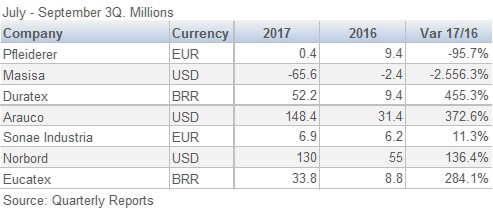
Norbord beats its major competitors

Canadian wood panel manufacturer Norbord reports the best performance figures in the third quarter of 2017.

The evaluation is carried out among the main international manufacturers of wood panels that published comparable results in Q3/2017: Arauco, Duratex, Eucatex, Masisa, Norbord, Pfleiderer and Sonae, Notifix reports.

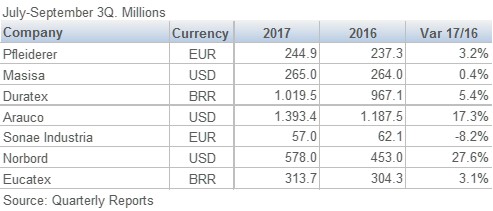
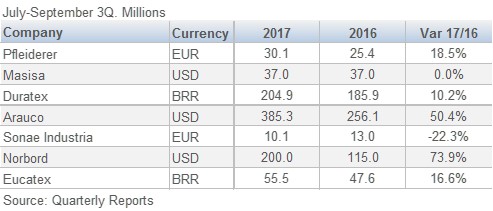
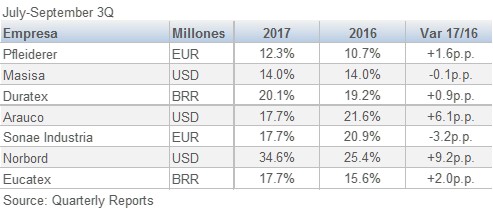
Compared to the Q3/2016, Norbord stood out in terms of growth in sales (+ 27.6%) and EBITDA (+ 73.9%), as well as EBITDA margin improvement (+6.1 percentage points). In sales growth Norbord was followed by Chile's Arauco and Brazil's Duratex with improvements of 17.3% and 5.4% respectively. On the contrary, Portuguese Sonae registered the biggest drop in sales in Q3/2017 (-8.2%), being the only one with negative growth.

As Notifix reported, during the Q3/2017, Chile's Arauco was second in terms of EBITDA growth (+ 50.4%), ahead of Pfleiderer (18.5%), Eucatex (16.6%), and Duratex (+ 10.2%). Sonae (-22.3%) had the biggest drop in EBITDA compared to the same period in 2016. Regarding the EBITDA margin, Norbord had a strong improvement of 9.2 percentage points, followed by Arauco, with an improvement of 6.1 percentage points, and Eucatex with 2.0 percentage points of improvement. Masisa was the only one whose EBITDA margin fell in Q3/2017 compared to the same period in 2016.

SALES

EBITDA

EBITDA Margin

Profit / Loss

Source: Notifix

Arauco has purchased Masisa’s industrial assets in Mexico

Arauco has signed in December a purchase agreement for Masisa’s industrial assets in Mexico.

The agreement involves an investment of $245 million for three industrial complexes located in Chihuahua, Durango and Zitácuaro.

In terms of production, the complexes include three particleboard (PB) lines with an annual installed capacity of 293,386msf (519,000 m3) and an MDF panel line of 124,360msf (220,000 m3) a year. In addition, there are three TFL lines, a resin plant, and a veneer line.

This action is part of our expansion plan that aims to position Arauco as a global company. With this acquisition, we will be extending our presence in the North American panel market, where we see trends of continued market growth for this type of product, focusing on residential and commercial furniture, and industrial markets,” said Matías Domeyko, Arauco CEO.

Back in September 2017, Masisa announced the sale of its manufacturing operations in Brazil to Arauco, for USD 102.8 million.

Masisa Brazil consists of two main manufacturing assets, which are two industrial complexes located in Ponta Grossa (Paraná) and Montenegro (Rio Grande do Sul), that include a line of MDF panels with an installed capacity of 300,000 m3 per year, a line of MDP panels with an installed capacity of 650,000 m3 per year and four melamine coating lines with a total installed capacity of 660,000 m3 per year.

Chinese furniture manufacturers relocate operations to Vietnam

Many Chinese furniture manufacturers are relocating their manufacturing operations to Vietnam in an effort to deal with rising domestic labor costs.  

According to Gao Ziu Zhi, chairman of China's Tianjin Furniture Association, Vietnam offers lower labor costs and tariff reductions brought on by a multitude of free trade agreements. Most of the companies looking to relocate are large-scale and possess major export markets.

“Vietnam is a promising market for Chinese firms to expand operations in the fields of furniture manufacturing, wood processing, and bike making," says Geng Wei, chairman of the Tianjin Foreign Economic and Trade Promotion Association. "Chinese firms are interested in co-operating with Vietnamese counterparts to transport and import tropical agricultural products and fruits through official channels.”

Several Chinese companies have gathered at Vietnam Expo 2017 held in Ho Chi Minh City last week to explore the market. The expo, organized alongside with Vietnam Hardware & Hand Tools 2017, is a major trade promotion channel between Vietnam and other countries like China, South Korea, Japan, India, and Singapore.

China is the largest trade partner of Vietnam, while Vietnam is China’s ninth largest.

The demand for Japanese biomass is forecast to triple by 2025

The Japanese demand for biomass fuels, including wood pellets, palm kernel shells (PKS), domestic biomass, and imported woodchips, will increase 351% from 2017 to 2025.

As Japan embraces biomass to be a significant part of its energy future, the wood pellet demand alone is projected to reach nearly 10 million tonnes by 2025, the latest report released by Future Metrics shows.

Japan shut down all of its nuclear power reactors following the Great East Japan Earthquake in March 2011. As of June 2017, only five reactors have resumed operation, and of Japan’s 57 nuclear power plants, 14 are slated for decommissioning due to their age.

METI’s target of having renewable energy sources provides 22-24 percent of Japan’s energy needs by 2030 and is based on the resumption of power generation at all of the remaining 43 nuclear power plants, but the number of plants that will resume operation remains a topic of national debate.

Accordingly, Japan currently relies on other energy sources to generate power – primarily coal and liquid natural gas.

After the accident in Fukushima, power companies began using wood pellets as a source for thermal power generation, though coal is still the main source. The companies use imported wood pellets, as prices are lower compared to those produced domestically.

Japan has a zero import tariff for wood pellets (HS4401.31) and the country's FIT incentive for the generation of electricity from biomass has driven a rapid increase in demand for biomass, including domestic and imported wood pellets, and the import of palm kernel shells (PKS).

Although Japan has abundant biomass resources, it is unable to harvest and transport those resources economically. Imports of wood pellets and PKS are therefore likely to increase in the coming years as existing coal thermal power plants are able to co-fire with wood pellets or PKS.

Wood Pellet Production and Consumption Since the GOJ’s “Biomass Nippon Strategy” was unveiled in 2002, the introduction of pellet boilers and stoves for heating in public facilities and ordinary households has expanded.

Accordingly, the number of plants and the production of pellets have increased significantly. In 2015, Japan’s production of wood pellets was 120,000 MT, and there were 142 plants. The production of wood pellets in 2015 decreased by 4.8 percent from the previous year as demands for heating decreased mainly due to a mild winter.

According to an industry source, production of wood pellets in 2018 is expected to recover to record-high 2014 levels as the use of cogeneration units running on wood pellets has started to spread across Japan. Thus, moving forward, domestic wood pellet suppliers are forecasting an increase in demand.

The production scale of wood pellet plants in Japan is very small compared to modern commercial plants in the United States and Europe. About 60 percent of the plants in Japan produce a mere 100 – 1,000 MT each year.

Among the 142 plants, only three plants have production capacity of more than 10,000 MT per year, and two of the three plants are producing wood pellets mainly for coal-fired power plants for mixed combustion.

In Japan, demand for wood pellets by coal-fired power plant operators is strong. The power operators rely on imported wood pellets mainly due to their price competiveness and availability.

As noted in the FY2016 Annual Report on Forest and Forestry in Japan, in order to increase competitiveness of domestically produced wood pellets, MAFF states that the production scale of the wood pellets plants must increase.

Japan is considering establishing its own standards to address concerns about environmental sustainability criteria for biomass products. Accordingly, post will continue to monitor the development of this policy plan.

Egypt emerges as key market for American hardwoods

Egypt was a key market for American hardwoods during 2016, with the wood imports to the Arab world's most populous nation surging to over $1.365 billion.

The information was released by the American Hardwood Export Council (AHEC) in a report, during the participation at the third edition of the Cairo WoodShow, held recently.

As per the latest statistics from the US Department of Agriculture (USDA), the total exports of US hardwood lumber and veneer to the Middle East & North Africa (Mena) region hit $73.36 million for the first three quarters, Trade Arabia informed.

A closer look at the statistics revealed that US hardwood lumber shipments to Egypt for the same time period reached a value of $4.523 million (volume equivalent to 5,961 cu m), emphasizing the importance of this major furniture producing market.

The total direct exports of US hardwood veneers to Egypt reached a value of $4.298
million from January to September of this year, while the market reports indicated that wood imports to Egypt reached $1.365 billion in 2016.

As the AHEC report showed, the wood-based furniture domestic production was valued at $750 million and that the Egyptian wood industry is poised to grow domestically, as the Government of Egypt engages in large-scale infrastructure projects.

Whilst these developments present ample opportunities for American hardwood species. Roderick Wiles, the AHEC director for Africa, Middle East, South Asia and Oceania, believes that market development activities need to take place to capitalize on these opportunities. Though, AHEC is confident that American tulipwood, as well as the full range of American hardwood species, could all work well in the products being produced in Egypt. However, it is crucial that the key industry players are made fully conversant with what is available from the US and also the NHLA lumber grading rules, noted the top official, Trade Arabia reported.

"Exports to Egypt, which saw significant growth during the past two years, fell by 20 percent
in volume and value during the first nine months of this year. The majority of this decrease
was accounted for by lower shipments of red oak, which accounted for over 50 percent of
the volume of lumber shipped to Egypt," stated Wiles.

In contrast, exports of white oak to the market actually picked up marginally. Despite the slight decrease in exports, Egypt is still in the top five markets for lumber in the region and remains the number one market for US hardwood veneers, he noted.

Given that Egypt is a major consumer of solid wood, primarily for furniture production, our
participation was aimed at educating visitors about the wide availability and variety of
American hardwood species as well as their proven environmental credentials,” he added.

Wood pellets prices in Germany on the rise in December

Wood pellets price in Germany has tightened during December 2017, at a national average of EUR 245.52/tonne. This represents a 2.7% increase over November and a 4.4% increase, as compared to December 2016.
The price per kilogram is 24.55 cents, while one kilowatt hour (kWh) of heat from wood pellets costs 4.91 cents. The price advantage for fuel oil is currently 17.5%, compared to 18% for natural gas, according to the German Energy Wood and Pellet Association e. V. (DEPV).
"Nationwide heating companies have already stocked up with pellets. Experienced wood pellet traders know that pellets cost more in winter than in summer, " confirms Martin Bentele, Managing Director of the industry association DEPV. "Increased demand is thus counteracted by unfavorable production conditions. According to a DEPV survey, however, the warehouses are well filled, so that the supply of domestic wood pellets is always assured. However, those who order pellets now have to keep in mind that short-term orders are often complicated by the winter weather and that there may be extra waiting times."
Regional prices(for 6 tonnes purchases) in December: Northern Germany: EUR 244.26 / t, Central Germany: EUR 244.79 per tonne, Southern Germany: EUR 244.90 / t.
Larger quantities (26 t) could be bought for the following prices: South: 227.08 EUR / t, Middle: 226.46 EUR / t, North / East: 225.58 EUR / t (all incl. VAT).

Timber prices in China forecast to rise in 2018

The trend for timber price index in China during 2017 was on the rise, even if it was affected by the macroeconomic regulation and control, the rising raw materials and the labor costs. Also, it is estimated that the price hike will go on in 2018.
Moreover, the raw material logs market was high, while the market of wood-based panel tended to be stable and the sawn wood market dropped slightly.
Timber market
As reported by Global Wood, starting October 2017,  the logs classification index closed at 1108.49, an increase of 0.2% qoq, while three major markets rose and other two fell. Guangzhou Yuzhu Wood Index was 1120.08, up 0.67%; Shanghai Furen logs index was 1177.26, up 0.04%; Sichuan Southwest Wood Index was 976.34, down 0.86%.
So far, the fish ball market, the representative of species of logs are still maintained the momentum of the best-selling, with a handle West Nutmeg, iron wood beans, pull, African rosewood, etc. are still favorable for downstream manufacturers, the transaction price was 2850 yuan / Cubic meter, 3000 yuan / cubic meter, 2650 yuan / cubic meter, 3650 yuan / cubic meter.
Wood-based panel market
By the end of October, the price index of China's wood-based panel was 1024.54, down by 1.14% from the previous month. The artificial board index of the fish ball market was 1070.01, up by 0.94% compared with the previous month; the Furen index was up by 824.01, up 0.11%; the big Southwest market index was down by 2.86% at 1202.34.
With the end of the traditional home improvement season, wood-based panel market gradually calm. To Guangdong fish ball, for example, 15%, 18% fine wood board average transaction price of 115 yuan / piece, 125 yuan / Zhang, the price is more stable, Global Wood reported.
Sawn timber market
China's sawn timber market price index was 1115.87, up 1.17% from the previous month, by the end of October. Yuzhu market lumber index was 1023.98, down 0.11%; Furen market index was 1193.06, up 1.19%; Sichuan Southwest Market Index was 1145.28, up 3.48%.
For now, the sales price of the representative varieties of Chinese fir in the southwestern market of Sichuan reported 1220 yuan / cubic meter, while the transaction price of natural white African wood was 3180 yuan / cubic meter.
Other markets such as the blessing market, on behalf of the varieties of red rubber, black walnut closed at 5800 yuan / cubic meter, 17,200 yuan / cubic meter. Insiders said that if there is no new factor boosted in the latter part of the market, the market of lumber is expected to continue to decline.
Factors affecting the trend of China's timber price index in 2017
Environmental crisis
If 2015 is the starting year for putting pressure on environmental protection policies and 2016 is the year for environmental policy outbreaks, then 2017 is the year of environmental reform. "Overall Plan for Monitoring Soil Environment in the Thirteenth Five-Year Plan", "Layout of National Control Point for Soil Environmental Monitoring" and "Work Plan for Prevention and Control of Atmospheric Pollution in 2017 in Beijing, Tianjin and Hebei Provinces and Peripheral Areas"; coal-to-electricity, and the slogan of "winning the battle to win the blue sky", according to Global Wood.
In 2017, this protracted environmental storm set off and covered 31 provinces across the country. Many wood-based enterprises stopped production and even rectification. Many small and medium-sized furniture enterprises will face the crisis of raw material shortage and unmarketable commodity products, eventually detonating the tide of collapse.
The supply gap
Although the timber industry suffered a serious blow, the market slowed down the delivery of goods, timber prices have declined, but there are also some wood due to discontinued processing plants caused the market in short supply and prices, such as North America, Gatson, escalating environmental crisis in August, Gatson import Increasing costs, the volume of stocks and stocks are also limited, the situation is in short supply prices rose trend. Recently Cass pine domestic and foreign post has been basically stable, market is better, and there are continued rising situation. In addition, rubber wood and Pinus sylvestris prices also soared, the recent trend has stabilized.
Cost increases
Labor costs increase. Most of the traditional wood factory production methods, the environment is poor, the imbalance between men and women, coupled with no family after 90 constraints, frequent job changes, the factory had to develop a variety of channels to recruit, raise wages, improve production and living conditions, high costs directly compress the business profit.
Transport costs increase. Since the second half of 2016, shipping costs have started to increase. Some European shipping companies have also issued circular notices that the cost will rise to 2,500 U.S. dollars or more in April this year. Imported timber producers are unmanageable.
November 1 this year, railways, shipping containers and other shipping prices also formally price increases, industry estimates that price adjustment will be between 5% -8%, while the supply of logs in overseas prices also continued to rise.
2018 wood market forecast
(1) rental security policy refinement to promote the development of wood-based panel industry
To date, over 48 cities nationwide have launched their own policy cards in order to promote the development of the leasing market. As the earliest city to implement the policy of "purchasing the same rights," Guangzhou has repeatedly issued three documents a month to refine the policy on rent protection, Global Wood reported.
The housing market, the New Deal, will spawn a number of institutional housing renters. Coupled with the change and advocacy of national housing policies, the future wage-earners may not necessarily become the homeowners, and as renters, they also enjoy many social benefits. Driven by such new policies, the rental market will inevitably grow rapidly, and the demand for new furniture will be magnified.
May 1, 2018, the new plywood standard will be fully implemented, the formaldehyde problem of the plywood furniture is expected to be resolved. In the demand side and the supply side of the two major good changes, panel furniture is expected to take the opportunity to come back, plywood industry will also be full of new vitality.
(2) environmental reform, a huge impact on timber prices or will continue
Some time ago, due to overcapacity in the market, coupled with many jerry-building, deliberately depressed the price of small businesses upset the market price, so many good products difficult to highlight, the price therefore can not mention. However, under tight policies, a large number of non-compliant enterprises will be severely punished. This will affect the stock market. When the contradiction between supply and demand is further intensified, coupled with inflation in raw materials and supporting costs and rising environmental costs, Lead to the overall increase in sheet metal products. Environmental storm is not over for the time being, so the tide of timber market is likely to continue until next year.
(3) ban export policies have been implemented in the timber market in short supply
As China's largest exporter of birch logs, Russia disrupted the relatively stable birch prices in Russia due to its bustling purchases of birch from China and its price advantage as a bait. In January of this year, Russia has put forward the requirement of limiting birch exports.
In addition, the Ministry of Industry and Trade of Russia implemented the quota system for unprocessed timber exported from the Russian Far East and revised the export tariff rate since December this year. Relevant proposals have been submitted to the government for approval.
At the same time, the Gabonese government decided not to fully implement the six-month ban on alpine blooms and the Malaysian government totally banned exports of rubber trees. The ban on logging and banning the export of logs in various places have been carried out one after another.
This situation is undoubtedly worse than the current status of the Chinese log market. Next, the demand for the Chinese log market will certainly fall short of demand. The price of timber rising next year is already visible.
Timber prices, the timber industry appears to be booming, but the price increases at the same time, operating costs also will increase, businesses are facing increasing pressure, high buy and sell high and can not bring greater profits, but to pay more time and effort. Behind the prosperity of the industry is the difficult operation of timber people.
Source: Global Wood

Klausner to open second lumber mill in the US in April

Klausner Lumber Two will open around April 2018, as the company informed the Halifax County Board of Commissioners.

At the beginning of January, the Commissioners toured the facility and learned of how the plant has planned on cutting the logs into distinct individual pieces using more than a mile of machinery. They also learned that Klausner Lumber Two has planned to sell almost each part of a log, from the wooden boards to the shavings and bark, the Daily Herald informed.

The site is about 85-90% complete. "I’m optimistic, and I think it’s going to happen March or April of 2018 as they have indicated,” Board Chairman Vernon Bryant said during the visit, referring to the fact that the mill was previously planned on opening in the summer.

Yet, the lack of lumber for the mill in the log yard of the facility interfered with the company's Florida site. Thomas Mende, the secretary of the company, spoke directly to the Board of Commissioners at its Dec. 4 meeting in Halifax and informed that the plant needed large piles of logs of the same size, which allowed the processing of numerous lumber without having to adjust equipment for different size logs.

Florida fixed those issues,” Mende said. “Now it runs the way we wanted it to run five months ago.”

The equipment at the Enfield facility is similar, Mende said. The company wanted to avoid the same problems, and now they have slated to have technicians come to start testing the mill equipment in Enfield in the second week of January. He added the company hopes to have the mill operational by March or April, the Daily Herald reported.Mende said the mill when operational will employ about 120-150 people per shift. At first, there will be one shift, then months later the second shift would join the fold and eventually a third shift.

Once the site becomes fully operational, it will employ about 350 people. About 35% of the product ships international, to countries and regions such as India, China, Central America, the Caribbean and South America, and the remaining 65% stays in the U.S., Mende said. He said the company provides product from Texas to Indiana to New York.

Klausner Lumber Two will be working with Culpeper Wood Preservers for treating the product. The company has opened recently in Roanoke Rapids.

EU tropical imports sliding again

While there are clear signs that the EU economy is picking up EU trade in tropical timber continues to slide. Market demand within in producer countries and other non-EU consuming markets are now probably more important drivers of trade volumes into the EU than the current and potential level consumption in the region.

With tropical wood supplies constrained globally and strong demand elsewhere, particularly in China, and the additional challenge of satisfying EUTR due diligence requirements in the EU, tropical suppliers seem more inclined to focus on other markets.

The total value of EU imports of tropical timber products was euro1.65 billion in the first nine months of 2017, 5% less than the same period in 2016. In quantity terms, imports into the EU between January and September 2017 were 1.53 million metric tonnes (MT), nearly 9% down on the previous year.

The unit value of EU tropical timber imports has increased slightly this year, from euro 1039/MT to euro1080/MT, mainly because imports of higher value products like plywood, glulam, veneer and decking have declined less than imports of unprocessed logs and sawnwood.

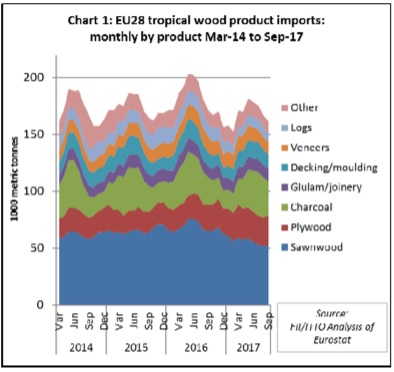
Although there was the usual seasonal rise in EU tropical timber imports in the first half of 2017, this was subdued compared to 2016 and imports declined sharply in the third quarter (Chart 1).

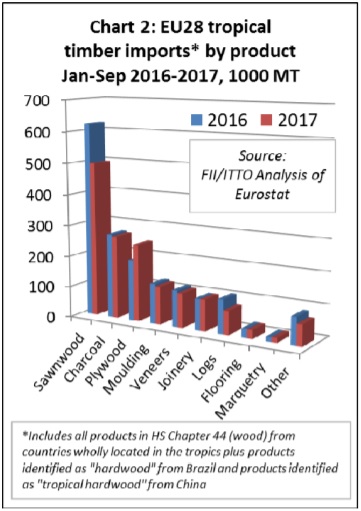
A large part of the decline in EU tropical timber imports in the first nine months of 2017 was concentrated in sawnwood, which in tonnage terms were down 20% compared to the same period in 2016.

During this period there was also a fall in import tonnage of tropical charcoal (declining 2% to 266,000 MT), decking/mouldings (declining 5% to 122,000 MT), veneer (declining 6.3% to 110,000 MT), logs (declining 31% to 76,000 MT) and flooring (declining 3% to 28,000 MT) (Chart 2).

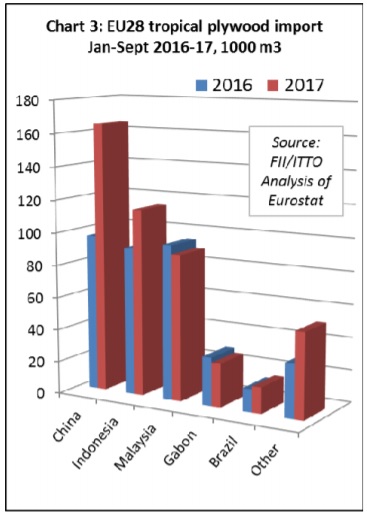
Tropical plywood apparently bucked this trend, with EU imports rising 30% to 464,000 cu.m in the first nine months of 2017.

However much of this gain comprised tropical hardwood plywood manufactured in China, rather than direct imports from the tropics, and may well be due to the increased range of hardwood types specifically identified as “tropical” rather than “other” in the HS product definition since the start of this year. (Chart 3).

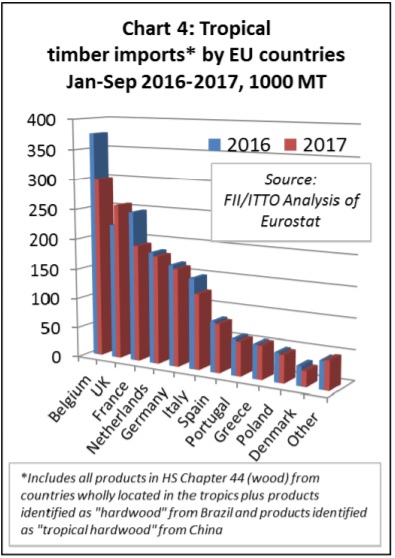
The downturn in EU imports of tropical timber products during the first nine months 2017 was concentrated in Belgium (declining 20% to 300,000 MT), France (declining 22% to 194,000 MT), and Italy (declining 16% to 125,000 MT).

The only market apparently recording significant growth in tropical timber imports during this period was the UK, rising 15% to 258,000 MT. (Chart 4).

The apparent rise in tropical imports in the UK is misleading because this is by far the largest European destination for tropical hardwood plywood from China. Direct imports of tropical timber products into the UK have not posted significant gains this year.

Upward price pressure in 2018 on US softwood lumber prices; Imports from Europe to rise

After the currency-driven global lumber price slump in 2015, market demand and prices both started to improve in 2016. While overall global demand improved modestly in 2017 — at only half the rate of 2016 — it has been supply disruptions and changing dynamics that created a wild and unpredictable market.

All markets appeared to be at least good to strong in 2017; this included the U.S., Canada, most of Europe, Japan, China and much of Asia. Only one market region remained unsettled again: the Middle East/North Africa (MENA) — Egypt and Algeria, specifically, along with some areas of the Middle East. The U.S. was a solid growth market again in 2017 (the case since 2010), but supply dislocations (forest fires, hurricanes, etc.) and other developments resulted in surging prices throughout the year, as reported by Wood Markets.

As usual, there are always various change factors at work that can directly or indirectly lead to unpredictable swings in lumber supply, demand and prices, and this was especially the case in 2017. One of the largest market variables in 2017 has been the initiation of import duties on Canadian lumber shipments to the U.S. (announced in late April and including retroactive duties back to late January of this year).

These duties were expected to cause huge disruptions and volatility, and certainly did so as Canadian exporters successfully pushed up U.S. market prices to cover all of the import duties.

North American Demand

Both the U.S. economy and housing starts continue to improve, although at a stubbornly slow pace. The official unemployment rate is now down to almost 4% (but the effective level is considered much higher), while home foreclosures are much closer to historical rates than ever — all good news.

New residential housing (the key driver of North American lumber consumption) remains on a slow but steady upward trajectory and should reach between 1.20–1.22 million units in 2017. Stocks of both new and existing homes have retreated to historical levels, but prices for new homes continue to move up in many markets (and in some cases are higher than those seen before the 2006 crash).

With a shortage of building lots and workers, as well as strong credit ratings required for new-home purchases, a number of factors have contributed to a tight housing inventory, fostering price increases.

The Wood Markets 2018 housing forecast is still very conservative and it doesn't forsee the US housing starts to be reaching 1.5 million units until 2022 at the earliest. Even with a slow rate of growth in U.S. housing starts in 2017 and given what is expected from 2018 to 2022, supply-side impacts have already led to some major imbalances; overall demand and market activity is anticipated to remain active and volatile again in 2018 and beyond.

U.S. Import Duties on Canadian Lumber

One of the biggest factors impacting lumber markets in 2017 in North America has been the implementation of U.S. import duties on Canadian lumber shipments. This included both the preliminary countervailing duty (CVD) of 19.88% (“all others” rate) and anti-dumping (ADD) duties of 6.87% (also determined to be retroactive for 90 days upon their announcement).

The reaction of Canadian exporters was to raise prices just prior to the date retroactive CVD duties might be expected to commence (late January 2017, according to the schedule). Markets were jolted by this non-market force, and that created huge uncertainty in the early part of the year. The lumber price increases proposed by Canadian exporters were largely accepted, and most (if not all) of the duties were passed on to U.S. buyers during the year.

As part of the U.S. trade law process, the Department of Commerce ruled in November 2017 that total CVD/AD duties of 20.83% were to be levied on Canadian lumber imports. The U.S. International Trade Commission (ITC) upheld this decision in early December, ruling that the U.S. lumber industry was injured by Canadian lumber imports. The ITC submitted its decision back to Commerce by December 22, and final duties were implemented as of December 28 when the CVD/AD order was published in the Federal Register. Some “ministerial error” corrections were applied to the AD rate for Canfor and the CV rate for West Fraser (to correct mathematical errors in the calculations). The final rates, including the total “all others” rate (which drops to 20.23% from 20.83%) are shown in table 1.

Table 1

Final Canadian Lumber Import Duties to US

CVD ADD Total
Canfor 13.24% 7.28% 20.52%
West Fraser 17.99% 5.57% 23.56%
Tolko 14.85% 7.22% 22.07%
Resolute 14.70% 3.20% 17.90%
JD Irving 3.34% 6.58% 9.92%
All Others 14.19% 6.04% 20.23%

As in previous trade disputes, Canada has already announced its plans to appeal the CV/AD duties before NAFTA and World Trade Organization panels.

North American Supply
North American production continued to expand in 2017 (as it has since 2009) as a result of slowly growing demand in U.S. housing and all other end-use segments. Higher prices in the U.S. market limited exports for both U.S. and Canadian companies, and this led to the fourth consecutive year of declining net trade (from 10.2 billion bf in 2013 to 6.2 billion bf in 2017).

Reduced exports and rising output from North American mills meant more shipments directed at the U.S.; there was also another significant increase in offshore imports to the U.S. market. With 45+ Canadian-owned mills situated in the U.S., and given the Canadian import duties and stronger prices in 2017, a flurry of capex projects to expand existing capacity is combining with more announcements of greenfield/brownfield mill projects to add incremental lumber output (almost all of these are in the U.S. South).

Canadian lumber production, which has continued to rise from its bottom in 2009, should reach 28.2 billion bf in 2017; however, this will represent a decline of about 300 million bf from 2016, well below the 2004 peak of 35.2 billion bf. Lumber output from the B.C. Interior was flat between 2011 and 2014 and then peaked in 2016 at 12.1 billion bf.

With the implementation of U.S. import duties starting in late January of this year, lumber prices were raised to cover the duties and stayed high, exacerbated by severe forest fires that crippled logging and sawmilling operations over a two-month period. Interior B.C. lumber output is likely to decrease somewhat in 2018, but this will depend on the declines in log supply (including the economic viability of processing dead pine timber) and lumber prices. It is still expected that as many as three to five sawmills will close in the B.C. Interior by 2025, but the timing is unknown.

Lumber exports to Asia may grow, but volume gains are expected to be small if they occur at all given softer market demand in Japan in 2018 and lower prices in China (versus the U.S.).

Eastern Canada (Ontario and Quebec) also continues to face longer-term timber supply issues as a result of legislated reductions in harvesting limits (annual allowable cuts) on government lands. In addition, the closure of several pulp and newsprint mills (with additional shuts expected) has negatively impacted chip prices in some regions.

However, lumber production continues to rebound in Eastern Canada from the lows of 2009. In fact, during the last few years, North America’s largest percentage increases have been achieved in this region, simply because this was the last area in North America to restart curtailed sawmills; Ontario, for example, is estimated to have grown its production by 20% in 2017 (although output will still be more than 30% below 2005 levels).

Eastern lumber output (including in the Atlantic provinces) should grow by almost 4% in 2017 (as a result of favourable U.S. market prices and strong demand in Canada. In 2018–19, these levels should remain relatively unchanged from 2017 levels as the bite is felt from U.S. import duties (except in Nova Scotia) and lower Canadian housing starts.

Canadian exports to the U.S. soared to over 15 billion bf in 2016 but will slow to about 14.1 billion bf in 2017, due partially to supply disruptions in the year and partially to import duties. Depending on a number of factors — including the trends in U.S. lumber prices — it is expected that Canadian exports to the U.S. will drop further in 2018 and probably move even lower again in 2019. This reduction will occur even though U.S. housing starts continue to rise (albeit slowly), and the Canadian supply response to import duties will noticeably impact both supply to the U.S. and lumber price volatility.

U.S. West output remained in a narrow range of 13.5–13.9 billion bf between 2013 and 2016, with each region (West Coast, Inland and California Redwood) showing equally flat production trends. With reduced Canadian imports to the U.S. in 2017 as a result of import duties, U.S. West lumber production is forecasted to rise by about 3% in 2017 and over 6% in 2018, and perhaps increase another 6% in 2019. This is an aggressive forecast, and it is subject to both log availability and suitable pricing.

U.S. South lumber output will continue to expand, and could increase by over 6% in 2018 from ~18.3 billion bf in 2017 with a further gain of up to 8% in 2019 — another aggressive forecast. The U.S. South has large volumes of incremental timber that is now fuelling new sawmill announcements. The South still has some of the lowest delivered log prices, the highest lumber prices, and the best sawmill margins in North America. With restrictive import duties on Canadian lumber now in place, a bet on new mills or expansions in the U.S. South is a good one. However, an increase in sawlog demand will start to move log prices higher, eventually leading to an erosion of the currently stellar sawmill margins.

Offshore imports of structural lumber will play an expanding role over the next five years, with European lumber imports soaring in 2017 due to higher U.S. lumber prices. At mid-December East Coast prices, Scandinavian and German mills will be able to bring in more volume given the high margins. Other European countries will be following if prices hold above US$500/Mbf to the U.S. East Coast region. The duties on Canadian imports have essentially opened the door for all of Europe's (and even some Russian) supply over the next five years.

Of the total North American output to 2019, the lion’s share of this increase will need to come from U.S. mills, whose shipments are projected to grow by 15% from 2017 to 2019. Although already limited by tightening timber harvests in the B.C. Interior and Quebec, Canadian shipments are projected to decline by 2.5% in the period 2017–2019, while Canadian exports to the U.S. could slip by 7%. The impact of import duties on Canadian lumber exports to the U.S. will make 2018 another very interesting and volatile year!

Summary

U.S. demand will be leaning more heavily on expansions in U.S. production and European lumber imports in the 2018–19 period. Production increases in the U.S. will be subject to many factors, including lumber prices, log supply and costs, financing, supply chain dynamics (including loggers and sawmill workers), etc. This means there could be varying supply responses in different regions of the U.S., and at different times.

There does not seem to be nearly enough available softwood lumber capacity in North America to meet U.S. demand by the end of the decade. While the slower pace of housing starts has somewhat delayed any potential “supply gap” in the last few years, the burden of import duties on Canadian lumber shipments to the U.S. has now exacerbated this situation (starting this year). Incremental supplies of logs and lumber will be required each year, while high lumber prices will result and attract more supply; in 2020 and beyond, there is strong potential for even higher prices.

As Wood Markets predicted last year that the implementation of a U.S. import tax on Canadian lumber shipments to the U.S. would cause prices to rise, this occurred earlier than expected. However, most elements of the lumber price “super cycle” are now in place.

It was always based on declining Canadian timber supplies and lumber production, as well as increasing imports into China, and this is finally playing out. Over the next five years, there will be times when timber and lumber supply in North America will not balance out, and this puts a high probability on even further record-level pricing.

Egger Group records increased turnover for first half of financial year

Egger Group concluded the first half-year of its financial year 2017/2018 with a consolidated turnover of EUR 1.32 billion (+11.1% compared to the previous year).

The result before interest, taxes and depreciation (EBITDA) increased to EUR 222.5 million (+17.4%). The EBITDA margin increased to 16.8 % (previous year: 15.9 %). Egger Group now has more than 9000 employees and finds itself in a growth phase and it expects a positive development for the full financial year 2017/2018.

Over the past half-year, Egger was able to profit from the largely positive economic situation and the growing building and renovation activities. The company managed to increase its turnover in Europe and all relevant geographic markets, as well as in all product segments.

The largest turnover increases (+11.0%) were recorded for Egger Decorative Products, which sells products for furniture and interior design. The largest development of this segment, with 76% of all sales, was in Central and Eastern Europe.

The successful worldwide introduction of the Egger Decorative Collection 2017-2019 had a particularly positive effect on the Decorative Products segment. Minor losses due to the exchange rate were recorded only in the UK. The overseas segment grew significantly, particularly in Asia and North America. The turnover of the new plant in Concordia, Argentina, which joined the Group on 1st October 2017, are also included.

Egger Flooring Products (Laminate, Comfort and Design flooring) achieved an increase in turnover of +6.4%, as compared to the same period during the previous year despite a still difficult market environment. The overall increase in the turnover primarily depends on the gradual marketing of the new flooring capacities in the Gagarin (RU) plant. However, the EBITDA development was negative, due to the incomplete utilization of capacities, as well as increased costs for wood and chemicals.

Egger Building Products also achieved a turnover increase of +9.2% in a market marked by increasing raw material costs and availability bottlenecks. The sales of OSB products and of timber also increased. The largest growth in the OSB segment was recorded in Eastern Europe. On the other hand, timber sales increased in Germany and certain overseas markets. In this segment the EBITDA is also under the level of the previous year, which is again due to the increase in raw material costs for wood and chemicals.

Intensive investment activity

The first half-year of the financial year 2017/18 was very eventful for Egger and marked by significant growth. The company took over a chipboard and MDF plant in Concordia, Argentina, on 1st October 2017. A further step is already in preparation in the US: Egger is planning a Greenfield project in Lexington, North Carolina. The announcement was made on 24th July 2017. Construction will start in 2018. The construction of Egger’s 19th plant has already began during the last half-year in Poland. In Biskupiec, in north-east Poland, an ultramodern production plant for 650,000 m3 of chipboard will be built by the end of 2018.

This growth strategy was already reflected in the first half-year of the financial year 2017/2018 in investments worth EUR 264.4 million (previous year: EUR 145.6 million). EUR 228.1 million (previous year: EUR 109.2 million) were spent on growth investments, including acquisitions. The main investments during the first half-year 2017/2018 were primarily the acquisition of the plant in Argentina, but also the start of the plant construction in Poland. Investments were also made in energy in France, as well as in logistics and automation projects in Austria and Germany. EUR 36.3 million (previous year: EUR 36.4 million) were spent on maintenance investments.

Positive outlook for the second half-year

The company is also expecting a stable development of its business activity for the second half of the financial year 2017/2018. Given the positive situation in Western Europe, the new plant in Argentina, and the strategic move of volume from weaker regions to alternative markets, Egger is expecting to increase turnover and maintain stable results throughout the Group for the financial year 2017/2018.

Egger’s current efforts outside Europe also mean market diversification and a secure future for the entire group, its customers and its employees. Thomas Leissing, spokesman of the Egger Group Management, commented: “We are pursue a conservative growth strategy, commit to moderation, and make sure that every step the organisation makes is viable. A solid financial basis supports long-term supply relationships with customers and suppliers, as well as further stable growth based on our own performance.”

Canadian wood pellet producer Rentech files for bankruptcy

Less than 90 days after Rentech announced it would voluntarily withdraw the company’s common shares from listing on the Nasdaq Capital Market, the company has filed for bankruptcy, and sold off the bulk of its assets, including one of its Ontario wood pellet plants, and U.S. wood pellet business New England Wood Pellet.

Rentech’s Wawa, Ontario, pellet plant has been plagued with operational issues over the past couple of years, resulting in contract shortcomings to pellet customer Drax, which has converted three of six units at its North Yorkshire, England, power station to wood pellets. The Wawa facility has been idle since early this year, and in October, Rentech announced it had entered into a deed of contract termination between Drax and the Wawa plant.

Despite Rentech’s Atikokan, Ontario, plant conveyor system issues, the plant has been meeting expectations, operating near capacity when needed, and meeting contractual obligations with Ontario Power Generation, according to Rentech. However, since February, it has only been operating at levels to fulfill its contract with OPG.

Despite its financial turmoil, in Rentech’s most recent quarterly financial results report, the company stated it expects its New England Wood Pellet and Fulghum Fibers businesses to continue to generate positive cash flow, and be self-sufficient from a liquidity perspective. Rentech acquired NEWP in May 2014, which added to its portfolio three pellet facilities in  Jaffrey, New Hampshire, and Schuyler and Deposit, New York.

The bankruptcy filing lists Lignetics of New England Inc. as the buyer of Rentech’s NEWP business, and persuant to the NEWP asset purchase agreement, Lignetics has agreed to acquire substantially all of the assets and assume certain specified liabilities of Rentech, for a purchase price of $35 million.

The purchase of NEWP adds to Lignetics current annual capacity of 650,000 tons. It purchased the Marth Companies in May, which included four pellet plants and trucking assets. The NEWP acquisition will bring the companies’ total pellet plant count to 12, with facilities located all across the U.S.

Rentech’s Atikokan facility will be purchased by Ontario Inc., an affiliate of True North Timber, a forest resources company in Ontario, according to the filing. Pursuant to the Atikokan asset purchase agreement, Ontario Inc. has agreed to acquire substantially all of the assets and assume certain CAD$3.2 million.

Newsletter

Subscribe to our digital newsletter for your daily digest of essential news, views and analysis from the international wood industry delivered directly to your inbox.


0