Article archive

EPAL pallets: Record results of 115.8 million in 2017

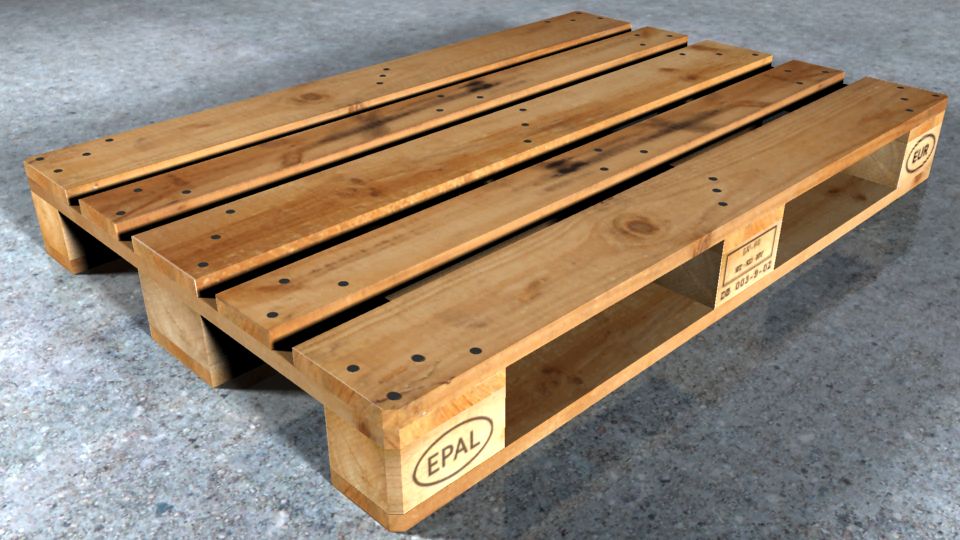
The European Pallet Association e.V. (EPAL) announces a record result for 2017 of 115.8 million EPAL quality load carriers produced and repaired. Compared to the previous year, this is an increase of nearly 10%.

In 2017, production figures alone rose by 9.7% to 88.3 million EPAL pallets, while repair figures climbed to 27.5 million; a solid increase of 10% compared to the previous year.

The EPAL Euro pallet is considered an early indicator for the economy. The rising economic barometer in economically strong countries over the past few years has driven the demand for EPAL Euro pallets to a peak last year: EPAL producers and repairers have been working to full capacity for months. The persistently high demand for sawn timber led to a shortage of the raw material in 2017 and a huge price rise in sawn timber for pallets, increasing cost pressure for EPAL pallet producers.

Martin Leibrandt, CEO of EPAL, “The current demand peaks can be cushioned with sound planning and a long-term partnership between EPAL pallet producers, suppliers and customers. Trade and industry partners who planned at an early stage and who value long-term supplier relationships are being well provided for. The outstanding 2017 figures are the result of the joint work of all EPAL National Committees and licensees, and a sign that trade and industry are increasingly relying on independently tested quality and safety, which pay off in the long term.”
China’s economic slowdown might become a problem for the Finnish lumber exporters

Concerns about the future development of the Chinese economy will again become headlines in Finland by the end of 2018. Among other things, the Bank of Finland drew attention to the decline in China's economic growth, the reliability of official statistics and the rapid debt accumulation.

Financial experts are quite unanimous about the fact that China's economy will face a crisis in the next few years. Its effects would be reflected elsewhere, depending on how dependent the various economic regions, countries or individual companies in China, shows a recent report from Luke.

Finland's export of wood to China

In 2017, the value of Chinese exports of Finnish forest industry products rose to nearly EUR 1.2 billion, and after Germany, China became the second most important export country in the Finnish forest industry.

The real value of the Chinese forest industry exports has increased on average by about 25% per year following 2009. The share of Finnish goods exports to China is about one third of forest industry products.

The export of the Finnish forest industry to China focuses on low-grade products. The aggregate share of pine and spruce sawn timber, bleached havus sulfate pulp and slag pulp from the total export value of the forest industry in China is almost 90%. Except for pine wood, China is the main destination for exports of these products.

Exports of sawn timber also helps the pulp mills' wood supply

In 2017, approximately 1.8 million cubic meters of Finnish softwood sawnwood were exported to China, with the country's demand growing rapidly, as a result of construction and the transition to a consumerist society.

Sawn timber exported from Finland has largely come to the production of wooden consumer goods, such as furniture and other interior decoration products. In addition, sawn timber has replaced tropical hardwood sawn timber.

In Finland, the export of sawn timber to China has meant increasing demand for logs and rising stock prices. As the majority of timber sales revenue from forest owners accumulates from the sales of logs, the good price of the log, the price changes and expectations of the future price have inspired forest owners to sell timber.

Can China be prepared for the risk?

During the autumn of 2017, many sawmills have commented on China's exports and its positive trend, but at the same time warned of the risk associated with increasing production on one country's market. Finding a replacement market, for example from India, Turkey or Iran can be difficult. There is no point in overcoming the uncertain market recovery in North Africa and the Middle East.

The Arabian experiences showed that market changes are also quickly transmitted to Finland. In China, on the other hand, it is foolish to be unlearned when iron is hot and demand is lively. There can be no impact on the possible collapse of the market, but it can be easier to survive by keeping the company's balance sheet in the best possible shape.

In the longer term, exports of Finnish forest products will be supported by China's political will and consumer habits in a more environmentally friendly direction. This has been seen, for example, as closures of their own polluting paper mills, as a protection for natural forests and as a green building program, where wood construction plays an important role.

Binderholz to expand glulam production in Jenbach

Binderholz has completed the third expansion stage (Plant 3) of the glulam in Jenbach, thereby expanding the site's capacity to 280,000 m³ per year.

In addition, up to 25,000 m³ of structural timber (KVH) can be produced on site. Following the investments for Plant 1 (1996) and the subsequent expansion of Plant 2 (2001), the third expansion stage was realized 16 years later, in a newly built 6,800 m² hall.

Plant 3 is based on fully automatic linked systems, and was designed according to the Industry 4.0 principle. The plant's current glulam production, which has a capacity of 60,000 m³ / year, can perform widths of 38-280 mm, heights of 240-1,000 mm and manufactured in lengths of 6.0-18.00 m.

In addition, the production of ceiling panels and floorboards in visual quality of up to 1,000 mm width is possible. A control console with 40 large screens monitors all the steps of the process.

Insolvent Tvilum sold to Danish investor group

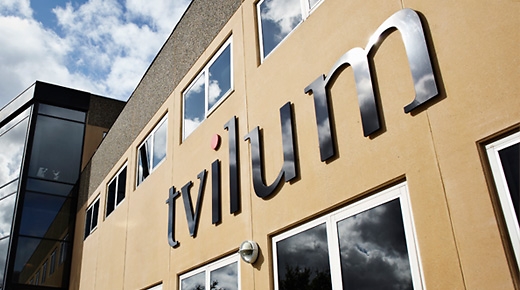
Tvilum filed for bankruptcy on the 2nd of February and ceased production on its plants in Farvang and Kjellerup, Denmark. One of the largest global RTA furniture manufacturers has already organized talks with potential buyers.

The appointed curators held talks with several potential buyers reaching an agreement with a group of local Danish investors consisting of the furniture company Viking Trading, current Tvilum CEO Torben Porsholdt and the Kristiansen family (the company founders). The investors, which have taken over the ready to assemble furniture manufacturer, have agreed no to disclose the purchase price, Notifix reported.

The future investors would buy the locations in Farvang and Kjellerup and would also have the option of acquiring the Tvilum subsidiary in Szczecinek, Poland. Torben Porsholdt will continue to lead the company as CEO, he had joined Tvilum about two months ago succeeding Andrew Long.

In 2016 Tvilum reported sales of DKK 1.26 billion (USD 207 million).

Myanmar government applies 10-year reforestation plan

Myanmar's government will apply a new plan for reforestation and rehabilitation of its forest across the country. The project is set to come into effect on a 10-year period.

Approximately 32,400-40,500 hectares will be covered each year, including establishing forest, nurseries and replanting of trees in forest reserve areas, as the Malaysian Forest Department reported.

According to Brinkwire, the 10-year project, which will also include training courses for forest staff and local residents, will be revised after five years of implementation. Myanmar is one of the most resource-rich countries in Southeast Asia. However, statistics show that forest coverage in Myanmar dropped to 42.92 percent over the years from over 57 percent in 1990.

Especially the Northwestern Sagaing region is the most affected by the illegal forest exploitation which is also found in Kachin and Shan states and Bago region. Thus, Malaysia has restricted wood log export, and encouraged more export of value-added wood products since 2014.

In addition to suspension of logging at the Bago Yoma mountain range for 10 years, one of the largest forests in Myanmar, the government announced in April 2016 to continue to halt logging across the country’s forest in the fiscal year 2016-17, Brinkwire reported.

In addition, the announcement added that it allows resumption of limited timber production in the present fiscal year 2017-18.


Largest unedged beech lumber sawmill in Europe to be build in Croatia

Cedar ltd., Vrobovsko of Croatia has commissioned the sawmill supplier Möhringer, Wiesentheid to build a beech sawmill in Vrobovsko, Croatia. 

The new sawmill is designed for a sawing capacity of approximately 200,000 m3 per year, making it Europe's largest sawmill for unedged beech lumber.

As a general contractor, Möhringer also supplies the associated log yard with long logging, surveying, capping and sorting of the log sections. The sawmill uses a combination of several log band saws, horizontal band saws and band saws from the CANALI product line.

The stacking of the unedged goods is handled by Möhringer's stacking robot FLEXISTACK. The entire system is highly automated and equipped with modern full-scale scanners for automatic quality assessment.

Möhringer has developed automation solutions especially for the hardwood industry in the last 10 years and thus offers complete solutions from the sawing to the finished package.

Plywood companies in China file petitions against US antidumping duties

Chinese plywood producers, exporters and domestic importers have filed appeals at the US Court of International Trade, relating to antidumping duties levied against them.

According to the Hardwood, Plywood & Veneer Association (HPVA), "the appeals challenge both the International Trade Commission's decision finding injury to U.S. producers from these imports and the Commerce Department's final rate determinations. The schedule for filing briefs and oral argument will be announced next. The antidumping and countervailing duties on Chinese hardwood plywood remain in effect.”

Back in November 2017, the US Commerce Department made final determinations that hardwood plywood from China was being subsidized and dumped in U.S. markets. It set an anti-dumping duty of 183.6 percent and anti-subsidy duties ranging up to 194.9 percent.

The United States imported around $1.12 billion of the products from China in 2016. It was the latest move by the Commerce Department against Chinese goods it deems to have benefited from state subsidies, including fresh duties against aluminum foil unveiled last month.

Moreover, imports from China in 2017 were significantly down because of the US antidumping and countervailing duties on plywood from China. Year-to-date plywood imports from China were 24% lower than in November 2016.

Apparently, every year, the US runs a steep trade deficit in goods with China of about US$350 billion and the US Commerce Department determined that exporters from China sold hardwood plywood products in the United States at 183.36 per cent less than fair value.

Italian woodworking machine tools production increased in value by 11.6% in 2017

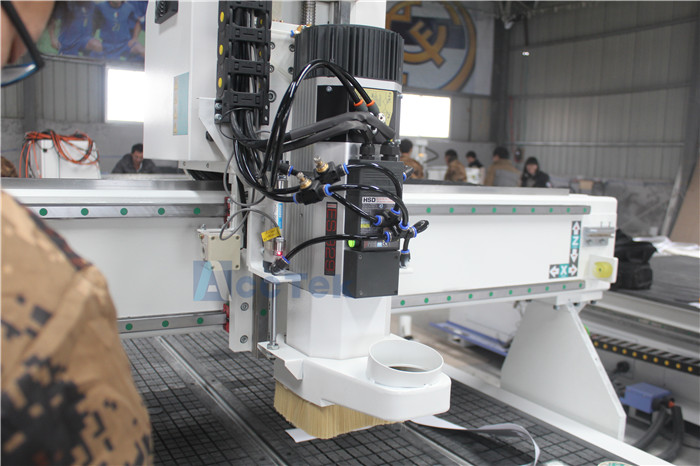
In 2017, the Italian woodworking machine tools producers achieved a production value of Euro 2.29 billion, up by 11.6% compared to the previous year.

According to the preliminary figures processed by the Studies Office of Acimall, the Confindustria member association representing industry companies, the export trend amounted to Euro 1.6 billion euro, 7.1% more than in 2016.

The top-ten destinations include the United States at number one, purchasing Italian woodworking technology for a total value of Euro 165.5 million, followed by Germany (Euro 105.8 million), Poland (Euro 102.4 million) and Frances (Euro 92.5 million).The value of import also increased to Euro 199 million, plus 10% compared to the previous year.

The domestic Italian market is also continuing to grow, driven by investment supporting measures introduced by the Italian government in recent years. Further progress is expected in the short and medium term: in 2016, Italian wood machinery “consumers” invested Euro 743 million, which increased to Euro 894 million in 2017, Acimall forecasts that in 2018 domestic market approach the one billion threshold, a new record after Euro 900 million in 2001.

The 3Q 2017 closed with a 36.8% order increase compared to the same quarter in 2016 (the growth rate in the July-August term was 42.9%, also compared to the same period of the previous year). This figure results from the trend of orders from abroad, up by 35.2% (51.5% in 3Q) and the excellent development of Italian demand, achieving 49.5% growth over the October-December 2016 period (it was just 19.7% in the second quarter).

Italian users are clearly going through a period of greater confidence which, combined with state incentives, is generating strong demand, exceeding even the most optimistic expectations”, said Dario Corbetta, Acimall director. “Such results are not just satisfactory for technology vendors, but also anticipate an increasing competitiveness of the entire system: in the past few years, the wood and furniture industry had to face a very complex season, reducing all investments to a minimum. By acquiring more innovative and updated technology, the can now rely on more effective and performing tools, produce more and better with an Industry 4.0 approach, leveraging the connection between technology and enterprise management systems to restore their competitiveness and capacity to offer attractive products”.

The analysis by the Confindustria member association of wood and wood-based materials machinery manufacturers shows an extension of the orders book to 3.6 months (versus 3.4 in the previous quarter): such figure indicates the impact that the trend of 4Q 2017 will have on the year that has just begun.

Prices as of January 1 show substantial stability, with a 1.1% increase, the same trend recorded in the July-September period. According to Acimall’s study, 50% of producers expect to increase production, while the remaining 50% predict stability. Employment will be unvaried according to 72% of the sample, growing according to 28%.

About 72% of the sample believe that, in the short term, orders from abroad will increase further, while 28% don’t expect significant variations (the balance is +72, versus +32 in the previous quarter). As to the domestic market, 39% expect a positive trend; according to 56%, stability will prevail, while 5% fear shrinking business (the balance is +34, it was just +5 three months ago).

Interfor’s huge US South sawmill plan to be decided by mid-2018

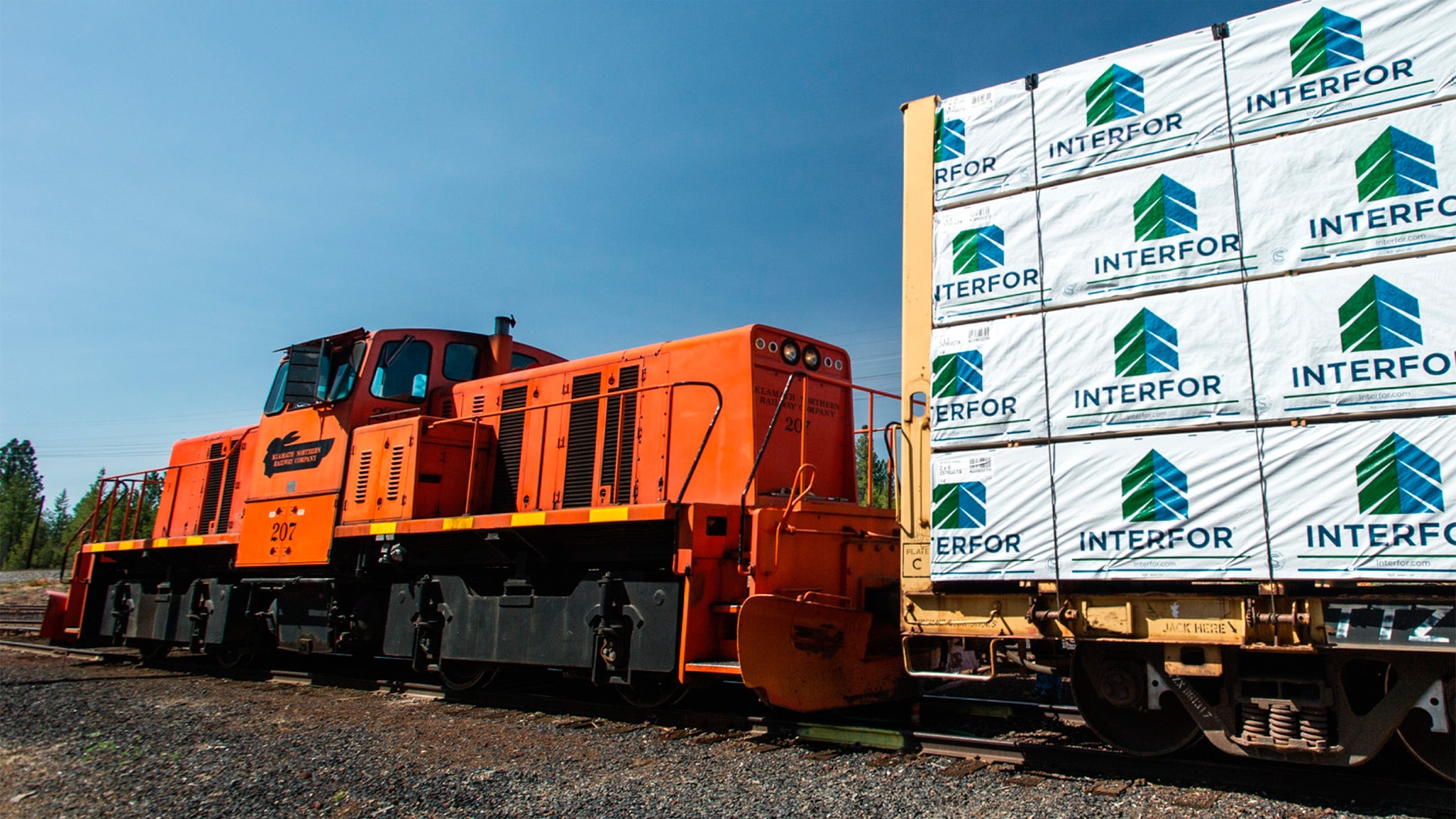
Interfor carries on to evaluate a greenfield sawmill opportunity in the central region of the US South. The company expects to finalize a decision on the project by mid-2018.

As reported in the company's Q4 and full-year results, Interfor estimates the total cost of the sawmill project, which would produce in excess of 200 million board feet (mmbf) of lumber per year, at approximately US$115 million including working capital and start-up costs.

The company also noted that it is continuing to pursue opportunities for further growth and is making progress on its multi-year strategic capital plan, which includes previously announced large-scale projects at its sawmills in Meldrim, Georgia and Monticello, Arkansas.

The Meldrim and Monticello upgrades, representing a total investment of around US$65 million, are on track for completion in Q1, 2019, the company said, and will add annual lumber production capacity of approximately 150 million board feet (mmbf).

Interfor is also continuing to advance other large capital projects to enhance existing operations, which will be  sequenced after the Meldrim and Monticello projects, subject to board approval, the release said.

Timber construction in Australia might be allowed up to 8 storeys

The Forest and Wood Products Australia (FWPA) insisted to make some changes in the National Construction Code (NCC) as to make it accessible for fire-protected timber to be used in all commercial buildings of up to eight storeys in height.

These proposed changes in the draft 2019 NCC builds on the program of work undertaken by FWPA, which saw similar changes for apartments, hotels and offices in the NCC 2016, Architecture and Design reports.

The Australian Building Codes Board’s technical committee is supporting the proposal and has tried to demonstrate that timber construction systems can meet the required building and fire safety standards.

Timber construction systems permitted under the Code would include both traditional ‘stick’ framing and newer ‘massive’ timber building systems utilising glue-laminated timber, laminated veneer limber (LVL), as well as cross-laminated timber products.

FWPA national manager codes and standards, Boris Iskra, says that the proposed changes would allow builders and developers to use timber without having to undertake time consuming and expensive ‘performance solutions’ to gain building approval. The designs would just have to meet the deemed-to-satisfy requirements, according to Architecture and Design.

At FWPA, we do everything we can to remove unnecessary restrictions on the use of timber. In 2016, we were successful with introducing similar changes for apartments, hotels and offices – and now we’re on the brink of extending that to other types of buildings,” says Iskra.

We’re proud to have successfully made the case to the authorities that timber can meet the required standards and would urge the timber industry and progressive builders and developers to make submissions supporting the proposed changes to the Code – it’s a great opportunity.”

The fire protection measures include fire-protective grade plasterboard, fire-resisting cavity barriers, and a compliant sprinkler system, along with hydrants, hose reels and portable fire extinguishers as required. In addition to all of this, timber also offers a number of sustainability benefits.

Obviously, wood stores carbon dioxide over the life of the building, which other materials don’t. It performs well thermally, so it doesn’t require as much energy to heat and cool. It also lends itself to prefabrication and quick installation, meaning less disruption to neighbours and fewer truck movements,” Ric Sinclair, managing director of FWPA, says.

The other major advantage is the speed of construction. Time is money when it comes to building.”

Lumber prices in the US on the rise, despite lowered consumption

Prices for framing lumber in the US continued to rise in all species during last week. Yet, trading cooled down, while the wintry weather in northern markets and rain in the South decreased consumption. 
Buyers widely expressed wariness about record prices and extended mill order files. Some traders also said the pullback in the stock market gave them pause. Even so, mills levered prices higher, and the Random Lengths Framing Lumber Composite Price rose $11, to $492.

Week
Feb 9
Week
Feb 2
Year Ago
2017
Random Lengths Framing Lumber Composite Price* $492 $481 $391
KD Western S-P-F #2&Btr 2x4 R/L Mill Price 516 510 387
KD Eastern S-P-F #1&2 2x4 R/L, delivered Great Lakes 601 594 438
Green Douglas Fir Std&Btr 2x4 R/L (Portland) 580 560 365
Southern Pine (Westside) #2 2x4 R/L 541 524 454
KD Coast Hem-Fir #2&Btr 2x4 R/L 545 535 390
Ponderosa Pine (Inland) #2&Btr 1x12 R/L 735 735 580
* Weighted average of 15 key items

Random Lengths Panel Market Report
Demand for structural panels outpaced supply, and prices climbed. OSB buyers scrambled for coverage amid unrelenting supply shortages.
Mill offerings were limited, most notably in the Southwest and Western Canada, where most producers were off the market. In Southern Pine plywood markets, sparse offerings and extended order files supported another week of price increases amid steady demand. Western Fir plywood trading was steady, but not at the pace seen in recent weeks.

(f.o.b. mill prices) Week
Feb 9
Week
Feb 2
Year Ago
2017
Random Lengths Structural Panel Composite Price* $512 $493 $387
Southern (west-east) 15/32-inch 3-ply rated sheathing plywood 510-555 500-540 380-395
Southern (west-east) 15/32-inch 4-ply rated sheathing plywood 515-560 505-545 380-395
Western 1/2-inch 4-ply rated sheathing plywood 540 531 405
North Central 7/16-inch Oriented Strand Board 375 355 288
*Weighted average of 11 key items

350 meter wooden skyscrapper planned in Tokyo

Sumitomo Forestry (SFC) summarized the concept W350 plan to realize wooden high-rise building with a height of 350 meter. According to the announcement, the  objective of the project is to realize an environmentally-friendly city made of high-rise buildings made of wood, transforming the town into forest.

The conceptual plan was prepared mainly by Tsukuba Research Laboratory of the company’s R&D institute. It provides a road map to future technologies such as building construction method, environmentally conscious technology, development of trees that become used parts and resources, and widens the possibility of wooden buildings in future.

This building is a wooden steel hybrid structure with 90% wood ratio. With the height of 350 meters, the building has 70 floors above ground. It consumes 185,000 m3 of wood. The project cost is around JPY 600 billion (around USD 5.5 billion).

In the quarter ended December 31, 2017 Sumitomo Forestry increased net sales by 11%.

Earlier Sumitomo Forestry announced start of the development of spec homes in Indonesia.

About Sumitomo Forestry:

The company operates in the areas of management of forests, development of new forestry and environment-related business, biomass power generation, purchase, manufacturing, secondary processing and sales of timber and building materials. Sumitomo Forestry also deals with contract construction, sales, after-sales maintenance and renovation of detached houses and multi-unit residences.

Stora Enso reported 18.5% increase in its Wood Products division

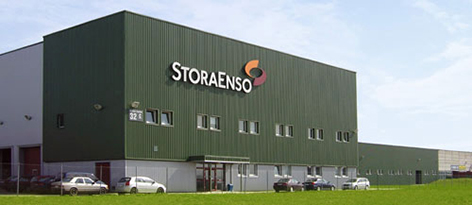
Stora Enso's Wood Products division recorded 18.5% increase in operational earnings before investment, tax, depreciation and amortisation (EBITDA) in Q4/2017, compared to Q4/2016.

This is the highest ever fourth quarter operational EBITA at EUR 25 million, an increase of EUR 8 million or 47.1%. Improved net mill price and the increasing share of value added to the business offset slightly higher raw material and fixed costs.

Stora Enso has made some strategic investments: Murów sawmill in Poland, laminated veneer lumber (LVL) line in Varkaus, Finland and pellet production at Ala sawmill in Sweden, which have contributed to a 6% growth in sales.

Stora Enso is currently investing in a new cross laminated timber (CLT) unit at the Gruvön sawmill in Sweden is proceeding as planned. The production is scheduled to begin during the first quarter of 2019.

Chinese buyers avoid sawmills in the US to buy logs; lumber market tightens

Logs buyers in China have been getting used to purchase the logs directly from exporters, avoiding sawmills in the US. Thus, not only are log exporters getting better quality material, they are purchasing them at well above average market prices, Woodworking Network reported. 

Gerald Storey of Storey Sawmill & Lumber Co. based in Troy, Tennessee, US, said that many sawmills in the area experience the same situation, which has begun a few years ago and strengthened in the last period.

The Chinese are subsidising their companies to the extent that U.S. sawmills can’t compete for the timber and logs in our area,” Storey said. “The Chinese are also illegally receiving logs not fumigated into their country to cut their cost. U.S. log exporters are going to force U.S. sawmills out of business.

As reported by Woodworking Network, despite exports of red oak dramatically increasing through three quarters of 2017, a 64 per cent rise occured and made up for some 29 per cent of the total log export of the US, at 16 million cubic feet. Meanwhile, with a 19 per cent jump in imports, China has maintained its position as the top recipient of hardwood logs from the US.

If this situation goes on and the demand keeps on increasing in the tight US market, the lumber prices could also go up, especially if there is a shortage of logs. And presently, according to the Woodworking Network, sawmills are beginning to run low in log inventory, further tightening the market.

Russia: Record exports of wood pellets in 2017

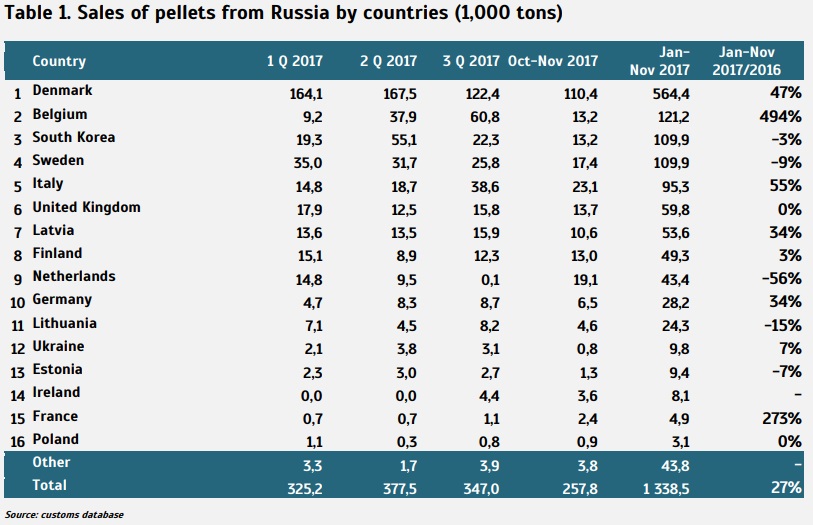
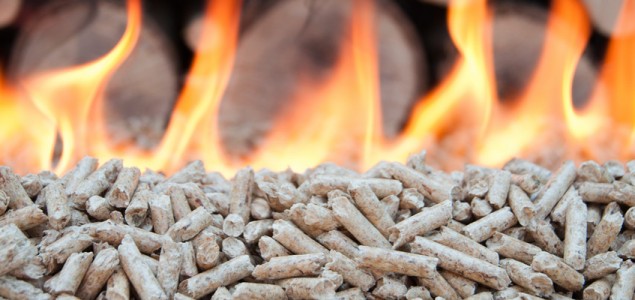
Wood pellet manufacturers in Russia have recorded record export sales in 2017. For the full year, the country exported 1.4 million tonnes of pellets, which is a 26% increase over 2016.

All the previously commissioned plants reached their production capacities, and, together with new enterprises, they assured the export growth.

Yet, the major contribution to 2017’s results was given by “Vyborg Forestry Development Corporation”, a plant that has been idle in 2016. Starting 2017, the company became the leader manufacturer of pellets, shipping 201,500 tonnes to markets in Europe. Most of the pellets went to Denmark (73% of all exports).

According to WhatWood, in August 2017, a new pellet production plant was opened by “MM-Yefimovsky”, part of Austrian Mayr-Melnhof Holz Holding AG). The plant has an annual capacity of 60,000 tonnes/year and 10,300 tonnes were exported from August to December 2017. Most of the pellets went to Italy (7,300 tonnes).

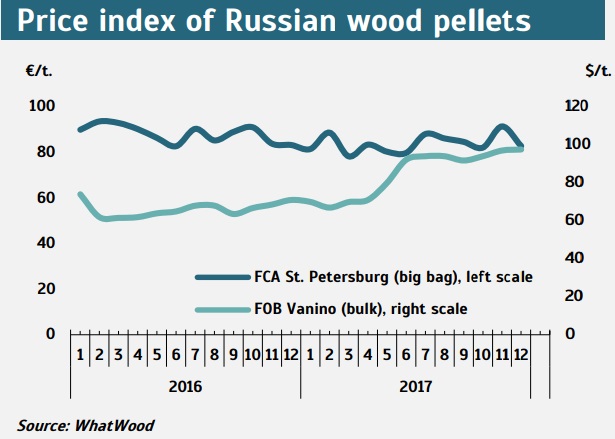
Moreover, the price index for Russian pellets grew: shipments to South Korea increased from $74/t in January 2016, to $98/t in December 2017. All in all, the pellet production reached 1.6-1.7 million tonnes at a 200-300 thousand tonnes capacity of the domestic market.

The structure of sales for Russian pellets has changed very little in 2017, as compared to the previous year. While Italy increased the country’s consumption of Russian pellets by 60%, to 98,600 tonnes, Belgium raised its pellets purchases from 20,000 tonnes to 121,500 tonnes during January-November 2017.

For full year 2017, as WhatWood reported, companies from the US and Canada (main competitor countries for Russian pellets), reduced their supplies to the main sales market, the UK. The US decreased the supplies by 188,000 tonnes, to 3.7 million tonnes during January-November 2017, while Canadian manufacturers exported 136,000 less tonnes of pellets for the first 7 months of 2017, as compared to the same period in the previous year.

Japan: Wood products demand projection for 2018; imported lumber from Europe and N. America to drop

The Japanese Forestry Agency recently held a meeting for wood products demand projection for the first half of 2018. Imported lumber from North America, Europe and structural composite lumber are expected to decrease while logs from North America for the second quarter and from New Zealand for the first quarter are expected to rise. Supply of domestic logs for lumber processing would decrease slightly, but logs for plywood would increase by 8.5%. Continue reading "Japan: Wood products demand projection for 2018; imported lumber from Europe and N. America to drop"

Germany registers record wood pellets production in 2017

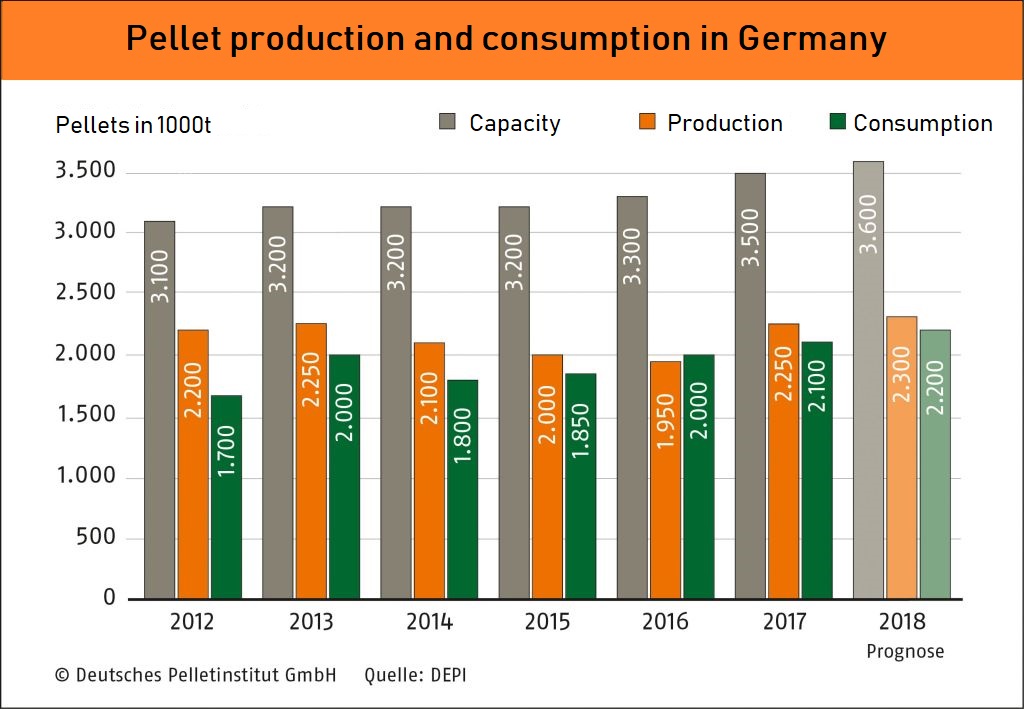
For the whole year 2017, Germany has produced 2,25 million tonnes of wood pellet, more than ever before. The production volume was slightly higher than the previous record year, 2013.

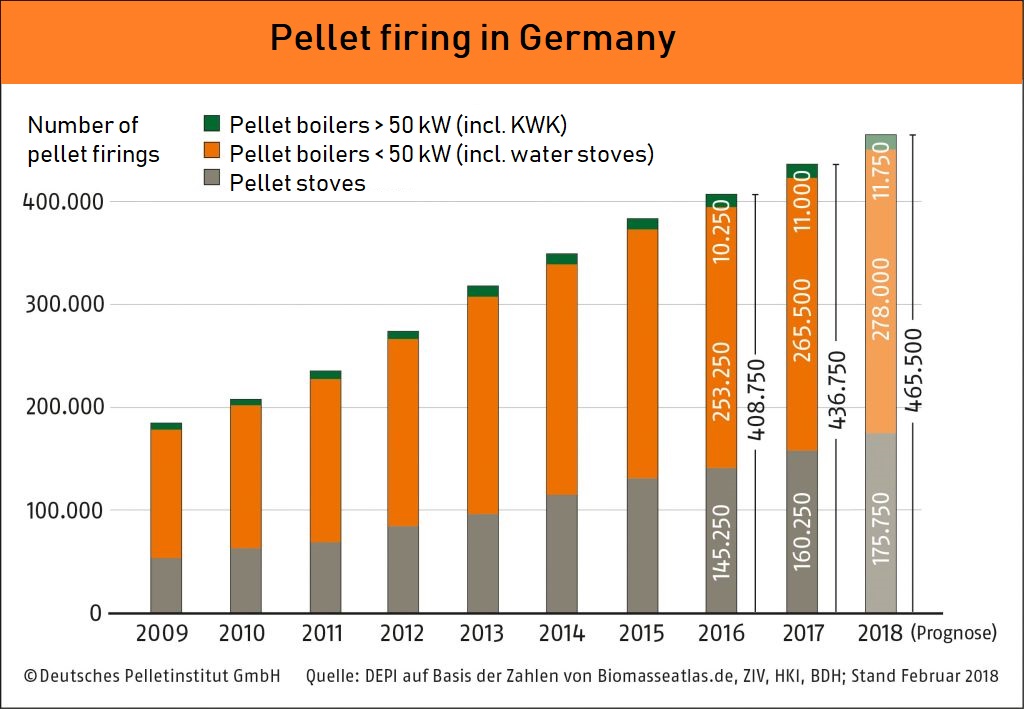
According to the German Energy Wood and Pellet Association e. V. (DEPV), the figures for pellet boilers and pellet stoves fell short of expectations. With 32,300 new pellet boilers in Germany, the forecast expansion was narrowly missed. There were 16,500 pellet stoves, 15,000 pellet boilers and water-bearing pellet stoves, with a capacity of up to 50 kW and 800 boilers / pellet CHP plants larger than 50 kW added.

Compared to the previous year (31,200 units), new construction increased by 3.5%. In 2017, 3.19 million tonnes of the greenhouse gas CO2 were saved by pellet firing. This is a saving effect of 92.5% compared to the greenhouse gases that would otherwise have expelled the pellets fossil heaters.

At the end of 2017, there were approx. 437,000 pellet furnaces in operation. For the year 2018, DEPV expects a sales volume of 33,900 furnaces (16,900 boilers and 17,000 pellet stoves). This would reduce the total stock of pellet firing to approx. 465,000 plants grow.

Production and consumption of wood pellets in Germany

With 2.25 million tonnes of wood pellets, the production volume in Germany increased by 15.4% in 2017 compared to the previous year (1.95 million tonnes).

Consumption in 2017 amounted to 2.1 million tonnes nationwide and pellets were made 95% from saw-by-products last year. The association expects a further slight increase in production to 2.3 million tonnes in 2018.

Germany is the largest pellet producer in Europe and produces almost 10% of the world's pressed wood pellets. Almost the entire production volume is produced according to the strict ENplus certification (98.5%). In the meantime, 63% of the pellets are also delivered to customers by certified fuel trading.

The price of pellets was also stable and cheap in 2017. On an annual average, heating companies paid EUR 239.83 for one tonne of pellets, equivalent to 4.80 ct / kWh. This was 3.9% more than in the previous year, but 0.7% less than in 2015. In 2017, heating oil was on average 5.71 ct / kWh 19.0% more expensive than wood pellets, gas averaging 5.92 ct / kWh even 23.3% more expensive.

Södra to increase the price for pine logs

Södra has decided to increase their purchase price for pulpwood and pine logs, as the demand for softwood and hardwood pulp is high and the sawn timber market stays strong. 
To ensure continued high levels of supply, Södra is raising its purchase price for pine logs by SEK 30/cubic metre of solid volume underbark (m ᶾ sub) and introducing a contracting premium of SEK 25/m ᶾ sub for softwood and hardwood pulp.
The strategic investments in Södra’s pulp mills in recent years have led to a steady increase in softwood pulpwood consumption and demand for softwood pulp. This market situation presents ideal conditions for increased forest thinning which, in the long term, will further strengthen both the value and quality of Swedish forests,” said Olof Hansson, President of the Södra Skog business area.
The price changes will apply from 1 February 2018.

Wood pellet co-firing to resume in the Netherlands; imports expected to rise sharply

German utilities company, RWE AG, expects to start co-firing biomass at its 600 MW coal-fired plant in the Netherlands by the end of February. The company plans to co-fire 50pc biomass at Amer 9, which will consume around 900,000 t/yr.

The production is further forecast to increase co-firing to 80pc in the coming years. This is very good news especially for Canadian wood pellet exporters, who will be among the first to ship to this plant.

The Netherlands used to be the largest importer of industrial wood pellets for co-firing in the world and, under its biomass support scheme, Milieukwaliteit van de Elektriciteitsproductie (MEP), the consumption of wood pellets for co-firing reached 1.5 million tonnes annually.

Yet, the imports started to decline very quickly from 2012, until they stopped, in 2014, when MEP's contracts expired.

Although the Government of the Netherlands (GNL) quickly replaced MEP with a new support scheme known as Stimulering Duurzame Energieproductie or SDE+, biomass co-firing remained stalled over sustainability concerns. While all parties have been able to agree on sustainability criteria, the Dutch authorities began working on verification procedures in early 2016 and are still evaluating which certification programs they will accept as evidence of sustainability. Canada’s SFI and CSA forest certification programs are being accepted on a provisional basis, Canadian Biomass reported.

The Swedish sawmill industry shows good competitiveness in a growing world market

The Swedish sawmill industry has gained a strong position and very good international competitiveness, mainly in the UK and North African markets.

Analysts from the global consulting company McKinsey believe that Sweden needs to continue to increase productivity, while working on product development in order to compete with the relatively low production costs. Continue reading "The Swedish sawmill industry shows good competitiveness in a growing world market"

Newsletter

Subscribe to our digital newsletter for your daily digest of essential news, views and analysis from the international wood industry delivered directly to your inbox.


0