
Article archive

Berlin aims to become timber construction center

Berlin wants to become timber construction center: DeSH welcomes decision in the House of Representatives

On March 21, 2019, members of the Berlin State Parliament unanimously supported the promotion of urban timber construction. The German sawmill and timber industry federation registered association (DeSH) sees itself confirmed in its commitment and will actively contribute to the development of a planned timber construction cluster.

The building sector is responsible for 30 percent of the total greenhouse gas emissions in Germany and thus represents a decisive set point in the fight against climate change. After Baden-Württemberg, the state of Berlin decided with the application "Sustainability on the building: Berlin builds with wood", As part of the Berlin Energy and Climate Protection Program (BEK), wood as a construction material will henceforth be used to a much greater extent and will contribute to climate protection and resource efficiency as a carbon dioxide storage system.

Key to climate protection and housing

DeSH General Manager Lars Schmidt expressly welcomes the signal from the capital: "Climate protection and housing are the central tasks of the future in our country." Building with wood can be the key to both. " Germany currently lacks one million apartments. A recent study by the Technical University of Darmstadt and the Pestel Institute, one of whose initiators included the DeSH, shows that the problem could be solved by increasing and re-compacting. "Wood offers outstanding technical, resource-efficient and climate-friendly solutions both in existing buildings and in new buildings, so wood can quickly create high-quality living space," explains Schmidt. This is attested in Berlin already realized multi-storey wooden buildings.

Berlin is to become a timber construction center

As the largest builder of the city-state, the Berlin Senate should lead the way in the future and increasingly use wood in state-owned buildings such as schools, kindergartens and residential buildings. Support programs, such as those in Baden-Württemberg, Hamburg and Munich, should also create incentives for private developers. In order to concentrate know-how on the ground, MEPs demand more support for forestry, craft, industry and science in the Berlin-Brandenburg area. The decision was also an appeal to woodworking companies to build additional sites and production capacity in the region. A timber construction cluster should develop and bundle the competencies along the value chain over the long term.

Wood industry already active in the capital

"The initiatives in Berlin and Baden-Württemberg show the right path," says Schmidt. Without the use of the renewable raw material wood, the climate goals of the federal and state governments can not be achieved. By using wood, CO2 emissions in the construction industry alone could be cut by 31 million tonnes a year. "Building with wood means active climate protection that every client can do, and we're happy to continue to support Berlin's policy in spreading this message and developing a cluster," said Schmidt. The exhibition "Building with Timber - Paths to the Future" initiated by the DeSH, which was shown in the Martin-Gropius-Bau in 2016/2017, as well as the newly established timber construction network Berlin, make it clear that

Law could anchor use of wood nationwide

The DeSH hopes after the impetus in the countries to impulse effect: still unscheduled building regulations and Bauplanungsrichtliche specifications inhibit the timber industry in some regions. By modern fire protection concepts, however, the construction and operation of wooden buildings is unproblematic. The Berlin building code was adjusted accordingly in the spring of 2018. The association now considers it necessary to anchor the use of renewable raw materials in state building projects nationwide in the planned Building Energy Act (GEG). "In the face of the alarming World Climate Report 2018, the federal government and some countries are now asked to tackle the necessary changes in the building sector consistently," concludes Schmidt


Swedish Setra confident that wood products trade with the UK will continue after Brexit

Wood products company Setra evaluated potential impacts of BREXIT on the company’s operations.

Olle Berg, Director of Market & Business Development at Setra stated:

“Roughly 200,000–250,000 homes are built every year in the UK, and that need isn’t about to disappear with Brexit. If the UK economy sees a decline as a result of Brexit, which some analysts are suggesting, it could have a negative impact on new construction. In such a situation, however, a growing home improvement sector could compensate to some extent.

“There’s no doubt we will eventually enter into new agreements. We all want to continue trading with one another. But the question is how we will get there. Is there sufficient administrative capacity on the UK side to manage this during the transition period? And what’s the situation in Sweden?

“It’s basically impossible to prepare for something when you don’t really know how it’s going to be. But of course we’re going to make sure that our stock levels in the UK are high in March, and that we are well prepared with extra administrative resources should they be needed. The UK needs our sawn wood products and I’m confident that trade will continue, although it may be a little more complicated in purely administrative terms. We have well-established relationships and I know that everyone involved will do their best to ensure everything goes as smoothly as possible.“

About Setra Group:

The company is one of Sweden’s largest wood products companies and a leading player in Europe. The Group has approximately 800 employees and annual sales of SEK 4 billion. Setra Group includes a total of nine sawmills, three processing units and two modular building factories. It exports its products to Europe, North Africa, the Middle East and Japan, which account for almost 60% of sales.

Furniture manufacturing factory to be built in Belarus For IKEA

The Belarusian subsidary of Polish IKEA supplier GABI Group has announced that it will build a manufacturing factory for the Swedish furniture giant in Grodno, Belarus.

The new factory will be built in the Belarusian special economic zone of GrodnoInvest and built on an area of 20,000 square kilometres, with its own woodworking base and pellet production facilities.

“The [IKEA] investment project is export-oriented. Companies of the IKEA group within the European Union and the countries of the Commmonwealth of Independent States will be the main consumers of these products,” GrodnoInvest said in a statement. Once completed, the investment will create 170 jobs in the Grodno area.

Once completed, the investment will create 170 jobs in the Grodno area.

US lumber prices drop for six consecutive weeks

While softness prevailed in prices, trading in US framing lumber picked up modestly amid drier and warmer weather in some markets. Increased demand was mostly reported among distributors, wholesalers, and other buyers, while orders were slower to reach back to the mills.
Even so, producers picked up on the modestly brighter tone, and some fielded enough orders to take a firmer stance in late trading. Early losses, however, left many prices lower, and the Random Lengths Framing Lumber Composite Price slipped for a sixth consecutive week.

Week
Apr 5
Last Week
Mar 29
Year Ago
2018
Random Lengths Framing Lumber Composite Price* $358 $360 $492
KD Western S-P-F #2&Btr 2x4 R/L Mill Price 341 350 540
KD Eastern S-P-F #1&2 2x4 R/L, delivered Great Lakes 440 445 612
Green Douglas Fir Std&Btr 2x4 R/L (Portland) 302 302 540
Southern Pine (Westside) #2 2x4 R/L 405 405 564
KD Coast Hem-Fir #2&Btr 2x4 R/L 390 393 535
Ponderosa Pine (Inland) #2&Btr 1x12 R/L 860 860 750
* Weighted average of 15 key items

Random Lengths Panel Market Report

Structural panel prices faded as conservative purchasing lagged mill offerings. OSB prices cracked in most producing zones across North America, as a number of mills accepted counters to alleviate buildups and push order files out one to two weeks. Southern Pine plywood trading was inconsistent, but buyers covering immediate needs supported an overall steady week of sales. Western Fir plywood trading remained subdued, leaving mills struggling with thin order files and excess production. Dull Canadian plywood sales left prices flat.

(f.o.b. mill prices) Week
Apr 5
Last Week
Mar 29
Year Ago
2018
Random Lengths Structural Panel Composite Price* $366 $370 $532
Southern (west-east) 15/32-inch 3-ply rated sheathing plywood 380-403 385-405 500-545
Southern (west-east) 15/32-inch 4-ply rated sheathing plywood 385-415 390-417 505-550
Western 1/2-inch 4-ply rated sheathing plywood 364 365 529
North Central 7/16-inch Oriented Strand Board 200 205 405
*Weighted average of 11 key items


Pfleiderer and Berneck place new orders from Siempelkamp

Two of the world's leading producers of wood processing products have placed orders for Siempelkamp's Prod-IQ® MES-system for all their plants. 

Pfleiderer’s goal is to connect the evaluation and performance analysis of the press and sanding lines to the SAP system, which has been achieved excellently in Gütersloh and Neumarkt. This year the plants in Grajewo, Baruth and Wieruszów follow suit.

Next to Siempelkamp’s production machinery, Berneck also favours Siempelkamp’s automation solution competence. In order to implement its digitalisation strategy the management opted for Prod-IQ® for the four existing lines as well as for the new plant in Lages, Brazil. In addition to the SAP connection of the press and sanding line, the scope of services also includes online quality monitoring by Prod-IQ.quality (SPOC).

The self-regulating wood-based panel plant is no longer a vision, Siempelkamp points out in a press release, but already in use in production today. Sophisticated mechatronic system components enable fully automatic product changeover, highly reliable machine condition monitoring and unique quality assurance, Siempelkamp says.

European sawmills delivered 4 million m3 of softwood lumber to the US in 2018

European softwood lumber exports to the USA continued to rise in 2018, although the pace of growth was significantly lower as compared to the previous year. Thus, from January to November 2018, European shipments to the US increased by 17 % (up to 3.95 million cubic meters). In January-December 2017, softwood lumber deliveries from Europe to the US were up by 77% as compared to the same period of 2016. 

In January-December 2018, US's main source for European softwood was the Netherlands with 2 million m3 and a share of 51 percent of the overall American imports from Europe. Germany came second with 936 thousand m3 and a 32% increase yoy. Significant growth rates were alsoregistered in U.S. imports from Austria (+152%).

Even if the US has only a minor share of all EU softwood lumber exports, the prospects are encouraging: the low domestic demand in recent years determined the European sawmills to search for other worldwide markets. This fact, combined with the encouraging housing recovery in the US and the quest for additional supplies of lumber, due to the softwood lumber trade dispute with Canada are strong reasons to believe that this upward trend will continue.

EU softwood lumber exported to USA from... (in cbm )

Exporting Country Jan.-Dec. 2017 Jan.-Dec. 2018 Change in %
EUROPEAN Union
3,372,586 3,950,515 17 %
Netherlands
1,885,393 2,074,279 10 %
Germany
707,923 936,235 32 %
Sweden
404,359 371,827 -8 %
Austria
114,327 287,788 152 %
Romania
141,755 158,754 12 %
Others
118,829 121,632 2 %
TOTAL 3,372,586 3,950,515 17 %

Europe’s role in the global furniture trade

Despite recent deterioration in the EU’s balance of furniture trade, European manufacturers remain a major force in the international furniture sector. Their dominance of the EU’s internal wood furniture market is also unlikely to be seriously challenged in the foreseeable future.

This is made clear in a series of detailed reports on Europe’s place in the global furniture sector newly released by the Italy-based research organisation CSIL.

CSIL estimate the total value of global furniture trade in 2018 was around US$149 billion, 4% up on the previous year and building on a 6% increase in 2017. CSIL expect the world furniture trade to continue to grow by 4% in 2019.

CSIL reckon world furniture consumption was US$460 billion in 2018 (production prices excluding the markup for distribution). World furniture consumption is forecast by CSIL to rise around 3.2% in real terms this year with growth concentrated in Asia and Pacific.

In the EU, CSIL estimate that total furniture production continued to grow in 2018, rising between 1% and 2% in real terms. According to CSIL forecasts, this rate of growth should continue until at least 2020.

The CSIL global ranking of 100 countries identifies Germany, the UK and France as the main importing countries worldwide after the United States (although at a distance). Germany, Italy and Poland are the main exporting countries at a global level, after China (at a distance).

CSIL highlight that while Asia has become more dominant in the global furniture sector, Europe remains the second largest furniture manufacturing region in the world and still accounts for around one quarter of global furniture production.

Europe is also the headquarters of some of the largest and most important sector players (around one third of the top 200 largest furniture companies in the world are located here).

Europe accounts for roughly one quarter of the global world furniture market. Per capita furniture consumption is the highest in the world (alongside North America). Europe accounts for around 44% of world furniture imports and 41% of world furniture exports

CSIL points out that the EU furniture sector now employs around one million workers, many of which are highly skilled, in 121,500 manufacturing firms, mainly micro and small sized. This, together with a rich cultural heritage, gives European manufacturers a competitive edge and promotes the development of creative competences which are recognized worldwide.

CSIL note that “the European industry is able to combine new technologies and innovation with cultural heritage, tradition and style, providing jobs for skilled workers and is also a world leader in the high-end segment of the furniture market”.

CSIL suggest that in addition to the barriers created by a large and highly competitive domestic industry, there are other obstacles to non-EU producers entering the market, including logistical costs and requirements for various forms of certification to specific technical and environmental standards.

Germany: Binderholz plans of doubling sawing capacity at Baruth mill ongoing

Eight drying kilns of the 1306 system from Mühlböck went into operation at Binderholz’s mill in Baruth, Germany.
At the Baruth location, the typical Brandenburg pine is dried with new Mühlböck drying kilns. The main benefits of System 1306 have been a compelling argument in favor of this project. The saving of thermal energy by heat recovery of up to 20% compared to classical systems is one of these reasons, according to the manufacturer.
In 2018, Binderholz started an extensive investment program at its plant in Baruth, Germany, which includes the expansion of the drying capacity from 600,000 to 760,000 m³.

In the first step, the drying capacity in the former Klenk sawmill is to be increased from 600,000 to 760,000 m³. This first extension was by December 2018.

In 2019, a further sawn timber sorting line, which produces 450,000 m³ in a three-shift operation, is to go into operation.

As a main investment, the cutting capacity will be doubled to 2.2 million m3 / year with a new sawing line. So far, the capacity is according to company information at 1.1 million m3. In addition, in plan, there is a fourth timber sorting line. Commissioning is scheduled for 2020. Log lengths of 2.5 to 5 meters and diameters of 10 cm or more will be processed.

With the commissioning of the new sawline, the drying capacity will then be adjusted in a second expansion step of the production volume to more than 1 million m³ of sawn timber.

The company is a leading European timber materials producer and owns 5 Austrian sites (Fuegen, Jenbach, St. Georgen, Hallein and Unternberg) and two Bavarian sites (Koesching/Interpark and Burgbernheim/Neustadt an der Aisch).

Also, the company’s range of solid wood products includes dimension lumber, surfaced lumber, solid wood panels edge glued and 3-ply, glulam beams, binderholz CLT BBS and pellet and briquet.

Mühlböck has specialised in the development and manufacture of timber drying plants.

Russia: Lumber exports equalize exports of logs

In 2018, Russia continued to reduce the exports of logs and increase the exports of lumber. The export volume of these products almost equalized at 19.03 million m3 (-2.1%) and 18.7 million m3 (+14.9%) respectively.

In 2018, the Russian government continued to implement policy to reduce the exports of raw wood and stimulate internal consumption of timber industry products. According to the report, the main events of 2018 in the Russian forest based industry were: the adoption of the strategy of forestry development of the Russian Federation until 2030; establishment of a new department of forest and consumer goods in the Ministry of Industry and Trade; the appointment of a new head of the Ministry of Natural Resources; raising the entry barrier to priority investment projects; new state initiatives to strengthen control over exporters.

Production of pellets in Russia in 2018 increased by 4.9% to 1,410 thousand tons — this is a new historical record. 2018 is the sixth year when production is growing. At the same time, Russia increased its market share in the EU, the largest consumer of pellets, by 0.9 p.p. The pellets supplies to the European Union in 2018 increased by 19.1%. The United States and Canada have increased their shares here for 9 p.p. and 2.7 p.p., respectively.

At the end of 2018, the total OSB production capacity in Russia reached about 2 million m3. Last year, 1.2 million m3 of OSB panels were produced and 1.3 million m3 consumed.

Vietnam expected to surpass China as largest supplier of wooden products to the US

The Comprehensive and Progressive Agreement for Trans-Pacific Partnership (CPTPP) officially took effect on December 30, 2018 and came into force on January 14, 2019 in Vietnam. Experts believe this will be a big opportunity for the nation to boost exports across the board, including wooden products to the 10 CPTPP markets, which together account for nearly 13.5 per cent of global GDP, and a $10 trillion comprehensive market size.

Nguyen Ton Quyen, vice chairman of the Vietnam Timber and Forest Product Association (Vifores), said: “The enforcement of the CPTPP will impact many stakeholders including those in the wood businesses, forest planters, wood traders, transport, and manufacturers.”

In recent years, such CPTPP member countries as Japan, New Zealand, Australia, Singapore, Canada, Peru, and Chile have been the potential consumers of Vietnamese wooden products. Some of them have strong wood industries, such as Canada which can boast an annual output of 600 million cubic metres.

“The CPTPP will help to facilitate the purchase of machinery, equipment, and technologies from developed countries such as Japan when tariffs are lowered, which will enable Vietnam’s products to become more competitive,” Quyen added.

Under the CPTPP, the country’s commitments to remove all tariff lines have been slower than other nations. Upon entry into force, almost all nations have to reduce tariffs for Vietnamese goods, such as Canada (94 per cent), Chile (95 per cent), Japan (86 per cent), and Mexico (77 per cent). However, the rate for Vietnam is only 66 per cent, which will be increased to 86 per cent over the next three years.

Quyen also expected that the ongoing US-China trade war will bring a boost to Vietnamese wood product exporters. Despite the existing 90-day trade war truce between the two superpowers, the already-applied duelling tariff increases will continue benefiting the Vietnamese lumber industry in the US market, while causing difficulties for it in China.

Additionally, the US has imposed a 10 per cent import tax rate on all Chinese wood products imported into its territory. In Vifores’ view, this will be of benefit to Vietnamese limber manufacturers.

It is estimated that the US’ new import tariffs on Chinese wood products have and will lead to a $7-8 billion reduction in Chinese wood export turnover. Last year, the US earmarked $36.8 billion for importing these products, of which $20.7 billion, or 56.25 per cent, was for importing Chinese products.

Currently, the US is the largest importer of Vietnamese wood products, occupying more than 30 per cent of the nation’s total timber export turnover.

According to the United State International Trade Commission, China and Vietnam are the two largest suppliers of wood and wooden products for the US. However, due to the impact of recent relations, Vietnam is forecasted to surpass China to become America’s largest wood supplier.

During the first 11 months of the year, the value of Vietnamese wood exports to the US increased by 18.4 per cent on-year to 3.5 billion, well exceeding the $3.26 billion recorded last year, the General Department of Vietnam Customs reported.

Pressure on the rise

However, despite reaping profits from the US market, domestic producers are ironically suffering from stringent competition by made-in-China products domestically.

Specialising in woodwork production since 2004, privately-owned Hoai Giang Ltd. Co in the northern province of Hung Yen used to export wooden products to China. However, over the last three years, the company has not been able to export any containers to the Chinese market as traders have been physically entering Vietnam to purchase products themselves.

“Vietnam’s wooden products are much better than China’s in terms of quality. However, Chinese products have a unique technique that makes them eye-catching, with Vietnam’s products unable to compete. Even though their products have far higher prices, they enjoy big orders,” Pham My Hoai, director of Hoai Giang Ltd. Co, said.

Technology is an obstacle, not only for Hoai Giang, but for most domestic lumber manufacturers. Therefore, many enterprises have considered co-operating with their Chinese counterparts in order to make use of their technologies.

With the recent impact of the US–China trade war, many Chinese businesses are considering shifting production to Vietnam in order to avoid paying heavy tax in the US. This will put a great deal of pressure on Vietnamese producers.

“Chinese wood businesses will redirect their raw materials exports towards Vietnam to hide their Chinese origin, then export the products under the ‘Made in Vietnam’ brand,” Huynh Quang Thanh, general director of Hiep Long Company, told VIR. “This can badly affect genuine Vietnamese products as they can face an anti-dumping duty with a rate of at least 10 per cent if the US wishes to impose it on products.”

In addition, domestic manufacturers have hit a snag regarding the origin of materials. Specifically, the EU and the US, which are the largest buyers of Vietnamese wood products, only import products that use 70 per cent materials licensed under the Forest Stewardship Council and 30 per cent original trace materials.

“This has made it difficult for wood and forest product processors. Having to use imported wood, the benefit for business is low despite a high export turnover,” a representative from Huong Mai, a company that trades wood products in the northern province of Bac Ninh, told VIR.

According to Nguyen Thanh Phong, Chairman of the Ho Chi Minh City People’s Committee, most domestic wood enterprises are either small or medium size businesses with limited knowledge of intellectual property.

“Intellectual property rights help protect the reputation of their brand names, prevent fake products, encourage diversified production, and make users take notice of good products,” he said.

According to the Vietnam Administration of Forestry under the Ministry of Industry and Trade, forest products exports were estimated at US$922 million in March, increasing forestry export turnover of the first quarter this year to roughly $2.4 billion, up 18 percent over the same period last year, the highest level in the past five years.Currently, Vietnam’s wooden products exported to the US, Japan, China, South Korea and the EU account for about 87 per cent of total export turnover, according to the Ministry of Agriculture and Rural Development.

IKEA tests furniture rental in 30 markets

IKEA will expand tests to allow customers to rent desks and sofas rather than buy them as it shifts away from selling low-cost disposable furniture in response to growing environmental concerns.

The worlds biggest furniture group first said it was looking into furniture leasing in February. It fleshed out its plans on Wednesday at an event held at its first ‘sustainable’ store in Kaarst, western Germany, opened in 2017.

“Testing out opportunities for leasing offers is one of the ways we are challenging ourselves to deliver on our transformation strategy,” said Jesper Brodin, chief executive of Ingka Group, which owns most IKEA stores.

“Climate change and unsustainable consumption are among the biggest challenges we face in society.”

IKEA’s move towards supporting a more circular economy comes as many young consumers say they want to minimize their impact on the environment, preferring to rent items ranging from clothing to cars.

Its business model has already come under pressure from the rise of online retail and a growing reluctance among younger shoppers to travel to its vast out-of-town stores, get the flat-pack furniture home and assemble it themselves.

Rent the Runway, which has previously only rented out designer apparel and accessories, said last month it will partner with Williams-Sonoma Inc’s West Elm brand to allow subscribers to rent home decor.

IKEA, which had global sales of 39 billion euros ($44 billion) last year, said it wants to develop subscription-based leasing offers to encourage products to be reused as many times as possible before being recycled.

It had already committed to make all its products from renewable and recycled materials by 2030 and also to design all its products to be reused, repaired and recycled. In 2018 it handled 1 million orders for spare parts to repair products.

IKEA has already started testing different furniture rental projects in the Netherlands, Sweden, Switzerland and Poland, and aims to expand the tests to all its 30 markets next year.

In Sweden and Switzerland, it is looking into providing furniture to companies on a subscription model, while in the Netherlands it is testing a rental package for students in cooperation with a housing association.

UPM to permanently close paper machine in Germany

UPM is planning the permanent closure of paper machine 10 at the Plattling site, which will reduce the annual production capacity for coated publication papers by about 155,000 tonnes in Europe. It is planned to continue paper production on machines 1 and 11 at UPM Plattling.

The plan would affect a total of 160 positions at the Plattling site. The employee negotiations and negotiations with the employee representatives will commence in the month of April in accordance with national legislation in Germany. It is planned to close the paper machine after completion of the employee negotiations.

"Paper markets around the world have seen a steady decline in demand for around 10 years. We have adjusted to this decline and ensure the long-term competitiveness and performance of our business through selective capacity adjustments. UPM Communication Papers will continue to pursue this approach in the future. The plans announced today to shut down the PM 10 are in line with this approach. We focus on operating our most powerful and competitive machines, "said Winfried Schaur, EVP, UPM Communication Papers.

Within UPM's papermaking paper manufacturing plant, the PM 10 in Plattling is technically the oldest machine with the lowest production capacity, says Ruud van den Berg, Senior Vice President, Business Unit Magazines, Merchants & Office, UPM Communication Papers. That's why this machine is being shut down. Van den Berg promises a fair dialogue with the employee representatives and assures the UPM customers to comply with all delivery obligations at any time and in full even after the closure of the PM 10.

UPM will book provisions of approximately EUR 30 million as special effects in Q2 2019 to ensure comparability of the quarterly results. The implementation of the planned measures would result in annual cost savings of around € 17 million.

German furniture exports at all-time high in 2018

In 2018 German furniture exports increased by 2.2 percent compared to the previous year, to €10.9 billion.

According to Jan Kurth, managing director of the Association of the German Furniture Industry (VDM) this is the highest export value recorded to date. The export rate, of 32.4 percent, remained stable at the previous year’s level. Within Europe, deliveries to France - the most important export market - were by 6.6% to €1.500bn. Outside Europe, the USA remains the most important export market with an export value of €513.2m (+0.5%).

According to Kurth, furniture deliveries to the USA only increased marginally, however, due to the uncertain trading environment. A significantly greater increase compared to the preceding year was achieved in China, in contrast, at +14.7 percent to €336.7m. The majority of German furniture exports were delivered to the EU (70.3%), followed by the remaining European countries at a proportion of 13.3 percent, Asia at 8.3 percent and North America at 5.3 percent.

At a figure of €12.6bn, German furniture imports were down 0.7 percent on the previous year’s figure. Development in this regard slackened off over the course of the year. In the first quarter VDM had recorded a 1.6% increase in imports, which leveled off to an increase of 0.6 percent during the first half of the year. By the end of September imports had slipped into the negative zone at 0.9 percent, but this slackened off again slightly by the end of December.

Within the ten most important supplier countries, increases were recorded in Poland (+2.2% to €3.35bn), Turkey (+0.9% to €327.6m) and France, although imports from France increased at the most significant rate of 6.8 percent to €309.1m (289.5m). Imports from Italy, at a value of €799.1m, stagnated at the previous year’s level.

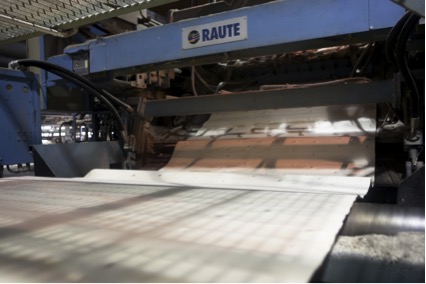
Raute receives major order from Russian plywood company

Raute Corporation has received orders worth over EUR 12 million from CJSC Plyterra of Russia.

The orders consist of veneer drying and patching lines and plywood lay-up and overlaying lines to be delivered toPlyterra's birch plywood mill located in Umet, Zubovo-Polyanskiy region in Mordovia. The ordered machinery and equipment will be delivered during the first quarter of 2020 and production on the new lines will be started during summer 2020.

The equipment will be engineered and produced in Raute’s production unit in Nastola and partly in the Kajaani unit, and also in the company’s partnership network. The equipment now ordered from Raute is part of Plyterra’s investment program through which the mill’s annual capacity will be increased up to 180,000 cubic meters.

The cooperation between Plyterra and Raute has continued since 2012 and Raute has already previously delivered plywood production machinery and equipment to Plyterra in various projects, such as a veneer peeling line in 2018. Also, several Plyterra’s production lines are under Raute’s preventive maintenance agreement.

Raute’s strong expertise in the entire plywood production process can be seen in the scope of the delivery. Lessons learnt from the previous deliveries and Raute’s presence in the Russian market also had an influence when selecting the supplier.

The present new order has no impact on Raute’s outlook for 2019. Raute’s net sales and operating profit for 2019 are expected to remain at the level of the previous year.

India achieved PEFC endorsement

The Programme for the Endorsement of Forest Certification (PEFC) informed that India has become the latest country to achieve the PEFC endorsement of its national forest certification system.

“PEFC endorsement is a landmark achievement for India, as we have long felt the need for such a country specific and internationally benchmarked forest certification system.

The newly endorsed national system will allow Indian forest managers to further strengthen their sustainable forest management practices, in line with global standards and multilateral requirements. “Vijai Sharma, Chairman of The Network for Certification and Conservation of Forests (NCCF)

NCCF joined the PEFC alliance in 2015 and submitted the national system to PEFC for endorsement in 2017. The system was developed through a multi-stakeholder group including forestry professionals, representatives from government, forest corporations, conservation organisations and industry bodies.

World’s tallest timber tower completed in Norway

The Mjøstårnet building in the Norwegian town of Brumunddal, which is historically engaged in wood processing, has been officially declared the tallest timber building in the world. Ranking second and third are Canadian Brock Commons and Australian 25 King with their heights of 53 and 45 metres respectively.

They do not come anywhere close to the 18-storey Mjøstårnet reaching a record-breaking height of 85.4 m. The building’s residential floor area is 11,300 sq. metres. The building was evaluated by the Council on Tall Buildings and Urban Habitat (CTBUH), a reputable international organisation.

The CTBUH notes that the project was made possible by advances in mass timber production and the increased availability of structural elements such as glue-laminated and cross-laminated timber (CTL).

Moelven Limitre, the project’s structural engineer, supplied and installed glue-laminated timber columns, beams and diagonals and CLT elevator shafts, stairs and floor slabs.

Mjøstårnet was completed on March 15. The building was initially supposed to be 81 meters high, but subsequently its design was slightly changed, and the skyscraper “grew up” by 4.4 metres. The structure was built by AB Invest.

Not only the building’s bracing and structural beams, but also elevator shafts, staircases andfloors are made of glue laminated timber making the project truly unique.

Japan’s wood pellet imports double again in 2018

Japanese wood pellet imports are on pace to exceed 1 million tonnes in 2018, approximately double the amount of imports from 2017. Through the first 3 quarters of 2018, 63% of Japan’s wood pellet imports came from Canada and 31% from Vietnam. Due to the fixed price and long contract length of the Feed-in-Tariff subsidy that supports renewable energy in Japan, long term contracts from strong counter-parties, like those in Canada and the USA are the preferred form of procuring wood pellets for most Japanese buyers. It is expected a rapid expansion in Japanese wood pellet imports in the years to come.

In 2012, Japan imported only 71,981 metric tons of wood pellets. By 2013, that volume grew to 83,769 metric tons. Wood pellet imports reached 96,745 metric tons in 2014, 232,425 metric tons in 2015, and 346,855 metric tons in 2016. Continue reading "Japan’s wood pellet imports double again in 2018"

Congo: New forest code could totally ban exports of logs

Against the backdrop of very quiet demand in China producers report no price movements other than the recent decline in okan prices, a favourite in the Chinese market.

The future of okoume log exports is now in doubt with countries scaling back exports or, as reported, because of the rumoured total log export ban in the Republic of Congo. This may be an early indication of the policy approach taken in the new forest code. While the code has not been made public producers say some new regulations are already being implemented. Continue reading "Congo: New forest code could totally ban exports of logs"

Keitele Timber to upgrade sawmills, pellet plant

NIB and Keitele Timber have signed a EUR 15 million loan agreement to finance the company investments in facilities for mechanical wood processing. The maturity of the loan is ten years.

NIB’s loan to Keitele Timber will finance the company’s investments in tangible capital; machines, flue gas scrubbers, dryers for sawdust and bark, as well as a pellet factory. Keitele Timber is a subsidiary of Keitele Group that runs three sawmills. Continue reading "Keitele Timber to upgrade sawmills, pellet plant"

Sharp slowdown in EU wood furniture trade at the end of 2018

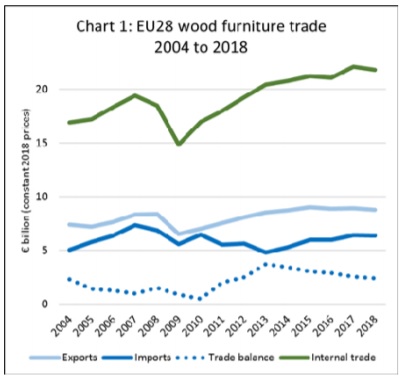
After a strong start to the year, the trade in wood furniture slowed sharply in the last quarter of 2018. EU imports of wood furniture from outside the region, which were up 6% in the first nine months of 2018, finished the year down around half a percentage point compared to 2017 at €6.36 billion. This is a reversal of the slow recovery in EU imports that began in 2013.

The decline in wood furniture imports closely mirrors changes in the wider European economy.

According to the EU Winter 2019 Economic Forecast published in February, economic activity in the EU cooled in the second half of 2018 as political tensions and uncertainty over fiscal policy and Brexit sapped business and consumer confidence and output in some Member States.

GDP growth in both the euro area and the EU slipped to 1.9% in 2018, down from 2.4% in 2017. Slowing economic growth fed through into a fall in the value of the euro and the British pound, both of which weakened against the U.S. dollar by around 8% during 2018.

These changing economic conditions are also indicated by a slowdown in internal EU wood furniture trade which, after hitting a peak of €22.1 billion in 2017, fell back nearly 7% in 2018 to €21.8 billion. The Brexit situation led to a slowing in UK imports both from within and outside the EU in the second half of 2018, while broader concerns about the EU economy contributed to a slowdown in trade elsewhere in the region.

The decline last year interrupts a long-term sharply rising trend in internal EU trade on-going since the financial crises in 2008-2009.

This long-term trend has been driven by increased market integration within the EU, the shift in manufacturing from higher cost countries in the western EU to lower cost eastern locations, particularly Poland, and the growing presence and influence of large-scale retailing chains operating at cross country level, most notably IKEA. More wood furniture imports into the EU from outside the region are also now being funneled via the Netherlands.

The drive towards greater integration of the EU furniture market and access to relatively lower cost manufacturing locations in the eastern EU partly explains the continuing dominance of EU-based manufacturers in the region.

EU-based manufacturers account for around 85% of all wood furniture sold in the region.

In recent years, European manufacturers have boosted productivity and competitiveness through investment in more advanced computer-controlled and automated manufacturing, cutting overheads and reducing the relative labour cost advantages of overseas producers.

There’s been a particularly large investment by Western European furniture manufacturers in Eastern European countries, notably since their accession into the EU from 2004, and this is now maturing. From being principally production satellites for large western European brands, Eastern European manufacturers are now developing their own identity and market momentum.

Furniture manufacturers in the EU area are also making a virtue of their shorter supply chains which not only reduce transport costs but also allow products to be delivered more rapidly.

External suppliers face other more direct challenges to expanding sales in the EU. Despite some recent consolidation, there is still a relatively high degree of fragmentation in the retailing sector in many European countries which complicates market access. Many overseas suppliers remain reliant on agents and lack direct access to information on fashions and other market trends. The progressive migration of European furniture sales online is also tending to favour local manufacturers better placed to meet the short lead times demanded by internet retailers and consumers.

Newsletter

Subscribe to our digital newsletter for your daily digest of essential news, views and analysis from the international wood industry delivered directly to your inbox.


0