Article archive

Latest prices for Indian teak, plywood and sawnwood

Latest prices for Indian teak, plywood and sawnwood - 1-15 June 2019
Plantation teak prices
C&F prices for plantation teak landed at Indian ports are within the same range as shown in the previous report.

US$ per cu.m C&F
Angola logs 389-574
Belize logs 350-400
Benin logs 290-714
Benin sawn 530-872
Brazil logs 344-540
Brazil squares 333-556
Cameroon logs 405-616
Colombia logs 478-743
Congo D. R. logs 450-761
Costa Rica logs 357-780
Côte d'Ivoire logs 289-756
Ecuador squares 333-454
El-Salvador logs 320-732
Ghana logs 294-452
Guatemala logs 324-646
Guyana logs 300-450
Kenya logs 515-876
Laos logs 300-605
Liberia logs 265-460
Malaysian logs 225-516
Mexican logs 295-808
Nicaragua logs 402-505
Panama logs 335-475
PNG logs 443-575
Sudan logs 358-556
Tanzania, teak, sawn 307-613
Thailand logs 511-700
Togo logs 334-590
Trinidad and Tobago logs 603-753
Uganda logs 411-623
Uganda Teak sawn 680-900
Price range depends mainly on length and cross section

Prices for locally sawn imported hardwoods
Demand for imported hardwoods remains steady and the recent price increase have been accepted by the market.

Sawnwood, (Ex-mill) (AD) Rs. per ft3
Merbau
4100-4250
Balau
2600-2750
Resak
1800-2000
Kapur
2250-2400
Kempas
1550-1750
Red Meranti
1500-1650
Radiata pine AD
850-950
Whitewood
850-950
Price range depends mainly on length and cross section

Myanmar teak prices
The steady demand for Myanmar teak has consolidated the recent ex-yard price increases.

Sawnwood (Ex-mill) Rs. per ft3
Myanmar Teak (AD)
Export Grade F.E.Q.
15000-22000
Plantation Teak A grade
9500-11000
Plantation Teak B grade
7500-8500
Plantation Teak FAS grade6
5000-7000
Price variations depend mainly on length and cross section.

Prices for imported sawnwood
The firming demand for sawnwood has lifted prices for imported European and US sawn hardwoods.

Sawnwood, (Ex-warehouse) (KD) Rs per ft3
Beech 1700-1850
Sycamore 1800-2000
Red oak 2000-2200
White Oak 2500-2600
American Walnut 5000-5500
Hemlock AB grade 2200-2450
Western Red Cedar 2300-2450
Douglas Fir 1800-2000
Price variations depend mainly on length and cross section.

Prices for WBP marine grade manufactured by domestic mills

Plywood, Rs per sq.ft
Ex-warehouse. (MR Quality)
4 mm 69
6 mm 92
9 mm 115
12 mm 143
15 mm 190
18 mm 201

Domestic ex-warehouse prices for locally manufactured MR plywood

Locally Manufactured
Plywood “Commercial
Grade”
Rs per sq.ft
Rubberwood Hardwood
4mm Rs.35 Rs.50
6mm Rs.52 Rs.66
8mm Rs.66 Rs.81
12mm Rs.81 Rs.95
15mm Rs.95 Rs.115
19mm RS.111 Rs.132
5mm Flexible ply Rs.70

Source: ITTO

Finland: Falling spruce roundwood prices in May 2019

Spruce roundwood prices in Finland are on a falling trend in May 2019, both as compared to the previous month as well as compared to May 2018.
Spruce sawlog prices are almost 4% lower compared to last year, while small-sized spruce logs by almost 2%.
Pine sawlogs' price is higher by almost 2% over last year, but has lost a few cents as compared to April.
Some mixed trends could be noticed in pulpwood prices evolution. Pine, spruce and birch pulpwood prices are well above the level of last year, but have fallen quite significantly as compared to April.

Average roadside prices of sales from non-industrial private forests in Finland (in EUR/m3) May 2018 April 2019 May 2019 Change in % May 2018/2019 Change in % April 2019/May 2019
Pine logs 59.93 61.65 61.18 +2.08% -0.61%
Spruce logs 62.26 64.1 61.72 -0.86% -3.72%
Birch logs 48.9 50.58 51.69 +5.70% +2.19%
Pine pulpwood 28.92 32.05 31.7 +9.61% -1.09%
Spruce pulpwood 32.05 35.36 33.77 +5.36% -6.81%
Birch pulpwood 29.08 32.64 32.38 +11.34% -0.79%
Small-sized logs, pine 37.18 39.48 41.44 +11.45% +4.96%
Small-sized logs, spruce 40.38 41.61 39.66 -1.78% -4.68%

Norbord resumes operations at its OSB mill in High Level

Norbord Inc. reported that its OSB mill in High Level, Alberta was cleared to restart, and safely resumed normal operations. 

On June 18th, Norbord reported that its High Level OSB mill had temporarily suspended production due to the wild fires burning nearby in the region. All non-essential mill employees were safely evacuated at the time and the mill did not incur any damage.

The curtailment is not expected to materially impact Norbord's second quarter results.

The High Level, Alberta mill has a stated annual production capacity of 860 million square feet (3/8-inch basis) and has been ramping up toward full production since resuming operations in late 2013. High Level is located approximately 720 kilometres northwest of Edmonton and 400 Norbord Profile

Norbord Inc. is a leading global manufacturer of wood-based panels and the world's largest producer of oriented strand board (OSB). In addition to OSB, Norbord manufactures particleboard, medium density fibreboard and related value-added products. Norbord has assets of approximately $1.9 billion and employs approximately 2,700 people at 17 plant locations in the United States, Canada and Europe.

SCA acquires another 10,000 hectares of forest land in Latvia

SCA has signed an agreement to acquire Sundin Mezs SIA from the unlisted Swedish company Livland Skog AB. Sundin Mezs SIA owns forest and land assets in Latvia.

The purchase price is approximately SEK 260 million (Euro 24.2 million) on a debt-free basis.

The acquisition comprises 9 600 hectares, of which 8 500 are forest land. The standing timber volume amounts to 900 000 cubic metres.

Earlier this year SCA acquired 10 000 hectares of forest land in Latvia and 10 000 hectares of forest land in Estonia.

“The Baltic states are part of our raw material base”, says Jonas Mårtensson, President Forest.”We have been present in the market for a long time as a buyer of timber. Having our own forest resource strengthens our operations in the region.”

The acquisition is expected to be closed in the third quarter 2019.

Latest prices for Brazilian exported logs, sawnwood and plywood

Latest prices for Brazilian logs, sawnwood and plywood as of 1-15 June, 2019.

Brazilian logs, mill yard, domestic US$ per m3
Ipê 206
Jatoba 115
Massaranduba 110
Muiracatiara 110
Angelim Vermelho 108
Mixed redwood and white wood 91
Source: STCP Data Bank

Continue reading "Latest prices for Brazilian exported logs, sawnwood and plywood"

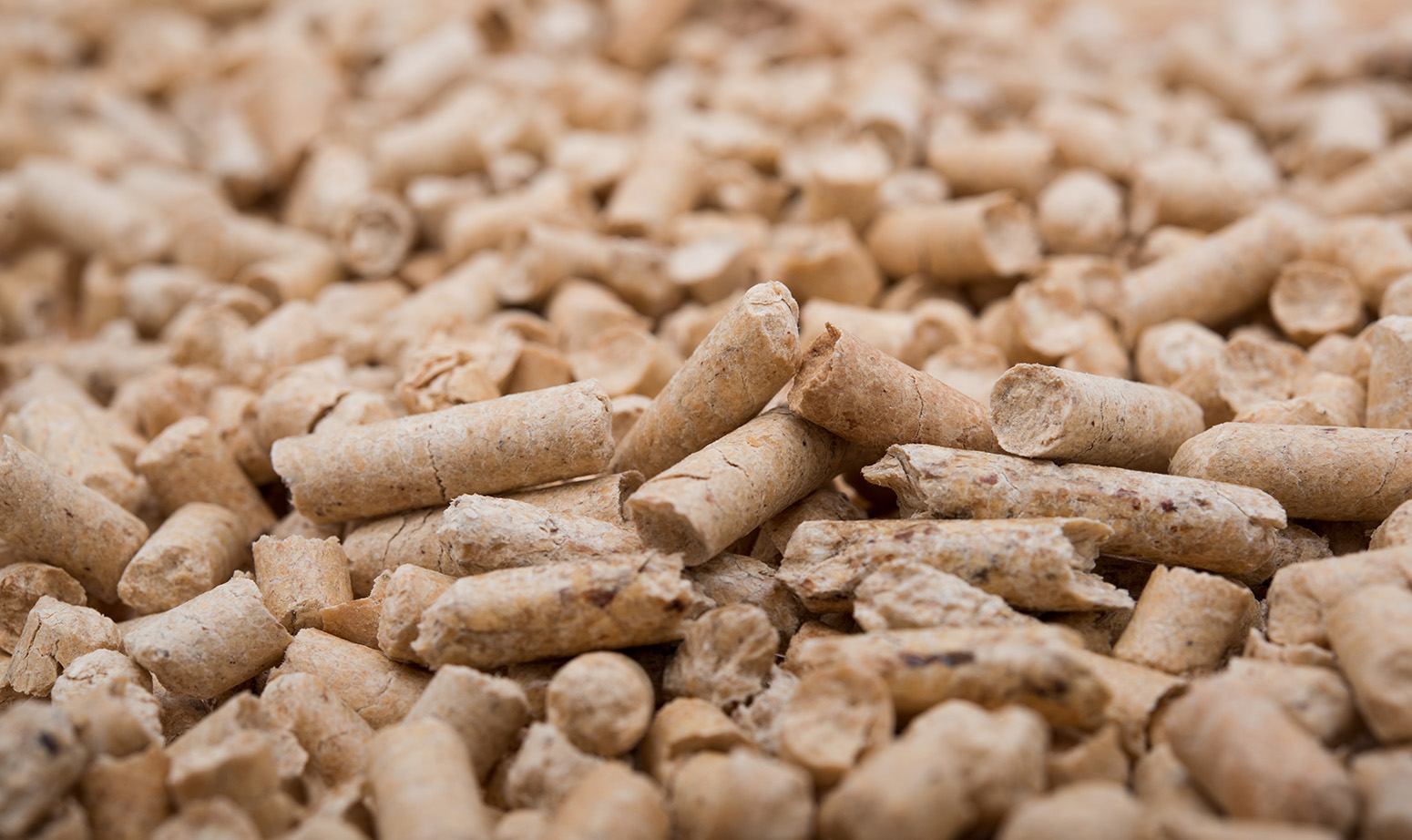
Rising prices for Russian pellets delivered to the EU this year

The average price of Russian wood pellets sent to the European Union countries in the first quarter of 2019 has increased by 10% as compared to the same period of last year. The most expensive Russian wood pellets were sent to Italy (€193/tonne) and to the United Kingdom (an average of €167/ton).
Russian pellets sent to Denmark in Q1/2019
Continue reading "Rising prices for Russian pellets delivered to the EU this year"

The Swedish glulam industry is expanding rapidly

The Swedish glulam industry continues to gain market share. The first quarter of 2019 shows a clear increase in sales compared to the previous year, despite reduced construction activity.

"The paradigm shift in the construction industry has been completed, glulam is increasingly emerging as the new first choice," says Johan Fröbel, head of technology and distribution at the trade association Svenskt Trä (Swedish Wood).

Total sales of glulam beams and glulam piles increased by about 6 per cent in the first quarter this year, compared with 2018. The figures for March are even stronger with an increase of about 10 per cent. This should also be seen in relation to the fact that housing construction continues to decline. For example, the Swedish Statistics Office  reports a 9 per cent drop in housing starts in January and February this year, as compared to the corresponding period of last year.

The product group that stands out most in the statistics on glulam sales is warehouse beams that are sold through the construction trade. The increase for March 2019 is as much as 31 per cent, and for the first quarter of this year 14 per cent, compared with the same period last year, which is also reflected in the fact that building materials traders make a strong first quarter.

The long-term trend is that the wood construction industry takes market shares. The climate and quality arguments for glulam have for some years landed at the construction industry, but we also see that more and more people are highlighting the rational construction that glulam makes possible, with time and cost efficiency as a result, says Johan Fröbel.

He can, among other things, lean against a survey conducted by Svenskt Trä which shows that 71 percent of those surveyed in the construction industry want to see an increased use of glulam as frame material. And according to the latest figures from the Swedish Statistics Office, 11.5 per cent of all multi-storey buildings in Sweden are now being built with glulam as frame material, an increase from 2015 when the corresponding figure was 8 per cent.

Traditionally, small and medium-sized construction contractors who, with their more flexible business models, have been able to broaden their offering with wood. Now, big players have also begun to step into the playing field, because more and more people see both climate benefits and business opportunities with glulam, says Johan Fröbel.

Conifex to sell Fort St. James sawmill to Hampton Lumber

Conifex Timber Inc. announced that it has entered into a definitive purchase agreement with Hampton Lumber for the sale of its Fort St. James sawmill and associated forest license. The purchase price is approximately $39 million plus the market value of finished lumber and log inventory at closing.

Ken Shields, Conifex's Chair and CEO, stated: "“We have known for some time that lumber industry rationalization is inevitable because too little sawlog supply is available to maintain the existing manufacturing base in the Interior region of BC. The decision we have taken to sell the mill was extremely difficult; however, we are encouraged by Hampton’s plans for the site. We believe this transaction supports the Province’s objectives for industry rationalization that is mindful of the impacts on people, communities and First Nations. We sincerely thank our employees, contractors, and other stakeholders for their hard work and contribution to the site over the past decade.”

Hampton Lumber operates nine sawmills in Oregon, Washington and British Columbia, including two in the Burns Lake area of British Columbia. Hampton Lumber CEO, Steve Zika commented that, “while economic conditions are extremely challenging right now for the lumber industry in British Columbia, we believe the long-term outlook for Canadian lumber is promising. We intend to build a new sawmill in Fort St. James and look forward to building relationships with local First Nations and other community partners similar to a successful joint venture we have with the Burns Lake Native Development Corporation in the Burns Lake area.”

Due to continued uncertain market conditions, Conifex does not expect to resume normal operations at the Fort St James site prior to closing of the transaction.

Closing is subject to certain regulatory approvals, including approval of the Minister of Forests, Lands, Natural Resource Operations, and Rural Development and other customary closing conditions. The proceeds of the transaction will be primarily used to retire debt and to provide additional liquidity so Conifex can better optimize performance and value at its other locations.

Sampsa Auvinen reconfirmed as President of the EOS

The 2019 European Organisation of the Sawmill Industry (EOS) General Assembly elected its new Board of Directors and President.

Sampsa Auvinen is reconfirmed as President of the European Organisation of the Sawmill Industry for his third mandate.

Ernest Schilliger is reconfirmed EOS Vice President for softwood. Maria Polz is elected for the first time and nominated EOS Vice President for hardwood.

The European Organisation of the Sawmill Industry (EOS) is a Brussels-based non-profit association representing the interests of the European sawmilling sector on European and International level.

The following Board Members were unanimously nominated for the mandate 2019-2021.

Sampsa Auvinen EOS President - III Mandate Latvia
Kai Merivuori Sahateollisuus Finland
Herbert Joebsti Stora Enso Austria
Stephan Lang Rettenmeier Germany
Ernest Schilliger Schilliger Holz - EOS Vice President Switzerland
Thomas Sève Sève-Monnet France
Mathias Fridholm Skogsindustrierna Sweden
Nicolas Douzain-Didier Fédération Nationale du Bois France
Maria Polz Ehp -EOS Vice President (HARDWOOD) Austria
Nicolae Tucunel FOREX Romania

China recognized wood framing in new standard

Wood Frame Construction Technology (WFC) has officially been recognized for the first time by China’s Green Building Evaluation Standard as a viable solution for the country’s green building credit rating. This is another milestone for WFC in China on the government regulations front after a series of prefabrication policies favorable to wood has been published in the past few years.

The newly revised standard, printed in May and scheduled to be implemented in August 2019, includes WFC as one of the three building solutions along with concrete and steel systems. It also awards credits to wood frame solutions for being an innovative construction technology. The new standard also introduces the entry Certified Level, making it aligned with the LEED certification system and offering more accessible eligibility. This also means that green building standard is likely to be implemented as de-facto compulsory measures in the future.

In 2006, the Chinese Ministry of Housing and Urban-Rural Development (MOHURD) released its first Evaluation Standard for Green Building, otherwise known as the Three Star System. Different from LEED’s total points rating system, the Chinese system requires that a building must obtain a certain number of points in all rating categories to qualify for a star rating.

Based on the 2006 Evaluation Standard for Green Building, MOHURD further revised the document the standard in 2015, vowing that 30% of all newly constructed buildings will be green by 2020. However, the 2015 revision still did not specify whether WFC was considered a green building solution.

MOHURD realized that WFC should also be a part of green building policies and standards, and started working on revising the Three Star System again in 2018, merely three years after its second iteration.

The standard is expected to be revised again in 2020.

Major global lumber-exporting countries increased their shipments in early 2019

The uptick in demand for lumber continued in early 2019, with most of the major lumber-exporting countries increasing their shipments as compared to early 2018.

Out of the top-ten exporting countries, the largest year-over-year increases (in %) were in Ukraine, Russia, the US, Chile and Germany. Lumber exports from Ukraine have taken off dramatically after the country banned practically all exports of softwood logs in 2017.

Lumber markets – North America

The free fall of lumber prices in the US came to a halt in early 2019, when prices were close to a four-year low. During the spring prices rose modest in both the US South and the US West. However, prices were substantially lower than their record highs in the 1H/18. Oversea supply of softwood lumber to the US has always been a fairly small share of the total import volume. Canadian supply has historically accounted for 94-97% of total imports, only declining when US lumber prices have been high, thus attracting imports from Europe and Latin America. However, non-Canadian imports have increased for six consecutive years and in 2018 reached their highest level seen in 11 years. Softwood lumber exports from Canada were down 6% year-over-year in 2018, with the biggest decline being in shipments to China. Despite efforts by Canada’s lumber industry to diversify its export shipments, 80% of total exports were destined for the US market in the 3Q/18 - a three-year high. However, this share fell to 76% in the 1Q/19 when exports to China rose again.

Lumber markets – Northern Europe

For the first time in five years, Swedish exports of softwood lumber fell year-over-year in 2018. The biggest declines from 2017 to 2018 were in exports to Asia and the MENA region, while shipments to the European market remained practically unchanged. The European share of total exports from Sweden reached 67% in 2018, the highest level seen since 2011. The MENA region accounted for just over 18% of total shipments, the second lowest share in ten years. Export prices (in US$) have stayed high during 2018 and actually averaged the highest level seen since 2014.

Lumber markets – China

Despite much uncertainty in the near future for the Chinese economy, lumber imports rose unexpectedly in the 1Q/19 by as much as 14%, as compared to the same quarter in 2018. Most of the increase was due to increases in shipments from Russia and Canada, while supply from Europe and Latin America declined. Import prices took a substantial hit in the past year, falling from an average of $335/m3 in March 2018 to $288/m3 in March 2019.

Lumber markets – Russia

Russia increased exports of softwood lumber by 7% from 2017 to 2018 to reach almost 30 million m3. This was the sixth consecutive year that exports have gone up from the previous year. Of the five largest export markets (China, Uzbekistan, Egypt, Azerbaijan and Japan), only Japan imported less lumber from Russia in 2018 than in the previous year.

Vietnam booming wood products exports to face shortage of raw materials

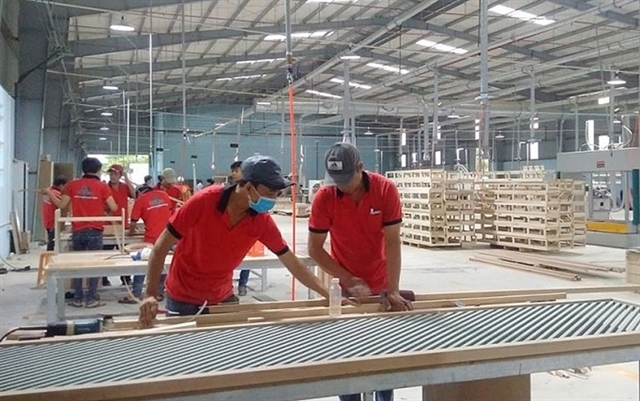
With its abundant potential in wood processing, Vietnam is emerging as a major exporter of finished wood products in the global wood market. However, the local wood industry is being challenged by shortages of imported materials which may affect its future exports.

Since early this year, Hoang Vinh Wood Processing JSC in the southern province of Binh Duong, which is Vietnam’s wood export hub, has been mobilising all of its 500 employees to work at full speed to meet the company’s contracts signed with a partner from France, worth US$20 million. The contracts must be fulfilled by early next month.

Last year, the firm reaped total export turnover of US$50 million, up 20% year-on-year, from some European and Asian markets.

In its business strategy, this firm will likely establish a joint venture with a partner from the Republic of Korea (RoK). “If the joint venture is established, we will be able to boost our exports significantly,” the company’s director Nguyen Hoang Vinh told VIR. “Currently, both sides are in negotiations and we hope a deal will be reached by the third quarter of this year.”

Nguyen Ton Quyen, vice chairman of the Timber and Forest Product Association of Vietnam (VIFORES), said that many foreign firms are seeking to co-operate with Vietnamese firms, like the potential Korean partner of Hoang Vinh, to boost exports to their nations.

“The wood industry’s export turnover has been rising strongly over the past few years, with US$7 billion in 2016, US$7.66 billion in 2017, and US$8.48 billion last year. Moreover, when Vietnam and the EU approve their shared Forest Law Enforcement, Governance and Trade Voluntary Partnership Agreement (FLEGT-VPA), Vietnam’s exports to the EU, one of its key export markets, will likely soar,” Quyen said.

The FLEGT-VPA is aimed to help improve forest governance, address illegal logging and promote trade in verified legal timber products from Vietnam to the EU and other markets.

Signed in October 2018, Vietnam and the EU are now working with each other towards taking the deal into effect this year.

Rising star

IMM Mission, funded by the EU and managed by the International Tropical Timber Organisation, stated, “Vietnam is emerging rapidly as a major player in international wood markets, both as an importer of wood materials and as a large exporter of finished wood products”

Vietnam signed FLEGT-VPA early this year and this presents unique opportunities, IMM said.

The IMM’s role is to use trade flow analysis and market research to independently assess trade and market impacts of VPAs in the EU and partner countries.

EU imports from Vietnam consist almost entirely of wooden furniture, with trade in this commodity strengthening this year after a dip in 2017. The twelve-month rolling total for EU furniture imports from Vietnam increased from 220,000 metric tonnes at the end of 2017 to 232,000 metric tonnes in November 2018, according to the IMM.

“Another potentially significant trend is that Denmark started to import larger volumes (up to 2,500 metric tonnes per month) of waste wood (for biomass energy) from Vietnam this year,” the IMM stated.

During her recent working visit to Vietnam, Heidi Hautala, Vice President of the European Parliament, stated that after the VPA takes effect, it will turn Vietnam into a more attractive investment spot for European wood investment, which remains humbly now.

“The VPA process and implementation will add to the confidence of European businesses in Vietnam’s business environment,” she said. “This will help Vietnam attract more investment from the EU, which is tending to increase now.”

“Currently the European consumers and businesses have growing demand for imported wood products with fairly transparent production and origins,” she said. “This will further prompt European investors to come to Vietnam to both implement projects directly and co-operate with local partners in exports. I am seeing many European businesses making plans to expand business and investment into Vietnam.”

Under the Comprehensive and Progressive Agreement for Trans-Pacific Partnership, which took effect for Vietnam on January 14, 2019, and the Vietnam-EU Free Trade Agreement, which is expected to be signed soon, almost all import tariffs will be eliminated, offering great potential for Vietnam’s wood exports, and for foreign firms to come to Vietnam to invest in the wood industry.

In 2018, Vietnam has about 3,200 enterprises engaging in exporting wood and wood products, including 529 foreign-invested enterprises which earned a total export turnover of nearly US$4 billion.

“Not only foreign firms, but many local ones have also been performing very well, and have secured export orders until the end of the second quarter of this year,” Quyen said. “While enterprise production is improving, the global demand for Vietnam’s wooden products are strongly rising, focusing on key markets including the US, China, Japan and the RoK.”

Last year, Vietnam’s wood exports turnover strongly increased from many markets, such as France (25.5%), Japan (16%), Malaysia (100%), the RoK (48%), and the US (17.5%).

The US, Japan, China, and the RoK purchased over around 80% of Vietnam’s total wood exports.

Nguyen Viet Vinh, Director of Vinh Hanh Furniture JSC in the south-central province of Binh Dinh, stated that this firm’s export turnover hit US$17 million last year – up about 18% over 2017. The figure is expected to be about US$10 million in the first half of 2019, up 20% year-on-year.

“We expect the figure will be about US$20-22 million in this year. We will continue seeking more export markets, in addition to our existing markets of Japan and the US, so that we can reach our target of US$25-27 million by 2020,” Vinh said.

VIFORES’s Quyen said many other firms are also performing very well in exports. For example, the export turnover of Nam Dinh Export Foodstuff and Agricultural Products Processing is expected to rise from US$50 million last year to nearly US$55 million this year. Meanwhile, many other firms like Tien Dat, Dai Thanh, Cancia Pacific, Hiep Long, Minh Phat and Phu Tai are also expected to reap export turnovers of US$30-50 million this year, up 10-15% year-on-year.

Early this year, Prime Minister Nguyen Xuan Phuc said the wood industry has grown by over 800% over the past 10 years. He ordered it to reach an export turnover of over US$11 billion worth of wood and forestry products in 2019.

Shortages of materials

However, one of the biggest challenges facing Vietnam’s wood industry is the upcoming shortages of imported material supplies, which will affect the country’s future wooden exports.

Currently, Vietnam must largely depend on foreign supplies to ensure its local production. Annually, it spends US$1.7-1.8 billion importing timber materials, which are largely from Laos (60% of round and sawn timber – the main timber for production), Cambodia (70% of precious timber), Papua New Guine, and Africa.

According to a wood industry report from VIFORES, Handicraft and Wood Industry Association of Ho Chi Minh City, and Forest Products Association of Binh Dinh, Vietnam will face major shortages of timber materials from these markets.

For example, Laos, which used to export nearly one million cubic metres (m3) of round timber to Vietnam annually, has stopped exporting timber materials since May 2017.

The policy has almost curbed all timber supplies from Laos for Vietnam. The volume of round timber has reduced from 322,000m3 in 2015 to 36,000m3 in 2016, and 6,000m3 in the first half of 2017.

In another case, Cambodia’s government is planning to more strictly control the country’s timber exports.

According to the report, timber supplies from Papua New Guine and Africa are facing issues regarding timber quality and legality, which are also affecting Vietnam’s wood processing and exports.

Hoang Vinh Wood Processing JSC is also suffering from wood materials. “We are trying to find new sources from EU. Though if the new sources offer at higher prices, we will have to accept, meaning that we may have to increase product prices,” said this firm’s director Vinh.

VIFORES’s Quyen said his association and businesses have been working with many partners in the US, France, Finland, some other EU nations, Japan, and New Zealand about wood material supplies.

“These are Vietnam’s new wood material suppliers. They even come to Vietnam to seek supplying contracts. In spite of higher prices, materials from these markets have higher quality and clearer origins,” Quyen said.

Recovery in EU softwood lumber deliveries to China, as Germany compensates sharp drop in Nordic exports

After a -32% drop in exports last year, European softwood lumber deliveries to China have recovered in the first quarter of the year. While Nordic exports continued the negative trend recorded in 2018, the German deliveries are responsible for the overall 7% in rise the overall EU exports. 

The European Union countries sent only 816 thousand m3 of softwood lumber to China, during the mentioned period, as compared to the 762 thousand m3 that they've sent in Q1/2018.

The biggest exporter was Finland, although its shipments decreased by -15% as compared to January-March 2018. The country sent 330 thousand m3 of softwood lumber to China. Swedish exports dropped by -34%, down to only 163 thousand m3.

On the other hand, the German softwood lumber exports to China had a great Q1/2019, and increased by 310%, up to 143 thousand m3. Austrian deliveries, though at a lower volume, hiked by 185%, up to 59 thousand m3.

EU softwood lumber exports to China from... (in m3 )

Exporting Country Q1/2018 Q1/2019 Change in %
EUROPEAN Union
762,442 816,181 7 %
Finland
387,068 330,718 -15 %
Sweden
249,316 163,374 -34 %
Germany
34,988 143,502 310 %
Austria
20,824 59,342 185 %
Latvia
14,634 25,598 75 %
Others
55,612 93,647 68 %
OTHER European Countries
237 147 -38 %
Croatia
237 147 -38 %
TOTAL 762,679 816,328 7 %

Skyrocketing lumber prices in US as Canadian curtailments crisis escalates

News broke last Monday of another mill closure in British Columbia, which shifted trading in most framing lumber species to a higher gear. West Fraser announced its intention to permanently close its Chasm lumber mill and eliminate a shift at the 100 Mile House mill in the third quarter.
Sales slowed in late trading, however, as buyers paused to assess the market. The reported price of Western S-P-F #2&Btr 2x4 jumped $30 higher, although upward momentum slowed in the second half of the week.

Week
Jun 21
Last Week
Jun 14
Year Ago
2018
Random Lengths Framing Lumber Composite Price* $345 $326 $554
KD Western S-P-F #2&Btr 2x4 R/L Mill Price 390 360 582
KD Eastern S-P-F #1&2 2x4 R/L, delivered Great Lakes 445 402 686
Green Douglas Fir Std&Btr 2x4 R/L (Portland) 323 303 560
Southern Pine (Westside) #2 2x4 R/L 332 318 568
KD Coast Hem-Fir #2&Btr 2x4 R/L 378 353 615
Ponderosa Pine (Inland) #2&Btr 1x12 R/L 860 860 770
* Weighted average of 15 key items


Random Lengths Panel Market Report

Structural panel trading displayed more energy. Sales of OSB kicked into high gear. Supply-side concerns pulled buyers into the market following recent curtailment announcements in Western Canada. A more positive tone emerged in Southern Pine plywood after a sluggish start shifted to steadier sales in late trading. An uptick in western Fir plywood activity at midweek generated enough sales for some producers to report their strongest sales in weeks. Canadian plywood traders experienced a sluggish week. The Random Lengths Non-Structural Panel Composite Price shifted for the first time since its inception, posting an $8 gain.

(f.o.b. mill prices) Week
Jun 21
Last Week
Jun 14
Year Ago
2018
Random Lengths Structural Panel Composite Price* $334 $333 $565
Southern (west-east) 15/32-inch 3-ply rated sheathing plywood 340-380 345-385 530-565
Southern (west-east) 15/32-inch 4-ply rated sheathing plywood 345-385 350-390 535-570
Western 1/2-inch 4-ply rated sheathing plywood 352 352 567
North Central 7/16-inch Oriented Strand Board 182 175 445
*Weighted average of 11 key items


West Africa: Logs & sawnwood FOB prices for Chinese market under pressure

European markets are uninspiring according to producers. FOB prices remain at the same level as in the past 2 months but there is some comfort to be gained from the market stability.
In recent weeks another shipment to Europe of around 10,000 cubic metres of azobe has swamped the market and is beginning to undermine FOB prices Prices for the Chinese market are becoming more volatile.
Analysts report that prices for ovangkol for the Chinese market have dropped 30-40% due to the lack of demand. Demand for okoume, padouk and belli has also fallen and this could eventually drive prices lower.
Heavy rain and the truck weight/load limits continue to be a problem for producers in Cameroon.
Exporters in SEZ having an easier time
Analysts report that it is now 6 weeks since the last export shipment by companies operating outside the Special Economic Zone (SEZ). It has been rumoured that several foreign companies have begun laying off workers. The situation for the mills within the SEZ is much better as export shipments are getting away on schedule. The main problem for mills in the SEZ is supply of the popular timbers.
Wood Show 2019 expands
The Gabon WoodShow, scheduled for 24-26 June, has attracted a wide range of wood processing and forestry machinery companies. The number of exhibitors has more than quadrupled with companies coming from India, Cameroon, Italy, Poland, Turkey, Germany, France, Singapore, Slovenia, UAE, Belgium, China and South Africa.
New forestry minister for Gabon
In the wake of the kevazingo scandal, locally called "kevazingogate", the President of Gabon has appointed a new minister of water and forestry.
It came as a surprise when it was announced the new minister is Lee White, a naturalised Gabonese citizen and an active conservationist. The British-born minster will lead a sector he is familiar with due to his work to conserve biodiversity in Gabon.
Log Export Prices

West Africa logs, FOB € per m³
Asian market
LM
B
BC/C
Acajou/ Khaya/N’Gollon
265
265
175
Ayous/Obéché/Wawa
250
250
225
Azobe & Ekki
275
275
175
Belli
290
290
Bibolo/Dibétou
215
215
Bilinga
275
275
-
Iroko 350
350
250
Okoume (60% CI, 40% CE, 20% CS) (China only) 220 220 200
Moabi 365 365 -
Movingui 210
210
-
Niove
160
160
Okan
220
200
Padouk
340
290
245
Sapele 310 310 265
Sipo/Utile
325
300
265
Tali 370 370

  Sawnwood Export Prices

West Africa sawnwood, FOB
€ per m³
Ayous FAS GMS 440
Bilinga FAS GMS 540
Okoumé FAS GMS
460
Merchantable 310
Std/Btr GMS 340
Sipo FAS GMS
520
FAS fixed sizes 560
FAS scantlings 750
Padouk FAS GMS 850
FAS scantlings 900
Strips 650
Sapele FAS Spanish sizes 850
FAS scantlings 500
Iroko FAS GMS 520
Scantlings 640
Strips
720
Khaya FAS GMS
400
FAS fixed
480
Maobi FAS GMS
540
Scantlings
640
Movingui FAS GMS
420

West Africa: Logs & sawnwood FOB prices for Chinese market under pressure

European markets are uninspiring according to producers. FOB prices remain at the same level as in the past 2 months but there is some comfort to be gained from the market stability.

In recent weeks another shipment to Europe of around 10,000 cubic metres of azobe has swamped the market and is beginning to undermine FOB prices Prices for the Chinese market are becoming more volatile.

Analysts report that prices for ovangkol for the Chinese market have dropped 30-40% due to the lack of demand. Demand for okoume, padouk and belli has also fallen and this could eventually drive prices lower.

Heavy rain and the truck weight/load limits continue to be a problem for producers in Cameroon.

Exporters in SEZ having an easier time

Analysts report that it is now 6 weeks since the last export shipment by companies operating outside the Special Economic Zone (SEZ). It has been rumoured that several foreign companies have begun laying off workers. The situation for the mills within the SEZ is much better as export shipments are getting away on schedule. The main problem for mills in the SEZ is supply of the popular timbers.

Wood Show 2019 expands

The Gabon WoodShow, scheduled for 24-26 June, has attracted a wide range of wood processing and forestry machinery companies. The number of exhibitors has more than quadrupled with companies coming from India, Cameroon, Italy, Poland, Turkey, Germany, France, Singapore, Slovenia, UAE, Belgium, China and South Africa.

New forestry minister for Gabon

In the wake of the kevazingo scandal, locally called "kevazingogate", the President of Gabon has appointed a new minister of water and forestry.

It came as a surprise when it was announced the new minister is Lee White, a naturalised Gabonese citizen and an active conservationist. The British-born minster will lead a sector he is familiar with due to his work to conserve biodiversity in Gabon.

Log Export Prices

West Africa logs, FOB € per m³
Asian market
LM
B
BC/C
Acajou/ Khaya/N’Gollon
265
265
175
Ayous/Obéché/Wawa
250
250
225
Azobe & Ekki
275
275
175
Belli
290
290
Bibolo/Dibétou
215
215
Bilinga
275
275
-
Iroko 350
350
250
Okoume (60% CI, 40% CE, 20% CS) (China only) 220 220 200
Moabi 365 365 -
Movingui 210
210
-
Niove
160
160
Okan
220
200
Padouk
340
290
245
Sapele 310 310 265
Sipo/Utile
325
300
265
Tali 370 370

  Sawnwood Export Prices

West Africa sawnwood, FOB
€ per m³
Ayous FAS GMS 440
Bilinga FAS GMS 540
Okoumé FAS GMS
460
Merchantable 310
Std/Btr GMS 340
Sipo FAS GMS
520
FAS fixed sizes 560
FAS scantlings 750
Padouk FAS GMS 850
FAS scantlings 900
Strips 650
Sapele FAS Spanish sizes 850
FAS scantlings 500
Iroko FAS GMS 520
Scantlings 640
Strips
720
Khaya FAS GMS
400
FAS fixed
480
Maobi FAS GMS
540
Scantlings
640
Movingui FAS GMS
420

EU asks for arbitration with Ukraine on wood export ban

The EU requested the establishment of an arbitration panel under the EU-Ukraine Association Agreement on Ukraine’s export ban on unprocessed wood.

The EU-Ukraine Association Agreement prohibits any form of export restrictions. The EU considers therefore that keeping in place since 2005 a permanent ban on exports of sawn wood violates the terms of the agreement.

This is also the case for the additional ten-year ban on exports of all unprocessed wood effective since 2015.

The EU has raised the issue of the export ban with the Ukraine authorities at all levels and instances since 2015. The ban remains though in place, which is why the EU has decided to launch a formal dispute settlement procedure.

The current panel request comes after consultations with the Ukrainian government held in Kyiv on 7 February 2019, which failed to resolve the matter. The EU hopes that the matter can be resolved during the arbitration panel proceedings and that Ukraine eliminates the trade restrictions in line with the requirements of the EU-Ukraine Association Agreement.

Enforcement of international trade rules has been identified as a top priority in the Commission’s ''Trade for All'' strategy of 2015. This step shows that the EU takes implementation and enforcement of our trade agreements seriously.

The panel request

More on dispute settlement
More on Ukraine

European log supply and lumber quality affected by bark beetle outbreaks and wildfires

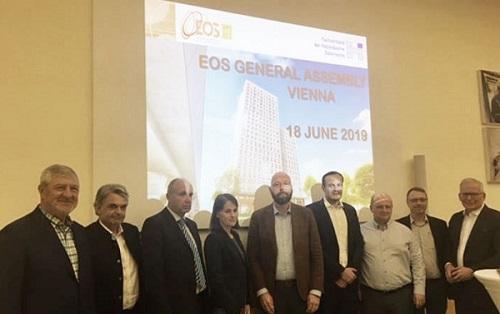
On 18 June 2019, EOS, together with its Member, Fachverband der Holzindustrie Österreichs, hosted the EOS General Assembly and the EOS Board meeting in Vienna.

The meeting was anticipated by the visit to the HoHo building. The new 84-meter, 24-storey high ‘HoHo Tower‘ in Vienna is one of the world’s tallest wood timber building - around 76 percent of the structure is constructed from wood. This timber construction system is resource- efficient, is highly efficient in terms of thermal insulation and also in terms of embodied energy. In the public debate, the health of our planet is becoming more and more a top priority. Buildings are responsible for approximately 40% of energy consumption and 36% of CO2 emissions in the EU. Solid wood lumber, commonly used in building construction, keeps carbon (previously absorbed by the tree) sequestered for the lifetime of the building and is thus a credible solution for environmentally-friendly buildings. At the end of a building’s life, wood can be recovered to be re-used in another structure, or by another wood industry, or chipped for use as fuel.

Looking at the sawn wood markets, although 2018 was a positive year for both softwood and hardwood lumber producers - production in the respective markets went up by 2.2% and 1.3% meeting a strong demand - the year 2019 is seeing significant changes in the markets. What is more, deep concerns have been highlighted regarding the effect of forests disturbances on the sawmill business. Forest disturbances such as pests and wildfire can lead to the destruction of entire forest stands having significant impacts on the productive capacity of forestry sectors and on wood quality supply. Insects and fungi reduce wood quality, resulting in lower yields and reduced timber prices.

Dr Tomáš Hlásny, co-writer of the “EFI study on the effect of pests in forests. Current situation and the possible effects caused by the climate change on forests”, gave a comprehensive presentation about the Study. This document was prepared in response to the alarming increase of bark beetle outbreaks in Europe’s conifer forests. He emphasised that bark beetle outbreaks in forests are expected to take a heavy toll in the coming years, particularly affecting spruce stands in Central Europe.

The 2019 EOS General Assembly elected its new EOS Board of Directors and President. Sampsa Auvinen is reconfirmed as President of the European Organisation of the Sawmill Industry for his third mandate. Ernest Schilliger is reconfirmed EOS Vice President for softwood. Maria Polz is elected for the first time and nominated EOS Vice President for hardwood.

The following Board Members were unanimously nominated for the mandate 2019-2021.

Sampsa Auvinen EOS President - III Mandate Latvia
Kai Merivuori Sahateollisuus Finland
Herbert Joebsti Stora Enso Austria
Stephan Lang Rettenmeier Germany
Ernest Schilliger Schilliger Holz - EOS Vice President Switzerland
Thomas Sève Sève-Monnet France
Mathias Fridholm Skogsindustrierna Sweden
Nicolas Douzain-Didier Fédération Nationale du Bois France
Maria Polz Ehp -EOS Vice President (HARDWOOD) Austria
Nicolae Tucunel FOREX Romania

During the General Assembly, the EOS Members received a copy of the 2018/2019 EOS Annual Report. This new edition contains a comprehensive review of the wood-working industry markets, with special attention to sawnwood markets, three special focuses – China, the Parquet Industry and the Erasmus +, and a thorough report of EOS advocacy activities in Brussels. EOS is engaged together with all its Members in the European dialogue to achieve a sustainable bio-based and environmentally-friendly future. Sustainably managed forests and products derived from these forests play an essential role in mitigating climate change by reducing greenhouse gases emissions and contribute to an environmentally-friendly economic growth.

Negative performance for the US forest industry in April and May

US forest industry performance in April and May was recently reported by both the US government and the Institute for Supply Management.

Total industrial production (IP) fell 0.5 percent in April, and the rates of change for the six prior months were revised down on net. Output in 1Q is now reported to have declined at an annualized 1.9 percent (originally -0.3 percent). Manufacturing output moved down 0.5 percent (-0.3 percent excluding autos) in April after being unchanged in March. Paper was among the largest gainers (+1.2 percent), with Wood Products trailing (+0.2 percent).

New orders turned lower again (-0.8 percent, but +1.6 percent YoY) in April and shipments dropped by the most in two years, further confirming weakness in manufacturing activity that threatens to undercut the broader economy. Demonstrating that much of said weakness is concentrated in the automotive and airline industries, orders excluding transportation rose by 0.3 percent. Caution on the part of business owners resulted in a 1.0 percent decline in investment spending—typically, equipment intended to boost output.

“Manufacturers have without question borne the brunt of the negative impacts from the imposition of tariffs, the retaliation from China, and the uncertainty regarding the outlook for trade policy,” said Amherst Pierpont Securities’ Stephen Stanley. “Factories have also been hit by the strengthening in the dollar last year.” The IP data suggest “a softer 2Q growth rate that will essentially cancel out the upside surprise we saw in 1Q,” added CIBC Capital Markets’ Avery Shenfeld.

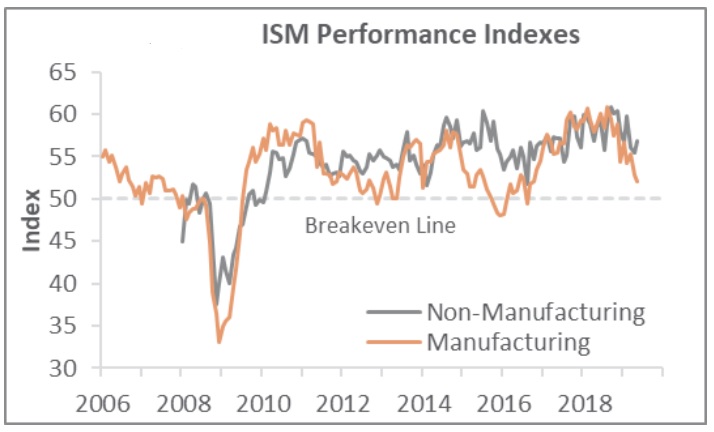
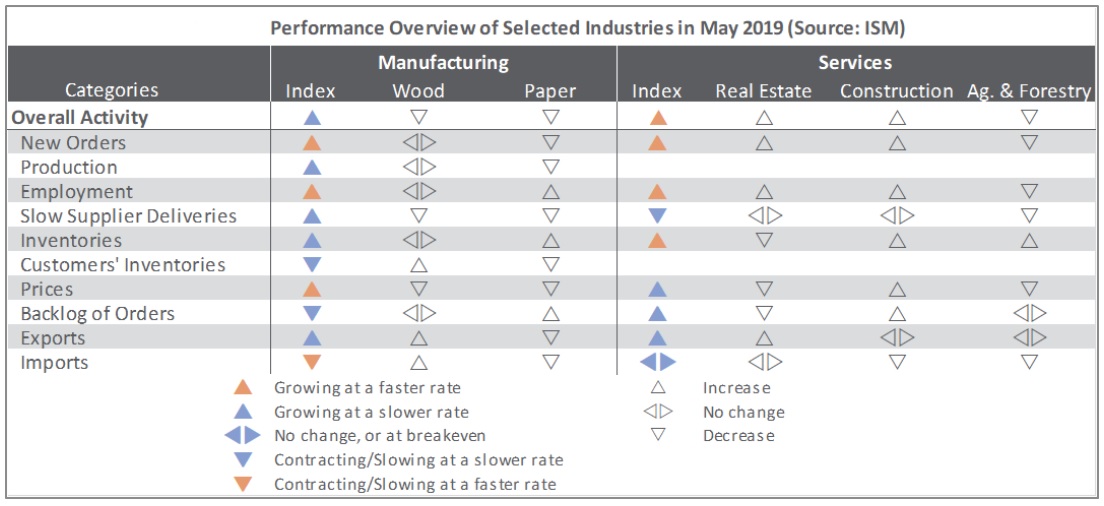
The Institute for Supply Management’s (ISM) May survey showed the expansion in US manufacturing decelerating (-0.7PP) to 52.1 percent. A jump in input prices (+3.2PP) and drop in order backlogs (-6.7PP) were the most noteworthy sub-index changes. Meanwhile, the pace of growth in the non-manufacturing sector accelerated (+1.4PP) to 56.9 percent. The jump in employment (+4.4PP) and drop in imports (-5.0PP) were notable.

IHS Markit’s May survey headlines were much more pessimistic than those of ISM, and “add to worrying signs about the health of the U.S. economy,” wrote Markit’s Chris Williamson. “The [combined] survey data indicate a deterioration of annualized GDP growth to just 1.2 percent in May, down from 1.9 percent in April, putting 2Q on course for a 1.5 percent rise.”

The consumer price index (CPI) increased 0.3 percent in April (+2.0 percent YoY), over two-thirds of which can be attributed to a 5.7 percent advance in the gasoline index. The New York Fed’s Underlying Inflation Gauge estimates annual CPI inflation to be trending in a range between +1.9 percent and +2.8 percent.

Concurrently, the producer price index (PPI) rose 0.2 percent (+2.2 percent YoY). Leading the advance, prices for final demand goods climbed 0.3 percent—mainly on a 5.9 percent jump in the gasoline index. The index for final demand services edged up 0.1 percent, and prices for final demand construction advanced 1.6 percent.

In the forest products sector, index performance included:

  • Pulp, Paper & Allied Products fell 0.1 percent (+1.4 percent YoY)
  • Lumber & Wood Products: -0.1 percent (-2.3 percent YoY)
  • Softwood Lumber: -0.8 percent (-12.6 percent YoY)
  • Wood Fiber: -0.6 percent (-2.0 percent YoY)

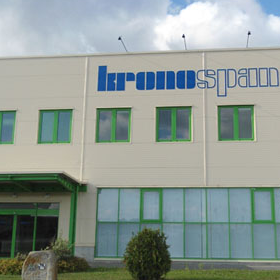
Kronospan reports heavy losses in Bulgaria

Kronospan Bulgaria, a wholly-owned subsidiary of Cyprus-based Konikato Holdings, said that its net loss nearly tripled to 12.9 million levs ($7.4 million/6.6 million euro) in 2018 from 4.7 million levs in 2017.

Kronospan Bulgaria's sales revenue fell by an annual 3.4% to 178.2 million levs in 2018, the company said in an annual financial statement.

Expenses for materials increased to 138.7 million levs last year from 130.2 million levs the year before, while amortisation costs rose to 22.6 million levs from 17.2 million levs.

Personnel expenses edged up to 12.6 million levs in 2018 from 11.4 million levs in 2017, while other operating expenses fell to 29.2 million levs from 32.5 million levs.

The company's assets grew to 570.8 million levs at the end of 2018 from 454.0 million levs a year earlier, following an increase of some 100 million levs in long term assets.

In March, Kronospan Bulgaria increased its capital by 17.6 million levs to 195.5 million levs, followed by a second capital hike to 213.1 million levs.

Burgas-based Kronospan manufacturers wood products for the furniture industry.

Newsletter

Subscribe to our digital newsletter for your daily digest of essential news, views and analysis from the international wood industry delivered directly to your inbox.


0