Article archive

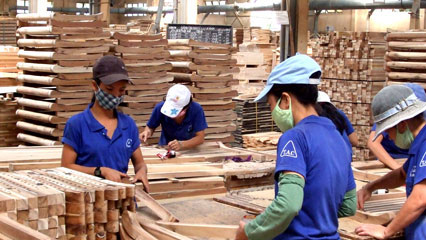
Vietnam’s wood products to expand on the EU market due to free trade deal

Vietnam and the European Union (EU) last week signed a landmark free trade deal that will slash tariffs on almost all goods, including wood and timber products. It is expected to give Vietnamese wood exporters better market access and more opportunities to expand their business.

The EU is among the top five buyers of Vietnamese wood and timber products, accounting for 13 – 17 percent of Vietnam’s wood exports.

In 2018, Vietnam’s export of wood and timber products reached a record value of 9.3 billion USD, 900 million USD of which was to the EU. The UK was the largest EU importer where Vietnam shipped 36.2 percent of its exports, worth 289 million USD, followed by France, Germany and the Netherlands.

According to the EU-Vietnam Free Trade Agreement (EVFTA), the EU will eliminate duties on many Vietnamese wood and timber products. For example, duties on plywood and particle boards from Vietnam will be cut from 7 percent to zero percent after five years while the 2 percent tariff on wooden kitchenware will be removed once the agreement comes into force.

Before the EVFTA was inked, Vietnam and the EU showed a joint commitment towards the implementation of the deal’s “Trade and Sustainable Development” Chapter, which includes provisions on sustainable forest management and trade in forest products.

In May, the two sides announced the completion of the process of approval and ratification of a Voluntary Partnership Agreement on Forest Law Enforcement, Governance and Trade (VPA/FLEGT), which took effect on June 1.

To implement the VPA/FLEGT, Vietnam is making efforts to develop a timber legality assurance system (VNTLAS) to ensure its exports of timber and timber products come from legal sources, including systems to verify that Vietnamese businesses were only importing timber that had been legally harvested and traded, according to General Director of the Vietnam Administration of Forestry Nguyen Quoc Tri.

This means that illegally harvested timber, as well as those businesses trading it, would not be able to be part of supply chains regulated by the timber legality assurance system that Vietnam is putting in place.

At the same time, Vietnam will adopt a mechanism for granting FLEGT licenses when the VNTLAS starts to operate.

The steps are expected to help the country enhance its competitiveness and boost wood exports to not only the EU but also other markets as Vietnamese wood producers will not have to waste time on proving the origin of their products.

On the other side, the EU is Vietnam’s second biggest supplier of legal wood materials, after the US. Last year, Vietnam imported 246.47 million USD worth of wood materials from the EU, up 5 percent from 2017. Imports mostly included oak, ash, beech and walnut.

Vietnam will benefit from wood materials imported from the EU and more importantly, Vietnamese producers will have opportunity to access advanced technology and high-tech machinery and equipment from the EU partners to improve their productivity and product quality, said Nguyen Ton Quyen, Vice President and General Secretary of the Vietnam Timber and Forest Product Association (VIFORES).

At the same time, goods imported from the EU will put pressure on Vietnamese firms so they have to improve themselves, he noted.

The EVFTA is hoped to contribute to the sustainable growth of Vietnam’s wood processing industry and make it one of the country’s key industries with international prestige in the next 10 years, Tri added.

US wood industry counts cost of trade dispute with China

The US trade and tariff war with China that has been reignited in recent weeks is directly impacting American log and wood products exporters, timberland owners and other members of the global wood fiber supply chain. The situation is fluid and there is a great deal of speculation and hyperbole driving much of the media coverage surrounding the issue.

So, what do we actually know about the current situation?

The US has imposed a new round of 25 percent tariffs on $250 billion in Chinese imports and is threatening to tax another $300 billion in imports in the future. China has responded by imposing retaliatory tariffs on $60 billion worth of US products.

A number of US wood raw materials, as well as wood and paper products will be affected by China’s punitive tariffs. Continue reading "US wood industry counts cost of trade dispute with China"

Biesse revises its 2019 outlook downwards as the woodworking industry is affected by demand volatility

Despite the more than EUR 40 million of signed orders achieved during the Ligna fair in May, the Biesse Group recognizes the slowdown in dynamics that is affecting the industry as a whole.

With that consideration the company has informed that its Board of Directors has prudently rectified the guidance for the FY 2019 lowering the forecast for consolidated sales and margins.

Biesse stated in a communication to the market “Given that the actual demand Continue reading "Biesse revises its 2019 outlook downwards as the woodworking industry is affected by demand volatility"

China and the United States agreed to restart consultations; the US will no longer impose new tariffs

On June 29, Chinese President Xi Jinping met with US President Trump in Osaka, Japan.

During the meeting, President Xi Jinping and US President Trump agreed that China and the United States should resume economic and trade consultations on the basis of equality and mutual respect. The US side said it will no longer impose new tariffs on Chinese exports. The economic and trade teams of the two countries will discuss specific issues. Continue reading "China and the United States agreed to restart consultations; the US will no longer impose new tariffs"

Brazilian wood products exports up 29% in May

In May 2019, Brazilian exports of wood-based products (except pulp and paper) increased 29% in value compared to May 2018, from US$ 211.1 million to US$ 272.6 million.

The value of pine sawnwood exports increased 24% between May 2018 (US$ 38.2 million) and May 2019 (US$ 47.4 million).

In volume terms exports increased 29% over the same period, from 180,800 cu.m to 233,300 cu.m. Brazilian tropical sawnwood exports increased 63.2% in volume, from 31,800 cu.m in May 2018 to 51,900 cu.m in May 2019. In value, exports increased 49.3% from US$ 14.0 million to US$ 20.9 million, over the same period.

Pine plywood exports increased 4.7% in value in May 2019 in comparison with May 2018, from US$45.1 million to US$47.2 million. The volume of pine plywood exports increased 37% over the same period, from 131,700 cu.m to 180,900 cu.m.

As for tropical plywood, exports declined in volume and in value, from 9,600 cu.m (US$4.2 million) in May 2018 to 9,000 cu.m (US$3.5 million) in May 2019.

The performance of Brazilian wooden furniture exporters was encouraging as export values increased from US$34.2 million in May 2018 to US$47.8 million in May 2019, an almost 40% rise.

Rising Dutch imports of FLEGT licensed timber

FLEGT licensing is helping importers to comply with EUTR, while the forest sector reforms and new procedures implemented during the FLEGT VPA process form part of a positive narrative that now needs to be communicated more widely to buyers and procurement officials in the EU.

These were key messages of the latest European trade consultation, which targeted Belgian and Dutch traders, hosted by the FLEGT Independent Market Monitor (IMM).

The event held in the Belgian port of Antwerp formed part of a series of consultations to inform IMM work to assess market drivers and market impacts and perceptions of FLEGT. Similar consultations were held last year in France, Germany and the UK, and others are planned in Spain and Italy later in 2019.

There were some comments made at the consultation by Meriam Wortel, representing the NVWA, the Dutch CA for EUTR and FLEGT. A role of NVWA is to monitor volume trends in Indonesian forest product imports into the Netherlands since the start of FLEGT licensing. Continue reading "Rising Dutch imports of FLEGT licensed timber"

West Fraser announces curtailments in Alberta

Today, West Fraser announced a temporary, two-week suspension of production at its Alberta Plywood operations and High Prairie sawmill to address low log inventories for the facilities.

Log inventories in support of these mills have been adversely impacted by wildfire-related logging curtailments compounded by recent wet weather. The decision to implement this temporary reduction provides time to build log inventories to more appropriate levels.

Plywood production is anticipated to be reduced by approximately 13 million square feet, while the impact on Alberta lumber production is anticipated to be minor.

EU softwood logs exports to China double this year

The total European softwood logs deliveries to China have went significantly up during the first quarter of the year, due to a boost in exports from Belgium, the Czech Republic and Germany.

According to the latest Eurostat figures, during the mentioned period, EU's softwood logs exports to China increased by 110%, to 2,575,200 m3, from 1,225,953 m3, exported during January-March 2018.

More than half of the logs came from Belgium, whose exports to China reached 1,293,125 m3, from from nearly nothing in the same period of last year. Also, the Czech Republic and Germany increased their exports to 498,783 m3 and 356,987 m3, respectively.

EU softwood logs exported to China from... (in m3 )

Exporting Country Q1/2018 Q1/2019 Change in %
EUROPEAN Union
1,225,953 2,575,200 110 %
Belgium
558 1,293,125 231,643 %
Czech Republic
17,916 498,783 2,684 %
Germany
2,250 356,987 15,766 %
Slovakia
- 167,434 %
Poland
29,532 93,554 217 %
Others
1,175,697 165,317 -86 %
TOTAL 1,225,953 2,575,200 110 %

The statistics are based on the numbers published by Eurostat. The product Softwood logs consists of following HS Codes: 44032.

Vietnam shows increasing hunger for American wood

Vietnam has been moving towards building a sustainable wood processing industry that uses legal materials in accordance with international and Vietnamese law, as well as regulations of major export markets like the US, EU and Japan.

The statement was released by Deputy Minister of Agriculture and Rural Development Ha Cong Tuan at a conference held by the American Hardwood Export Council and the Vietnam Timber and Forest Product Association in Hanoi last week.

Tuan said Vietnam’s wood products had been exported to 120 countries and territories, of which the US is its most important market.

Last year, the country’s exports of wood and forest products reached $9.4 billion, about 42 per cent of which came from the US.

Tuan said Vietnam also imported large quantities of timber and wood products from the US. Vietnam is currently the top destination for US hardwood in Southeast Asia.

In the first five months of this year, the country imported $138 million of timber and forest products from the US, an increase of 24.9 per cent compared to the same period last year.

“The potential to export even more US hardwood to Vietnam is very big,” Tuan said.

Tuan said the US product had confirmed its important place in Vietnam’s forest product processing and export industry.

“To make processing wood and forest products a key economic sector, we need coordination from the US, especially from suppliers of raw materials. The Vietnamese wood industry aims to be transparent and apply good production processes to ensure sustainable development.

“Vietnam’s wood export is currently ranked fifth in the world, ranking second in Asia. It cannot rest on these achievements but must aspire to develop further, applying science, advanced technology and experience as well as expanding cooperation with the US in this field.”

According to Nguyen Ton Quyen, Deputy Chairman of the Vietnam Timber and Forest Product Association, the US has one of the largest forest areas in the world, with output of more than 300 million cubic metres per year. US wood is guaranteed to be of traceable, legal origins and good quality. It has competitive prices.

“With these advantages and over 20 commercial timber species, American wood is always the first choice for Vietnamese importers,” Quyen said.

Quyen said Vietnam had signed many free trade agreements, in which it committed to processing only legal timber.

Robert Hanson, Head of the Foreign Agricultural Service of the US Embassy in Vietnam, said Vietnam had accounted for 77 per cent of the US’s wood exports to Southeast Asia.

Hanson said the Forest Law Enforcement Governance and Trade Voluntary Partnership Agreement (FLEGT-VPA) between Vietnam and the EU has taken effect to ensure the legality and sustainability of Vietnamese wood products. Under the agreement, Vietnam will give priority to importing wood materials from sustainable and legal sources.

Quyen said Vietnam’s forest product processing industry had rapidly and stably developed in recent years, not only meeting domestic demand for wood products but also moving towards sustainable exports.

There are now 5,000 enterprises involved in the production and processing of wood products (excluding households and small businesses), about 1,800 more than there were five years ago.

Vietnam has halted the exploitation of natural forests for three years and has been pushing forestation. The 3.5 million hectares planted for future exploitation will provide about 35 to 40 million cubic metres of timber in the next five to 10 years.

The Vietnamese government set a target for the forest products sector to reach $11 billion in exports this year. To help, the government has committed to creating good conditions for businesses, including domestic and foreign invested enterprises.

At the conference, the organisers also explained the classification system for US wood to designers, processors and importers. The conference also served as a chance for Vietnamese and US businesses to explore future cooperation opportunities.

China: Softwood lumber imports up 17% in January-May 2019; imports prices fall sharply

In January-May 2019, China increased softwood lumber imports by 17.1% year-on-year to 11.6 million m3, while average price declined 11.5% to $183 per m3.
Russia continues to increase its lumber exports to China adding 18.3% in volume (7.0 million m3) and 7.3% in value ($1.2 billion) from January to May, according to China Customs data.
Canada’s softwood lumber exports to China jumped 43.2% to 2.3 million m3, while export value rocketed 29.1% to $430.5 million.
Average price for softwood lumber supplied to China from Russia slid 9.3% to $171 per m3 and from Canada was down 9.9% to $190 per m3.
From January through May, softwood lumber exports from Finland to China fell 20.4% to 513.3 thousand m3 and export value decreased 27.9% to $118.2 million. Softwood lumber exports from Sweden dropped 20.2% to 311.1 thousand m3 with export value declined 40.1% to $59.6 million.

Russia: Segezha Group starts construction of 250,000 m2/yr CLT production plant

Segezha Group launched construction of the CLT manufacturing plant. The modern engineered material for wooden construction to be produced in Sokol, Vologda Region of Russia. A new asset – Sokol CLT – is created within Segezha Group to implement the project. Equipment delivery and mounting are planned for May 2020.

According to the announcement, the investments in a new manufacturing facility accounts for more than RUB 3 billion (around USD 47.5 million). The capacity of the new enterprise is 250,000 m2 production per year. Continue reading "Russia: Segezha Group starts construction of 250,000 m2/yr CLT production plant"

Steady growth in China’s plywood exports and prices

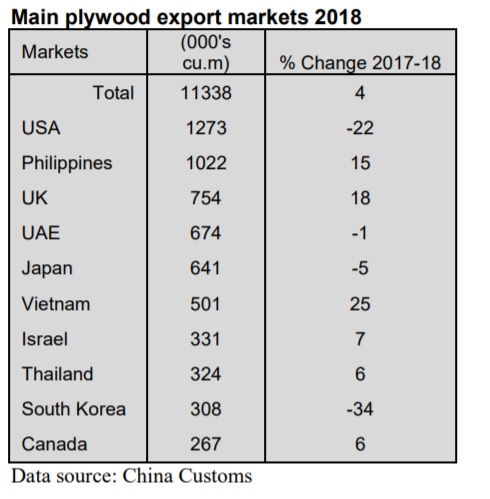
According to the data from China Customs, the volume of China’s 2018 plywood exports was 11.33 million cubic metres, up 4% from 2017.

The average price for 2018 China’s exported plywood was US$489 per cubic metre, a year on year increase of 4%. China’s plywood exports to the top 10 countries amounted just 54% in 2018 as market diversification continues.

The pace of growth of China’s plywood exports to Vietnam was the highest, surging 25%. That is because more and more Chinese wood products manufacture enterprises have been transferred to Vietnam. In addition, the volume of China’s plywood exports to UK and the Philippines rose 18% and 15% respectively.

However, the volume of China’s plywood exports to South Korea and US declined drastically, falling 34% and 22% respectively. The main reason for the decline in exports to South Korea, say analysts, was rising prices.

Increased tariffs and anti-dumping penalties on China’s wood products resulted in sharply higher transaction costs to the US market. The US was the largest market for China’s plywood exports in 2018 but accounted for just 11% of total plywood exports.

Dutch and Belgian importers’ views on FLEGT

Although the EU Timber Regulation (EUTR) has narrowed the supply base for tropical timber imported into the EU, traders in Belgium and the Netherlands strongly support the FLEGT regulatory approach – combining licensing with EUTR – as a platform to help rebuild confidence in tropical timber in the EU market.

FLEGT licensing is helping importers to comply with EUTR, while the forest sector reforms and new procedures implemented during the FLEGT VPA process form part of a positive narrative that now needs to be communicated more widely to buyers and procurement officials in the EU.

These were key messages of the latest European trade consultation, which targeted Belgian and Dutch traders, hosted by the Continue reading "Dutch and Belgian importers’ views on FLEGT"

US lumber prices continue rising trend at the end of June

The frenzied pace of trading in many US framing lumber species in recent weeks gave way to a calmer tone, although last week’s surge followed through in Southern Pine.

Trading in many species shifted to the secondary level, where wholesalers and distributors were focused on selling from inventories built up in the recent rally. Sticker shock among retailers was a factor, as were the holidays next week in Canada and the U.S.

The Random Lengths Framing Lumber Composite Price rose $9, led by gains in Southern Pine.

Week
Jun 28
Last Week
Jun 21
Year Ago
2018
Random Lengths Framing Lumber Composite Price* $354 $345 $547
KD Western S-P-F #2&Btr 2x4 R/L Mill Price 392 390 590
KD Eastern S-P-F #1&2 2x4 R/L, delivered Great Lakes 460 445 680
Green Douglas Fir Std&Btr 2x4 R/L (Portland) 338 323 565
Southern Pine (Westside) #2 2x4 R/L 351 332 544
KD Coast Hem-Fir #2&Btr 2x4 R/L 387 378 600
Ponderosa Pine (Inland) #2&Btr 1x12 R/L 855 860 775
* Weighted average of 15 key items

Random Lengths Panel Market Report

Structural panel prices gained ground amid mixed trends in overall trading. OSB sales slowed from last week’s rapid pace, but prices in northern regions posted increases for the second consecutive week. In Southern Pine plywood, a perception of bottoming prices combined with emerging needs fueled steady trading and kept prices on mostly firm footing. After months of dull trading, sloppy prices, and little confidence in the western Fir plywood market, traders sensed a better tone. Canadian plywood trading picked up later in the week.

(f.o.b. mill prices) Week
Jun 28
Last Week
Jun 21
Year Ago
2018
Random Lengths Structural Panel Composite Price* $342 $334 $553
Southern (west-east) 15/32-inch 3-ply rated sheathing plywood 340-380 340-380 510-545
Southern (west-east) 15/32-inch 4-ply rated sheathing plywood 345-385 345-385 515-550
Western 1/2-inch 4-ply rated sheathing plywood 355 352 547
North Central 7/16-inch Oriented Strand Board 200 182 445
*Weighted average of 11 key items

Could wood be 3D printed?

A 3D printing process that uses a wood-based ink to produce components with the unique ‘ultrastructure’ of wood has been demonstrated by a group of researchers from Sweden’s Chalmers University.

It is claimed that the technology could ultimately enable wood products to be “grown” to order.

The breakthrough builds on earlier research carried out by the team in which a 3D printing ink was produced by converting wood pulp into a nanocellulose gel.

By also interpreting and digitising wood’s genetic code the technique is able precisely control the arrangement of key structural components known as cellulose nanofibrils. This enables the technique to reproduce many of the desirable properties of natural wood – such as porosity, toughness and torsional strength.

A further advance is the addition of hemicellulose, a natural component of plant cells, to the nanocellulose gel. The hemicellulose acts as a glue, giving the cellulose sufficient strength to be useful, in a similar manner to the natural process of lignification, through which cell walls are built.

The project’s leader Professor Paul Gatenholm said that the technique paves the way for new ways of producing sustainable products, effectively growing them to order. “It means that those products which today are already forest-based can now be 3D printed…and the metals and plastics currently used in 3D printing can be replaced with a renewable, sustainable alternative.”

group has already used the technique to developed a prototype for an innovative packaging concept. The team printed out honeycomb structures, with chambers in between the printed walls, and then managed to encapsulate solid particles inside those chambers. Cellulose has excellent oxygen barrier properties, meaning this could be a promising method for creating airtight packaging for foodstuffs or pharmaceuticals for example.

Alongside applications in healthcare products and clothing, Gatenholm also sees potential for the technology in space, believing that it offers the perfect first test bed to develop the technology further. “The source material of plants is fantastically renewable, so the raw materials can be produced on site during longer space travel, or on the moon or on Mars. If you are growing food, there will probably be access to both cellulose and hemicellulose,” he said.

China’s imports of US forest products were down 43% in January-April 2019

The flow of lumber, logs and pulp from the US to China has fallen sharply since the US government initiated tariffs on Chinese imports to the US in May of 2018. In the first four months of 2019, China’s imports of US forest products were down 43% from the same period in 2018.

The trade war between the US and China has not only resulted in higher costs for US consumers on home appliances, electronics, apparel, footwear, and industrial machinery, but has also impacted US exporters of forest products to China. Continue reading "China’s imports of US forest products were down 43% in January-April 2019"

Turkey: Furniture exports increased 18 times since 2000

Turkey's furniture exports have grown consistently since 2000. The industry's foreign sales achieved an eighteenfold rise to nearly $3.2 billion, up from $180 million in 2000, according to data from the Furniture Associations Federation (MOSFED).

The furniture industry exceeded its export target last year, hitting $3.14 billion, a 14 percent year-on-year increase, compared to $2.76 billion in 2017. The industry now eyes reaching $3.75 billion at the end of this year, an increase of nearly 20 percent.

Emphasizing that they aim to have a 1.5 percent share of the global trade by 2023, MOSFED Chairman Ahmet Güleç noted that Turkey's furniture exports soared to $3.2 billion from $180 million in 2000, while its imports have soared to $800 million from $260 million in 2000. "We are an industry exporting four times more net than importing," he added.

Güleç added that Turkey exports furniture to 179 countries is gaining greater market shares.

Since the furniture industry is based on manufacturing, Güleç said that entrepreneurs have created a furniture industry that can easily access any part of the world and that cooperates.

Noting that the government has a significant role in this development, Güleç said that a stable management approach that has been pursued over the last 17 years, contributing to the growth of the industry.

Touching on the importance of the value-added tax (VAT) reduction in furniture, introduced by the government, Güleç said: "In a period of uncertainty about what would happen in the global crisis environment of 2010 and when everyone was anxiously waiting, President Recep Tayyip Erdoğan brought VAT reductions to the furniture industry. With the reduction, the furniture industry had a larger share of the global market. Then again, we saw in 2017, in the last two months of 2018 and in the first five months of 2019 that VAT is very important for us. The domestic market needs to be more active to have a share of the global market. We want the VAT reduction to continue. We request it remains at 8 percent and permanent."

A comprehensive tax package to cut VAT and excise duties in a number of areas, including real estate properties, furniture, commercial vehicles and home appliances, was announced by Treasury and Finance Minister Berat Albayrak last year and was extended by the government several times later on. Sector representatives yesterday called for another extension of the practice, which is to expire on June 30.

Bergs Timber to acquire wood pellet plant in Sweden

Bergs Timber AB has signed an agreement with AB Fogelfors Bruk to acquire all shares in Fågelfors Hyvleri AB, Sweden. The agreement is based on the letter of intent published on May 8, 2019.

The acquisition was completed and the shares in Fågelfors Hyvleri were taken over in conjunction with the signing of the agreement. Of the total purchase price, SEK 48 million ($5.2 million), SEK 18 million ($1.9 million) is paid in newly issued shares in Bergs Timber.

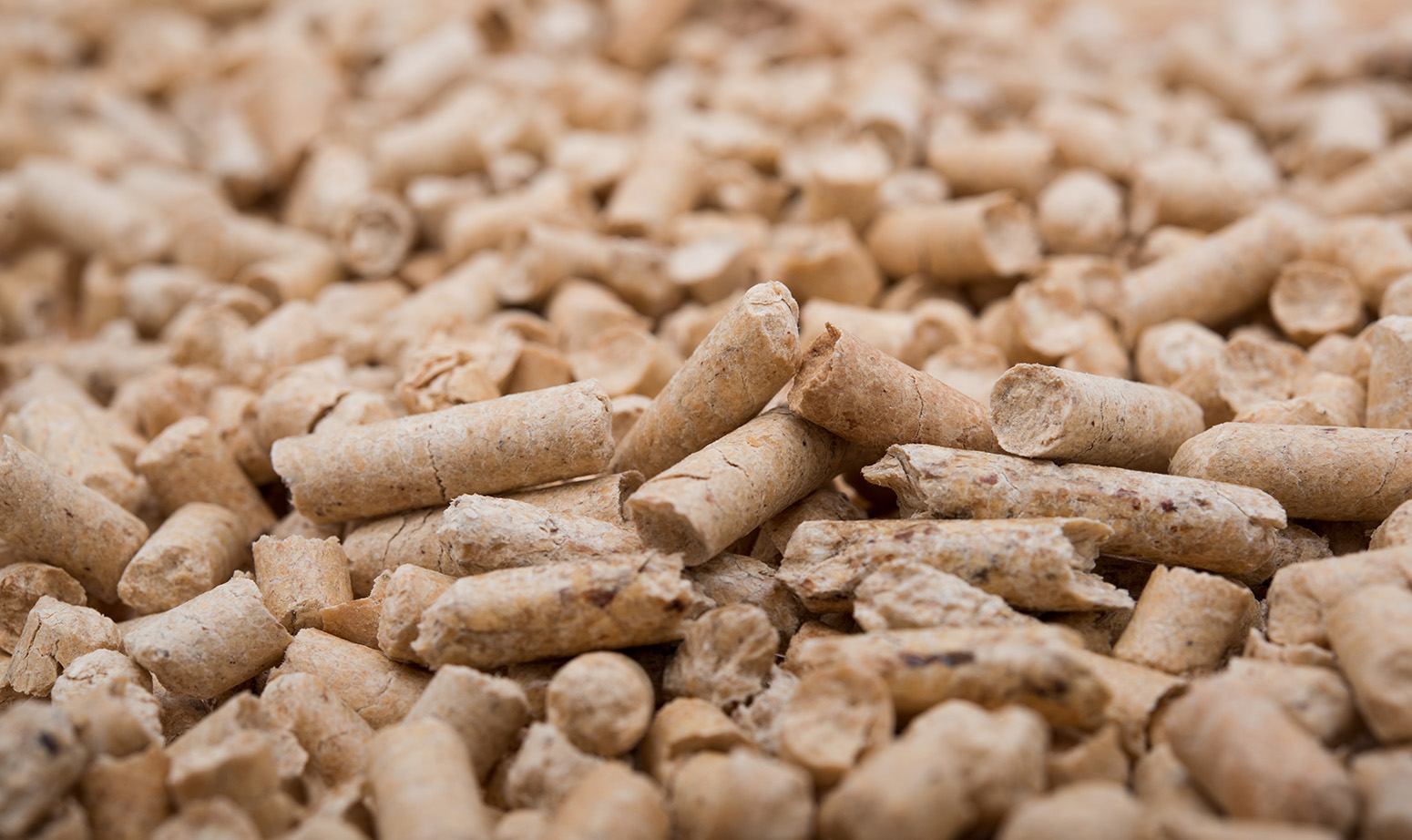
The acquired business mainly consists of a completely new plant for the production of wood pellets with a capacity of 100,000 tones per year. In addition, there is capacity for a production of 20,000 tons of heating logs. A great part of the raw material will be retrieved from the by-products generated at Bergs Timber's Swedish plants.

The other part of the acquired company consists of a planing mill, currently with a production of approximately 30,000 cubic metres planed goods per year.

Based on Bergs Timber's forecast of price development for pellets and raw material, the acquisition is expected to contribute to the Group's net sales by SEK 150-160 million ($16-17.2 million) per year with an EBITDA margin in excess of other operations within Bergs Timber. In addition to a favorable cash flow, the acquisition is expected to provide a certain contribution to earnings per share already this year.

Why the Russian pine has become so popular in China?

In recent years, the central and western regions have become a hot spot for China's timber trade investment, and the flow of people, goods, and capital has been concentrated here. Such a prosperous market sentiment brought vitality to the Chinese timber market, which is undergoing structural changes.

Among the many regional timber markets in the Midwest, Sichuan is undoubtedly one of the best. In recent years, with the continuous advance of the “Belt and Road” construction, timber sales in Sichuan have been climbing. Statistics show that the trade volume of wood and wood products in Sichuan Qingbaijiang International Timber Exchange Center in 2018 reached 2 million cubic meters, a 135% increase from 2017. Among them, the annual sales volume of Russian pine, such as white pine and scotch pine, reached 1 million cubic meters, with sales of about 1.6 billion yuan. So what is the reason for the rapid development of timber trade in Sichuan in just a few years?

According to a recent investigation of the Chinese media, thanks to China's national strategic deployment of the “Belt and Road” initiative, the pine industry in the central and western regions of Sichuan has ushered in a period of rapid development in recent years, and the market demand continues to grow. In an interview with Chinese reporters, Xintianshun Building Materials Management Department of Qingbaijiang District said that at present, the monthly import volume of pine in the Qingbaijiang timber trading market in Sichuan is about 40 trains, the contract is 100,000 cubic meters per month, and the annual sales volume exceeds 1 million cubic meters.

"This huge amount couldn't have been imagined in the past few years." In the last years, the import of pine construction materials in the southwestern Sichuan market was less than 2/3 of what is at the moment. Imports of pines have grown so rapidly during the last years, mainly thanks to the “One Belt, One Road” national strategy. Continue reading "Why the Russian pine has become so popular in China?"

Stora Enso to close Kitee sawmill in Finland; to rise spruce production at Varkaus

Stora Enso plans to consolidate the Finnish spruce (whitewood) production to Varkaus sawmill. The plan includes a permanent closure of Kitee sawmill and production increase to Varkaus.

The objective is to improve profitability and competitiveness by creating a fully integrated sawmill for spruce production in Varkaus, optimising the synergies from the existing LVL (Laminated Veneer Lumber), pulp and board mills.

The consolidation plan is part of Stora Enso’s profit protection programme of EUR 120 million targeting reductions in variable and fixed costs. The possible consolidation is subject to completion of the co-determination negotiations at Kitee sawmill which will start in August. The production at Kitee sawmill is planned to be stopped gradually until the end of 2019.

“The planned consolidation would enable us to optimise the full potential of Varkaus mill as an integrated mill, delivering a variety of value added wood products such as further processed sawn wood and LVL. This would provide us possibilities for improved product mix, stronger R&D and innovation as well as opportunities for efficient and automatised production. In Varkaus we also see strong synergies with Stora Enso’s pulp and board mills when it comes to shared raw material, logistics, infrastructure and energy usage. This consolidation would further enhance Stora Enso’s position as a global provider of high quality wood products and innovative wood-based solutions”, says Jari Suominen, Head of Stora Enso’s Wood Products division.

At Kitee sawmill the planned closure would result in a reduction of maximum 85 FTEs (full-time equivalents). Varkaus sawmill and LVL mill currently employ a total of 105 people. An increased production in Varkaus would require an additional 20 FTEs. Decisions regarding the planned consolidation, closure and employee reduction will be taken after the co-determination negotiations have been concluded.

Newsletter

Subscribe to our digital newsletter for your daily digest of essential news, views and analysis from the international wood industry delivered directly to your inbox.


0