Article archive

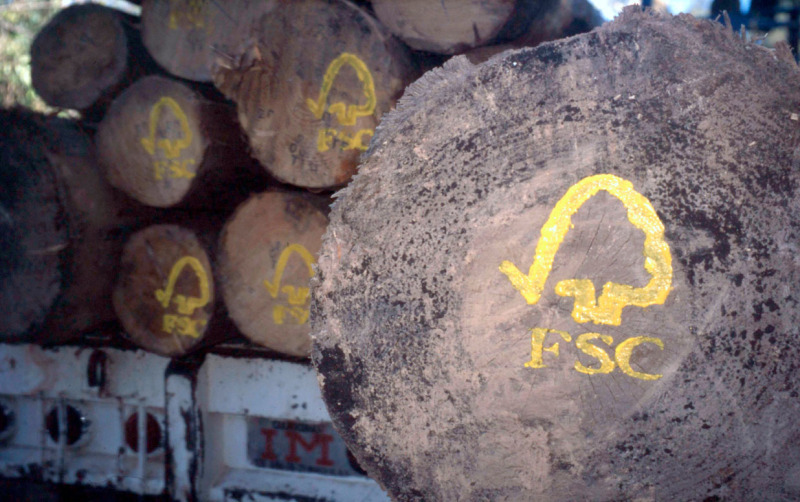
WWF criticizes FSC: No positive environmental effects in northwestern Russia

The seal of the Forest Stewardship Council (FSC) is considered by environmental organizations to be the most demanding international certificate for more responsible forest management. A study commissioned by the WWF on the situation in Russia shows that a positive ecological effect is not everywhere: In the areas investigated in the northwest of the country, no significant difference between FSC-certified forests and those without a certificate could be established.

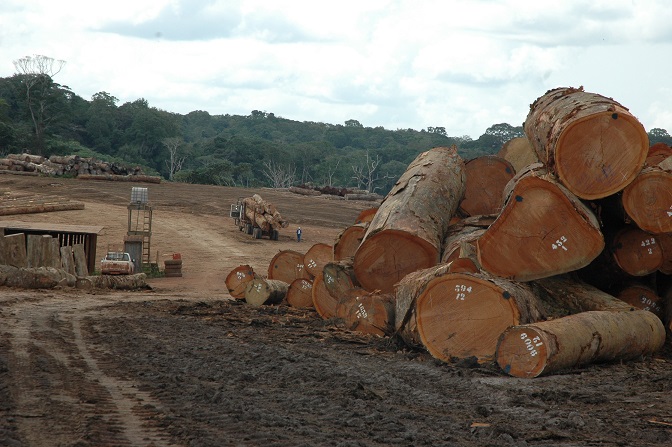
"In the forests studied, regardless of certification, we are dealing with large-scale clearcuts that are difficult for nature to recover. This is a worrying finding, " Susanne Winter, Program Director Forest at WWF Germany, said.

The results of the study indicate that there is no real change in Russia through the FSC label towards more environmentally responsible forest management. Clearcuts of up to 50 hectares accept the decline in the ecological functionality of forests, for example as climate protectors or as habitat for animals and plants. "As part of the FSC certification, forest protected areas are established in Russia. That is undoubtedly a positive effect. However, the study shows that the Russian FSC standard ignores important criteria for sustainable forest management. This has to change quickly, otherwise the certificate threatens to lose its credibility. The FSC urgently needs to use the current revision of the Russian standard in order to move away from massive deforestation ",

According to the WWF, the present study is one of the first studies to systematically attempt to compare FSC-certified and non-certified timber harvesting in the boreal forest. Responsible was the Center for Econics and Ecosystem Management at the University for Sustainable Development Eberswalde. In addition, the WWF as the client, the Northern Arctic Federal University in Arkhangelsk, the State University of Petrozavodsk (both in Russia), the Nicolaus Copernicus University in Torun (Poland) and the Writtle University College (UK) were involved.

"We have clearcuts of two representative companies, each with or without FSC certification managed, as well as a jungle in detail and recorded a variety of environmental indicators," says Jeanette Blumröder, scientist of the University of sustainable development Eberswalde, the field work and the Analysis has cited. "There are no significant ecological differences because even under the FSC seal virtually all wood biomass is harvested and transported away on the clearcuts". Also number and size of the clear cuts would not be changed under the certification. Particularly critical are the consequences for the microclimate of the forests. The big clearcuts warmed up very strongly in the summer.

The Eberswalde conservation professor Pierre Ibisch says as responsible for the study: "The FSC-certified areas have spread rapidly in Russia. The reason is that companies want to gain access to the European market. Consumers in Europe buy the FSC-certified wood and believe they are doing something good for the Russian forests. Unfortunately we can not confirm this with our case study. I think it is irresponsible that the destruction of the last great primeval forests of Russia is progressing under the guise of sustainability. "


Chinese tariffs will result in closing sawmills in US and falling hardwood prices

24% of hardwood produced in the United States is exported to China and 22% is exported to other countries. The newly Chinese imposed tariffs on hardwood imports from the United States will significantly reduce US timber sales to China, resulting in excess US hardwood timber and falling timber prices.
According to Gene Wengert, “The Wood Doctor”, due to the current low margins of hardwood sawmills, falling prices may turn quite a number of sawmills into non-profit operations.
“Once the factory will start to close, the tariff war will continue for a long time. When the demand in the timber market increases, there will be a large shortage of timber. As the demand in the Chinese market increases (China is the largest consumer and manufacturer of forest products) and the reduction of sawmills in the United States advances, we will see a record high price for hardwood. By then, the sawmills will be in a good position, and the US secondary dealers will be in trouble due to rising timber prices."
"The second impact of falling hardwood prices and reduced sales today is that the employees in the lumber industry will be unemployed or diverted," Wengert said. "When the timber market will recover and grow in the future, the supply of logs will not be available due to reduced loggers. " We are satisfied," Wengert said: "In this industry, individual manufacturing companies are now involved in the supply of logs, perhaps not buying sawmills, but creatively working with sawmills to meet the demand for hardwood now and in the future."
Wengert also mentioned recent tariffs affecting the packaging industry. The Trump administration has increased tariffs on several products, including packaging, to 25%. In response, China announced that it will impose a 25% tariff on US paper products from June 1. Recycled paper that was $150 per ton 18 months ago is now only $50 recently.
China consumes about a quarter of the world's paper products. About a quarter of China relies on imports because of the lack of domestic natural resources. According to some reports, China has been acquiring a closed US paper mill. Wengert said: "This situation shows that Chinese companies are affected, they use cardboard packaging or cardboard containers to ship goods, or to buy goods shipped in cardboard. In addition, this also shows a trend, namely that Chinese are buying American manufacturing plants, including furniture and cabinets."

China’s wood products trade continues to expand

The total value of China’s wood products trade rose 6% to US$163.5 billion in 2018. Of the total, the value of wood products exports rose 3% to US$81.6, and imports grew 8% to US$ 83.7.

Around 27% of the total value of trade in 2018 was nonwood products (US$45.2 billion) a year on year increase of 4%. Of the total, the value of non-wood product exports rose 8% to US$20 billion, accounting for 25% of the total national wood product exports. Imports increased 2% to US$25.2 billion, making up 30% of the total national wood products imports.

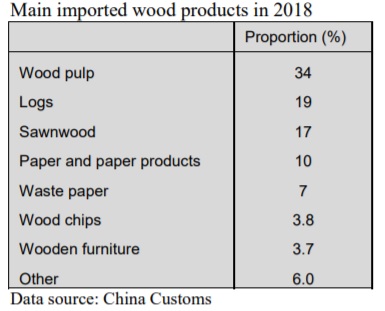
China imported wood pulp, logs, sawnwood, paper, paperboard and paper products in 2018. Wood pulp imports were about 25 million tonnes valued at US$19.7 billion, a year on year increase of 4% in volume and 29% in value. China’s log imports in 2018 totaled 59.75 million cubic metres valued at US$10.984 billion, a year on year increase of 8% in volume and 11% in value. 2018 sawnwood imports totalled 36.74 million cubic metres valued at US$10.13 billion, a year on year decline of 2% in volume and a slight increase (1%) in value.

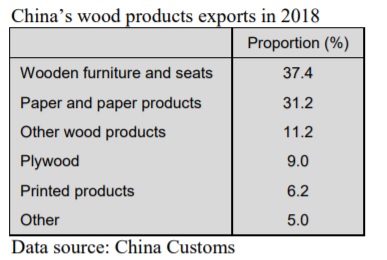
China mainly exported wooden furniture, paper, paperboard and paper products, other wood products and plywood. The value of China’s wooden furniture exports rose 1% to US$22.9 billion.

The value of other wood products such as flooring exports grew 12% to US$6.9 billion .China’s plywood exports were 11.33 million cubic metres valued at US$5.546 billion, a year on year increase of 5% in volume and 9% in value.

Record volume of roundwood was felled in Finland in 2018

78.2 million cubic metres of roundwood was felled in the forests of Finland in 2018, representing an increase of roughly eight percent from the previous year. Almost 90 percent of the wood was used by the Finnish forest industry companies and slightly over 10 percent by heat and energy producers.

The volume of industrial roundwood increased by nearly nine percent to 68.9 million cubic metres, with pulpwood accounting for 57 percent and logs 43 percent of the total volume. Small Finnish sawmills used an additional 300,000 cubic metres of roundwood, according to the Natural Resources Institute Finland (Luke).

The roundwood used as wood chips by heat and energy plants and as firewood by households amounted to almost nine million cubic metres last year.

Luke estimated in the second half of last year that the maximum sustainable felling potential of forests is 84 million cubic metres of roundwood per year during the ten-year period between 2015 and 2024. The estimate does not take into consideration all biodiversity objectives and carbon sink obligations.

“In 2018, roundwood removals accounted for up to 93 percent of the sustainable felling potential. Between 2015 and 2018, the corresponding average figure was 86 percent,” commented Jukka Torvelainen, a senior statistician at Luke.

The so-called roundwood drain – the volume of felled roundwood, roundwood left in forests in connection with felling and unused natural deadwood – rose by almost seven percent to 94 million cubic metres, reported Luke.

“Some 107 million cubic metres of new roundwood grow in our forests every year. This means that the total amount of roundwood increased by roughly 13 million cubic metres, regardless of the record-high drain,” told Torvelainen.

Price drops in exports of New Zealand logs to China

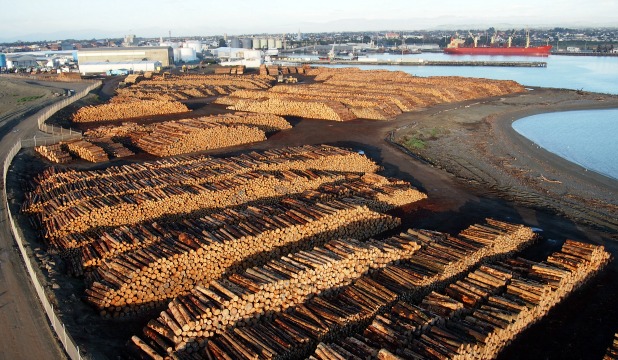
Prices for New Zealand domestic log sales in June are mostly unchanged from May as we move to the end of Quarter 2. Most mills anticipate some relief in log prices in Quarter 3 due to the lower export log prices, especially to China.
Most NZ mills will start to get more discerning over the quality of log they receive as the economic returns between the sawn timber grades is widening. The larger pruned and structural grades are selling well but marketing the rest of the log is a struggle.
The domestic market for sawn timber has remained stable with settled weather through May. The start of the winter season will see demand drop in some sectors. We are seeing more finger joint, mouldings and other remanufactured products being imported from China and this will place pressure on supply.
The CFR sale prices for New Zealand logs in China has dropped -US$4 to -US$6 over the last month, with A grade logs now selling at around US$130 per JASm3.
The weakening of the NZD against the USD through May somewhat buffered the drop for the June At Wharf Gate (AWG) prices offered to log suppliers at NZ ports. The average drop in AWG prices was -US$5-6 per JASm3. The Chinese Yuan (CNY) has recently stabilised against the USD providing some relief to the Chinese log buyers. The NZD however has recently strengthened against the USD, and if this continues will have an adverse effect on July AWG prices.
The markets for sawn timber produced by New Zealand mills has not changed from last month. The large Clear1 grade boards are selling well in Europe and parts of the US, but there is too much volume of the smaller Clear2 grade and knotty grades in Asia. Volume is still moving but at much lower prices.
The domestic market for sawn timber remains very stable.
Due to the drop in the AWG log prices the PF Olsen Log Price Index for June decreased -$2 to $128. The index is currently $1 below the two-year average, $2 above the three-year average, and $10 higher than the five-year average.

Production and consumption of European parquet downturned in 2018

After three years of moderate growth or stabilisation, and despite a generally good start of the year, the overall consumption figures of parquet in Europe downturned for 2018.

The consolidated data provided by the FEP - European Federation of the Parquet industry - member companies and affiliated national associations are now pointing to a slight contraction of the global European market by 2,3% in 2018 compared to 2017.

It must be noted that, due to the presence of some discrepancies between the official German data, which are collected by the German Federal Statistical Office, and the internal data recently collected by the German federation of parquet (VdP), the production and consumption figures presented below will be revised upward in the coming weeks.

As was witnessed in the past, the results show some variation from country to country. The market contraction is mainly due to decreases of parquet consumption observed in Germany and Switzerland, and, to a lesser extent, in the Nordic Cluster and the Benelux.

The production in FEP territory declined moderately by 1,3% but exceeds significantly the 75 million square meter threshold. It is important to note that, as of 2007, production and consumption figures for Italy have been revised according to the new method used by the Italian national federation – Federlegno Arredo. The European production outside FEP countries is at an estimated 14,8 million square meters – 9,2 million square meters produced in EU countries and 5,6 million square meters in European non-EU countries.

The total production in FEP territory slightly declined by 1,3% to a volume of 75.335.600 m². Taking into account the total production in Europe (FEP countries + non-FEP countries in Europe) implies that production in 2018 fell moderately by 0,8% and exceeded 90 million m².

Consumption in the FEP area declined by 2,3%, to a level of 79.854.300 m².

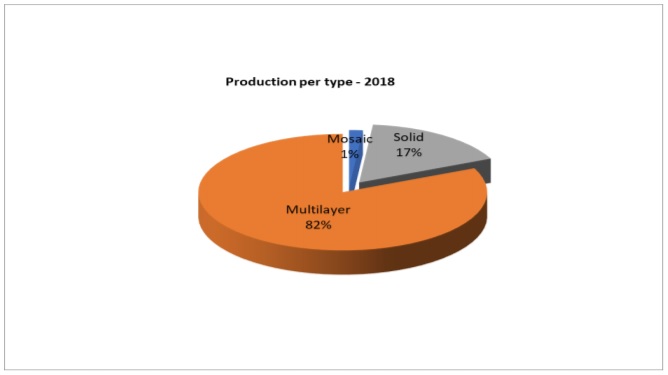
The 2018 total parquet production per type remains similar to the picture already presented from 2010 onwards, whereby multilayer comes in first with 82% (compared to 81% in 2017), being followed by solid (including lamparquet) with a stable 17% and mosaic at 1% of the total cake (compared to 2%).

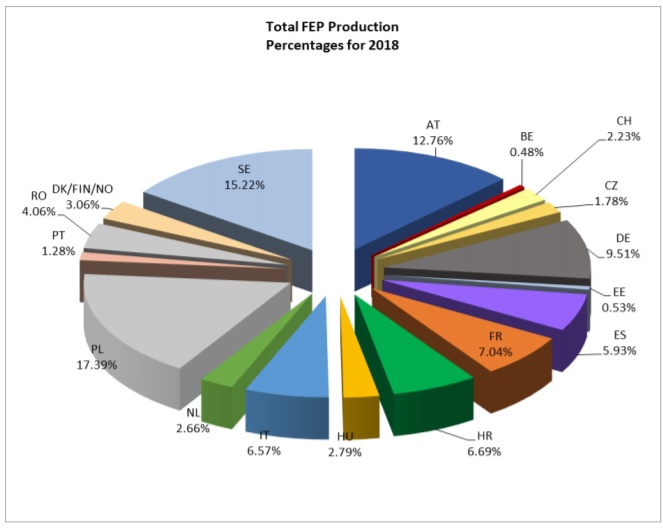
In absolute production figures by country, Poland maintains its top position at 17,37%. Sweden keeps its second place on the podium with 15,22%. It is followed by Austria at 12,76%, while Germany comes in as fourth (9,51%).

In terms of consumption per country, Germany remains in first position, despite its sill declining market, with 18,78% and is followed by Italy at 11,56%. France completes the podium with 10,59%. Sweden at 10,42% gets the fourth seat. Austria with 8,15% keeps its fifth position while the Nordic Cluster (7,81%) and Switzerland (7,25%) come in sixth and seventh position respectively.

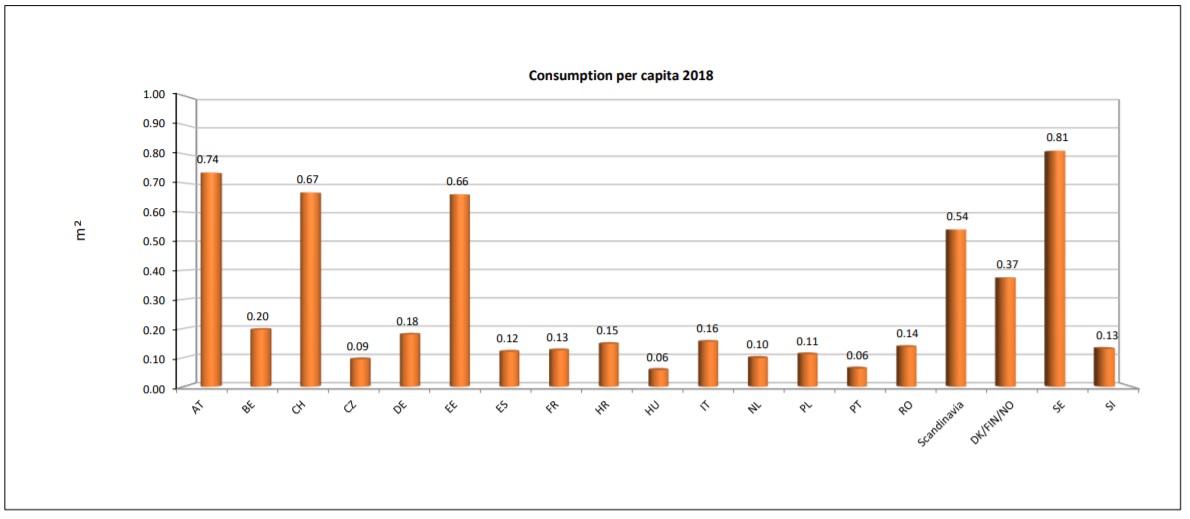
As regards the per capita parquet consumption, Sweden keeps the first seat (0,81 m2 ) before Austria (0,74 m²) and Switzerland (0,67 m2 ). In the total FEP area, the consumption per inhabitant remains stable at 0,19 m² in 2018.

Outlook for 2019 & 2020

After three years of moderate growth or stabilisation, the overall consumption figures of parquet in Europe slightly downturned for 2018. While the market is still lacking visibility for the coming months, the European parquet markets are generally showing stable to slightly positive trends for the three first months of 2019 when compared to the same period in 2018, pointing to stable or moderately increasing parquet consumption. Furthermore, parquet consumption restarted to grow in Germany, the main European parquet market.

On the other hand, the competition from “wood like” flooring solutions, especially from LVT, remains harsh.

As regards raw material, there is no shortage of wood for the time being, but affordability is decreasing also for layers (HDF, plywood) other than the top one.

At European level, FEP welcomes the increasing recognition by the EU authorities of the positive contribution of wood products, including parquet, to fight climate change and to support Circular Economy, Circular Bioeconomy & sustainability. This recognition should be now translated into supportive policies for our industry and used to convince the end-consumer: Parquet is and remains the only Real Wood flooring which allows bringing nature in home and building a better future!

Swedish wood construction takes centre stage at the UN’s global conference

Swedish wood construction was a key point on the agenda at the first UN-Habitat Assembly, which focused on innovations in sustainable development and was held in Nairobi, Kenya, on 27-31 May. A seminar on Tuesday stressed the global importance of beginning to ‘grow our cities’. 

“There’s a huge need globally to transition to sustainable cities, and Sweden’s knowledge of modern wood construction, combined with sustainable forestry, can drive this transformation. The Swedish forest and wood industry offers technical, economic and sustainable solution for future cities,” stated Jörgen Hermansson, head of Södra Building Systems, who represented Swedish Wood in Nairobi.

The theme of this year’s Assembly was Agenda 2030, which fits in well with UN-Habitat’s ambition ‘For a better urban future’. According to the UN’s Intergovernmental Panel on Climate Change (IPCC), the construction industry currently accounts for 40% of global carbon emissions. The discussions about sustainable construction were therefore an important point on the agenda.

Wooden housing developer Arvet presented an exhibition on how wood construction meets all of the UN’s 17 Sustainable Development Goals, with sustainable forestry and the expertise of the Swedish wood industry as core factors. Architects Sweden, in partnership with the Swedish Institute and the Swedish Embassy, also unveiled ‘Woodland Sweden’ – an exhibition about the know-how that Swedish architects possess with regard to designing wooden buildings and sustainable societies of the future.

“Sweden has amassed a great deal of experience and knowledge about modern wood construction. Building cities in wood – literally growing our cities – offers a sustainable solution to challenges such as housing supply, climate change, employment and urbanisation,” said Susanne Rudenstam, head of the Swedish Wood Building Council.

From the Swedish Embassy in Kenya, State Secretary Elin Olsson later posted the Assembly’s message on social media, writing that the development of cities and communities needs to take account of site-specific conditions and place people at the centre of decisions. She also stated that it is possible to solve several challenges at the same time, and that Goal 11 of the 2030 Agenda, sustainable cities and communities, can and must be linked up with other global sustainability goals.

More about the UN-Habitat Assembly
On Tuesday, a seminar on sustainable urban development was attended by State Secretary Elin Olsson, Minister Counsellor Michael Hjelmåker from the Swedish Embassy in Kenya, Klas Groth from UN-Habitat in Nairobi, Sandra Frank from Arvet and Jörgen Hermansson from Södra Building System. Tove Dumon Wallsten of Architects Sweden led the discussion. The seminar was held in the Swedish Wood pavilion, designed by architectural firm In Praise of Shadows, which was represented at the event by Katarina Lundeberg.

Recent trends in Russia's birch plywood market

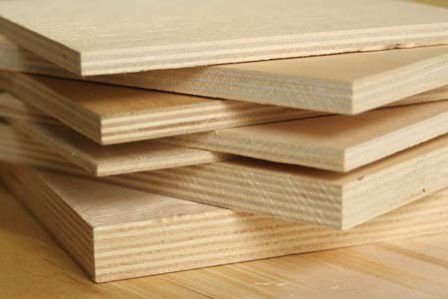
Global plywood production has reached a level of about 160 million m3 in the recent years. China accounts for over 70% of this. However, shifting the focus to the birch plywood business brings out a different story.
Global birch plywood consumption is expected to grow from the current 4.5 million m³ to nearly 6 million m³ by 2030. Most of this demand is expected to be satisfied by Russian plywood.
Current status
Russian birch plywood production is concentrated in the European part of Russia in connection to the so called “birch belt”. Domestic plywood producers are the largest consumer of harvested birch logs in Russia, accounting for over 9 million m3 of logs annually.
Since 2010, plywood output has increased from 2.3 million m3 to almost 3.5 million m3, which corresponds to approximately a 3 million m3 increase in domestic consumption of birch logs.
Russian birch plywood mills are usually significantly bigger than in the other producing countries. Typical size of Finnish plywood mill is 50 – 60 000 m3 of plywood per annum. Number wise, Russian plywood mills tend to be older and some of the production equipment is outdated. Many mills are still very labour intensive. However, labour intensity has been on a declining trend for the past decade in the wood processing industry.
In order to meet the demands, set by rapid inflation and rise in labour costs, as well as higher quality requirements, modernization investments among Russian producers have focused on veneer peeling and processing (drying, patching, scarf jointing, composing, and glue application).
Prices for veneer logs are steadily increasing in Russia. Harvesting of softwood logs for sawmills has a major impact on birch plywood producers. The development of overall harvesting volumes has not been able to match the pace of demand growth for Russian birch plywood.
Labour is still relatively inexpensive, and the mill investments concentrate on improved quality. However, automation and reliability play important roles in investments, especially in areas where availability of qualified workers is low.
Birch plywood mills’ recent capacity utilization rate has expected to have been around 90% on average. For comparison, capacity utilization rate among Finnish producers has been considerably lower and has amounted to only about 60% mainly because of less flexible business environment and working policies in comparison to the competing producer countries. Continue reading "Recent trends in Russia's birch plywood market"

Recent trends in Russia’s birch plywood market

Global plywood production has reached a level of about 160 million m3 in the recent years. China accounts for over 70% of this. However, shifting the focus to the birch plywood business brings out a different story.

Global birch plywood consumption is expected to grow from the current 4.5 million m³ to nearly 6 million m³ by 2030. Most of this demand is expected to be satisfied by Russian plywood.

Current status

Russian birch plywood production is concentrated in the European part of Russia in connection to the so called “birch belt”. Domestic plywood producers are the largest consumer of harvested birch logs in Russia, accounting for over 9 million m3 of logs annually.

Since 2010, plywood output has increased from 2.3 million m3 to almost 3.5 million m3, which corresponds to approximately a 3 million m3 increase in domestic consumption of birch logs.

Russian birch plywood mills are usually significantly bigger than in the other producing countries. Typical size of Finnish plywood mill is 50 – 60 000 m3 of plywood per annum. Number wise, Russian plywood mills tend to be older and some of the production equipment is outdated. Many mills are still very labour intensive. However, labour intensity has been on a declining trend for the past decade in the wood processing industry.

In order to meet the demands, set by rapid inflation and rise in labour costs, as well as higher quality requirements, modernization investments among Russian producers have focused on veneer peeling and processing (drying, patching, scarf jointing, composing, and glue application).

Prices for veneer logs are steadily increasing in Russia. Harvesting of softwood logs for sawmills has a major impact on birch plywood producers. The development of overall harvesting volumes has not been able to match the pace of demand growth for Russian birch plywood.

Labour is still relatively inexpensive, and the mill investments concentrate on improved quality. However, automation and reliability play important roles in investments, especially in areas where availability of qualified workers is low.

Birch plywood mills’ recent capacity utilization rate has expected to have been around 90% on average. For comparison, capacity utilization rate among Finnish producers has been considerably lower and has amounted to only about 60% mainly because of less flexible business environment and working policies in comparison to the competing producer countries. Continue reading "Recent trends in Russia’s birch plywood market"

China: Price overview for imported logs and sawnwood from main timber markets in May 2019

The report below contains the latest prices of logs and sawnwood from main timber markets in China, between 15-31 May 2019.

1 Yuan=0.13 EUR
1 Yuan=0.14 US$
Guangzhou Yuzhu International Timber Market

Logs yuan/cu.m.
Merbau Dia. 100 cm+ 4-6000
Bangkirai Dia. 100 cm+ 3200-4200
Kapur Dia. 80 cm+ 2700-3000
Ulin All grades 6500
Lauan Dia. 60 cm+ -
Kempas Dia. 60 cm+ 2000-3000
Teak Dia. 30-60 cm+ 8500-8600


Logs yuan/cu.m.
Greenheart Dia. 40 cm+ 2300-2400
Purpleheart Dia. 60 cm+ 3000-4500
Pau Rosa Dia. 60 cm+ 2800-3000
Ipe Dia. 40 cm+ 2800-3000
Yuan per tonne
Cocobolo All grades 40-70000

 
Sawnwood

Sawnwood yuan/cu.m
Makore Grade A 9800-11800
Zebrano Grade A 9500-12500
Walnut Grade A 9500-15000
Sapelli Grade A 5000-7500
Okoume Grade A 3700-4700
Padauk Grade A 15000-18000
Mahogany Grade A 6500-7500


Sawnwood yuan/cu.m
Ulin All grade 9000-10000
Merbau Special grade 7500-9500
Lauan Special grade 4300-4700
Kapur Special grade 5000-6000
Teak Special grade 14000-22000


Sawnwood yuan/cu.m
Maple Grade A 9000-9500
Beech no knot 9000-9500
Ash no knot 5600-6300
Basswood no knot 2800-3300
Oak no knot 5300-5700
Scots pine no knot 2100


Sawnwood yuan/cu.m
Cherry Fas 2 inch 9000-11000
Black walnut Fas 2 inch 15000-18000
Maple Fas 8200-10000
White Oak Fas 7500-13000
Red Oak Fas 6500-8300
Finnish pine Grade A 2600-2900

Zhangjiagang Timber Market Wholesale Prices

Logs, all grades  yuan/tonne
Sapelli 3000-4000
Kevazingo 8000-32000
Padouk de africa 2400-3100
Okoume 1400-1800
Okan 2400-2800
Dibetou 2200-2500
Afrormosia 5500-6500
Wenge 4700-5500
Zingana 3400-4800
Acajou de Africa 3000-3500
Ovengkol 3100-3600
Pao rosa 5900-6600


Logs, all grades  yuan/tonne
Merbau 3500-5800
Lauan 1800-2020
Kapur 2020-2500
Keruing 1700-2200
Geronggang 1600
Kauri 1700-1850


Logs, all grades  yuan/tonne
Amoora 1900-2080
Calophyllum 2150-2350
Red Ganarium 1300-1400

(Source: ITTO)

Softwood log stocks in Chinese ports starting to fall

Total softwood log stocks across China have reduced slightly from last month to around 3.8 million m3. Daily uplift from the ports is averaging about 78,000 m3 per day so demand is still reasonably healthy.

Construction activity in China has started to slow with the start of the hottest months of June and July.  Most industry commentators expect the China government to introduce some stimulation spend into the construction market, but it will take a few months before the effect is felt in the log market.

The CFR sale prices for New Zealand pine logs in China dropped a further -US$4-6 through May and the A grade sale price is now around US$130 per JASm3.

Supply of softwood logs from other countries continues to reduce. Logs from the US have been hit with further tariffs of up to 25% introduced by China’s Ministry of Finance on June 1st within the Harmonized Tariff Schedule (HMS). The Southern Yellow Pine (SYP) from the South East of the US had already significantly reduced and is now just a trickle of container volume. There has been more volume from the Pacific North West, but this is now expected to slow considerably.

Many harvesting operations in South America have stopped and this will also reduce softwood supply into China. Current stocks in China are being heavily discounted in an effort to move this stock before the hot sticky season in China. The smaller sized South American softwood logs are more perishable than the New Zealand pine logs.

China: Transformation of the Nanxun wood industry

Major changes have taken place in the Nanxun timber industry over the past few years. The main change has been the shift from family workshops to modern factories, from single product lines (plywood and veneers) to diversified solid wood flooring, home furnishing and the adoption of ‘clean green’ manufacturing.

Nanxun District of Huzhou City in Zhejiang Province has become one of the most important flooring production bases in China. More than 300 flooring manufacturers are located there.

The old style manufacturing created pollution. In particular, the use of volatile organic compounds (VOCs) was not well managed. To address this a ‘Special Action Plan for Environmental Pollution Control in Wood Industry’ was formulated in Nanxun District in 2017.

This says no production shall be allowed if the production processes do not meet the requirements of environmental protection standards. Nanxun District government has acted to close or relocate many industries. Of the 3,922 wood enterprises listed in the City, over 80% have been forced to close, the balance have undertaken renovation measures.

The changes have promoted the development of industrial clusters and the surviving enterprises have become bigger and stronger and the environment continues to improve. Data show that the emission of volatile organic compounds (VOCs) from wood product enterprises in Nanxun districts has been reduced by more than 2,000 tonnes and the tax revenue has increased by more than RMB600 million.

More than 600 companies urge Trump to end tariffs on Chinese imports

Companies across a wide array of industries have almost uniformly opposed the Trump administration's plan to expand a 25% import tariff to cover all goods from China, warning that any damage done to China will be at the expense of U.S. businesses and workers.

The Office of the U.S. Trade Representative has been flooded with more than 600 public comments on President Donald Trump's proposal to hit more than $300 billion worth of Chinese goods with a 25% levy, with an overwhelming majority of them urging the administration to go another direction.

If fully implemented, Trump's latest tariff proposal, coupled with his earlier tariff swipes against Beijing, would effectively set a 25% duty on every single item imported from China. The move has stirred opposition even from traditional Republican-allied industry groups like the U.S. Council for International Business.

"The tariffs will make it harder for U.S. companies to compete for global sales against other foreign companies that make more of their revenue from sales outside of the U.S.," USCIB Vice President Robert Mulligan wrote to the USTR on Tuesday. "In addition, China's retaliation and threats of future retaliation further exacerbate uncertainties caused by this proposed action."

Trump's showdown with China began with a rebuke of Beijing's failure to protect foreign intellectual property and its rules requiring overseas companies to hand over sensitive technology as a condition of doing business.

While tech and IP issues still loom large in the negotiations between the two governments, the tit-for-tat tariff escalation has affected scores of other industries. To date, the two sides have set tariffs on more than $300 billion worth of goods, including household items like furniture, electronics and appliances.

The newly proposed list would expand the coverage even further, stretching the 25% levy to apply to Chinese food and beverage items, vehicles, and consumer products such as cameras, food processors and tools.

Among the industry organizations lining up against the new duties was the Semiconductor Industry Association, which is exactly the sort of sector the U.S. was looking to safeguard when it called China out for its IP and tech rules.

"To avoid inevitable harm to U.S. consumers, employment, economic growth, IT industries, and technology leadership, we request that the U.S. administration rethink the imposition of tariffs on all remaining trade with China," the SIA said.

The group added that it agrees with the administration's general push to stand against Chinese policies that have frustrated the U.S. tech sector for years, but made clear that across-the-board tariffs were not a viable solution.

"Rather than creating more opportunities for U.S. business, sweeping tariffs will restrict U.S. agriculture, goods, and services exports and raise costs for businesses and consumers," the group wrote.

The tariffs have also drawn interest from Capitol Hill, with the Alaska delegation writing to spare imported salmon and cod from China from the duties, or risk a severe disruption to the state's delicate seafood market.

"This unanticipated whiplash is creating tremendous uncertainty for our seafood industry in the months ahead, as they attempt to negotiate sales and contracts with the sudden looming threat of new, unforeseen duties on their products," Alaskan Sens. Lisa Murkowski and Dan Sullivan and Rep. Don Young, all Republicans, wrote to the USTR.

Although most of the comments came out against the duties, a few groups, like the Coalition for a Prosperous America, urged the administration to stay the course, painting the new tariffs as giving a boost to domestic producers.

"Tariffs on U.S. imports from China are justified, and not only to incentivize China to change its behavior to meet international norms," the CPA wrote. "We also believe that tariffs can deliver a stronger growth rate for the U.S. economy, stimulating domestic production in the tariffed sectors."

Along with comments on the looming tariffs, the USTR's docket was inundated with requests to testify at a public hearing on the matter slated for June 17.

Trump has said he will not decide on whether to move ahead with the duties until after he meets with Chinese President Xi Jinping on the sidelines of the G-20 summit at the end of the month. Talks between the two governments have been halted ever since the U.S. accused China of reneging on previous commitments and moved ahead with its latest tariff threat.

West Fraser to permanently close Chasm lumber mill

West Fraser announced its intention to permanently close its Chasm lumber mill and eliminate the third shift from its 100 Mile House lumber mill, both to occur during the third quarter of 2019.

“We sincerely regret the impact this decision will have on our employees, their families and the affected communities. We will be making efforts to mitigate the effects of this business decision, including opportunities for affected employees to transition to other company locations,” said Ray Ferris, President and Chief Operating Officer.

“This decision is not a reflection of the contributions of our employees, contractors and the communities where these mills operate. It is the result of well-documented timber supply constraints owing to B.C.’s devastating Mountain Pine Beetle infestation, recent record wildfires, price declines in lumber markets and high saw log costs,” stated Ferris. “As a result of reduced harvesting levels set by the Chief Forester of B.C., there is insufficient timber supply to support the current lumber production capacity of the lumber mills in these locations. Today’s decision better aligns West Fraser’s production in the region with current timber supply.”

These production curtailments and closures are expected to impact approximately 176 employees at Chasm and approximately 34 employees at 100 Mile House. Lumber production is anticipated to be permanently reduced by approximately 314 million board feet as a result of this announcement. In 2018 and 2019, West Fraser will implement total temporary and permanent capacity curtailments of approximately 125 million and 614 million board feet respectively.

West Fraser has deep roots in B.C. The Company has made $600 million in strategic investments in its operations since 2013 to ensure modern, efficient and well-capitalized B.C. operations are competitive in anticipation of the reduced long-term post-beetle timber supply in the province.

Global trade of softwood lumber reaches the second highest level on record

Global trade of softwood lumber reached 120 million m3 in 2018, the second highest level on record. The uptick in demand for lumber continued in early 2019, with most of the major lumber-exporting countries increasing their shipments as compared to early 2018.

Out of the top-ten exporting countries, the largest year-over-year increases (in %) were in Ukraine, Russia, the US, Chile and Germany. Lumber exports from Ukraine have taken off dramatically after the country banned practically all exports of softwood logs in 2017.

Lumber markets – North America

The free fall of lumber prices in the US came to a halt in early 2019, when prices were close to a four-year low. During the spring prices rose modest in both the US South and the US West. However, prices were substantially lower than their record highs in the 1H/18. Oversea supply of softwood lumber to the US has always been a fairly small share of the total import volume. Canadian supply has historically accounted for 94-97% of total imports, only declining when US lumber prices have been high, thus attracting imports from Europe and Latin America. However, non-Canadian imports have increased for six consecutive years and in 2018 reached their highest level seen in 11 years, reports the Wood Resource Quarterly (WRQ). Softwood lumber exports from Canada were down six percent year-over-year in 2018, with the biggest decline being in shipments to China. Despite efforts by Canada’s lumber industry to diversify its export shipments, 80% of total exports were destined for the US market in the 3Q/18 - a three-year high. However, this share fell to 76% in the 1Q/19 when exports to China rose again.

Lumber markets – Northern Europe

For the first time in five years, Swedish exports of softwood lumber fell year-over-year in 2018. The biggest declines from 2017 to 2018 were in exports to Asia and the MENA region, while shipments to the European market remained practically unchanged. The European share of total exports from Sweden reached 67% in 2018, the highest level seen since 2011. The MENA region accounted for just over 18% of total shipments, the second lowest share in ten years. Export prices (in US$) have stayed high during 2018 and actually averaged the highest level seen since 2014.

Lumber markets – China

Despite much uncertainty in the near future for the Chinese economy, lumber imports rose unexpectedly in the 1Q/19 by as much as 14%, as compared to the same quarter in 2018, according to the WRQ. Most of the increase was due to increases in shipments from Russia and Canada, while supply from Europe and Latin America declined. Import prices took a substantial hit in the past year, falling from an average of $335/m3 in March 2018 to $288/m3 in March 2019.

Lumber markets – Russia

Russia increased exports of softwood lumber by 7% from 2017 to 2018 to reach almost 30 million m3. This was the sixth consecutive year that exports have gone up from the previous year. Of the five largest export markets (China, Uzbekistan, Egypt, Azerbaijan and Japan), only Japan imported less lumber from Russia in 2018 than in the previous year.

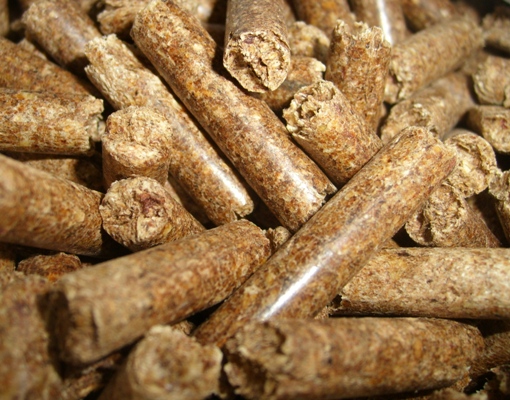
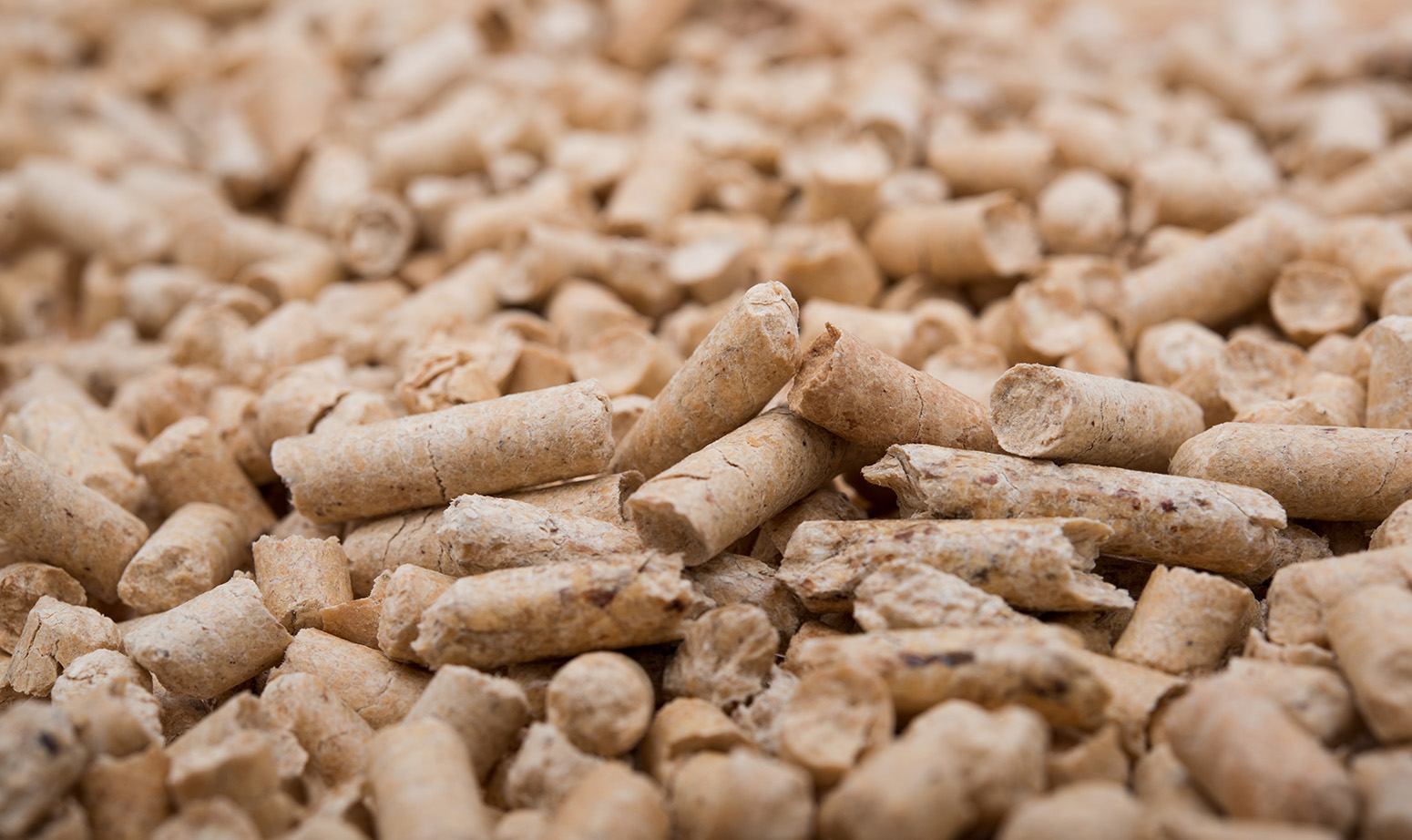
Germany: Summer price for wood pellets in June

As well as in May, in June the price of wood pellets in Germany fell from the previous month by 0.5 percent.
The average price fell to € 240.99 (purchase quantity 6 tons (t)) or 4.82 cents per kilowatt-hour (kWh) of heat. The price advantage of pellets over fuel oil is 24.6 percent and over natural gas 23.1 percent.
"When summer makes you sweat, it's the best time to stock up on pellets for the winter," says DEPV Managing Director Martin Bentele. "Clever pellet buyers know how to use the attractive summer price and now order their annual delivery from the certified EN plus retailers."
Regional prices
The price for wood pellets varies regionally in June 2019 (purchase volume 6 t): As in the two previous months, pellets are the most cheapest in Southern Germany at 237.58 EUR / t. In northern and eastern Germany, the average price per tonne is € 240.86, while in the center of Germany € 243.02.
Larger quantities (26 t) were traded in June 2019 under the following conditions: South: 223.39 EUR / t, Central: 223.75 EUR / t, North / East: 226.62 EUR / t (all incl. VAT).

Russian sawmilling industry- Factors influencing investments and business outlook

The Russian sawmilling industry is characterized by fragmentation, a division between large export-oriented companies and smaller companies relying on the domestic market, labour intensity, and advantages in stumpage and labour costs. However, the industry is facing serious pressure brought on by inflation and other factors driving up the prices of delivered logs, and the necessity to invest into infrastructure and new equipment to maintain competitiveness.

The Russian Sawmilling Industry at a Glance

Russian sawnwood production has nearly doubled since 2000.

The overall production level and industry development is heavily driven by exports. However, both production and domestic demand for sawn softwood is expected to be at a somewhat higher level than the official statistics indicate. Continue reading "Russian sawmilling industry- Factors influencing investments and business outlook"

Former closed sawmill in BC converts to wood pellets; production exported to Japan

A sawmill in McBride, B.C., that shutdown 13 years ago is getting a new life as a wood pellet plant.

Boreal BioEnergy, a B.C.-based forestry company, has purchased the site and started building the new plant in the community about 200 kilometres southeast of Prince George in the central Interior.

"We're well into our engineering and we're hoping to start our civil works this fall," company CEO Jason Janus told Daybreak North host Carolina de Ryk.

Construction is expected to start early next year and the plant will begin operations in late 2020. Once it's fully operational, it will produce up to 250,000 tonnes of black pellets each year, creating 50 to 60 jobs for the region.

The plant's first shipment of wood pellets is scheduled to arrive in Japan in 2021.

Torrefaction is a process in which wood biomass is heated in the absence of oxygen to produce a fuel that burns more like coal than the original wood fibre.

Janus expects the plant will be in business for at least 15 years, based on contracts with purchasers.

"I think there is definitely a niche for pellet producers to be able to fill some of that forestry gap because unlike the forestry industry, which is subject to price changes and fluctuations, we tend to operate more like ... a commodity — like coal," he said. "So we can do future planning with a great deal more certainty."

Janus said the company is also looking at doing the same in Fort Nelson and Fort St. John in northeastern B.C., both at old sawmill sites. He said he hopes to be in the pre-engineering phase for both of those plants by this fall.

Louisiana-Pacific to shut down OSB mill in BC

Louisiana-Pacific Corporation (LP) is the latest company to join a growing list of lumber producers who are curtailing mill operations, primarily in British Columbia.

LP announced that its Peace Valley facility in Fort St. John, B.C., will indefinitely curtail production of oriented strand board (OSB) beginning early in the third quarter.

“Despite efforts by our Peace Valley team to reduce costs over the past several months, this decision is necessary to support the optimization of our OSB business in challenging market conditions,” said Jason Ringblom, LP executive vice president for OSB. “Declining housing starts, high wood costs and associated cost pressures require us to take this action that aligns with our performance driven strategy.”

Sluggish demand and dwindling lumber prices, partially due to a slow housing market in the United States, is leading lumber suppliers to temporarily halt operations.

The curtailment move by Nashville, Tenn.-based LP places it on a list of large lumber suppliers who have already announced that they were suspending operations including Canfor, Interfor, West Fraser and Western Forest Products, among others.

Ringblom added, “This decision ensures that LP is efficiently balancing our commodity OSB production with our customer demand and improving the overall competitiveness of our OSB business. Going forward, we will leverage our strong manufacturing footprint across Canada and the U.S. to meet the needs of our valued customers.”

The Peace Valley OSB mill currently employs approximately 190 people. It has an annual capacity of 800 million square feet (3/8-inch basis), according to LP.

Europe’s “zero deforestation” policies: an opportunity for tropical timber?

Increasingly the twin concepts of “zero deforestation” and “embodied deforestation” lie at the heart of European policy making, both in the public and private sector, in relation to the trade in commodities from tropical countries. This has significant implications for the tropical wood products trade with potential impacts throughout the supply chain, from the forest through to the final consumer.

Policy decisions taken in relation to the so-called “Amsterdam Declarations” and an imminent EC “Communication on Stepping up EU Action against Deforestation and Forest Degradation” may be critical for the competitiveness of forestry operations and wood products in the European market, with wide-ranging, and unpredictable, effects filtering through into world markets.

The effects on wood industry competitiveness will act on at least two levels: at forest level, in relation to other commercial users of the land; and in finished products markets - construction, furniture, packaging, and energy production - where wood products from different regions and with various sustainability assurances and labels compete with each other and a wide, and growing, variety of non-wood products.

The two Amsterdam Declarations—one on deforestation and one on “sustainable palm oil” - were launched on December 7th, 2015 in the context of the Paris Climate Agreement and build on the New York Declaration on Forests’ commitments.

The two declarations have since been merged into one “Amsterdam Declaration Partnership (ADP) strategy”.

According to the “Partnerships For Forests” - which acts as ADP secretariat– the aim is to achieve “fully sustainable and deforestation-free agro-commodity supply chains in Europe by 2020”. To date, Denmark, Germany, Netherlands, Norway, the United Kingdom, Italy and France have signed.

The ADP strategy is intended to stimulate private sector commitment and progress on agricultural commodities associated with deforestation (such as palm oil, soy and cocoa) for which Europe has a significant market share. Continue reading "Europe’s “zero deforestation” policies: an opportunity for tropical timber?"

Newsletter

Subscribe to our digital newsletter for your daily digest of essential news, views and analysis from the international wood industry delivered directly to your inbox.


0