
Article archive

John Deere expects increase in sales of forestry equipment

In it's fourth quarter 2013 financial report, John Deere reported that the company's construction and forestry sales rose by 4 percent for the quarter, with operating profit of $94 million compared with $71 million a year ago.

The improvement in operating profit was due primarily to lower production costs, decreased research and development expenses, and price realization, says JD. These factors were partially offset by the impact of lower production volumes.

For 2014, John Deere expects that its worldwide sales of construction and forestry equipment to increase by about 10 percent for 2014. The company counts on a further economic recovery and higher housing starts in the U.S. as well as sales increases outside the U.S. and Canada.

JD's global forestry sales are expected to be up for the year due to general economic growth and improved sales in European markets.


AS Graanul Invest builds largest pellet plant in the Baltic region

OÜ Osula Graanul, the subsidiary of AS Graanul Invest, is beginning the construction of the largest pellet plant in the Baltic countries in Võrumaa, Sõmerpalu county, the company announced in a press release.
The new plant has production capacity around 250,000 tons of pellets per year. Plant’s equipment enables to use various types of wood (firewood and pulpwood, woodchips, sawdust and shavings) at the annual rate of 600 000 solid cubic meters, which will provide wood processors and forest owners of South – Estonia chance to utilize their production residues and low quality roundwood to the local producer all year around.
The plant is expected to start test production in the end of 2014. It is Graanul Invest Group’s seventh pellet factory which will increase the Group’s production capacity to over one million tons annually.

Current timber price trends across China

This report contains latest prices of logs, sawnwood, plywood and other wood products from main timber markets in several Chinese regions. (Source: ITTO)
Guangzhou Yuzhu International Timber Market

Logs Yuan/cu.m
Lauan Dia. 60 cm+ 2000-2200
Kapur Dia. 80 cm+ 3100-3200
Merbau Dia. 100 cm+ 5200-5400
Teak Dia. 30-60 cm 6500-13000
Wenge 4300-4800
Red Oak (France) Dia. 30 cm+ 2500-2600
Purpleheart Dia. 60 cm+ 3500-3600
Rosewood 3700-4200
Sawnwood
Maple Grade A 7500-9500
Walnut USA FAS 2 inches 14000-16000
Cherry USA FAS 2 inches 10000-12800
Sapelli Grade A 6600-7000
Okoume Grade A 4200-4500
Teak (plantation) Grade A 9600

Shanghai Furen Forest Products Wholesale Market

Logs Yuan/tonne
Red Sandalwood India All grades 1-2 mil.
Rengas (Vietnam and Nepal) All grades 7000-8800
Granadillo (Mexico) All grades 7500-8000
Sawnwood Yuan/
Okoume (Africa) grade A 4300-4700
Sapelli (Africa) grade A 5800-6300
Beech (Europe) grade A 4500-4800
Red Oak (North America) 2 inches FAS 7000-7300
Cherry (USA) 2 inches 9800-10500
Maple (USA) 2 inches 8700-8900
Merbau (Indonesia) All grade 10000-11500

Hangzhou Timber Market

Logs Yuan/
Ash 4m 30cm 3200-4800
Larch 4m 8-10cm 1800-2900
Linden 4m 26cm 2400-3500
Sawnwood
Beech (Europe) All grades 2800-5000
Black walnut (N. America) All grades 7000-13000
Teak (Myanmar) All grades 9000-18000
Red oak (N. America) All grades 3500-5000
Alder (Myanmar) All grades 4500-5300
Merbau All grades 7200-12000
Plywood Yuan/sheet
Red beech 3mm 50-75
Black walnut 3mm 60-102
Teak 3mm 70-148

Shandong De Zhou Timber Market

Logs Length Diameter Yuan/cu.m
Larch 4m 18-22 cm 1180
4m 24-28 cm 1300
4m 30 cm 1450
6m 18-22 cm 1280
6m 24-28 cm 1300
6m 30 cm 1500
White Pine 4m 24-28 cm 1350
4m 30 cm 1450
6m 24-28 cm 1350
6m 30 cm 1500
Korean Pine 4m+ -
6m+ 2000
Mongolian
Scots Pine
4m 30cm 1350
4m 36cm 1500
6m 30cm 1360
6m 36cm 1560

Wenzhou Timber Trading Market

Logs Yuan/
Ash 2m 20-30cm 1300
Chinese fir 4m 16-18cm 1500
Wenge all grades 4500-5100
Teak (plantation) all grades 2100-2500
Merbau all grades 3500-5000
Spelle all grades 3200-3700
Plywood  Yuan/sheet
Red beech 4'x8'x3mm 40-80
Black walnut 4'x8'x3mm 40-85
Teak 4'x8'x3mm 45-110

FSC suspends certificate for IKEA's subsidiary, Swedwood Karelia

Following an investigation by the NEPcon audit company, the FSC forest management certification issued to Swedwood Karelia was suspended. The NEPcon FSC audit started in October 2013 and it was aimed to screen the forest management, the Chain of Custody and how the company follows standards of FSC certification in the forests of Kalevala and Kostomucksha in Karelia.
Following the announced suspension, the head of inter-regional public environmental organization SPOK Alexander Markov said to the Forest portal of Karelia:

''This is the confirmation of the claims of Russian and Swedish environmental organizations expressed in December 2012 at the meeting with the managers of IKEA Group which owns Swedwood company. The most acute problems of IKEA are the lack of interaction with stakeholders and the unsolved matter of conservation in the valuable forests. This practice should be changed,'' he added.

Back in 2012, Swedish environmental organizations strongly criticized IKEA for allowing its subsidiary Swedwood, to practice questionable forestry management in Karelia. More specific, Swedwood was accused of ''felling the last untouched taiga sites'' in Northern Karelia and also that it had clear-cut areas of old-growth forest containing 200-600 year-old trees.
During a meeting in Stockholm, the environmentalists demanded from IKEA ''to provide detailed maps of high conservation value forests leased by Swedwood Karelia, as well as to start negotiations for the conservation of these forests with stakeholders, including the regional government.''
Moreover, the ecologists ''demanded from IKEA and Swedwood to make a public statement of support for the planned system of specially protected natural areas in Karelia and to take effective plan for the relocation of logging activities from old-growth forests and areas of high conservation value to secondary forests''.
Reactions to the FSC certificate suspension decision came immediately: “We have won! FSC has decided to withdraw its certificate for IKEA’s unscrupulous logging of the Russian virgin wood”, Sara Vikstrøm Olsson from the Field Biologists stated in a press release. The environmental groups Save the Forest Sweden and Field Biologists (Nature and Youth Sweden) are the two main NGO's who oppossed IKEA's practices in Karelia.

Until now, IKEA hasn't issued any statement regarding the NEPcon decision.

Sweden: Ivar storm caused damages of 8 mil. cubic meters

In northern Sweden, the Ivar storm has caused in December damages of around 8 million cubic metres of wood, the Swedish Forestry Agency (Skogsstyrelsen) reported. The current evaluation has been taking a long time and it is still subject to some uncertainty. The most affected provinces were Jämtland and Västernorrland.
The amount of damaged wood caused by the Ivar storm is higher than all the other previous storms that occured in southern Sweden (Simone, Hilde and Sven). Altogether, the recent storms in Sweden caused damages of about 13-14 million cubic metres.
At the present, Skogsstyrelsen warns the Swedish forest owners to rapidly remove the fallen trees to avoid a bark beetle infestation.

Norbord is considering a major investment at Scottish OSB plant

Norbord Inc. on February 7, 2014 submitted a notice of intent for a planning application to Highland Council for a major investment in its OSB (oriented strand board) manufacturing site at Morayhill, near Inverness, Scotland, the company said in a press release.

The application is subsequent to a detailed feasibility study into upgrading the current 25-year old facility to include state-of-the-art continuous press and environmental control technologies. Norbord holds that its investment would help secure the long term future of the 130 staff directly employed at the site, as well as over 300 jobs supported indirectly through the supply chain.

“We are excited by the potential for what would be a major step forward for our European business,” said Karl Morris, Managing Director of Norbord Europe.

The amount of the investment was not disclosed by the company.

Roundwood prices slightly recovered in Sweden

Roundwood prices in Sweden have continuously declined throughout the first three quarters of 2013. However, in the fourth quarter there are some signs of recovery: pine and spruce logs prices gained on average almost EUR 2,5/ m³. Pulpwood assortments continued the price downward trend: especially birch pulpwood price has become cheaper by EUR 2,4/m³.
Year on year, in the fourth quarter of 2013, there are some discordant results: spruce logs prices grew by 4,22%, while pine logs are now cheaper by -0,87%. Pulpwood ranges have significantly decreased by between -2,1% to -8,2%.

Roadside prices of roundwood in Sweden EUR/m³ u.b.

 Q4 2012 Q3 2013 Q4 2013 Change
Q4/2012
to Q4/2013
LOGS
Pine 51,60 48,87 51,15 -0,87%
Spruce 51,37 51,03 53,54 4,22%
Pine&Spruce 51,49 50,23 52,51 1,98%
PULPWOOD  
Pine 30,76 29,73 29,50 -4,09%
Spruce 32,12 31,10 31,44 -2,11%
Birch 37,36 36,68 34,29 -8,21%
Pulpwood Total 32,35 31,89 31,21 -3,52%

The prices in the table are converted from SEK to EUR at a conversion rate of EUR/SEK = 0.11382
The above results are collected from metla.fi

Softwood lumber prices increase in Austria

Prices for softwood lumber in Austria rose slightly for almost all assortments. There are some exceptions: edge and rough boards, and boards in 28 mm. For the other products, prices have increased over December 2013 up to a maximum of 2 euros. The highest rise was registered for boards in 4-6 m length.
As compared to January 2012, prices are higher by 1 to 5 euros. Edge boards, however, are a bit cheaper. The lower price limit also stands above last year levels. But in general softwood lumber prices in Austria rise at the beginning of the year.

Softwood Lumber Spruce/Fir January 2013 December 2013 January 2014 Change Jan. '13 to '14
€ / cbm EXW
Edged Boards, 0-IIIa, 23 mm + 229-244 231-243 230-241 +1 / -3
Rough boards in fixed dimensions, 18-22 mm 228-240 231-240 230-240 +2 / -
Squared timber, standard dimensions, I/II, 4-6 m 206-216 209-216 210-217 +4 / +1
Reserve squared timber, II/III 150-158 153-160 154-161 +4 / +3
Boards, III-IV, 8-16 cm, 4-6 m 145-151 146-150 147-154 +2 / +3
Boards, III-IV, 8-16 cm, just 4 m 147-153 147-154 149-155 +2 / +2
Boards, III/IV, 23 mm, 4-6 m 146-152 149-154 150-155 +4 / +3
Boards, III/IV, 28 mm +, 3-6 m 151-158 157-164 155-163 +4 / +5

Weak growth for the Finnish forest industry in 2013

Finland's wood products industry’s production volume exceeded the 10 million cubic metre mark, totalling 10.1 million cubic metres, which represents a seven per cent increase from the previous year, the Finnish Forest Industries Federation (FFIF) reported.

Exports to countries outside Europe increased, especially to Asia, the Middle East and North Africa.  European economic uncertainty affected construction output as well. Demand for wood products fell in Finland and housing construction decreased by about a fifth compared to 2012.

High roundwood costs weakened industry’s competitiveness on the international market. Wood raw material-based biorefineries under construction and on the drawing board in Finland  Construction of a biorefinery that will use crude tall oil as a raw material continued in Lappeenranta. The refinery is due to be completed in 2014.

Decline in paper demand continued, paperboard and pulp production increased

The Finnish paper industry’s situation continued to be challenging in 2013 due to the weak economic situation in Europe and declining demand for graphic papers, FFIF reports.

In 2013, a total of 10.6 million tonnes of paper and paperboard were produced in Finland. This is one per cent less than in 2012. In 2013, production of graphic paper, printing and writing paper as well as newsprint, totalled 6.3 million tonnes, which is a reduction of almost five per cent from 2012 levels.

Production of paperboard grades designed for packaging purposes amounted to 2.9 million tonnes, which is almost seven per cent more than in 2012.

Pulp production in Finland totalled 7.1 million tonnes, which is almost four cent more than in the previous year. Pulp export deliveries were about 8 per cent higher than in 2012.

The drawn out economic downturn took a turn for the better at the end of 2013 but growth remained slow. The forest industry’s situation in its main export markets in Europe continued to be challenging 

The Finnish forest industry’s competitiveness has suffered due to, for example, its high cost structure, as production and labour costs have increased faster than in competitor countries. Additional burdens placed on industry in Finland further weaken the export-driven forest industry’s competitiveness in the coming years.

The windfall tax will be adopted in 2014. The sulphur directive, which targets forest industry maritime transports, comes into effect in 2015. The wage solutions agreed upon last autumn do not improve the sector’s competitiveness in the short-term and collective labour agreements did not include the reforms desperately required by the forest industry.

“With decisions that support the export industry, we could contribute to the Finnish forest industry’s competitiveness and help ensure it provides jobs in future as well. In this spring’s budget framework session, the government must not propose any new taxes or increased costs for industry,” says Timo Jaatinen, Director General of the Finnish Forest Industries Federation.

“For example, the energy tax refund scheme must be developed so that industry’s energy taxes are no higher than what the EU demands. Sufficient funding must be secured for logistics infrastructure, particularly the maintenance of basic transport infrastructure. We now need swift decisions that speed up economic growth so that Finland can return to growth,” Jaatinen says.

Resolute reports improved results in wood products segment

Resolute Forest Products Inc. reported net income, excluding special items (CA$746 million), of CA$107 million for the year ended December 31, 2013, up 24% compared to 2012, on sales of CA$4.5 billion, unchanged from prior year.

In the fourth quarter of 2013, the company reported net income, excluding special items ($35 million), of $32million up 13% from the fourth quarter of 2012. Sales were $1.2 billion, up 2% from the fourth quarter of 2012.

"In 2013, 45% of adjusted EBITDA came from our market pulp and wood products businesses," said Richard Garneau, president and chief executive officer. "Because of our diversified asset base, improvements in market pulp and wood products made up for a challenging year in paper grades.  We've taken important steps to grow these businesses with acquisitions and investment commitments, while at the same time optimizing paper assets to maximize capacity utilization and margins.  We also continued to focus on costs to improve earnings power."

Compared to breakeven in the third quarter, operating income rose to $9 million in the fourth quarter.  The average transaction price rose by 7%, or $26 per thousand board feet, but shipments slipped by 9% from the high levels recorded in the third quarter.  The delivered cost remained stable, at $353 per thousand board feet.  Finished goods inventory rose by 15%as a result of weaker demand in November.

Resolute's Wood products division generated an operating income of CA$41 million in 2013, up CA$15 million from 2012. There was an 11% increase in average transaction price, or CA$37 per thousand board feet, and a 3% rise in shipments, both reflecting stronger market conditions as U.S. housing starts were 18% higher than 2012. The delivered cost increased by 8%, or CA$26 per thousand board feet, primarily because of log costs, due to higher stumpage fees and other costs associated with the comprehensive modification of the forest tenure system in the province of Québec, and lower internal wood chip selling prices, the company reported.

Resolute's market pulp division generated operating income of $16 million in the fourth quarter, $5 million less than the third quarter. There was a 5% increase in shipments, or 18,000 metric tons, but the delivered cost rose by 3%, at $639 per metric ton, mostly as a result of higher maintenance costs, including lost cogeneration production, fuel energy consumption at Canadian mills and wood costs at U.S. mills due to wet weather. Inventories shrank by 21%, to 81,000 metric tons, their lowest level since the acquisition of Fibrek.

Big merger in Sweden's wood pellet industry

Neova AB, a subsidiary of the Swedish Vapo Group, and Lantmännen, one of the largest groups in agriculture, machinery, energy and food in the Nordic region, are merging their respective wood pellets activities. The new company will include Neova's pellets activities in Sweden and the corresponding Lantmännen Agroenergi businesses in Sweden and Latvia.
The merged company will have an annual turnover of around one billion Swedish kronor (aproximatelly EUR 113 million) and 160 employees. The company will continue to market its products under the same brands as before - namely Neova Pellets, Agrol and Agroenergi. The two companies hold that the new merger will be the market leader in Sweden and a strong competitor in the Baltic region.

“In order to meet exacting customer demands, we need to continue to lead the way in product and services development and offer the most reliable products on the market. The merged company will be in an even better position to meet future market challenges and create a platform for continued development of our value proposition to our customers,” says Torbjörn Claesson, CEO Neova.
“Together, we will create a competitive company with big opportunities. Our customers will gain an even better proposition from a sustainability perspective – for example, we will be able to optimise our logistics in an even better way than now,” says Lantmännen Energi Sector Manager Carl von Schantz.

The company will take the form of a joint venture with Neova and Lantmännen each having a 50% stake. The merger is expected to be completed in the first six months of 2014 following approval by the competition commissions concerned.

Big merger in Sweden’s wood pellet industry

Neova AB, a subsidiary of the Swedish Vapo Group, and Lantmännen, one of the largest groups in agriculture, machinery, energy and food in the Nordic region, are merging their respective wood pellets activities. The new company will include Neova's pellets activities in Sweden and the corresponding Lantmännen Agroenergi businesses in Sweden and Latvia.

The merged company will have an annual turnover of around one billion Swedish kronor (aproximatelly EUR 113 million) and 160 employees. The company will continue to market its products under the same brands as before - namely Neova Pellets, Agrol and Agroenergi. The two companies hold that the new merger will be the market leader in Sweden and a strong competitor in the Baltic region.

“In order to meet exacting customer demands, we need to continue to lead the way in product and services development and offer the most reliable products on the market. The merged company will be in an even better position to meet future market challenges and create a platform for continued development of our value proposition to our customers,” says Torbjörn Claesson, CEO Neova.

“Together, we will create a competitive company with big opportunities. Our customers will gain an even better proposition from a sustainability perspective – for example, we will be able to optimise our logistics in an even better way than now,” says Lantmännen Energi Sector Manager Carl von Schantz.

The company will take the form of a joint venture with Neova and Lantmännen each having a 50% stake. The merger is expected to be completed in the first six months of 2014 following approval by the competition commissions concerned.

Stable 4thQ and full year 2013 for Metsä

Metsä Group's sales for the full year 2013 amounted to EUR 4,932 million (2012: EUR 5,001 million), the company said on Thursday. Operating result excluding non-recurring items was EUR 342 million (256), while operating result including non-recurring items was EUR 334 million (241).

For the fourth quarter of 2013, Metsä reported sales of EUR 1,217 million (10–12/2012: EUR 1,228 million). Operating result excluding non-recurring items was EUR 87 million (71) and operating result including non-recurring items was EUR 88 million (77).

Metsä Group's financial results were influenced by strong sales and production of pulp. The Group's delivery volumes of paperboard decreased from the previous quarter mainly due to seasonal reasons. At the same time, delivery volumes of paper were approximately on a par with the previous quarter.

Kari Jordan, President & CEO of Metsä Group commented on the company's performance: "Metsä Group's full-year operating result improved clearly, while sales remained at the previous year's level. During the past year, we have decreased our net debt, and our equity ratio has improved as planned. Considering the prevailing market conditions, we can also be satisfied with the return on capital employed.

''Our focused strategy is working well. As a producer of pulp and board, we are among the international leaders. Our strong brand products in tissue and cooking papers match the growing demand well, and the refocused strategy of wood products industry lays a solid foundation for the business area in the future. Our businesses are supported by efficient wood supply, guaranteeing a steady flow of raw material to our mills.''

For the near term outlook, Metsä foresees that wood orders of Metsä Forest’s customers for 2014 will be at a normal level. Moreover, the demand for wood will continue to be steady for all timber grades. Also the demand for wood products will continue to be stable within the normal seasonal fluctuation range. The industrial and sawn timber product market is expected to be reasonably balanced during the first quarter. However, the outlook for construction and upgrading business is challenging in large part of the main market areas, the company added in its press release.

Swiss wood pellets cheaper in February

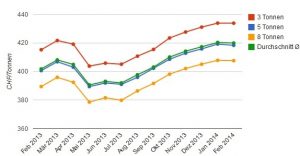
In Switzerland, the average price of pellets has registered a minor decrease in February as compared to January. The current price stands at CHF 419.9/tonne (approximately EUR 343.5) down from January's price of CHF 420.3/tonne (EUR 343.8). However, as compared February 2013, the price is higher by 4.5%.
In February 2013, for orders of 3 tonnes, the current price is CHF 433.83/t (EUR 354.96); for 5 tonnes purchases CHF 418.31/t (EUR 342.26), while for larger quantities (8 t) one can pay CHF 407.57/t (EUR 333.47).
Prices of Pellets in Switzerland (February 2013-February 2014)
pelletspricesSwitzerland
The above results are collected from the trade platform pelletpreis.ch.

Ghana: Wood products export on the rise

The latest „Export of Wood Products Report‟ from the Timber Industry Development Division of the Ghana Forestry Commission reports earnings of approximately euro 91.4 mil. from the export of 206,603 cu.m of wood products in the first nine months of 2013.
This equates to an increase in the value of exports of 32.5% and a 14.9% growth in the volume of exports compared to the same period in 2012. The figures illustrate that the average FOB price in the first three quarters of 2013 increased to euro 442 per cu.m from Euros 383 per cu.m January to September 2012, a 15% plus improvement.
Sawnwood, boules, veneers and plywood were the main products exported and altogether contributed approximately euro 83.1 mil. or 91% of the total export earnings. Export of poles (round wood and billets) earned about euro 2.0 mil., slightly down on 2012 levels. Exports of mouldings, flooring, dowels and profile boards contributed around euro 6.3 mil. for a volume of 11,239 cu.m to in the period January to September 2013.
Europe was the major market for Ghana's wood product exports, accounting for 48.5% of all exports in value terms.
Markets in Africa took 75,500 cu.m for a value of euro 24.8 million in the first three months of 2013. The overall share of markets in Africa grew by over 30% in the first three quarters of 2013 compared to the same period in 2102. The ECOWAS market (mainly Nigeria, Niger, Senegal, Burkina Faso, Togo, Benin and Mali) accounted for the bulk of Ghana‟s exports to African markets.

Norway: Roundwood prices up slightly

Roundwood prices in Norway have slightly increased in December 2013 over November. Pine sawlogs prices gained almost 1 euro and spruce sawlogs price rose by nearly 1,5 euros. Pulpwood prices recorded minor changes: a 0.50-1.10 euros hike for pine and broadleaves, while pulpwood spruce registered an insignificant decrease.
However, as compared to December 2012, there are some discordant price movements: pine and spruce sawlogs prices increased by more than 5%. At the same time, pulpwood is significantly cheaper than December 2012, with pine and spruce costing less by 15%.

Roadside prices of roundwood in Norway (EUR/m³ u.b.)*

 December 2012 November 2013 December 2013 Change
Dec.'12
to Dec. '13
Sawlogs
Pine 47.79 49.91 50.85  6.40%
Spruce 46.62 47.79 49.20 5.53%
Broadleaves 42.27 - 41.57 -1.65%
Pulpwood
Pine 27.60 22.78 23.37 -15.32%
Spruce 28.77 24.54 24.43 -15.08%
Broadleaves 27.95 25.72 26.89 -3,79
 
*Prices are converted from NOK to EUR at a conversion rate: EUR/NOK = 0.11743

The above results are collected from metla.fi

Sweden: Beetle infestation might occur after storms

After the storms that have occured from October to December over southern Sweden, the Swedish Forest Administration Skogsstyrelsen now warns against a rise in spruce bark beetle infestation risk. The combination of large amounts of wind-felled trees and late summer drought in 2013 is a perfect breeding ground for the bark beetle.

The provinces of Skåne, Blekinge, Halland and Kronoberg call their forest owners to speed the work on removing the wind-felled trees. 

After the recent storms, in Skåne province 670000-800000 cubic meters of wood were brought down, in Blekinge 150000-170000 cubic metres, in Halland about 400,000 cbm and in Kronoberg about 500,000 cbm.

Schweighofer continues expansion in Romania

Holzindustrie Schweighofer is continuing to invest in Romania, therefore several expansion measures were taken, the company stated in a press release.

In Siret the extension of the annual edge glued panels capacity production from 45.000 m³ to then 66.000 m³ was finalized. A new cutting line and sewing equipment with automatic sorting were installed with total investment of 6 Mio Euro.

The new block board production in Comanesti (capacity 70.000 m³) is nearly ready, the company added. The production will finally be 135.000 m³ per year (95.000 m³ so far). Approximately 20 Mio Euro were invested by Schweighofer.

In Radauti the pellets production capacity was extended (up to 165.000 tons/year) and now a new glue lam (Beam) plant is being built. The annual capacity will be 100.000 m³. Additionally the planing hall was enlarged up to 11.000 m² and the investment for Beam-plant amounted to 14 Mio Euro.

In the factory in Sebes an additional pellets production was implemented – by that the production will be increased to 124.000 tons/year (investment sum 2 Mio Euro).

By end of 2013 Schweighofer was given the permission for construction for the 5th Schweighofer factory in Reci by the county council of Covasna. Start of production is planned for beginning of 2015. The company says that 150 Mio Euro will be invested and approximately 650 people from the region will find a place to work. Cutting capacity 800.000 m³ and glue lam production (Post) will be 100.000 m³, moreover pellets production will reach 130.000 tons per year.

2.750 employees worked at Schweighofer group by end of 2013, of which 2.500 people in Romania. For end of 2014 the planned turnover should amount to 800 Mio Euro and the number of employees should be increased up to 3.000.

Brazil: Timber export prospects improve

In November 2013, Brazil's timber products exports (except pulp and paper) increased to US$218.8 mil., up 7.5% compared to November 2012, ITTO reported.

The gains recorded for November exports extended into December. November pine sawnwood exports increased 19.2% year on year, from US$15.6 million to US$18.6 million. In terms of volume, exports rose 11.8%, to 81,500 cu.m, over the same period.

Tropical sawnwood exports continue to decline and November exports were down 7% to 31,300 cu.m compared to levels in November 2012. The value of pine plywood exports also fell in November 2013 and were down 6% (US$ 33.9 mil. or 93,300 cu.m) compared to November 2012.

Tropical plywood exports decreased 45.5% in volume, from 6,600 cu.m in November 2012 to 3,600 cu.m in November 2013. In value, exports of tropical timber fell 42.1%, from US$ 3.8 million in November 2012 to US$ 2.2 million in November 2013.

The downward trend in year on year exports continued into December. The value of wooden furniture exports in November and December were down 10.2% and 4.2% respectively. December wooden furniture exports were just US$38.9 mil.

HOMAG Group takes over US’ Stiles Machinery

HOMAG Group AG, has by agreement dated today with effect as of February 3, 2014, increased its share in the voting capital of the US distribution and service company Stiles Machinery Inc. from 26.7 to 100 percent, the company announced in a press release.

HOMAG Group AG has held shares in Stiles since 1992. The shares were sold by Peter Kleinschmidt who has headed up the company for 39 years and is now retiring from active business. The purchase price in US-Dollar is in the low double-digit million range.

With a 35 percent share of the relevant market, Stiles is the leading distribution and service organization for machines and production lines for the US woodworking industry. With more than 290 employees, Stiles generated annual sales revenue of about USD 158 million in 2013, up 22 percent on 2012.

Newsletter

Subscribe to our digital newsletter for your daily digest of essential news, views and analysis from the international wood industry delivered directly to your inbox.


0