
Article archive

Ukraine: Trade Ministry suggests roundwood exports ban to be revoked

The Economic Development and Trade Ministry of Ukraine suggested that the ban on exports of roundwood has to be revoked. Apparently, the ban causes alarm among the EU member states, according to Interfax Ukraine.
As Deputy Economic Development and Trade Minister Maksym Nefyodov, said, some new mechanisms to protect the domestic market might be a better option. Also, these mechanisms should meet the requirements of the World Trade Organization (WTO).

Nefyodov said that "Ukrainian lawmakers along with their safeguard measures regarding timber caused a serious problem in relations between Ukraine and the EU. The 10-year ban on round wood exports made the EU and the WTO raise their concerns. We propose a draft-law that is supposed to resolve this issue: on the one hand, it stipulates revoking the ban in question and on the other hand the introduction of the mechanism designed to protect the domestic market without infringing the WTO regulations, and we hope that MPs will support it.”

Moreover, Nefyodov said that a unified timber registration system is required, and that timber sale should be conducted in two stages: the first one for local producers and the second for foreign producers. The latest would be able to buy the timber that hasn’ been sold during the first market session.
He added that he would ask cabinet members to handle the bill, because the adoption of the bill depends on the next tranche of the macro-financial assistance from the EU.
In November 2015, the logs export ban introduced by the Ukrainian Law Nr. 325-VIII (09.04.2015) entered into force. The law temporarily prohibits (10 years) the exportation outside the customs territory of Ukraine of untreated wood from all tree species (except pine) as of November 1, 2015. The same would apply to pine as well, but later - starting from January 1, 2017.
The legislative draft in question stipulated a temporary ban for the following: unprocessed wood including raw wood, such as roundwood in the form of logs, poles etc. with moisture content exceeding 22% and sawn timber with the thickness exceeding 70 mm and moisture content more than 22%.
 
[gravityform id="1" title="true" description="true"]
 
[gravityform id="2" title="true" description="true"]
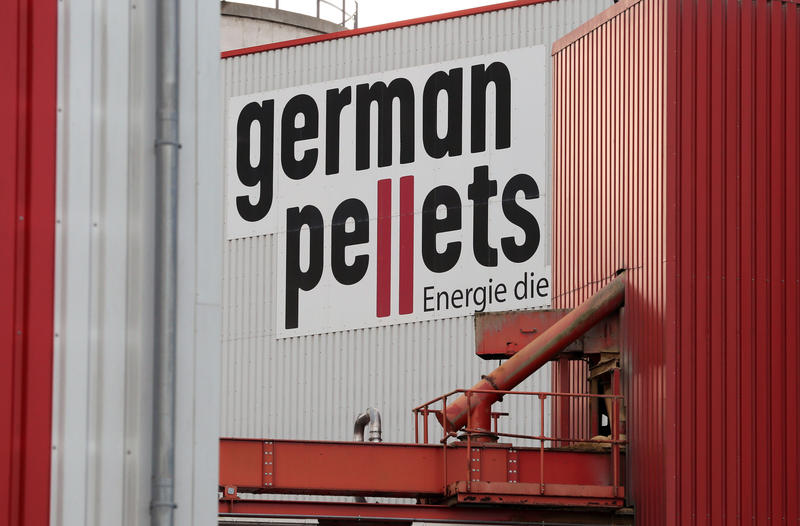
German Pellets restarts production in Wismar

Wismar’s German Pellets’ plant is programmed to start production today. The fuel producer filed for insolvency proceedings on the 10th of February 2016 and was offered a credit to start production, provided that the plant registers no losses.
The Insolvency Administration offered the money for the resumption of production and, as the spokesman for the provisional insolvency administrator Bettina Schmudde, Wolfgang Weber-Thedy advised, they should let the production start as to create interest in potential buyers.
122 potential acquirers have already shown their interest in Wismar’s fuel producer, among which there are both financial investors and industrial companies in the industry. Also, two renowned consulting companies have been chosen to continue the search for investors.
As Weber-Thedy said, the main objective of the German Pellets Group is to sell the company as a whole, but if the sale fails, they will take into consideration the sale of parts of the group.
Since production stopped on the 10th of February, the German Pellets GmbH, has more than EUR 220 million in debts. Also, the US activities have filed for insolvency, while creditor protection was filled.
One of the reasons for which the Wismar’s wood pellet producer got to this situation is the decline of oil costs, which brought the wood pellets price tag way below pressure. In addition, the incomes have lowered due to the weather conditions (the last two years’ warm winters) and the acquisition of Kago, the furnace producer, in 2010, which turned out to be a bad investment.
 
[gravityform id="1" title="true" description="true"]
 
[gravityform id="2" title="true" description="true"]


Rayonier's profits affected by low Chinese demand

Rayonier’s division in New Zealand recorded a 28% decrease in earnings. The lower Chinese demand that influenced the export prices, together with the weaker kiwi dollar affected the forestry group.
The global forestry group’s division has more than 13,000 ha of plantations in New Zealand, being the third biggest company in the country. Rayonier reported last month adjusted earnings of $US 33 million in 2015, before interest and taxes, compared to the 2014 earnings of $US 46 million.
The total sales volume increased by 2.2%, to 2.41 million tonnes, of which domestic sawn timber increased 6.2%, to 682,000 tons and domestic pulpwood rose 23%, to 434,000 tonnes. Also, the exports increased: sawn timber rose 19% to 982,000 tonnes and pulpwood increased 17%, to 83,000 tonnes, as NBR reported.
The prices drooped, both in domestic and export markets. Sawn timber was sold at $US 64.05 a ton, going down 18%, and the domestic pulpwood decreased 15%, to $US 32 a ton. The sawn timber exports also dropped 21%, to $US 88.59 a ton.
Still, the lower Chinese demand was balanced by the low prices of oil, which provided low shipping costs.
In 2015, Rayonier bought 1800 ha of forestry rights for $US 9.9 million and they expect adjusted earnings of about $US 23 million to $US 28 million in 2016. Last year, the forestry group invested NZ$ 242 million into Matariki as to increase its 65% stake to 77%.
 
[gravityform id="1" title="true" description="true"]
 
[gravityform id="2" title="true" description="true"]
 

Rayonier’s profits affected by low Chinese demand

Rayonier’s division in New Zealand recorded a 28% decrease in earnings. The lower Chinese demand that influenced the export prices, together with the weaker kiwi dollar affected the forestry group.

The global forestry group’s division has more than 13,000 ha of plantations in New Zealand, being the third biggest company in the country. Rayonier reported last month adjusted earnings of $US 33 million in 2015, before interest and taxes, compared to the 2014 earnings of $US 46 million.

The total sales volume increased by 2.2%, to 2.41 million tonnes, of which domestic sawn timber increased 6.2%, to 682,000 tons and domestic pulpwood rose 23%, to 434,000 tonnes. Also, the exports increased: sawn timber rose 19% to 982,000 tonnes and pulpwood increased 17%, to 83,000 tonnes, as NBR reported.

The prices drooped, both in domestic and export markets. Sawn timber was sold at $US 64.05 a ton, going down 18%, and the domestic pulpwood decreased 15%, to $US 32 a ton. The sawn timber exports also dropped 21%, to $US 88.59 a ton.

Still, the lower Chinese demand was balanced by the low prices of oil, which provided low shipping costs.

In 2015, Rayonier bought 1800 ha of forestry rights for $US 9.9 million and they expect adjusted earnings of about $US 23 million to $US 28 million in 2016. Last year, the forestry group invested NZ$ 242 million into Matariki as to increase its 65% stake to 77%.


[gravityform id="1" title="true" description="true"]


[gravityform id="2" title="true" description="true"]

 

Setra to invest in a new log feeder at Kastet sawmill

Setra has decided to commission Gösta Hedlund AB to install a new log feeder at Kastet sawmill in Gävle, Sweden. The new log feeder is expected to be in place during autumn 2016.
The investment in a new log feeder at Setra Kastet will secure Kastet’s current production level while enabling continued good development of the business.

“The investment at Setra Kastet is intended to further improve efficiency at a well-performing unit and at the same time strengthen Setra’s long-term competitiveness,” says Jonas Björnståhl, Setra’s Production Director.

In parallel with the investment in the new log feeder, a new progressive kiln is also being installed at the unit. The new kiln will connect to a rail system which will further improve operational efficiency.

“Throughout this project we have kept our eyes on the long-term so that we get a facility which can handle future requirements. For example bark handling will be increasingly done online so that the need for tractor trips can be reduced,” says Ove Sjögren, Manager at Setra Kastet.

The investment project is expected to completed and in operation during autumn 2016.
In recent time, Setra made other investments in its sawmills. At Setra Malå the investment involved upgrading the trimmer; a camera for automated sorting and a new control system meant to improve the efficiency of timber sorting with more consistent quality, lower production costs and improved flexibility. At Setra Färila the investment included a saw line and sawing equipment for a higher yield and more precise measurement of goods produced.
Setra Kastet, in Gävle, Sweden, has approximately 70 employees and is a specialised redwood sawmill. Production volume in 2015 totalled approximately 230,000 cubic metres of sawn product. Setra Kastet primarily saws small-dimension logs for production of raw material for glulam, claddings and furniture for customers in Japan, the UK, and Sweden, among other countries.
 
[gravityform id="1" title="true" description="true"]
 
[gravityform id="2" title="true" description="true"]
European Bioeconomy reached a turnover of 2.1 trillion EUR

The European Bioeconomy reached a turnover of 2.1 trillion EUR and employment of 18.3 million jobs, according to a Bio-based Industries Consortium (BIC) study. An additional internal survey from BIC revealed that its members alone are investing more than 2.1 billion EUR in new demo and flagship infrastructure at the moment.
The total European Bioeconomy amounts to 2.1 trillion EUR turnover, and includes the food, feed and beverages sectors which are responsible for roughly half of the turnover. The so-called bio-based industries – chemicals and plastics, pharmaceuticals, paper and paper products, forest-based industries, textile sector, biofuels and bioenergy – contribute with 600 billion EUR.
The total employment in the European Bioeconomy is 18.3 million employees with primary biomass production (agriculture, forestry & fishery) as the biggest contributor (58%). The analysis shows different situations among Member States. Eastern European Poland, Romania and Bulgaria are strong in primary production and their commodities’ sectors have a high employment/turnover ratio. Western and Northern European countries generate a much higher turnover compared, hence have lower employment/turnover ratios. Frontrunners for Bioeconomy are Germany, Italy and France which share the highest turnover and employment in the EU-28.

“Bio-based industries show 600 billion EUR turnover and 3.2 million employees. The Bio-based industry is already an important part of the European economy and a pivotal element in the transition towards a sustainable, circular economy in Europe with renewable raw materials as key enablers. Europe should continue on this path and create stable policies to further accelerate the European Bioeconomy," says Marcel Wubbolts, Chair of the Bio-based Industries Consortium (BIC).

The study shows an overall increase in the bio-based share of the total chemical industry in the EU-28 from 5% in 2008 to 6% in 2013. Only taking into account organic chemistry, the overall bio-based share increased from 10% in 2008 to 12 % in 2013. Denmark stands out as the Member State with the highest bio-based share in the chemical industry, due to the high production of enzymes. Latvia and Sweden follow due to a large production of charcoal and tall oil.
The BIC annual survey from early 2015 indicate that BIC members currently invest more than 2.1 billion EUR in bio-based industries, mainly demonstration projects or new flagships. Most of the short-term investments will take place in the lignocellulosic and forestry based value chains.

"The commitment of the industry is there, and the new BBI public-private partnership certainly shows its first impact. Now politics has to follow and enable a swift transition from fossil to bio-based resources," comments Dirk Carrez, Executive Director of BIC.

Full report at: http://biconsortium.eu/news/european-bioeconomy-eur-21-trillion-turnover-and-183-million-employees#sthash.6azHXThn.dpuf
 
[gravityform id="1" title="true" description="true"]
 
[gravityform id="2" title="true" description="true"]

Danzer increases sales in 2015; especially in the hardwood flooring segment

Danzer closes its business year with a considerable increase in sales of 9.5 percent compared to the previous year. In addition to the acquisition of the modern veneer splicing plant in Raspenava, Czech Republic, Danzer significantly grew its business with deck layers for hardwood flooring.
Consequently, the capacities for this business segment will be increased further. In contrast, the demand for logs in China has decreased in line with the economic development there. The general trend: Oak and walnut still dominate the furniture sector.

“Especially in the sector of our deck layers for hardwood flooring the demand increased – like in the previous years – significantly. Since we have started our flooring activities in the year 2012, we have continuously increased our capacities in this sector and that is what we are going to do in the future. In line with our strategy we will continue to invest in the production of deck layers in the next years”, says Hans-Joachim Danzer, Chief Executive Officer of the Danzer Holding AG.

The planned investments of 15 million Euros will be used to expand and upgrade plants in France and in the Czech Republic. In 2016 the production of deck layers will also start at Danzer plants in the USA.
Demand for logs in China weaker
“Furthermore, with the acquisition of the Czech splicing company Raspenava we can now offer our European customers both veneers and spliced faces. The plant can meet flexibly smaller, customer specific requests and is an expert in splicing thick-cut veneers”, says Danzer regarding this investments and comments further: “In China, the demand for logs declined with the overall cooling off of the economy.” The share of sales of North American wood has increased in 2015 – to 46 percent (from 44 percent in the year 2014). European wood still adds 24 percent to the overall Danzer sales. The share of sales of African wood has decreased to 29 percent (from 32 percent in the year 2014).
Unchanged trend 2015: Oak and walnut for the furniture sector
Danzer achieved approximately 41.4 percent of its sales with lumber, followed by veneer with 36.5 percent, logs with 9.7 percent and specialty products and custom solutions, e.g. 3D-Veneer with 12.4 percent. “In the furniture sector oak and walnut are still the dominating species. For flooring there is a slight trend towards species in a more clean and less rustic look, although European Oak still is the dominating species”, Danzer adds with regard to current trends.
 
[gravityform id="1" title="true" description="true"]
 
[gravityform id="2" title="true" description="true"]

Japanese logs exports reach record high

In 2015, Japanese log exports reached 691,830 cbms, 32.7% more than 2014, and a record high. On contrast, Japan's lumber exports reached 61,621 cbms, 10.3% less than in 2014.
Japan's total forest products exports in 2015 were valued at 26,300 million yen (around 230,9 million US$), 24.8% more as compared to 2014. This exceeded the amount that the Japanese Ministry of Agriculture, Forestry and Fisheries drew up as a yearly target by 2020.
Log exports was the most important business in the forest products. The main destinations for the Japanese logs were China, Korea and Taiwan, with China taking a share of more than 50%. For China, the import share of Japan's logs is about 1.5%, with Japan being its 15th log supplier.
If the price remains low, it is possible that in the upcoming years, Japan to increase log exports to China. However, there is a tough competition in Japan for the biomass power generation business, which consumes a sizable amount of low grade logs, so log shippers have a difficult time to accumulate logs for export. Also, the exchange rate is an important factor. When the yen gets stronger, it will be tough to offer attractive dollar prices.
Log exports for Korea also increased largely as demand for Japanese cypress is strong for interior finishing and furniture.
Lumber exports to  Korea and Taiwan increased but the overall Japanese exports have dropped sharply.
Japan's plywood exports in 2015 expanded rapidly with a volume of 67,049 cbms, 143.7% more than 2014, getting close to the lumber export volume.
 
[gravityform id="1" title="true" description="true"]
 
[gravityform id="2" title="true" description="true"]

Latvia increases wooden furniture exports

The wooden furniture exports in Latvia reached EUR 128.01 million, registering a 2.85% growth from 2015, according to the Baltic Course, using data of the Forest Department of the Latvian Agriculture Ministry.
At the moment, out of the country's total forest industry exports, the Latvia's wooden furniture has a share of 6.2%. Germany is the main wooden furniture importer in Latvia, reaching 18.9% share of their total exports. In 2015, exports to Germany reached EUR 24 million. Next, was Denmark, with EUR 17 million and the UK, with EUR 11 million. the shares were 13.7% and 9.37% respectively, of the total furniture exports of Latvia.
Still, the imports of wooden furniture decreased by 9% in 2015, to EUR 64 million, compared to 2014. Poland sent the most, at a 25.8% share, followed by Italy (16.5%) and Lithuania (10.6%). The imports from these three countries were worth EUR 15 million, EUR 9.6 million and EUR 6.2 million respectively.
 
[gravityform id="1" title="true" description="true"]
 
[gravityform id="2" title="true" description="true"]
 

UK: House building at its weakest

Great Britain’s construction industry recorded a 10-month low in February, according to Reuters.
Even if the forecasts of Reuters’ poll of economists expected an increased index of 55.5, the Markit /CIPS UK Construction Purchasing Managers' Index (PMI) decreased from 55.0 to 54.2, a thing which shows a big slowdown of the economy.
Britain’s economy started to recover back in June 2013, but the house building didn’t manage to increase it. The construction firms also hired their staff at a very low price. February 2016 was the weakest month in the last three years.

Tim Moore, senior economist from survey compiler Markit, said that "aside from the pre-election slowdown last year, the latest upturn in construction output was the weakest for over-two-and-a-half years. What's different this time around is that construction companies have cut back on employment growth in response to the uncertain business outlook.”

The construction firms bought the materials at the slowest pace since June 2013 and hope for a slight growth this year. Still, Britain's referendum on its membership of the European Union from June, will also add to the risk this decrease represents for households and construction firms.
 
[gravityform id="1" title="true" description="true"]
 
[gravityform id="2" title="true" description="true"]

 

US forests are threatened by increasing drought

Climate change and increasing drought are affecting the US forests, as a new study released by Duke University shows. The forests in the West were the first to be affected by the climate change consequences, but now, the bark beetle infestations, the wildfires and drought-induced forest diebacks are spreading across a wider territory of the US.

James S. Clark, lead author of the study and Nicholas Professor of Environmental Science at Duke University, said that their analysts “show virtually all U.S. forests are now experiencing change and are vulnerable to future decline. Given the high degree of uncertainty in our understanding of how forest species and stands adapt to rapid change, it's going to be difficult to anticipate the type of forests that will be here in 20 to 40 years."
 

As the weather conditions become warmer and drier, many tree populations can’t respond by migrating to other regions. Especially the Eastern forests can’t expand enough into favorable environments.

Clark added that "prolonged drought affects wildfire risks, species distribution, forest biodiversity and productivity, and forest-based products, so there is a pressing need to know how we can manage for these changes.”

Clark and his colleagues published their paper on February 22 in the Early View online edition of the peer-reviewed journal Global Change Biology. The paper synthesizes findings from hundreds of studies and serves as a summary overview of a full report released earlier this month by the U.S. Department of Agriculture and the U.S. Global Change Research Program as part of the U.S. Forest Service’s National Assessment on the Impacts of Drought on Forests and Rangelands.
Without a better understanding of the complex interactions between trees, species and environmental conditions, even the most sophisticated current models can provide only limited guidance on climate effects, he explained.
 
[gravityform id="1" title="true" description="true"]
 
[gravityform id="2" title="true" description="true"]

Scotland's £1billion forest industry to be outlined in Inverness

An audience of around 60 north forestry professionals will gather in Inverness this week to hear how the future is shaping up for the sector, according to All Media Scotland.
Three speakers will provide updates on the economic value of forestry in Scotland; progress towards driving up health and safety standards in the industry; and local forestry priorities for the north.
The Highlands and Islands Forest Industry Cluster (HIFIC) is behind the event being held at the Inverness Caledonian Thistle stadium this Thursday, 3rd March. HIFIC events stimulate a great deal of discussion on the latest thinking around important subjects in the forestry sector.
This week’s event will provide a valuable insight by the head of business development at Forestry Commission Scotland into the findings of a key economic survey launched later in 2015 on the value of Scotland’s forestry sector.
The chief executive of the Forest Industry Safety Accord (FISA) will provide an update on the latest thinking relating to health, safety and welfare initiatives. The north Conservator of Forestry Commission Scotland will then deliver an informative presentation on issues affecting the industry at a more local level.
As All Media Scotland reported, a wide range of forestry workers, from harvesters, processors and contractors to estate personnel, managers and public sector employees will attend the event.

The new chair of HIFIC, Johnny Dean, said: “The recently published report by Forestry Commission Scotland is first on the agenda and with a headline figure putting the value of the Scottish forest economy at around £1billion, we will be interested to hear what this means for the industry.
“The latest thinking on health and safety will help north forestry businesses be better prepared on employee welfare issues and hearing from Forestry Commission Scotland/Forest Enterprise representatives about their local objectives and priorities for 2016, should provide a fitting conclusion to the evening.”

Highlands and Islands Enterprise (HIE) has provided core funding to HIFIC to deliver eight events over a two-year period, as well as the services of a facilitator to help organise these.

Caoimhe McCarthy, HIE’s development manager, energy infrastructure and supply chain, said: “Having focussed on fairly specific subjects like technology and pollution in 2015, HIFIC has returned in 2016 with a wider mix of relevant subjects on national and local forestry issues.
“This enables those attending to benefit from a diverse range of information and knowledge about the latest developments in the forest industry that they can apply to their business or organisation.”


Scotland’s £1billion forest industry to be outlined in Inverness

An audience of around 60 north forestry professionals will gather in Inverness this week to hear how the future is shaping up for the sector, according to All Media Scotland.

Three speakers will provide updates on the economic value of forestry in Scotland; progress towards driving up health and safety standards in the industry; and local forestry priorities for the north.

The Highlands and Islands Forest Industry Cluster (HIFIC) is behind the event being held at the Inverness Caledonian Thistle stadium this Thursday, 3rd March. HIFIC events stimulate a great deal of discussion on the latest thinking around important subjects in the forestry sector.

This week’s event will provide a valuable insight by the head of business development at Forestry Commission Scotland into the findings of a key economic survey launched later in 2015 on the value of Scotland’s forestry sector.

The chief executive of the Forest Industry Safety Accord (FISA) will provide an update on the latest thinking relating to health, safety and welfare initiatives. The north Conservator of Forestry Commission Scotland will then deliver an informative presentation on issues affecting the industry at a more local level.

As All Media Scotland reported, a wide range of forestry workers, from harvesters, processors and contractors to estate personnel, managers and public sector employees will attend the event.

The new chair of HIFIC, Johnny Dean, said: “The recently published report by Forestry Commission Scotland is first on the agenda and with a headline figure putting the value of the Scottish forest economy at around £1billion, we will be interested to hear what this means for the industry.

“The latest thinking on health and safety will help north forestry businesses be better prepared on employee welfare issues and hearing from Forestry Commission Scotland/Forest Enterprise representatives about their local objectives and priorities for 2016, should provide a fitting conclusion to the evening.”

Highlands and Islands Enterprise (HIE) has provided core funding to HIFIC to deliver eight events over a two-year period, as well as the services of a facilitator to help organise these.

Caoimhe McCarthy, HIE’s development manager, energy infrastructure and supply chain, said: “Having focussed on fairly specific subjects like technology and pollution in 2015, HIFIC has returned in 2016 with a wider mix of relevant subjects on national and local forestry issues.

“This enables those attending to benefit from a diverse range of information and knowledge about the latest developments in the forest industry that they can apply to their business or organisation.”


Possible renewal of the Softwood Lumber Agreement on meeting between Obama and Trudeau

Next Thursday, the Prime Minister Justin Trudeau and outgoing President Barack Obama meet to sign on to the continental environment and climate-change strategy. As the International Trade Minister, Chrystia Freeland, stated, the talks will also include the renewal of the Softwood Lumber Agreement between Canada and the US, according to The Globe and Mail.
The US and Canadian officials are now working on the presentations of the data for the meeting and even if the details are kept hidden, there is information that the new agreement will include stronger auto-emission and fuel standards as to develop electric cars, charging stations, self-driving vehicles and ride-sharing apps.
As The Globe and Mail reported, when it comes to the SLA renewal, there are sources saying that it couldn’t be completed during the US election year, because it could damage the Democrats’ image in the Congress. US producers don’t seem so interested in the renewal of the agreement that expired back in October 2015, even if the strong US housing starts and there is increased demand for Canadian softwood lumber.

As Freeland explained, “the visit is still coming together but I am very hopeful there will be some real accomplishments on the environment and climate change. We are still 10 days away and negotiations are very intense right now and I am not going to get ahead of where negotiators are.”

If the agreement won’t be renewed, Canadian softwood lumber producers may be imposed new tariffs starting October 2016. Still, this issue will be talked about during the Thursday meeting in the Oval office. The meeting is very important, as Canada hasn’t been invited to the White House since 1997, according to Ms. Freeland.
 
[gravityform id="1" title="true" description="true"]
 
[gravityform id="2" title="true" description="true"]


New version of the Guidance Document for EUTR published

The updated version of the Guidance Document for the EU Timber Regulation was adopted on 12 February 2016.
The document presents some amendments compared to the 2013 version. Main modified elements include:

  • point 4      - Clarification of the requirement for documents showing timber's compliance with applicable legislation
  • point 10B - Treatment of CITES-unlisted timber products made of CITES-listed timber species
  • point 11    - Treatment of Agents
  • point 12    - Treatment of Monitoring Organisations (MOs)

The new EUTR Guidance 2016 can be downloaded here.

[gravityform id="1" title="true" description="true"]
 
[gravityform id="2" title="true" description="true"]
Siempelkamp shifts capacity to China and the Czech Republic

The Krefeld-based Siempelkamp Group seeks a stronger international focus in future, and thus will make greater use of its foreign production locations. With this move, Siempelkamp is reacting to new competitive situations, and to the weakening of originally strong markets such as Russia and Brazil, Siempelkamp explains. However, the Krefeld location remains the "heart and mind" of Siempelkamp.
In recent years, the company has consistently been expanding its manufacturing facilities internationally in the Czech Republic and China. The global network of sales and service companies is also a component of this internationalisation process.
The new large-scale manufacturing site in Qingdao, China, which went operational in October 2015, will in future be used much more intensively for producing large-scale parts for press manufacturing. Further, Siempelkamp will significantly expand its production facility in Blatnice, Czech Republic, in order to continue being able to produce at competitive prices in future, as the company explained.
As a result, Siempelkamp will eliminate a total of 350 jobs in Germany in 2016 and 2017.

"Complex technologies and business secrets will remain here in Krefeld, and at other locations in Germany," emphasised Dr Hans Fechner, Spokesperson of the Executive Management at G. Siempelkamp GmbH & Co. KG.

In addition to increasing the value of foreign production locations, Siempelkamp will additionally be sustainably strengthening the German location: at the Bad Kreuznach location, a modern logistics and service centre is being created for supplying replacement parts globally to Siempelkamp customers.
 
[gravityform id="1" title="true" description="true"]
 
[gravityform id="2" title="true" description="true"]

 

China increases hardwood plywood market share in US

US_hardwood_plywood_imports
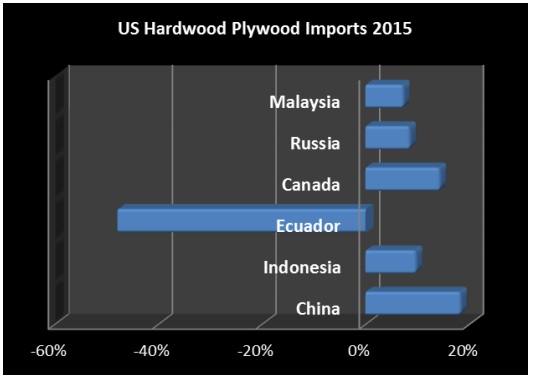
US imports of hardwood plywood increased 12% in 2015 compared to the previous year. A total of 3.25 million cu.m. of hardwood plywood were imported in 2015. The antidumping duties on Chinese plywood were removed in November 2013, but imports did not recover until 2015.
China exported 1.80 million cu.m. of plywood to the US in 2015. Its share in total US plywood imports grew from 52% in 2014 to 55% in 2015.
All other major sources of hardwood plywood increased shipments to the US in 2015, with the exception of Ecuador. Imports from Ecuador fell by almost half to 88,342 cu.m.
Indonesia remained the second-largest source of imports in 2015 at 491,965 cu.m., up 10% from the previous year. Imports from Malaysia grew 7% from 2014 to 78,627 cu.m.
Imports of hardwood plywood from countries other than Malaysia and Indonesia increased by 21% in 2015. Of the others, Europe was the most significant supplier led by Spain, Italy and Latvia (with Latvia producing mainly birch plywood).
The US imported 38,908 cu.m. of plywood from Uruguay in 2015, 25,400 cu.m. from Panama, and 25,017 cu.m. from Brazil.
 
[gravityform id="1" title="true" description="true"]
 
[gravityform id="2" title="true" description="true"]

Mohawk Industries announces record earnings in Q4/2015

Mohawk Industries announced Q4/2015 net earnings of $192 million and diluted earnings per share of $2.57. Excluding restructuring, acquisition and other charges, net earnings were $210 million and EPS was $2.82, a 24% increase over last year's Q4 adjusted EPS.
Net sales for the fourth quarter of 2015 were $2.0 billion, up 2% versus the prior year's Q4. For the Q4 of 2014, net sales were $1.95 billion, net earnings were $147 million and EPS was $2.00; excluding restructuring, acquisition and other charges, net earnings were $167 million and EPS was $2.27.
For the twelve months ending December 31, 2015, net sales were $8.1 billion, an increase of approximately 3% versus prior year or an increase of approximately 10% on a constant currency exchange rate basis. Net earnings and EPS for the twelve month period were $615 million and $8.31, respectively.
As Jeffrey S. Lorberbaum, Chairman and CEO of Mohawk Industries, said, the company had a strong growth strategy that began back in 2013. Since then, they invested nearly $5 billion, another $3.5 billion in 9 acquisitions and $1.5 billion to bring in innovative products in their existing businesses.
Mr. Lorberbaum added:  "We remain optimistic about 2016, and this year we will invest an additional $600 to $650 million in internal projects, which include increased ceramic capacity and upgrades in the U.S, Mexico, Europe and Russia, process improvements in carpet manufacturing, additional LVT manufacturing in the U.S. and Europe, increased wood production in U.S. and Europe and installation of advanced technology in our U.S. and European laminate businesses. Last year, we achieved record results in every quarter with about 30% of our business outside the U.S., where we faced significant foreign exchange translation headwinds.
"During the fourth quarter, our Flooring North America segment's sales were flat versus last year as reported, or increased 6% on a constant day's basis with adjusted operating income increasing 31%. The adjusted operating margin increased to 14% due to improved productivity, volume, input costs and the IVC acquisition partially offset by price and mix. The Flooring North America segment has made progress in expanding our brands and customer relationships, enhancing our style and design, transferring innovative manufacturing practices and utilizing the Mohawk distribution system for all products. Our vinyl sales are performing as planned and our new LVT plant continues to improve its performance with increased production levels. We continue to ramp up our Mohawk branded LVT and sheet vinyl sales in the builder, multi-family and retail markets, and we are developing new products to extend our sheet vinyl further into commercial channels.
"For the quarter, our Flooring Rest of the World segment's sales rose 22% as reported or 41% on a constant days and exchange rate basis with adjusted operating income improving 59% over the prior year. The adjusted operating margin increased to 16% due to improved volume, input costs and the IVC acquisition. Our laminate and wood business in Europe outperformed the market as a result of our focus on differentiated products at mid to high-end price points. We continue to expand our latest laminate embossing technology, which creates more realistic visuals. Our European wood sales are growing quickly, supplied from our Czech wood plant with the balance coming from our Malaysian facility. The IVC vinyl sales increased but were constrained by capacity limitations. Our new LVT plant in Belgium is operating well, and sales are developing better than planned. The plant is constrained by manufacturing limitations, and equipment additions in the middle of the year will increase our capacity about 50%. Our insulation products had record sales this year, and we have expanded our offering and our geographical footprint with recently acquired plants in Ireland, the U.K. and Belgium. Our other board product sales were up slightly and margins improved from mix, asset upgrades and plant consolidations.
"2015 was the best year in Mohawk's history, and we expect the momentum to continue this year. We anticipate that the demand trends in our U.S. and international markets will remain consistent with what we have been experiencing. Although growth in Europe is limited and negative in Russia, our international businesses are delivering solid results on a local basis. Our sales and margins should continue to improve over last year as a result of our continued innovations, process improvements and disciplined execution. Our recent acquisitions are progressing with operational and market synergies that we anticipated. This year we will increase investments in our existing businesses to improve our long-term performance. Taking all these factors into account, our guidance for the first quarter is $2.24 - $2.33 per share, which would be a 32 -37% increase over 2015, excluding any restructuring, acquisition and other charges, " Mr. Lorberbaum concluded.
 
[gravityform id="1" title="true" description="true"]
 
[gravityform id="2" title="true" description="true"]


Norway prepares for EUTR equivalent enforcement

Norway is making progress in implementing an EUTR equivalent. A Norwegian importer was quoted saying that Norwegian companies were informed in December they had one year to get their DDS (Due Dilligence System) in place.
Norway’s approach to implementing and enforcing the EUTR will be very similar to Sweden, according to a report in the ETTF Newsletter. Norway will apply the EUTR to both join in efforts against illegal timber trade and also to facilitate trade with EU countries, by operating to similar standards.
According to a press release issued by the Norwegian government, Norway has operated “on the same level as the EU countries regarding the timber regulation” since that date.
Norway has become a significant financier of REDD and other climate-related forest protection policies in tropical countries – but is not generally recognised as a significant player in the tropical wood industry.
The country remains the only one in the world where the national government bans the use of all tropical timber in public sector buildings and construction works.
As noted by Chatham House, the UK-based policy and research organisation, this policy is unlikely to be consistent with WTO procurement rules but has never been challenged, possibly because it has had limited impact.
Nevertheless, Norway's direct imports of wood related products from tropical countries are not negligible, in the region of $80 to $90 million each year, dominated by wood furniture from Vietnam, Thailand and Malaysia, and charcoal from Indonesia.
Norway has already appointed two Competent Authorities for enforcement of the new timber regulation: the Agricultural Authority will be in charge of checking on timber and timber products of Norwegian origin and the Norwegian Environmental Agency is responsible for imported timber.
Also, there are plans by Switzerland to introduce an equivalent to the EUTR will also impact on the tropical wood trade. Although Switzerland imports only around 4.3% of timber and timber products from outside the EU, the country imported in excess of US$100 million of products containing wood fibre direct from tropical countries in 2014. Much of this consisted of furniture and other added value products, notably from Thailand, Vietnam and Indonesia.
The Swiss Federal Council had hoped to have the new regulation in place this year or early in 2016. However, consultation is taking longer than expected and introduction of the EUTR may now be delayed until the second half of next year or even into 2017.
 
[gravityform id="1" title="true" description="true"]
 
[gravityform id="2" title="true" description="true"]

Steinhoff's Conforama counterbids Fnac's offer for Darty

Conforama, South African furniture group of Steinhoff, has offered a counterbid for Darty, after Fnac already made an offer to the company, which they agreed on. Darty is now Europe’s third electrical goods retailer and earns 70% of its revenue in France, according to Reuters.
Fnac already raised its bid to one Fnac share per 37 Darty shares held, reaching a value of $859 million for Darty, a deal that is due around the middle of 2016.
Still, Conforama offered Darty nearly $925 million bid in cash and the company said that they were considering the offer. Conforama also made another offer for Britain's Home Retail this month, as the South African furniture group wants to expand its business in Europe, as Reuters reported.

Darty reported that "there can be no certainty that any firm offer will be made by Conforama, nor as to the terms on which any firm offer might be made."

Liberum analysts said that Conforama’s offer is 9% higher than Fnac’s offer and it’s “cleaner” because is in cash. They added that the offer represents a better valuation of Darty’s shareholders.
 
[gravityform id="1" title="true" description="true"]
 
[gravityform id="2" title="true" description="true"]
 

Newsletter

Subscribe to our digital newsletter for your daily digest of essential news, views and analysis from the international wood industry delivered directly to your inbox.


0