
Article archive

China: Prices for imported softwood logs

According to official data from China Customs a sharp drop in Chinese log imports was recorded in 2015. China’s log imports in 2015 totalled 44.55 million cubic metres valued at US$8 billion, a year on year decline of 13% in volume and 32% in value.
The average price for imported logs was US$181 per cubic metre. Of total log imports, softwood log imports fell 16% to 30.06 million cubic metres, accounting for 67% of the national total.
The average price for imported softwood logs was US$122 per cubic metre in 2015, down 20% from 2014. The rate of decline for softwood log imports was larger than that for hardwood log imports.
Average softwood log prices in 2015

Average price US$/m3 Change in % 2014/2015
New Zealand 113 -21%
Russia 114 -13%
USA 164 -18%
Australia 98 -25%
Canada 154 -20%
Ukraine 115 -13%
Japan 123 -10%
Belarus 110 -12%
France 121 -24%
North Korea 118 -1%

 
Softwood log sources

2015 imports m3 mil. Change in % 2014/2015
New Zealand 10.72 -8%
Russia 8.99 -10%
USA 3.54 -36%
Australia 2.48 16%
Canada 2.34 -23%
Ukraine 0.84 -46%
Japan 0.43 42%
Belarus 0.18 25%
France 0.12 -59%
North Korea 0.12 35%

 
[gravityform id="1" title="true" description="true"]
 
[gravityform id="2" title="true" description="true"]

Will a new SLA solve the trade disputes between Canada and the US?

The trade dispute between Canada and the US, regarding the softwood lumber, has been going on for 30 years already. At the moment, there are ongoing talks about the renewal of the Softwood Lumber Agreement, that expired in October 2015. Justin Trudeau, Canada’s Prime Minister, together with Chrystia Freeland, the Trade Minister, are working on finding new solutions to solve the issues, as the US Liberals aren’t as interested as the Conservatives were, to make this trade work, according to CBC News.
Trudeau has been trying to raise this concern during the APEC meeting with President Barack Obama, back in November, but it seems that the renewal isn’t possible at the moment. The first SLA was signed in 2006. Since then, the free trade included no tariffs and no restrictions on trade between the US and Canada. At the moment, there is an ongoing standstill, valid for a year after October 2015, during which the US can’t impose any actions on Canada.

Apparently, renewing the deal isn’t enough to solve the issues that have appeared on the way. The US Lumber Coalition says that "border measures against subsidized and unfairly traded Canadian lumber imports are essential — otherwise differences between the U.S. (mostly private) and Canadian (mostly public) timber sales systems give Canadian producers an unfair cost advantage."

As CBC News reported, there are a lot of things that changed since the first deal was signed. The lowering of the Canadian dollar has made imports into the US more competitive and the hit took by the supply of lumber in Canada due to the pine beetle in BC lowered the share of the US market from 40% to 27%. Also, four companies from BC bought mills in the US to isolate them from future trade actions.
At the moment, the Americans seem to be more interested in the Trans-Pacific Partnership, which would allow a competitive market from Chile and New Zealand. And since there is no interest to renew the SLA, the best would be to extend the standstill beyond October 2016. Also, the US lobby works on rejecting import tariffs on Canadian softwood lumber.
For Grenier, a former federal and Quebec trade bureaucrat, said that “nobody really knows what will happen this October”, as imposing new tariffs could take up to 2 years to implement. He explained that the initial deal affected Ontario and Quebec, leaving BC to come up for three-quarters of the exports. "If there's a deal, it will be a more restrictive deal than the last one and it won't be good news for Canada," Grenier said.
 
[gravityform id="1" title="true" description="true"]
 
[gravityform id="2" title="true" description="true"]



Brazilian exports of wood products drop at the beginning of the year

In January 2016, Brazilian exports of wood-based products (except pulp and paper) declined 6.6% in value compared to January 2015, from US$187.5 million to US$175.2 million.
However, pine sawnwood exports increased 13.5% between January 2015 (US$17.8 million) and January 2016 (US$20.2 million). In terms of volume, exports increased 33.5% year on year in January from 76,400 cu.m to 102,000 cu.m.
Brazil's tropical sawnwood export volumes in January 2016 fell almost 11%, from 27,900 cu.m in January 2015 to 24,900 cu.m in January this year. There was an even sharper fall in the value of exports (-21%) from US$15.3 million in January last year to US$12.1 million this year.
Pine plywood exports followed the downward trend falling 16.4% from US$31.8 million to US$26.6 million in January 2016 in comparison with figure of January 2015, However, there was a steep rise in the volume of exports which increased by almost 21%, from 85,300 cu.m in January last year to 102,900 cu.m this year.
Brazilian tropical plywood export volumes increased 13% from 5,500 cu.m in January 2015 to 6,200 cu.m in January this year while the value of exports fell 21.4% from US$2.8 million to US$2.2 million year on year.
As for wooden furniture , the exported value fell from US$ 26.4 million in January 2015 to US$ 23.6 million in January 2016, a 10.6% fall in the total exports of the product during the period.
 
[gravityform id="2" title="true" description="true"]
 
[gravityform id="2" title="true" description="true"]

SCA: Forest Products segment reports drop in operating profit

The Swedish SCA's Forest Products division achieved a 2% increase in net sales up to SEK 4,133 million (2014: 4,037). Sales growth excluding exchange rate effects was 1%, of which price/mix accounted for -2% and volume for 3%. Exchange rate effects increased sales by 1%.
Despite the rise in sales, SCA Forest Products divison's operating profit, excluding items affecting comparability, decreased by 10% to SEK 612 million (2014: 683).
In the quarter, kraftliner showed higher prices (including exchange rate effects) and lower volumes. Publication papers and solid-wood products showed lower prices (including exchange rate effects) and higher volumes. Pulp showed lower prices (including exchange rate effects) and lower volumes, SCA explains.
The lower operating profit for SCA's Forest Products is mainly attributable to lower prices (including exchange rate effects), higher costs associated with production stops and impairment loss of trade receivables of approximately SEK 40m attributable to restrictions in the Egyptian financial market.
According to SCA, earnings were favorably affected by higher volumes, lower raw material and energy costs, and lower depreciation.
 
[gravityform id="1" title="true" description="true"]
 
[gravityform id="2" title="true" description="true"]
 

Sonae-Arauco joint venture gets green light

On February 26, the Directorate General for Competition of the European Commission gave a green light to the joint venture planned by Arauco and Sonae Industria.
The decision came earlier than it was expected. The European Commission launched a simplified review at the start of February, and it said that a final decision will be taken on March 8. The Commission explained that the merger was approved as the two companies will have a moderate market share in Europe if their activities merge.
The new venture will be named Sonae-Arauco, S.A. In order to form the joint-venture, Arauco subscribed for 50% of Sonae's Tafisa, for a $150 million investment. Tafisa owns 10 panel mills that are distributed in Spain, Portugal, Germany and South Africa. Combined, these production facilities employ 3,000 people and produce a total of 4.2 million cubic metres of panels.
Tafisa has estimated annual sales of $900 million- produces and sells OSB, MDF, and PB panels, as well as sawn timber. Arauco will operate two panel mills and one saw mill in Spain; two panel mills and one resin facility in Portugal; four panel mills in Germany and two in South Africa. Sonae-Arauco’s production capacity will be about 460,000 m3 of OSB, 1.45 million m3 of MDF, 2.27 million cubic metres of particleboard and 100,000 cubic metres of sawn timber.
This investment will rank Arauco as the second producer in the wood panel global raking, with an annual production of 9 million m3, which includes 50% of Tafisa’s production.
 
[gravityform id="1" title="true" description="true"]
 
[gravityform id="2" title="true" description="true"]

US lumber prices inch up at the beginning of March

While a measured pace prevailed through Wednesday, trading in framing lumber picked up steam on the Thursday of last week. One catalyst was a strong upward move in futures, although the impact on the cash market was uneven. Another key to the pickup was the approach of spring; many producers took a firmer stance on pricing on the premise that customers’ needs would increase with the arrival of milder weather. The late activity helped to nudge up the Random Lengths Framing Lumber Composite Price for a fifth straight week.

This Week
Mar 4
Last Week
Feb 26
Year Ago
2015
Random Lengths Framing Lumber Composite Price* $316 $315 $348
KD Western S-P-F #2&Btr 2x4 R/L Mill Price 276 271 300
KD Eastern S-P-F #1&2 2x4 R/L, delivered Great Lakes 364 364 400
Green Douglas Fir Std&Btr 2x4 R/L (Portland) 322 318 307
Southern Pine (Westside) #2 2x4 R/L 367 372 410
KD Coast Hem-Fir #2&Btr 2x4 R/L 315 310 322
Ponderosa Pine (Inland) #2&Btr 1x12 R/L 675 670 665
* Weighted average of 15 key items


Random Lengths Panel Market Report
Structural panel prices fluctuated mildly amid a moderate sales pace. In most producing regions, OSB prices hit a flat spot. Buyers spent most of the week digesting recent purchases, and mills generally had sufficient order files to hold quotes firm. The Southern Pine plywood market hummed along at a steady clip, and most prices were unchanged. In rated sheathing, thick panels drew more attention than thinner ones. Western Fir plywood prices edged downward, as most buyers remained cautious about purchasing beyond immediate needs.

(f.o.b. mill prices) This Week
Mar 4
Last Week
Feb 26
Year Ago
2015
Random Lengths Structural Panel Composite Price* $348 $348 $378
Southern (west-east) 15/32-inch 3-ply rated sheathing plywood 368-395 368-395 440-495
Southern (west-east) 15/32-inch 4-ply rated sheathing plywood 370-398 370-398 445-505
Western 1/2-inch 4-ply rated sheathing plywood 325 330 406
North Central 7/16-inch Oriented Strand Board 227 227 192
*Weighted average of 11 key items

 
Source: Random Lengths
 
[gravityform id="1" title="true" description="true"]
 
[gravityform id="2" title="true" description="true"]

European Commission calls upon member states to step up EUTR efforts

As its latest review on the first two years of EUTR reveals, the European Commission main concern is that member states need to put more effort into implementing and enforcing the EUTR. Human and financial resources, in particular, should be increased to raise the number and quality of checks on operators. Moreover, there should be additional efforts to inform operators, especially SMEs, about their obligations and cost-effective possibilities of carrying out due diligence.
The Commission says it will continue to provide guidance and facilitate communication between member states, with the ultimate aim to achieve uniform implementation and enforcement of the Regulation. The Commission says it may also consider expanding the product scope. On the other hand, it sees no occasion for changing the substantive provisions of the EUTR, as “the evaluation did not identify a clear need for changes in the core elements of the legislation”.
Industry echoes call for EUTR enforcement
During a meeting with the EU Environment Commission in November last year representatives of the EU timber industry and NGOs joined forces and called for the EUTR to be more stringently enforced.
This meeting followed a statement organised by WWF last September, which was signed by more than 65 companies and seven industry associations.
This statement urged the Commission to expand the scope of the Regulation, claiming that less than 50% of the EU’s wood product imports are currently covered. It also called for uniform implementation and enforcement of the EUTR in all Member States.
 
[gravityform id="1" title="true" description="true"]
 
[gravityform id="2" title="true" description="true"]
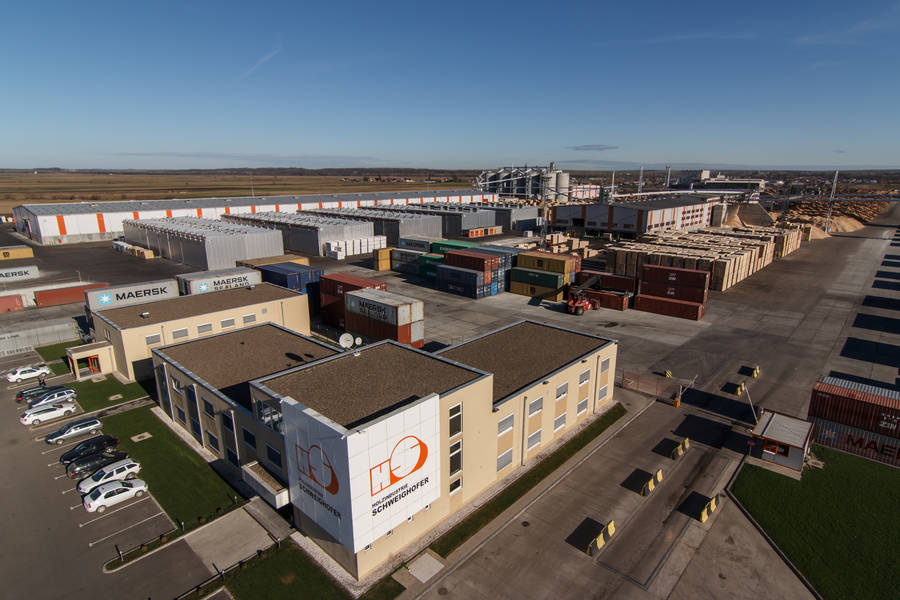
WWF files complaint against Schweighofer's FSC certification

WWF Austria has filed an appeal against the FSC certification of Holzindustrie Schweighofer. The complaint is responding to an announcement made in January, when the Austrian company had received a new FSC certification, for the Chain of Custody (CoC) of its locations in Romania and three other countries. According to Schweighofer, the new FSC certification was meant to ensure that no timber that the company uses comes from controversial sources. However, the WWF has doubts that the competent certification body Quality Austria, has complied with the FSC standards and demands a comprehensive review of the process.
The complaint was lodged against the FSC accreditation body "ASI" (Accreditation Services International). ASI is not part of FSC, but accredits independent certification on behalf of FSC. Like all other certifiers, Quality Austria has also received approval from ASI FSC to be able to issue certificates.
The WWF also expresses doubts as to how the certifier could have come to know that the entire timber procurement of Schweighofer was legal, without checking all suppliers. Massive accusations from various non-governmental organizations of former foresters, or the Romanian authorities, in which Schweighofer is directly connected to illegal timber and organized crime, concerns about bogus companies etc. were apparently ignored. Most of these investigations against Holzindustrie Schweighofer are not yet completed or have not yet begun, however.
In November last year, the WWF has also filed a complaint against Schweighofer with the FSC. FSC was asked verify the allegations that Schweighofer is buying illegal wood sources from non FSC certified forests. FSC International had accepted this complaint and has started a review process.
 
[gravityform id="1" title="true" description="true"]
 
[gravityform id="2" title="true" description="true"]


WWF files complaint against Schweighofer’s FSC certification

WWF Austria has filed an appeal against the FSC certification of Holzindustrie Schweighofer. The complaint is responding to an announcement made in January, when the Austrian company had received a new FSC certification, for the Chain of Custody (CoC) of its locations in Romania and three other countries. According to Schweighofer, the new FSC certification was meant to ensure that no timber that the company uses comes from controversial sources. However, the WWF has doubts that the competent certification body Quality Austria, has complied with the FSC standards and demands a comprehensive review of the process.

The complaint was lodged against the FSC accreditation body "ASI" (Accreditation Services International). ASI is not part of FSC, but accredits independent certification on behalf of FSC. Like all other certifiers, Quality Austria has also received approval from ASI FSC to be able to issue certificates.

The WWF also expresses doubts as to how the certifier could have come to know that the entire timber procurement of Schweighofer was legal, without checking all suppliers. Massive accusations from various non-governmental organizations of former foresters, or the Romanian authorities, in which Schweighofer is directly connected to illegal timber and organized crime, concerns about bogus companies etc. were apparently ignored. Most of these investigations against Holzindustrie Schweighofer are not yet completed or have not yet begun, however.

In November last year, the WWF has also filed a complaint against Schweighofer with the FSC. FSC was asked verify the allegations that Schweighofer is buying illegal wood sources from non FSC certified forests. FSC International had accepted this complaint and has started a review process.


[gravityform id="1" title="true" description="true"]


[gravityform id="2" title="true" description="true"]


New Zealand and Russia are the main sources of logs for China

New Zealand was the main log supplier to China in 2015 accounting for 24% of the national total. Imports from New Zealand totalled 10.77 million cubic metres, a year on year decline of 8%.
The second ranked supplier of logs was Russia at 10.61 million cubic metres, accounting for just over 23% of the national total. In 2015 a year on year decline of 7% was recorded in log imports from Russia.
The decline in average prices for imported logs from New Zealand (-21%) was larger than that from Russia (-11%).
Top 10 countries shipping logs to China

2015 m3 mil. Change in % 2014/2015
New Zealand 10.77 -8%
Russia 10.61 -7%
USA 4.12 -32%
PNG 3.16 -4%
Australia 2.83 21%
Canada 2.36 -22%
Solomon Island 2.22 1%
Ukraine 0.96 -42%
Eq. Guinea 0.66 32
France 0.65 -11%

 
Average log prices from top 10 suppliers

Average price US$/m3 Change in % 2014/2015
New Zealand 113 -21%
Russia 121 -11%
USA 200 -10%
PNG 209 -14%
Australia 101 -23%
Canada 157 -20%
Solomon Island 198 -8%
Ukraine 128 -7%
Eq. Guinea 272 -24%
France 203 -4%

Global timber prices continue to fall

GSPIThe Global Sawlog Price Index (GSPI) continued its two year decline in the 4Q/15 when the Index fell another 4.8% quarter-over-quarter. In just two years, the GSPI has fallen 21.6% due to combination of the strengthening US dollar and diminishing demand for lumber in Asia, the MENA countries and in Europe.
Sawlog prices in Europe have generally fallen faster than in other parts of the world, with the Central European prices decreasing by almost one-third in the past two years. In the 4Q/15, the European Sawlog Price Index (ESPI) dropped to US$91.00/m3, the lowest level since the 1Q/09.

Global Pulpwood Prices

Hardwood fiber prices continued to fall in most of the major pulp-producing countries in the world in the 4Q/15. The biggest declines were seen in Brazil, Chile, Russia, France, Germany and Indonesia. In most regions, the price adjustments were in both in the local currencies and in US dollar terms. The hardwood price index (HFPI) fell 2.2% from the 3Q/15 to US$84.27/odmt.
With the exception of the US South and New Zealand, softwood fiber prices were also down throughout the world in the 4Q/15. The declines ranged between two to ten percent from the previous quarter. The softwood price index (SFPI), was US$88.46/odmt, a reduction of 1.4% from the previous quarter.

Global Pulp Markets

Global market pulp production was 3.3% higher in 2015 than in 2014. Production was up in most GSPI2regions with the exception of Western Europe. The biggest increases in pulp export in 2015 were in shipments from Brazil, Canada, the Netherlands and Russia.
NBSK pulp prices have fallen during much of 2015 but started to find a bottom late in the year. Prices for hardwood pulp (HBKP) started to weaken during the 4Q/15 and prices in Europe were only $15-20/ton lower than those for NBSK.

Global Lumber Markets

A majority of the 20 largest softwood lumber-consuming countries in the world increased their importation of lumber in 2015, resulting in global trade reaching its highest level in ten years. The US imported 10% more lumber year-over-year and a number of countries in Europe also raised their consumption of imported lumber last year. Lumber demand in Japan, the Middle East and Northern Africa was weaker, resulting in a decline in importation of lumber.
The US lumber market was a bright spot as compared to most other regions of the world in 2015. Lumber consumption was up almost 5% and import volumes were 10% higher. The strong domestic market and a weakening Asian market also resulted in less lumber being exported.
Lumber prices in Sweden have fallen 30% from their five-year high in March 2014.
Although importation of softwood lumber to China fell by two percent in 2015 from the previous year, Russian volumes were up by almost 20 percent year-over-year. Russia is now the largest supplier of lumber to China.
Demand for wood in Japan has fallen the past two years partly as the result of an eight percent decline in housing starts.

Global Biomass Markets

North American overseas pellet exports increased for the second consecutive quarter in the 3Q/15, rising 15% from the previous quarter to reach a new record high of just over 1.6 million tons, according to North American Wood Fiber Review.
Although pellet production in Sweden has been fairly stable the past four years, importation has fallen by more than 50% from 2011 to 2015. In the local currency, pellet prices fell during the fall of 2015 and were four percent lower in the 4Q/15 than in the 4Q/14.
 
[gravityform id="1" title="true" description="true"]
 
[gravityform id="2" title="true" description="true"]

Québec's Minister Lessard points out his concers on the SLA renewal

Quebec's Minister of Forests, Wildlife and Parks, Laurent Lessard, had a conversation last week with the Canadian Minister of International Trade, Chrystia Freeland. Minister Lessard mentioned that the Québec government intends to ensure that the particularities of its forest regime are recognized during the process to renew the softwood lumber agreement.

"Our forest regime is the strictest in the world. In addition, some elements of the regime, such as the open market and the timber marketing board, match US demands for a price for lumber from Québec's public forests that better reflects market conditions. These particularities must be fairly recognized, and I was pleased to note Minister Freeland's attentive response," states Minister Lessard.

This Thursaday, the Prime Minister Justin Trudeau and outgoing President Barack Obama meet to sign on to the continental environment and climate-change strategy. As the International Trade Minister, Chrystia Freeland, stated, the talks will also include the renewal of the Softwood Lumber Agreement between Canada and the US.
Still, there are sources saying that it couldn’t be completed during the US election year, because it could damage the Democrats’ image in the Congress. US producers don’t seem so interested in the renewal of the agreement that expired back in October 2015, even if the strong US housing starts and there is increased demand for Canadian softwood lumber.

"Québec is a world leader in the field of forestry, and the federal government has a duty to promote our regime and its particularities. We will continue to highlight these particularities in upcoming discussions and negotiations concerning exports of forest products from Québec. Forestry is part of Québec's DNA and provides over 60,000 high-quality jobs in all regions of Québec. This is why we will spare no effort to protect the forest and maximize forest-related economic benefits," concludes Minister Lessard.

Québec's forest regime was passed by a unanimous vote of the National Assembly in 2010 and came into force in 2013. Its main feature is to ensure that sales of timber from the public forests are made at the best possible price. For this reason, it provides a fairer reflection of the true value of the timber than the systems applied in many other jurisdictions such as Maine, Minnesota, Georgia and Washington.
 
[gravityform id="1" title="true" description="true"]
 
[gravityform id="2" title="true" description="true"]
 

Québec’s Minister Lessard points out his concers on the SLA renewal

Quebec's Minister of Forests, Wildlife and Parks, Laurent Lessard, had a conversation last week with the Canadian Minister of International Trade, Chrystia Freeland. Minister Lessard mentioned that the Québec government intends to ensure that the particularities of its forest regime are recognized during the process to renew the softwood lumber agreement.

"Our forest regime is the strictest in the world. In addition, some elements of the regime, such as the open market and the timber marketing board, match US demands for a price for lumber from Québec's public forests that better reflects market conditions. These particularities must be fairly recognized, and I was pleased to note Minister Freeland's attentive response," states Minister Lessard.

This Thursaday, the Prime Minister Justin Trudeau and outgoing President Barack Obama meet to sign on to the continental environment and climate-change strategy. As the International Trade Minister, Chrystia Freeland, stated, the talks will also include the renewal of the Softwood Lumber Agreement between Canada and the US.

Still, there are sources saying that it couldn’t be completed during the US election year, because it could damage the Democrats’ image in the Congress. US producers don’t seem so interested in the renewal of the agreement that expired back in October 2015, even if the strong US housing starts and there is increased demand for Canadian softwood lumber.

"Québec is a world leader in the field of forestry, and the federal government has a duty to promote our regime and its particularities. We will continue to highlight these particularities in upcoming discussions and negotiations concerning exports of forest products from Québec. Forestry is part of Québec's DNA and provides over 60,000 high-quality jobs in all regions of Québec. This is why we will spare no effort to protect the forest and maximize forest-related economic benefits," concludes Minister Lessard.

Québec's forest regime was passed by a unanimous vote of the National Assembly in 2010 and came into force in 2013. Its main feature is to ensure that sales of timber from the public forests are made at the best possible price. For this reason, it provides a fairer reflection of the true value of the timber than the systems applied in many other jurisdictions such as Maine, Minnesota, Georgia and Washington.


[gravityform id="1" title="true" description="true"]


[gravityform id="2" title="true" description="true"]


IKEA opens first store in India; expects growth higher than in China

IKEA will start its business in India in the second half of 2017, by opening a store in Hyderabad. The Swedish furniture retailer also plans to open other stores in Mumbai, Delhi-NCR and Bengaluru. By 2025, IKEA’s project in India includes other 25 stores in nine cities, according to DNA India
The furniture retailer got government approval for its RS 10,500 crore proposal as to be able to build retail stores under 100% FDI. The store in Hyderabad will measure 4 lakh square feet in size and will have all the facilities, such as play area and restaurant. The company bought 13 acre of land close to the IT hub in Hyderabad's HITEC city last year, for the building of the store.

As IKEA Asia Pacific Retail President Mikael Palmquist, said, "we will open our first store in Hyderabad in later half of 2017. Digging for construction of our first store in India started this week. After Hyderabad, in the first phase of growth, we plan to open stores in Delhi, Mumbai and Bangalore. We are searching for land in these cities. We want to open more than one store in locations where our stores come up."

IKEA expects a faster growth in India, compared to China, and they are ready to respond to a large request. The furniture retailer has been opening 3 stores a year in China in the last 15 years and expect to be able to open stores at the same rate until 2025.
Regarding the sourcing norms, Palmquist said that the "start date has changed from first investment from date of store opening.” Thus, the company still needs some time to invest in sourcing solutions as to find local entrepreneurs and to source raw materials.
 
[gravityform id="1" title="true" description="true"]
 
[gravityform id="2" title="true" description="true"]


Canadian housing construction slipping

Canadian housing starts fell 18% in December at a seasonally adjusted annual rate. The decrease was in multi-family construction in the major cities, while singlefamily construction was unchanged from November.
Overall the housing market remained strong in 2015 despite low oil prices and a contraction in GDP in two quarters. Low mortgage rates and relatively low unemployment supported the housing market, except in Alberta where job losses related to the oil industry were high.
The Canadian Housing and Mortgage Corporation expect a modest decline in home construction in 2016 and 2017, but given the uncertainty in the global economic outlook housing starts could also strengthen from 2015.
 
[gravityform id="1" title="true" description="true"]
 
[gravityform id="2" title="true" description="true"]
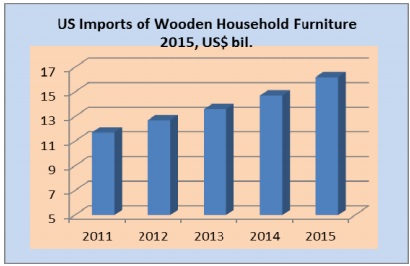
Strong increase in US wooden furniture imports from Malaysia and Vietnam

USwoodenfurnitureimportsUS furniture imports grew faster in 2015 than in the two previous years. Wooden furniture imports were worth US$16.23 billion in 2015. Imports from all major suppliers increased.
China’s share in total imports decreased slightly to 47.3%, while Vietnam’s share grew to 18.5%. Malaysia’s share in total imports increased from 3.8% in 2014 to 4.1% last year.
The strongest growth was in imports from Malaysia and Vietnam. Imports from Malaysia were worth US$673.3 million in 2015 (+20%). Vietnam exported close to US$3 billion worth of wooden furniture (+19%). Imports from China increased 10% to US$7.67 billion in 2015.
Furniture imports from Mexico have grown in recent years. In 2015, the US imported US$760.3 of wooden furniture from Mexico, representing almost 5% of total imports.
Imports from Indonesia were worth US$587.6 million, up 5% from 2014.
Wooden furniture imports from Europe did not grow as strongly in 2015 as imports from Asia, Canada and Mexico.
 
[gravityform id="1" title="true" description="true"]
 
[gravityform id="2" title="true" description="true"]

Rottneros makes investments in fossil-free energy

Rottneros’ Board of Directors has granted Rottneros Mill to invest SEK 98 million (EUR 10,4 million) in a new energy and emission efficient biomass boiler. It will replace fossil oil as the energy source used to dry pulp in the mills flash dryers.
The investment will also lead to large parts of the mill’s energy system being rebuilt, which will increase energy efficiency significantly, Rottneros explains. The detailed planning work has begun and the new biofuel boiler will be completed and put into use around mid-2017.
Rottneros Mill produces two different kinds of high yield pulp for paper producers, CTMP and groundwood pulp, and has for many years used oil to dry the pulp. When the new biomass boiler is completed, the biomass will replace all oil used today, and the mill's energy consumption will thus be entirely fossil-free. The new biomass boiler has an effect around 18MW and will replace an older biomass boiler. Supplier of the new boiler will be selected in the near future.
When we’re now investing in a new biofuel boiler, we will also optimize and rebuild our energy system at the mill. It will result in significant energy efficiency improvements and environmental benefits in terms of lower emission levels. The extents of the savings are at least SEK 25 million per year, says Olle Dahlin, CEO of Rottneros Mill.
 
[gravityform id="1" title="true" description="true"]
 
[gravityform id="2" title="true" description="true"]

EUTR- still a long way to effectiveness

The European Commission released the results of the first review of the EU Timber Regulation (EUTR) on 19 February.
The review covers the period from March 2013 to March 2015 and is based on Member States’ reports on the application of the EUTR, an open public consultation, targeted stakeholder surveys and an evaluation report produced by an external consultant. It analyses the EUTR for relevance, effectiveness, efficiency, coherence and EU added value.
The overall conclusion of the analysis was that the EUTR “has the potential to achieve its objectives”. However, various shortcomings were identified as  well, especially the slow pace of implementation in many member states and the unequal levels of enforcement and penalties.
EUTR contributes to raising awareness of illegal logging
One of the primary achievements of the EUTR, according to the review, was its raising awareness of the problem of illegal logging and also creating an incentive for producer countries to develop systems to demonstrate compliance with EUTR requirements.
Six producer countries have started implementing a bilateral agreement (Voluntary Partnership Agreement) with the EU in this context and nine other countries are negotiating similar agreements.
Moreover, the EUTR is encouraging non-EU consumer countries – such as Australia, Japan and Korea - to adopt or consider similar regulatory measures. And other nonEU European countries, such as Norway, Iceland, and Lichtenstein, are currently implementing the EUTR as well.
Within the EU, there is evidence that the EUTR “has encouraged more responsible sourcing policies and, therefore, demonstrated its potential to change operators’ market behaviour”. Communication campaigns carried out by both the Commission and member states played an important role in this context.
 
[gravityform id="1" title="true" description="true"]
 
[gravityform id="2" title="true" description="true"]
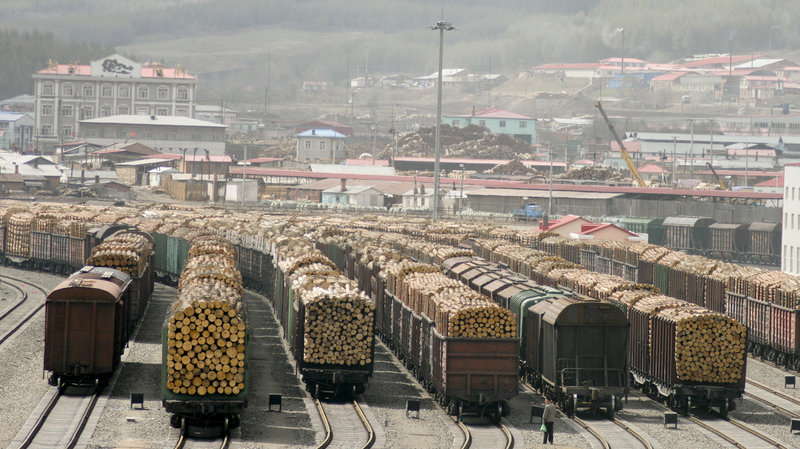
Prices of imported softwood&hardwood logs in China crashed in 2015

Official data from China Customs shows a sharp drop in log imports in 2015. China’s log imports in 2015 totalled 44.55 million cubic metres valued at US$8 billion, a year on year decline of 13% in volume and 32% in value. The average price for imported logs was US$181 per cubic metre, ITTO reported.
Of total log imports, softwood log imports fell 16% to 30.06 million cubic metres, accounting for 67% of the national total. The average price for imported softwood logs was US$122 per cubic metre, down 20%. The rate of decline for softwood log imports was larger than that for hardwood log imports.
Hardwood log imports fell 6% to 14.49 million cubic metres and made up 33% of the national total. The average price for imported hardwood logs was US$303 per cubic metre, down 27%.
Of total hardwood log imports, tropical log imports were 8.9 million cubic metres valued at US$2.8 billion, down 10% in volume and 32% in value and accounted for 20% of the national total.
While not reflected in the official data, estimates put the 2014 volume of logs arriving from Myanmar, despite the log export ban in Myanmar, at between 800-900,000 cubic metres. In 2015 analysts estimate that this had fallen to just over 350,000 cubic metres. Log imports from Myanmar are not included in the analysis below.
The average price for imported tropical logs was US$319 per cubic metre, a year on year decrease of 25%.
China’s log imports in 2015

2015 million cubic meters % Change 2014-2015 2015 US$ bil.
Total log imports 44.55 -13% 8000
Softwood logs 30.06 -16% 3700
All hardwood logs 14.49 -6% 4400
of which tropical 8.9 -10% 2800

Source: China Customs
Average log prices

 2015 Average price in US$/m3  % Change 2014-2015
Average price  181  -22
Softwood logs  122  -20
All hardwood logs  303  -27
of which tropical  319  -25

Source: China Customs
 
[gravityform id="2" title="true" description="true"]
 
[gravityform id="1" title="true" description="true"]

Prices of imported softwood&hardwood logs in China crashed in 2015

Official data from China Customs shows a sharp drop in log imports in 2015. China’s log imports in 2015 totalled 44.55 million cubic metres valued at US$8 billion, a year on year decline of 13% in volume and 32% in value. The average price for imported logs was US$181 per cubic metre, ITTO reported.

Of total log imports, softwood log imports fell 16% to 30.06 million cubic metres, accounting for 67% of the national total. The average price for imported softwood logs was US$122 per cubic metre, down 20%. The rate of decline for softwood log imports was larger than that for hardwood log imports.

Hardwood log imports fell 6% to 14.49 million cubic metres and made up 33% of the national total. The average price for imported hardwood logs was US$303 per cubic metre, down 27%.

Of total hardwood log imports, tropical log imports were 8.9 million cubic metres valued at US$2.8 billion, down 10% in volume and 32% in value and accounted for 20% of the national total.

While not reflected in the official data, estimates put the 2014 volume of logs arriving from Myanmar, despite the log export ban in Myanmar, at between 800-900,000 cubic metres. In 2015 analysts estimate that this had fallen to just over 350,000 cubic metres. Log imports from Myanmar are not included in the analysis below.

The average price for imported tropical logs was US$319 per cubic metre, a year on year decrease of 25%.

China’s log imports in 2015

2015 million cubic meters % Change 2014-2015 2015 US$ bil.
Total log imports 44.55 -13% 8000
Softwood logs 30.06 -16% 3700
All hardwood logs 14.49 -6% 4400
of which tropical 8.9 -10% 2800

Source: China Customs

Average log prices

 2015 Average price in US$/m3  % Change 2014-2015
Average price  181  -22
Softwood logs  122  -20
All hardwood logs  303  -27
of which tropical  319  -25

Source: China Customs


[gravityform id="2" title="true" description="true"]


[gravityform id="1" title="true" description="true"]

Newsletter

Subscribe to our digital newsletter for your daily digest of essential news, views and analysis from the international wood industry delivered directly to your inbox.


0