
Article archive

Swedish Court revokes Andritz’s patent after dispute with Valmet

Back in February 20, 2015, Andritz Oy had filed a summons application with the Stockholm District Court against Valmet AB regarding patent infringement. In the claim Andritz is asking that Valmet under a penalty ceases to utilize the system allegedly infringing Andritz's patent and to impose royalty and damages on Valmet AB with EUR 54 million and interest for the alleged infringement. Valmet has not made any provisions concerning the claim.

The validity of Andritz's patent has been challenged by Valmet, and this matter has been awaiting a decision from the Swedish Court of Patent Appeals. The Swedish Court of Patent Appeals has on March 23, 2016 decided to revoke Andritz's patent.

An appeal of the decision now made by the Swedish Court of Patent Appeals can be filed to the Supreme Administrative Court by May 23, 2016.

[gravityform id="1" title="true" description="true"]

[gravityform id="2" title="true" description="true"]

London's first timber skyscraper to be built at the Barbican

London’s first skyscraper made out of timber may have a greater resistance to fire than most conventional steel structures, as the Cambridge University architects have stated, according to Evening Standard.
As the developers of the skyscraper revealed, the 80-storey skyscraper will be built at the Barbican and will reach 300 meters in height. PLP Architecture and engineers Smith and Wallwork, along with Cambridge researchers have already submitted the conceptual plans to the Mayor of London.

“The Barbican was designed in the middle of the last century to bring residential living into the city of London – and it was successful. We’ve put our proposals on the Barbican as a way to imagine what the future of construction could look like in the 21st century,” said Dr Michael Ramage, Director of Cambridge’s Centre for Natural Material Innovation.

Ramage added that the natural materials, including timber, aren’t used at their full capacity, taking into consideration that timber is a natural and renewable resource. Thus, the plans include 1,000 new residential units’ proposals, alongside with the timber tower. The use of timber may reduce the overall costs, along with a shorter building time.
Also, there is a decreased risk of fire, compared to the steel and concrete buildings.
Image credit: Cambridge University/PLP Architecture/Smith and Wallwork
 
[gravityform id="1" title="true" description="true"]
 
[gravityform id="2" title="true" description="true"]
 

London’s first timber skyscraper to be built at the Barbican

London’s first skyscraper made out of timber may have a greater resistance to fire than most conventional steel structures, as the Cambridge University architects have stated, according to Evening Standard.

As the developers of the skyscraper revealed, the 80-storey skyscraper will be built at the Barbican and will reach 300 meters in height. PLP Architecture and engineers Smith and Wallwork, along with Cambridge researchers have already submitted the conceptual plans to the Mayor of London.

“The Barbican was designed in the middle of the last century to bring residential living into the city of London – and it was successful. We’ve put our proposals on the Barbican as a way to imagine what the future of construction could look like in the 21st century,” said Dr Michael Ramage, Director of Cambridge’s Centre for Natural Material Innovation.

Ramage added that the natural materials, including timber, aren’t used at their full capacity, taking into consideration that timber is a natural and renewable resource. Thus, the plans include 1,000 new residential units’ proposals, alongside with the timber tower. The use of timber may reduce the overall costs, along with a shorter building time.

Also, there is a decreased risk of fire, compared to the steel and concrete buildings.

Image credit: Cambridge University/PLP Architecture/Smith and Wallwork


[gravityform id="1" title="true" description="true"]


[gravityform id="2" title="true" description="true"]
 

US housing market helps the flooring market grow, says Armstrong's CEO

Armstrong World Industries (AWI) has dismissed their Armstrong Flooring (AFI) subsidiary last week. The CEO of AFI, Don Maier, stated that this is a very important step for the flooring company to grow in the rapidly developing market of the residential housing market, according to The Street.

“Our business is actually split 65% residential, so it is very important to us as to what happens in the homebuilding market. But we are 35% commercial as well, so that's also an important segment for us,” Mayer added.

Lancaster, the Pennsylvania-based Armstrong Flooring is the biggest manufacturer of wood flooring products all over North America, operating 18 facilities in 3 countries. The company provides flooring for Lowe’s and Home Depot, offering direct distribution too.
Due to the fact that the hard-surface flooring demand has grown by 4% from 2012 to 2016, Maier stated that this was also an important thing for AFI to take into consideration.
US housing starts have registered a 9% growth from 2013 to 2015 and may keep on growing until at 11% CAGR from 2015 to 2017. Existing sales have also increased at 2% CAGR from 2013 to 2015 and may continue the increase until 5% CAGR from 2015 to 2017.

"We use the consumer journey, which is almost always going to involve a stop in one of the big box locations, to our advantage and that helps support our independent retailers as well," said Maier.

Regarding the recent issues of Lumber Liquidators, whose products have been detected to raise cancer risks, Maier stated that AFI is a strong brand, in whom the costumer can trust.
"In times of uncertainty when people are not sure about some products coming in from Asia, it is really important to pick a brand consumers know they can trust. And that is Armstrong," said Maier. The drop in petroleum prices is also boosting margins for the company, he added.
Maier said he does not view the major home improvement retailers as direct competitors.
"We use the consumer journey, which is almost always going to involve a stop in one of the big box locations, to our advantage and that helps support our independent retailers as well," said Maier.
 
[gravityform id="1" title="true" description="true"]
 
[gravityform id="2" title="true" description="true"]



US housing market helps the flooring market grow, says Armstrong’s CEO

Armstrong World Industries (AWI) has dismissed their Armstrong Flooring (AFI) subsidiary last week. The CEO of AFI, Don Maier, stated that this is a very important step for the flooring company to grow in the rapidly developing market of the residential housing market, according to The Street.

“Our business is actually split 65% residential, so it is very important to us as to what happens in the homebuilding market. But we are 35% commercial as well, so that's also an important segment for us,” Mayer added.

Lancaster, the Pennsylvania-based Armstrong Flooring is the biggest manufacturer of wood flooring products all over North America, operating 18 facilities in 3 countries. The company provides flooring for Lowe’s and Home Depot, offering direct distribution too.

Due to the fact that the hard-surface flooring demand has grown by 4% from 2012 to 2016, Maier stated that this was also an important thing for AFI to take into consideration.

US housing starts have registered a 9% growth from 2013 to 2015 and may keep on growing until at 11% CAGR from 2015 to 2017. Existing sales have also increased at 2% CAGR from 2013 to 2015 and may continue the increase until 5% CAGR from 2015 to 2017.

"We use the consumer journey, which is almost always going to involve a stop in one of the big box locations, to our advantage and that helps support our independent retailers as well," said Maier.

Regarding the recent issues of Lumber Liquidators, whose products have been detected to raise cancer risks, Maier stated that AFI is a strong brand, in whom the costumer can trust.

"In times of uncertainty when people are not sure about some products coming in from Asia, it is really important to pick a brand consumers know they can trust. And that is Armstrong," said Maier. The drop in petroleum prices is also boosting margins for the company, he added.

Maier said he does not view the major home improvement retailers as direct competitors.

"We use the consumer journey, which is almost always going to involve a stop in one of the big box locations, to our advantage and that helps support our independent retailers as well," said Maier.


[gravityform id="1" title="true" description="true"]


[gravityform id="2" title="true" description="true"]


Salone del Mobile awaits 2,400 exhibitors in Milan

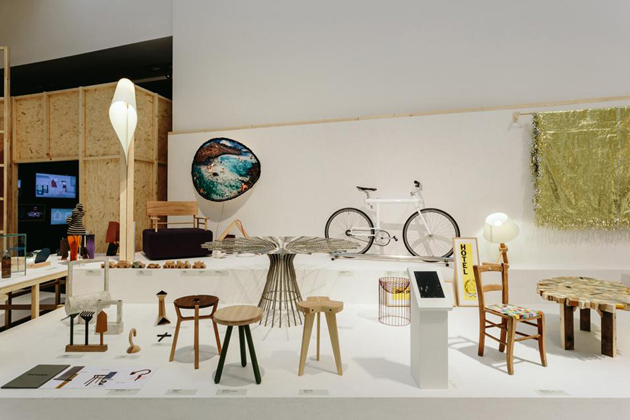
The Salone del Mobile, which is one of the biggest date on the world's furniture calendar will take place in from the 12th until the 17th of April 2016. Approximately 2,400 exhibitors are expected to take part to this fair, including a large number of foreign manufacturers will make up 30% of all manufacturers. Several Italian manufacturers will then have the chance to liaise and network with foreign operators. Indeed the export sector is a key driver of growth for Italian manufacturers.
After seven consecutive years of decline, 2015 was a positive year for Italian manufacturers as the turnover grew by 3.6% compared with 2014, to almost 25 billion Euros. Exports were especially buoyant as they grew by more than 6%, to 12.5 billion Euros. Mr Roberto Snaidero, President of Federlegno Arredo, reckons that the export sector will continue to remain very important for Italian manufacturers.
The Italian exports to the US and the UK markets were particularly positive as they grew respectively by 22.4 and 15.3%; turnover to these countries exceeded 1 billion Euros. Exports to China (+27.5%) and Iran (32.9%) also rose remarkably.
Both the kitchen and bathroom sectors were especially affected by the long economic crisis as they are less export-oriented than other sectors. But finally in 2015 the negative trend was bucked.
Overall, the Italian kitchen sector turnover in 2015 was almost 1.85 billion Euros, which is a 3.7% increase compared with 2014; Exports accounted for 39% of the total turnover (in 2014 they accounted for 37% they grew by 10.1%). France remains the largest export market with 128 million Euros (+1.1% vs 2014), followed by the US (93 million Euros, +72%), and Russia (55 million euros, -26.4%).
As regards Italy's bathroom sector, its turnover grew by 1% in 2015 and reached almost 2.6 billion Euros. Exports accounted for 38% of the total turnover (in 2014 they accounted for 37%, they grew by 4.4%). Germany is the largest export destination with 139 million Euros (+6.2%), closely followed by France (137 million Euros, -0.3%); UK ranks third with 92 million Euros (+4.6%).
Overall in Italy, the wooden furniture sector is made up of 81,500 enterprises, which employ 326,000 people. Mr Snaidero is confident that even 2016 will be a positive year.


[gravityform id="1" title="true" description="true"]
 
[gravityform id="2" title="true" description="true"]
Malaysia: Sarawak's timber exports down 9%

The value of Sarawak’s 2015 timber exports fell 9% to RM6.6 billion compared to RM7.2 billion in 2014. Export earnings for the first two months of 2016 are also trending lower.
The State Minister of Resource Planning and Environment, Awang Tengah Ali Hasan, reported that only sawnwood exports have held up with all other products posting losses. To-date products that contributed most to 2016 export earnings were plywood (48%), logs (27%) and sawn timber (12%).
In the first two months of the year Japan continues to be the major market accounting for 36 % (RM373 million) of total wood product exports. Other markets included India (21%), Taiwan P.o.C (9%), Middle East countries (9%), Korea (8%), the Philippines (6%), Vietnam (3%) and Thailand (2%).
Efforts to combat illegal logging in Sarawak have been intensified. The Chief Minister, quoting official statistics for the period 2009 – 2014, said that the volume of illegal logs seized was less than 1% of total log production and that none of the main logging companies had been found to be logging illegally.
Regional markets to be foundation of 2016 exports
In related news, the Malaysian Timber Council (MTC) is optimistic of maintaining the momentum in wood product exports this year despite global challenges.
MTC Chief Executive, Dr. Abdul Rahim Nik, revealed that Malaysia’s 2015 exports of sawnwood, plywood, veneer and furniture increased 6.5% year on year to around US$5.5 billion.
Furniture exports alone increased 14% last year and overall, the timber sector provided just over 18% to total exports earnings in the commodity sector. Rahim said the outlook for the industry was quite positive, especially in terms of the opportunities for sales within the region. India is a market with huge potential as is the furniture market in China.
To capture the opportunities in these markets Rahim said “Continued growth and progress are largely dependent upon industry’s ability to shift from the current manufacturing-based mind-set to one that is more innovation centric, providing more value-added products to international markets”.
Sarawak plywood prices
Plywood Traders in Sarawak reported the following export prices:

  • Floor base FB (11.5mm) US$580/cu.m FOB
  • Concrete formboard panels CP (3’ x 6’) US$500/cu.m FOB
  • Coated formboard panels UCP (3’ x 6’) US$580/cu.m FOB

Standard panels

  • S Korea (9mm and up) US$390/cu.m FOB
  • Taiwan P.o.C (9mm and up) US$400/cu.m FOB Hong Kong US$400 FOB/cu.m
  • Middle East US$380/cu.m FOB

 
[gravityform id="1" title="true" description="true"]
 
[gravityform id="2" title="true" description="true"]
Malaysia: Sarawak’s timber exports down 9%

The value of Sarawak’s 2015 timber exports fell 9% to RM6.6 billion compared to RM7.2 billion in 2014. Export earnings for the first two months of 2016 are also trending lower.

The State Minister of Resource Planning and Environment, Awang Tengah Ali Hasan, reported that only sawnwood exports have held up with all other products posting losses. To-date products that contributed most to 2016 export earnings were plywood (48%), logs (27%) and sawn timber (12%).

In the first two months of the year Japan continues to be the major market accounting for 36 % (RM373 million) of total wood product exports. Other markets included India (21%), Taiwan P.o.C (9%), Middle East countries (9%), Korea (8%), the Philippines (6%), Vietnam (3%) and Thailand (2%).

Efforts to combat illegal logging in Sarawak have been intensified. The Chief Minister, quoting official statistics for the period 2009 – 2014, said that the volume of illegal logs seized was less than 1% of total log production and that none of the main logging companies had been found to be logging illegally.

Regional markets to be foundation of 2016 exports

In related news, the Malaysian Timber Council (MTC) is optimistic of maintaining the momentum in wood product exports this year despite global challenges.

MTC Chief Executive, Dr. Abdul Rahim Nik, revealed that Malaysia’s 2015 exports of sawnwood, plywood, veneer and furniture increased 6.5% year on year to around US$5.5 billion.

Furniture exports alone increased 14% last year and overall, the timber sector provided just over 18% to total exports earnings in the commodity sector. Rahim said the outlook for the industry was quite positive, especially in terms of the opportunities for sales within the region. India is a market with huge potential as is the furniture market in China.

To capture the opportunities in these markets Rahim said “Continued growth and progress are largely dependent upon industry’s ability to shift from the current manufacturing-based mind-set to one that is more innovation centric, providing more value-added products to international markets”.

Sarawak plywood prices

Plywood Traders in Sarawak reported the following export prices:

  • Floor base FB (11.5mm) US$580/cu.m FOB
  • Concrete formboard panels CP (3’ x 6’) US$500/cu.m FOB
  • Coated formboard panels UCP (3’ x 6’) US$580/cu.m FOB

Standard panels

  • S Korea (9mm and up) US$390/cu.m FOB
  • Taiwan P.o.C (9mm and up) US$400/cu.m FOB Hong Kong US$400 FOB/cu.m
  • Middle East US$380/cu.m FOB


[gravityform id="1" title="true" description="true"]


[gravityform id="2" title="true" description="true"]
UK: Confor launches poll on Brexit and consequences for the forest sector

Confor has opened a poll to gauge the views of the forestry and wood sector on the forthcoming referendum on the UK's membership of the European Union.
As well as asking whether those responding wish to remain in the EU, it also asks Confor members if they think they have enough information to make a decision when the vote takes place on June 23rd.
The results of the poll will be revealed at the All-Party Parliamentary Group on Forestry (APPGF) at Westminster on April 19th. The APPGF will discuss how a vote to leave the EU might impact on the sector, with two MPs speaking up for each side of the argument. MPs from England, Scotland, Wales and Northern Ireland will participate in the discussion.

Stuart Goodall, Chief Executive of Confor, said: "It is clear that there is a range of opinions across the sector on the future of the EU. We are keen to get an idea of where the balance of opinion lies."

Confor is also producing a report, written by Guy Watt of John Clegg Consulting Ltd, outlining what the implications of a vote by the British people to leave the European Union might be for the forestry and wood sector.
Stuart Goodall said: "There are clearly a number of areas where businesses in our sector are impacted by the decisions of the European Union - such as regulations and subsidy payments - and by the operation of a single European market.
"The referendum is a hugely important decision for the British people to take. Confor wants to make sure our industry is well-informed about he key issues for forestry and wood processing." 
He added: "Predicting national and international trends is not easy and there will be implications for our sector whatever decision the British people take.  What we do know is that inside or outside the EU, demand for wood products will continue to grow. Governments throughout the UK need to do more to help plant the large numbers of trees needed to meet our requirements for wood in future."

You can access the poll from the Confor website - simply enter the following link into your web browser: http://conforuk.polldaddy.com/s/europe

[gravityform id="1" title="true" description="true"]
 
[gravityform id="2" title="true" description="true"]

China’s 2015 fiberboard exports slide

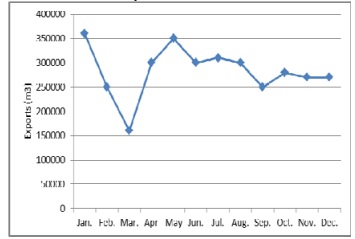
China’s fiberboard exports in 2015 totaled 3.41 million cubic metres valued at USD1.4 billion, a year on year drop of 12% in volume and 13% in value. It can be seen from the above graph that China’s fiberboard exports fell sharply in March but never fully recovered.
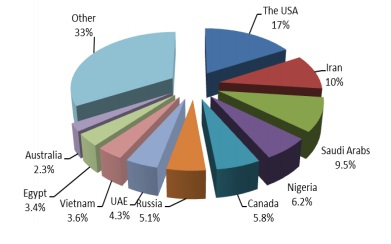
China’s fiberboard exports were distributed between three largest markets, the US, Iran and Saudi Arabia (36.5% of all fiberboard exports).
Exports to the US, Canada and Russia fell 19%, 34% and 68% respectively in 2015. The drop was mainly because of formaldehyde emission issues. However, China’s fiberboard exports to Vietnam, Nigeria and Iran surged 69%, 57% and 40% respectively.
Shanghai and Nanjing Ports accounted for 41% and 31% respectively of all fiberboard exports in 2015.


[gravityform id="1" title="true" description="true"]
 
[gravityform id="2" title="true" description="true"]

U.S. LUMBER Group merges with Boston Cedar

U.S. LUMBER Group, a multi‐regional two step building materials distributor operating across the southeast and mid‐Atlantic states and Mansfield, Mass.-based Boston Cedar, the premier specialty building materials distributor in New England have agreed to merge their interests. Rob Ankner, founder and principal of Boston Cedar has agreed to become a partner at U.S. LUMBER and will take a seat on the Board of Directors.
Lawrence Newton, U.S. LUMBER’S founder and CEO says, “We are delighted to be in business with Rob and his 40 plus years of insight, experience, and perspective. Under Rob’s leadership, his team at Boston Cedar has built a best‐in‐class company with their unique business model through long‐standing customer partnerships. Boston Cedar and U.S. LUMBER combined have the unique capability to serve customer and supplier partners up and down the Eastern Seaboard…from the Canadian border to South Florida.”
U.S. LUMBER will have a controlling interest in the combined enterprise and will manage the business from its corporate office in Atlanta. The company operates nine distribution centers, two internal reloads, and covers 21 states.
 
[gravityform id="1" title="true" description="true"]
 
[gravityform id="2" title="true" description="true"]
Finnpulp aims environmental permit for the world's largest softwood pulp mill

Finnpulp has submitted the environmental and water permit application to the Regional State Administrative Agency of Eastern Finland regarding the construction of bioproduction mill in Sorsasalo, Kuopio. The application is based on the information gained from the environmental impact assessment process that was completed in December and a number of additional studies performed in early 2016.
The bioproduction facility consists of sulphate pulp mill, a bark-drying and gasification unit, a power plant and a wastewater treatment plant. The wastewater treatment plant will also be used to treat wastewaters from the Savon Sellu Oy fluting mill and the leachate from Ekokem-Palvelu Oy. During the project, environmental permit applications for a biogas facility and a biocoal facility will also be submitted. The permit application concerns activities and emissions during operation. A permit application in compliance with the Water Act for taking water for the facility from Virtasalmi in Kallavesi, placing and building the water collection and discharge pipes in Kallavesi and filling a water area will also be submitted simultaneously.
Finnpulp estimates that the permit procedure by authorities will be completed and the permit decision published by early fall.
The environmental permit application will be subjected to public consultation by the Regional State Administrative Agency of Eastern Finland.
If implemented, the Finnpulp project would be the largest softwood pulp mill in the world. The employment effect of the 1.4 billion euro facility investment in the project phase is 5,700 full-time work years. The immediate employment effect of the completed bioproduction facility equals 1,500 people in North Savo and 3,400 people in the national value chain. 200 people will work in the facility area.
The annual production capacity of the facility will be 1.2 million tons of pulp. Additionally, the facility will produce 60,000 tons of tall oil and one terawatt hour (TWh) of bioelectricity for the national electricity grid. The facility will use 6.7 million cubic metres of raw wood material per year.
Photo: Plan of Finnpulp's softwood pulp mill
 
[gravityform id="1" title="true" description="true"]
 
[gravityform id="2" title="true" description="true"]
Finnpulp aims environmental permit for the world’s largest softwood pulp mill

Finnpulp has submitted the environmental and water permit application to the Regional State Administrative Agency of Eastern Finland regarding the construction of bioproduction mill in Sorsasalo, Kuopio. The application is based on the information gained from the environmental impact assessment process that was completed in December and a number of additional studies performed in early 2016.

The bioproduction facility consists of sulphate pulp mill, a bark-drying and gasification unit, a power plant and a wastewater treatment plant. The wastewater treatment plant will also be used to treat wastewaters from the Savon Sellu Oy fluting mill and the leachate from Ekokem-Palvelu Oy. During the project, environmental permit applications for a biogas facility and a biocoal facility will also be submitted. The permit application concerns activities and emissions during operation. A permit application in compliance with the Water Act for taking water for the facility from Virtasalmi in Kallavesi, placing and building the water collection and discharge pipes in Kallavesi and filling a water area will also be submitted simultaneously.

Finnpulp estimates that the permit procedure by authorities will be completed and the permit decision published by early fall.

The environmental permit application will be subjected to public consultation by the Regional State Administrative Agency of Eastern Finland.

If implemented, the Finnpulp project would be the largest softwood pulp mill in the world. The employment effect of the 1.4 billion euro facility investment in the project phase is 5,700 full-time work years. The immediate employment effect of the completed bioproduction facility equals 1,500 people in North Savo and 3,400 people in the national value chain. 200 people will work in the facility area.

The annual production capacity of the facility will be 1.2 million tons of pulp. Additionally, the facility will produce 60,000 tons of tall oil and one terawatt hour (TWh) of bioelectricity for the national electricity grid. The facility will use 6.7 million cubic metres of raw wood material per year.

Photo: Plan of Finnpulp's softwood pulp mill


[gravityform id="1" title="true" description="true"]


[gravityform id="2" title="true" description="true"]
Latvia: Roundwood prices continued to fall in 2015

In the second half of 2015, the average roundwood purchase prices in Latvia have continued their downward trend. According to data compiled by Latvia's Central Statistical Bureau (CSB), the sharpest fall in the softwood segment was recorded in purchase prices for spruce logs (diameter up to 14 cm), while in the hardwood segment- in the purchase prices of black alder logs (with a diameter over 24 cm).
When compared to the first half of 2015, spruce sawlogs (d>14) price dropped by 10% or EUR 5/m3 excluding VAT, while the purchase prices for spruce logs diameter 18-26 cm dropped by 6% or 5/m3. The purchase prices of pine logs  in diameter 14–18 cm fell by 6% or EUR 4/m3 excl. VAT. The smallest reduction was observed in purchase prices of pine logs in diameter 18–26 cm and spruce logs in diameter 14–18 cm and in diameter exceeding 26 cm – around 2 %.
In the second half of 2015, the highest price increases in the softwood segment were recorded in the purchase prices of aspen logs in diameter 18–24 cm- up to 5% or EUR 2/m3 excl. VAT. Also, the purchase prices of black alder logs in diameter 18–24 cm were up by of 2 % or EUR 1/m3.
Purchase prices of birch logs in diameter 18–24 cm and in diameter over 24 cm were stable – EUR 49/m3 and EUR 63/m3, respectively.
In the 2nd half of 2015, average purchase prices of veneer logs of category B in Latvia have decreased by 6% or EUR 4/m3 excluding VAT. Average purchase prices of veneer logs of category A did not change and stood at EUR 89/m3.
During the last seven years, the purchase prices of pine sawlogs in Latvia have went up by 69–84 %. More notable price increases were recorded in  2009–2010 and 2013–2014. Starting with the first half of 2014, pine sawlogs' prices started to fall. The sharpest drop was noticed in pine logs in diameter over 26 cm.
As compared to the first half of 2009, when due to the economic crisis the purchase prices of Latvian roundwood reached the lowest level, in the second half of 2015, average purchase prices of birch logs in diameter over 24 cm increased by 65 % or on average by EUR 40/m3 excluding VAT and of birch logs in diameter 18–24 cm – by 34 % or on average by EUR 25/m3 excluding VAT. During the last seven years, average purchase prices of veneer logs of category A went up by 78 % or EUR 39/m3 excluding VAT and average purchase prices of veneer logs of category B – by 63 % or EUR 21/m3 excluding VAT.

Average purchase prices of roundwood in Latvia

2011/2nd half year 2012/1st half year 2012/2nd half year 2013/1st half year 2013/2nd half year 2014/1st half year 2014/2nd half year 2015/1st half year 2015/2nd half year
Pine sawlogs up to 14 cm in diameter 43.33 39.76 39.2 43.21 45.6 50.16 48.32 48.25 46.11
Pine sawlogs 14-18 cm in diameter 54.79 57.65 56.59 64.37 65.55 69.68 69.37 67.75 63.85
Pine sawlogs 18-26 cm in diameter 59.93 61.55 61.97 67.39 68.18 73.6 72.31 66.1 64.61
Pine sawlogs more than 26 cm in diameter 63.69 62.45 63.82 73.92 76.11 78.48 74.5 71.91 69.22
Spruce sawlogs up to 14 cm in diameter 42.23 43.63 42.79 46.77 47.71 52.61 48.09 51.65 46.54
Spruce sawlogs 14-18 cm in diameter 58.89 57.47 59.16 66.19 67.52 71.21 70.05 67.32 65.94
Spruce sawlogs 18-26 cm in diameter 61.98 62.92 64.16 74.22 71.3 74.04 72.27 70.92 66.4
Spruce sawlogs more than 26 cm in diameter 63.94 65.25 65.45 75.08 76.44 75.08 74.27 68.86 67.22
Birch sawlogs 18-24 cm in diameter 48.11 48.49 51.75 49.26 49.53 53.19 55.54 49.35 49.3
Birch sawlogs more than 24 cm in diameter 50.2 54.55 55.59 59.08 59.45 64.63 65.24 62.53 62.86
Black alder sawlogs 18-24 cm in diameter 34.85 33.1 32.77 37.02 38.73 37.13 34.88 36.97 37.84
Black alder sawlogs more than 24 cm in diameter 44.78 47.32 43.5 43.51 43.54 39.5 42.17 44.25 42.33
Asp sawlogs 18-24 cm in diameter 37.29 33.62 35.1 37.34 38.32 38.3 36.53 34.35 36
Asp sawlogs more than 24 cm in diameter 42.6 41.56 41.92 43.44 44.17 43.67 44.55 43.89 42.81
Birch veneer logs (A category) 60.74 63.65 63.29 59.53 65.11 76.76 86.56 88.73 89.22
Birch veneer logs (B category) 57.8 55.85 55.86 54.47 58.95 62.69 63.87 64.39 60.51

 
[gravityform id="1" title="true" description="true"]
 
[gravityform id="2" title="true" description="true"]

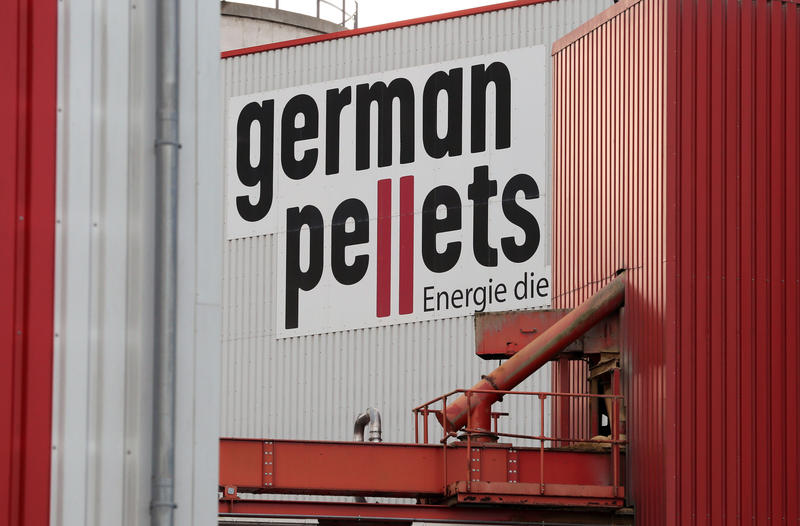
VIDEO: Deutsche Welle report on the German Pellets bankruptcy

German Pellets is broke, and private investors are set to lose millions. SME bonds are falling more and more into disrepute. There's a long list of bankruptcies which have caused disastrous losses for many private investors.

Source: Deutsche Welle
 
[gravityform id="1" title="true" description="true"]
 
[gravityform id="2" title="true" description="true"]

Germany and Italy see healthy wood furniture export growth

Germany and Italy, the traditional heavyweights in European furniture making, both achieved above-average growth in their wood furniture exports to countries outside the EU last year. German wood furniture exports were up 9% to €1.37 billion and Italian exports grew 5.5% to €2.93 billion.
According to the German furniture federation VDM, Germany’s total furniture exports exceeded €10 billion for the first time ever in 2015. This figure includes all exports of wood and non-wood furniture to both EU and non-EU countries.
VDM reports German furniture sales to markets outside of the Eurozone increased in particular. Exports to the US, for example, increased 25.6% in 2015. VDM believes that the weakness of the euro was one of the driving forces behind export growth, in addition to the reputation of the “Made in Germany” brand.
The Italian Center for Industrial Studies (Csil) also reports a positive recent trend for the Italian furniture industry in its World Furniture Magazine. Both Italy’s domestic furniture consumption and exports to European and nonEuropean countries increased last year.
For 2016, Csil reckons with further signs of growth in Italy. International demand is expected to remain strong but slow down slightly compared to 2015.
Growth in wood furniture exports from Poland, which is the third most important EU exporter and has seen large increases in most of the last seven years, slowed down to just +1.2% and a total of €791 million last year.
Other non-Eurozone EU countries experienced similar or even weaker trends: exports from Sweden, for example, fell by 5.3% to €492 million, those from Lithuania by 4.1% to €351 million and those from the UK by 1.5% to €200 million. On the other hand, Denmark’s wood furniture exports increased 8.8% to €504 million. And Portugal and Austria were unable to benefit from the weak euro, with a fall in wood furniture exports by 4.4% to €204 million and 5.9% to €241 million, respectively.
Among the remaining important wood furniture exporters in the Eurozone, France recorded growth by 14.4% to €394 million and Spain by 7.2% to €322 million.
 
[gravityform id="1" title="true" description="true"]
 
[gravityform id="2" title="true" description="true"]

EC names another EUTR Monitoring Organisation

Last month, the European Commission appointed another Monitoring Organisation (MO). The Commission recognised the Dutch TimberChecker (Westeinde 6, 1334 BK Almere, Netherlands) as the 13th MO. TimberChecker can act as MO only in the Netherlands..
Last year nine more MOs were appointed, including BM TRADA Latvija and Germany's DIN CERTCO.
Only five MOs have permission to offer their services in all EU member states. The other MOs are either just recognised for their home countries or for selected member states.
See full list of MO's here
The European Commision has thoroughly evaluated the accredited MOs, which were found able to assist EU operators in fulfilling their EUTR obligations. MOs provide their clients with EUTR-compliant Due Diligence System and are obliged to keep their system updated. They also conduct regular evaluations of their members' due diligence performance and are formally obliged to report repeated failures to observe due diligence to the relevant Competent Authority.
 
[gravityform id="1" title="true" description="true"]
 
[gravityform id="2" title="true" description="true"]
Japan's Sumitomo continues expansion in the US home building market with a new acquisition

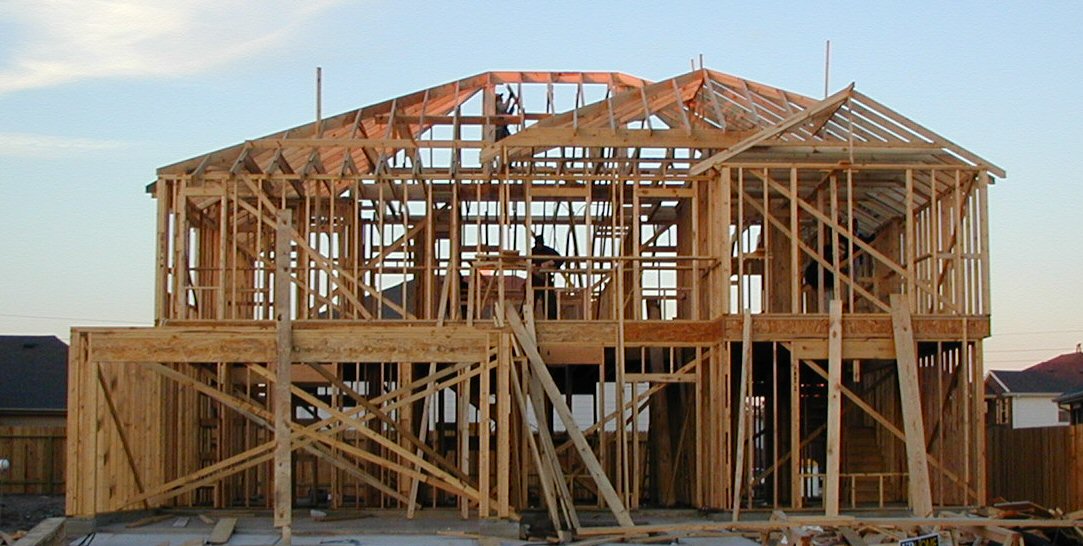
Sumitomo Forestry America, which is a subsidiary of Tokyo-based Sumitomo Forestry Co., is buying Gehan Homes Ltd., a Dallas homebuilder. Two years ago, the Japanese housing firm has already purchased more than 50% of Gehan, and the Dallas company announced it would sell its remaining ownership to Sumitomo, according to The Dallas Morning News.
In the past year, Gehan Homes' revenue has grown nearly 50 percent. In 2014, Gehan ranked No. 21 on the North Texas Middle Market 50 list with annual revenue in 2014 of nearly $378 million.

 “With the sale of the company to Sumitomo Forestry America Inc., Gehan Homes will have added financial strength that will allow the company to be more aggressive in the area of land acquisitions,” said John Winniford, president at Gehan.

Gehan has been functioning for 25 years now and has operations all around Houston, Austin, San Antonio and Phoenix. The company also builds homes for approximately 24 communities, at a $250,000 starting price.
“Sumitomo, as it sought to expand its homebuilding operations in the U.S., was drawn to Gehan Homes due to the solid foundation that had been laid to support its growth, its senior management team, and the company’s culture and commitment to its employees,” Atsushi Iwasaki, president of Sumitomo Forestry America, said.
Sumitomo also acquired half the ownership of Bloomfield Homes L.P. back in 2013, one of the top home builders in North Texas. Back in February this year, Sumitomo bought 60% shares of DRB Enterprises, which owns Dan Ryan Builders (DRB) group in Maryland for 10 billion yen (US $90 million). Sumitomo aims to become one of the top builders in the States.
 
[gravityform id="1" title="true" description="true"]
 
[gravityform id="2" title="true" description="true"]

 

Japan’s Sumitomo continues expansion in the US home building market with a new acquisition

Sumitomo Forestry America, which is a subsidiary of Tokyo-based Sumitomo Forestry Co., is buying Gehan Homes Ltd., a Dallas homebuilder. Two years ago, the Japanese housing firm has already purchased more than 50% of Gehan, and the Dallas company announced it would sell its remaining ownership to Sumitomo, according to The Dallas Morning News.

In the past year, Gehan Homes' revenue has grown nearly 50 percent. In 2014, Gehan ranked No. 21 on the North Texas Middle Market 50 list with annual revenue in 2014 of nearly $378 million.

 “With the sale of the company to Sumitomo Forestry America Inc., Gehan Homes will have added financial strength that will allow the company to be more aggressive in the area of land acquisitions,” said John Winniford, president at Gehan.

Gehan has been functioning for 25 years now and has operations all around Houston, Austin, San Antonio and Phoenix. The company also builds homes for approximately 24 communities, at a $250,000 starting price.

“Sumitomo, as it sought to expand its homebuilding operations in the U.S., was drawn to Gehan Homes due to the solid foundation that had been laid to support its growth, its senior management team, and the company’s culture and commitment to its employees,” Atsushi Iwasaki, president of Sumitomo Forestry America, said.

Sumitomo also acquired half the ownership of Bloomfield Homes L.P. back in 2013, one of the top home builders in North Texas. Back in February this year, Sumitomo bought 60% shares of DRB Enterprises, which owns Dan Ryan Builders (DRB) group in Maryland for 10 billion yen (US $90 million). Sumitomo aims to become one of the top builders in the States.


[gravityform id="1" title="true" description="true"]


[gravityform id="2" title="true" description="true"]


UK: TTF announces new Guidance for members on Marine Plywood

The Timber Trade Federation has announced new Guidance for members on sales of Marine Plywood in the UK.
Following a meeting of the Governing Board of the TTF on March 16th 2016, it was confirmed that:  “As of June 1st 2016, all sales in the UK by TTF Members of non-independent third party Quality Assured Marine Plywood will cease.”
The decision has been ratified by the Governing Board and will form part of the new TTF Code of Conduct for panel product traders as this is updated. This means that only those products supported by Independent Third Party Quality Assurance can be sold as “Marine Plywood”.
The TTF will be issuing guidance via Merchants and other professional bodies as well as to its own members.
David Hopkins, Managing Director of the TTF said: “It is essential that our Members maintain the highest standards across all product ranges. We need to provide the market with the assurance and evidence it requires, that products sold by TTF members are fit for purpose and appropriate for the buyers needs.”
Given this potentially significant implication for TTF Members the matter was referred for consideration and confirmation by the Governing Board of the TTF.
About Marine Plywood
Marine plywood is manufactured from durable face and core veneers, with few defects so it performs longer in both humid and wet conditions and resists delaminating and fungal attack. Its construction is such that it can be used in environments where it is exposed to moisture for long periods. More recently, tropical producers have become dominant in the marine plywood market.
Okoumé from Gabon is now the accepted standard for marine plywood, even though the wood is not very resistant to rot and decay. Each wood veneer will be from tropical hardwoods, have negligible core gap, limiting the chance of trapping water in the plywood and hence providing a solid and stable glue bond. It uses an exterior Water and Boil Proof (WBP) glue similar to most exterior plywoods.
 
[gravityform id="1" title="true" description="true"]
 
[gravityform id="2" title="true" description="true"]
 

Newsletter

Subscribe to our digital newsletter for your daily digest of essential news, views and analysis from the international wood industry delivered directly to your inbox.


0