

Japan's imports of radiata pine logs and lumber decreased considerably in 2015, compared to 2014. The demand for lumber in crates and by the pallet remained slow, despite the weak yen.
The Japanese radiata pine logs imports from New Zealand reached 421,850 m3, 20.2% less than in 2014, while the radiata pine lumber imports reached 75,936 m3, 10.5% less compared to the previous year. Also, Japanese imports of Chilean radiata pine lumber summed 222,353 m3, 14.3% less than in 2014.
Japan's imports from China dropped mostly because of the slowing Chinese economy. The neighboring countries such as Korea, Thailand and Philippines, are also affected by the slow Chinese market, affecting the overall demand for lumber in crates.
Because of this decrease, the radiata pine sawmills in Japan reduced their production in 2015 by 20%, which resulted in a lower demand for radiata pine logs. Chilean radiata pine suppliers planned eight shipments to Japan in 2015 but the last one reached Japan at the beginning of 2016. Chilean sawmills also reduced their production due to the low Chinese demand and fierce competition with European sawmills in the Middle East.
[gravityform id="1" title="true" description="true"]
[gravityform id="2" title="true" description="true"]
Article archive
Finland: Softwood lumber exports performed well in Europe and Asia in 2015

In 2015, Finnish softwood lumber exports increased in volume by 16% as compared to 2014. Finnish sawmills exported about 7,86 million cubic meters of planed and sawn lumber against 6,75 million cbm exported in 2014.
The European Union and Asian countries have in particular driven up Finnish exports. Despite the downward trend registered in recent years, Finnish softwood lumber exports to the EU registered a 10% increase in 2015. The EU has now a share of 38% of all Finnish softwood lumber deliveries.
The driving force behind the positive development in Europe is undoubtedly the United Kingdom, which is at the moment the main European buyer of Finland's lumber, with an increase in imports by 21% (808 thousand cbm in 2015).
Germany and France, two other major European consumer countries, have reported some negative developments: Finnish shipments to Germany stagnated in 2015, while deliveries to France dropped by -6% (down to 460 thousand cubic meters).
The Asian market has also developed well in 2015. Exports were higher by 43%. Finnish softwood lumber exports to China increased by 73%, despite the overall sloppy Chinese economical context and despite the fact most of Finland's main competitors reported significant declines in shipments to China last year.
Exports to Japan boomed as well in 2015, with a 31% increase and 901 thousand cbm of lumber delivered. Also exports to Israel and Saudi Arabia performed well, with an increase of 23% and 7% respectively.
Finnish deliveries to African countries are also on an upward trend. Egypt, Finland's worldwide main client has bought 15% more Finnish softwood lumber. The other major African customer country is Algeria, also with a 10% surge in imports in 2015.
| Finland's exports of softwood lumber (in cbm); Top 10 Destinations |
2014 | 2015 | Change in % |
| Egypt | 1,086,527 | 1,254,366 | 15% |
| Japan | 690,638 | 901,665 | 31% |
| United Kingdom | 668,948 | 808,520 | 21% |
| China | 368,317 | 635,679 | 73% |
| Algeria | 441,193 | 485,442 | 10% |
| Germany | 481,487 | 480,231 | 0% |
| France | 489,414 | 460,359 | -6% |
| Israel | 366,724 | 450,912 | 23% |
| Saudi Arabia | 365,070 | 391,381 | 7% |
| Estonia | 203,550 | 261,951 | 29% |
| Others | 2,677,581 | 2,543,546 | -5% |
| Total exports | 6,752,922 | 7,865,532 | 16% |
The statistics are based on the numbers published by Eurostat. HS Code: 440710.
[gravityform id="1" title="true" description="true"]
[gravityform id="2" title="true" description="true"]
US and Europe hardwood producers focus on the Middle East and North Africa

More and more wood companies from Europe and the United States are interested to invest in the sales of their products across the markets in the Middle East and North Africa, especially the Mena region, according to Thomson Reuters Zawya.
This information has circulated at the Dubai WoodShow 2016. The companies in the US and Europe present at the show were very interested in the rising hardwood demand from the Middle East, which is a growing timber market for them.
Participants at the event believe that the green initiatives taken in the Gulf may lead to a higher use of wood.
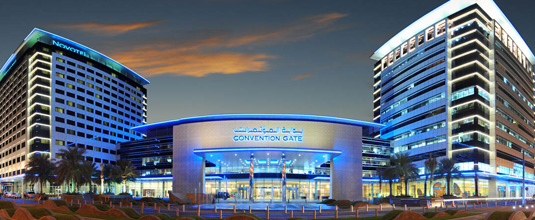 The Dubai Wood Show 2016 is held at the Dubai International Convention and Exhibition Centre (in the photo) and lasts until today. The event started on the 4th of April and offers the perfect platform for many suppliers, manufacturers & machinery companies to exhibit their products and their newest technologies to the main players in the wood and & woodworking machinery industry in the Middle East and North Africa region.
The products which were presented at the show included wood, woodworking machinery, blades, knives, tools, abrasives and other related products.
[gravityform id="1" title="true" description="true"]
[gravityform id="2" title="true" description="true"]
Innovations4Flooring sues Välinge for patent infringement

Innovations4Flooring (I4F), a technology company providing flooring installation solutions, announced that it has initiated the filing of an action to nullify the Dutch part of the base patent EP 1 084 317 (displaced surfaces) from Välinge Innovation AB. The invalidity proceedings on the merits against Välinge were filed before the District Court of The Hague in the Netherlands.
I4F claims that it has clear evidence that the Dutch part of the base patent is fully anticipated by various prior art references, and is seeking a ruling that the claims of Välinge’s EP 1 084 317 are invalid. The enforcement of Välinge’s patent EP 1 084 317 has been imposed on the flooring industry for close to seventeen years, says I4F.
The proceedings allow for a decision in the Netherlands. A first instance decision, dealing with validity, can be obtained within approximately one year.
I4F claims that it is the original creator and provider of a truly patented one piece drop-lock solution, based on a threefold locking mechanism, suitable for laminate, LVT, WPC and wooden flooring panels. The company’s 3L TripleLock one piece drop-lock technology has patents granted in 37 countries worldwide and multiple additional patent applications pending.
In a similar case, on 27 November 2015, the Court of The Hague in the Netherlands issued a first decision in favour of Unilin in the patent battle between Unilin and Innovations 4 Flooring .
I4F filed this case requesting interim measures from the court of The Hague since I4F was of the opinion that there was a high likelihood that I4F would succeed in an invalidation action against the Dutch counterpart of Unilin's European patent EP 1 026 341. In the first case, the Court of The Hague fully denied I4F's claims and instructed I4F to reimburse Unilin's legal costs for this case. A final a decision on this issue is expected in the middle of 2016.
[gravityform id="1" title="true" description="true"]
[gravityform id="2" title="true" description="true"]
China: Plywood exports drop 8% in 2015; prices rise

China’s plywood exports totaled 10.77 million cubic metres in 2015 valued at USD5.5 billion, a year on year decline of 8% in volume and 5% in value.
Chinese plywood exporters shipped to multiple markets in 2105. The main markets in terms of value were the USA (17%), UAE (6.8%), UK (6.7%), Japan (6.2%), South Korea (6.1%), Philippine (5.6%) and Saudi Arabia (4.6%).
Top 10 destination countries of plywood exports
| Volume m3 | Change in % 2014-2015 | |
| USA | 1,830,000 | 9% |
| UAE | 730,000 | 5% |
| UK | 720,000 | 1% |
| Japan | 670,000 | -19% |
| South Korea | 660,000 | -7% |
| Philippines | 600,000 | -11% |
| Saudi Arabia | 490,000 | -18% |
| Taiwan P.O.C. | 290,000 | -11% |
| Vietnam | 280,000 | 5% |
| Thailand | 280,000 | -11% |
Data source: China Customs
The value of plywood exports to the top 10 markets accounted for 61% of all 2015 plywood exports.
The 2015 average price for plywood exported to developed countries was higher than to less developed countries because of quality and end-use differences. In 2015 the average price of plywood shipped to the UAE, Philippines and Saudi Arabia rose 19%, 3% and 7% respectively but average prices for the US, Japanese and South Korean markets declined in 2015.
Average plywood prices to top 10 markets
| Average price US$/m3 | Change in % 2014-2015 | |
| USA | 753 | -1% |
| UAE | 435 | 19% |
| UK | 494 | 1% |
| Japan | 465 | -7% |
| South Korea | 381 | -2% |
| Philippines | 443 | 3% |
| Saudi Arabia | 331 | 7% |
| Taiwan P.O.C. | 366 | -3% |
| Vietnam | 433 | 0% |
| Thailand | 357 | -5% |
Data source: China Customs
The main exit points for plywood exports in 2015 were Nanjing and Qingdao ports which accounted for 40% and 36% respectively of the national total.
Plywood exports through Tianjin ports plummeted 47% but the average price of shipments surged 64%.
The average price for plywood exports through Shanghai and Nanjing ports rose 6% and 2% respectively but the average prices through the rest of the ports declined on varying degree.
[gravityform id="1" title="true" description="true"]
[gravityform id="2" title="true" description="true"]
Improving demand for wood furniture throughout the EU
Of the EU member states, the UK remains by far the largest single importer of wood furniture from outside the EU. In 2015, UK imports from non-EU countries increased by 21.9% to €2.06 billion.
The British industry has shown a strong general performance over the last two years, with consumer confidence and new homes construction and completions increasing – and hence rising demand for furniture.
According to the Guardian, “the number of new homes in England jumped by 25% in 2014-15, the biggest increase in 28 years“.
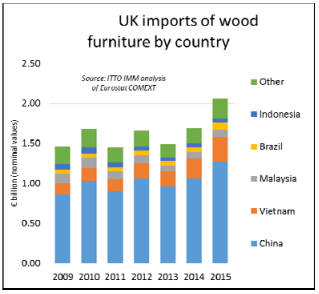
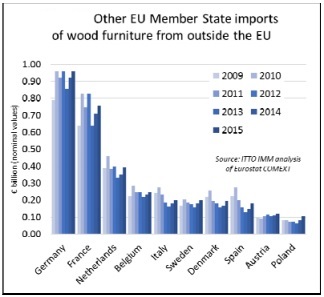
While the UK remained the dominant market, all ten of the next largest importers of wood furniture from outside the EU showed growth in 2015, many by double-digit percentages.
In 2015, there was healthy growth in imports by Germany (+4.1% to €969.2 million), France (+6.5% to €755.9 million), Netherlands (+13.1% to €396.2 million), Belgium (+6.9% to €247.6 million), Italy (+10.3% to €201.1 million), Sweden (+10.4% to €199.3 million), Denmark (+15.8% to €194.8 million) and Spain (+21.1% to €180.5 million).
[gravityform id="1" title="true" description="true"]
[gravityform id="2" title="true" description="true"]
No EUTR penalties for Finland yet

The European Union Timber Regulation (EUTR) has been long considered to be ineffective. The regulation is starting to have effect even though in Finland penalties haven’t been required yet, according to a Finnish Forest Association report.
The EUTR came into force in March 2013 and it’s also valid for timber logged from countries in the EU. In March 2016, the Dutch authorities have first imposed penalty on an importer who brought illegally logged timber from West Africa (Cameroon). But, because of the company that bought the timber that didn’t rectify the diligence procedure, it now must pay a non-compliance penalty.
Especially the due diligence system has to ensure the legality of the timber trade in the European Union and the companies that import timber must possess clear information about the imported timber and the parties involved in the trade.
Mr. Tatu Torniainen, an expert at the Finnish Ministry of Agriculture and Forestry, stated that a forest certification may reduce the risks regarding the origin and supply of the timber chain. In Finland, the regulation applied to 2.500 companies.
“In Finland, the aim is to increase companies’ awareness of their obligations by providing advice and information,” Torniainen said.
Following various inspections, the Agency for Rural Affairs in Finland asked companies to amend their due diligence system, but penalties haven’t been required for Finland yet. In most of the cases, the reason for checking the system of some companies was just for incomplete information regarding wood chips, the import origin of which is very hard to track.
The EUTR applies for the sale of timber inside the EU too, in which case forest owners would be responsible. In fact, the legality of the timber in such a case can be verified in the notification of forest use. But the Finnish forest industry had already developed systems to monitor the legality of the timber long before the EUTR got into action.
The first evaluation published by the EU Commission showed that the member states should improve the implementation of the EUTR and the procedures for ensuring compliance. In countries such as Romania, Hungary, Greece or Spain, the EUTR hasn’t been implemented at all.
[gravityform id="1" title="true" description="true"]
[gravityform id="2" title="true" description="true"]
Malaysian HeveaBoard invests in particleboard and furniture production

Malaysian HeveaBoard, manufacturer of particleboard and modular furniture under the HeveaPac brand, plans investments for the 2016 financial year of MYR 20 million (EUR 4.4 million) for the modernization of its production capacity.
According to local media, roughly MYR 8 million (EUR 1.8 million) of the planned investment is for the particleboard line at the Gemas site and MYR 12 million (EUR 2.6 million) is to be invested on production of RTA furniture in the Seremban site. In the particleboard plant, HeveaBoard plans to improve quality and increase production by 10-15%. In the furniture plant, the product range is will be optimized and diversified by a new children's furniture line.
HeveaBoard utilises rubberwood residues and has subsidiaries producing downstream Ready-to-Assemble furniture manufacturing and other panel products. In 2015 Heveaboard exported about 80% of its particleboard production mainly to China, Japan, South Korea, India. Most RTA items are for Japan, Europe, Australia and the United States.
HeveaBoard was incorporated in 1993 as a private limited company under the name of HeveaBoard Sdn Bhd. The company was converted into a public limited company in 2004 and assumed its present name, and was subsequently listed on the main board of Bursa Malaysia Securities Berhad in January 2005.
[gravityform id="1" title="true" description="true"]
[gravityform id="2" title="true" description="true"]
India: Plywood and particleboard losing market share to alternatives
Rising prices for logs and process chemicals and the continual shortage of labour are creating problems for plywood and particleboard industries which have found they are losing market share to MDF, HDF and WPC (Wood Plastic Composite) boards.
Composite panels are finding wider acceptance in the more sophisticated urban markets and are slowly eating away at the market share held by plywood and particleboard.
In India, pre-laminated particleboard and MDF panels are finding a ready market as they are perceived as elegant and less expensive than plywood.
Indian plywood and particleboard manufacturers were slow to embrace overlay lamination. Because of this, new enterprises spank up to buy raw boards from the manufacturers and apply laminates. However, this depends on finding skilled craftsmen to apply laminates, but now, many such craftsmen have migrated to Middle East and African countries attracted by higher wages.
Today, many Indian board manufacturers have invested in laminating and sell ready-to-use panels to furniture and door manufacturers.
Board manufacturers without laminating capacity now face marketing problems. WPC boards are gaining popularity as they are strong and water resistant and can be manufactured from a wide range of residues. WPC boards are not only cheaper than conventional panels but are suitable for a wide range of enduses.
[gravityform id="1" title="true" description="true"]
[gravityform id="2" title="true" description="true"]
Rising E.U. exports of softwood lumber to U.S. in 2015

The U.S. has significantly increased its imports of European softwood lumber in 2015. The volume was up by 67% (to 1,73 million m3) as compared to 2014, while the value of exports increased by 70% (116,9 million EUR).
U.S.'s main source for European softwood was the Netherlands with 1,27 million m3 and a share of 71 percent of the overall American imports from Europe. Sweden came second with 251 thousand m3 and a 136% increase yoy. Significant growth rates were registered in U.S. imports from Romania (+372%) and Austria.
Even if the US has only a minor share of all E.U. softwood lumber exports, the prospects are encouraging: the low domestic demand in recent years determined the European sawmills to search for other worldwide markets. This fact, combined with the encouraging housing recovery in the U.S. and the quest for additional supplies of lumber are strong reasons to believe that this upward trend will continue.
Softwood Lumber exported to USA from... (in cbm )
| Exporting Country | 2014 | 2015 | Change in % | |||
|
1,037,522 | 1,734,956 | 67 % | |||
|
752,184 | 1,247,419 | 66 % | |||
|
106,864 | 251,787 | 136 % | |||
|
101,628 | 82,009 | -19 % | |||
|
15,570 | 73,500 | 372 % | |||
|
29,015 | 37,406 | 29 % | |||
|
32,261 | 42,835 | 33 % | |||
|
3 | - | -100 % | |||
| TOTAL | 1,037,525 | 1,734,956 | 67 % |
HS Codes: 440710
Softwood Lumber exported to USA from... (in EUR )
| Exporting Country | 2014 | 2015 | Change in % | |||
|
68,690,530 | 116,942,320 | 70 % | |||
|
23,144,630 | 51,034,210 | 121 % | |||
|
23,894,420 | 21,648,260 | -9 % | |||
|
3,945,580 | 17,571,890 | 345 % | |||
|
6,981,540 | 9,792,570 | 40 % | |||
|
2,336,490 | 4,189,310 | 79 % | |||
|
8,387,870 | 12,706,080 | 51 % | |||
|
8,870 | 1,750 | -80 % | |||
| TOTAL | 68,699,400 | 116,944,070 | 70 % |
HS Codes: 440710
[gravityform id="1" title="true" description="true"]
[gravityform id="2" title="true" description="true"]
Sweden: Sawmill industry benefits from weaker krona
At the moment the Swedish rising economy offers great benefits for sawmills. Also, the competitiveness of the Swedish sawn timber and pulp and paper sectors benefit from the weak Swedish krona.
Q1 2016 shows that Sweden's economy continues to stand out relative to similar countries. Extremely low interest rates and the recent weak krona determined growth for the economy. Yet, given the mediocre development in the rest of the world, it is not realistic to expect that the Swedish economy will continue to boom in the upcoming period.
Most sectors of the Swedish forest industry have encountered a slight slowdown in early 2016, except for the construction sector, which has developed very good in recent months. The consumption of wood products has also developed well. But the Swedish sawmills experienced a prolonged period of falling export prices caused by the lingering global oversupply and fierce competition.
Sweden's production of pulp had a positive development during 2015 and the positive trend continued in January and February 2016. The confidence indicator for the Swedish pulp&paper industry showed a strong rebound in the first two months as to fall back slightly in March. However, the indicator is well above its historical average. Moreover, Swedish manufacturers expect a slight growth in the coming months.
Paper production stabilized in 2015, while the production of packaging materials is unchanged and the graphic paper production has continued to decline. Exports of paper fell by just under 1% over the previous year, although shipments to the EU showed a downturn. Export value of paper developed positively and also rose by 1%, due to the increasing exports of packaging materials. Swedish companies now look at a positive outcome for the near future, both for orders and production.
[gravityform id="1" title="true" description="true"]
[gravityform id="2" title="true" description="true"]
The German sawmill industry competitiveness affected by high roundwood prices

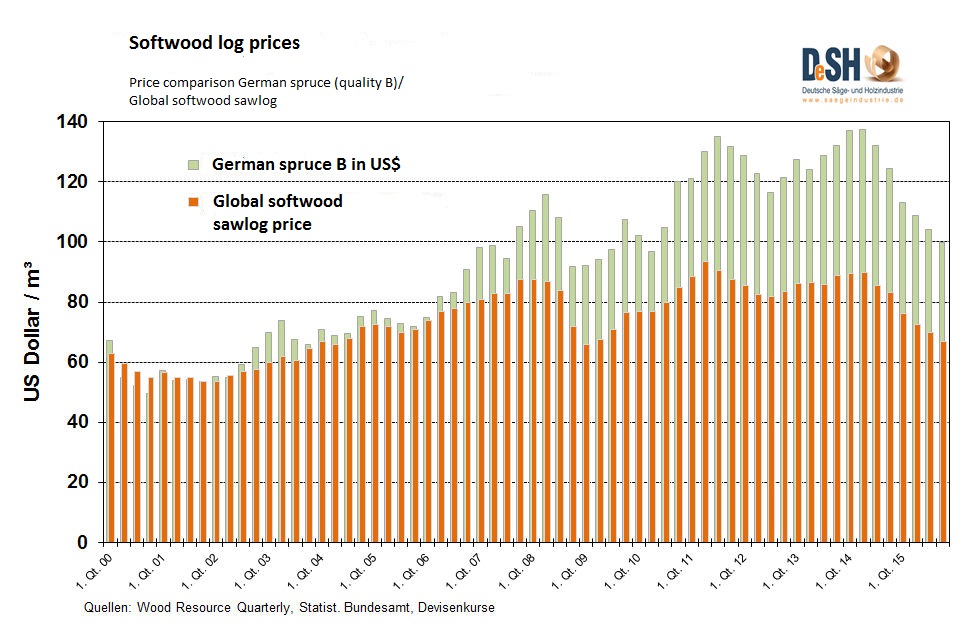
Worldwide roundwood prices are falling, but there is still a constant distance between the high German and significantly lower international softwood roundwood prices, which determines a crucial competitive disadvantage for the German sawmill industry. Although the Global Sawlog Price Index (GSPI) has fallen sharply, the German sawyers can't benefit. Moreover, the German sawmill industry expects a pressure on prices in 2016, especially on sawmill by-products, in relation with high raw material purchase costs.
 The positive softwood lumber trade balance in favour of exports has shrunk dramatically over the course of 2015. Germany's exports of softwood lumber declined by almost 6.9%, down to 6.5 million cubic meters (a decrease of 470 thousand m3). At the same time, imports were up by 5 percent or 220 thousand m3.
Also, the global market competitiveness has increased a lot in the last years. The competition has intensified significantly in Europe and in the Far East. Because of the economic slowdown, the German sawmills couldn’t keep up the pace, losing market shares in many important markets.
The German spruce sawlog quality B is still around 49% above the recently published Global Sawlog Price Index for Q4 2015, despite the changed US dollar exchange rate (see picture above).
The past disadvantage of the expensiveness of raw materials for the German sawmills was compensated by the fact that sawmills were much better positioned on the global market and able to keep up with technology and equipment. However, since the raw material is increasingly cheaper worldwide, the locational disadvantage for the German sawmills cannot be compensated anymore. Thus, Germany has lost a lot of market shares on the foreign markets.
Another issue for Germany is the recent German Pellets insolvency. Effects are yet to come and combined with the past mild winter and thus lower demand for pellets, are more issues which will affect the German sawmill industry.
[gravityform id="1" title="true" description="true"]
[gravityform id="2" title="true" description="true"]
Transparent wood might replace glass, says Swedish institute

Windows and solar panels could be made out of wood, as researchers at Stockholm's KTH Royal Institute of Technology have recently discovered a new transparent material made out of wood, which is also suitable for mass production.
During the study, published in the American Chemical Society journal, Biomacromolecules, optically transparent wood was divided into microscopic samples as to study its anatomy. Thus, the project made by KTH also includes a way to use wood on a large scale, as Lars Berglund, a professor at Wallenberg Wood Science Center at KTH, stated.
"Transparent wood is a good material for solar cells, since it's a low-cost, readily available and renewable resource. This becomes particularly important in covering large surfaces with solar cells,” Berglund added.
He said that these transparent wood panels can be used for windows and also for semitransparent facades, because the material lets the light in, but preserves the privacy. This optically transparent wood is a type of veneer wood in which the lignin is removed through a chemical process. Thus, the white porous veneer substrate is filled with a transparent polymer, making the optical properties of the two to match.
"When the lignin is removed, the wood becomes beautifully white. But because wood isn't not naturally transparent, we achieve that effect with some nanoscale tailoring," Berglund explained.
The project also includes to enhance the transparency of the material and balance the manufacturing process, because wood is the most used bio-based material in buildings construction, offering various mechanical properties, as strength, low density and low thermal conductivity, as Berglund added.
[gravityform id="1" title="true" description="true"]
[gravityform id="2" title="true" description="true"]
EU furniture imports dominated by China

After a rather patchy development between 2009 and 2013, when signs of growth were always immediately followed by renewed weakness, 2014 and 2015 finally saw some stability in EU wood furniture imports.
More than half of all EU wood furniture imports, €3.15 billion, came from China in 2015, with deliveries rising 12.1%. Chinese deliveries have therefore fully recovered from dips experienced in 2011 and 2013 and last year exceeded the previous peak level of €3.06 billion recorded in 2010.
Volatility in Chinese wood furniture deliveries to Europe over the last few years may be attributed to exchange rate effects and declining competitiveness of China relative to EU domestic producers.
The challenges of verifying timber legality in China’s complex supply chains may also have deterred some European buying following introduction of EUTR in March 2013. However the recent recovery in imports from China suggests that European buyers may now be more comfortable with the legality assurances provided by Chinese manufacturers.
EU imports of wood furniture from tropical countries increased 16% from €1.47 billion in 2014 to €1.70 billion in 2015. While China remains the EU’s largest external supplier of wood furniture, Vietnam is the star performer in terms of sales growth. EU imports of wood furniture from Vietnam increased 21.6% to €725 million in 2015.
This follows 19% growth the previous year and is a clear demonstration of Vietnam’s rising competitiveness in global furniture manufacturing.
[gravityform id="1" title="true" description="true"]
[gravityform id="2" title="true" description="true"]
Moody’s: Northern Europe giants lead paper sector transformation

European paper and forest products companies, particularly some of those based in the Nordics, are continuing to benefit in terms of earnings growth from their diversification in recent years away from the fundamentally declining segments of the European paper market, according to a new report by Moody's Investors Service.
The ratings agency anticipates higher dividend payments in 2016 on the back of long-term profit improvements and the expectation of further solid financial results this year, despite continuing macroeconomic uncertainties and anaemic demand growth in Europe.
"Nordic companies are at the forefront of a transformation in the European paper sector," says Matthias Volkmer, a Vice President -- Senior Credit Officer at Moody's. "They have successfully diversified their operations towards more profitable segments such as specialty papers and labels, paper packaging, liquid packaging and dissolving wood pulp, and away from less profitable ones like graphic paper."
European paper and forest products companies reported an average 6.5% increase in EBITDA in 2015, with some like Finland-based Metsa Board Corporation (Ba2 stable) even showing record double-digit earnings growth. Stora Enso Oyj (Ba2 stable) and UPM-Kymmene (Ba1 positive) also continue to reap the profits of their efforts to reposition or broaden their business profiles through sizeable investments, as well as profit improvement programmes across their operations.
Through improved operating rates and pricing across newsprint, magazine, coated and uncoated paper in 2016, Norske Skogindustrier ASA (Caa3 negative), UPM and Stora Enso, will recover profitability in their respective paper operations, following substantial capacity closures in 2015 and a lower decrease in demand than in previous years, says Moody's.
Moody's expects paper price increases to start coming into effect from Q2 2016, following the lengthy negotiations at the start of the year. The success of these negotiations is likely to be underpinned by announcements of additional capacity closures.
[gravityform id="1" title="true" description="true"]
[gravityform id="2" title="true" description="true"]
China: Wood products exports rise slightly in 2015

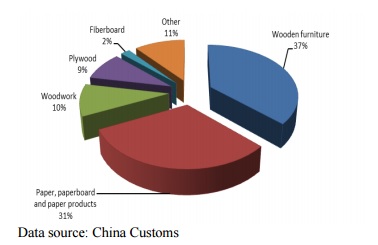
The total value of China’s forest product exports in 2015 rose 4% to US$75.3 billion. Of the total, the value of wood products rose 3% to USD6.14 billion. Nearly 90% of wood products comprised furniture, paper, paperboard and paper products, builders’ woodwork, plywood and fiberboard.
USA the main market for furniture
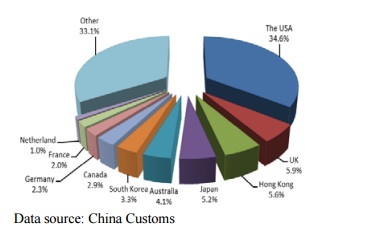
The total value of China’s furniture exports in 2015 rose 4% to US$2.29 bil. Just over 65% of all China’s furniture exports went to 10 countries as shown below. The main market, at almost 35% of exports, was the US. A string of second tier countries and territories ech accounting for around 5% of exports included the UK, Hong Kong and Japan.
The main departure ports for China’s furniture exports in 2015 were Shenzhen and Shanghai which accounted for 25% and 19% respectively of all furniture exports.
US and Japan main markets for China’s builders’ woodwork
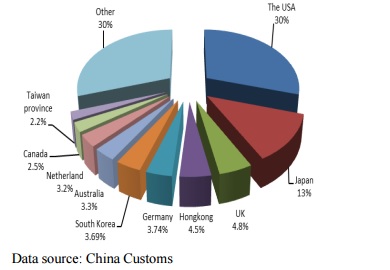
The total value of China’s builders’ woodwork exports in 2015 was almost US$6 billion, a year on year increase of 9%. The main markets were the US and Japan which accounted for 30% and 13% respectively of the national total.
The main exit ports for China’s builders’ woodwork was Shenzhen, Ningbo, Dalian and Fuzhou ports which accounted for 17%, 16%, 11.2% and 11.1% respectively of the national total.
[gravityform id="1" title="true" description="true"]
[gravityform id="2" title="true" description="true"]
Brazil: Domestic economic crisis affecting timber industry

The Wood Trade Brazil - Lignum Brazil Fair promoted by the Brazilian Association of Mechanically-Processed Timber Industry (ABIMCI), the Federation of Industries of Paraná State (FIEP) and Malinovsky Events was held in Curitiba early March. This brought together representatives of the timber industry, log producers and professionals involved in the wood supply chain.
During the event the state of the Brazilian economy and its effect on the timber industry was discussed. The consensus was that negative domestic economic growth is diminishing opportunities in the domestic market and that, to survive, industry must seek alternative markets.
At the beginning of this decade the timber industries in Brazil were operating in a favourable economic climate but this did not last and the sector soon began to experience great difficulties to the point that output and sales fell. In 2015 the timber industry saw production drop by almost 5%.
As the situation deteriorated there was a fall in sector employment but this was less so in the sawmilling sector than in manufacturing. In respect of exports, although volumes sales rose, prices dropped however, the impact on the profitability of Brazilian companies was cushioned by the weakening real against the dollar. Speakers at the Fair concluded that throughout 2016 the lack of confidence and rising uncertainty will remain intense.
According to the ABIMCI presentation during the Fair, resumption of activity in the North American construction sector should have a positive impact on Brazilian wood product exporters. In addition, in other markets such as Mexico as well as some African and Middle Eastern countries demand remains firm. Even in Europe there is a steady demand for Brazilian wood products especially pine plywood.
Brazil has an advantage over some competitors in the European market as ocean freight charges are low. Brazilian exporters also benefit from good, long term relationships and partnership with companies in Europe. Such partnerships are the foundation for development of new products such as cross laminated timber and other prefabricated wood products for the EU market.
[gravityform id="1" title="true" description="true"]
[gravityform id="2" title="true" description="true"]
The Dubai Wood Show starts off today

The Dubai WoodShow starts today, 4th of April, 2016, until Wednesday, at the Dubai International Convention and Exhibition Centre. More than 10,000 visitors are expected to visit the exhibition of wood products and machineries, as Dawood Al Shezawi, CEO, Strategic Marketing & Exhibitions, stated today.
The latest technical developments and sustainability practices from the wood industry and the construction and design sectors will be presented during these three days. Many importers, exporters, producers, suppliers and dealers will participate at the event.
The show is important especially because the timber industry is a major part in many industries of the region (construction – 70% and furniture sectors 30%).
The Dubai WoodShow 2016 attracts companies to come and build strategic partnerships and develop new business ideas in the Middle East region. Companies such as ACIMALL, Italian Woodworking machinery and tools manufactures' association; AFEMMA, private organization which promotes the development of Spain's timber and wood sector; AIMSAD, the woodworking machinery and side industries businessmen association; American Hardwood Export Council (AHEC); Eumabois, European Federation of Woodworking Machinery Manufacturers; French Timber, an association founded in 2001 by the National Timber Federation (Fédération Nationale du Bois) are partners of the Dubai WoodShow.
Also, the Malaysian Timber Council; Lunjiao, first professional online B2B platform for woodworking machinery in China; Quebec Wood Export Bureau, a non-profit organisation showcasing wood products from Quebec in export markets; and Swedish Wood, are partners of the show.
"New products and solutions will make debut at the show as well as we will highlight new technologies offered by leading companies and international institutions," said Al Shezawi.
Moreover, the results of softwood lumber imports will be presented during this year’s show. Imports of softwood lumber in Saudi Arabia recorded 24% increase during January-July 2015, compared to the similar period of 2014.
American Softwoods (AMSO) will also be present at the event and three important US softwood trade associations will form the promotional partnership to be introduced at Dubai WoodShow.
In the previous years, 60% of the visitors came from the UAE, while 15% of other Gulf States. Also, 9% of the visitors arrived from Asia, while only 6% came from Europe. 6% were represented by the rest of the Middle, while 2% were from Africa and the last 2% from the USA.
The show offers the perfect platform for many suppliers, manufacturers & machinery companies to exhibit their products and their newest technologies to the main players in the wood and & woodworking machinery industry in the Middle East and North Africa region.
[gravityform id="1" title="true" description="true"]
[gravityform id="2" title="true" description="true"]
Good April start for US lumber prices
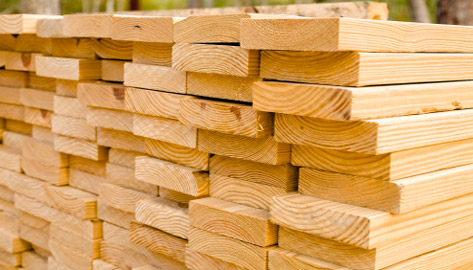
The first quarter came to a close with framing lumber prices still pointing upward. Early last week strength in futures buoyed mill positions and trader confidence. Mill order files in various species extended into mid-April and beyond. By most accounts, demand was steady to brisk, and many buyers circulated back to their suppliers for coverage. Supply constraints related to production, weather, spring breakup, or species mix also played a role in strengthening prices.
|
This Week |
Last Week |
Year Ago |
|
| Random Lengths Framing Lumber Composite Price* |
$345 |
$340 |
$336 |
| KD Western S-P-F #2&Btr 2x4 R/L Mill Price |
309 |
303 |
282 |
| KD Eastern S-P-F #1&2 2x4 R/L, delivered Great Lakes |
388 |
378 |
381 |
| Green Douglas Fir Std&Btr 2x4 R/L (Portland) |
337 |
332 |
300 |
| Southern Pine (Westside) #2 2x4 R/L |
393 |
387 |
399 |
| KD Coast Hem-Fir #2&Btr 2x4 R/L |
370 |
352 |
310 |
| Ponderosa Pine (Inland) #2&Btr 1x12 R/L |
680 |
675 |
670 |
| * Weighted average of 15 key items | |||
Random Lengths Panel Market Report
OSB led the way in structural panel trading. OSB sales accelerated and shifted to a higher gear in the second half of the week. Mills extended order files and steadily pushed quotes higher. While most Southern Pine plywood prices finished flat, the tone of the market was cautiously optimistic. On rated sheathing, mills quoted shipments for the week of April 11. Although the pace in western Fir plywood tapered off from last week’s brisk activity, decent follow-through generated steady upward pressure on prices.
|
(f.o.b. mill prices) |
This Week |
Last Week |
Year Ago |
| Random Lengths Structural Panel Composite Price* |
$358 |
$354 |
$374 |
| Southern (west-east) 15/32-inch 3-ply rated sheathing plywood |
373-397 |
373-397 |
442-500 |
| Southern (west-east) 15/32-inch 4-ply rated sheathing plywood |
375-400 |
375-400 |
447-508 |
| Western 1/2-inch 4-ply rated sheathing plywood |
365 |
358 |
425 |
| North Central 7/16-inch Oriented Strand Board |
235 |
225 |
180 |
| *Weighted average of 11 key items | |||
Source: Random Lengths
[gravityform id="1" title="true" description="true"]
[gravityform id="2" title="true" description="true"]
US wood pellets continued to dominate the European market in 2015

EU imports of wood pellets from the United States showed no signs of slowing in 2015, with the rate of growth likely to stabilize or even accelerate this year. According to Eurostat latest statistics, the European Union countries have imported 19% (up to 4,28 million tons) more wood pellets from the U.S. in 2015 as compared to 2014. Thus the U.S. covers now almost a third (32,05%) of all EU worldwide pellet purchases, and it is its major source.
The driving force behind this development is unmistakably the United Kingdom, as major UK power plants such as Drax are currently undergoing major coal-biomass conversion plans. In 2015, the UK imported 3,52 million tons of wood pellets from the US (+28% yoy) at a value of €618 million. UK is now covering 82% of the overall European wood pellet imports from the US.
Belgium is the second EU importer of US pellets, with a quantity of 628 thousand tons, higher by 67% over 2014. On contrast, in the period mentioned, Italy and the Netherlands, the other two major European pellet consumers, have significantly decreased their imports of US pellets, by -71% and -82% respectively.
TOP 10 Importing Countries
Wood pellets imported from the United States by... (in tons )
| Importing Country | 2014 | 2015 | Change in % |
| European Union | 3,608,366 | 4,286,614 | 19 % |
| United Kingdom | 2,745,795 | 3,527,986 | 28 % |
| Belgium | 376,659 | 628,970 | 67 % |
| Italy | 169,282 | 48,322 | -71 % |
| The Netherlands | 209,218 | 38,048 | -82 % |
| Denmark | 77,705 | 28,367 | -63 % |
| Others | 29,707 | 14,922 | -50 % |
| TOTAL | 3,608,366 | 4,286,614 | 19 % |
Data Source: Eurostat; HS Codes: 440131,44013020
[gravityform id="1" title="true" description="true"]
[gravityform id="2" title="true" description="true"]

