
Article archive

Steico Group expands LVL production at its mill in Poland

The Steico Group produced the first laminated veneer lumber (LVL) board at its new, second production line in Czarna Woda, Poland.

According to the announcement, the line has been installed in record time, with construction work more than nine weeks ahead of schedule. Regular operations are expected to start during the first half of 2018. The total capital expenditure for the second line is around EUR 45 million.

The new line will double the production capacity for Laminated Veneer Lumber from a current total of around 80,000 cbm/year to around 160,000 cbm/year. STEICO took its first line for Laminated Veneer Lumber into operation at the start of 2016.

As a result of the high demand for this highly resilient engineered wood product, STEICO already resolved to double capacity in August 2016.

The company expects that the use of bark and production residues will allow the majority of production heat and steam to be produced in the company’s two own biomass power plants.

The company is focused on production of green building products.

Roseburg orders new LVL production line for its mill in the US

Roseburg Forest Products placed an order for a world’s largest continuous LVL press with Dieffenbacher.

According to the announcement, the investment is expected to total USD 200 million . Construction starts in the first quarter of 2018. Production of the first board is planned for 2019.

The capacity of RFP’s new LVL mill will be 285,000 m3 per year. The upstream 600 kW microwave will be the most powerful preheating system of this type in LVL production.

Roseburg publicly announced the project July 11, 2017 at a joint news conference with officials representing the state of South Carolina and Chester County.

Earlier Roseburg appointed a new Director of Strategic Business Development and External Affairs.

The company is one of North America’s leading producers of particleboard and thermally fused laminates. It also manufactures softwood and hardwood plywood, lumber, LVL and I-joists. Roseburg owns 630,000 acres of timberland in Oregon and Northern California. Its products are shipped throughout North America and the Pacific Rim.

Moelven Norsälven AB sawmill closed down

The Board of Moelven Norsälven AB has decided to close down the sawmill. This is because investment needs in the plant are extensive and will not result in the necessary profitability.

According the company's press release, the Chairman of the company, Managing Director Anders Lindh of the Moelven division Timber, said that even with significant investments, it is not possible to achieve a forward-looking and profitable plant.

It is with a heavy heart we close down a business, and it’s a difficult time for the employees at the company. Unfortunately, Moelven Norsälven currently has a very low technical status and requires extensive ongoing maintenance to keep up operations. It is only a matter of time before operations become untenable,” Lindh says.

Lind says that Moelven currently doesn’t recognize opportunities to prioritize funds for extensive investments with such uncertain returns.

A plan will now be prepared for winding down activity in the company. It is assumed that this will be more or less completed in the first quarter of 2018.

Japan’s Daiken to acquire Dongwha New Zealand

Japanese building materials giant Daiken Corp. will acquire Dongwha New Zealand at the end of December.

The company announced on the 26th of September that the size of the deal has not been announced, but is estimated at 10 Bn yen (US$89.7 Mn).

Both companies manufacture MDF. Daiken currently has factories in New Zealand and Malaysia and is hoping to expand the business through Dongwha's sales networks in Oceania and North America.

Through its local subsidiary, Daiken will acquire all of Dongwha's shares from the Hong Kong-based parent company and other minority stockholders. Dongwha's sales were NZD91.59 Mn (US$67 Mn) for the fiscal year ending December.

Although plywood is more commonly used in Japan, Daiken is trying to promote MDF, which is highly durable.

"This is just a first step toward expanding MDF operations," said Masanori Okuda, president of Daiken. "We will continue to actively invest if there are good deals going forward."

New Zealand log prices hit 23-year high

New Zealand structural log prices hit the highest level in the last 23 years, as mills compete to the export market so to secure the local construction market supply.
The price for structural S1 logs lifted to $128 a tonne this month, from $127 a tonne last month, and is sitting 11 percent above last year's level and 21 percent higher than the five-year average, according to AgriHQ's monthly survey of exporters, forest owners and saw millers.
Also, the S1 structural log price is at its highest level since April 1994.
Demand for New Zealand logs is strong in China, New Zealand's largest log market, with in-market prices for unpruned logs at their highest level since mid- 2014 and pruned log prices just shy of their last peak in mid-2016, AgriHQ said.
China has clamped down on harvesting of its own forests and reduced tariffs on imported logs. It imported 2,894,326 tonne of logs in July, the highest level since April 2014, with New Zealand recording the largest lift, making up 37 percent of imports in the month, ahead of the 35 share it typically holds, AgriHQ said.
"As far as the market is concerned, any potential downward movement in values will have to be driven by wharfgate values," said AgriHQ analyst Reece Brick. "Mills are ruing the on-going strength of the export market, forcing them to meet these values or find themselves short on supply."
Some mills have paid premiums above the main contract market to secure supplies from the spot market, Brick said, noting that the current price for structural S1 logs is about $3 a tonne more than the wharfgate price A-grade logs.
Still, Brick said further upward movement in prices is less likely as domestic pruned log supply moved into balance over recent weeks and export interest remains short of the level experienced in early 2016.
He noted residential construction activity is slowing in Canterbury as the bulk of the earthquake rebuild reaches completion, while talk of stagnating house prices has slowed building from property investors.
"Whether this is a temporary state brought about by winter or an indication of a longer-term trend will become more obvious over the next month or two," Brick said. "Other areas have displayed a little more resilience, though it does appear that construction has come back from its peak through Auckland and the central North Island."

Finnish roundwood prices on an upward trend in July

During July 2017, the roundwood prices in Finland have mostly been on an upward trend as compared to the same period of 2016.
The price for pine sawlogs amounted to EUR 58.74/m3 in July 2017, a 2.08% increase from its corespondent month last year. Spruce logs could be bought for EUR 61.19/m3, 5.37% more than in July 2016. Yet, birch logs were traded for less in July and the price went down by -4.83%, to EUR 47.22/m3.
The pulpwood prices mostly decreased, with pine going down by -3.75%, to EUR 27.69/m3 and birch decreasing by -2.05%, to EUR 27.71/m3. Only the price for spruce went up, by 0.62%, to EUR 30.52/m3.

July 2016 June 2017 July 2017 Change in % July 2016-July 2017
Pine logs 57.54 58.52 58.74 +2.08%
Spruce logs 58.07 60.12 61.19 +5.37%
Birch logs 49.62 47.73 47.22 -4.83%
Pine pulpwood 28.77 27.89 27.69 -3.75%
Spruce pulpwood 30.33 29.74 30.52 +0.62%
Birch pulpwood 28.29 28.71 27.71 -2.05%

EU furniture industry could boost revenues from cutting waste

Improved refurbishment and remanufacture of discarded furniture can trigger up to 157,000 new jobs and save about 6 million tonnes of COequivalent in the EU.

According to a new study made by EEB, which presents a range of policy options to improve waste prevention and resource management in the European furniture sector, this would in turn allow value recovery, economy growth and job creation while saving on resources and the environment.

The EEB is Europe’s largest network of environmental organisations with 140 members in over 30 countries.

The European furniture sector faces a number of challenges due to increasing raw material costs, poor turnover in its workforce and growing competitiveness of low-cost countries such as China.

Despite this, every year 10 million tonnes of furniture are put on the EU market and about the same amount is discarded by businesses and consumers, the majority of which is destined for either landfill or incineration.

Such a waste of valuable materials is a missed opportunity for the economy, but it also undermines efforts to transition to a circular and low-carbon economy.

The refurbishment and remanufacture of furniture guarantees that resources are kept in the economy rather than wasted in landfills or incinerators, which increases the amount of COreleased in the atmosphere.

The most effective measures recommended include a stricter criteria for Ecodesign, including restrictions on the use of chemicals to facilitate reuse, repair and recycling; better business models to cut furniture waste; incentives to take back discarded furniture and mandatory producer responsibility schemes and life-cycle impact information for procurers, repairers and recyclers as well as consumers.

Holzwerke Weinzierl plans to invest into a new log sorting line in Germany

Holzwerke Weinzierl invests into a new log sorting line at its sawmill in Vilshofen in Bavaria, Germany.

According to the announcement, the company placed an order for the new line with Holtec.

At that time, the Holtec technology has already convinced us in the sawmill – thus, it was a consistent step to prefer Holtecin the log sorting as well," Hans Weinzierl, managing director in Vilshofen, said.

The company runs one of the best performing softwood sawmills in Germany. At a area of more than 20 hectare, more than 700 000 solid cubic meters of logs are processed each year.

African countries commit to fight against illegal timber trade

African countries have pledged to tame illegal trade in timber and other forest products by ensuring that the sub-sector makes a meaningful contribution to the country's Gross Domestic Product (GDP).

Kenya's Chief Conservator of Forest Emilio Mugo said representatives from Kenya, Uganda, Mozambique, Madagascar, Tanzania and Zanzibar (Tanzania) who met in Nairobi on Tuesday agreed to take stern action against those caught in the illegal trade of the products.

"Illegal trade in timber and forest products is not only degrading the rich forests assets of the region but also represents an enormous loss in economic values and livelihood opportunities to the countries," Mugo said at the end of a two-day meeting.

He noted that the meeting marks a significant step forward in efforts to ensure timber trade in Eastern Africa is managed in a way that brings equitable benefits to all.

Mugo said that the meeting agreed to assist people with timber products to benefit from the products by ensuring that they reap maximum profit from the consumers.

The meeting followed the Zanzibar Declaration meeting that was signed in September 2015 during the XIV World Forestry Congress in South Africa.

Since signing the declaration, the countries have seen huge progress in addressing rampant illegal trade in the member countries.

They agreed develop a mechanism to collaborate on implementation of trade governed under the Convention on International Trade in Endangered Species of Wild Fauna and Flora (CITES).

"We have jointly agreed to pursue the Global Environmental Facility funding opportunity to help improve our forest cover and also fight climate change effects," Mugo added.

The members also agreed to deal with produce seized from illegal trade and raise fund to help improve the state of environment in the region.

The Kenya Forest Service is partnering with the Timber Manufacturers Association in establishing tree seedlings to help achieve and surpass her set goal of 10 percent tree cover.

The tree nurseries in the country currently produce 2.5 million indigenous seedlings and are set to increase to 4.5 million.

"This will immensely boost the rehabilitation program throughout the country," TMA chairman Benson Gitau said.

He noted that trees will be planted especially in arid and semi arid regions to help reduce land degradation.

Brazil’s furniture exports set to grow

After the market instability of 2016 the performance of the Brazilian furniture industry has started to improve. Between January to March this year furniture exports totalled U$141 million, an 8% increase compared to the same period in 2016.

According to IEMI (IEMI - Inteligência de Mercado) analysis of data from the Ministry of Development, Industry and Foreign Trade (MDIC), around 26% of exports went to the US followed by 12% to the UK and 10% to Argentina.

Expectations for further expansion of exports in the second half of 2017 are high even though the pace of export growth appears to be slowing.

The industry cites rising costs as a major hurdle to be overcome. IEMI expects a rise of 4.5% in furniture exports in dollars for 2017.

The range of styles and quality of Brazilian furniture industry has widened in recent years which is giving a boost to exports according to the Brazilian Foreign Trade Association (Associação de Comércio Exterior do Brasil - AEB).

Malaysia: Raw material and labour shortages to drive down wood products export prospects

The Ministry of Plantation Industries and Commodities (MPIC) has revised projections of the country’s woodbased exports from RM53 billion a year to between RM25 and RM30 billion by 2020. In 2009, the MPIC had projected that the wood-based exports will hit RM53 billion by 2020.

Minister Mah Siew Keong said the revision was made due to a likely shortage of raw material as well a shortage of as skilled and unskilled workers. First half year wood product exports totalled RM11.5 billion, a 5.2% increase year-onyear.

In 2016, exports stood at RM22 billion.

Mah said it is crucial for the government and sector stakeholders to overcome the shortage of labour and of raw materials and to embrace e-commerce and digitalisation to improve profitability.

At a recent National Timber Industry Policy (NATIP) gathering, the Minister reported that his ministry will also implement a national initiative, namely the development of the 2050 National Transformation Plan for the commodity sector including the timber industry.

Drax CEO to step down

British power producer Drax said chief executive Dorothy Thompson will step down after 12 years in the role.

The company's current finance chief Will Gardiner will succeed Dorothy Thompson who will step down from the post and leave the group at the end of 2017.

Shares of the company, which owns the UK's largest power station, fell 1.5 percent in early trading.

Drax is speeding up plans to convert its units to gas.

Under pressure from government plans to close all coal plants by 2025, Drax has increasingly turned to burning compressed wood pellets, or biomass.

The company will begin the process of appointing a new chief financial officer and will also review the option of making an appointment on an interim basis, it said on Thursday.

IKEA Industry invests in Lithuania in order to double furniture production capacity

IKEA Industry has decided to invest in furniture production in Kazlų Rūda and advanced technology will offer an opportunity to double the production capacity. Construction is scheduled to start this autumn. 

“IKEA Industry sees great potential in Kazlų Rūda. When it comes to operational experience, competencies of co-workers, opportunities in attracting new co-workers and availability of raw materials, Lithuania is truly competitive,” says Inga Urbonavičiūtė, Managing Director of IKEA Industry Lithuania.

The construction of the factory is scheduled to begin this autumn and planned to be completed in the summer of 2019.

“The investments will not only increase the volume of furniture production, but also improve it. The new equipment will be more efficient and help us to manufacture faster and allow more efficient use of raw materials, which will reduce costs and waste generation. Additionally, the level of automation will be much higher, and an advanced automatic quality control system will increase the quality for our customers”, says Karolis Jonaitis, Manager of IKEA Industry Lithuania furniture factory.

Some of the most important changes are related to the working conditions in the factory. Improvement areas cover ergonomics of workplaces and changing work schedules from 7 to 5 business days a week. The IKEA factories in Kazlų Rūda employ more than 700 co-workers, producing particleboard and furniture.

Swiss Krono buys new particleboard plant in Menznau, Switzerland

Swiss Krono commissioned new particleboard plant with CPS+ in Menznau, Switzerland. Dieffenbacher supplied all the essential machines, from gluing through raw board handling, for the replacement project.

A highlight of the new plant is the EVOjet P gluing system. It ensures optimum gluing and significant glue savings compared to conventional systems and requires minimum care and maintenance.

With its order of a CPS+ in late 2015, Swiss Krono was among the first companies to acquire the new gold standard for efficient continuous press systems.

The cutting-edge press offers optimum board quality, reduced material consumption, highest productivity and lowest lifecycle costs. The new production line in Menznau is already the fourth plant with CPS+ in operation worldwide.

EU imports more tropical plywood, mainly from China

Plywood is one of the few sectors of the EU market where tropical products have been performing reasonably well, although much of the gain has been in indirect imports from China rather than direct imports from tropical countries.

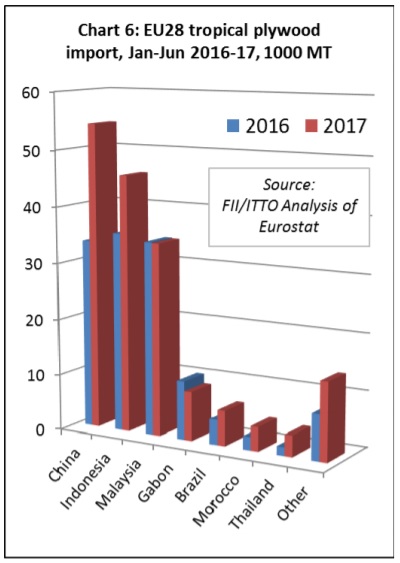
In the first six months of 2017, EU imports of products faced with tropical hardwood manufactured in China increased 62% to 54,300 MT, while direct imports from tropical countries increased 21% to 171,100 MT.

Most of the gains in direct imports were from Indonesia, rising 29% to 45,700 MT. Imports from Malaysia were stable at 34,200 MT and imports from Gabon fell 16% to 8,700 MT in the first half of the year.

These are mixed results for those looking for evidence of immediate market gains after issue of the first FLEGT licenses in Indonesia at the end of last year. The 21% rise in EU imports from Indonesia is encouraging and seems to confirm early anecdotal reports that some EU importers are favouring Indonesian product as it avoids the need for time-consuming and expensive due diligence assessments.

On the other hand, plywood manufacturers in China, even though using tropical hardwood veneers, appear to be conforming to the EUTR due diligence requirements to the satisfaction of many importers and regulators.

There are also reports that some plywood buyers in Europe are still avoiding Indonesian plywood because of lack of clear information on the exact species content when orders are placed, usually a month or two before shipment.

Many Indonesian plywood mills do not know ahead of time the exact mix of logs that will be available and importers only have access to species information when the order has been shipped and the FLEGT licence issued.

That conflicts with the internal procurement policies of some large corporate buyers who now require, well in advance, clear information on the exact species content of all delivered timber products. Some of the larger Chinese mills are better able to meet this requirement, while also satisfying those buyers’ needs for more regular large shipments.

The rise in EU tropical plywood imports in the first half of this year was mainly driven by the UK (+29% to 82,000 MT), Belgium (+52% to 30,300 MT), and Germany (+24% to 11,000 MT). These gains offset a decline in imports in the Netherlands (-29% to 16,400 MT) and France (-20% to 10,300 MT).

Timber exports from Ghana dropping sharply this year

The volume and value of Ghana’s timber exports has been falling in each of the past five months.

According to the Timber Industry Development Division (TIDD) of the Forestry Commission, the country secured Euro 62.65 million from the export of 116,952 cu.m of wood products in the first 5 months of this year representing a 27% drop in value and a 31% drop in volumes compared to the same period in 2016.

The average unit price of wood products in the period January to May 2017 dropped to Euro 536/cu.m from Euro 564/cu.m in the same period in 2016, an almost 5% decline.

Secondary wood products (sawnwood, boules, veneers and plywood) accounted for 82% of exports followed by primary product exports (poles and billets) 7% with the balance being tertiary wood products (mouldings, flooring, dowels and furniture parts).

Asian markets accounted for close to 70% of all wood product exports with China and India being the leading importers.

EU imports of wood products from Ghana have been falling over the past months. Analysts suggest the fall in exports is most likely linked to the growing problem mills have in securing adequate log supplies.

Because this is seen as a long term problem some millers are asking the government to allow timber imports which would secure existing businesses, maintain employment in the sector and possibly lead to more investment in processing capacity.

Edwards Wood Products to invest $30 million to open new sawmill

Edwards Wood Products will invest $30 million to open new sawmill in Scotland County.

Edwards Wood Products will open a new sawmill, creating 46 new jobs over three years, N.C. Commerce Secretary Anthony M. Copeland announced today. The manufacturer of wood pallets, high grade lumber, wood chips, and by-products will invest $30 million in the next three years to open a sawmill in Scotland County that will increase capacity and expand markets. The company plans for a phase two that will include an additional $20 million investment.

"Edwards Wood Products has grown significantly over the past several years, and this expansion is key to their continued success," said Secretary Copeland. "Scotland County is well-suited for this project, and the partnership we had between the county, community college, the Department of Transportation and N.C. Railroad was key to making this happen."

Edwards Wood Products was founded in 1969 in Marshville, N.C. by Carroll Edwards. Today, the group of six companies is owned and led by his son, Jeff Edwards. Edwards Wood Products is one of the largest producers of wood pallets, high grade lumber, wood chips, crane and bridge mats and by-products in the Southeast U.S. Current locations include Marshville, Peachland, Laurinburg and Liberty, N.C. and Manning, S.C.

Spain’s furniture exports outpace imports

As Spain’s furniture exports continue to grow at a much faster pace than imports, the country’s trade deficit in the industry was reduced by 5.6% in the first half of the year.

In the first half 2017 Spain’s furniture exports were up 4.5% and reached EUR 1.05 billion while furniture imports grew 1.2% to EUR 1.51 billion for a 5.6% reduction in Spain’s furniture trade deficit from EUR 489 million in the first half of 2016 to EUR 462 million in 1H-2017.

France continued as Spain’s main export market in 1H-2017 with EUR 272 million compared to EUR 270 million in 1H-2016 (+0.8%), followed by Portugal with EUR 120.3 million (1H-2016: EUR 118.4 million) and Germany EUR 77.9 million (1H-2016: 84.9 million) that suffered the largest drop in the period (-8.3%). Mexico was the fastest growing export market for Spanish furniture in 1H-2017 (+24.1%) reaching EUR 25.3 million.

On the furniture import side China continued as the main furniture supplying country with EUR 359.7 million in 1H-2017 (1H -2016: 336.2 million) and 7% growth. Portugal was the second furniture supplying country in 1H-2017 with EUR 225.7 million (1H-2016: 222.7 million), followed by Germany with EUR 153.9 million (1H-2016: EUR 147.5 million) and Italy that surpassed Poland, with EUR 120.4 million (1H-2016: 124.1 million). Vietnam was the fastest growing supplier in 1H-2017 with an increase of 43.4% and Poland had the largest drop in furniture shipments to Spain (-33.6%) in the first half 2017.

Norbord starts production at OSB mill in Inverness

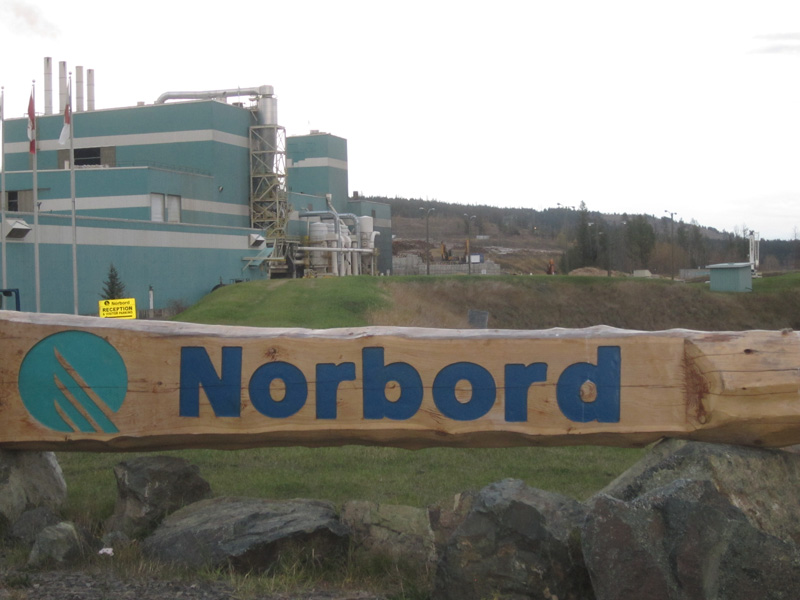
Norbord completed GBP 95 million investment at its OSB mill in Inverness, the UK. According to the announcement, the company started up its production.

The company relocated the continuous press from the Alberta, Canada (produced by Dieffenbacher) site to Scotland and constructed a new OSB wood yard.

The company has recently placed an order with Holtec for a debarker line with VARIO technology designed for a throughput capacity of 60 t(b.d./h). The equipment supplier will provide the log infeed up to the strand infeed conveyor to the wet bin. In addition to the conveying systems with electrical switch and control system, the project includes the waste evacuation, the complete steel-structure as well as the complete installation. The completion is scheduled for Mid 2017.

About Norbord:

The company is an international producer of wood-based panels with assets of around USD 1.8 billion, employing approximately 2,600 people at 17 plant locations in the United States, Europe and Canada. Norbord is one of the world’s largest producers of oriented strand board (OSB). In addition to OSB, Norbord manufactures particleboard, medium density fibreboard (MDF) and related value-added products.

2017 International Softwood Conference- 4th-6th October 2017 in Hamburg

After the great success of the previous editions, the 2017 International Softwood Conference will be organized this year on the 4th-6th October 2017 in Hamburg.

Located on the River Elbe, Hamburg is one of the three city-states in Germany and the largest sea-port in Germany, third largest in Europe.

As per tradition, the conference will be anticipated by a cocktail reception in the early evening on the 4th October, then will officially start at 9 o’clock the following morning with the market analysis from the perspective of top-class international speakers.

The presentations will be focused on facts and figures showing softwood production as well as consumption in the most relevant timber markets such as North Africa, Egypt, Japan, Russia and USA, for mentioning just a few. An insight view of the Great Britain market after the Brexit result will be one of the most interesting points of discussion of this year’s ISC. Moreover, a detailed insight view of the Canadian market and clarification on the softwood lumber agreement between USA and Canada will certainly contribute to enrich the debate between participants.

The 2017 International Softwood conference is hosted by the German Timber Trade Federation (GD HOLZ), the European Timber Trade Federation (ETTF) and the European Organization of the Sawmill Industry (EOS).

Newsletter

Subscribe to our digital newsletter for your daily digest of essential news, views and analysis from the international wood industry delivered directly to your inbox.


0