Article archive

China and rising European construction sector- key factors for growing Finnish softwood lumber exports

Production figures for the Finnish forest sector will clearly be impacted by new investments in both 2017 and 2018.

Growth will be particularly strong in 2018 in pulp exports, once the Äänekoski pulp factory begins operating at full capacity. Exports of paperboard will also increase due to investments made earlier in the year.

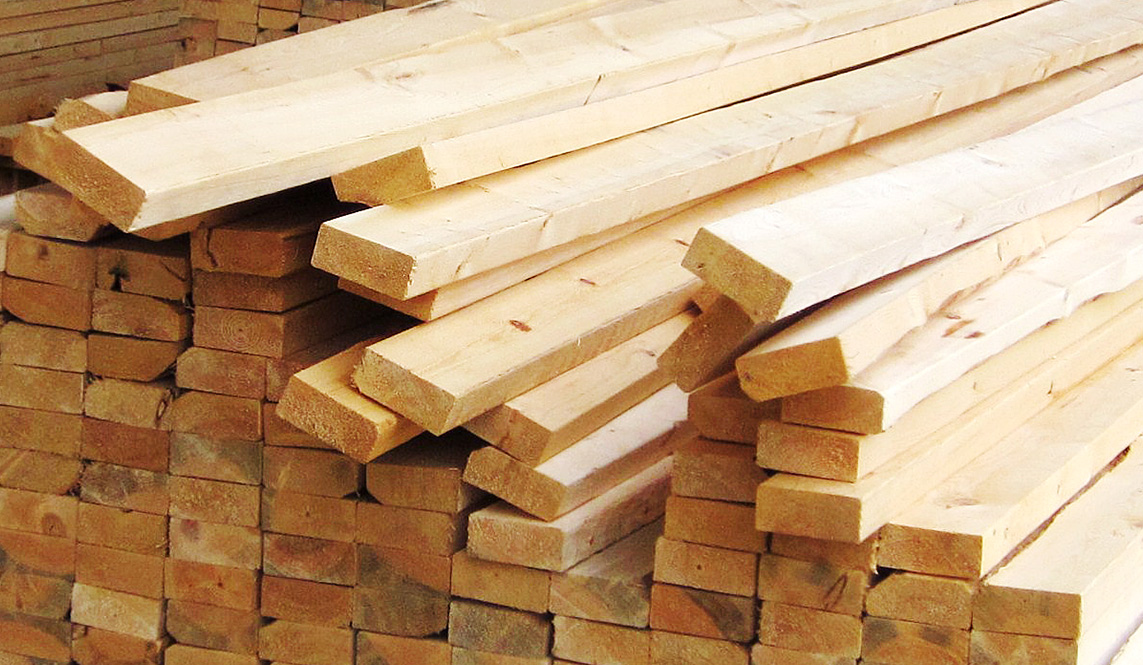
The demand and export of the Finnish forest sector’s key export article, paper, will continue to decline during both years. Exports in sawn goods will continue to grow thanks to strong demand in China. The demand for wood products will be supported by increasing construction in Finland and Europe.

Paper exports will continue to fall, while growth is expected in paperboard exports. The production and exports of paper in Finland will fall by 3–4 percent in 2017 and by 2–4 percent the following year. The reason for the decline is the demand for printing and writing paper, which has been diminishing for many years.

There still remains an oversupply of paper, and the average export price in Finland is expected to go down during the forecast period. In spite of the decline in production, paper will continue to account for about 35 percent of export earnings of the Finnish forest industries during the forecast period.

The production volume of paperboard will rise in 2017–2018. Thanks to earlier investments, the increase in 2017 will be considerable at 5–6 percent. The average price of paperboard will also see a slight increase, while pulp export volumes will rise to new heights thanks to increased capacity.

Finnish pulp exports will continue to grow in 2017 and 2018. The rise in capacity is due especially to the Metsä Group Äänekoski plant that became operational in August. Also, the extension of the UPM Kymi plant will push up exports.

Finnish exports will grow 4–5 percent in 2017 and 15–17 percent in 2018. Thanks to the growth in exports, the overall volume of pulp production in Finland will see strong growth of 5–6 percent next year.

Due to increased supply and the strengthening of the euro against the dollar, the price of Finnish exports will decline markedly next year. Also, strong growth in sawn goods exports will continue, while the volume of sawn goods exports to China will grow markedly this year as well.

Exports will also be supported by increasing construction in important European markets. An estimated 76 percent or more of the volume of sawmill production will be exported this year and the next, although domestic demand has strengthened.
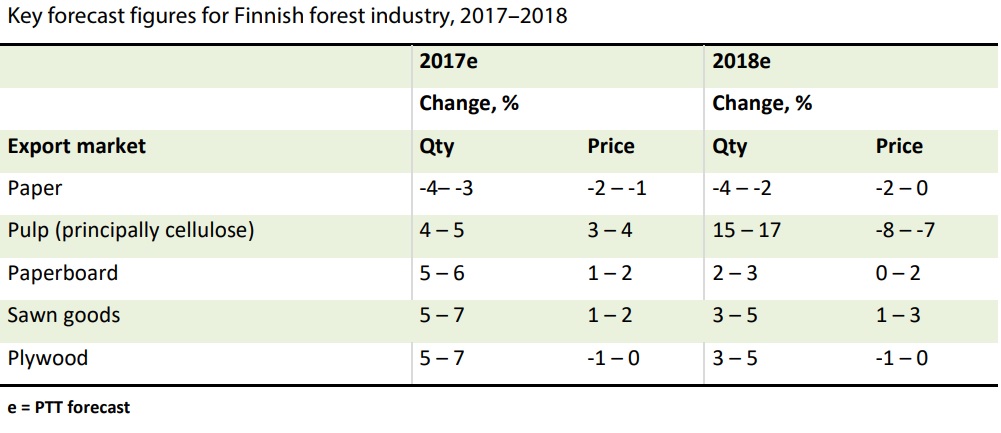
Production will grow 5–6 percent in 2017 and 3–5 percent in 2018. The profitability of the sawmill industry will remain low due to the strengthening of the euro against the dollar and the price development of wood raw material.

The price of sawn goods is expected to turn into a slight rise towards the end of the year and in 2018. The export of plywood will rebound after the decline of 2016, but the average price is expected to go down a little.

Finnish roundwood prices mostly up in September

Roundwood prices in Finland have mostly increased during September 2017, as compared to the same period in 2016. 
All the prices for logs went up, with spruce increasing the most, by 4.27%, to EUR 60.24/m3. In September, pine could be bought for EUR 57.70/m3, 0.96% more than last year, while birch logs cost 4% more than last year, to EUR 48.30/m3.
The only prices to descend from 2016 where for pulpwood pine (-1.17%) and birch (-2.86%). Pine pulpwood could be bought for EUR 27.83/m3, while birch cost was EUR 27.85/m3. At the same time, the price for spruce pulpwood went up to EUR 30.17/m3, registering a 1.07% increase.

September 2016 August 2017 September 2017 Change in % September  2016-September 2017
Pine logs 57.15 57.84 57.70 +0.96%
Spruce logs 57.77 60.06 60.24 +4.27%
Birch logs 46.44 49.96 48.30 +4%
Pine pulpwood 28.16 27.72 27.83 -1.17%
Spruce pulpwood 29.85 29.85 30.17 +1.07%
Birch pulpwood 28.67 27.99 27.85 -2.86%

Stora Enso divests Puumerkki wholesaler of wooden building materials

Stora Enso has divested 100% of its shares in the Finnish Puumerkki Oy and the Estonian Puumerkki AS to Mimir Invest AB, a global investment firm.

Puumerkki is a specialised wholesaler of wooden building materials and was 100% owned by Stora Enso.

This divestment supports Stora Enso's Wood Products division in focusing on its growth strategy and further build on the strength of the premium portfolio of products and services. Puumerkki's wholesale business does not belong to Stora Enso's core business. The new owner is in a better position to give Puumerkki the attention it deserves and ensure its long-term development. Puumerkki will continue to be a key customer for Stora Enso's renewable building materials also going forward.

Puumerkki's sales in 2016 were approximately EUR 160 million, and it has approximately 170 employees. The transaction was finalised immediately, and it will have no significant impact on Stora Enso's operational EBIT or net debt. Stora Enso will book a loss of EUR 8 million in its operational EBIT in the fourth quarter of 2017 as an item affecting comparability (IAC).

MIMIR is a global investment firm acquiring non-core business units of larger corporations and private companies that need operationally oriented ownership.

Russian companies announce massive investments in CLT capacities

The capacity of the CLT panels market in Russia is estimated at 130,000-150,000 m2 each year. In years ahead, this number could increase nearly three times.

According to the WhatWood, the legal base for housing construction using CLT panels with more than three floors has not been approved yet, but promotion of material is actively implemented by Ministry of Industry and Trade.

Promstroyles company will invest 200 million rubles of own and borrowed funds into completion of the second phase of its plant producing CLT panels in Kolpinsky district, Leningrad region. Thus, the capacities of the company will increase from 30,000 to 80,000 m2 per year.

The second phase will start operation at the end of 2017, and it is planned to increase the capacities by another 50,000 m2 for 200 million rubles next year. The company currently supplies CLT boards to the internal (about 70%) and the European markets, WhatWood reports.

The most important buyers are construction companies, state corporations and private customers. The cumulative turnover of the companies of the Promstroyles holding (harvesting and production in the Leningrad region and exhibit area in Bavaria) is 500 million rubles.

The shareholder of the group is St. Petersburg entrepreneur Yevgeni Islamov. He said: "The situation in the wooden housing construction market is currently difficult. It can be said that the crisis in fact eliminated middle-class buyers. Presently there are only buyers in the premium segment, as well as in the economy segment".

Islamov thinks that companies which work in the wooden housing construction will be able to stay in the market mainly if they participate in state programs.

In particular, Promstroyles plans to participate in the program on resettlement from dilapidated and dangerous housing, applying primarily CLT technologies. If cooperation with the regional authorities is successful, the company will be ready to construct new CLT plants in Komi and Krasnoyarsk regions, according to WhatWood.

At the moment, there are two large projects on housing production with CLT panels in Russia: Ladozhsky DSK CJSC, owned by English company SAB INDUSTRIES LTD., that constructed a plant in the village of Avrovo (Volkhovsky district, Leningrad region), with a capacity of 2.5 million m2.

Segezha Group (part of AFK Sistema holding) plans to construct a plant for the production of CLT panels on the basis of Sokolsky DOK for €10–15 million in the Vologda region. The launch of production with a capacity of 250,000 m2 panels per year is scheduled for 2019.

According to WhatWood, one more enterprise which manufactures and mounts houses made of CLT has recently appeared in the Moscow region, ArkhTekhnoPlus LLC.

China: Guangdong province the first largest furniture output

According to a 2017 report ‘China’s Wood Furniture Output’ published by the China Business and Industry Academy, in the first half of 2017 China’s wooden furniture production exceeded 13 million pieces.

The top 10 producer regions are Guangdong, Zhejiang, Shandong, Fujian, Jiangxi, Sichuan, Jiangsu, Liaoning, He’nan provinces and Beijing capital.

Of the national total, 21% of the furniture output originated from manufacturers located in Guangdong Province, the top ranked Province in terms of production.

Furniture manufacturing has a long history in the Shunde District, Foshan City in Guangdong Province. There are more than 5,000 furniture manufacturers and around 10,000 outlets providing furniture accessories.

The total value of furniture output in Shunde District last year was RMB10.13 billion of which RMB8.06 billion was exported. Exports from Shunde District accounted for about 6.5% of all furniture exports from Guangdong Province.

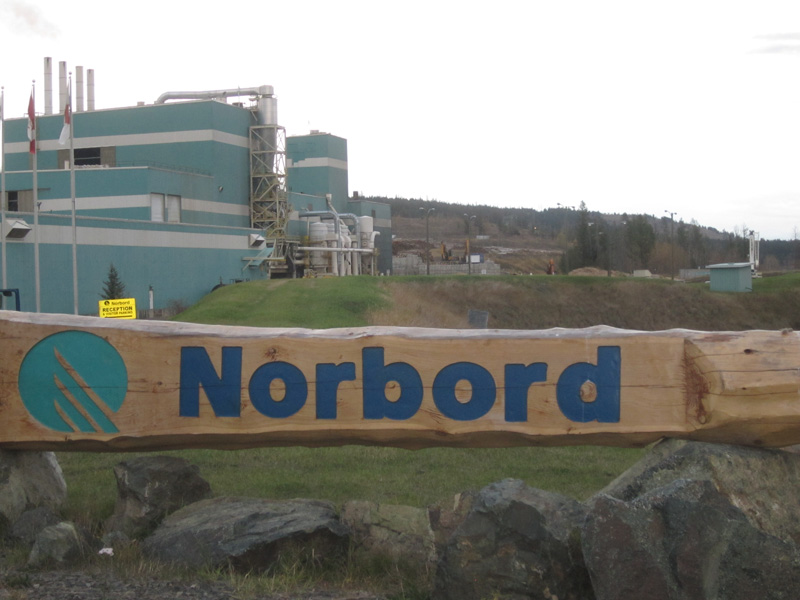
Norbord reports 27.6% increase in sales for 3Q/2017

Norbord Inc., one of the main OSB producers in the world, reported sales revenues of USD 578 million in the 3Q-2017 compared to USD 453 million in the same period 2016 (+27.6%) and adjusted EBITDA of USD 200 million for the third quarter of 2017 versus USD 115 million in the third quarter of 2016 and USD 165 million in the second quarter of 2017.

The improvement is primarily due to higher North American oriented strand board (OSB) prices and shipment volumes. North American operations generated adjusted EBITDA of USD 184 million compared to USD 106 million in the same quarter last year and USD 157 million in the prior quarter. European operations delivered adjusted EBITDA of USD 14 million versus USD 10 million in the same quarter last year and USD 9 million in the prior quarter.

“Our third quarter performance continued to accelerate and we delivered our best Adjusted EBITDA result in 13 years,” said Peter Wijnbergen, Norbord’s President and CEO. “In North America, our shipment volumes increased 5% and benchmark OSB prices were 36% higher year-over-year due to already strong OSB demand that was pushed even further by the hurricanes in the US south. In Europe, our financial performance is back on track as improved panel prices outpaced the currency translation headwind from the weaker Pound Sterling and the negative impact of higher resin prices.”

Roundwood prices in Sweden on a negative trend

During the third quarter of 2017, roundwood prices in Sweden have mostly decreased among the logs assortments, while pulpwood types could be bought at a higher value, as compared to the same quarter of 2016.
Pine logs could be bought for SEK 448/m3 in the Q3/2017, -2.39% less than last year, but 0.44% more than in the Q2/2017. At the same time, spruce was traded for SEK 503/m3, -2.89% less than last year and 2.44% more than in the Q2/2017.
As for the pulpwood assortments, the price for pine went up by 1.87% from its corresponding quarter of 2016, while its price was the same with the one in the Q2/2017. Spruce amounted to SEK 283/m3, 2.9% more than in the Q3/2016 and 1.07% more than in the previous quarter of 2017.
Birch was traded for SEK 290/m3 in the Q3/2017, -0.68% less than in the Q3/2016 and -2.35% less than in the Q2/2017.

Roadside prices of roundwood in Sweden SEK/m³ u.b. 

Q3 2017 Q2 2017 Q3 2016 Change 
 Q3/2017
  to Q3/2016
Change Q3/2017 to Q2/2017
LOGS
Pine 448 446 459 -2.39% +0.44%
Spruce 503 491 518 -2.89% +2.44%
Pine&Spruce average 482 473 495 -2.62% +1.9%
PULPWOOD
Pine 271 271 266 +1.87% 0%
Spruce 283 280 275 +2.9% +1.07%
Birch 290 297 292 -0.68% -2.35%
 Pulpwood total 280 280  275 +1.81% 0%

Overview of China’s timber trade in the first half of the year

China's total volume of imported roundwood rose 7.9 per cent, to 25.8 Mn cbm, worth US$4.55 Bn (+14.8% YoY), during the first half of 2017.

The volume of imported sawnwood rose 16.1 per cent to 18.12 Mn cbm, worth US$4.74 Bn (+24.2% YoY). For the first time, the value of sawnwood exceeded that of roundwood. Also, over 70 per cent of the wood came from Russia, New Zealand and North America; of this, Russia accounts for the majority, about 35 per cent.

Softwood imports

The softwood roundwood imports rose by 9.5 per cent to 17.65 Mn cbm, at a value of US$2.3 Bn (+19.3%). Softwood sawn timber imports amounted to 12.4 Mn cbm (+14.9%) and the value got to US$2.37 Bn (+29.2%).

Softwood from North America saw huge increases, with roundwood from Canada increasing 33 per cent and from America, 21 per cent. Also, imports from Japan increased  by 40 percent, mainly cedar and cypress, while softwood from Northern Europe climbed; from Finland, 64 per cent increase and from Sweden, 31 per cent.

Softwood Round wood

1H/2017

1H/2016

Increase (%)

Vol.

(Mn cbm)

Unit Price (USD)

Vol.

(Mn cbm)

Unit Price

(USD)

Vol.

Unit Price

New Zealand

6.17

129

5.44

116

13.5

11.2

Russia

4.5

118

4.77

110

-5.6

7.3

USA

2.19

158

1.81

156

21.0

1.3

Australia

1.98

115

1.98

115

-

-

Canada

1.58

156

1.19

147

32.5

6.1

Japan

0.335

134

0.239

124

40.2

8.1

Fig. 1: Main supplier countries of softwood round wood in 1H/2017

Species

1H/2017

(Mn cbm)

1H/2016

(Mn cbm)

Increase (%)

Scots Pine

2.04

2.47

-17.6

Fir/ Spruce

2.50

2.63

-4.7

Radiata Pine

7.56

6.61

14.3

Larch

1.19

1.22

-2.2

Douglas Fir

0.877

0.829

5.8

Others

3.47

2.34

48.3

Total

17.65

16.11

9.5

Fig. 2: Species breakdown (round wood)

Softwood Sawnwood

1H/2017

1H/2016

Increase (%)

Vol.

(Mn cbm)

Unit Price (USD)

Vol.

(Mn cbm)

Unit Price

(USD)

Vol.

Unit Price

Russia

7.08

181

5.99

160

18.1

13.1

Canada

2.50

189

2.77

154

-9.6

22.7

Finland

0.836

224

0.511

235

63.6

-4.7

Sweden

0.455

217

0.347

215

31.1

0.9

Chile

0.351

243

0.343

237

2.3

2.5

Fig. 3: Main supplier countries of softwood sawnwood in 1H/2017

Species

1H/2017

(Mn cbm)

1H/2016

(Mn cbm)

Increase (%)

Scots Pine

4.74

4.2

12.8

Fir/ Spruce

4.78

4.16

15.0

Radiata Pine

0.58

0.54

7.7

Others

2.28

1.88

21.3

Total

12.4

10.8

14.9

Fig. 4: Species breakdown (sawn wood)

Hardwood imports

Hardwood roundwood imports grew by 4.5 per cent to 8.13 Mn cbm, at a value of US$2.25 Bn (+10.4%), while hardwood sawn timber rose 18.7 per cent to 5.71 Mn cbm, at a value of US$2.36 Bn (+19.6%).

Shipments from Latin America and North America were up 52 per cent and 40 per cent respectively and, for the first time, tropical hardwoods from Brazil declined, reaching 1.35Mn cbm, a 23 per cent fall.

Sawn rubber wood from Thailand reached 2.17 Mn cbm, accounting for nearly 40 per cent of total hardwood sawn timber imports.

Hardwood Round wood

1H/2017

1H/2016

Increase (%)

Vol.

(Mn cbm)

Unit Price (USD)

Vol.

(Mn cbm)

Unit Price

(USD)

Vol.

Unit Price

Africa

1.88

424

1.90

410

-1.2

3.4

Brazil

1.35

196

1.77

177

-23.4

10.7

Russia

1.35

148

1.13

146

19.4

1.4

Solomon Islands

1.25

171

1.09

163

15.4

4.9

Europe

0.992

206

0.91

190

8.3

8.4

USA

0.482

485

0.34

432

40.1

12.3

Latin America

0.204

354

0.13

338

52.2

4.7

Fig. 5: Main supplier countries of hardwood round wood in 1H/2017

Hardwood Sawnwood

1H/2017

1H/2016

Increase (%)

Vol.

(Mn cbm)

Unit Price (USD)

Vol.

(Mn cbm)

Unit Price

(USD)

Vol.

Unit Price

Thailand

2.16

313

1.88

296

14.8

5.7

USA

1.19

602

1.01

582

18.0

3.4

Russia

0.667

285

0.571

298

16.8

-4.4

Europe

0.412

261

0.305

392

35.1

-33.4

Vietnam

0.288

326

0.163

337

76.7

-3.3

Gabon

0.192

551

0.142

565

35

-2.5

The Philippines

0.167

141

0.130

140

28.5

0.7

Indonesia

0.143

859

0.131

786

9.2

9.3

Malaysia

0.138

367

0.113

373

22.1

-1.6

Fig. 6: Main supplier countries of hardwood sawnwood in 1H/2017

The value of the imported wood-based products climbed 17.5 per cent to US$1.15 Bn. The wood-based panels are on an upward trend: particleboard imports rose 46 per cent, vs a 42 per cent increase in 2016 compared to the year before.

Low grade boards account for the majority of imports, which are mostly from Malaysia, Thailand and Romania. The higher grade boards are generally from Canada and Germany.

Finland: Roundwood prices expected to rise in 2018

Finland’s paper and pulp industry will drive the growth of the national forest industry, a role previously attributable to sawmills.
Planned investments had earlier increased roundwood trade and fellings, but the use of pulpwood will not pick up until 2018. The increasing demand is reflected in rising prices, and the prices of pine logs and pine pulpwood are picking up compared with the mean price of 2016.
The price development of Finnish pine pulpwood will nevertheless be flattened out by supply, as determined by forest management needs. Gross stumpage earnings will improve through the increasing use of domestic roundwood and the price hike.
Pulp and paper industry, new growth driver in roundwood use
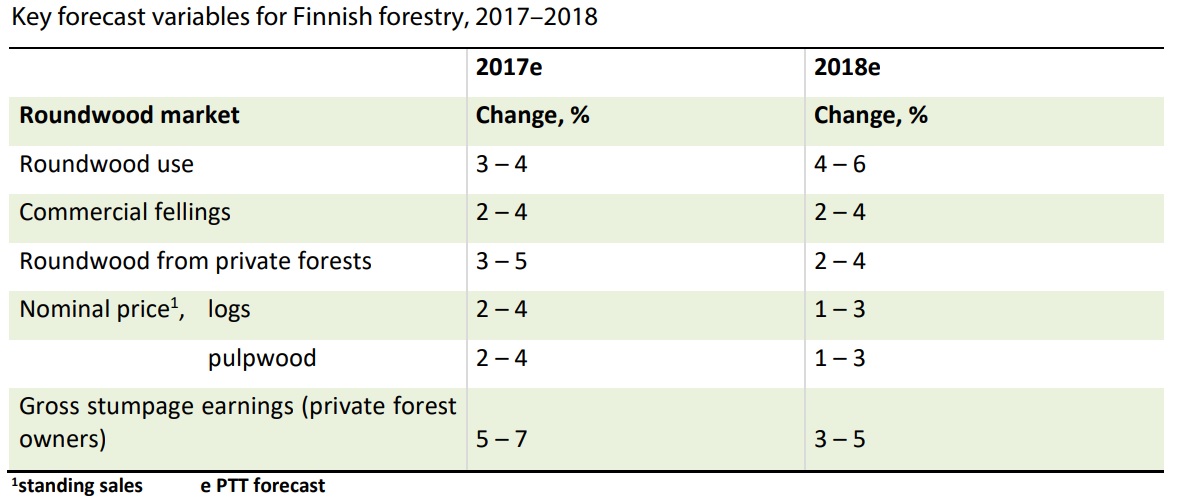
The use of roundwood in Finland is expected to increase, thanks to growing production volumes in the mechanical forest industry. When the Äänekoski mill will be operating at nearly full capacity next year, the use of pulpwood will increase.
The increasing use of roundwood will rely heavily on domestic supply: the share of imported roundwood among overall use of wood in 2017 and 2018 will be about 12 percent higher.
During the forecast period, commercial roundwood removals will continue to grow at a rate of 2–4 percent annually. Most of the growth will be observed in standing sale removals in private forests.
Hikes foreseen in average prices for pinewood
Roundwood trade in private forests sped up in 2016, with volumes increasing by about one-fifth from the preceding year.
In 2017, the largest rise, from January–August, was in standing sales of pine logs and pulpwood, while trade in spruce logs and pulpwood have remained at the high level reached last year.
The volume of delivery sales is expected to decrease by about 12–15 percent this year. The total growth of roundwood trade in nonindustrial private forests will be 3–5 percent this year and will fall slightly next year.
In 2016, the annual average price of pine logs and pulpwood fell from the preceding year. The average price is expected to rise 2–3 percent this year and 1–4 percent in 2018. The annual average price of pine pulpwood will rise about 3 percent this year and 2–4 percent in 2018.
Owing to reasons related to forest management, the Finnish supply will remain quite strong, which will keep price developments moderate. The demand for pulpwood will be lightened by the large supply of sawmill chips. Stumpage earnings will increase next year to exceed one billion euros.
Spruce logs demand elsewhere in Europe
Demand for Finnish pulpwood has been particularly active in the southern parts of Central Europe and in parts of Sweden.
The growing demand in Sweden is also expected to be reflected during this autumn as a modest price increase, even though list prices came down somewhat earlier this year. The log market in central Europe has been affected by storm damages that took place in late summer in Poland, Czech Republic, southern Germany and Austria.
Bark beetles have also caused extensive damage, resulting in a good deal of poor quality wood entering the market.

Egger starts construction of particleboard plant in Poland

The Austrian wood-based materials company EGGER has officially commenced the construction of particleboard production plant in Biskupiec.

This investment is valued approx. € 250 million and represents Egger's 19th plant and the first in Poland and its construction started on the 25th of October. The plant has been located in Warmińsko-Mazurskie Voivodeship, in the town of Biskupiec and will be a key plant in this part of Europe, equipped with the best available technologies.

The plant will produce mainly raw chipboards for the furniture industry and will produce approximately 650 000 cubic meters of chipboards annually.

After months of preparation, the company has started the building works. The new plant is planned to start its production in Q4 2018.

"The construction of the plant is a response to the growing number of customers in Poland and the current and expected further development of the Polish furniture market", said Michael Egger.

400 new jobs will be created directly, while additional 600 new employees will be hired by company’s partners and subcontractors. Biskupiec will be a key plant for Egger Group in this part of Europe.

The plant’s products will target both Polish and regional external markets. Besides of raw chipboards, the plant will produce chipboards with decorative surfaces and other processed materials for the Polish and international furniture producers and interior design companies.

The plant will be divided into several major parts, such as wood storage, production halls, further processing, product magazine and administration. The location of different parts of the factory has been chosen in such a way as to minimize the impact of the factory on the surroundings and the environment.

Lumber prices in the US driven by lighter trading

Framing lumber sales in the US were mixed during last week, while trading was modestly lighter. 
Weakness in Southern Pine and green Fir dimension, as well as 2x4 studs in various species, drove a drop in the Random Lengths Framing Lumber Composite Price for a second straight week.
Price strength remained focused on random dimension in Canadian S-P-F and western dry species, although upward momentum eased in the West and Eastern S-P-F.

Week
Oct 27
Week
Oct 20
Year Ago
2016
Random Lengths Framing Lumber Composite Price* $433 $438 $350
KD Western S-P-F #2&Btr 2x4 R/L Mill Price 457 449 307
KD Eastern S-P-F #1&2 2x4 R/L, delivered Great Lakes 555 553 400
Green Douglas Fir Std&Btr 2x4 R/L (Portland) 462 467 325
Southern Pine (Westside) #2 2x4 R/L 410 420 432
KD Coast Hem-Fir #2&Btr 2x4 R/L 470 470 330
Ponderosa Pine (Inland) #2&Btr 1x12 R/L 720 710 650
* Weighted average of 15 key items

Random Lengths Panel Market Report
Steep discounts surfaced amid quiet trading in structural panel markets. The upward trend that lasted for most of the year to date hit a wall in OSB markets, and prices tumbled in some regions.
Softness was most apparent in southern and western markets. Prices of Southern Pine plywood rated sheathing were in a downward slide. Some mills offered double-digit discounts to entice reluctant buyers to purchase beyond immediate needs.
Western Fir plywood sales slowed, as producers and buyers engaged in a standoff.

(f.o.b. mill prices) Week
Oct 27
Week
Oct 20
Year Ago
2016
Random Lengths Structural Panel Composite Price* $527 $535 $372
Southern (west-east) 15/32-inch 3-ply rated sheathing plywood 495-520 505-528 362-385
Southern (west-east) 15/32-inch 4-ply rated sheathing plywood 500-525 510-530 365-392
Western 1/2-inch 4-ply rated sheathing plywood 500 513 355
North Central 7/16-inch Oriented Strand Board 455 455 287
*Weighted average of 11 key items

Canada-US softwood lumber trade on impasse, West Fraser CEO predicts

The US lumber lobby doesn't want to make any compromise regarding the softwood dispute with Canada. This goes for a long impasse in the trade battle, that started back in October 2015, when the 2006 softwood lumber agreement expired.

According to The Globe and Mail, the lack of progress in renegotiating the North American freetrade agreement also paints a gloomy outlook for reaching a separate softwood deal any time soon, West Fraser Timber Co. Ltd. chief executive officer Ted Seraphim said during a conference call with industry analysts on Tuesday.

In November 2016, after the expiration of a one-year litigation moratorium, a group led by the US Lumber Coalition, petitioned the US Department of Commerce to impose countervailing and antidumping duties on Canadian lumber shipments into the United States. In 2017, the Commerce Department deciding to penalize Canadian producers.

“We would not be optimistic about a settlement in the short term, and I don’t think NAFTA helps at all in that regard at this point,” Mr. Seraphim said.

While Foreign Affairs Minister Chrystia Freeland recently raised crossborder lumber issues with the U.S. government, the coalition holds the key to any breakthrough. “I know that Minister Freeland continues to have discussions with the U.S.,” he said.

The real question at the end of the day here is the coalition ultimately is the decision-maker, at least at this point in time in the U.S., and they haven’t shown a willingness to effectively negotiate,” Mr. Seraphim said. He added that Vancouver-based West Fraser and other Canadian producers such as Vancouver-based Canfor Corp. and Montreal-based Resolute Forest Products Inc. have weathered preliminary U.S. tariffs, with lumber prices rising to mostly offset the duties.

Frankly, given that we’ve been able to pass along most of the duties, I think patience on the Canadian side will be a virtue in the long run,” Mr. Seraphim said.

The Commerce Department slapped preliminary countervailing duties starting on April 28 and then preliminary anti-dumping duties beginning on June 30, with the combined tariffs averaging 26.75 per cent. The countervailing duties ended in late August, but the antidumping tariff averaging 6.87 per cent lasts until late December, The Globe and Mail reported.

On November 13th, the Commerce Department has a deadline to make a final determination on punitive duties. Thus, if the US Commerce Secretary Wilbur Ross upholds the American view that subsidized Canadian lumber is being dumped at below market value, then producers from Canada will be forced to pay combined final tariffs in 2018.

The preliminary tariffs imposed against West Fraser totalled 30.88 per cent. The countervailing duty expired, but the anti-dumping rate of 6.76 per cent against Canada’s largest lumber producer lingers. In the third quarter, West Fraser saw expenses of $31-million arising from duties, and during first nine months of this year, tariffs totalled $65-million.

Yet, despite the tariffs, West Fraser reported solid third-quarter results as profit rose to $120-million, up 12 per cent from $107-million in the same period of 2016. Quarterly revenue climbed 8 per cent to $1.25billion. West Fraser shares jumped $3.52 to close at a record high of $80.51 on Tuesday on the Toronto Stock Exchange. The stock price for the Canadian forestry company has soared 68 per cent since the start of 2017, shaking off sawmill disruptions from summer wildfires in the B.C. Interior.

West Fraser is primarily a lumber producer with sawmills in Canada and the United States, although it is also a major maker of pulp and paper. “We are impressed by West Fraser’s lumber segment performance,” Raymond James Ltd. analyst Daryl Swetlishoff said in a research note.

As reported by The Globe and Mail, trade in lumber is not part of NAFTA, though the long-running softwood fight factors into one of the most controversial elements of the bilateral agreement – NAFTA’s Chapter 19, which sets up trade panels to settle disputes.

If the Commerce Department’s final determination next month reinforces the U.S. industry’s position, Canada could appeal under Chapter 19, or to the U.S. Court of International Trade, or through the World Trade Organization.

European imports and exports of softwood lumber developing at a similar growth pace

European imports of softwood lumber grew by 3.7% in 2016 to reach 35.9 million m3, comprised mainly of shipments between European countries. However, imports from outside of Europe increased at a slightly faster rate (4.4%) to reach 7.1 million m3.

Most imports from outside the European subregion originate in the Russian Federation, Belarus and Ukraine. Collectively in 2016, imports from Belarus and the Ukraine grew by 0.5 million m3, with both countries exporting more than 1 million m3 of softwood lumber to Europe. Imports from the Russian Federation, conversely, decreased by 0.2 million m3 to 3.3 million m3. Imports to Europe from overseas were marginal last year, and there was little change in volume (COMTRADE 2017/Eurostat 2017).

Both of the two largest softwood lumber importers in Europe — the U.K. and Germany — grew their imports by more than 5% in 2016. The U.K. consistently imports half its softwood lumber from Sweden, representing the largest trade flow of this product in Europe and accounting for more than 10% of the continent’s imports and 3.1% of imports globally (UNECE/FAO, 2017). Overall, softwood lumber imports grew at a faster pace than consumption in the European subregion in 2016, with intrasubregional imports rising as markets in traditional importing countries recovered.

European softwood lumber exports grew by 3.8% in 2016 (versus 1% in 2015) to reach 49.5 million m3. The increase was driven mainly by rising exports within Europe (i.e., demand in the main overseas export markets increased by just 1.2%).

European overseas exports showed strong regional variations in 2016, but the overall development was positive. With the exception of Finland, exports from all European exporting countries to North Africa dropped (-10% to 5.7 million m3) due to declining demand in that region. The situation was similar in the Middle East: European exports there decreased by 7% to 2.8 million m3.

The decline in softwood lumber exports to North Africa and the Middle East last year was offset by strong demand in Asia. Exports to China were up 37% to 2.1 million m3, with most of the additional volume supplied by Finland and Sweden. Despite the phenomenal growth in shipments to China, however, Egypt and Japan are still the largest overseas markets for European exporters. In fact, European softwood lumber exports to Japan grew by 15% in 2016 to reach 2.7 million m3. European exports to the U.S. also jumped rapidly (+31%), although the total volume was small at just 0.6 million m3.

In the first four months of 2017, year-over-year (y/y) European exports increased rapidly in China (+75%) and the U.S. (+83%); they were similar to the previous year in Japan; and they continued to drop in North Africa and the Middle East. The spruce export market is developing well overseas, but weakness in the traditional pine markets of North Africa and the Middle East is leading to an imbalance in demand for spruce and pine and presenting a challenge to Nordic sawmills.

By comparison, North American exports to China were lower for the third consecutive year, with returns in the U.S. market better than those in China. Canadian exports to China dropped by 6% y/y to 5.2 million m3, while U.S. exports to China increased by 8% to 640,000 m3 (although on much smaller volumes). Canadian exports to China fell by a further 15% in the first four months of 2017, but U.S. exports to China increased by 30% during the same period. While Japan’s softwood lumber imports from all countries grew by 5.7% in 2016 (to 6.2 million m3), North American exports to Japan were down by 4% (to 2.2 million m3).

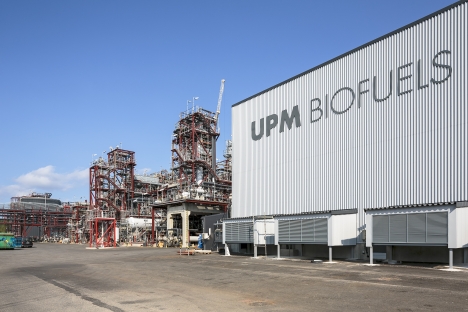
UPM evaluates potential construction of a new biorefinery in Germany

UPM is evaluating the potential of building a biorefinery in the Chemical Park Frankfurt-Höchst in Germany.

According to the announcement, the new-to-the-world biorefinery would combine novel technologies and utilize sustainable wood raw material in an innovative way. This opportunity is the outcome of more than five years of extensive technology development and piloting.

The planned industrial scale biorefinery would convert wood into bio-monoethylene glycol (bMEG), bio-monopropylene glycol (bMPG) and lignin up to 150,000 metric tons per year. Production would be based on hardwood from sustainably managed forests in Central Europe.

UPM will now proceed with a detailed commercial and basic engineering study to verify the attractiveness of the business case. The estimated duration of this phase is about 12 months. If all preparation phases are concluded successfully, UPM would initiate the company’s standard procedure of analysing and preparing an investment decision.

Juuso Konttinen, Vice President, UPM Biochemicals, commented: We are truly excited about this opportunity to bring bio-based products to the market, which would enable replacement of fossil-based materials with new renewable alternatives.

Renewable raw material and efficient processes enable significant reductions in CO2 footprint compared to fossil-based products. Furthermore, wood as a second generation raw material does not compete with food production. These are compelling sustainability arguments for brand owners and their businesses.

Application areas for bio-monoethylene glycol include textiles, bottles, packaging and deicing fluids. Bio-monopropylene glycol is used for example in composites, pharma and cosmetics or detergents. Lignin can be used for example in wood resins, plastics or foams and coatings.

Earlier UPM announced an expansion of the plywood production in Russia.

UPM is largely focused on fibre- and biomass-based businesses, recyclable raw materials and products. UPM integrates bio and forest industries and operates across six business areas: UPM Biorefining, UPM Energy, UPM Raflatac, UPM Paper Asia, UPM Paper ENA (Europe and North America) and UPM Plywood.

LCA provides foundation for new tropical wood promotion campaign

According to the European Timber Trade Federation (ETTF), a 12-strong group of Netherlands Timber Trade Association (NTTA) members is planning to use the findings of two recent Life Cycle Assessment (LCA) projects as the basis of a campaign to promote greater use of sustainable tropical timber.

The campaign will target civil engineers and focus on both sustainable tropical timber’s environmental benefits in relation to climate change mitigation, renewability and low environmental impacts as well as its technical, design and maintenance attributes.

The campaign draws on a 2016 LCA study, backed by the EU Sustainable Tropical Timber Coalition (STTC), on the use of tropical timber for pile planking. It was commissioned from EY Climate Change and Sustainability Services by the NTTA’s Centrum Hout operation with support from FSC Netherlands.

This study put three sustainable tropical species through LCA, alongside planking in plastic. Timber scored significantly better both in overall impact and carbon performance.

Earlier, the Dutch government commissioned a similar comparative study for pedestrian bridges, measuring the LCA performance of tropical timber versus concrete, steel and reinforced composites. Again, tropical wood came out on top.

The promotion campaign will involve meetings for engineers, and distribution of literature, including fact sheets already prepared on sustainable tropical timber and environmental impact, CO2 reduction and the bio-based and the circular economy.

The pile planking study has also generated literature on total cost of ownership of the product through its life, and a design and calculation guide. There is also an online facility to calculate embodied and lifetime in-use carbon performance of a particular timber application.

Africa: Logs & sawnwood prices upward trend on a pause

Central/West African producers report a few minor prices changes for recent sawnwood shipments but log prices have stabilised after the recent bout of weakness for a few species.
Analysts report a pause in the general upward trend in prices and volumes that buoyed the markets through until the end of September. Producers are hoping that the current slowdown in forward orders for China is only a temporary phase as importers and merchants re-balance landed stocks.
The anti-dumping duties the US has imposed on plywood imports from China have resulted in a drastic decline in plywood imports which will impact China’s demand for logs. While this would affect Asia/Pacific log suppliers more than African exporters, some African shippers are already noticing a slight slowdown in orders for okoume logs.
Kevazingo in the news again – exports likely to continue
The latest news from Gabon is that the government has decided not impose the 6 month moratorium on felling, processing and export of kevazingo. It appears that the government plans to consult with the larger millers to select those which may be authorised to process and export this valuable timber which is in very high demand in China.
Kevazingo is CITES listed and inspections and monitoring are to be strengthened to ensure exports are compliant with the CITES regulations.
Rains are still affecting production in Cameroon and Gabon is also now experiencing rains in the north of the country and the south will some be affected.
Generally slow demand all round
The markets in the Middle East continue to be firm and active but producers report that European demand is still dull with no sign from buyers of any sudden increase in orders.
US demand for tropical timbers from Africa is low and seems unlikely to improve even though house starts continue to rise.
For South Africa, prospects for new business appear bleak as the government is not in a position to stimulate demand in the private sector or to release funds for planned infrastructure projects. The forthcoming elections may help to stabilise the situation but, in the meantime, timber trading both domestically and imports is reported at very low levels.
Viewing the fourth quarter market prospects it appears that the subdued market activity will prevail where importers are cautious and exporters ready themselves for stable prices but marginally lower forward sales.
 

Log Export Prices

West Africa logs, FOB € per m³
Asian market
LM
B
BC/C
Acajou/ Khaya/N’Gollon
215↓
215↓
160
Ayous/Obéché/Wawa
245
240
190
Azobe & Ekki
230
230
160
Belli
250
250
Bibolo/Dibétou
180
170
Bilinga
230
230
-
Iroko 325
300
265
Okoume (60% CI, 40% CE, 20% CS) (China only) 245↑ 240 190
Moabi 330 300 235
Movingui 210
200
160
Niove
175
160
Okan
230
205
Padouk
300
275
210
Sapele 260↓ 260↓ 220
Sipo/Utile
290
270
200↓
Tali 330 320

 
Sawnwood Export Prices

West Africa sawnwood, FOB
€ per m³
Ayous FAS GMS 425↓
Bilinga FAS GMS 530
Okoumé FAS GMS
430
Merchantable 320↑
Std/Btr GMS 350
Sipo FAS GMS
540
FAS fixed sizes 560↑
FAS scantlings 560
Padouk FAS GMS 880↑
FAS scantlings 1000↑
Strips 645
Sapele FAS Spanish sizes 505
FAS scantlings 510
Iroko FAS GMS 630
Scantlings 710
Strips
410
Khaya FAS GMS
450↓
FAS fixed
470
Maobi FAS GMS
620
Scantlings
630
Movingui FAS GMS
430

Africa: Logs & sawnwood prices upward trend on a pause

Central/West African producers report a few minor prices changes for recent sawnwood shipments but log prices have stabilised after the recent bout of weakness for a few species.

Analysts report a pause in the general upward trend in prices and volumes that buoyed the markets through until the end of September. Producers are hoping that the current slowdown in forward orders for China is only a temporary phase as importers and merchants re-balance landed stocks.

The anti-dumping duties the US has imposed on plywood imports from China have resulted in a drastic decline in plywood imports which will impact China’s demand for logs. While this would affect Asia/Pacific log suppliers more than African exporters, some African shippers are already noticing a slight slowdown in orders for okoume logs.

Kevazingo in the news again – exports likely to continue

The latest news from Gabon is that the government has decided not impose the 6 month moratorium on felling, processing and export of kevazingo. It appears that the government plans to consult with the larger millers to select those which may be authorised to process and export this valuable timber which is in very high demand in China.

Kevazingo is CITES listed and inspections and monitoring are to be strengthened to ensure exports are compliant with the CITES regulations.

Rains are still affecting production in Cameroon and Gabon is also now experiencing rains in the north of the country and the south will some be affected.

Generally slow demand all round

The markets in the Middle East continue to be firm and active but producers report that European demand is still dull with no sign from buyers of any sudden increase in orders.

US demand for tropical timbers from Africa is low and seems unlikely to improve even though house starts continue to rise.

For South Africa, prospects for new business appear bleak as the government is not in a position to stimulate demand in the private sector or to release funds for planned infrastructure projects. The forthcoming elections may help to stabilise the situation but, in the meantime, timber trading both domestically and imports is reported at very low levels.

Viewing the fourth quarter market prospects it appears that the subdued market activity will prevail where importers are cautious and exporters ready themselves for stable prices but marginally lower forward sales.


Log Export Prices

West Africa logs, FOB € per m³
Asian market
LM
B
BC/C
Acajou/ Khaya/N’Gollon
215↓
215↓
160
Ayous/Obéché/Wawa
245
240
190
Azobe & Ekki
230
230
160
Belli
250
250
Bibolo/Dibétou
180
170
Bilinga
230
230
-
Iroko 325
300
265
Okoume (60% CI, 40% CE, 20% CS) (China only) 245↑ 240 190
Moabi 330 300 235
Movingui 210
200
160
Niove
175
160
Okan
230
205
Padouk
300
275
210
Sapele 260↓ 260↓ 220
Sipo/Utile
290
270
200↓
Tali 330 320


Sawnwood Export Prices

West Africa sawnwood, FOB
€ per m³
Ayous FAS GMS 425↓
Bilinga FAS GMS 530
Okoumé FAS GMS
430
Merchantable 320↑
Std/Btr GMS 350
Sipo FAS GMS
540
FAS fixed sizes 560↑
FAS scantlings 560
Padouk FAS GMS 880↑
FAS scantlings 1000↑
Strips 645
Sapele FAS Spanish sizes 505
FAS scantlings 510
Iroko FAS GMS 630
Scantlings 710
Strips
410
Khaya FAS GMS
450↓
FAS fixed
470
Maobi FAS GMS
620
Scantlings
630
Movingui FAS GMS
430

Interview with Thomas Leissing on Egger Group’s future development in South America

Following the announcement made by the Austrian company Egger Group about the acquire of the industrial assets of Masisa Argentina, Thomas Leissing, spokesman for the group's board of directors, presented back in August in the City of Buenos Aires, the plans that the company developed for the domestic market and the projection of its operations within Latin America.

Leissing also confirmed that Egger Argentina started its activity October 1, becoming the group's first subsidiary outside Europe.

During the meeting in August, Leissing outmarked the expectations the company has once with their arrival to Argentina and highlighted the professional and human quality they observe in the management team.

Throughout the meeting, the manager talked about the investment plans for the Concordia plant in order to adapt it to Egger's production and quality standards; he also said that the plant will help the company expand their products variety starting from the local production and the incorporation of inputs from its global portfolio. Leissing alos announced that the Placentro network will remain a priority commercial channel, although it will change its name and add products and services for professionals and carpenters.
- What are the expectations that Egger has once with the arrival to Argentina?
- We are very happy to have been able to complete this purchase of the industrial assets of Masisa Argentina, and we are also very anxious to start working as Egger Argentina. This operation is very important for the Egger Group because for the first time we are going to produce outside Europe.

In fact, in Argentina will be our first production plant outside Europe. We think it is the right time to make this investment because there are going to be many changes in the country. We are a company that is growing and there are some limitations in Europe for future expansion, mainly derived from the lack of wood, because even in Eastern Europe, the growth rate is still very low. Outside Europe, we sell products worth 200 million dollars annually, but we know that in order to enter a stage of growth in each of the markets we must participate locally. And that is the strategy we are applying with our arrival in Argentina.

- When did the company take the decision to come to Argentina?
- We saw that there is a need to go towards a more open economy in the country and that prompted us to make the decision. But we would not have invested from scratch with a project of a type we call dreamfield because there were already two very important actors on the market. So the decision was to get through the acquisition of one of these actors, in this case Masisa. There are many similarities between what Masisa Argentina is and Egger's philosophy. And that's very good. In addition, we see many things in common in how the Argentine culture treats the design and values ​​the quality, in particular in the furniture sector, and how we put it in Egger, with our clients.

- What is Egger's portfolio made up of?
- We use the boards we make in our plants for three specific things. First, to reach directly the retail segment through the design of furniture for offices and homes, which represents 75% of the portfolio of the group. Clearly this will be strengthened and fed back from the Concordia plant. Another segment in which Egger operates is the construction, mainly with its floors. The third segment is that of complementary products, such as tapacants and laminates, solutions from the melamine base board addressed to the carpenter or end user. This portfolio will be available in Argentina, because Egger wants to offer all of its variety of products to the Argentine market.

- What are your plans for production in Argentina?
- For Egger, the industrial part is very important and the company wishes to keep it at a high level. We are continually investing in new machinery and equipment. We put a very strong focus on the reinvestment of profits in the different units, both administrative and productive.

In the case of the Concordia plant we see that it has development opportunities. We will apply some investments to improve technology and expand capabilities that are going to be analyzed with the local team, to the extent that the market goes along.

The acquisition of the Concordia plant is not an isolated decision, but the unit joins the Egger Group, which will now have around 9,000 employees. Our policy as a company is to invest a lot in training and in generating a team. We remain a family business and one of the key points for the success of our strategy is our people, their training and growth.

We are very respectful regarding the local culture, but at the same time we consider that all the subsidiaries must maintain the same spirit of Egger, as to be able to develop the businesses. That's what unites the company.

In the case of Argentina, we emphasize communication and open minds to new ideas. This will greatly facilitate the integration process. Concordia represents an excellent base for the future growth, since the supply of wood is assured, and we also have a chemical plant and a database of very valuable people. In addition, we are clear that there are many opportunities to gain productivity within the plant with investments in existing machinery.

- Do you have any estimates of these investments?

- As a reference, the Egger Group invests around 400 million dollars globally, every year. Of that figure, about 80 million are to keep the plants running in optimum conditions and the rest is destined for new technology and digital investments.

The latest investments have focused on the digitization, automation and process productivity improvement. In the case of Argentina, we did not come to transfer production from other sides, but to strengthen Egger's position and its regional insertion.

As I said, we still have to sit down with the local team to define the details. We are aware that we have to invest in the plant because it was dedicated to supplying the Argentine market and our intention is to grow regionally, so that future investments will not only be to strengthen local production, but to have more volume to go to other markets. These investments will be in two stages: first, to improve the existing installation on environmental and safety issues and a second stage, where we think of a volume growth for a new facility, aimed at serving other markets.

Surely, we will also integrate a power generation plant that will take advantage of the waste that can not be used in the production of boards.

- Considering that Masisa has been a leader in Argentina in boosting the use of the board and hierarchic it through the design, what strategy will be taken with Egger Argentina?

- We know that Masisa is a step ahead of the competition regarding the way in which it has introduced and commercialized the product in Argentina and, in general, in the region. Even so, Egger has a much broader business model, not only in design, but also in quantity of textures.

But Masisa introduced in Argentina a marketing strategy that raised the level of competition in the local market for boards and furniture, with a very high degree of influence on designers, architects and manufacturers. Now, clearly, we are entering a new stage of growth, combining the 24-year local experience with a much broader product portfolio and a strategic vision of a world leader.

In this strategy we will incorporate new products, starting from the local production all the way to importing the products. Fundamentally, the largest volumes will be produced locally, but we will bring a range of complementary products that, by the scale of production, we will not manufacture locally.

- Within that strategy, what will happen with the Placacentro network?

- The Placancentro network that Egger acquired in this operation includes Argentina, Uruguay and Paraguay and reaches 57 businesses that we do not own, but belong to 43 different owners throughout the network, mainly family SMEs.

In turn, Network M, which brings together more than 9,000 members, also entered the operation because it is associated with the Placacentros network. For Egger, the network of Placacentros is fundamental, and we find very interesting the way in which it has developed and we will make it our distribution network.

We will strengthen the existing business model with the possibility of incorporating new products, so that for each of the Placacentros the possibilities will be greatly expanded under the Egger brand.

- Will they keep the brand?

- The brand will change, not only the brand Masisa, but also the Placacentro brand. It is not yet defined what will be the new brand, but this is going to reveal in the coming weeks. For that, the local marketing team will travel to Austria and will visit the plants and shopping centers to understand the best synergy between the two companies and create the best business model, but maintaining the concept of what today means the Placacentro.

In addition, we are positively surprised to have found the Red M program: we have the same program in Europe, where we cultivate a very close relationship with the carpenters. We will also enhance that brand, but it will change its name. Egger is a strong brand at level global, with a broader portfolio of products, so we will make a change to the new brand and we will begin to work on its positioning in the Argentine market quickly.

Thomas Leissing weighed the advantage that Egger has in Argentina in the face of a more restrictive supply context in Europe today: "Due to the subsidy scheme that exists in Europe for bioenergy, sawmill waste is mainly going to production of pellets, instead of going to the production of boards. It is a profound cultural change that impacts our activity. The compensation of the lack of wood that this provokes for our plants we do it through the use of recycled material of the constructions of wood of different cities. But you always need the forest. In the case of Argentina, we have signed a contract to supply wood with the Masisa forestry branch in the country for a long period, which guarantees the supply of raw material for a long-term operation."

Source: Asora Madera&Tecnología

Wood products prices drop in Germany

In August, the German producer prices for wood products have predominantly tended downwards. Compared to July, only boards, battens and stock timber were on a rising price trend.
Eight of the 17 analyzed wood products have become cheaper over the previous month, while six show an unchanged price level. The price for laminate flooring, raw particleboard and KVH has declined.
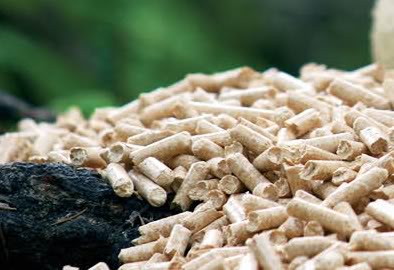
Year on year the picture is almost balanced. Almost half of the index values ​​rose, while the rest dropped. Especially hardwood assortments are more expensive than a year ago. Engineered wood assortments show a mixed performance while softwood products are mostly cheaper. The price of pellets is 8 percent lower than last year.

Producer price indices of industrial products 
(2000 = 100)

Aug 2016

July 
2017

Aug 2017

Change.  
August '16  
to '17

Spruce and Fir lumber (Picea abies Karst.)

116.4

114.7

112.8

-3.09%

Lumber according to DIN 4074/S10

116.6

117.1

115.1

-1.28%

Finger-jointed squares and beams (KVH)

104.4

99.3

98.5

-5.65%

Boards, width 16 cm

122.6

123.0

124.1

+ 1:22%

Boards, width from 8 to 16 cm, size from 15 to 24 mm

110.6

111.1

110.2

-0.36%

Battens according to DIN 4074/S10

121.7

118.7

120.3

-1.15%

Stock timber A / B, 10X10-12X12

114.2

115.8

116.0

+ 1:57%

Softwood, size>6mm, planed, sanded, finger-jointed

112.4

111.2

110.9

-1.33%

Wood chips from softwood

96.4

99.8

99.8

+ 3:52%

Pellets and Briquets, compressed

117.5

107.9

107.9

-8.08%

Hardwood lumber

108.9

111.7

111.7

+ 2:57%

Beech blocks, A/B, size 50-60 mm, length 3m, damped

102.3

106.8

106.8

+ 4.39%

Beech frames, size 26-32 mm, length  3m, undamped

109.6

112.2

112.2

+ 2.37%

Chipboard

117.1

114.5

112.7

-3.75%

Particle boards, laminated with decor

113.9

115.2

115.2

+ 1:22%

HDF panels, size > 800 kg/m³, raw/sanded

112.1

114.4

114.2

+ 1.87%

Laminate floorings, density > 800 kg/m³

109.1

110.2

107.9

-1.09%

Newsletter

Subscribe to our digital newsletter for your daily digest of essential news, views and analysis from the international wood industry delivered directly to your inbox.


0