
Article archive

Italian woodworking machinery sector increases foreign orders by 51.5% in Q3/2017

The Italian woodworking machinery and tools sector closed its Q3/2017 with an order increase of 42.9%, as compared to the same period last year.

According to the results of the periodical trend survey by the Studies Office of Acimall (Italian Woodworking Machinery and Tools Manufacturers' Association), foreign orders got a 51.5% growth (versus 34.8% in second quarter 2017) and were the driving force behind this excellent trend.

Domestic orders were also very positive. Acimall reports that after some indecision at the beginning of the year, waiting for the application guidelines of the recent “Industria 4.0” plan by the Italian government, in Q3-2017 orders were up a healthy 19.7 percent.

Moderate optimism is also emerging from the forecast survey: 32 percent of respondents expect expanding orders from abroad in the short term, while 68 percent predict a stationary trend. The domestic market is expanding according to 21 percent of the sample; it will remain stable according to 63 percent and shrink according to 16 percent.

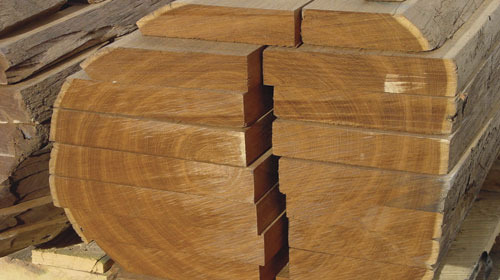
Overview of the global forest industry in Q3/2017

The strong softwood fiber global prices, led by the US dollar weakening and the growing demand from China have risen the Global Sawlog Price Index to U$75.69/m3 in Q3/2017. 
Global Timber Market
Sawlog prices were up in most regions of the world in the 3Q/17. The price increases from the 2Q/17 were generally smaller in the local currencies than in US dollar terms because of the weakening US dollar, according to the latest Wood Resource Quarterly.
The Global Sawlog Price Index (GSPI) has gone up for three consecutive quarters to reach $75.69/m3 in the 3Q/17, while the Euro-based European Sawlog Price Index (ESPI-€) also trended upward the past year, but at a slower pace than the GSPI.
Global Pulpwood Price
Wood fiber costs increased for wood pulp manufacturers in most regions of the world in the 3Q/17, with the biggest increases in cost being for hardwood fiber, while the Global Hardwood Fiber Price Index (HFPI) was up 2.9% quarter-overquarter in the 3Q/17. The HFPI has trended upwards for the past 18 months and was seven percent higher in the 3Q/17 than at its 16-year low in the 1Q/16.
Softwood fiber prices were also going up during the 3Q/17, mainly because of a weakening US dollar and the Global Softwood Fiber Price Index (SFPI), which had been steady for three consecutive quarters, jumped almost four percent in the 3Q/17 from the previous quarter to reach US$88.21/odmt.
Global Pulp Markets
Global production of market pulp has increased in all major pulp-producing regions in 2017. As has been the case for a number of years, Latin American pulpmills have expanded output the most, with production during the first eight months of 2017 being four percent higher than during the same period in 2016.
The strong demand for pulp has moved prices for both softwood pulp (NBSK) and hardwood pulp (BHK) upward for more than a year. Prices for BHK have increased faster than those of NBSK and in October, were close to par for the first time in over two years.
Global Lumber Markets
Demand for imported softwood lumber to the US has fallen by six percent during the first nine months of 2017 as compared to the same period in 2016. This contrasts with the world’s second largest lumber importer, China, to which import volumes have been up by 21% year-over-year. The lumber trade in Europe has also picked up in 2017, with the United Kingdom, the Netherlands, Austria, Denmark, and Spain having increased imports the most so far in 2017, reports the WRQ. Countries in the Middle East and North Africa, also known as the MENA countries, have sharply reduced consumption of lumber this year. In the first eight months of 2017, Egypt and Algeria have decreased imports by 24% and 39% respectively.
The increase in US lumber demand during the third quarter was met by higher domestic production both in the South and the West, while lumber prices in both Finland and Sweden have strengthened in 2017, and in August, reached their highest levels since early 2015. Healthy domestic demand for lumber and strong export markets both contributed to the upward price trajectory.
Average import prices to China have continued their three-year climb to reach $190/m3 in September and the Russian sawmilling sector continues to add capacity in Siberia and the Far East, targeting the expanding demand for lumber in China. Just during the first eight months of this year, Russia increased shipments to China by 23% as compared to the same period in 2016.
Global Biomass Markets
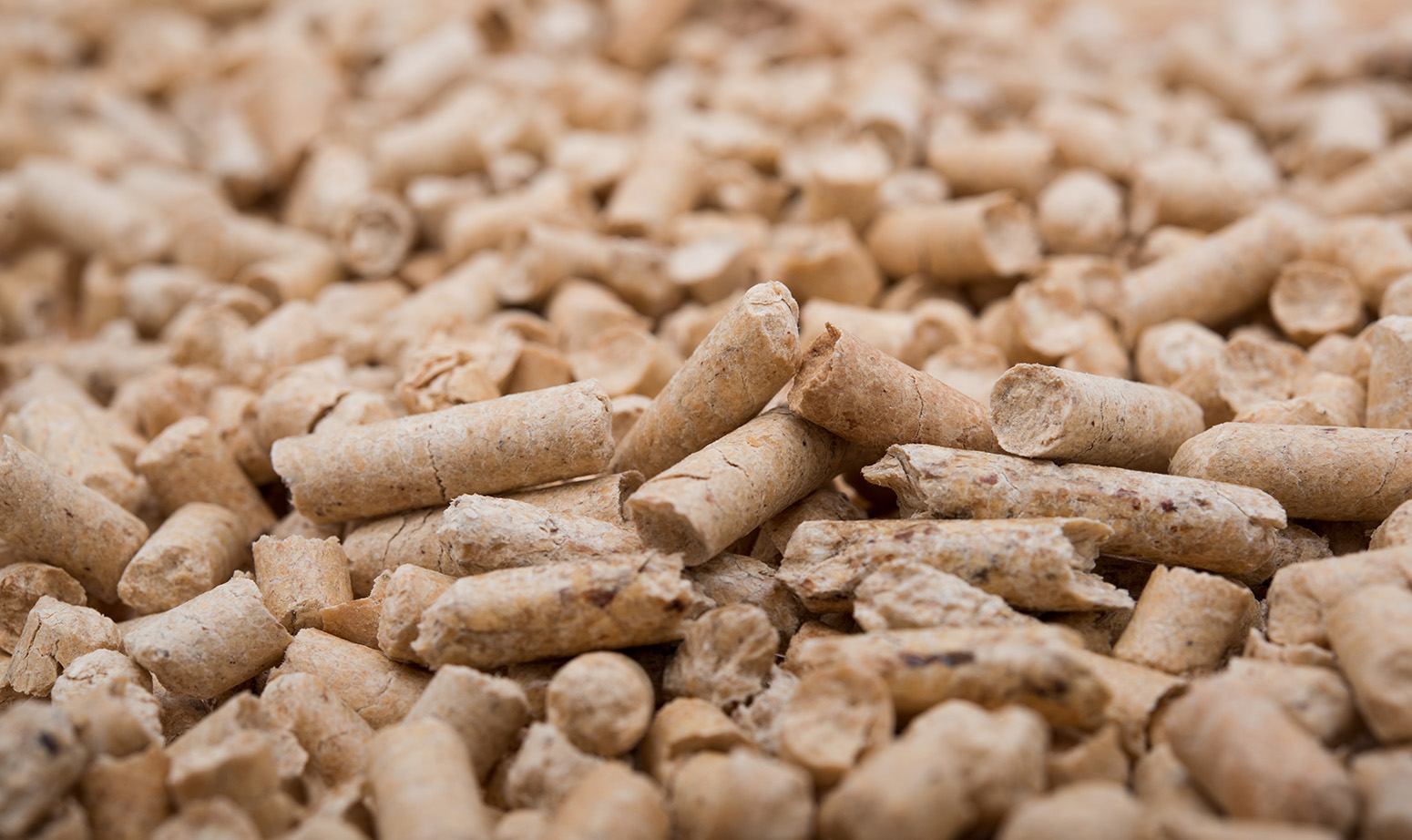
It is likely that 2017 will be another year of record trade of wood pellets. The biggest increases in shipments to the major markets this year have been in pellets bound for Denmark, South Korea and Italy.

Latest prices for Indian teak, sawnwood and plywood

The price list for teak, sawnwood and plywood between 1-15 November, 2017.
Plantation teak prices

US$ per cu.m C&F
Angola logs 389-574
Belize logs 350-400
Benin logs 290-714
Benin sawn 530-872
Brazil logs 344-540
Brazil squares 333-556
Cameroon logs 405-616
Colombia logs 478-743
Congo D. R. logs 450-761
Costa Rica logs 357-780
Côte d'Ivoire logs 289-756
Ecuador squares 333-454
El-Salvador logs 320-732
Ghana logs 294-452
Guatemala logs 324-646
Guyana logs 300-450
Kenya logs 515-876
Laos logs 300-605
Liberia logs 265-460
Malaysian logs 225-516
Mexican logs 295-808
Nicaragua logs 402-505
Panama logs 335-475
PNG logs 443-575
Sudan logs 358-556
Tanzania, teak, sawn 307-613
Thailand logs 511-700
Togo logs 334-590
Trinidad and Tobago logs 603-753
Uganda logs 411-623
Uganda Teak sawn 680-900
Price range depends mainly on length and cross section

Prices for locally sawn imported hardwoods
Prices for imported hardwoods remain unchanged. Traders report demand is firming as hardwoods begin to take market share from imported teak where quality has been declining in recent months.

Sawnwood, (Ex-mill) (AD) Rs. per ft3
Merbau
3200-3500
Balau
2000-2100
Resak
1350-1550
Kapur
1750-1850
Kempas
1250-1400
Red Meranti
1100-1200
Radiata pine AD
600-700
Whitewood
650-750
Price range depends mainly on length and cross section

Myanmar teak prices
Importers say the availability of sawn Myanmar teak is satisfactory but that domestic sales are flat because the price of Myanmar teak is high compared to alternative hardwoods.

Sawnwood (Ex-mill) Rs. per ft3
Myanmar Teak (AD)
Export Grade F.E.Q.
9000-16000
Plantation Teak A grade
7000-8000
Plantation Teak B grade
5000-6000
Plantation Teak FAS grade
3500-4000
Price variations depend mainly on length and cross section.

Prices for imported sawnwood
Prices for imported sawnwood (KD 12%) remain unchanged.

Sawnwood, (Ex-warehouse) (KD) Rs per ft3
Beech 1350-1450
Sycamore 1500-1650
Red oak 1600-1750
White Oak 2200-2250
American Walnut 4250-4500
Hemlock clear grade 1200-1400
Hemlock AB grade 1200-1250
Western Red Cedar 1850-2000
Douglas Fir 1550-1750
Price variations depend mainly on length and cross section.

Prices for WBP marine grade manufactured by domestic mills
At its 23rd meeting the GST Council almost 200 items were shifted from the upper tax bracket of 28% to 18%. Amongst the items which will enjoy a lower GST are plywood and panel products.
This has been welcomed by manufacturers who have lobbied strongly for a lower tax.

Plywood, Rs per sq.ft
Ex-warehouse. (MR Quality)
4 mm 50
6 mm 67
9 mm 85
12 mm 105
15 mm 140
18 mm 147

Domestic ex-warehouse prices for locally manufactured MR plywood

Locally Manufactured
Plywood “Commercial
Grade”
Rs per sq.ft
Rubberwood Hardwood
4mm Rs.25.0 Rs.37
6mm Rs.37.75 Rs.48
8mm Rs.48 Rs.58
12mm Rs.58 Rs.69.5
15mm Rs.70.5 Rs.84.25
19mm RS.80.25 Rs.95
5mm Flexible ply Rs.50

Source: ITTO

IHC conference in Venice pointed out current developments for the global hardwood sector

On 15 and 16 November 2017 the International Hardwood Conference took place in Venice. Several speakers pointed out recent achievements of the hardwood industry as well as their threats and challenges as there are illegal logging and trade and at least partly a lack of raw material.

Outstanding hardwood projects

Italian hardwood furniture maker Riva has formed a marketing relationship with Lamborghini, branding a new range after the supercar marque and backing it with high-octane promotion (www.riva1920.it)

At the same time, sports stadia architects Populous have incorporated 11 American white oak glulam beams as core structural components of a new stand at the Lord’s Cricket Ground in London. At 23m long and four tonnes each, they are thought to be Europe’s largest cantilevered engineered timber beams, not to mention a structural application first for white oak (www.americanhardwood.org).

And in another hardwood twist, the ‘Fair and Precious’ branding initiative has been launched by the International Tropical Timber Technical Association (ATIBT), underlining the economic, environmental and social value of the tropical sector.

Each of these projects formed a speaker topic at the 2017 International Hardwood Conference, appropriately held in Venice, a city, which CNR Ivalsa researcher Nicola Macchioni explained to the 150-strong, 17-nationality IHC audience, was built on an ingenious foundation system of largely hardwood piles. With these and other upbeat presentations, the IHC communicated a confident, international hardwood industry that’s adapting to market needs.

Challenges: Illegal logging, raw material supply and the ‘800 pound gorilla’

But the event, organised by Italian trade federation Fedecomlegno in association with the European Timber Trade Federation and European Organisation of Sawmill Industries (EOS), wasn’t 100% positivity. It acknowledged too that the sector had obstacles to overcome. Illegal logging and trade remained significant issues and verifying the legality and sustainability of the bona fide industry’s products could also prove complex, said speakers. Ensuring raw material supply, given growing worldwide demand, was another challenge.

The consensus was that the hardwood business has exciting opportunities, but operates in an ever faster moving, more competitive market. Key issues highlighted were globalization and seismic geographical shifts in consumption to emerging markets, notably, although not exclusively, China, or as AHEC Executive Director Mike Snow put it, the ‘800 pound gorilla in the room’.

In his welcome address Fedecomlegno chairman and CEO of Legnonord Spa Alessandro Calcateterra summarized the sector’s position. “Average per capita wood consumption is still just 0.5%, so there’s huge growth capacity,” he said. “In fact global roundwood demand is forecast to rise 60% by 2030. This makes it ever more critical to address where timber comes from, how it’s produced (FAO experts forecasts one third will come from plantations by then) and where it should be used.”

Hardwood log exports: A crucial issue for European sawmills

EOS president Sampsa Auvinen also highlighted industry challenges. In Europe, he said, the hardwood sector had to contend with a stubborn lack of growth despite economic recovery. In fact sawmill numbers in France, Germany and Belgium alone were down 30% in the last decade. This was partly due to industry concentration in the downturn, but there was also the crucial issue of increasing log exports to emerging economies. “We have great opportunities to capitalize on hardwood’s performance characteristics,” said Mr Auvinen. “But, while avoiding protectionism, we must insist on a level international timber procurement playing field. Without raw material the European sawmill industry will be forced out of the market.

Global trade trends: Flat market with strong rise of consumption in Asia

In his international market overview, analyst Rupert Oliver of Forest Industries Intelligence said latest statistics showed global hardwood trade static at around $35 billion, underlining a continuing and ‘disappointing’ lack of market value growth since the 2000s. “Since then global population has increased by 1 billion, with 1.4 billion people taken out of poverty, so you’d expect more growth,” he said. “But bar a surge in rosewood trade in 2014, market value has been flat.” However, underlying this outwardly static picture was a dramatic shift in the balance of hardwood market power, both in terms of log and sawnwood consumption, to Asia.

India had been a hardwood log consumer on the rise, but blocks on teak exports from Myanmar and Malaysian supply issues had seen its transition to more lumber buying. But log imports by China, and to a lesser extent Vietnam and other Asian hardwood product manufacturers, continued their inexorable rise. In fact Chinese imports hit 14.3 million metric tonnes in 2015, with 15.4 million tonnes forecast for 2016.

In sawn hardwood, total global temperate trade was worth around $6 billion in 2016 and tropical $4.5 billion, with the US the single leading exporter and Thailand biggest tropical supplier. China again was the consumer making the headlines with imports this year expected to be nine million tonnes, up from 2016’s eight million and including around 1.5 million tonnes from the US alone.

Mr Oliver concluded that the hardwood sector may struggle near term to grow trade volumes, but had opportunities to increase value. Difficulties to overcome included over reliance on a few species, limitations of current environmental controls to halt illegal trade and industry fragmentation, which limited opportunities for concerted promotion and investment, including in plantation development. But positives were revived interest among specifiers in real wood as opposed to substitutes, development of higher specification engineered and modified hardwood products and emergence of more realistic risk-based assurance of legality and sustainability. “Latest technology can also better evaluate trade data and reduce sustainability certification cost,” he said.

America's hardwood transition: Lower production, higher exports, notably to China

Mike Snow’s topic was a US hardwood sector in dramatic transformation for the past 10-15 years. The economic and construction crisis of the late 2000s and before that US manufacturing’s migration to lower labour cost countries, saw sawn hardwood output slump. It has since recovered, but is still 4.2 billion bd ft below 1999’s 12.6 billion peak.

At the same time, reflecting decline in domestic construction and hardwood manufacturing demand, mills have refocused on industrial lumber for the US market and grade exports. “In 2005 grade lumber accounted for 59.7% of US output, today that’s 48%,” said Mr Snow. “Moreover, 45% of it is now exported and rising, compared to 17% in 2000.

China’s role in this evolution has been central, accounting for all US sawn hardwood export growth since 1992, and today buying 25% of the boards America produces. US exports to China have grown particularly rapidly since the international economic crisis, thanks to the potent combination of contraction in the American domestic market and the rise of China’s new middle class, firing growth in its domestic consumption. “In 2000 85% of our exports to China were re-exported as finished goods,” said Mr Snow. “Today 80% goes into products for its domestic market.”

Asked which country will be the ‘next China’, Mr Snow’s response is China thanks to accelerating development of its less industrialised western regions. US mills see this as a further lumber market opportunity, however, their growing concern is the accompanying rise in China’s log imports. “So far logs have gone mainly to finished goods makers processing timber for their requirements,” said Mr Snow. “The concern now is emergence of Chinese mills cutting US logs for the general market.

Europe in focus: shrinking market and raw material issues

The European market described by ETTF and EOS Presidents Andreas von Möller and Nicolae Tucunel is also a blend of challenge and opportunity. Mr von Moller described the EU’s shrinking tropical timber business – with total imports down from 8 million m3 in 2000 to 2 million m3 in 2014 – as  ‘sad’. It was partly due, he said, to the recession, but market misconceptions about its environmental credentials also contributed.

While renewed effort was needed to halt this trend, however there were overall European hardwood market positives, notably broad economic and construction recovery. While the UK’s outlook may look uncertain due to Brexit, most European economies, and importantly their construction industries, were growing. So far this had led only to hardwood market stability since 2013. “But after recession, stability is not a bad thing,” said Mr von Möller.

Mr Tucunel reported forecast 2017 total European hardwood production at 10.8 million m3, imports at 3.4 million, exports 5.7 million and consumption 8.6 million, all roughly on a level with 2016 figures. Turning to his own country Romania, Mr Tucunel said it remained a leading European hardwood producer, with annual sawn output of 1.7 million m3. But its private sector mills were increasingly hindered by raw material availability due to a harvest decrease from 19 million m3 to 17 million m3, caused in part by “excessive” NGO-driven environmental legislation”. “This has led to mills restricting output, even closing,” said Mr Tucunel.

Legality regulation and trade regionalization: Tropical timber imports swing to emerging countries

Raw material availability and distribution also formed a core theme for Davide Pettenella of Padua University.  He addressed whether national and regional timber legality controls were creating a ‘dual market’ for tropical timber.

His study compared trends in primary tropical timber product imports by EU states, the USA and Australia, representing developed countries with strict timber market legality regulation, and China, Vietnam and India representing emerging consumers with lighter controls. This highlighted import swings to the latter. In 2001 of all tropical timber imported by these countries, the developed economies accounted for 63% by volume and 72% by value, the emerging countries for 37% and 28%. Today the respective division is 44% and 47% and 56% and 53%.

While legality controls may be implicated in this trend, Mr Pettenella said it was not the exclusive factor. “Emerging countries’ economic development and increasing south-south trade are also involved,” he said. In fact, his conclusion was that the trade trend influencer to monitor was the latter and other intra-regional trade growth. “It’s a phenomenon which should be of concern to policy makers,” said Mr Pettenella. “In 1990, there were just 20 regional trade agreements. Today there are 283.”

Looking at future forest product supply and flows, consultant Pierre Desclos concluded that rising population could also boost intra regional consumption. “For instance, Africa has 15% of the world’s forests, but it’s forecast to have a third of its population by 2100, so will be consuming most of its own timber.” He agreed that this will increase pressure on the timber industry to both manage the forest resource more sustainably and use wood to its full potential.

New hardwood applications

Head of the European Hardwood Innovation Alliance Andreas Kleinschmit von Lengefeld described the role of his organization in this. “Working closely with the industry, we're evaluating the potential outcomes of research into areas ranging from forest management systems, to development of new cellulose fibres, and hardwood in smart buildings,” he said.

David Venables from AHEC took the topic further, describing US hardwood innovation now gaining market traction. The massive American white oak glulam beams at the Lords Cricket Ground were one example. Perhaps even more significant was development of tulipwood cross laminated timber for structural application. The material first formed the core structure of two global headline grabbing AHEC showcase projects at the London Design Festival; Endless Stair and The Smile. Subsequently the same material was used in a cancer care centre in northern England, the first permanent building constructed in hardwood CLT.

Architects and engineers are increasingly convinced of hardwood’s structural potential – in fact they’re our best ambassadors for it,” said Mr Venables, “And global CLT production is set to hit 1 million m3 next year. Softwood dominates the sector, but imagine if hardwood took just a small percentage!

Branding initiatives: Rising awareness for hardwood through market value as well as beauty and performance

Meanwhile Fair & Precious, explained Benoit Jobbé-Duval from ATIBT, was a potentially powerful new tool to raise awareness and increase marketability of sustainably sourced tropical hardwood. The brand, commits users across the supply chain to verified sustainability and corporate social responsibility goals in procurement. “The aim is to advance hardwood sustainability by enhancing its market value,” said Mr Jobbé-Duval.

Hardwood’s other new branding exercise, Riva’s collaboration with Lamborghini, centres on beauty and performance. “It works because we share a passion for quality and design and a commitment to using the finest raw materials,” said Maurizio Riva.

On another upbeat note, Elvio Florian, Chief Executive of Italian hardwood producer and IHC sponsor Florian Legno, described how through an integrated production line approach, timber companies in developed economies can survive and prosper. Started in 1950, his business now comprises 16 companies, employs 900 people and processes 300,000 m3 of timber annually.

Estonian spruce logs reach new price record level

In October, the prices of nearly all roundwood product ranges in Estonia have risen, as compared to the same period last year and to September 2017. Only pine and aspen logs have declined, as compared to the previous month.
Due to the further increase of spruce prices to a new record level, the spruce in October is more expensive than pine.
Pine logs' prices dropped by 1%, as compared to September and aspen logs went down by 0.9%. All other assortments have risen, most of all the pulpwood assortments.
Compared with the same period of 2016, all roundwood product ranges increased. In particular, softwood logs became significantly more expensive, with prices rising beyond 10%. Birch wood also increased by 9%, while only the price for aspen wood has developed much slower.

Oct'16 €/m3 Sep'17 €/m3 Oct'17 €/m3 Change% Oct 16/ Oct 17 Change % Sep/ Oct 17
Pine 64,38 68,67 67,97 5,58% -1,02%
Pine d<18cm 52,34 53,56 55,84 6,69% 4,26%
Spruce 63,28 67,06 68,54 8,31% 2,21%
Spruce d<18cm 49,52 52,91 54,18 9,41% 2,40%
Birch veneer 104,69 109,97 113,41 8,33% 3,13%
Birch 59,18 60,72 60,92 2,94% 0,33%
Aspen 30,86 34,18 33,87 9,75% -0,91%
Pine pulpwood 24,35 28,08 28,18 15,73% 0,36%
Spruce pulpwood 24,09 25,56 26,90 11,66% 5,24%
Birch pulpwood 24,05 24,28 26,26 9,19% 8,15%
Aspen pulpwood 19,43 18,89 20,02 3,04% 5,98%
Firewood 19,41 19,94 20,75 6,90% 4,06%

Drax starts production at former German Pellets wood pellet plant in Louisiana

Drax Biomass Inc. (DBI) began start up production this week at its newest facility, LaSalle BioEnergy in Urania, Louisiana.

This is a very exciting moment, we have a dedicated and motivated work force that after months of upgrades, retrofits, and training is ready to produce,” said Pete Madden, President and CEO of Drax Biomass. “We knew this was a strong facility, in an ideal location and we are eager for it to come online.”

LaSalle BioEnergy will employee approximately 78 employees and is the third pellet plant in DBI’s portfolio including Morehouse BioEnergy in Bastrop, Louisiana and Amite BioEnergy in Gloster, Mississippi. The wood pellet manufacturing facility, which is roughly 160 miles northwest of Baton Rouge can produce approximately 450,000 metric tons of wood pellets per year.

A series of upgrades and repairs have been ongoing at the plant since the acquisition in early April of 2017, supporting a further investment of more than US$20 million for the region. The asset was a strategic investment considering LaSalle BioEnergy’s proximity to an abundant wood basket and its production capacity that supports DBI’s strategy of increasing self-supply.

LaSalle BioEnergy further demonstrates DBI’s commitment to the revitalisation of the local wood products sector, which has suffered in recent years from the closure of several large-scale paper mills. Drax Biomass is committed to expanding its positive presence and supporting the communities in which it operates by promoting sustainable forestry and investing in local economic development.

Back in April 2017, Drax acquired Louisiana Pellets, a former wood pellet plant which belonged to German Pellets.

Asian biomass market development leads to promising outlooks

The bioenergy market in Asia Pacific is still fairly immature compared to the European market. However, recent developments have led to expectations of significant demand that could lead to this region quickly surpassing the European market in terms of traded volumes.

As of March 2017, the amount of certified capacity under “general wood and agriculture waste” has, with 11.4 GW, already far surpassed the bioenergy targets initially defined by the Japanese government (2.7 to 4.0 GWe).

If all the projects awarded feed-in tariff (FIT) contracts under this category go ahead, biomass demand could reach 47 million oven dry metric tons (ODMT) by 2021. Announced bioenergy projects in South Korea are also expected to increase current wood biomass import demand from 2 million ODMT to up to 12 million ODMT by 2024.

Biomass Sourcing Strategies

Bioenergy projects in Asia Pacific are mainly targeting industrial wood pellets, woodchips and palm kernel shells (PKS) as biomass fuel. As these feedstocks all have different characteristics, the technical design of each bioenergy plant will need to be tailored according to the biomass feedstock mix, in order to maximize efficiencies and minimize operating costs.

Detailed trade-off analysis, covering different biomass supply chains and technical designs, will afford developers and their investors a better understanding of expected returns and underlying risks, and help define risk mitigation strategies.

Even though some project developers have already formulated biomass sourcing strategies, the actual implementation of these strategies may yet change in reaction to future market conditions and requirements brought forward by investors.

The Japanese market is especially characterized by a high level of uncertainty regarding preferred biomass fuel assortments, and stakeholders will have to develop in-depth market knowledge and prepare strategies covering a range of potential future market scenarios.

Despite a theoretical potential of approximately 15 million metric tons of PKS in Indonesia and Malaysia, only a limited share of these volumes will be available in the long run to meet demand from Japan and South Korea.

The PKS market will experience considerable changes going forward; increased mobilization efforts from international buyers in combination with often challenging inland logistics, and further increasing domestic demand for PKS as biomass fuel, are likely to result in considerable price increases.

The majority of biomass fuel imports into Japan and South Korea will need to come in the form of industrial wood pellets or wood chips, both of which largely come from the same fiber resource base.

Thus, before defining long-term biomass sourcing strategies, a detailed understanding of current and future wood fiber availability in potential supply regions is required, in order to develop a clear understanding of the risk of upcoming fiber shortages and price increases.

Such assessments will also need to consider competing demand from and market expectations of other wood consuming industries, such as pulp and paper, and wood products.

For example, the Japanese and Chinese pulp and paper industries, both of which are currently importing around 10 million ODMT of wood chips per year, might be wary of the increasing demand pressure, and its effect on international wood chip markets.

Supply Chain Opportunity 

Additional challenges come from the short timelines for developing and implementing sourcing strategies, as projects in Japan have a window of only three years from receiving a FIT contract to the start of operations.

This does not allow for the development of significant additional forest plantation resources, and buyers will have to contend for the existing resource base in the short- to medium-term. Competition for existing supply opportunities will be intense, and buyers will have to mobilize resources from further afield, with associated higher transport costs.

Not only could this increase supply costs, at least initially, it could also lead to less favorable carbon footprints, negating some of the positive impact bioenergy can have on net carbon emissions in the power sector. Project cancellations can also be expected, as developers are likely to struggle to secure long-term supply contracts for the required biomass assortments at affordable price levels.

The expectation of significant demand increases in Japan and South Korea offers interesting opportunities for a range of stakeholders across wood pellet and wood chip supply chains. Indonesia, Malaysia, Thailand and Vietnam are attractive supply sources where production capacity can be expanded, drawing on a mixture of roundwood from fast-growing forestry plantations, residues from wood processing industries, and other residue sources such as rubber wood plantations.

Other regions, such as the Russian Far East, western Canada, Brazil and Australia are also expected to play important roles as potential supply regions, due to an existing biomass surplus and the potential for establishment of new plantations.

Several developers of bioenergy projects in Japan and South Korea have also shown intent to invest upstream, by acquiring or co-investing in existing biomass supply projects, or by developing their own greenfield projects.

However, any upstream integration strategy that does not cover the full supply chain still leaves the risk of increasing biomass raw material prices, or even supply shortages, potentially increasing investors’ exposure to risk.

Only full upstream integration strategies, similar to strategies employed by Japanese pulp and paper producers, can provide a high level of supply and price security. In any case, such ventures will require comprehensive project due diligence covering all aspects of the supply chain, followed by a sound implementation strategy to successfully secure financing.

The Japanese and South Korean biopower sectors are set to be the driving force behind substantial changes in dynamics for international biomass markets, and stakeholders will have to tackle considerable uncertainties.

Resource owners, biomass suppliers, and bioenergy producers need to develop a sound understanding of short-, medium- and long-term price trends for each biomass assortment to avoid entering into unfavorable or unsustainable long-term fuel supply agreements.

Source: Poyry

Vietnam’s wood products exports reach a 11.3% rise in the first nine months of 2017

Vietnam's turnover for wood and woodwork during the first nine months of 2017 amounted to $5.55 billion, representing a 11.3% increase over the same period of 2016.

The Vietnamese companies usually export more in the last months of year and, therefore, analysts predict that the total export turnover in 2017 will reach $8 billion, or 14% higher than last year. In 2016, the export turnover of wood, non-wood forestry products and woodwork was $7.3 percent, of which wooden exports brought $5.12 billion, up by 7.1 percent over the year before, Vietnam Net reported.

Huynh Van Hanh, deputy chair of the Handicraft and Wood Industry Association of HCMC (Hawa), explained that companies obtained two-digit export growth rate this year because they invested in technology and design.

Many enterprises expanded their factories and set up more production lines with advanced technologies. Others increased investment capital by two or three times. The moves helped them obtain more orders from importers. In the past, Vietnamese enterprises simply did outsourcing according to the designs given to them. But now, they design new products and export products under their own names, according to Vietnam Net.

The Vietnamese companies can now afford modern technologies and install new production lines, which would raise the productivity value by $15,000 per year.

Also, the Vietnamese manufacturers on the domestic market target the high-end market segment, which was previously dominated by imports. At some construction works, 80 percent of woodwork is made in Vietnam. The domestic market grew by 5-6 percent per annum and the consumption is expected to increase to $2 billion this year.

Vietnam only imports $68 million worth of wooden furniture products every year, mostly from China.

Belgian furniture industry turnover drops in H1/2017

The Belgian furniture industry underwent a 0.4% decline in its turnover for the first half of the year, to EUR 1,262 billion, as compared to the same period last year.

The 1.6% growth experienced during the Q1 of the year contrasted with the -2.3% decline registered in the Q2. Still, there was no chance for the industry to reach the 3.6% increase from 2016 for the whole half year period.

With the exception of office and shop furniture, the Fedustria association records declines in turnover for all subdivisions. The most serious decline in the first half year was -4.4% experienced by manufacturers of kitchen furniture. In the area of living room furniture, which includes chairs, seating furniture, living room, dining room and bedroom furniture as well as garden and patio furniture, turnover declined by 1.8%.

The turnover for mattresses and beds was 1.5% down on last year’s figure. In the category of office and shop furniture, by contrast, an increase of 6.4% was achieved. This category had already achieved the highest growth rates over the entire period of 2016 (+7.1%) and in the first quarter of 2017 (+8.6%).

Lumber prices in the US slipped at the end of November

Framing lumber trading in the US was constant during last week in some species, while buyers pulled back in others.
Caution was most pronounced in Western and Eastern S-P-F; mills rode order files, but prices softened as prompt offerings emerged. Wary buyers noted historically high prices weighed on their confidence, given the time of year and a futures market that maintained an unusually deep discount to cash.
The Random Lengths Framing Lumber Composite Price slipped $2.

Week
Dec 1
Week
Nov 22
Year Ago
2016
Random Lengths Framing Lumber Composite Price* $436 $438 $355
KD Western S-P-F #2&Btr 2x4 R/L Mill Price 478 489 324
KD Eastern S-P-F #1&2 2x4 R/L, delivered Great Lakes 547 555 403
Green Douglas Fir Std&Btr 2x4 R/L (Portland) 460 458 338
Southern Pine (Westside) #2 2x4 R/L 448 438 434
KD Coast Hem-Fir #2&Btr 2x4 R/L 490 490 342
Ponderosa Pine (Inland) #2&Btr 1x12 R/L 730 730 625
* Weighted average of 15 key items

Random Lengths Panel Market Report
Structural panel markets displayed more liquidity, but most sales required discounts. Price erosion covered the gamut in OSB.
Discounts of as much as $40 were reported in some regions, while signs of stability emerged elsewhere. An uptick in Southern Pine plywood sales Wednesday nurtured an improved tone in the market, but downward price pressure in rated sheathing remained.
After a slow start to the week in western Fir plywood, activity picked up on Wednesday.

(f.o.b. mill prices) Week
Dec 1
Week
Nov 22
Year Ago
2016
Random Lengths Structural Panel Composite Price* $433 $451 $364
Southern (west-east) 15/32-inch 3-ply rated sheathing plywood 405-470 415-485 348-380
Southern (west-east) 15/32-inch 4-ply rated sheathing plywood 410-475 420-490 350-385
Western 1/2-inch 4-ply rated sheathing plywood 442 447 350
North Central 7/16-inch Oriented Strand Board 315 355 282
*Weighted average of 11 key items

Romania tops EU OSB exports

During January-September 2017, Romania was the top OSB exporter in the European Union, while the country also increased its exports as regarding to last year's same period.

Thus, Romania exported a total of EUR 213 million during the mentioned period, which represents a 5% increase over January-September 2015.

EGGER and Kronospan have made large investments in recent years in their OSB capacities in Romania. Kronospan produces yearly approximately 350,000 cubic meters of OSB at Brașov, meanwhile at Rădăuți, EGGER has a close production capacity of Continue reading "Romania tops EU OSB exports"

US home sales reach 10-year high in October

Sales of new U.S. single-family homes unexpectedly rose in October to hit a 10-year high amid robust demand across the country, offering a boost to the housing market.

The Commerce Department said new home sales increased 6.2 percent to a seasonally adjusted annual rate of 685,000 units in October, the highest level since October 2007. September’s sales pace was revised down to 645,000 units from the previously reported 667,000 units.

Economists had forecast new home sales, which account for 11 percent of overall home sales, falling 6.0 percent to a pace of 625,000 units last month. Sales surged 18.7 percent on a year-on-year basis in October.

New home sales, which have now increased for three straight months, added to strong homebuilding and existing home sales data in painting a positive picture of the housing market after it appeared to stall this year.

Brazil: Current prices for wood products

Latest prices for Brazilian logs, sawnwood and plywood prices 1-15 November 2017.

Brazilian logs, mill yard, domestic US$ per m3
Ipê 219
Jatoba 122
Massaranduba 122
Muiracatiara 125
Angelim Vermelho 118
Mixed redwood and white wood 103
Source: STCP Data Bank

Export Sawnwood Prices

Sawnwood, Belem/Paranagua Ports, FOB US$ per m3
Ipe 1429
Jatoba 890
Massaranduba 777
Muiracatiara 750
Pine (KD) 183
FOB Belém/PA; Paranaguá/PR; Navegantes/SC and Itajaí/SC Ports. High quality wood (no cracks / without knots) / Measuring 2,50 m in length; 15 cm wide; and 30 mm thick. Source: STCP Data Bank

Domestic Sawnwood Prices

Brazilian sawnwood, domestic (Green ex-mill) US$ per m3
Ipê 963
Jatoba 484
Massaranduba 452
Muiracatiara 449
Angelim Vermelho 403
Mixed red and white 269
Eucalyptus (AD) 224
Pine (AD) 161
Pine (KD) 184
Source: STCP Data Bank

Export Plywood Prices

Pine Plywood EU market, FOB US$ per m3
9mm C/CC (WBP) 284
12mm C/CC (WBP) 268
15mm C/CC (WBP) 253
18mm C/CC (WBP) 255
Source: STCP Data Bank

Domestic Plywood Prices (excl. taxes)

Parica US$ per m3
4mm WBP 611
10mm WBP 490
15mm WBP 425
4mm MR 506
10mm MR 377
15mm MR 349
Prices do not include taxes. Source: STCP Data Bank

Prices For Other Panel Products

Domestic ex-mill Prices US$ per m3
15mm MDParticleboard 260
15mm MDF 319
Source: STCP Data Bank

Export Prices For Added Value Products

FOB Belem/Paranagua Ports US$ per m3
Decking Boards
Ipê 2,514
Jatoba 1,467

Source: ITTO

Ilim Group signs 4-year syndicated loan agreement for USD 500 million

lim Group announced signing of a four-year unsecured syndicated loan agreement for USD 500 million.

The company Ilim plans to use the funds to finance its strategic development projects focusing on Europe and Asia, which are its priority markets.

According to the announcement, the loan was arranged by Raiffeisen Bank International (RBI Group) and Intesa Sanpaolo, with Crédit Agricole also joining the syndicate on the European side. In Asia, the syndicated loan includes the four largest banks in China – Bank ICBC, Agricultural Bank of China, Bank of China and China Construction Bank – as well as Korea’s KDB Bank. The split between European and Asian sides of the syndicate is approximately 50:50.

The final amount raised significantly exceeded the target, the conditions of the loan agreement allow Ilim Group to increase the credit line up to USD 750 million.

Ksenia Sosnina, CEO of Ilim Group, commented: “Our ability to raise such a substantial amount of funding for our industry is proof of the confidence that investors and the European and Asian financial communities have in us. 2017 is the company’s landmark year and we are expecting strong operational and financial results. We are celebrating 25 years of Ilim, and 10 years of partnership with International Paper under our joint venture agreement. The fact that a Russian-American JV can achieve success and gain the trust of financial institutions in Europe and Asia is for me a striking example of business diplomacy and long-term strategy implementation, as well as the ability to pursue opportunities in a challenging environment.

About Ilim Group:

The group is the largest pulp and paper company in Russia. Its business assets are located in the Leningrad, Arkhangelsk and Irkutsk regions, those are the largest mills in the Russian forest products industry accounting for more than 70% of the total pulp production in Russia and 20% of the Russian board production. The annual pulp and paper production volume of the company totals more than 2.96 Mt, it employs 17 thousand people.

Canadian EACOM Timber has confidence in future lumber trade with US

Eacom Timber Corporation doesn't think that is necessary to search for new opportunities on overseas markets now that the US has strengthened its protectionist policies and imposed the high tariffs against Canadian softwood lumber.

As reported by Timminis Press, 55% of Eacom's wood products are sold to the US and this is not likely to change.

“North America is the biggest consumer of building products, the biggest builder of homes,” said Blair Sullivan, Eacom's general manager of Ontario Forest Operations. “A little over half is going to the US, the rest is in Canada.”

To ship lumber to Asia from the mills in Ontario and Quebec wouldn't be at all profitable for the company, which has 7 sawmills, including ones in Timmins and Gogama.

“We don't go west. BC ships a lot into China and Asia but they've got a few thousand kilometres head-start on us, being on the other side of the country,” said Sullivan.“If we have to ship overseas, loading it on a boat, shipping, the margins may be there, they may be not. We're going to focus on the market that is closest to us (the United States) and they need our lumber. So we're confident we're going to prevail” on the issue of US tariffs."

The US Lumber Coalition, which successfully lobbied the US government to impose new tariffs, claims the Canadian forest industry is able to sell its wood below cost in the US because the bulk of Canadian lumber is harvested on Crown land. The US coalition typically portrays the Canadian industry as government subsidized, as Timminis Press reported.

Sullivan said Eacom and the rest of the Canadian forest industry is determined, once again, to take whatever legal measures available to have the tariffs declared unfair.

“Thirty years it's been going on, for 30 years we've challenged it through the World Trade Organization and NAFTA (North American Free Trade Agreement), and for 30 years we have won. And we've got to go through it again.”

Sullivan also explained that the US housing market couldn't handle the demand without Canadian forest products, given the fact that the US forest industry provides 70% of that country's lumber, while the rest is provided by Canada.

On its side, Canada is currently taking the softwood lumber case to the World Trade Organization, setting in motion a potentially years-long fight against the United States before the international commercial body. The government has requested WTO for consultations over American lumber duties.

SCA takes EUR 150 million loan from EIB for mill modernization

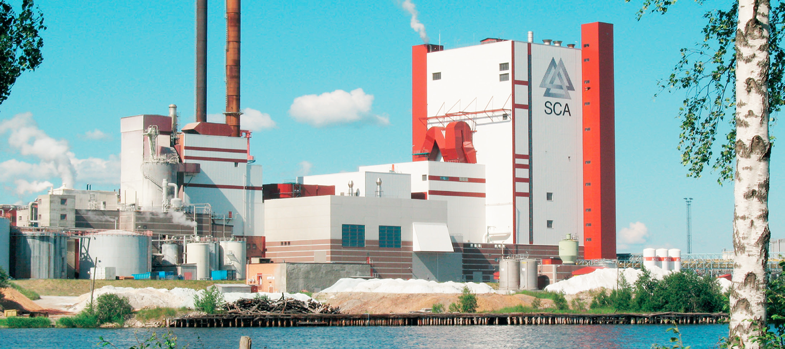
The European Investment Bank and Svenska Cellulosa Aktiebolaget (SCA) have signed a EUR 150 million loan agreement.

The EIB financing will support renewable energy and energy efficiency measures in a pulp mill in Timrå, Sweden, the regeneration and replanting of 68,000 ha of forest – almost three times the area of Stockholm – and the construction of 4 250 km of forest roads.

New, advanced process technologies will be installed at the pulp mill in Timrå, resulting in substantial energy efficiency gains. Additionally, the mill will be able to make use of renewable resources, like bark and by-products from the production process, for its energy generation, including both power and heat.

As a result, the modernized pulp mill will not only be energy self-sufficient and increase its production capacity, but it will be able to export surplus (green) power, SCA said.

The pulp mill will start up in June 2018 once the modernisation project has been completed. The forestry project and the upgrade of the forest road network will be carried out over a period of five years from 2017 to 2021.

Growing housing demand in the United Arab Emirates drives wood market growth

Once that over 25,000 homes have been added to the UAE’s residential market this year, the wood and furniture market is likely to witness solid growth.

The forecast was made in a report released ahead of the Dubai WoodShow, which will be  held from March 12 to 14, 2018. The event is the largest such exhibition in the Middle East, showcasing a wide range of wood-based products at the Dubai World Trade Centre.

More than 300 exhibitors from 100 countries are all set to showcase their innovative solutions at the next edition of Dubai WoodShow,

Wood and wood-based furniture and household accessories products are expected to get a solid boost from the $2.4-trillion worth of construction activities, especially when new home-owners start purchasing their furniture and home décor products. At the moment, around 70% of the timber and wood products are used in construction industry while the rest are used in real estate, interiors, furniture and other industrial applications.

The growing demand for wood products in the region is mainly driven by the overall economic growth. However, with more than 35,000 residential units slated for delivery in 2018, the costs for wooden products is expected to jump 40 per cent to Dh350 million.

"The growth in the housing market will drive the wood, wood-related and timber business across the region and this creates a great opportunity for the industry," remarked Dawood Al Shezawi, the CEO of Strategic Marketing and Exhibitions, the event organiser.

"As families move to their new freehold homes, they will require a fresh supply of furniture and due to the tastes and trends, most families look for authentic wooden furniture and products – wherein lies the new demand. However, consumers are also looking for new, innovative products to replace the old furniture, especially innovative furniture that help families to manage spaces in a better way. Those products will be in solid demand,” he added.

Euroconstruct: European construction sector set to grow in 2017

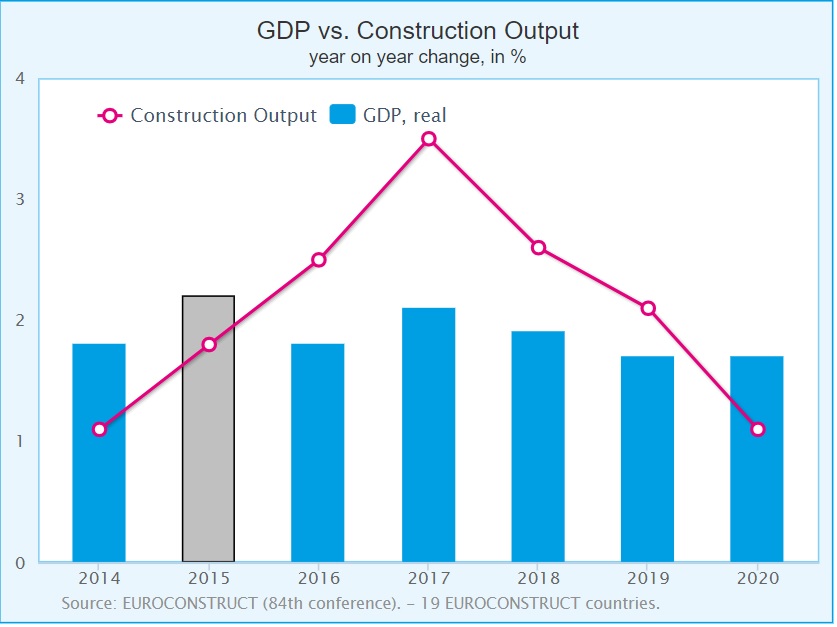
Construction volume in the Euroconstruct area is expected to grow by 3.5% in 2017. The strongest stimuli will once again come from residential construction. Developments in 2017 are remarkable for two reasons.

Firstly, growth in construction measures in Europe reached its highest level since 2006, or shortly before the outbreak of the international financial crisis. Secondly, construction demand is rising in all 19 member countries in 2017. This is the first time that growth has been seen across the board in Europe since Germany’s reunification; and it looks like this feat will be repeated in 2018.

The European construction industry has now been on track for growth since 2014. Construction output in the four years from 2014 to 2017 has increased by a total of 9%. A further increase of 6% can be expected in the 19 Euroconstruct member states by 2020. Growth rates will slow considerably in the future in both residential construction and non-residential construction, while civil engineering will take over the role of market driver in the medium term. The civil engineering sector is also expected to grow at the unprecedented rate of over 4% in 2018 and 2019 respectively. At the same time, the new construction segment will clearly lose importance in the years ahead. By 2020 the renovation sector is expected to see stronger growth than new construction for the first time since 2014.

The favourable development in construction demand is partly due to robust economic growth and its positive implications for household income, corporate profits and the state of public finances. Moreover, the low interest rate level, immigration and internal migration flows, as well as the investment backlog that has accumulated in areas like infrastructure since the financial crisis is supporting the upswing.

There are also clear constraints on the public sector’s scope to take action. This is reflected in the cautious approach to taxation and/or the subsidy policy adopted by several European countries. In some places high vacancy rates and/or excessively high real-estate prices are also preventing a stronger upturn in construction activity.

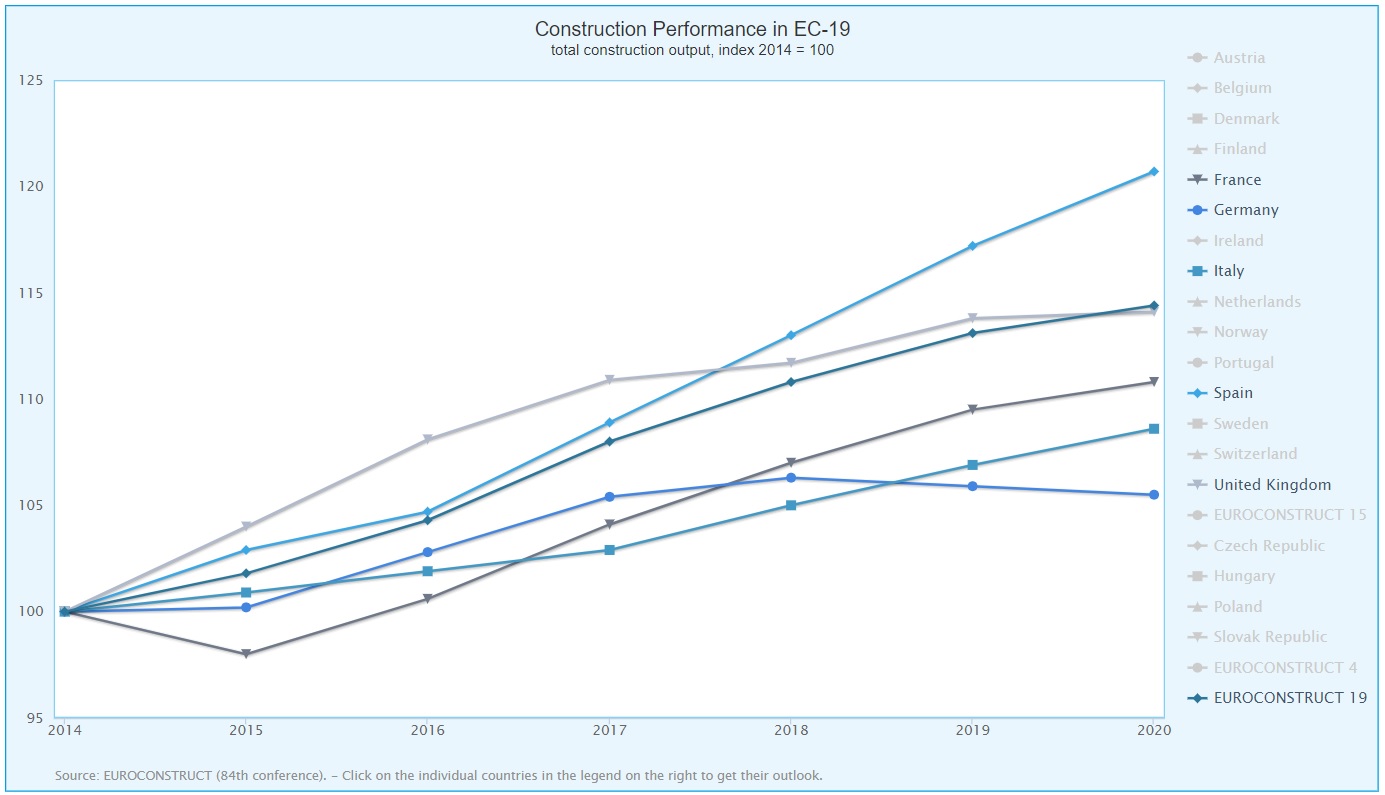
In 2017 construction demand is expected to be strongest in Hungary (+25%), the second smallest market in the Euroconstruct area, followed by Ireland (+15%), Sweden (+10%), and Poland (+9%). Hungary will also post the highest growth rates for the next three years through 2020 (+33%). In addition to state subsidies for residential construction, the more consistent use of EU funds especially for civil engineering will play an important role here. In the three-year growth projections Hungary is once again followed by Ireland (+28%), then comes Poland (+25%), the Czech Republic and Portugal (+15% respectively).

In Germany construction activity in 2017 will even increase more strongly than in 2016, driven by higher demand for residential accommodation, a greater willingness to invest on the part of companies and a civil engineering drive by the German government. Although growth will slow down significantly in the mid-term, investment in both the residential and the infrastructure segments is expected to be high in the long term.

Södra to sell Södra Wood Norway to Sörnsen Holzleisten

Södra is preparing to sell its Norwegian operation, Södra Wood AS, to German company Sörnsen Holzleisten. The handover is expected to take place on 1 February 2018.

The operation in Norway encompasses two production units (one in Brumunddal specialising in mouldings and one in Engesetdal in foil-wrapped MDF), two distribution terminals in Brumunddal and Namsos and a marketing organisation located in Gardemoen. A total of about 70 employees will be affected by the sale.

On 1 January of this year, we transferred Södra Wood Grimslöv to Sörnsen Holzleisten and in June the subsidiary UAB SIWood in Lithuania was sold to the company. We are now also selling the Norwegian operations to the same buyer. We have productive partnership with Sörnsen, which is now one of our main suppliers. The takeover of Södra Wood AS provides Sörnsen with a larger part of the value chain that will enable the company to leverage its competitive production and our strong sales and distribution organisation to positively develop the interior business in Norway. This sale will create a stronger, more stable and more competitive company,” said Peter Karlsson, segment manager for interior wood at Södra.

The buyer is Sörnsen Holzleisten, which was founded in 1945 and has several production sites in northern Germany, Estonia, Sweden and Lithuania. The company produces a broad range of mouldings; its standard range contains more than 3,000 items in various types of wood and it delivers to countries worldwide.

Södra Interiör is a well-known brand name that has meant stability and competence for the Scandinavian markets for many years. We are happy to continue such a prestigious brand together with Södra as a partner. The new vertical integration of the largest moulding production in Europe is a strong signal to all wholesalers in Norway. With Södra’s excellent logistics hubs in Namsos and Brumunddal new products can easily be introduced to our Norwegian customers,” said Robert Sörnsen, President of Sörnsen Holzleisten.

Log prices in New Zealand reach 24-year high

Structural log prices in New Zealand reach the highest level in 24 years, while A-grade export logs hit a new record.
Thus, the local sawmills started to compete with the export market as to secure the supply for the domestic construction market amid strong demand from China.
The price for structural S1 logs increased to $130 a tonne this month, from $128 a tonne last month, marking the highest level since 1993, according to AgriHQ's monthly survey of exporters, forest owners and saw millers.
Also, as Wood Week reported, the export log prices lifted between $2-to-$5 a tonne for the majority of grades, with the price for A-Grade logs touching $128 a tonne, up from $127 a tonne last month and the highest level since AgriHQ began collecting the data in 2008.
New Zealand is also facing very strong demand for logs from China. The country has enforced a ban on harvesting its own forests and also reduced the tariffs on imported logs to meet demand on its local market.
Thus, the softwood logs demand from China stays strong, lifting back to record levels in the latest data for September with Chinese imports of New Zealand logs currently tracking 10 percent ahead of last year.
"Those trading in the domestic log market are continuing to receiver near-record returns and there's nothing to signal that this situation will change anytime soon," said AgriHQ analyst Reece Brick. "Looking forward, all prospects will be determined by the direction the export log market takes."
Brick said wharf gate values climbed through October and early November and will likely hold high until the Chinese New Year period. Also known as the 'spring festival', the Chinese New Year falls on Feb. 16 next year, and the festival will last until March 2, about 15 days in total. As an official public holiday, Chinese people can get seven days' absence from work, from Feb. 15 to 21.
He noted the latest situation and outlook report released by the Ministry of Primary Industries continues to shed a positive light on forestry's prospects over the next two years.
"They predict strong Chinese interest in logs over the short-medium term, underpinned by its ban of commercial logging of natural forests, falling Russian log supplies, and a 2 percent reduction on its imported log tax."
Brick said "the only proper negative" when it comes to the export market is shipping rates, which are rising faster than log values. However, this was being masked by a weaker New Zealand dollar, he said.
"There is still a level of uncertainty as to whether shipping rates have reached their peak or have a little more upswing to come," Brick said.
Still, he said "in terms of market fundamentals it is all still quite positive."

Newsletter

Subscribe to our digital newsletter for your daily digest of essential news, views and analysis from the international wood industry delivered directly to your inbox.


0