Article archive

Egger plans to start construction on its wood-based material factory in the US at the end of 2018

Egger started the construction of a new wood-based material factory in Lexington, North Carolina, US. The company organized a ceremony for the office building on site.

The office building, which is expected to be completed in early 2019, will house EGGER’s North American future office staff. In addition, Egger plans to set up a training centre there to train and promote local professionals. At the same time, the company’s own building offers the opportunity to present Egger products and services to architects, designers, retail and furniture industry customers. The administrative building also forms the basis for the future production plant.

The wood-based material manufacturer is planning to start the construction of the production plant at the end of 2018. During the first phase of the project, Egger will build a chipboard plant with coating capacities in Lexington, NC. This first phase involves an investment volume of approximately EUR 260 million and will create 400 direct jobs over the next six years. The start of construction of the production plant is planned for the end of 2018. Production in the future plant is scheduled to start in 2020.

The North Carolina plant will have ultramodern facilities for making laminated chipboard and will allow Egger to better serve its customers in North America. Egger’s previous distribution activities in the US and Canada have already clearly shown that the range of products, the quality, and the price structure of the product portfolio are very attractive for architects, designers, wholesalers, and industry customers. The planned production plant in Lexington, North Carolina, is expected to enable Egger to increase its presence in the North American wood-based materials market, ensuring product availability for its customers and increasing delivery speed.

Earlier, Egger announced an expansion production capacities of its St. Johann mill in Austria.

The company is one of the leading European groups in the wood-based material industry. Started its story in 1961 with commissioning of the  chipboard plant in St. Johann (Austria), now production plants are located all across the Europe including CIS states. The EGGER Group has 9,000 employees, sales in 2016/17 financial year accounted EUR 2.38 Bn.
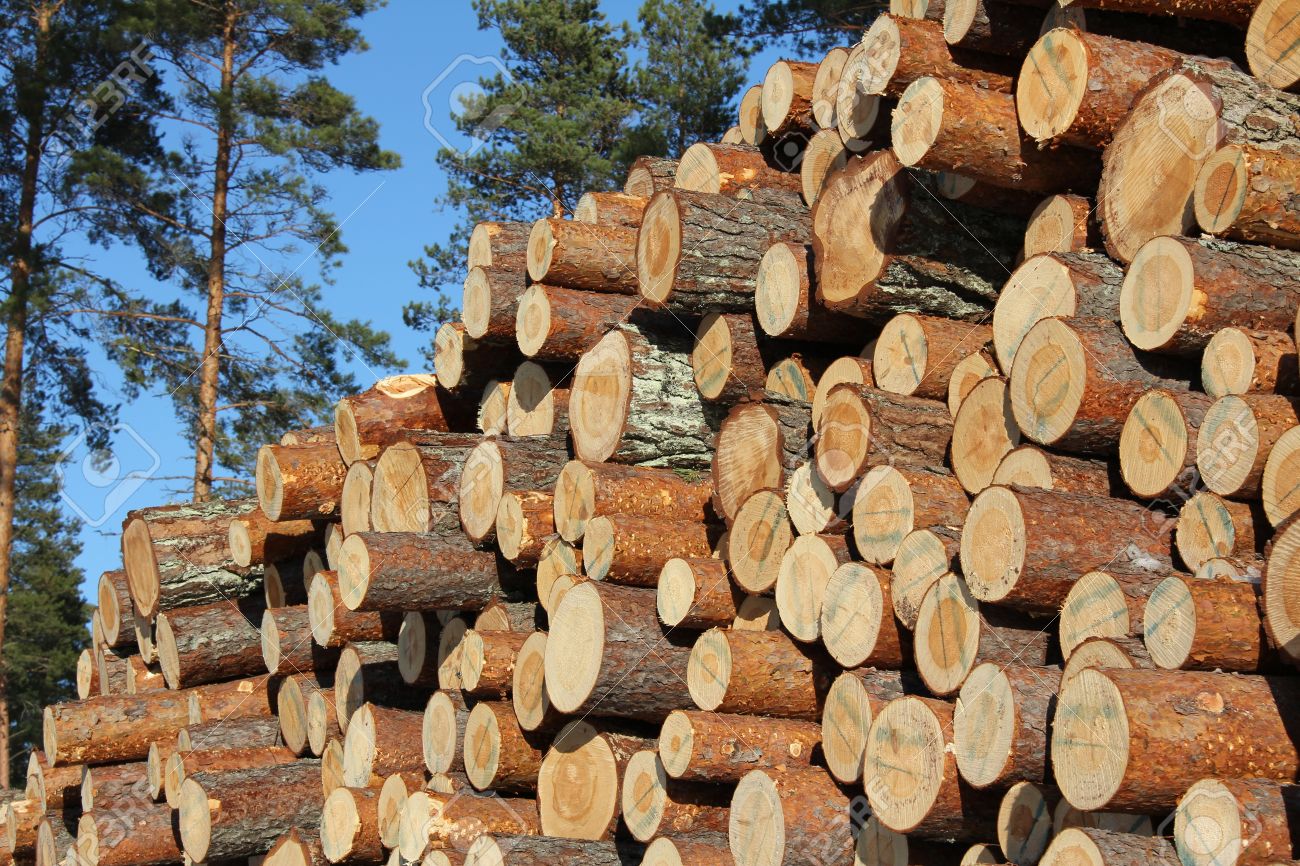
Belarus to further limit the exports of logs to the West

Belarus introduced a regulation on compulsory licensing of foreign trade activities regarding export of certain timber types outside the Eurasian Economic Union.

The respective decision is defined by the Decree no. 59 issued by the country's Council of Ministers as of January 25, 2018.

According to the Decree those who export certain types of timber, namely logs (HS code 4403) and rotary-peeled masts (HS code 4404), outside the Eurasian Economic Union must apply for a license (permit) to do so at the Belarus' Antimonopoly Regulation and Trade Ministry with the concurrence of the Forestry Ministry.

The key clauses of the Decree came into force on February 1, 2018 and will apply until July 1, 2018.

The Eurasian Economic Union is an international organization for regional economic integration. The Member-States of the Eurasian Economic Union are the Republic of Armenia, the Republic of Belarus, the Republic of Kazakhstan, the Kyrgyz Republic and the Russian Federation.

Overview of EU wood products imports in 2017

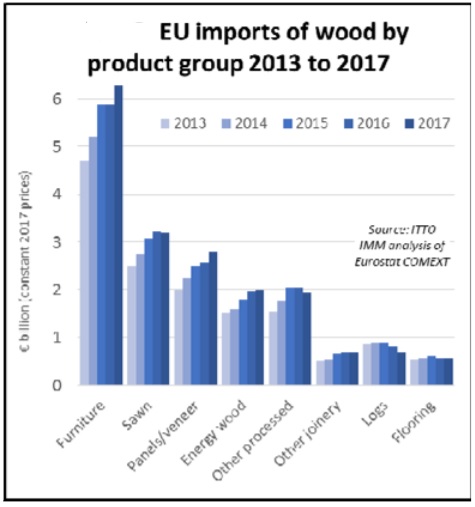
The value EU imports of sawnwood (including softwoods and hardwoods) was unchanged in 2017, at Euro 3.2 billion, ending the rising trend which began in 2013. There was a particularly significant 21% decline in the value of EU sawn wood imports from Africa in 2017 which offset a 12% rise in imports from the CIS countries.

EU imports of sawn wood from Russia and other CIS countries continue to benefit from the relative weakness of currencies in the region.

EU imports of panels (mainly plywood) increased 9% to Euro 2.79 billion in 2017. This follows a 3% rise in 2016 and an 11% increase in 2015. Most of this gain was due to a rise in plywood imports from Russia and other Eastern European countries. The value of EU plywood imports from China and tropical countries was generally stable or declining in 2017.

The long-term rise in EU imports of energy wood continued in 2017 with annual import value exceeding Euro 2.01 billion for the first time. This was only 3% more than in 2016, a slower pace of increase compared to average annual growth of 11% in the previous five years.

EU imports of energy wood (now dominated by pellets) increased sharply from the CIS region last year. Imports from the US, still by far the largest external supplier to the EU, were stable in 2017.

Following a 22% increase in 2015 and 4% increase in 2016, EU imports of other joinery products (mainly doors and laminated wood for window frames) declined 1% to Euro 690 million in 2017.

Imports of joinery products from Russia and Ukraine continued to rise last year, while imports from the tropics and China lost ground (although China is still the single largest external supplier).

EU imports of wood flooring were stable at Euro 550 million in 2017, after falling back 9% in 2016. Flooring imports from China, by far the largest external supplier, were flat in 2017, while imports from the CIS region increased 12%, helping to offset a decline in imports from South East Asia and South America.

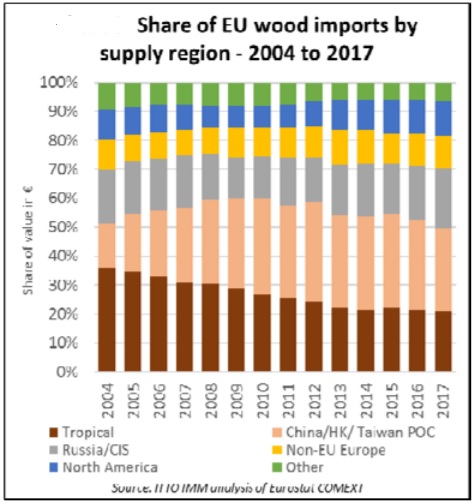
The value of EU imports of wood products from tropical countries decreased 1.8% to Euro 3.78 billion in 2017. This follows a 1% fall the previous year. The share of tropical countries in the total value of EU wood product imports declined from 22% in 2016 to 21% in 2017. This is a resumption of a long- term trend in declining share of tropical countries in total EU imports after a brief rebound in 2015.

China’s share in total EU imports of wood products fell from 30.5% in 2015 to 28.9% last year, the lowest level since 2008. Meanwhile the share of Russia and other CIS countries increased from 19.3% to 21.1%.

In 2017, there was a slight increase in share of EU imports from non-EU European countries (from 10.9% to 11%) and North America (from 11.5% to 11.7%).

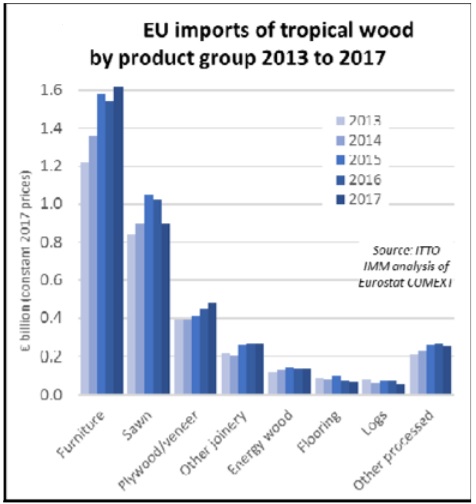
The slight decline in the total value of EU wood product imports from the tropics in 2017 hides variations between products groups.

Last year, there was a sharp 13% decline in EU imports of sawn wood from tropical countries, from Euro 1026 million to Euro 896 million. There was also a continuing decline in EU imports of tropical flooring, by 12% to Euro 68 million, and tropical logs, by 29% to Euro 53 million.

However, these declines were offset by rising EU imports of tropical furniture, up 5% to Euro 1.62 billion, panels (mainly plywood), up 7% to Euro 480 million, and energy wood (notably charcoal), up 2% to Euro 143 million.

BlueLinx acquired Cedar Creek for $345 million

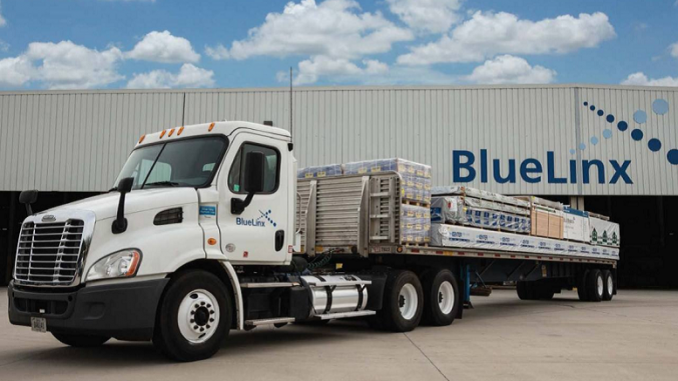
BlueLinx, a leading distributor of building and industrial products in the US, entered into a definitive agreement to acquire Cedar Creek, a leading building products wholesale distributor, a portfolio company of Charlesbank Capital Partners for a purchase price of USD 413 million on a debt-free, cash-free basis.

According to the announcement, the purchase price will consist of approximately USD 345 million in cash and approximately USD 68 million as the agreed value of the capital leases.

BlueLinx has commitments from Wells Fargo Bank, N.A. and Bank of America, N.A. to arrange a USD  750 million revolving credit facility that includes a USD  150 million accordion feature, subject to certain conditions, including the finalization of definitive loan agreements.

Additionally, BlueLinx has a commitment from HPS Partners for a USD  180 million term loan, subject to certain conditions, including the finalization of definitive loan agreements. Proceeds from the ABL Revolver and Term Loan will be used, among other things, to fund the purchase price and repay debt.

The company anticipates having excess availability under the ABL Revolver after the acquisition closes and at the end of the second fiscal quarter of approximately USD   110 million.

The combination of BlueLinx and Cedar Creek is expected to create a leading building products wholesale distributor with one of the largest product offerings in the building products industry, including over 50,000 branded and private-label SKUs, and a distribution footprint of 70 national locations servicing 40 states.

Together with Cedar Creek, BlueLinx will be able to distribute its comprehensive range of structural and specialty products to approximately 15,000 national, regional, and local dealers, as well as specialty distributors, national home centers, industrial, and manufactured housing customers.

The transaction is also expected to enable the combined entity to serve diverse end markets from new residential and light commercial construction to industrial, as well as residential repair and remodel. BlueLinx and Cedar Creek’s combined revenue was USD 3.2 billion in 2017 and its pro forma LTM Adjusted EBITDA for 2017 would have been approximately USD 154 million including at least USD 50 million of annual cost savings.

Both companies have highly experienced executive teams with proven leaders in the building products industry. Mitch Lewis, President and Chief Executive Officer of BlueLinx, will continue as CEO of the combined company, which will remain headquartered in Atlanta, Georgia. Alex Averitt, CEO of Cedar Creek, will become COO of BlueLinx and D. Wayne Trousdale, Chairman of Cedar Creek, will become Vice Chairman of the operating companies. Initially, the Parent Company will remain named BlueLinx and Cedar Creek will retain its name in its locations.

Mitch Lewis, President and Chief Executive Officer of BlueLinx, commented: “This transaction will create a leading US wholesale distributor of building and industrial products, and significantly enhance the value. With an extensive cache of products, the benefits of our combined technology and a strong footprint East of the Rockies, we will be well-positioned to drive profitable growth for our stakeholders, as we realize the significant strategic and financial benefits of this transaction and expand to additional geographic territories.

The transaction has been unanimously approved by BlueLinx’s Board of Directors and is expected to be completed within 45 days, subject to customary closing conditions and regulatory approvals.

Gabon government announces launch of Gabon WoodShow, from 20 – 22 June, 2018

The Global WoodShow (Dubai and Cairo) organizing committee announced the start of the 3rd edition of the WoodShow series that will take place in Gabon, Africa, from June 20 to June 22 2018, in Libreville, Gabon.

This trade fair is being organized in partnership between GSEZ, the Ministry of Water and Forests of Gabon and Strategic Marketing & Exhibitions, a specialist in organizing large scale international events based in Dubai, United Arab Emirates.

Gabon WoodShow is a 3 days premium event that will be offering a great opportunity to meet wood, woodworking and forestry professionals, develop ideas for increasing the range and quality of your business, and learn new techniques and sources of supply. It is a quest to be the best platform for creative ideas and new technologies, and showcase innovative resources that would lead to lucrative transactions.

Boasting the second highest forestry potential in Africa, Gabon's forests cover 22.8 million hectares which is 88% of the country’s land surface. 12.5 million hectares are suitable for the sustainable harvest of timber.

The Gabon WoodShow aims to transform Gabon into a world leader in certified tropical timber production. This will be achieved through an industrial strategy, aimed at sustainable managing timber stocks and by promoting secondary and tertiary processing. The timber industry is already the largest private sector employer, employing 28% of the working population, and represents an extremely significant growth potential.

Mega construction projects in UAE push wood products demand in the region

The demand for wood and wood related products in the United Arab Emirates are driven by planned and ongoing construction of mixed-use mega projects.

"Any segment, including the wood industry, is going to be important in a country like the UAE, which is seeing vast developments to prepare for global events such as Expo 2020," Dr Abdullah bin Mohammed Belhaif Al Nuaimi, UAE Cabinet Member and Minister of Infrastructure Development, said during the opening of Dubai WoodShow on the 12th of March. "The wood industry is very important to us and it is an added value to our economy."

The three-day international trade show is showcasing the latest wood products, woodworking, machine tools, and new technology; and has drawn the participation of more than 300 exhibitors from 55 countries, MENAFN reported.

The show also features six country pavilions - Canada, China, Finland, Russian Federation, Turkey, and the USA. More than 10,000 trade visitors are expected to participate at the international event - including visitors from the GCC and other markets to source the latest products, services, machineries as well as renew their existing trade relations.

Dawood Al Shezawi, president of Strategic Marketing and Exhibitions, says: "A surge in oil prices which are trading over $60 a barrel brings back optimism and as investor sentiment rides high, we have seen a string of project announcements from the beginning of this year that will later create demand for interior dcor, wood products and woodworking machineries. The massive construction activities in the GCC, especially in Dubai, will continue to drive demand for wood products and we expect to see the wood import and export value to exceed Dh4 billion recorded in 2016 - in the following years."

Pacome Moubelet Bouyeba, Gabonese Minister of Forest and Environment, also spoke about the importance of sustainable logging practices, especially in a country like Gabon, which has 22 million hectares of natural forest.

"Over 88 per cent of our country is made up of rainforests, and we have a responsibility to take care of this valuable resource for the generations that will follow ours," he said. "We are seeing a huge demand from emerging economies. The GCC and Middle East has also seen a huge increase in trade volumes; over the past three to four years we have seen a 25 per cent increase in the sector."

Finnish forest machine manufacturer Logset signs dealership agreement in Brazil

Finnish forest machine manufacturer Logset Oy and Brazilian heavy equipment dealer PESA (Paraná Equipamentos S/A) have signed a dealership agreement.

Under the terms of the agreement, PESA will sell Logset machines, parts and services for the products manufactured by Logset. PESA’s territory of action covers the Southern Brazilian states of Paraná, Santa Catarina and Rio Grande do Sul.

Through Logset forest machines, PESA gains technology leadership in CTL systems. Logset machines fit perfectly to PESA’s CAT machine range.

“We’ve wanted to improve our presence in Brazil for some time, and the talks we had with PESA developed smoothly into an agreement. The Brazilian forestry is expanding fast. The Southern Brazilian states are rich in pine, which suits Logset’s harvester heads perfectly. For the Southern eucalyptus areas, the Logset TH65 Euca is the perfect match with excellent debarking results. PESA is a partner with an existing customer base, capable and motivated personnel, and excellent resources, including their own rental fleet, for starting a successful collaboration with Logset. We were convinced by their product support capability, and their CAT machines fit well as base machines for our TH heads. I believe that Brazil will become an even more important market for Logset,” says Tapio Nikkanen, Chairman of the board.

Logset Oy is a Finnish forest machine manufacturer located in Koivulahti, near Vaasa. The company was established in 1992 and today it has approximately 70 employees. Logset produces CTL solutions. The Logset machine range contains of seven forwarders, seven harvesters and seven different harvester heads. All the products are manufactured in the company's factory. Logset’s distribution network covers 20 countries, and Logset machines are working in more than 25 countries.

US lumber production on the rise in 2017

U.S. sawmills increased softwood lumber production by 4.2% in 2017 to a full-year total of 33.888 billion board ft. (bbf), up from 32.535 bbf in 2016, the Western Wood Products Assn. (WWPA) of Portland, Oregon, reported.

Of the 2017 total, Western U.S. sawmills accounted for 14.063 bbf, a 3.0% increase from 13.654 bbf in 2016, while Southern U.S. sawmills contributed 18.229 bbf - up 5.1% from 17.349 bbf.

In December 2017, softwood lumber production was 2,600 bbf, a year-over-year increase of 6.0% from 2.453 bbf, but down 1.6% from 2.643 bbf in the previous month.

Western sawmills contributed 1.057 bbf to December's production, a 2.1% gain from 1.036 bbf in December 2016, but down 8.5% from 1.155 bbf in November 2016.

Sawmills in the South produced 1.420 bbf in December, up 9.1% from 1.302 bbf a year earlier, and 4.2% higher than production in November 2017 of 1.363 bbf.

Apparent U.S. softwood lumber consumption advanced 1.1% to 47.865 bbf in 2017 from 47.367 bbf in 2016. In December, consumption was 3.713 bbf - up 2.9% from 3.609 bbf in December 2016, but down 3.3% from 3.837 bbf in November 2017.

Canadian softwood lumber production/consumption

Canadian sawmills produced 28.334 bbf of softwood lumber in 2017, almost level with 2016's production volume of 28.335 bbf, WWPA reported.

Sawmills in British Columbia contributed 12.950 bbf to the full-year production volume, a drop of 4.5% from 13.559 bbf in 2016. Sawmills East of the Rockies produced 15.384 bbf, up 4.1% from 14.775 bbf a year earlier.

In December 2017, Canadian sawmills produced 2.008 bbf, a year-over-year drop of 0.7% from 2.023 bbf, and down 18.4% from November's production volume of 2.460 bbf.

British Columbian sawmills produced 924 million board ft. (mmbf) of softwood lumber in December, a 1.4% drop from 937 mmbf in the previous December, and a 15.2% decline from 1.090 bbf in November 2017. Sawmills East of the Rockies produced 1.084 bbf in December, a year-over-year drop of 0.2% from 1.085 bbf, and down 20.9% from 1.370 bbf in the previous month.

Apparent Canadian softwood lumber consumption climbed 3.3% to 9.871 bbf in 2017 from 9.556 bbf in 2016. In December alone, consumption was 586 mmbf, a year-over-year increase of 3.0% from 569 mmbf, but down 27.5% from 808 mmbf in November 2017.

U.S. and Canada utilization/inventories

U.S. production as a percentage of practical capacity averaged 87% in 2017, up from 86% in 2016, while the percentage in Canada fell to 88% from 91%.

U.S. inventories rose by 0.9% in December 2017 to 2.898 bbf from 2.872 bbf in December 2016, while Canadian inventories were up 10.7% to 3.144 bbf from 2.840 bbf.

Brazilian Expoforest to attract more than 220 participating companies

The Brazilian forestry market is one of the few segments that do not directly reflect the country’s economic situation. Even with the threat of recession and political scandals abounding, the forestry sector exported over $7.7 billion in 2017. This figure represents an 11% growth from the previous year.

With excellent soil and climate conditions, Brazil arises as a key player in the global scenario of forestry production. This is largely thanks to two foreign species – pine and eucalyptus – which have adapted extremely well to the country’s conditions. Brazil’s territory covers 8,516,000 km² (or 2.104 billion acres). According to Ibá (the Brazilian Tree Industry), the country’s most representative forestry association, only 7.84 million hectares (19.373 million acres) are occupied by planted forests – a mere 0.92% of the country’s land. Pine and eucalyptus species represent the majority of planted trees – over 90%. Conifers (pine) represent 20% of planted areas, whereas eucalyptus forests account for 71%. The rapid growth of eucalyptus and pine species in Brazilian lands is the most important factor motivating these planted areas, as well as research and investments in these species. In 2016, Brazil led the global forestry productivity ranking, averaging 35.7 m3/hectare per year for planted eucalyptus forests; and 30.5 m3/hectare per year for planted pine forests, according to the most relevant companies in the sector. On average, the eucalyptus production cycle is 7 years long, and 15 years for pine.

In order to present present this promising market to investors worldwide, as well as showcase what Brazilian silviculture does best and attract new technologies from the world’s most important timber producing countries, the Expoforest – Brazilian Forestry Fair was created. The fourth edition of the world’s largest dynamic forestry fair in 2018 takes place from April 11th to 13th, in Santa Rita do Passa Quatro, a town within the greater Ribeirão Preto area in the state of São Paulo, Brazil. The event will be held in 200-hectare cloned eucalyptus forest belonging to International Paper.

“We believe Expoforest 2018 will once again prove to be a great opportunity to gather the world’s entire timber production chain and demonstrate once and for all the sheer strengths of the forestry sector in Brazil and in the world,” says Jorge R. Malinovski, president director of Malinovski, the company behind Expoforest. At the moment, still a few months away from the event itself, 226 companies are already confirmed exhibitors for the fair, and they are getting ready to present their new product launches, technologies and trends covering the entire timber production cycle. According to Malinovski, over 30,000 visitors – from Brazil and other countries with long-standing tradition in forestry – are expected during the three days of the event.

Expoforest is a part of Forestry Demo Fairs (FDF), a specialized board responsible for ensuring quality and safety in the world’s larges dynamic forestry fair. In this group, Expoforest stands alongside Asturforesta (Spain), EKO-LAS (Poland), Elmia Wood (Sweden), Euroforest (France), FinnMETKO (Finland) and KWF-Tagung (Germany).

According to the organizers of the exhibition, in its last edition, held in 2014, over 208 exhibitors were present, showcasing new machinery, equipment and technology employed in timber production from planted forests. In total, 25,107 specialized visitors from Brazil and 27 other countries were present at the fair, resulting in $48 million in business transactions.

French Court offers permission to Rougier to restructure African business

French tropical wood specialist Rougier has gained court permission for restructuring measures after filing for insolvency protection.

The group filed for court protection this month after suffering persistent difficulties in Cameroon, where a chronic backlog at the port of Douala has caused significant operational disruption for subsidiaries in Cameroon, Congo and the Central African Republic.

The situation has led to persistent cash flow pressures, exacerbated by the delays with VAT credit reimbursements for the operational African subsidiaries.

Its application for protection was granted by Poitiers Commercial Court on Monday. Restructuring measures are to be implemented for the Rougier Afrique International business.

Rougier had been in talks with its main creditors about the situation and was supported in seeking insolvency protection. The Rougier Afrique International operation has more than two million hectares of forest concessions, several processing facilities and is a major trader in logs, sawn timber, processed products and plywood, shipping to countries all around the world.

Total exports of US hardwood lumber and veneer to the MENA region amount to $96.74 million in 2017

Total exports of U.S. hardwood lumber and veneer to the Middle East and North Africa (MENA) region including Pakistan reached USD 96.74 million for the year 2017.

According to a statement issued by the American Hardwood Export Council (AHEC), the leading international trade association for the American hardwood industry, the statistics, which have been compiled from the latest data released from the United States Department of Agriculture (USDA), reveal a 7 percent overall increase over 2016 figures.

The announcement was made on the 12th of March, at the opening of the Dubai WoodShow, which is due to run until March 14 at the Dubai International Exhibition and Convention Center.

According to the data released, exports of American hardwood lumber reached a value of USD 75.46 million and a volume of 92,273 cubic meters, marking an increase of 20 percent and 17 percent respectively over 2016.

A closer look at the numbers also revealed that direct shipments of U.S. hardwood veneers to the MENA region during 2017 reached a total value of USD 21.13 million, falling by 23 percent over the previous year. However, American hardwood veneers are also shipped to the region from European countries and China, while veneers are also produced in the region - notably in Turkey - from imported American hardwood logs.

The UAE was the region's strongest performer last year, with exports of U.S. hardwood lumber to the market rising by 86 percent in both volume and value to 24,597 cubic meters and USD 21.05 million, as compared to the previous year.

This means that over a quarter of all U.S. hardwood lumber shipped to the MENA region was destined for the UAE last year.However, a large percentage of what goes to the UAE is for re-export to neighboring Gulf markets, as well as to markets further afield. Nonetheless, a very buoyant construction sector in the UAE ahead of Dubai's World Expo 2020, is expected to keep demand for American hardwoods at a high level through this year and beyond.

Among the other major destinations for American hardwoods in the MENA region, increases were also seen in exports to Saudi Arabia (up by 10 percent in volume to 6,539 cubic meters), and Jordan (up by 12 percent in volume to 4,395 cubic meters).

One MENA market that showed remarkable growth in demand for U.S. hardwood lumber last year was Lebanon, to which exports grew by 70 percent in volume and 61 percent in value as compared to 2016. In addition, American hardwood veneer exports to Lebanon also increased by 27 percent to reach a value of USD 3.317 million in 2017.

At the same time, exports of U.S. hardwood lumber to the region's two other major markets - Pakistan and Turkey - remained almost unchanged from the previous year.Positive of increased growth across the region, AHEC is participating at the annual ‘Dubai WoodShow’. During the three-day show, AHEC is hosting a pavilion with individual booths occupied by fourteen U.S. hardwood exporting companies along with the Hardwood States Export Group (HSEG) - a coalition of major eastern U.S. hardwood exporting states.

Confirmed exhibitors include MacDonald & Owen Lumber Company; Hartzell Hardwoods, Inc.; Atlantic Veneer Corporation; Baillie Lumber Co., Inc.; Midwest Hardwood Corporation; Hermitage Hardwood Lumber Sales; Oaks Unlimited, Inc.; American Lumber; Nina Company; Wood'n Slabs; Northland Corporation; Missouri Walnut LLC; Thompson Hardwoods, Inc.; and Wheeland Lumber Company.

Tactile, warm, unique, natural and sustainable are just some of the adjectives ascribed to American hardwoods by architects and designers in the Middle East. Whether it is for a one-off furniture piece or a large-scale interior fit out, hardwoods from the United States are increasingly being specified, as they become better known and more widely appreciated. As a result, the United States is the number one supplier of temperate hardwoods to the Middle East. Timber is certainly experiencing a global renaissance as a preferred material and as architects and designers seek out natural material alternatives across a variety of applications, we expect to see American hardwoods becoming increasingly widely-specified in the region,” concluded Roderick Wiles, AHEC Regional Director.

Global sawlog prices on the rise in Q4/2017

The Global Sawlog Price Index (GSPI) increased to US$76.34/m3 in the 4Q/17, up 1.0 percent from the 3Q/17. This was the fourth consecutive q-o-q rise, with the GSPI being up 9.8 percent in one year.

Sawlog prices have gone up universally in US dollar terms in 2017, with the biggest growth occurring in Eastern Europe, the Nordic countries and in Western North America.

Sawlog prices in Europe were generally lower in the 4Q/17 (in Euro terms) after having reached a two year peak in the 3Q/17. In the 4Q/17, the European Sawlog Price Index (ESPI) fell 1.2% from the previous quarter.

Global Pulpwood Prices

Pulp manufacturers in many countries have seen their wood costs go up during 2017, with the biggest increases in US dollar terms occurring in Western North America, Europe, Russia and Australia.

The Global Softwood Fiber Price Index (SFPI) increased for the third consecutive quarter in the 4Q/17, and was 4.0% higher than in the same quarter in 2016. Year-over-year, wood fiber prices have gone up the most in Western Canada, Sweden, Spain, Russia and Chile.

Hardwood fiber prices have also trended upward over the past year with the Global Hardwood Fiber Price Index (HFPI) reaching its highest level in almost three years during the 4Q/17.

Global Pulp Markets

Pulp production was up throughout the world in 2017 with the total production reaching just over 53 million tons, or 3.2% more than in 2016.

The biggest increase from 2016 was seen in Western Europe where output was up +5.1%. Prices for market pulp reached new record highs in early 2018 when softwood market pulp (NBSK) prices in Europe averaged over $1000 per ton.

Global Lumber Markets

Trade of softwood lumber reached an all-time-high in 2017 as demand for wood was strong in most key markets around the world. An estimated 126 million m3 of softwood lumber was shipped from forest- rich countries such as Canada, Russia, Sweden and Finland to markets with high consumption of lumber, including China, the US, the United Kingdom, Japan and Germany.

US softwood lumber production in 2017 reached the highest level seen in ten years, with the biggest increase in the southern states.

The strong market for lumber in the US led to record high lumber prices in both the US and Canada in late 2017 and early 2018.

Finnish softwood lumber production reached a ten-year high in 2017. The higher production was driven by expanding lumber exports, particularly to China.

Over the past two years, prices for imported softwood lumber to China have been steadily rising and reached the highest levels in three years in early 2018.

The Middle Eastern and North African (MENA) lumber markets grew fast from 2007 to 2015, reaching a peak in 2015. Since then, import volumes have fallen by over 20% to an estimated nine million m3 in 2017.

Although lumber imports to Japan fell in the 4Q/17, the total volume for the year was up slightly for the second consecutive year.

Global Biomass Markets

Global trade of wood pellets has grown quite substantially over the past five years, from 11.8 million tons in 2013 to 18.3 million tons in 2017 with Europe being the dominant market.

Most of the investments in pellet production over the past five years have been in the US South, while investments in Canadian capacity have been limited.

Segezha Group commissions new glulam processing line from Hundegger

Sokol Timber Company invested in a new for a new  processing line to produce house parts made of the glued laminated timber (glulam). 

The new line, supplied by Hundegger (Germany), allows to increase production and to expand the premium product range with 280 mm timber. The line is also expected to decrease production costs.

The new equipment secures the quality tolerances in the range of +/- 0.5 mm. It allows to manufacture one house set (around 150 m2 area) in up to one working day. All parts are marked according to a project and its specification. The Hundegger’s processing line works with CAD-based engineering software. The equipment works round the clock.

Sokol Timber Company is the largest woodworking production enterprise in the European part of Russia. It was the first in the country mastering glued beams production technology and manufacturing house kits based on the technology. The company is part of Segezha Group (Sistema JSFC).

Earlier Sokol Timber Company presented wood frame-panel based luxury quarter project for the Moscow region of Russia

Segezha Group company comprises Russian and European enterprises in the forest, wood processing and pulp and paper industries, as well as paper packaging.

Prices for wood pellets in Switzerland go down over corresponding period in 2017

The Swiss wood pellets' price amounted to an average of CHF 376.3/t (EUR 321.91/t) in March 2018. This is a 1.1% decrease over the same period last year, but, as compared February 2018, the price went up by 0.34%. 
Prices vary depending on the delivery quantity between 363.97 CHF / t (311.37 EUR / t) for an 8-tonne purchase to 389.88 CHF / t (333.53 EUR / t) for a 3-tonne purchase.
Larger quantities for commercial customers currently cost 374.01 CHF / t (319.96 EUR / t) for a 17-tonne purchase.

Price of wood pellets in SwitzerlandCHF/tonne March 2017 February 2018 March 2018
3 tonnes purchase quantity 392.95 389.93 389.88
5 tonnes purchase quantity 378.1 372.86 374.91
8 tonnes purchase quantity 370.42 362.14 363.97
Average price 380.5 375 376.3

US lumber prices start to descend for the first time since December

The record run in framing lumber prices in the US stopped last week, as the cracks in prices widened across the array of species, offering the first definitive signs of softness since December.
Buyers sensing the change in tone backed away from offerings at the mills. By week’s end, more producers had trimmed quotes or opened to counters. The Random Lengths Framing Lumber Composite Price inched up to a new record of $513 at midweek. But weakness in the latter half of the week shaved $2 off the all-time high.

Week
Mar 9
Week
Mar 2
Year Ago
2017
Random Lengths Framing Lumber Composite Price* $511 $512 $402
KD Western S-P-F #2&Btr 2x4 R/L Mill Price 539 542 354
KD Eastern S-P-F #1&2 2x4 R/L, delivered Great Lakes 625 625 434
Green Douglas Fir Std&Btr 2x4 R/L (Portland) 580 595 370
Southern Pine (Westside) #2 2x4 R/L 587 578 484
KD Coast Hem-Fir #2&Btr 2x4 R/L 555 560 392
Ponderosa Pine (Inland) #2&Btr 1x12 R/L 740 740 600
* Weighted average of 15 key items

Random Lengths Panel Market Report
Upward momentum stalled in structural panel markets. A quiet week of sales left prices of OSB unchanged in most producing regions. One notable exception was Western Canada.
In Southern Pine plywood markets, reported prices of rated sheathing were mostly unchanged from last week, but mills extended order files amid steady sales. A quiet start to the week had western Fir plywood buyers anticipating that prices would crack.
However, a major producer on Wednesday pushed order files out two additional weeks, which led to a firmer tone in the market.

(f.o.b. mill prices) Mar 9 Mar 2 Year Ago
2017
Random Lengths Structural Panel Composite Price* $541 $540 $404
Southern (west-east) 15/32-inch 3-ply rated sheathing plywood 530-575 530-575 390-415
Southern (west-east) 15/32-inch 4-ply rated sheathing plywood 535-580 535-580 390-417
Western 1/2-inch 4-ply rated sheathing plywood 550 550 402
North Central 7/16-inch Oriented Strand Board 405 405 305
*Weighted average of 11 key items

Central/West Africa: Producers await buyers for Chinese market to see reaction to higher FOB prices

Analysts say there is little to report in terms of market reaction to the higher log FOB asking prices which were increased sharply after the Cameroon increased Customs fees for export logs.

Central/West African producers say it is unlikely there will be any consideration of the proposed new FOB prices until buyers for the Chinese market begin business in March.

Informal indications are that the new prices are unlikely to be accepted but, as current business activity is very slow, there are no real guidelines on how markets will respond.

However, producers are confident that they will achieve a price increase because of the rising trend in both softwood and hardwood log prices in all major markets.

In spite of the proposed higher log FOB prices, sawnwood prices are unchanged and production and demand appear to be in balance in major markets. European markets are still dull and appear unlikely to change for the better until the spring and summer.

Sudden interest in belli and tali

The few buyers that are active at present are in the market for the heavier hardwoods such as belli and tali for which FOB prices are now on the rise.

The available volumes of these species are very limited and producers question for how long this sudden interest in belli and tali will continue.

Hints that kevazingo trade may be banned

It is rumoured that strict regulation of kevazingo production could be announced very soon and some are suggesting this may even extend to a total ban on logging this valuable timber.

Heavy rains are hampering transport operations in Gabon. Companies in the country continue to risk government action being taken against those that fail to follow approved management plans. For guilty companies heavy fines have been imposed.


Log Export Prices

West Africa logs, FOB € per m³
Asian market
LM
B
BC/C
Acajou/ Khaya/N’Gollon
260
255
170
Ayous/Obéché/Wawa
270
260
180
Azobe & Ekki
270
270
180
Belli
295
295
Bibolo/Dibétou
195
175
Bilinga
265
265
-
Iroko 370
350
270
Okoume (60% CI, 40% CE, 20% CS) (China only) 250 250 190
Moabi 355 345 275
Movingui 230
230
170
Niove
175
160
Okan
240
240
Padouk
335
275
210
Sapele 310 300 245
Sipo/Utile
335
315
245
Tali 380 370


Sawnwood Export Prices

West Africa sawnwood, FOB
€ per m³
Ayous FAS GMS 425
Bilinga FAS GMS 530
Okoumé FAS GMS
430
Merchantable 320
Std/Btr GMS 350
Sipo FAS GMS
540
FAS fixed sizes 560
FAS scantlings 560
Padouk FAS GMS 880
FAS scantlings 1020
Strips 645
Sapele FAS Spanish sizes 505
FAS scantlings 510
Iroko FAS GMS 630
Scantlings 710
Strips
410
Khaya FAS GMS
450
FAS fixed
470
Maobi FAS GMS
620
Scantlings
630
Movingui FAS GMS
430

Source: ITTO

Pinnacle to convert particleboard plant to wood pellet production

Pinnacle Renewable Holdings Inc. says it's moving forward with plans to redevelop an existing Smithers, B.C., particleboard facility to produce wood pellets.

The company is redeveloping the site under the Smithers Pellet Limited Partnership, in which it owns a 70 per cent interest and West Fraser Timber Co Ltd. owns the rest.

Pinnacle says the facility will have an annual production capacity of 125,000 tonnes and will be linked directly by rail to its Westview Port Terminal in Prince Rupert, B.C.

The company says pellet production is expected to start in the third quarter this year and that it already has secured wood fibre supply and off-take agreements under long-term contracts.

The pellets will be burned to generate electricity as part of a growing practice to use the renewable resource in power generation.

Pinnacle says it is the third-largest producer of wood pellets globally with six industrial wood pellet production facilities in operation as well as new ones under development in Entwistle, Alta, and Smithers.

New Zealand’s XLam to start CLT production at site in Australia

New Zealand wood products manufacturer XLam started manufacturing Cross Laminated Timber (CLT) panels at its Wodonga site in Australia.

The AUD 30 million investment was announced in the mid of 2016. The new facility was expected to produce 60,000 m3 of CLT each year.

Gary Caulfield, XLam CEO, commented:

“XLam is very excited to finally offer the building and construction industry a locally produced treated or non-treated CLT product. The opening of our state-of-the-art facility represents a significant milestone for our company and the industry. Congratulations and thanks to the entire project team on the delivery of the new ‘high-tech’ plant.

Lead-times for product from our New Zealand plant are currently at 16 weeks from the date of contract signing and upon receipt of suitable engineering and architectural details/drawings. We have made a commitment to the Australian market that the new plant will offer the same great service to our Australian customers.”

Cross Laminated Timber (CLT) – an engineered wood product comprised of wood boards laminated perpendicular to each other in three to nine layer panels.

About XLam:

The company is the first manufacturer of cross laminated timber in the Southern Hemisphere. It was founded in New Zealand in 2010 by brothers Robin and Ian Jack. XLam’s vision is to be the leading provider of sustainable solutions for commercial and residential construction throughout New Zealand, Australia and beyond, focusing on the use of branded CLT and derivative products.

Brazil: Exports of wood products rise sharply at the beginning of the year

In January 2018, Brazilian exports of wood products (except pulp and paper) increased 28.8% in value compared to January 2017, from US$183.7 million to US$236.6 million.

The value of pine sawnwood exports increased 23% between January 2017 (US$33.6 million) and January 2018 (US$41.2 million). In terms of volume, exports increased 18% over the same period, from 168,300 cu.m to 198,900 cu.m.

In contrast tropical sawnwood exports fell around 12% in volume, from 32,800 cu.m in January 2017 to 29,000 cu.m in January 2018. But unit prices were higher such that export values fell less than 1% over the same period.

Pine plywood export values increased a startling 55% in January 2018 in comparison with a year earlier from US$34.8 million to US$54.0 million. The volume of plywood exports increased but by only 27% over the same period, from 133,000 cu.m to 169,400 cu.m.

As for tropical plywood, exports increased in both volume and value, from 10,600 cu.m (US$3.9 million) in January 2017 to 12,300 cu.m (US$ 5.1 million) in January 2018.

The good news on exports continued with for wooden furniture where export values rose from US$26.6 million in January 2017 to US$32.0 million in January 2018, a 20% rise.

Germany: Uneven price movements for wood products in January

Producer prices for wood products in Germany registered uneven movements in January 2018. The great part of the products became a bit more expensive as compared to December.
About one third have recorded prices drop. Wood chips gained the most in value (+1,52%), while wider boards (above 16 cm width) registered the most significant price drop (-0.99%).
A similar picture can be noticed when compared with the previous year, but with bigger swings. The largest price increase compared to January 2015 can be seen in beech blocks (+2,59%).
This is followed by hardwood lumber (+1,17%) and beech frames (+0,98%). Thus, the hardwood lumber products have recorded the largest price increases over the previous year.
The most significant price fall can be seen in wood pellets (-8,82%), followed by raw particleboard (-5,91%). The indexes for wood materials, with the exception of decorative particleboard, shows no change.

Producer Price Index Commercial Products
(2000=100)

January 2017

December
2017

January 2018

Change 
January '17
to '18

Spruce and Fir lumber (Picea abies Karst.)

113,1

112,6

112,9

-0,17%

Lumber according to DIN 4074/S10

116,5

116,5

117,1

+0,42%

Finger-jointed squares and beams (KVH)

100,5

99,3

98,6

-1,89%

Boards, width over 16 cm

120,9

121,8

120,6

+0,32%

Boards, width from 8 to 16 cm, size from 15 to 24 mm

108,8

109,4

109,8

+0,27%

Roof battens according to DIN 4074/S10

116,2

116,3

117,5

+1,11%

Stock squared timber, A/B, 10X10 - 12X12

115,8

113,4

113,3

-2,15%

Softwood, size>6mm, planed, sanded, finger-jointed

111,1

110,5

110,5

-0,54%

Wood chips from softwood

100,3

98,5

100,0

-0,29%

Pellets and Briquets, compressed

121,2

110,2

110,5

-8,82%

Hardwood lumber

110,6

111,8

111,9

+1,17%

Beech blocks, A/B, size 50-60 mm, length 3m, damped

104,2

106,6

106,9

+2,59%

Beech frames, size 26-32 mm, length  3m, undamped

111,3

112,4

112,4

+0,98%

Particle boards, raw or sanded

118,3

110,6

111,3

-5,91%

Particle boards, laminated with decor

115,2

115,2

115,2

0,00%

HDF panels, size > 800 kg/m³, raw/sanded

115,8

114,7

113,7

-1,81%

Laminate floorings, density > 800 kg/m³

109,3

109,0

108,8

-0,45%

Newsletter

Subscribe to our digital newsletter for your daily digest of essential news, views and analysis from the international wood industry delivered directly to your inbox.


0