Article archive

Segezha’s new plywood mill in Russia ready to start production

Vyatsky Plywood Mill (subsidiary of Segezha Group) has almost competed the commissioning of the second stage of the plywood mill modernization project.

Mikhail Shamolin, President, Chairman of the Board of Directors of Segezha Group, commented: “We built a factory for additional 100 thousand m3 of plywood. The new production of the latest generation with the newest equipment, high level of automation, manufacturing products of the highest quality. We plan to supply the base quantity of the plywood produced abroad. The plywood will be produced according to the widest assortment of standard sizes, finishing options, including for the construction of ships carrying condensed gas. At present, we certify for this purpose LNG-plywood. "

Modernization of Vyatsky Plywood Mill with the construction of a new plant for the production of premium plywood is carried out within the framework of the Cooperation Agreement signed on December 14, 2016 by the Chairman of the Board of Sistema JSFC Vladimir Yevtushenkov and the Governor of Kirov region Igor Vasiliev.

According to the order of the Ministry of Industry and Trade of the Russian Federation No. 4313 dated December 11, 2017, the project is included in the priority list in the area of forest development.

The project will cost RUB 6.4 billion (around USD 110 million). The company planned to start production in Marh 2018 reach the planned capacity is planned in 4Q2018.

The most important competitive advantage of the renovated mill is seen in entering the market with an additional volume of deficit large format plywood with increased water resistance (2440 x 1220 mm), with a thickness range from 6 to 40 mm, unlined and lined with various tapes.

The new facilities will allow to increase the production of polished and laminated long grained plywood by 60.1 thousand m3 per year and to increase the output of plywood in the current product range by 26 m3 per year. The aggregate capacity of Vyatsky Plywood Mill LLC will be 192 thousand m3 of birch plywood per year.

Teh company expects an increase in the profitability of Vyatsky Plywood Mill LLC and an increase in OIBDA by RUB 1 billion per year.

Earlier Segezha announced plans to further develop its industrial site in Karelia.

The company is one of the largest Russian forest industry holdings with the vertically integrated structure and a full cycle of logging and added-value wood processing. The holding comprises Russian and European enterprises in the forest, wood processing and pulp and paper industries, as well as paper packaging.

Sales for Arauco increased by 10% during 2017

Arauco’s consolidated sales for the year reached USD 5,238.3 million an increase of 10% compared to the USD 4,761.4 million in 2016.

Revenues reached USD 1,331.3 million during the fourth quarter of 2017, a 4.5% decrease compared to the USD 1,393.4 million obtained in the third quarter of 2017. And an increase of 9.1% compared to the USD 1,220.6 obtained in the same quarter of 2016.

Net income reached USD 83.2 million in the fourth quarter, a decrease of 44.0% or USD 65.2 million compared to the USD 148.4 million obtained in the third quarter of 2017. And an increase of 9.8% or USD 7.4 million compared to the same quarter of 2016 (USD 75.8 million). Consolidated net income for 2017 reached USD 270.4 million, an increase of 24.3% compared to 2016(USD 217.6 million).

In December 2017, Inversiones Arauco Internacional Limitada and AraucoMex, S.A. de C.V. agreed with Masisa S.A. the total buyout of the social rights of its subsidiaries in Mexico. The transaction price is for approximately USD 245 million.

Main assets consist of three industrial complexes located in Chihuahua, Durango and Zitácuaro in Mexico, with a total annual installed capacity of 220,000 m3 of MDF; 519,000 m3 of PB; 426,000 m3 of melamine; 66,000 tons of resins; 60,600 tons of formaldehyde and 22.8 million m2 of impregnation lines. The transaction is subject to a series of conditions, customary in this type of operations, with the most relevant one being the approval by the Mexican antitrust authority and is estimated to be materialized during 2018.

In the US, Arauco’s Grayling Project continues its course on schedule. As of December 31st, 2017, the progress was a 40% completion and today is 70%. The particleboard mill located in Grayling, Michigan, USA, will cost approximately USD 400 million and will have a capacity of 800,000 m3 per year. Rollout of the first panel is estimated to occur during the latter part of 2018.

Biesse Middle East gets EUR 1.3 million contracts at Dubai Woodshow 2018

Biesse Middle East has signed contracts worth more than Euro 1.3 million euros at the Dubai Woodshow. The 13th edition of the Dubai Woodshow took place at the World Trade Centre in Dubai on the 12th to 14th of March 2018.

Biesse participated for the 10th year in a row with a 200 m2 stand displaying technological solutions for 3 different applications. Additionally there were sections dedicated to bSuite, the software platform that supports the performance of machining operations and Wirutex, Biesse’s official partner for tools.

This year, Biesse has organized a tech tour to the Biesse’s own Dubai Campus in Dubai Silicon Oasis. The facility represents the only showroom of its kind in the entire Region and permanently features around 10 fully operational machines. A dedicated team of salesmen and technicians at the showroom conducted a tech tour of the full Campus for the visitors. This allowed interested attendees to witness, under an hour and a half, the full range of Biesse technology both at Dubai Woodshow exhibition and at the Campus.

Being a part of the Dubai Woodshow is integral for Biesse as we get to participate in a trade fair unique to our industry and be among 55 other exhibitors. This is our 10th year participating directly as a subsidiary and we are especially proud this year as we have our new Dubai Campus which provides an experience like no other” says Renato Manganelli, Managing Director of Biesse Middle East, “We were able to give visitors a glimpse of our machines and technology both at the Show and at our Campus and highlight the fact that this special campus is open year round and always available to visit for demos” concluded Mr. Manganelli.

Rising prices for softwood lumber in Austria in February

Prices for softwood lumber in Austria rose again in February. The increase compared to January is on average between EUR 1 to 3 per cubic meter.

The highest increase was registered in edged boards prices, which rose by about EUR 6/ per cbm. At the same time, prices for rough boards are the same in February as in January.

Compared to the same month last year, the increase fluctuates from EUR 3 to 6/ cbm or over. Only the upper price limit for rough boards has stagnated.

Softwood Lumber Spruce/Fir Feb. '17 Jan. '18 Feb. '18 Change Feb. '17 to '18
€ / cbm EXW
Edged Boards, 0-IIIa, 23 mm + 229-244 230-241 236-247 +7 / +3
Rough boards in fixed dimensions, 18-22 mm 227-240 230-240 230-240 +3 / -
Squared timber, standard dimensions, I/II, 4-6 m 206-216 210-217 211-219 +5 / +3
Reserve squared timber, II/III 150-160 154-161 156-162 +6 / +2
Boards, III-IV, 8-16 cm, 4-6 mcm, 4-6 m 145-151 147-154 150-155 +5 / +4
Boards, III-IV, 8-16 cm, just 4 m 146-152 149-155 151-156 +5 / +4
Boards, III/IV, 23 mm, 4-6 m 146-152 150-155 152-157 +6 / +5
Boards, III/IV, 28 mm +, 3-6 m 150-157 155-163 157-166 +7 / +9

Russia dominates China’s sawn softwood imports

According to data from China’s Custom, total sawnwood imports from Russia amounted to 15.58 million cubic metres in 2017. China’s sawn softwood imports from Russia have been increasing in recent years and totalled 14.282 million cubic metres in 2017, a year on year increase of 23%.

Softwood shipments from Russia dominating China’s sawn softwood imports and the average price for the year was US$83 per cubic metre, up 6% year on year.

The proportion of China’s sawn softwood imports from Russia grew to 57% in 2017 from 36% in 2016. The rising imports from Russia resulted in a decline in sawn softwood imports from Canada. The proportion of China’s sawn softwood from Canada fell to 20% in 2017 from 46% in 2011.

China’s sawn hardwood imports from Russia in 2017 rose 12% to 1.298 million cubic metres at an average price of US$279 per cubic metre, down 1%. Around 45% of sawn hardwood imports from Russia were birch. China’s imports of birch sawnwood from Russia will fall in 2018 because the Russian government has announced controls on birch exports.

China’s hardwood log imports from Russia

Data from China’s Customs shows that hardwood log imports from Russia rose 27% to 2.419 million cubic metres in 2017 at an average price for the year of US$146 per cubic metre, up 2% year on year. China’s hardwood log imports from Russia have surged since 2013.

EU associations push for higher plywood quality standards

Timber trade associations in two leading EU importing countries have recently been pushing forward plywood quality, performance and legality initiatives.

In the UK, the Timber Trade Federation (TTF) has undertaken a Plywood Review over the last 18 months.

This is in response to concerns over import of products, mainly from China, that the TTF claims do not meet key EU/UK legal compliance legislation.

That included products classified as high risk under the EUTR not being adequately risk mitigated through tropical veneer species testing. The initiative was also in response to insufficient glue-bond testing being undertaken, notably in EN.314 Class 2 product, to be able to draw up a Declaration of Performance (DoP).

The TTF has liaised with Chinese trade associations on these issues and produced recommendations for members.

These include; for EUTR compliance, to implement regular plywood species testing from high-risk suppliers; to provide clear species marking on packs; and to ensure suppliers operate documented Factory Production Control (FPC) in compliance with the EU Construction Products Regulation.

The TTF said the review is ongoing and will be subject to more discussion and actions in coming weeks.

In Germany, GD Holz has been continuing to develop its Plywood Quality Initiative (Initiative Qualitäts Sperrholz /IQS). With five member importers, and aims to include more, the focus is on ‘ensuring correct description of all product characteristics and properties’.

The companies are obliged to ensure suppliers meet national product codes and to include all relevant product technical details and descriptions with deliveries.

Recently GD Holz has issued a leaflet to inform members’ customers what to expect from an IQS supplier and a brochure detailing softwood and hardwood plywood production codes of Brazil (ABNT), Russia (GOST), Finland (SFS) and the EU (DIN-EN).

Currently IQS is concentrated on technical issues, but it intends eventually to add legality and sustainability to its remit.

Greenpeace to withdraw from FSC

Greenpeace is withdrawing from the main global group for certifying sustainable wood products, saying it is failing to protect natural forests from exploitation.

Greenpeace, a founding member of the Forest Stewardship Council, said the organization "fell short" of its goals of conserving forests and benefiting society.

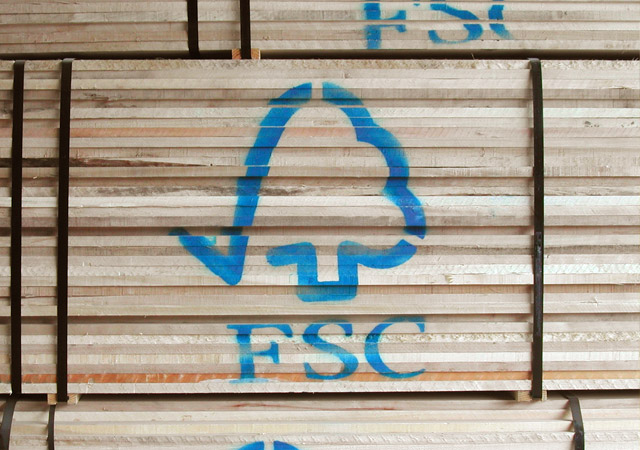
The FSC mark, a stylized tree, is sought by paper producers and other wood users as an endorsement they can use in the marketplace to promote their products as sustainable and charge a premium.

The council had successes in some regions, the environmental group said, but was failing in "high risk regions where democratic and civil society institutions are weak and corruption is high."

Greenpeace International said in a statement on its website that the council has become a "tool for forestry and timber extraction" and it wouldn't renew its membership. It said national branches of Greenpeace that are members will make their own decisions about continuing to work with the council.

In Indonesia, where rainforests are being felled at an epic rate, the FSC has given certifications to Korindo, a Korean-Indonesian joint venture that has been clearing rainforests in Papua for logging and palm oil plantations.

In 2007, the FSC withdrew its certification of Asia Pulp & Paper, the global paper products arm of the family-owned Sinarmas conglomerate that was notorious for deforestation and land grabs in Indonesia.

However for the past decade it continued to certify diary and notebook company Nippecraft and its Collins Debden brand, which is owned by the Sinarmas family through APP. The council is now reviewing those specific certifications.

Greenpeace said a major deficiency in FSC's systems was lack of transparency such as failure to publish digital maps that locate the commercial forests certified by the council.

"To be considered credible, a forest certification scheme must publish digital maps," it said. "Neither FSC, nor any other timber certification schemes, currently publish maps globally, or make audit reports publicly available."

FSC, which is based in Bonn, did not immediately respond to an emailed request for comment.

New Zealand’s logs exports to China over 1 million m3 in January

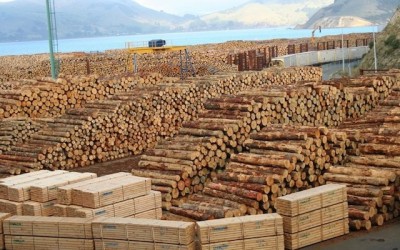
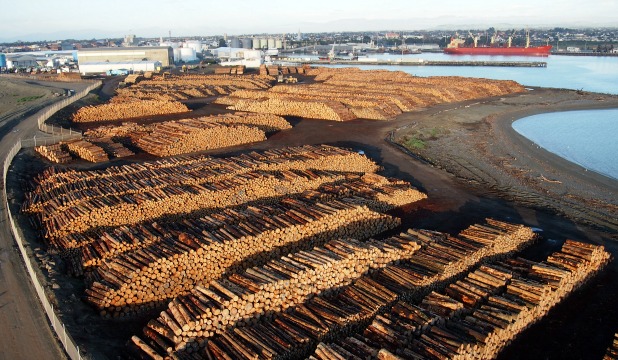
New Zealand exported more than one million cubic metres of softwood logs in January, only the second time in the country's history that such a high volume has been shipped in the month.

The country exported 1.1 million cubic metres of softwood logs overseas in January this year, up 32 percent on January 2017, according to data from Global Trade Information Services published in AgriHQ's monthly forestry market report. That's the highest level for the month since 2014 and only the second time volumes have exceeded 1 million for a January month.

"New Zealand’s softwood log exports started 2018 with a bang," AgriHQ analyst Reece Brick said in his March report under the heading 'Flying start for log exports'. "The strong start to 2018 bodes well for the coming year, as January is historically the weakest month each year."

The large export volumes in January were partly down to the later timing of Chinese New Year, which moved some of the heavy pre-Chinese New Year trading into January rather than December. New Zealand log exports in January fell 31 percent from December levels ahead of Chinese New Year celebrations, which ran from mid-February through to early March. However, the generally high level of exports this past 12 months were also a factor in lifting January volumes, AgriHQ noted.

New Zealand cemented its position as China's top source of softwood logs last year, with its share of the market lifting to 36.3 percent from 34.7 percent. AgriHQ noted that New Zealand's strong presence in the Chinese log market continued in January, with imports of New Zealand logs jumping 43 percent from the same month a year earlier, and accounting for 40 percent of China's total log imports, significantly ahead of its closest rival Russia with a 21 percent share.

China's demand for softwood logs has increased after Asia's largest economy clamped down on harvesting its own forests and reduced tariffs on imported logs to meet demand in its local market.

"All eyes are focused on the direction that China takes after the Chinese New Year holidays," Brick said. "Activity was relatively dead over the past month, but port-level offtake in the past week or two has reportedly lifted more sharply than expected.

"There’s little to show there will be any deviation from what’s been witnessed over the past 12 months and the general sentiment is for small price increases over the next two months."

Forest products are New Zealand's third-largest commodity export group behind dairy and meat products.

Canada tries to persuade WTO to step in the softwood lumber trade dispute with the US

Canada wants to persuade the World Trade Organization (WTO) to set up an adjudication panel for the judgment of the country's dispute with the US over Canadian lumber exports. Canada indicates that the US talks have failed.

According to Global News, the country has submitted the request for a meeting of the WTO’s dispute settlement body on March 27. Ottawa launched the complaint in November, saying it would forcefully defend its lumber industry against punitive U.S. tariffs, which it said were “unfair, unwarranted and deeply troubling.”

Canada also started a challenge under the North American Free Trade Agreement’s Chapter 19 dispute settlement mechanism, which the US wants to remove, as part of talks to modernize the regional trade pact the two countries share with Mexico.

On the other side, the US Commerce Department says that Canada is unfairly subsidizing and dumping softwood lumber, while the duties affect about $5.66 billion worth of imports.

The disagreement centers on the fees paid by Canadian lumber mills for timber cut largely from government-owned land. They are lower than fees paid on U.S. timber, which comes largely from private land, Global News reported.

The US imposed the tariffs after the failure of talks to resolve the decades-long dispute over the lumber trade.

Softwood lumber consumption in the US forecast to reach record-highs by 2030

US consumption of softwood lumber is likely to reach record-highs by 2030, resulting in export opportunities for sawmills in Europe and Latin America.

Higher lumber demand from all end-use sectors in the US in the coming years will result in continued expansion of sawmill capacity in the US South and increased imports from overseas, while Western Canada will reduce its shipments to the US market, according to a new study from ForestEdge and Wood Resources International.

The study forecasts that US softwood lumber demand will grow at an annual rate of 2.3% through 2030, which will be higher than the reports projection of real GDP.

The study’s Base Case demand scenario suggests that US lumber consumption will reach an all-time high by 2030.

A detailed analysis of the future consumption of softwood lumber in each of the five enduse categories (residential housing, repair & remodeling, non-residential construction, material handling and other) reveals that the category “Non-Residential Construction” will grow at the fastest rate and will increase its share of the total softwood lumber usage from just over 11% in 2016 to almost 14% by 2030.

Lumber consumed by the residential housing sector, including repair and remodeling, will continue to account for the almost 70% of the end-use market.

At an estimated softwood lumber production cost of less than US$200/m3 in 2016, the US South is one of the lowest cost suppliers of softwood lumber to the US market. This, combined with a significant “overhang” supply of softwood sawtimber as a result of the Global Financial Crisis in 2008-09 and a mature plantation resource, is expected to continue to facilitate a major expansion of sawmill capacity in the region.

The Canadian lumber producers market share in the US is expected to decline in the coming years, with the biggest reduction occurring between 2017 and 2025.

The outlook for available log supply to the sawmilling sector will be different in the two major lumberproducing regions in Canada, with harvest levels falling substantially in British Columbia over the next ten years.

Overseas supply of lumber to the US is forecasted to increase both in volume and market share by 2025, followed by a decline until 2030. Based on the study’s lumber supply curve analysis, the major supplying regions are likely to include Brazil, Chile, Germany and the Nordic countries.

In the study’s High Demand Scenario, which projects a very strong rebound in housing starts, R&R and non-residential construction, overseas supply will be crucial and reach a market share of over 10 % by 2030.

After nearly two decades of real price declines of sawlogs in North America and elsewhere, the combination of a rebounding US softwood lumber demand, constraints on log supply and export production in Western Canada, and continued strong demand for softwood lumber from markets in Europe, Asia and the Middle East/North Africa (MENA) region, is expected to push conifer log prices higher in real US dollar terms in many timberland investment regions by 2030.

Russia might start forest products exports to UAE

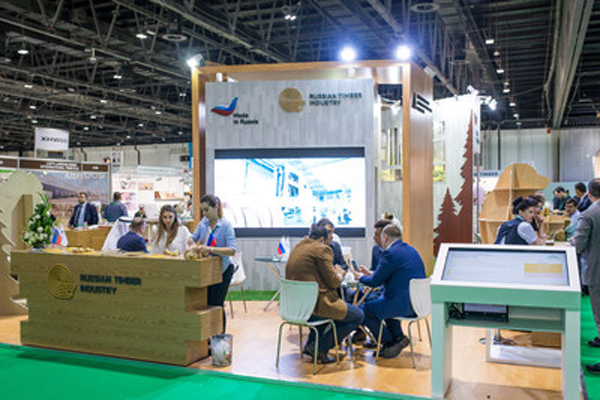
During the Dubai WoodShow (12-14 March 2018), Russian enterprises presented their products at a joint stand, organized by Russian Export Center. The stand was visited by more than a thousand participants and guests from three dozen countries, including the states of the Persian Gulf, IndiaSoutheast AsiaEurope and the US.

"The products of the Russian timber industry are of high quality, thanks to which they compete with the best world standards on equal terms. In general, according to experts, in 2017, the volume of exports of goods of the Russian timber industry amounted to 673 billion rubles, which is 19 billion rubles more than for the previous year. We aim to continue work to develop the export potential of the timber industry," said Victor Evtukhov, the State Secretary - Deputy Minister of Industry and Trade of the Russian Federation.

To discuss the prospects of the investment potential and export of Russian products of the timber industry complex, representatives of Russian enterprises met with Mohammed Hamdan al-Zaabi, Director of the Trade Promotion and Investment Department at the Ministry of Economy of the UAE. The representative of the UAE stated about the interest they have in cooperation with Russia; the parties planned a joint round table on investments and visit of partners to Russian enterprises for detailed study of products lines.

Russian companies presented the latest samples of plywood, chipboard, OSB and MDF, glued and LVL-beams, wall panels, furniture panels and components, and sawmill products. Interest in the Russian line of modern wood processing products is high - the enterprises held more than one hundred and fifty negotiations. An agreement was reached on the supply of flooring for the scaffolding to Kuwait by Modern Iumber Technology Ltd. (Utralam TM) to the amount of $ 500,000; preliminary applications were received for the products of other Russian exhibitors.

As Elena Smirnova, Head of timber industry export of Russian Export Center, said: "Russian participation in Dubai WoodShow 2018 shows mutual interest of Russian and foreign timber enterprises in effective cooperation. Our manufacturers have managed to get new ways to foreign markets having successfully agreed on various formats of joint venture."

"There is safety in numbers"

Russian companies note the benefits of working as part of a joint stand. Kraslesinvest JSC: "The products of Russian enterprises are difficult not to be recognized even against the background of hundreds of other participants. We feel big interest and loyalty of foreign partners thanks to the support of the Ministry of Industry and Trade of the Russian Federation". "100 business cards have already been distributed on the first day, and new ones were ordered in Dubai," notes a representative of Forestry Holding "Altailes" Ltd.

Participation in the exhibition Dubai WoodShow 2018 is aimed at promoting Russian timber construction materials in the international market, developing the export potential of Russia, the priority of which is to increase the share of non-resource exports.

Holzindustrie Schweighofer sells all its Romanian forest investment to Swedish GreenGold Group

Holzindustrie Schweighofer decided to sell its wholly-owned subsidiary Cascade Empire s.r.l. (Cascade Empire) as well as its forest management unit Ocol Silvic Cascade Empire s.r.l. to the Swedish company GreenGold Group.

One of Europe’s leading wood processing companies will quit its Romanian forest investments, but no further information on the purchase price of contract details have been released yet.

The forest areas owned by Cascade Empire reach 14,283 hectares located in the Romanian regions of Hunedoara, Gorj, Valcea, Prahova, Buzau, Neamt and Suceava, which the company bought between 2003-2011.

Also, Holzindustrie Schweighofer entered the Romanian market in 2003 and is now operating 3 sawmills and 2 panel factories. The company employs around 3,100 people and has implemented an action plan for a sustainable timber industry in Romania that goes far beyond all legal requirements.

Softwood lumber global demand reached record-high in 2017

Global trade of softwood lumber reached a record-high in 2017, as demand for wood continued to increase in the US, China and Europe.

Global Lumber Trade

Trade of softwood lumber reached an all-time-high in 2017 as demand for wood was strong in most key markets around the world. An estimated 126 million m3 of softwood lumber was shipped from forest-rich countries such as Canada, Russia, Sweden and Finland to markets with high consumption of lumber, including China, the US, the United Kingdom, Japan and Germany.

Since the global recession in 2008, international trade of lumber has gone up by as much as 50%. With the economy forecasted to stay healthy in the US and Europe in 2018, this might be another good year for lumber exporters.

Lumber markets – North America

US softwood lumber production in 2017 reached the highest level seen in ten years. The biggest increase came in the southern states, but other regions of the country also had healthy production gains year-over-year.

The higher domestic production levels resulted in decreased demand for imported lumber as US lumber consumption was up by only one percent from 2016. The strong market for lumber in the US led to record high lumber prices in both the US and Canada in late 2017 and early 2018.

Lumber markets – Northern Europe

Softwood lumber production in Finland reached a ten-year high of 11.9 million m3 in 2017. The higher production was driven by expanding lumber exports, particularly to China. High demand for lumber from Europe, Asia and the US in late 2017 pushed export prices in the Nordic countries to their highest levels in almost three years.

Lumber markets – China

Over the past two years, prices for imported softwood lumber to China have been steadily rising and in January 2018 reached their highest levels since March 2015. Lumber supply from Russia and North America has generally been the lowest cost lumber imported to China, while lumber from Chile, Sweden and Finland typically is at the higher end of the price spectrum.

Russia and Canada continue to be the major suppliers, but their total market share has shrunk from 81% in 2015 to 76% in 2017, with particularly Nordic mills increasing their presence in this fast-growing market.

Lumber market – Japan

Although lumber imports to Japan fell in the 4Q/17, the total volume for the year was up slightly for the second consecutive year. The biggest changes in supply over the past few years have been reduced shipments from Canada and increased imports from Finland and Sweden. Compared to most other major markets of the world, domestic and import prices for lumber have been surprisingly stable.

Lumber market – Middle East/North Africa

The Middle Eastern and North African (MENA) lumber markets grew fast from 2007 to 2015, reaching a peak of imported lumber of about 11.5 million m3 in 2015. Since then, import volumes have fallen by over 20% to an estimated nine million m3 in 2017. This decline came as the result of financial and political uncertainties in many countries in the region. Additionally, Finland and Sweden began redirect their sales to meet growing wood demand in China and other European nations.

Lumber prices in the US on steep decline

Lumber sales trends in the US pointed decidedly downward during last week, with cuts deepening in most dry species and a rout befalling green Douglas Fir. 
The Montreal Wood Convention, a buying show, and the fourth snowstorm in the East in as many weeks contributed to buyers maintaining a low profile and low expectations. Nonetheless, many mill sales representatives worked the phones hard, as they probed for levels that would generate more volume.
The Random Lengths Framing Lumber Composite Price tumbled $15.

Week
Mar 23
Week
Mar 16
Year Ago
2017
Random Lengths Framing Lumber Composite Price* $491 $506 $398
KD Western S-P-F #2&Btr 2x4 R/L Mill Price 503 522 360
KD Eastern S-P-F #1&2 2x4 R/L, delivered Great Lakes 600 612 442
Green Douglas Fir Std&Btr 2x4 R/L (Portland) 525 560 372
Southern Pine (Westside) #2 2x4 R/L 589 595 467
KD Coast Hem-Fir #2&Btr 2x4 R/L 530 550 395
Ponderosa Pine (Inland) #2&Btr 1x12 R/L 745 740 615
* Weighted average of 15 key items

Random Lengths Panel Market Report
Structural panel markets were mixed. An OSB producer’s announcement that mechanical issues idled its mill indefinitely jolted markets throughout the South.
Deep discounts available earlier in the week dried up quickly. Northern OSB markets were mixed. Southern Pine plywood trading took on a softer tone, and some producers discounted small volumes to extend order files.
The sales pace in western Fir plywood was quiet, but some traders reported an uptick late in the week.

(f.o.b. mill prices) Week
Mar 23
Week
Mar 16
Year Ago
2017
Random Lengths Structural Panel Composite Price* $540 $541 $399
Southern (west-east) 15/32-inch 3-ply rated sheathing plywood 525-570 530-575 365-395
Southern (west-east) 15/32-inch 4-ply rated sheathing plywood 530-575 535-580 365-400
Western 1/2-inch 4-ply rated sheathing plywood 528 540 405
North Central 7/16-inch Oriented Strand Board 405 405 308
*Weighted average of 11 key items

Charles Ingram Lumber invests $33 million in sawmill expansion in the US

Charles Ingram Lumber Co., a family-owned sawmill located in Effingham, S.C., is expanding its existing operations. With $33 million of capital investment, the company is expected to create 22 new jobs.

Serving the southeastern U.S. since 1931, Charles Ingram Lumber Co. owns timberland where trees are grown for pulpwood and saw timber. The company also operates a lumber mill, which produces approximately 120 million board feet of Southern Yellow pine annually.

Located at 4930 Planer Road in Effingham, S.C., the company will be adding a new dry kiln this year, which will enable them to dry an estimated 70 million board feet of lumber. The company will also begin construction on a new manufacturing line which, over the next several years, will provide a significant amount of the required additional production.

EU plywood prices on the rise, due to increased demand and limited supply

Plywood prices are rising sharply in the EU on the back of buoyant demand across the region and supply issues in a range of key exporting countries. There is also an increasing tendency to order more just-in-time, little and often to hedge against the risk of the present ‘market bubble’ bursting.
That summarizes recent feedback from leading European plywood importers and distributors on trade and market trends. One leading player described market dynamics over the last six months as ‘increasingly tricky’. It had reached the point where, due to constrained supply and competition for what supply was, the company is now effectively rationing product.
There’s certainly no need for advertising currently – everything we’re bringing in is already sold,” he said. “In fact, we’re allocating product to a waiting list, with loyal, long-term customers obviously at the front of the queue.”
Adding to market challenges, importers say they have had to become even more selective in choice of the suppliers, as a response to what they describe as an increasingly stringent and more uniform application of the EU Timber Regulation (EUTR).
This and our own increasingly strict corporate social responsibility policy and stress on minimizing reputational risk means that, where we previously had 10-15 suppliers, we now have just four or five who we know we can rely on to consistently satisfy our due diligence requirements,” said another importer.
But clearly that potentially exacerbates availability issues when supply is tight. Descriptions of price rises resulting from this combination of market pressures range from ‘significant’ to ‘seismic’. A UK importer said that in the last six months they’ve seen prices for Malaysian and Chinese tropical plywood increase 25% and 20% respectively, while Brazilian elliottii is up 30%.
A continental European buyer said they’d seen an even steeper hike in the cost of elliottii pine plywood since last June.
Then, we were paying US$240/245 per cu.m fob for standard 20mm C+C, now we’re at US$330,” they said. “We’ve been cushioned to an extent by the weakening of the dollar, which nine months ago was at EUR 1.06 and is now EUR 1.23. But even so, a rise of US$80 per cubic meter is a lot to take on board – and if the dollar strengthens, we’ll be in for even stiffer rises. Larger customers with a more global perspective understand the situation and accept they have to pay more, but efforts to pass on at least some of the increases to smaller businesses are meeting with resistance.”
The main driver for EU demand of both tropical and temperate hardwood and coniferous plywood is the continuing construction growth across much of the EU, particularly, according to one international importer/trader.
The latest report from Euroconstruct Forecast 2017 shows that the construction growth in its 19 focus countries at 3.5%. The report added that it was the first time there had been an ‘across the board’ increase in activity in all countries since 1989, and that growth in a basket of construction market measures was at its highest since 2006.
The result, say suppliers, is healthy demand for everything from shuttering/formwork plywood, to top end structural and exterior grades.
Furthermore, Euroconstruct predicts that the EU building sector will see another 6% expansion by 2020, with civil engineering projects, refurbishment and maintenance sectors taking over from residential and non-residential building in providing most market momentum.
Source: ITTO

Finnish and Swedish wood giants at risk due to melting ices in the Arctic region

The forest floors below the Arctic circle are starting to melt, as the unusually mild winters are turning once icy grounds into thick layers of mud, which can swallow the 25 tonne vehicles that harvest the woods in the area.

According to the foresters who work the land in Finland and Sweden, the machines that harvest the materials which go into pulp, paper and packaging are in danger of being washed down by the Arctic Ocean waters.

"We will see more and more of these difficult conditions," Uno Brinnen, head of forestry at Sweden's BillerudKorsnas AB, said in an interview. "It will always shift between warm and cold winters, but the long-term trend seems clear."

According to the Business Times, temperatures across large swathes of Sweden were as much as 3 deg C higher than normal in December and January, as reported by the Swedish Meteorological and Hydrological Institute (SMHI). That warming forms part of a trend that is likely to persist, according to SMHI, whose scientists expect temperatures to continue rising over the next six decades because of climate change.

The travails increasingly experienced by Nordic foresters underscore the economic impacts of climate change. Even so, many countries and companies in the region are being forced to adopt new ways of conducting traditional business.

For Swedish and Finnish companies such as BillerudKorsnas, Holmen AB, Stora Enso Oyj and UPM-Kymmene Oyj, the changing climate poses major challenges because if the ground does not freeze enough to support the heavy vehicles used for harvesting, companies cannot get to the raw materials that they need to do business year round.

"The high water levels after the wet and mild autumn and winter creates a tough situation for the wood supply," Sweden's largest forest-owner association, Sodra AB, said in January, when it opted to harvest closer to major public roads in order to minimize the risk of driving over mushy woodlands.

The economic stakes are high. Forest industry products have for centuries been a pillar of the Swedish and Finnish economies. Exports of such goods accounted for 10 per cent of Sweden's total exports last year and 22 per cent of Finland's in 2016. The combined value of the forestry to the two Nordic countries is about 24 billion euros (S$38.9 billion), The Business Times reported.

"The root cause of the shortage of pulp wood is the unusually wet and mild start of the winter," said Swedish packaging giant BillerudKorsnas in January.

BillerudKorsnas gets 75% of its raw material from the Swedish forests. The company announced that the warmer weather caused shortages in late 2017 and early 2018, resulting in an estimated negative impact of as much as 100 million kronor (S$16 million) on Q1/2017 earnings. Also, BillerudKorsnas started to scan its forests with lasers to map out more sensitive areas and to try to find stable routes through woodlands, even when they are wet.

The company has also found a solution, by using bigger wheels and rubber tracks on some machines to reduce the damage that they cause to the ground and forest growth, another problem stemming from the milder weather.

"Winters have started later in large parts of our world, and it's a lot of wood we want to get hold of when the grounds are frozen," Stora Enso chief executive officer Karl-Henrik Sundstrom said. "It's something I think we have to get used to, work with and even adjust our harvest cycles."

Norbord temporarily halts production at its 100 Mile House mill in BC, Canada

Norbord Inc. announced that a shortage of wood will cause it to temporarily suspend production at its oriented strand board (OSB) mill in 100 Mile House, British Columbia, Canada.  

Norbord currently expects the suspension to commence on or about May 14, 2018 and to continue for approximately one month.

The significant wildfires that the province of British Columbia experienced in the summer of 2017 seriously damaged logging areas surrounding the 100 Mile House mill. Further, the severe weather conditions this winter have limited loggers' ability to access the forests during the months when the mill typically builds its annual log inventory. Combined, these extraordinary circumstances have impacted Norbord's ability to secure a sufficient wood supply to operate the mill on a continuous basis during this one-month period.

Norbord will continue to supply its customers with production from its other OSB mills and the 100 Mile House mill will continue to receive log deliveries during this period. The Company currently estimates that the curtailment will negatively impact its 2Q 2018 financial results by approximately $5 million.

The 100 Mile House mill has a stated annual production capacity of 440 million square feet (3/8-inch basis).

Norbord Inc. is a leading global manufacturer of wood-based panels and the world's largest producer of oriented strand board (OSB).

Lumber trading in the US declined, with wider prices cuts

Trading in framing lumber in the US softened during last week, while the cuts in prices widened. Buyers held back amid expectations of a significant downside correction.
However, producers’ approaches varied, generating some differences in how traders saw the market unfolding heading into spring. Mills in the West were particularly aggressive in seeking out trading levels.
Producers in Western Canada were most prone to hold their quotes, citing an acute backlog of late shipments and little improvement in rail service.

Week
Mar 16
Week
Mar 9
Year Ago
2017
Random Lengths Framing Lumber Composite Price* $506 $511 $396
KD Western S-P-F #2&Btr 2x4 R/L Mill Price 522 539 352
KD Eastern S-P-F #1&2 2x4 R/L, delivered Great Lakes 612 625 434
Green Douglas Fir Std&Btr 2x4 R/L (Portland) 560 580 367
Southern Pine (Westside) #2 2x4 R/L 595 587 475
KD Coast Hem-Fir #2&Btr 2x4 R/L 550 555 387
Ponderosa Pine (Inland) #2&Btr 1x12 R/L 740 740 605
* Weighted average of 15 key items

Random Lengths Panel Market Report
Sales of structural panels slowed, with two-tiered pricing evident in OSB and plywood markets. In OSB, the disparity between trading levels in the secondary market remained a point of discussion.
Those in the West still sold at premiums to mill quotes, while discounts were available in the East and South. Southern Pine plywood sales tapered, and buyers spent more time monitoring prices than placing orders.
Trading also was quiet in western Fir plywood, as buyers anticipated lower prices and were wary of downside risk.

(f.o.b. mill prices) Week
Mar 16
Week
Mar 9
Year Ago
2017
Random Lengths Structural Panel Composite Price* $541 $541 $402
Southern (west-east) 15/32-inch 3-ply rated sheathing plywood 530-575 530-575 380-405
Southern (west-east) 15/32-inch 4-ply rated sheathing plywood 535-580 535-580 380-410
Western 1/2-inch 4-ply rated sheathing plywood 540 550 398
North Central 7/16-inch Oriented Strand Board 405 405 305
*Weighted average of 11 key items

Wood pellets price in Germany still on the rise in March due to cold weather

Again, the wood pellets price in Germany is slightly higher in March 2018, than in the previous month. The national average price has reached the value of EUR 255.28/tonne, 0.9% more than in February, but only 10 cents more than in March 2017. 
During March, a kilogram of wood pellets costs 25.53 cents, while one kilowatt hour (kWh) of heat from wood pellets costs 5.11 cents. Also, the price advantage for fuel oil is currently 13%, compared to 15% for natural gas, reports the German Energy Wood and Pellet Association e. V. (DEPV).
"The cold February has attracted the demand for wood pellets, which is reflected in the price," explains Martin Bentele, CEO of the industry association DEPV.
Regional prices (for 6 tonnes purchases) in March: Central Germany: EUR 253.92 / t, Southern Germany: EUR 254.39 per tonne, Northern Germany: EUR 257.61/ t.
Larger quantities (26 t) could be bought for the following prices: South: 239.31 EUR / t, Middle: 234.68 EUR / t, North / East: 235.64 EUR / t (all incl. VAT).

Newsletter

Subscribe to our digital newsletter for your daily digest of essential news, views and analysis from the international wood industry delivered directly to your inbox.


0