
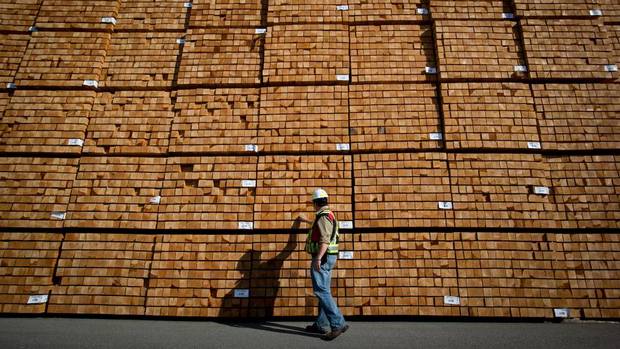
With few mill acquisitions, almost all of the production gains arose from improvements at existing mills. Of the top 40 companies, 8 in Canada and 6 in the U.S. recorded production declines - not the trend you'd expect during a time of near-record-high to record-high lumber prices.
Total Canadian softwood lumber shipments declined by 1.7% to 28.0 billion bf while U.S. production increased by 3.7% to 33.9 billion bf.
The top 10 Canadian producers have seen their shipments grow at a slightly slower pace than the overall Canadian industry since 2014. In 2017, the softwood lumber shipments of the top 10 decreased marginally versus a larger decline in Canada as a whole (-1.4% for the top 10; -1.7% for Canada). The drop in Canadian shipments is a function of many factors, but the implementation of import duties to the U.S. in early 2017 was one that caused Canadian companies to re-evaluate their markets and mills. Continue reading "Top 10 North American lumber producers in 2017"
Article archive
BC wood invests CAD 7.8 million to promote Canadian wood overseas
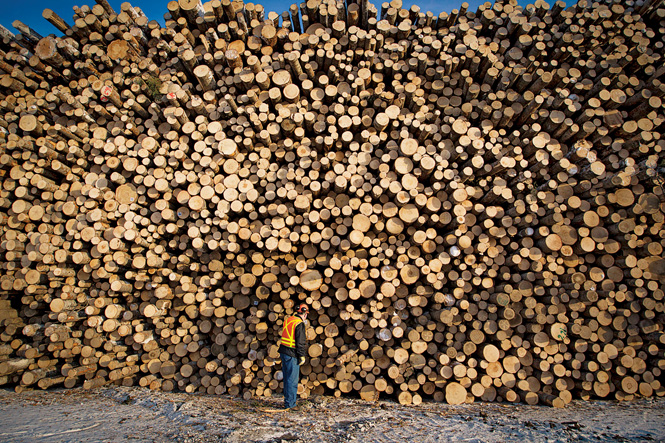
Forestry Innovation Investment informed that the Government of British Columbia Province of Canada is investing CAD 7.8 million to promote the use of B.C. wood overseas, advance wood building systems and products, and expand global markets.
According to the announcement, through an annual, competitive call for proposals process, 13 industry trade associations and research institutes were selected to receive funding and deliver market development, or wood innovation programs, on behalf of government and industry. B.C.’s contribution is being managed through Forestry Innovation Investment, the Province’s market development agency for forest products. The Province will cost-share these activities, with additional funding provided by B.C. industry and the federal government, through Natural Resources Canada.
Of the CAD 7.8 million:
CAD 5.985 million will be made available for activities targeted at expanding markets for B.C.’s wood products, with investment priorities that reflect evolving market opportunities in Asia and North America
CAD 1.852 million will be made available for activities delivered through the Wood First program, which fosters the innovative use of wood and wood building systems in B.C. through research, education, marketing and capacity building. Bruce Ralston, Minister of Jobs, Trade and Technology, commented:
“Expanding our international markets, especially in Asia, is crucial to the long-term success of B.C.’s forest sector. This funding support opens the door to more trade opportunities for B.C. companies, and will lead to greater innovation in the industry.”
The B.C. forest sector directly employs more than 57,000 British Columbians and supports over 7,000 businesses. Provincial revenue generated through forestry is key to providing essential public services such as education, health care and infrastructure. In 2017, B.C. exported CAD 14.1 billion in forest products (lumber, pulp and paper and other wood products), which represented 32% of B.C.’s total exports.
Wood fiber costs for hardwood pulp manufacturers in Sweden are among the lowest in Europe
Hardwood pulp manufacturers in Europe have some of the highest wood fiber costs in the world despite prices for hardwood pulplogs having trended downward in most key markets on the continent over the past five years. In the second half of 2017, that trend reversed, with fiber prices going up in both the local currencies and in US dollar terms.
In the 4Q/17, prices for hardwood logs in Spain were the highest on the continent, while Swedish prices were on the lower end of the hardwood cost spectrum, according to the Wood Resource Quarterly.
Hardwood fiber supply in Sweden tightened in late 2017 because of an unusually wet and mild early winter season. Tight supply in central Sweden resulted in an odd importation of Eucalyptus chips from Brazil during the 4Q/17 at a reported price that was substantially higher than the domestic hardwood prices. Prices for hardwood pulplogs trended upward during most of 2017 after they reached an 11-year low in the 4Q/16. Despite the recent price rise, birch pulplog costs were in the 4Q/17 about 15% lower than their 10-year average in US dollar terms.
Prices for softwood chips and pulplogs were also up in Sweden during 2017 because of an imbalance between domestic supply and demand. The higher domestic fiber prices resulted an increase in importation of softwood chip to Sweden in 2017, reaching almost double the volume imported five years ago. The imports in the 4Q/17 were the second highest quarterly volume on record.
Historically, most imported chips have been destined for the country’s pulpmills, but over the past two yearsthere has been an increase in imported chips to be used for energy. Latvia, Norway, Estonia and Finland, in ranking order, are the major suppliers of softwood chips, accounting for 95% of the total import volume in 2017. With a higher percentage of lowercost energy chips over the past few years (predominantly from Norway), the average value for imported chips has declined by about 40% 2013 to 2017, reports the WRQ in its latest issue. Of the four major supplying countries, Finland supplied the highest cost chips, while Norway was the lowest cost supplier in 2017.
Vietnam’s wood industry faces shortage in raw materials

Vietnam’s wood industry faces a quandary as bright export growth prospects are clouded by difficulties in finding necessary raw materials.
Nguyen Ton Quyen, Vice President and General Secretary of the Vietnam Timber and Forest Product Association (VIFORES), expected a mixed bag of fortunes in the domestic wood sector this year, with a handful of new trade agreements set to take effect.
Quyen said that he was certain exports of wood products from Vietnam will increase significantly, even for a country that is already the world’s third largest and ASEAN’s biggest wooden furniture exporter.
He cited the EU-Vietnam Free Trade Agreement (EVFTA) and the Comprehensive and Progressive Agreement for Trans-Pacific Partnership (CPTPP) as major boosts for wood exports, opening up access to a total of 28 markets across the world.
But such hope will be in vain without the necessary policies and guidelines to facilitate processing enterprises in the face of high global standards, changing technology and a shifting labour source, he added.
Worse still, while exports are to rise, the Vietnamese wood industry faces a seemingly insolvable problem of increasing the quantity of raw materials to meet producers’ demand for legally obtained timber.
Quyen showed particular concern for an imminent fierce competition to obtain materials, especially from the Chinese market, whose wood processing industry is expected to demand about 60 million cubic metres of raw timber this year alone.
He explained that Chinese enterprises will scour neighbouring markets to procure this massive amount of materials, thus putting Vietnam and other Southeast Asian countries under competitive pressure.
Meanwhile, neighbouring countries such as Laos, Cambodia or Myanmar will continue to ban the export of logs and sawn timber directly from plantations, further reducing supply.
Nguyen Quoc Tri, Director General of the Ministry of Agriculture and Rural Department’s (MARD) Vietnam Administration of Forestry (VAF), was certain that the country’s wood products export turnover will reach 9 billion USD or more in 2018.
Tri said that although Vietnam has closed its natural forests for more than a year, the wood processing industry is still developing well, proving that they can do just fine without consuming natural wood. But in order for that to happen, the country still needs about 34 million cubic metres worth of raw material, he said.
Nonetheless, the VAF has set a target of 201,000 hectares of new forests and to regenerate 360,000 hectares with an additional 50 million trees to be planted, in order to supply up to 18 million cubic metres of raw timer in 2018.
He worried that without proper sustainable forest management, improved productivity, quality and distribution, there will not be enough wood to meet domestic demand.
Deputy Minister of Agriculture and Rural Development Ha Cong Tuan suggested extending the life cycle of timber forests as a method to improving the added value and quality of raw wood materials.
The deputy minister said on the Government’s online portal that he counted on the support of foreign partners for Vietnamese enterprises to raise wood export turnover in 2018.
According to the MARD, the export value of wood and wood products in the first two months of 2018 had reached 1.34 billion USD, up by 26.3 percent over the same period in 2017.
Brazil: Booming wood-based products exports

In February 2018, Brazilian exports of wood-based products (except pulp and paper) increased 27% in value compared to February 2017, from US$192.3 million to US$244.0 million.
Over the same period the value of Brazil's pine sawnwood exports increased almost 26% from US$30.8 millionto US$38.7 million. In terms of volume exports increased 21% over the same period from 152,700 cu.m to 185,600 cu.m.
On the other hand tropical sawnwood exports declined slightly from 31,100 cu.m in February 2017 to 31,200 cu.m in February 2018 however, export values rose around 4% o US$ 14.3 million.
In February, Brazilian pine plywood exports increased sharply (56%) in value in comparison with the figure of US$36.7 million February 2017, from. The increase in the volumes of pine plywood were more modest at 27%,from 138,100 cu.m to 175,200 cu.m.
As for tropical plywood, export volumes and value increased from 9,800 cu.m (US$3.6 million) in February 2017 to 12,700 cu.m (US$5.2 million) in February 2018. In addition, exports of Brazil's wooden furniture also rose from US$32.8 million in February 2017 to US$38.7 million in February 2018, an 18% increase.
Monthly data released by the Brazilian Ministry of Development, Industry and Foreign Trade (MDIC) for February show a significant increasing pace of all types of furniture exports. Compared to February 2017 furniture export increased by 17% to US$51.6 million compared to US$44.1 million.
The positive result is mainly due to the expansion of sales to the United States, which rose 27% in the first two months of this year and to the United Kingdom (up 24%). The top three importers (US, UK and Argentina) increased their share of the total volume from 47% in the first two months of 2017 to 49% this year.
EU tropical sawn hardwood imports fall to all-time low

EU tropical sawn hardwood imports fall to all-time low The EU imported 2.04 million cu.m of sawn hardwood from outside the region in 2017, 13% less than the previous year.
EU imports of tropical sawn hardwood were 875,000 cu.m in 2017, 18% less than the previous year. Imports of tropical sawn hardwood last year were the lowest ever recorded by the EU, below the previous low of 930,000 cu.m in 2013 during the euro-zone crises and only around a third of the level prevailing before the global financial crises.
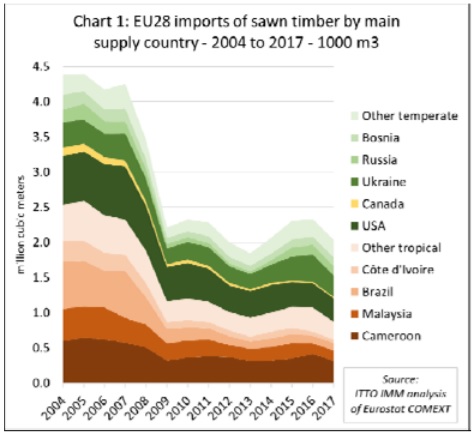
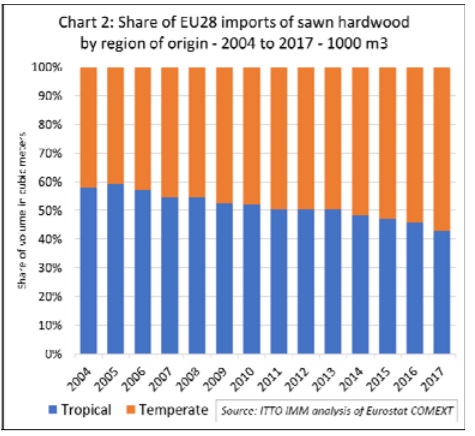
The value of EU imports of tropical sawn timber decreased by 16% to €653 million in 2017. The average unit value of tropical sawn hardwood imports into the EU in 2017 was €746 per cubic meter, up from €728 per cubic meter the previous year.
In 2017, EU imports of temperate sawn hardwood fell by 8% to 1.16 million cu.m. The more rapid pace of decline in imports from the tropics meant that the share of tropical in total EU sawn hardwood imports fell from 46% in 2016 to 43% in 2017, an acceleration in the long term downward trend.
Mixing trends in US lumber prices
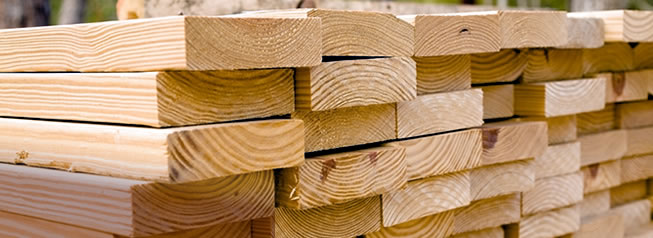
A mix of trends in prices of framing lumber emerged across producing regions. Trends varied based on species, product groups, and even volumes sold. Gains were most pronounced in Western S-P-F, with #2&Btr 2x4 standing out; mill prices surged $20-30 for the week. Prices of green Douglas Fir, which had bounced off lows the previous week, flattened, while double-digit price moves in either direction were posted in Coast dry framing. Myriad factors pulled Southern Pine in both directions, as well.
| This Week Apr 6 |
Last Week Mar 30 |
Year Ago 2017 |
|
| Random Lengths Framing Lumber Composite Price* | $492 | $489 | $414 |
| KD Western S-P-F #2&Btr 2x4 R/L Mill Price | 540 | 515 | 392 |
| KD Eastern S-P-F #1&2 2x4 R/L, delivered Great Lakes | 612 | 602 | 458 |
| Green Douglas Fir Std&Btr 2x4 R/L (Portland) | 540 | 537 | 377 |
| Southern Pine (Westside) #2 2x4 R/L | 564 | 577 | 478 |
| KD Coast Hem-Fir #2&Btr 2x4 R/L | 535 | 525 | 410 |
| Ponderosa Pine (Inland) #2&Btr 1x12 R/L | 750 | 750 | 635 |
| * Weighted average of 15 key items | |||
Random Lengths Panel Market Report
Price declines outnumbered gains in structural panel markets. Sales of OSB were modest in most regions, and prices adjusted in both directions. Buyers in the South confined purchases to immediate needs, citing concern about near-term downside risk. Southern Pine plywood trading was mixed and increasingly dependent on situational circumstances such as order volumes and destinations. Western Fir plywood trading was sluggish and sheathing prices were sloppy.
| 0.(f.o.b. mill prices) | This Week Apr 6 |
Last Week Mar 30 |
Year Ago 2017 |
| Random Lengths Structural Panel Composite Price* | $532 | $538 | $410 |
| Southern (west-east) 15/32-inch 3-ply rated sheathing plywood | 500-545 | 515-560 | 365-395 |
| Southern (west-east) 15/32-inch 4-ply rated sheathing plywood | 505-550 | 520-565 | 370-400 |
| Western 1/2-inch 4-ply rated sheathing plywood | 529 | 534 | 415 |
| North Central 7/16-inch Oriented Strand Board | 405 | 405 | 320 |
| *Weighted average of 11 key items | |||
Africa: Congestion at Douala Port frustrates timber shippers
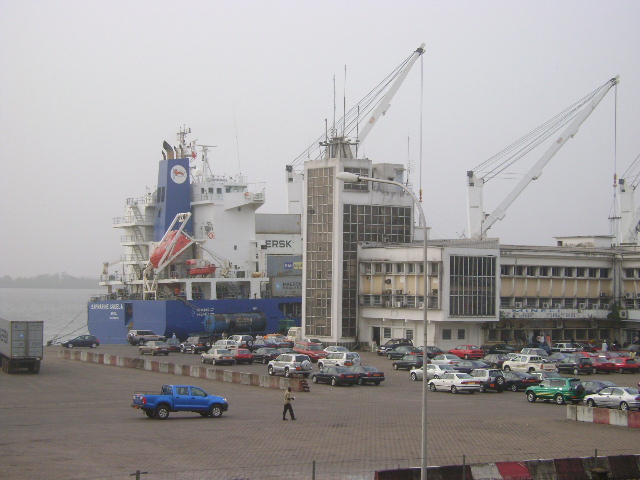
Exporters continue to be frustrated over the congestion at Douala Port. Reports suggest up to 60,000 cu.m of logs destined for China are stuck in the port awaiting shipment.
The situation is becoming worse with ships having to leave with only part cargos and in some cases sawnwood shut out from loading is being left quayside.
Almost all export shipments from Cameroon’s pass through Douala Port which also serves landlocked Chad and the Central African Republic.
Shippers complain that the procedures and costs (direct and indirect) for getting goods out of the country are a major challenge.
In a letter to the government the Port’s Director General said that it is the lack of investment in upgrading port facilities that is mainly the cause of the problems at the Port.
When built the Port was equipped to handle 7 million tonnes annually but last year there were around 12 million tonnes to be shipped.
Producers in northern Congo Brazzaville are starting to truck their exports 1,500km to Point Noir Port in order to avoid the congestion at Douala.
This long distance transport is very costly but ends up cheaper than the costs arising from long delays, high charges and possible short shipment penalties from shipping thorough Douala.
Changing US hardwood plywood supply channels
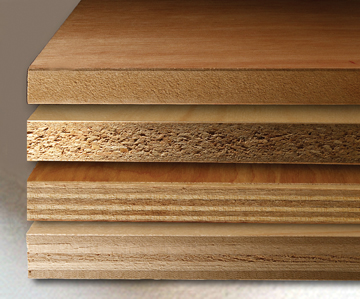
US hardwood plywood imports declined by 5% in January to 202,536 cu.m. but the value of imports increased to US$143.9 million.
China’s share in US hardwood plywood imports was only 18% in January, down from 60% in January 2017 before the US imposed anti-dumping and countervailing duties.
Indonesia, Vietnam and Cambodia gained the most from the duties on Chinese plywood. Plywood imports from Vietnam and Cambodia are still relatively small, but in January they surpassed Malaysia’s shipments to the US
Plywood imports from Indonesia were 29% higher than in January 2017, while the value of imports increased by 40%.
Canadian lumber giants making good profits despite US duties

Main lumber producers in British Columbia keep on booking major profits on near record lumber prices a year after the US Department of Commerce instituted the antidumping duties on Canadian lumber imports.
The benchmark price for 1,000 board-feet of top-quality western Canadian two-by-fours hit US$540 about a month ago, according to the trade publication Madison's Lumber Reporter, compared with US$315 at the start of 2017 before US interests re-ignited the ongoing trade dispute, Prince George Citizen reported.
Bottlenecks in rail transportation plaguing all industries are one reason lumber prices have spiked so high, but solid demand has also allowed producers to simply pass the price of tariffs along to consumers in prices, said Susan Yurkovich, president of the B.C. Lumber Trade Council.
"Who knows how long these prices will hold, but for now (they are) mitigating the impact of duties for Canadian producers," said Yurkovich, who is also CEO of the Council of Forest Industries, one of the forestry sector's main industry groups.
After the US Lumber Coalition complained about the Canadian lumber producers last April, the US Department of Commerce levelled preliminary duties. The final duties were set last fall at between 20.8 per cent and 22.1 per cent, depending on which company it is.
In the meantime, West Fraser Timber Co. Ltd., Canada's biggest lumber producer, reported a $596 million profit in 2017, up from $326 million in 2016. Canfor Corp., the country's second-biggest producer, reported $345 million in profits up from $151 million in 2016. The US case is that Canadian, particularly British Columbian, lumber producers are unfairly subsidized because the province's methods of granting access to Crown-owned timber doesn't constitute a fair market, allowing B.C. producers to undercut American mills. Last year, however, B.C.'s lumber production shrank slightly due in large part to the record wildfires that interrupted logging and burned timber supplies, Prince George Citizen reported.
During 2017, the total lumber exports from British Columbia decreased by 9%, to 25.3 million m3, while shipments to the US came down by 10%, to 16.1 million m3. The decline was also caused by B.C. having to reduce timber harvests for several decades to allow its forests to recover from the mountain pine beetle infestation.
And US lumber producers, including mills that turn out competing southern yellow pine, have been able to push up prices for their own product in lock step with tariff-driven Canadian prices, said Keta Kosman, publisher of the trade publication Madison's Lumber Reporter.
"You could almost say sawmills in the southern US must be doing handsprings," Kosman said, "because it is putting southern-pine prices up when that has nothing to do with the (tariffs)."
However, B.C.'s biggest lumber producers, such as West Fraser Canfor and Interfor, are also sharing in those benefits having bought some 40 US mills between them during the term of the last Canada/US trade agreement. The biggest losers among Canadian forest-product producers, Kosman said, are the value-added manufacturers who are being charged the higher prices for lumber then have to pay tariffs on finished products that they sell into the US, Prince George Citizen reported.
Yurkovich said Canada is continuing to push the dispute in litigation having filed appeals both under NAFTA and with the World Trade Organization. For the moment, however, she added that efforts to renegotiate NAFTA have put negotiations for a new Canada/US lumber deal on the back burner.
India shows great interest in Swedish pine

The Indian wood industry is showing strong interest in Swedish pine, particularly for furniture and joinery. Indian architects and designers are also proving inquisitive about the versatile and sustainable material.
This was what industry organisation Swedish Wood discovered from its participation in the India Wood trade show alongside nine Swedish sawmill companies.
India Wood was held on 8–12 March 2018 in Bangalore, southern India. There was strong interest in the Swedish softwoods, particularly pine, from visitors who mainly comprised representatives of Indian furniture and joinery companies, wood importers and, to a lesser extent, interior designers, architects and furniture designers.
“The signals we received from the Indian furniture market at the trade show is that the younger generation are showing an interest in softwood furniture that is relatively light, feels modern and is easy to transport when moving house, for example,” says Charlotte Dedye Apelgren, Director of Interior and Design at Swedish Wood.
At the trade show, Swedish Wood also signed a joint project agreement with Indian state training body the Furniture & Fitting Skill Council (FFSC). Under the agreement, Swedish Wood will help to spread knowledge in India about how to work industrially with softwood in the manufacture of furniture and joinery products.
“The FFSC sees a considerable need for training in the furniture industry in India, and as the Swedish sawmill industry increases its exports of softwood to the country, it is important to also drive up expertise in the furniture and joinery industry on how best to work with the material,” explains Charlotte Dedye Apelgren.
Swedish exports of sawn wood products to India are currently quite modest, but they are growing rapidly. Last year, Sweden exported 27,000 cubic metres of sawn softwood worth around SEK 50 million (6 million USD). That represents a 35 percent increase compared with 2016. The volume of exports has more than trebled since 2013, when exports of sawn wood products from Sweden to India began to pick up.
Sweden is the fifth largest country for softwood exports to India, after competitors such as Germany and Canada, and the country that has seen the greatest increase in exports in recent years. The Swedish sawmill industry sees India as a priority market for the future, and exports to India from Sweden are expected to continue growing.
Swedish production of sawn and planed wood products totals 18 million cubic metres, of which 13 million is exported, representing an export value of SEK 27 billion (3,2 billion USD). Sweden is thus the world’s third largest exporter of sawn wood products, by volume. Sweden exports mainly to Europe, North Africa, the Middle East and Asia.
Swedish Wood was joined at the trade show by the following nine Swedish sawmill companies: Holmen Timber, Martinsons, Moelven, Norra Timber, Norrskog Wood Products, SCA Timber, Setra Group, Siljan Timber and Södra.
Swedish Wood’s stand displayed samples of Swedish sawn pine and spruce, examples of products for interiors and construction, plus pine surface samples showing different types of surface treatment. The seating and tables on the stand were designed by a Swedish designer and manufactured in India using Swedish pine.
Swedish Wood also took part in the Timber Forum seminar that was organised by the trade show. Its presentation included examples of how Swedish wood is used in modern design and architecture, as well as the technical properties of Swedish softwood.
Malaysian log exports might suffer further cuts, affecting traders

Tropical logs exports from Malaysia will continue to decrease once with the fall of the logging volumes in a key region in the Southeast Asian country, because of tougher environmental regulations and bad weather.
The state of Sarawak, in northwestern Borneo, in July 2017 cut its export quota to 20% of total logging volume, down from 30% previously, Nikkei Asian Review reported.
"I have not heard that it was decided by the [local] government. But such rumors are spreading among local exporters," said the president of a Tokyo-based lumber trading company, referring to rumors that Sarawak will cut its export quota to 10% of production volume as early as July, eventually banning exports entirely.
The possible second quota reduction in a year might be seen as a continuation of Sarawak's current policy, but the move might actually be aimed at allocating more logs to domestic plywood makers, who are suffering from a shortage of unprocessed wood.
According to the Japan Lumber Importers' Association, imports fell 24% in 2017 from a year earlier to 40,689 cu. meters. That is a decline of more than 90% from 2007, when Japan imported 576,576 cu. meters of tropical logs from Sarawak.
As Nikkei Asian Review reported, imports have been shrinking because natural forests are dwindling and due to tougher environmental regulations. In addition, there has been a shift away from tropical wood as consumers become more aware of environmental issues and show a stronger preference for domestically grown wood. Japanese importers have also been outbid in Sarawak by their Chinese and Indian counterparts.
Prices for tropical logs produced in Sarawak are continuing to rise. Wholesale prices for Meranti Regular, the benchmark log produced in Sarawak, in Tokyo are now hovering around 12,400 yen ($116) per 0.28 cu. meter, based on the Brereton log volume calculation method, up 5% from a year earlier and the highest price since 1993.
Because Indonesia has banned the export of logs and Malaysia is restricting exports, some companies in Japan, China and India have started switching to suppliers in Papua New Guinea and the Solomon Islands.
"There are some [products] for which only logs produced in Sarawak are suitable in terms of quality," said an official at a major Japanese trading house, citing furniture and homes.
Daiken cleared to buy MDF plant in New Zealand

The Commerce Commission in New Zealand has granted clearance for Daiken New Zealand to acquire 100% of the shares in Dongwha New Zealand Ltd.
Daiken, which manufactures and supplies MDF from a plant it operates in North Canterbury, sought clearance to acquire Dongwha, which manufactures and supplies MDF from a plant it operates in Southland.
In making its decision, the Commission considered competition issues in the national market for the manufacture and supply of raw MDF panels.
Deputy Chair Sue Begg said the Commission is satisfied that the merger would not substantially lessen competition in the relevant market.
“We were satisfied on the evidence before us that the market is currently delivering competitive outcomes and that the proposed acquisition is not likely to substantially change that situation,” Ms Begg said.
Daiken is the New Zealand subsidiary of Daiken Corporation, a Japanese company specialising in the manufacture and supply of wood- based construction materials. In New Zealand, Daiken manufactures and supplies medium density fibreboard (MDF) from a plant it operates in North Canterbury.
Dongwha is 80% owned by Dongwha International Limited (a company incorporated in Hong Kong) and 20% owned by Laminex Group (NZ) Limited. In New Zealand, Dongwha manufactures and supplies MDF from a plant it operates in Southland. Its minority shareholder, Laminex (which is part of Fletcher Building Products Limited), purchases MDF from Dongwha for its own wood products business in New Zealand. Laminex also on-sells some of the MDF it purchases from Dongwha to other parties.
Latvian exports of forestry products up by 8.3% during January
In January 2018, Latvia exported EUR 189.658 million worth of forestry products, up 8.3 percent against the same month last year.
Timber and timber products made up the bulk or 85.9 percent (85 percent a year ago) of total forestry product exports in January 2018, accounting for EUR 162.926 million and rising 9.4 percent year-on-year, according to information released by the Agriculture Ministry.
Timber exports in January 2018 included EUR 47.822 million worth of sawn timber, down 1.1 percent year-on-year. Firewood exports dropped 6.5 percent to EUR 22.995 million, and exports of woodchip plates climbed 22.2 percent to EUR 17.95 million. Exports of plywood declined 16.4 percent to EUR 15.222 million, and round-timber exports grew 40.4 percent to EUR 14.647 million.
According to the Agriculture Ministry's data, exports of wooden furniture declined 9.2 percent from January 2017 to EUR 10.392 million, or 5.5 percent (6.5 percent a year ago) of total forestry product exports, and exports of paper, cardboard and their products grew 9.4 percent to EUR 10.309 million, or 5.4 percent (5.4 percent a year ago) of total forestry product exports.
In January 2018, Latvia supplied forestry products mainly to the UK (15.5 percent), Denmark (10.4 percent) and Sweden (9.7 percent). In comparison with January 2017, exports of forestry products to the UK grew 2.8 percent to EUR 29.33 million, exports to Denmark rose 26.9 percent to EUR 19.756 million, and exports to Sweden picked up 9.7 percent to EUR 18.381 million.
In January 2017, Latvia exported EUR 175.176 billion worth of forestry products.
Global pulp markets registered improved profitability during 2H/2017
Modest increases in wood fiber costs and a substantial rise in market pulp prices have improved profitability for many market pulp manufacturers worldwide during the second half of 2017.
Pulp manufacturers in many countries have seen their wood fiber costs go up during 2017. In the 4Q/17, both the global softwood and hardwood fiber price indices reached their highest levels in over a year, according to the Wood Resource Quarterly. However, market pulp prices increased even faster, resulting in a period of increased earnings by the pulp industry.
Pulp manufacturers in many countries have seen their wood fiber costs go up during 2017, with the biggest increases in US dollar terms occurring in Western North America, Europe, Russia and Australia, according to the Wood Resource Quarterly (WRQ). The Global Softwood Fiber Price Index (SFPI) increased for the third consecutive quarter to reach $89.08/odmt in the 4Q/17, 4.0% higher than in the same quarter in 2016.
Hardwood fiber prices have also trended upwards over the past year, with the Global Hardwood Fiber Price Index (HFPI) reaching its highest level in almost three years during the 4Q/17. In US dollar terms, hardwood fiber prices have gone up the most in Europe, Russia and Indonesia during 2017. The only region that has experienced a decline in wood fiber costs has been the US South, where hardwood pulplog prices were 2.3 % lower in the 4Q/17 than in the 4Q/16.
Wood fiber costs remain the single largest cost component in the manufacture of wood pulp, ranging between 40-60% of the total cash costs, depending on region and pulp grade. The wood fiber costs as a percentage of the price of Northern Bleached Softwood Kraft market pulp (NBSK) have been on a downward trajectory over the past eight years.
The substantial increases in market pulp prices during the 4Q/17 and only small upward price adjustments of pulpwood resulted in the wood fiber cost percentage reaching a record low of 23.2% in the last quarter of 2017 (down from 36% in 2012). Since wood fiber costs account for a majority of the pulp manufacturing costs, the low wood cost share has improved profitability for market pulp manufacturers throughout the world during 2017.
UK Softwood Conference 2018 approached Brexit effects

On Tuesday 7th March 2018, over 120 leading suppliers, importers and traders of softwood products across the UK and Europe gathered at the UK Softwood Conference 2018, which was held in London.
Several presentations from high quality speakers helped attendees understand the key market dynamics that are shaping production, demand and trade all over the world, the European Organization of the Sawmill Industry (EOS) reported.
Also, EOS President Sampsa Auvinen and the EOS Board Member Mikael Eliasson were present. Mr Auvinen also delivered a presentation, titled “EU Production and Global Demand”. He discussed trends and developments across the EU softwood production industry underlining the shift of European softwood exports towards Asian markets.
Other presentations focused on how Brexit might influence the trade patterns of softwood in UK and Europe, on the internal UK sawmill sector in 2017-2018, on the UK housing market and on how global demand of softwood timber has peaked in the past two years and is expected to grow even more until 2022. The Conference also featured a panel discussion involving leading suppliers to the UK, such as Sweden, Latvia, Germany and Finland. Themes discussed in the panel include issues like Brexit, supply sources, sales trends and market forecasts.
During the debate, TTF MD David Hopkins highlighted the work the TTF has undertaken - in conjunction with major trade organisations across the UK timber industry - to ensure the transition towards a post-Brexit economy is as smooth as possible. This includes keeping high quality standards and regulations (EUTR), negotiating a mutually beneficial customs arrangement with the EU and lobbying the government on VAT upfront payments.
Rising roundwood prices in Latvia

As compared to the 1st half of 2017, in the 2nd half of the year the average purchase prices of roundwood in Latvia increased.
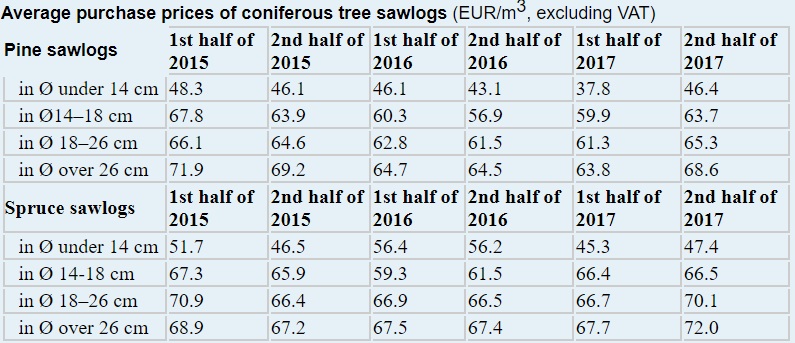 Latest data of the Central Statistical Bureau (CSB) show that within the coniferous tree sector, the greatest rise was observed in purchase prices of pine sawlogs in diameter under 14 cm, while within deciduous tree sector – in purchase prices of birch veneer logs of category A, according to the Baltic Course.
In the 2nd half of 2017, compared to the 1st half, the most notable rise within the coniferous tree sector was observed in purchase prices of pine sawlogs in diameter under 14 cm (on average of 23% or 9 EUR/m3)* and in diameter above 26 cm (8% or 5 EUR/m3). Lower rise was recorded in purchase prices of spruce sawlogs in diameter above 26 cm (on average of 6% or 4 EUR/m3), in diameter under 14 cm (on average 5% or 2 EUR/m3), and in diameter 18–26 cm (5% or 3 EUR/m3). The average purchase prices of spruce sawlogs in diameter 14–18 cm did not change and comprised 67 EUR/m3.
Compared to the 1st half, in the 2nd half of 2017 the most notable rise within the coniferous tree sector was observed in purchase prices of black alder sawlogs in diameter over 24 cm (of 11% or 5 EUR/m3) and asp sawlogs in diameter 18–24 cm (10% or 3 EUR/m3). Smaller increase was observed in purchase prices of birch sawlogs in diameter 18–24 cm (of 5% or 2 EUR/m3) and asp sawlogs in diameter over 24 cm (4% or 2 EUR/m3). Slight reduction was recorded in purchase prices of birch sawlogs in diameter over 24 cm (of 1% or 1 EUR/m3) and black alder sawlogs in diameter over 24 cm (1% or 0.4 EUR/m3).
As reported by the Baltic Course, during the 2nd half of 2017, compared to the 1st half of the year, the greatest increase among deciduous trees was registered in the average purchase prices of birch veneer logs of category A (of 16% or 15 EUR/m3), whereas the largest decline was observed in purchase prices of birch veneer logs of category B (of 3% or 2 EUR/m3). The average purchase prices of deciduous tree packing timber went up by 7% or 2 EUR/m3.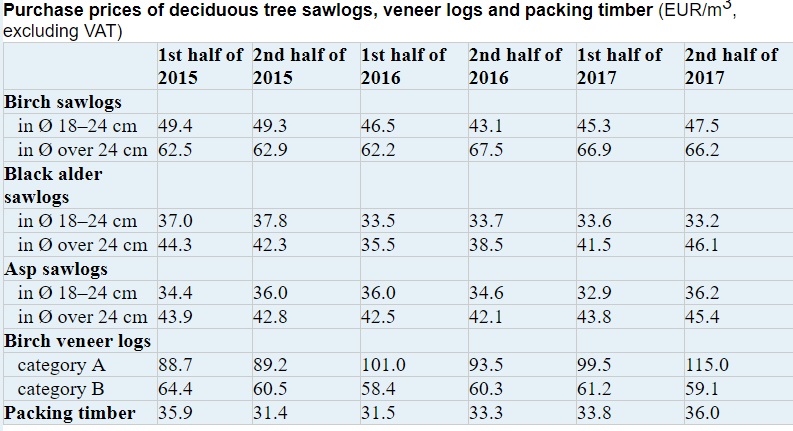
Rise in prices of roundwood of all assortments might be related to the rainy summer and autumn of 2017 when weather conditions hindered logging and transportation of sawlogs from forest. This resulted in difficulties of logging enterprises to fulfil their contractual obligations to deliver the timber. The high demand for raw materials by timber processing enterprises in local and global timber market contributed to the roundwood purchase price increase in Latvia.
In the 2nd half of 2017, compared to the 1st half of 2009, when due to the global financial crisis timber purchase prices reached the lowest level, the greatest increase among coniferous trees was recorded in the average purchase prices of spruce sawlogs in diameter under 14 cm (on average of 89% or 22 EUR/m3), compared to the rise in average purchase prices of other spruce sawlogs which varied between 66% and 70%. Purchase prices of pine sawlogs grew by 66–73%.
Over the last eight years, within deciduous trees sector the average purchase prices of birch sawlogs in diameter over 24 cm increased on average by 74% or 28 EUR/m3. The greatest rise was observed in prices of veneer logs of category A – on average of 143% or 68 EUR/m3, compared to 49% or 19 EUR/m3 increase in prices of veneer logs of category B.
Compared to the 1st half of 2009, in the 2nd half of 2017 the average purchase prices of deciduous tree packing timber went up by 63% or 14 EUR/m3. Purchase prices of asp sawlogs grew by 44–46%. The smallest increase in deciduous tree sector was observed in average purchase prices of black alder sawlogs in diameter over 24 cm (on average of 19% or 7 EUR/m3), while purchase prices of black alder sawlogs in diameter 18–24 cm did not change (constituting 33 EUR/m3).
* All average purchase prices of sawlogs are indicated excluding value added tax (VAT).
Finnish wood pellets production grew significantly in 2017

Finnish wood pellets production amounted to 324,000 tonnes during 2017, one fifth more than in 2016 and the third highest result in history, since 2008's result of 373,000 tonnes.
As reported by the Natural Resource Institute Finland (Luke), another record was reached in Finland's wood pellets imports. A total of 87,000 tonnes of wood pellets were imported to Finland during 2017, which is 74% more than in 2016. At the same time, the exports of wood pellets amounted to 37,000 tonnes, 8% more than in the preceding year.
The apparent consumption (production + imports – exports) of wood pellets in Finland amounted to 373,000 tonnes, Luke reported.
Deliveries by pellet producers based on domestic pellet production grew by 15%, as compared to the previous year, amounting to 349,000 tonnes, the highest volume ever.
Also, the amount of wood pellets delivered to power and heating plants and large buildings increased by 18% to 288,000 tonnes. The amount of wood pellets delivered to small-scale housing and farms increased by 6% to 62,000 tonnes.
Wood products imported to China are checked for toxins starting March

The China National General Administration for Quality Supervision, Inspection and Quarantine has announced a new regulation aimed at eliminating potentially harmful products from the market. This regulation could affect imports of fibreboard, laminated wood and wooden furniture.
The items that will be closely checked for formaldehyde emissions and flame retardants will be fibreboard (HS code:4411131900 44111,41900 and 4411192900). laminated wood (HS code 4413000000)and wooden furniture( HS codes:9403300090 9403400090 940350 0910,9403509990 and 9403609910).
Close attention will be paid to the heavy metal coatings on imported wood children’s furniture, structural safety and flame resistance. Imported wood products identified in the new regulation entering China after 1 March 2018 are being checked.
EU plywood imports decreased by 7% during 2017
The total EU plywood imports in 2017 were down by 7%, to 2.159 million metric tonnes (MT). The decrease was mainly caused by the fall of the other hardwood plywood markets, with imports down by over 20%, from 1.346 million MT, to 1.076 million MT.
Also, the decrease was caused by a revision of customs product codes in 2017, which saw a large number of species previously labelled ‘other hardwoods’ now identified as ‘tropical’. However, this was clearly not the only factor in the downturn, as tropical and softwood plywood imports increased by a combined total of only 115,000 MT in 2017; the former rising from 262,000 MT to 320,000 MT, the latter from 707,000 MT to 760,000 MT. (Chart 1)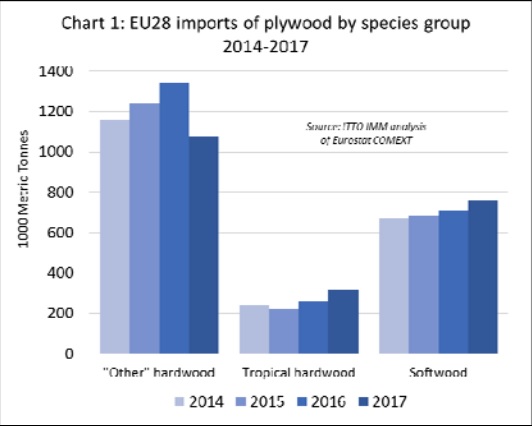
Overtaking both Indonesia and Malaysia as the largest supplier of tropical hardwood to the EU was China, with imports up 44,000 MT to 106,000 MT in 2017. This is almost entirely due to the HS product code reclassification, as Chinese ‘mixed red hardwood’ plywood was most affected.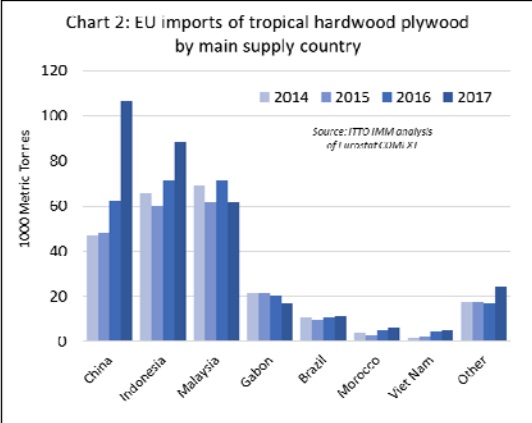
EU imports of Indonesian plywood were ahead 24% in 2017, rising from 71,000 MT to 88,000 MT, while imports of Malaysian plywood dipped 15% from 71,000 MT to 62,000 MT, and imports of Gabon plywood fell 19% from 21,000 MT to 17,000 MT. (Chart 2).
The largest EU tropical plywood importer in 2017 remained the UK, which increased its purchases by 29% from 120,000 MT to 155,000 MT.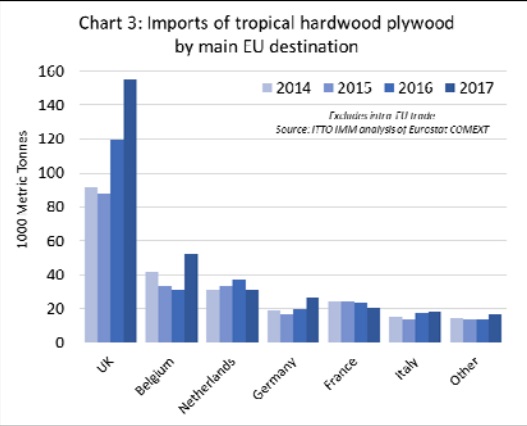
Belgium became the second biggest, with imports rising 21,000 MT to 52,000 MT, taking over from the Netherlands where imports fell 6,000 MT to 31,000 MT. Germany also saw an increase of 35% to 27,000 MT in 2017. (Chart 3).

