Article archive

Finnish roundwood prices increased significantly during January

Roundwood prices in Finland increased during January 2018, as compared to the corresponding month in 2017.
The prices for sawlogs went up at a rate of 2-5%, with birch ascending the most, by 5.52%. In the mentioned period, the price for pine increased by 2.81%, to EUR 58.45/m3, while spruce logs could be bought by EUR 59.76/m3 (+4.32%).
At the same time, the price for pine pulpwood went up by 2.27%, to EUR 27.90/m3, while spruce pulpwood could be bought for EUR 30.40/m3 (+1.36%) during January 2018. Also, the price for birch pulpwood increased by 3.98%, to EUR 28.68/m3.

January 2017 December 2017 January 2018 Change in % January 2017-January 2018
Pine logs 56.85 58.44 58.45 +2.81%
Spruce logs 57.28 59.94 59.76 +4.32%
Birch logs 46.16 48.55 48.71 +5.52%
Pine pulpwood 27.28 27.92 27.90 +2.27%
Spruce pulpwood 29.99 30.62 30.40 +1.36%
Birch pulpwood 27.58 27.80 28.68 +3.98%

European parquet markets mainly in a positive mood, except Germany

The Board of Directors of the European Federation of the Parquet Industry met on 4 April 2018 and discussed amongst others both the parquet situation and recent economic indicators on the European market.

The European markets are generally in a positive mood and experience slight growth. When
compared to the same period last year, the provisional results for the first quarter of 2018 point to a
continuation of the moderately positive parquet consumption trends observed in 2017 with the
exception of Germany which is reporting a significant decrease.

Projects are the main driver of the market although renovation should create additional activity. In
spite of the long and wet winter, the availability of raw material is not a critical issue for the time
being.

Nevertheless, as efficient harvesting has been demanded from forest-owners and sawmillers,
small formats are now unfortunately lacking.

A brief per country recap is provided below:

Austria - The Austrian parquet sales continued to increase by 2% during the first quarter 2018 compared to the same period last year.

Belgium - The indications available point towards a growth of 3% of the parquet consumption during the first three months of 2018.

Baltic countries - Baltic countries’ markets are showing a slightly positive trend during the first quarter 2018.

Denmark - The Danish parquet market remains flat, reflecting the decrease on the retail market which is compensated by the increases observed for contracts and projects.

Finland - Parquet sales slightly rise by 1% on the Finnish market – (large) projects are the main driver of this moderate growth while the residential market is stable.

France - The French market continues to develop positively. Parquet sales grew by an estimated 2% during the first quarter 2018.

Germany - Data indicates that parquet sales fell by 5% during the first quarter of the current year,
compared to the first quarter 2017 which was good. This decrease reflects the subdued
residential market, the lack of installers which leads to shifting of projects, the competition
from “wood look” floor coverings and the disappearing spaces for hardwood flooring on shelfs
in DIY.

Italy - Parquet sales rose by 2% during the first quarter 2018 and continued to benefit from the positive economic developments observed in Italy.

Netherlands - The information received points to a confirmation of the improvements already observed on the Dutch market – parquet sales increased by an estimated 3% during the first quarter 2018.

Norway - Compiled data indicate that the Norwegian market is flat to slightly improving (0-1%) during the first months of 2018.

Spain - Despite the turbulent political situation, the Spanish market seems to evolve slowly but positively by 1 to 2% during the first quarter of the year 2018.

Sweden - The trends observed in 2017 are continuing and the parquet consumption rose by 2% during the first quarter 2018 compared to the same period last year. Sales in retailing decrease while
project markets keep growing. Sweden is currently the most dynamic market in Scandinavia.

Switzerland - Parquet consumption remains flat but at a high level in Switzerland during the first months of 2018. There are lots of large on-going renovation projects.

Prices for wood pellets in Germany started to descend in April

The wood pellets' price in Germany has started to descend in April 2018. The national average price has reached the value of EUR 252.25/tonne, 1.2% less than in March, but 2.5% more than in April 2017.
During the mentioned period, one kilogram of wood pellets costs 25.23 cents and one kilowatt hour (kWh) of heat from pellets costs 5.05 cents. Pellets currently have a price advantage of about 20% for heating oil and about 14% for natural gas.
"Due to its typical seasonal character, the price of pellets drops when temperatures rise in the spring," explains DEPV Managing Director Martin Bentele. "No other source of energy is as stable in price as wood."
Regional prices (for 6 tonnes purchases) in April: Central Germany: EUR 249.46 / t, Southern Germany: EUR 253.60 per tonne, Northern and Eastern Germany: EUR 253.58/ t.
Larger quantities (26 t) could be bought for the following prices: South: 237.61 EUR / t, Middle: 231.08 EUR / t, North / East: 230.40 EUR / t (all incl. VAT).


Strong lumber markets in the US and Europe increased the global sawlog price by 10%

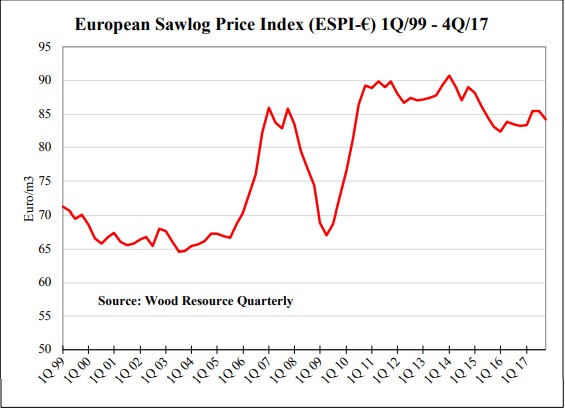
The Global Sawlog Price Index (GSPI) increased substantially, driven by strengthening lumber markets in both the US and Europe. The Euro-based ESPI sawlog price index fell in the 4Q/17 after reaching a two-year peak in the 3Q/17.
As the Wood Resource Quarterly reported, during the 4Q/17, the Global Sawlog Price Index (GSPI) rose one percent from the previous quarter to reach just over $76/m3. This was the fourth consecutive quarterover-quarter rise, with the GSPI being up 9.8 percent in one year.
Sawlog prices have gone up universally in US dollar terms in 2017, with the biggest growth occurring in Eastern Europe, the Nordic countries and in Western North America, while the price movements have been more modest in the US South, Latin America and Oceania, according to the WRQ.
Sawlog prices in the Western US have seen a spectacular increase in less than two years. A combination of restricted log flows due to wildfires, low sawlog inventories, and strong domestic lumber markets resulted in a substantial jump in sawlog prices in the western states in the 4Q/17.
This came at a time when prices had already been slowly trending upward for over a year. In the 4Q/17, average prices for Douglas-fir and hemlock sawlogs were about 27% higher than in early 2016, making the current price levels the highest recorded since the WRQ started tracking sawlog prices in 1995.
With a few exceptions, sawlog prices in Europe were lower in the 4Q/17, which resulted in a 1.2 percent decline quarter-over-quarter of the European Sawlog Price Index (ESPI). This came after the index reached a two-year peak in the 3Q/17.
By far the biggest price increase in 2017, in Euro-terms, was in Eastern Europe, where demand for sawlogs increased as lumber production rose. In addition, log supplies around the Baltic Sea region were tight because of unfavorable weather for logging and transportation, adding to upward price pressure in the second half of 2017.

UK imports of timber and panel went up by 10.8% during 2017

The Timber Trade Federation has issued its Monthly Statistical Bulletin for April 2018. The stats show that volumes of imported timber and panel products in the first month of 2018 were lower than in January 2017 by around 68,000m3. It should be noted however that January 2017 was the best January by volume for over 10 years.

The 16% fall in volume of solid wood was somewhat offset by an 8% uplift in panel products, resulting in the overall decline of 7.3% for the month. The April Stats Bulletin also features a Focus on the 2017 Source of timber and panel supply to the UK.

Key findings include:

UK imports of the main timber and panel products rose in 2017 by 10.8% to climb to a total of nearly 10.9 million m3.

Europe accounted for the great majority of the volume imported to the UK, supplying almost 87% of all imports (+1% compared to 2016).

Import volume specifically from the EU amounted to 8.9 million m3, or around 95% of all volume from Europe, up from 93% in 2016.

The share of supply from Asia fell once again in 2017, to 7.5% of all imports, down from 8.0% in 2016 and 8.7% in 2015.

The share of supply held by North America was also lower in 2017, down to 1.7% from 1.9% in 2016, 2.1% in 2015 and 2.3% in 2014.

Central and South America amounted to 3.3% of the 2017 total, down from 3.5% in 2016 and 3.8% in 2015, while the share of supply for Africa in 2017 reached 0.7% (+0.2% compared to 2016).

Source of Supply for UK Timber and Panel Imports in 2017

Global Supply:

UK wood and pannel global imports 2017UK imports of the main timber and panel products rose in 2017 by 10.8% to climb to a total of nearly 10.9 million m3. Europe accounted for the great majority of this volume, supplying almost 87% of all imports, an increase in the share of volume of nearly 1%.

Volume from Europe rose to 9.4 million m3; more volume by nearly 1 million m3. Europe defined here is all of Europe including Russia. Import volume specifically from the EU amounted to 8.9 million m3, or around 95% of all volume from Europe, up from 93% in 2016. Imports from the EU as a share of all volume from all regions amounted to 82% of the total in 2017.

The share of supply from Asia fell once again in 2017, to 7.5% of all imports, down from 8.0% in 2016 and 8.7% in 2015.

The share of supply held by North America was also lower in 2017, down to 1.7% from 1.9% in 2016, 2.1% in 2015 and 2.3% in 2014.

The increasing share of supply from Europe also affected the share of volume supplied from Central and South America where volume amounted to 3.3% of the 2017 total, down from 3.5% in 2016 and 3.8% in 2015.

Although the volume supplied from Africa is relatively small in overall terms, this region improved its 2017 share of total supply to 0.7% from 0.5% in 2016.

Supply from Europe:

UK wood and pannel imports 2017 EuropeSoftwood continues to be the highest volume product imported from Europe, accounting for nearly 71% of all volume from Europe. Despite greater volumes of softwood imported in 2017 from Europe, the share of supply fell from nearly 73% of the total in 2016. This was due to higher growth of hardwood and MDF supplied from and through European countries in 2017.

The share of hardwood supplied in 2017 rose to 3.2% of the total, up from 2.6% in 2016. The share of MDF increased to 8.1% of supply from Europe, up from 7.1% in 2016. The share particleboard and softwood plywood supplied from Europe in 2017 was very similar to 2016. Less hardwood plywood imported from Europe realised a lower share of supply, down to 2.9% from 3.5% while growth in OSB volume raised its share to 4.1% of the total, up from 3.2% in 2016.

Supply from Asia:

UK wood and panel imports 2017 AsiaThe great majority of imports to the UK sourced from Asia consists of hardwood plywood with the share this product accounting for 90% of all volume from this region - very similar to that in 2016. China, Malaysia and Indonesia all increased shipments of hardwood plywood to the UK in 2017. A small increase in the volume and share of softwood plywood from Asian countries took place in 2017.

Supply from the Americas:

UK wood and panel imports 2017 South AmericaUK wood and panel imports 2017 North AmericaCentral and South America supplies the majority of softwood plywood imported by the UK with nearly 89% of the volumes sourced from this region consisting of softwood plywood.

The majority of supply from North America is hardwood and softwood. The share of softwood supplied from North America rose in 2017 to 32.5% from 29.5% in 2016 with both Canada and the USA shipping higher volumes. The share of hardwood from this region fell from nearly 63% of the 2016 total to 58% in 2017 due to a reduction in hardwood volume supplied from the USA.

Finland: Export of sawn goods set to grow and prices to rise

New investments in the Finnish forestry sector will have a significant impact on production figures both for 2018 and 2019.
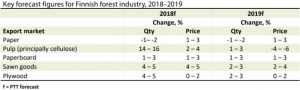
Growth in 2018 will be particularly strong in pulp exports as the Äänekoski pulp factory begins operating at full capacity. Exports of paperboard will also increase this year and next thanks to earlier investments. Exports of paper, the primary product of the forest industry, will continue to fall both this year and next, but prices may rise slightly.
Exports of sawn goods will benefit from good prospects in all key market areas. Export prices of sawn goods is expected to rise as a result of increasing demand and accelerating inflation.
Export of sawn goods set to grow and prices to rise
The demand of sawn goods is being supported by the invigoration of the construction industry in
key market areas, a trend that will also translate to a rise in export volumes this year, although the
growth will see a decrease from last year. Around 77 percent of Finnish sawn goods production will
go to export in 2018.
Domestic demand is also expected to grow somewhat from last year due to increases in the construction sector. Sawn goods production is set to grow 4–5 percent in 2018 and 3–5 percent in 2019. The production volume of both pine and spruce sawn goods will see an equally steady increase.
Due to increasing demand and inflation, the export price of sawn goods will turn upward this year, with a rise of 8–9 percent expected in the price of pine sawn goods. The increase is due to the recovery of the market in North Africa and increasing demand for pine goods in China. The export price of spruce sawn goods is expected to rise 2–3 percent, narrowing the price difference between pine and spruce.
With the euro strong against the dollar and the price of roundwood having increased, the profitability of the sawmill industry will remain low.
Export volume of pulp will see significance increase in 2018
Spurred by investment, pulp exports from Finland will increase significantly in 2018. Production
capacity will be particularly improved by Metsä Group’s Äänekoski mill, with its production capacity
reaching its target volume in summer 2018.
Exports will also be boosted by the newly completed extension of the UPM Kymi plant. Finnish exports will grow 14–16 percent this year and 1–3 percent the next. Due to growth in exports, the overall volume of pulp production in Finland will see a strong growth of 5–6 percent in 2018. Due to increased supply, the price of Finnish exports will decline in 2019, although prices will remain high.
Paper exports will fall steadily, paperboard exports grow
Paper production and export will continue to decline by 1–2 percent this year and next. The reason is
the continuing decline in demand for printing and writing paper, which has been ongoing for many
years and is expected to continue in the future.
A modest rise in the export price of paper is expected in 2018, however. It will be caused by growth in the global economy and the general acceleration of inflation, the high price of pulp and a reduction in the capacity of paper production, all of which have reduced the supply of paper. In spite of the decline in production, paper will continue to account for about 34 percent of export earnings of the Finnish forest industries during the forecast period. Export volumes of paperboard will continue to grow steadily during the period, as will its average export price.

 

Forte expands particleboard production in Poland

One of the largest European furniture manufacturers Fabryki Mebli “Forte” S.A. is ramping-up production at its new particleboard line in Suwalki, Poland.

According to the announcement, in regular production operation, the company already fabricates 15 mm particleboards with a density of 530 kg/m³, among other products.

The production line in Suwalki was strated up in February 2018. The acceptance test procedures were completed by the technology provider Siempelkamp  and Forte on March 21,  2018 – four months earlier than contractually planned.

Earlier Siempelkamp increased shareholding in Pallmann Maschinenfabrik.

Forte is one of the largest European manufacturers of furniture for self-assembly. It manufactures a wide range of furniture for the dining rooms, living rooms, kitchens, bedrooms and youth rooms. Currently, the company operates four state-of-the-art manufacturing plants located in Ostrów Mazowiecka, Suwałki, Białystok and Hajnówka in Poland.

Prices for wood pellets in Switzerland slightly descend during April

The price for wood pellets in Switzerland amounted to an average of CHF 372.3/t (EUR 313.58/t) during April 2018, which is 0.21% less than in the same period of 2017 and 1.06% less than in March 2018.
Depending on the delivery quantity, the prices vary between 360.32 CHF / t (303.49 EUR / t) for an 8-tonne purchase to 385.6 CHF / t (324.78 EUR / t) for a 3-tonne purchase.
Larger quantities for commercial customers currently cost 344.99 CHF / t (290.58 EUR / t) for a 17-tonne purchase.

Price of wood pellets in SwitzerlandCHF/tonne April 2017 March 2018 April 2018
3 tonnes purchase quantity 386.08 389.88 385.6
5 tonnes purchase quantity 371.32 374.91 371.07
8 tonnes purchase quantity 361.82 363.97 360.32
Average price 373.1 376.3 372.3

Lumber prices in the US picked up again; trading experienced mix trends

Framing lumber trading in the US experienced mix trends during last week. While the rally in Canadian S-P-F settled back into a calmer and quieter pace, sales of Coast dry and Southern Pine picked up. 
Green Douglas Fir, meanwhile, was vulnerable in certain items at some mills, leaving traders of that species off balance. Sales of 2x4 studs were solid, and key prices posted gains through the week. All told, gainers outnumbered losers and the Random Lengths Framing Lumber Composite posted a $2 increase.

Week
Apr 13
Week
Apr 6
Year Ago
2017
Random Lengths Framing Lumber Composite Price* $494 $492 $433
KD Western S-P-F #2&Btr 2x4 R/L Mill Price 546 540 392
KD Eastern S-P-F #1&2 2x4 R/L, delivered Great Lakes 620 612 458
Green Douglas Fir Std&Btr 2x4 R/L (Portland) 540 540 377
Southern Pine (Westside) #2 2x4 R/L 554 564 478
KD Coast Hem-Fir #2&Btr 2x4 R/L 547 535 410
Ponderosa Pine (Inland) #2&Btr 1x12 R/L 755 750 635
* Weighted average of 15 key items

Random Lengths Panel Market Report
Structural panel trading was idle during the mentioned period. Mill sales of OSB were dull and prices showed little change.
Most traders focused on logistical issues or news about which mills were coming back on the market or those that were taking downtime. Southern Pine rated sheathing sales picked up on Wednesday morning, allowing mills to move off lows and extend order files into late April.
Western Fir plywood trading was active on specialty panels to start the week. On Wednesday, interest picked up in sheathing.

(f.o.b. mill prices) Week
Apr 13
Week
Apr 6
Year Ago
2017
Random Lengths Structural Panel Composite Price* $528 $532 $420
Southern (west-east) 15/32-inch 3-ply rated sheathing plywood 490-540 500-545 375-405
Southern (west-east) 15/32-inch 4-ply rated sheathing plywood 495-545 505-550 380-410
Western 1/2-inch 4-ply rated sheathing plywood 521 529 437
North Central 7/16-inch Oriented Strand Board 405 405 328
*Weighted average of 11 key items

Rise in US wooden furniture imports from Indonesia and India

US wooden furniture imports grew 1% in January to US$1.69 billion. Imports were 6% higher than in January 2017. Imports from China and Malaysia were slightly down in January, but most other countries increased exports to the US.

The highest growth rate was in imports from Indonesia and India – both month-on-month and compared to the same time last year. Italy also expanded its furniture shipments to the U.S.

Despite the overall growth in wooden furniture imports, imports of office and upholstered seating furniture declined in January. The strongest growth was in nonupholstered seating.

Slow start to year for furniture and cabinet businesses

Furniture manufacturers reported contraction in February according the Institute for Supply Management’s survey (Manufacturing ISM Report On Business). Wood product manufacturing was unchanged from January, while most other manufacturing industries in the US reported growth.

For 2017, new furniture orders were up 4% over 2016 according to the Smith Leonard survey of US residential furniture manufacturers and distributors. Furniture shipments also increased 4% in 2017 from the previous year.

2018 started with lower sales by furniture retail and by cabinet manufacturers. Retail sales at furniture stores were down in January from the previous month, according to US Census preliminary figures, but sales increased 5% compared to January 2017.

Cabinetry sales were down 3% in January compared to the same month in 2017 based on the Kitchen Cabinet Manufacturers Association’s Trend of Business Survey. For 2017, US cabinet manufacturers reported a 3% increase in sales.

Sharp fall in EU imports of African sawnwood

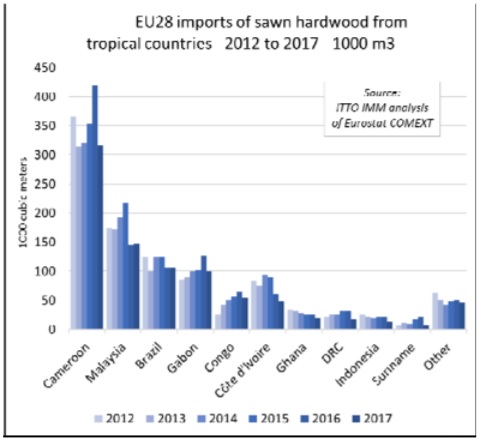
The most notable trend in the supply of sawn hardwood to the EU in 2017 was the sharp fall in imports from Africa, particularly from Cameroon, but also Gabon, Congo, Cote d’Ivoire, Ghana and DRC. Imports from Malaysia and Brazil were more stable.

Following a surge in 2016, EU imports from countries in the Congo region declined sharply in 2017. Imports decreased by 24% from Cameroon to 316,000 cu.m, by 22% from Gabon to 99,000 cu.m, by 17% from Congo to 54,000 cu.m, and by 51% from DRC to 16,000 cu.m.

Last year, there was also a continuation of the long-term decline in EU imports of sawn hardwood from West Africa. Imports fell by 21% to 48,000 cu.m from Côte d'Ivoire, and by 23% to 20,000 cu.m from Ghana.

EU imports from Brazil and Malaysia were more stable in 2017, although only a shadow of earlier levels having already declined significantly in previous years. Last year the EU imported 148,000 cu.m of sawn hardwood imports from Malaysia 2% more than the previous year, and 105,000 cu.m from Brazil, 1% less than in 2016.

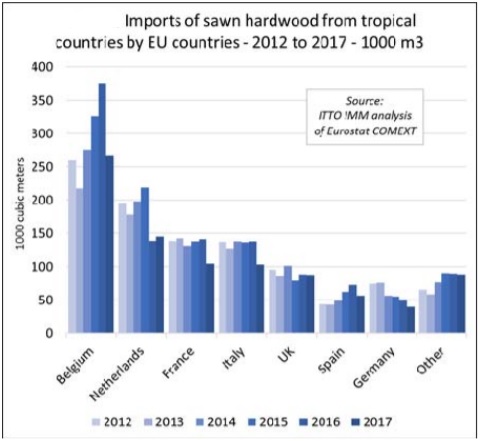
The decline in imports of tropical sawn hardwood during 2017 was particularly notable in Belgium (down 29% to 266,000 cu.m), France (down 26% to 105,000 cu.m), Italy (down 25% to 103,000 cu.m), Spain (down 22% to 56,000 cu.m) and Germany (down 21% to 40,000 cu.m).

Imports increased 5% to 145,000 cu.m in the Netherlands, after a sharp decline the previous year. Imports in the UK declined only 1% to 88,000 cu.m.

Increasing concentration of trade in the hands of a small number of large companies close to EU ports, and their role to distribute tropical sawn timber throughout the EU, mean it is becoming more difficult to relate import trends with changes in consumption at national level in the EU.

UK: Concern at shortage of timber for pallets

UK's Timber Packaging & Pallet Confederation (TIMCON) has warned of a shortage of smaller logs required by the pallet and packaging sector.

At the confederation’s general meeting last month, delegates heard of the “serious challenges affecting availability of timber, particularly of the smaller logs required by the pallet and packaging sector, with discussion between manufacturers, saw-millers and other related industry partners.”

“The record numbers who attended last month’s general meeting illustrates the severity of the situation in which the timber packaging and pallet business currently finds itself,” said John Dye, TIMCON president.

“Fortunately, as a part of the wider forest-based industry, we have strong allies with whom we are sharing information and developing coordinated responses and solutions to the current challenges.

“Timber remains the most sustainable and economic choice of material, not only for pallets and packaging, but also an increasing number of consumer and industrial goods.”

Russian plywood producer Murom orders plant from Siempelkamp

Russian plywood producer CJSC “Murom” has ordered a complete plant from Siempelkamp. The ambitious goal of this cooperation was the development of OSB Advanced, an innovative product for forward-looking customers and markets, produced on an industrial scale in a way that conserves resources.

With the product OSB Advanced and the new plant, JSC “Murom” will fully utilize round timber resources used in plywood production for its wood-based material production, thus saving considerable production costs. With OSB Advanced, CJSC “Murom” will be able to offer a formaldehyde-free OSB board which, due to its outstanding mechanical properties, is increasingly used in interior design as well as in the furniture industry.

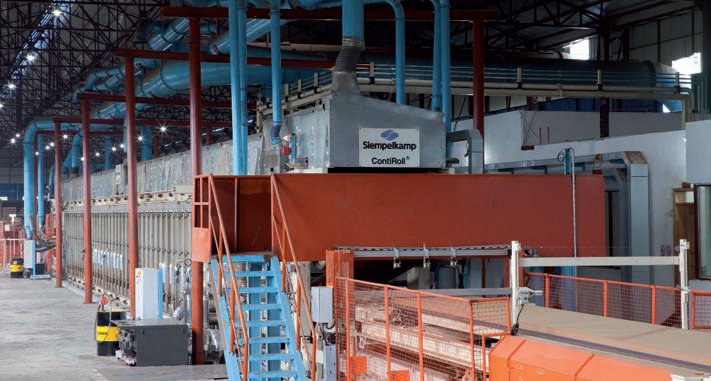
Siempelkamp from Krefeld will produce the core of the plant – the ContiRoll® Generation 9, with a length of 30.4 m and a production width of 8.5´. This ultra-modern continuous press offers numerous technical innovations.

With the new investment, CJSC “Murom” will produce 50,000 m² of OSB Advanced boards daily, mainly for national demand. This will more than double the production capacity of CJSC “Murom” to 550,000 m³ annually. The start of installation at the plant is already planned for the 4Q 2018. Commissioning is scheduled for the end of 2019 and regular production will get underway in the spring of 2020.

Mozambique to further extend restriction on logging and timber exports

The Mozambican Ministry of Land, Environment and Rural Development has completely banned the exploitation of three species of hardwoods, and barred the export of a further three.

The Ministry dispatch, reported in Tuesday's issue of the independent daily “O Pais”, states that, as from the date of the document, 29 March, no wood at all may be cut from the species Pterocarpus tinctorius (known as Nkula), Swartzia madagascariensis (ironwood) and Combretum imberbe (Mondzo).

The hardwoods known as chanfuta (azfelia quanzensis), umbila (pterocarpus abgolensis) and jambire (millettia stuhlmannii, sometimes known as partridge wood) may only be used to supply the domestic timber market, and may not be exported.

Under the new rules, the export of wood from any native species of tree will only be authorised to operators certified by the Ministry. Certification will only be granted to companies that present an annual plan of exports, and comply with the ministry-established criteria for setting up timber industries.

The latest national forestry inventory noted a decline in unbila, jambire, ironwood and mondzo, which is doubtless why the new restrictions have been imposed. The situation with Nkula may be critical, since the inventory did not find “commercial volumes” of this species.

For this year, the ministry has determined that the maximum amount of wood that can be exploited is 350,000 cubic metres - which is less than 60 per cent of the 600,000 cubic metres requested by the end of the first quarter.

Bearing these limits in mind, the Ministry says it will only license operators after an inspection of their equipment and of the potential of the areas where they plan logging operations.

As for exports, the new regulations fix a maximum this year of 436,000 cubic metres of sawn timber, and semi-finished and finished products. There is already a ban in place on the export of logs.

The volume of exports is greater than the volume of wood than can be exploited, because of the existing stockpiles of timber.

WTO to establish two panels to rule on US lumber duties

At the request of Canada, the WTO’s Dispute Settlement Body (DSB) agreed on 9 April to establish two panels to examine Canada’s complaints regarding anti-dumping and countervailing duties imposed by the United States on imports of Canadian softwood lumber, WTO announced.

Canada recalled that on 27 March it had first requested the establishment of a panel to examine this dispute, as consultations held in January with the United States had failed to resolve the matter. However, the United States objected to Canada's first request. Canada reiterated its argument that the measures at issue were inconsistent with US obligations under the Agreement on Subsidies and Countervailing Measures (SCM Agreement) and the General Agreement on Tariffs and Trade (GATT) 1994. The duties imposed are having a negative impact on softwood lumber producers in various Canadian provinces, Canada said.

The United States reiterated its belief that the measures in question were fully consistent with US obligations under the WTO agreements. It also reiterated concerns that the Canadian request for a panel included an item that was not identified in Canada's request for consultations, and was thus not subject to consultations; and that the request included claims against so-called measures that do not exist and could not be challenged "as such". The United States said it was disappointed that Canada had proceeded to request a special DSB meeting to consider its second panel request rather than addressing these concerns.

Canada recalled that, at the time of its request for consultations, it identified orders imposing countervailing and anti-dumping duties as measures that will be part of the dispute. Canada considered that the fact that the orders were issued after the consultations has not changed the scope and the essence of the dispute. It insisted that the orders at issue fall properly within the panel's terms of reference.

The DSB agreed to the establishment of the panel. The European Union, Japan, Korea, China, Turkey, the Russian Federation, Brazil, Kazakhstan and Viet Nam reserved their third-party rights to participate in the panel proceedings.

Anti-dumping measures applying differential pricing methodology to softwood lumber from Canada

Canada recalled that, after consultations held in January 2018 did not resolve the dispute, it requested on 27 March the establishment of a panel to review the United States' application of the Differential Pricing Methodology in its anti-dumping determinations regarding softwood lumber from Canada. The US blocked that request at the 27 March DSB meeting. Canada said the United Stated has acted inconsistently with its obligations under both the Anti-Dumping Agreement (ADA) and the GATT 1994.

Canada reiterated its request for the establishment of a panel and suggested, in accordance with Article 10.4 of the Dispute Settlement Understanding (DSU), that the matter be referred to the original panel that considered the Differential Pricing Methodology in DS464, "US — Anti-Dumping and Countervailing Measures on Large Residential Washers from Korea". For softwood lumber producers and communities across Canada, these duties represent a considerable hardship, which only furthers the negative impact of the punitive countervailing measures imposed by the United States on the same product, Canada said.

The United States said it was disappointed with Canada's decision to move forward with its second request and reiterated that its measures were fully consistent with US obligations under WTO law. It also noted that the panel request raises an item that was not identified in Canada's request for consultations, and was thus not the subject of consultations. The United States also said that the panel request includes an unwarranted assertion of urgency and a "baseless" argument that the measures at issue are already the subject of a panel proceeding. The US said this is incorrect because the measure at issue is the final determination in the anti-dumping investigation of softwood lumber from Canada made in November 2017.

In response, Canada referred to its earlier comments regarding the non-existence of the measure during consultations and to its statements at the DSB meeting of 27 March with respect to Article 10.4 of the Dispute Settlement Understanding. The United States said that Article 10.4 concerns measures that are the subject of panel proceedings, which it considered not to be the case at hand; Canada's request for the establishment of a panel referred to anti-dumping measures imposed on Canadian softwood lumber while the measure at issue in DS464 was the methodology used by the United States which Korea challenged as such. In the absence of an agreement on Canada's request, the DSB cannot refer the matter to the original panel, the US said.

Canada replied that it was not requesting that the matter be referred to the original panel but rather that a panel be established. Canada explained that it would deal with panel composition in due course.

The DSB agreed to the establishment of the panel. The European Union, Japan, Korea, China, the Russian Federation, Brazil, Kazakhstan and Viet Nam reserved their third-party rights to participate in the panel proceedings.

British Columbia softwood lumber exports to US crash in March

Softwood lumber exports from British Columbia to the United States plunged 20 per cent in March from a year ago, the federal government said, amid railway transportation problems.

Global Affairs Canada said in its monthly report that the country's largest lumber-producing province exported 514.4 million board feet to the United States last month, down from 644.7 million board feet a year ago.

"Output from the B.C. Interior remains depressed due to shipping constraints," Hamir Patel of CIBC World Markets wrote in a report.

First-quarter shipments from the B.C. Interior, which account for more than 90 per cent of B.C.'s lumber exports, were 18 per cent weaker than a year ago, largely due to transportation issues. B.C. Coastal shipments were 36 per cent lower.

Total Canadian shipments in the first three months were down 17.4 per cent, but up two per cent from February to March.

Shipments from Quebec — Canada's second-largest forestry producing region — were down 16.6 per cent in the first quarter and Ontario was 8.6 per cent lower. Alberta was down 28 per cent while the Maritimes were nearly five per cent higher.

Canadian National Railway and Canadian Pacific Railway say western Canadian routes were more affected by cold winter weather and unexpected volume increases that slowed traffic.

Paul Quinn of RBC Capital Markets said transportation shortages were at the forefront of a recent Montreal wood convention.

"Canadian railway and trucking officials in attendance pledged that improvements were expected soon, but ... two weeks since the convention most traders report that rail service in Western Canada remains poor," he wrote in a report.

Shipments from B.C. have represented 47 per cent of U.S. imports from Canada so far in 2018, below the 48 per cent in 2017 and the 10-year average of 54 per cent. Patel said nearly 60 per cent of B.C. export volumes went to the U.S. in February, down from 68.4 per cent in January.

B.C. exports to China have been decreasing annually since 2013 and are running 22 per cent lower for the year after falling 27 per cent in February. Shipments to Japan are up marginally.

The slide in export volumes comes as western SPF (spruce, pine, fir) lumber prices ended last week at near record highs of US$540 per thousand board feet. The price of lumber has surged to cover the softwood lumber duties applied by the United States government.

Indonesian plywood prices reach record high

Export prices of Indonesian plywood continue to climb with no sign of slowing down. In particular, thin panel of 2.5 mm prices shot up to about US$1,000 per cbm C&F, the highest record.
Weather in Indonesia is much worse than Malaysia and with tightening control of illegal harvest, log production is plunging. Log production seems to have dropped more than half of normal pace with no sign of recovery. By this log supply shortage, plywood mills’ deliveries are largely delayed.
Even regular suppliers are two to three months behind schedule and some have not delivered volumes contracted last summer.
Looking at price trends for Indonesian plywood, the bottom prices were summer of 2016. 4 mm plywood prices were about US$600 per cbm C&F, which are about US$750, 25% up. 2.5 mm panel prices were US$720-750 in 2016, which are now over USUS$950 with some offer of US$1,020.
In Japan, 2.5 mm panel market prices were 350-390 yen per sheet in summer of 2016, which are now about 500 yen. 4 mm prices are 630-650 yen, 30-50 yen up from February.

Stora Enso to re-open planing line at Varkaus mill

Stora Enso Wood Products division will in April re-open the classic planed line in Varkaus sawmill, Finland.

The planing line was closed in January 2013 due to decreasing demand, but the combination of the new laminated veneer lumber (LVL) production and the planing opens up new possibilities for product development and increased sales.

“Wood is versatile and renewable construction material. With the geographically diverse and large scale asset base, we have a unique ability to respond to the increasing global demand of classic planed. Today we see a growth in demand much driven by increased construction of wooden frame homes,” says Jarkko Nevalainen, Operations Director in Stora Enso Wood Products’ Varkaus unit.

“The demand for classic planed is increasing globally. The US is for instance one of the markets we will supply from Varkaus in the coming years. The US market offers a good starting point due to strong market demand, product fit and our established customer base and channels to market,” Matthew Wood, Head of Classic Planed comments.

The capacity for the planed line is estimated to be around 10,000 cubic metres during the ramp-up phase. The new operations will employ one to two new persons.

Since 2016 the planing line has been used to produce special LVL grades. Varkaus sawmill and LVL line has a total of 110 employees. The sawmill capacity is 150,000 cubic metres and LVL line capacity 70,000 cubic metres.

Fall in EU tropical imports driven mainly by supply-side issues

In practice, the recent decline in tropical imports into the EU is better seen as a region-wide phenomenon driven mainly by supply side trends.

In 2017, a range of factors conspired to result in extremely low tropical sawn hardwood imports across the EU. These include:

  • On-going serious problems and delays with shipping out of Douala Port in Cameroon.
  • Overstocking in the EU at the end of 2016 following arrival all at once of a large volume of delayed shipments from Africa.
  • Diminishing commercial availability of tropical hardwood species of interest to European buyers.
  • The problem of delayed payment of VAT refunds by African governments, partly linked to low oil prices, which is creating additional financial challenges for operators in the region.
  • Good demand and willingness to pay higher prices for tropical hardwood in other regions including Asia, the Middle East, and North America.
  • Reduced focus on supply of sawn timber to the EU by many tropical suppliers, particularly encouraged in Africa by strong demand for logs from China, and in South East Asia by on-going efforts to move into higher value products such as furniture.
  • Continued substitution of tropical hardwoods for a range of modified temperate wood species and alternative non-wood products.
  • Fashion changes, particularly the strong trend towards the oak look in EU and the fact that there is now very little demand for redwood finishes in the EU interiors sector.
  • The on-going trend towards prefabrication in construction, is increasingly favouring tightly specified engineered wood products which are more readily accessible from domestic manufacturers than from the tropics.
  • Intensifying enforcement of EUTR across the EU and the challenges and expense of legality due diligence in some tropical countries.

UPM to sell its Myllykoski mill site

UPM sells its Myllykoski mill site and premises, located in Kouvola, Finland, to Redeve Oy. The buyer is specialised in real estate development.

The transaction was completed today and the ownership of the real estate was transferred to the buyer with an immediate effect.

UPM closed its Myllykoski paper mill in 2011. Since then, UPM has been searching for a solution to enable further usage of the site.

"We have been searching for a credible buyer for quite some time and have investigated several options. We are very pleased with the end-result. Redeve is well-known for their capabilities and experience in real estate development. We believe they will bring business and prosperity to the site," says Samuli Eerolainen, Director, Real Estate at UPM.

The contract includes the mill site with its premises, as well as 100 hectares of land. The biomass boiler, turbine and generator from Myllykoski site have been acquired by Blue Energy Europe in Germany.

UPM Paper ENA (Europe and North America) is the world's leading producer of graphic papers, offering an extensive product range for advertising and publishing as well as home and office uses.

Newsletter

Subscribe to our digital newsletter for your daily digest of essential news, views and analysis from the international wood industry delivered directly to your inbox.


0