Article archive

Södra’s sales of construction timber reached new record-high levels

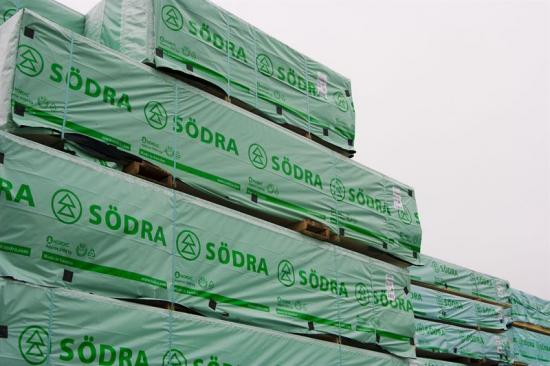
Swedish construction customers are buying timber products like never before. Södra’s sales of Swedish construction timber broke all records in May. Sales rose 5 percent compared with the corresponding period in 2017, up from already very high figures.

In May, Södra’s sales of Swedish construction timber reached new record-high levels. Sales have increased for the fourth consecutive year, and from already very high levels.

This is a clear trend, and a very positive result. Timber is the construction material of the future, and the advantages are becoming more and more obvious. The recognition of timber construction as the sustainable and climate-smart alternative is affecting our purchasing behaviour,” said Fredrik Gustavson, Sales Director of Södra Wood Scandinavia.

Demand for timber and timber products is strong from both the building trade and the construction industry. This applies for products of both spruce, which are mainly used as structural timber, and pine, which are treated and used for decking and other outdoor applications.

Both professional and DIY customers are requesting timber products. Private customers are mainly interested in using sustainable products for their home renovations and extensions, and these products are also aesthetically attractive,” said Fredrik Gustavson.

The cold and wet winter had a certain dampening effect on wood supplies, but also on demand, meaning that inventory levels are balanced. However, there are no major inventory surpluses, and there could be shortages during the summer if demand remains strong.

I am not making any forecasts, but much seems to indicate that the high level of demand will continue. This is obviously very positive, and we are working hard to secure wood deliveries to our customers,” said Fredrik Gustavson.

European sawn softwood sales boosted by the construction sector and strong Chinese and US demand

On the 15th of  June 2018, the European Organisation of the Sawmill Industry (EOS) held its Summer General Assembly in Oslo. The event was hosted by the EOS Member Treindustrien (Norwegian Wood Industry Federation) and it was preceded by the Moelven’ sawmill tour, one of the largest wood processing Groups.

The sawmills in Moelven are organized in two divisions, Moelven Timber and Moelven Wood, the latter mainly producing further processed goods for the Scandinavian markets. Moelven`s mills are, with a few exceptions, located in the middle of Sweden and in the south-east of Norway. The Group employs more than 3,400 people.

During this General Assembly, the 2017/2018 edition of the EOS Annual Report was presented. The latest edition of the Report includes a comprehensive review of the woodworking industries markets – with a strong emphasis on the sawnwood markets – as well as a report on the EOS advocacy activities at European level. It also contains a section about the high-level conferences co-organized by EOS in 2017, namely the International Softwood Conference and the International Hardwood Conference.

As far as the softwood market is concerned, the picture is overall rosy: a dynamic construction sector in Europe and lively demand in relevant importers such as the US and China underpinned the strong performance of many businesses. The exceptions were all linked to challenges in wood supply.

Some countries also raised awareness on difficulties connected to the oversupply of by-products in the market. Conversely, while there is higher demand compared to previous years also in the hardwood markets, the hardwood sector’s production is not growing, which is mainly due to a shortage of raw materials in many important producer countries. The flight of roundwood to faraway countries represents a challenge for the whole sector, which needs appropriate solutions in order to remain strong on the market.

On occasion of the General Assembly, EOS Members adopted the PRIORITY ACTIONS’ LIST FOR FORESTS AND WOOD PRODUCTS. As integrated part of the bio-economy, the forest-based sector can play a significant role in decarbonizing the economy if governments seize the opportunity to increase the use of wood products in construction and as “every day” materials.

In the framework of the ongoing mid-term revision of the EU Forest Strategy, EOS calls for coherent actions to boost the competitiveness of the sawmill industries. Wood mobilisation is recognised as one of the most significant challenges facing the forest sector over the coming decade. For this reason, it is about realising expected increases in wood supply and meeting rising demands for wood resources from all major end users, in an efficient and cost-effective manner.

Two external speakers gave a presentation, respectively on “Changes in Harmonised System Code 2022 with Focus on Engineered Wood Products” (Florian Steierer, Economic Affairs Officer, UNECE/FAO Forestry and Timber Section) and “Research and Innovation” (Johan Elvnert Managing Director of the Forest-based Sector Technology Platform - FTP). Mr Steierer presented the revision process of the Harmonized System, which is an internationally standardized system of names and numbers to classify traded products. He showed that from 2022 high-potential engineered wood products will very probably have their own lines in the Harmonized System, which is important to track their growth. Mr Elvnert showed that within FTP, the European forest-based sector finds a dedicated platform to provide a coordinated and bottom-up contribution to the most important funding programmes. In the framework of HORIZON 2020, a direct financial support is provided to SMEs that intend to increase their innovation capacity.

The next EOS General Assembly will be held on 12 October 2018, in the framework of the 66th INTERNATIONAL SOFTWOOD CONFERENCE on 10TH-12TH OCTOBER 2018, in Riga, Latvia.

European parquet market strengthens its upward trend; outlook positive

Parquet consumption continues to progress in the EU, benefiting from the encouraging economic context, especially from the growth of the European consumption, and the positive trends shown by the construction sector.

Regretfully, Germany, the biggest European market for parquet, has officially reported a significant decline in parquet consumption. The consolidated data provided by the FEP (European Federation of the Parquet Industry) member companies and affiliated national associations are at present pointing to a slight growth of the global European market of 0,3% in 2017 compared to 2016.

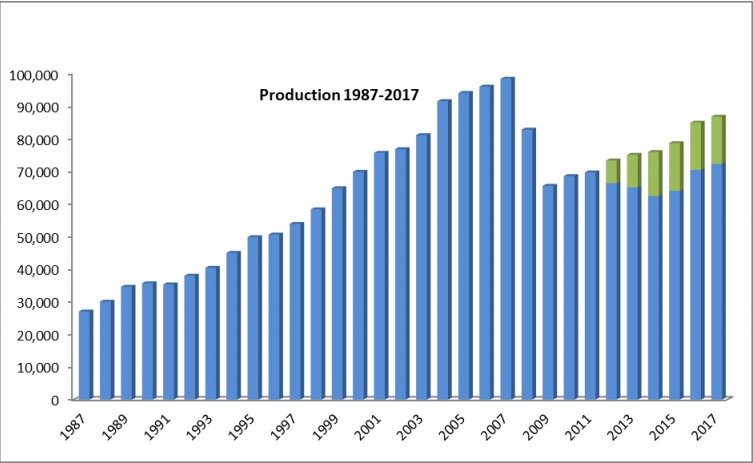
As usual, the results show some variation from country to country. The production in FEP territory confirms its growth by 2,6% and exceeds significantly the 72 million square meter threshold.

It is important to note that, as of 2016, figures from Croatia, Estonia, Portugal and Slovenia are considered in the general FEP overview. The European production outside FEP countries is at an estimated 14,5 million square meters – 9 million square meters produced in EU countries and 5,5 million square meters in European non-EU countries.

The total production in FEP territory rose by 2,60% to a volume of 72.184.490 m². Taking into
account the total production in Europe (FEP countries + non-FEP countries in Europe) implies that
production in 2017 increased by 2,15% and exceeded 86,7 million m².

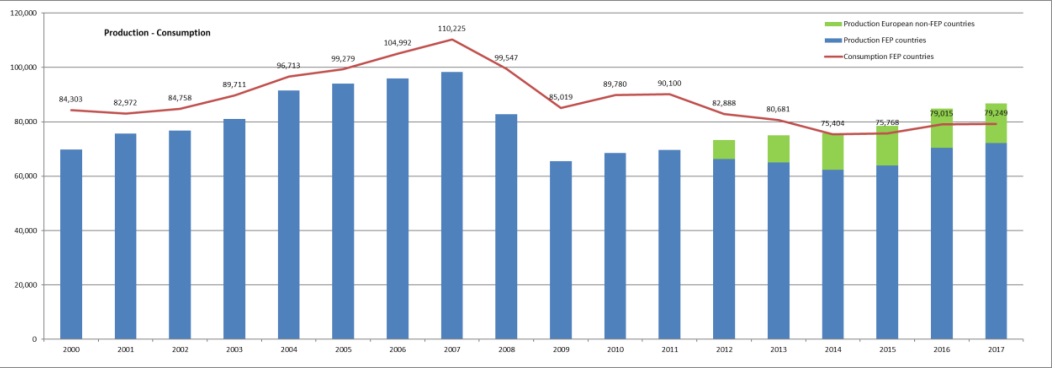
Consumption in the FEP area improved by 0,3%, to a level of 79.249.514 m²

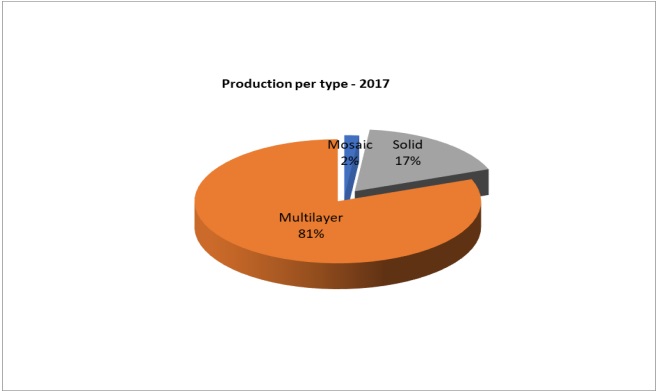
The 2017 total parquet production per type remains similar to the picture already presented from
2010 onwards, whereby multilayer comes in first with 81% (compared to 80% in 2016), being
followed by solid (including lamparquet) with 17% (compared to 18%) and mosaic at 2% of the total
cake.

In absolute production figures by country, Poland maintains its top position at 19,17%. Sweden
consolidates its second place on the podium with 15,50%. It is followed by Austria at 13,06%, while
Germany comes in as fourth (10,47%).

Consumption in the FEP area rose by 0.3% to reach 79.249.514 m² compared to 79.014.520 m2
the year before.

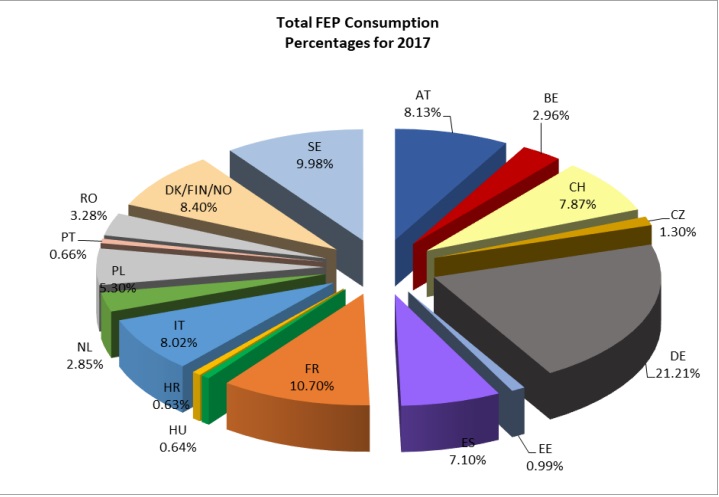
In terms of consumption per country, Germany remains in first position, despite its declining market,
with 21,21% and is followed by France at 10,70%. Sweden completes the podium with 9,98%. The
Nordic Cluster at 8,40% keeps the fourth seat. Austria with 8,13% takes back its fifth position from
Italy (8,02%) while Switzerland (7,87%) comes in seventh position only.

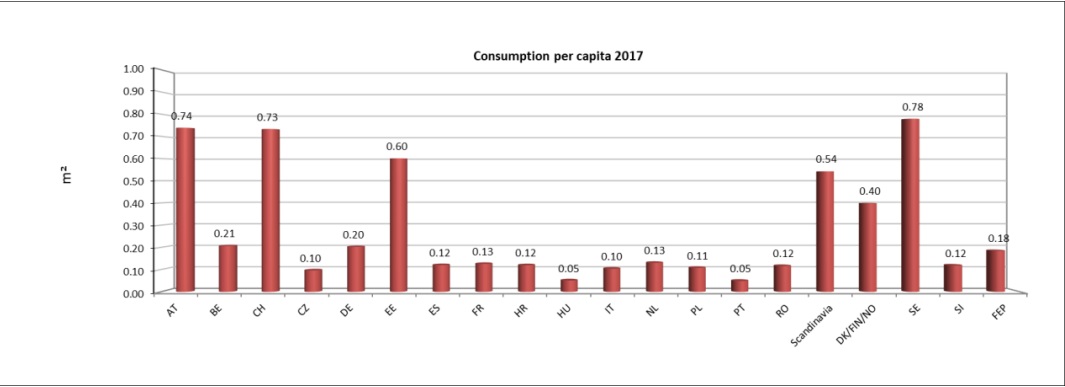
As regards the per capita parquet consumption, Sweden keeps the first seat (0,78 m2) before Austria
(0,74 m²) and Switzerland (0.73 m2). In the total FEP area, the consumption per inhabitant remains
stable at 0,18 m² in 2017.

Use of wood species

The usage of wood species in 2017 as shown on the above graph indicates that the share of oak
remains stable and reaches 80,6% compared to 80,8% in 2016. Tropical wood species use continues
to represent 4,0% of used wood. Ash and beech remain the two other most common chosen species
with 6,2% and 2,4% (compared to 5,7% and 2,5% in 2016) respectively.

Outlook for 2018 & 2019

After several years of a challenging situation, the general trends on the parquet market eventually
turned positive in 2016 and progressed further in 2017. The results after the first quarter of the
current year point to a continuation of the moderately positive parquet consumption trends with the
exception of Germany which is again reporting a significant decrease. All other European markets are
generally in a positive mood and experience slight growth.

Projects are the main driver of the market although renovation should create additional activity. As
the economic picture at European level, and for the construction sector in particular, continues to
improve steadily, the captains of the parquet industry consider that parquet will benefit from these
developments throughout the year 2018.

In general, and in spite of the long and wet winter, the availability of raw material is not a critical
issue for the time being. Nevertheless, as long as oak represents more than 80% of the wood used to
produce parquet, any variation in its availability can be problematic for the industry. Furthermore, as
efficient harvesting has been demanded from forest-owners and sawmillers, small formats are now
unfortunately lacking.

Although the competition from “wood look flooring substitutes” remains harsh and the widespread
misuse of the PARQUET denomination causes a growing and unjust confusion at consumer level,
parquet remains the genuine original, the only flooring solution made of sustainable and renewable
raw material Real Wood, coming from sustainably managed and expanding forests.

Global softwood lumber prices keep on going up during Q1/2018

Global softwood lumber prices continued their two-year climb in the 1Q/18 with the pace being higher in North America than in the Nordic countries, Russia and China.
Lumber markets – North America
After softwood lumber consumption in the US reached a ten-year high in 2017, demand fell in early 2018. Despite the reduced first quarter consumption, lumber production on the US west coast was actually up by 9% y-o-y when compared to the 1Q/17 due to strong demand from China. In fact, shipments to China during the 1Q/2018 were up almost 50% as compared to the 1Q/17, as the Wood Resource Quarterly reported.
While lumber production in Canada’s eastern provinces increased slightly in early 2018, sawmills in British Columbia reduced their production by an estimated three percent in the 1Q/18 as compared to the 1Q/17. Production levels were down partly because of lower demand for wood in the US during the winter season, but also because of reduced availability of logs due to severe weather conditions. The weather also impacted lumber shipments by rail, resulting in substantial slowing in exports from BC.
Lumber markets – Northern Europe
In the Nordic countries, the sawmilling industry has seen their markets improve both in regard to demand and to pricing during the past year. Although export volumes declined somewhat in early 2018 as compared the same period in 2017, prices increased, reaching the third highest level seen in the past decade (in local currencies). Sawmills in Finland and Sweden have increased their presence in different markets in 2018, with Swedish sawmills predominantly expanding sales in Europe, and Finnish exports increasing to the Middle East and Japan, reports the Wood Resource Quarterly (WRQ). Both countries reduced sales to China during the typically slow season of January and February when the Chinese New Year is celebrated.
Lumber markets – China
Demand for wood in China slowed in the 1Q/18, following a record-2017, with import volumes of softwood lumber falling to their lowest levels since the 4Q/16. Imports from Canada fell the most, with quarterly shipments reaching an eight-year low in the 1Q/18. The Nordic countries have filled the gap where Canadian suppliers have pulled back. In the 1Q/18, lumber volumes from Finland and Sweden accounted for 12% of total imports, a doubling of their market share as compared to 2015.
Lumber market – Japan
The record high softwood lumber prices in the US have impacted the costs for North American lumber imported to Japan in the past six months. In May 2018, prices for US Douglas-fir lumber (45x105) and Canadian hemlock lumber (45x105) delivered to Japan reached their highest levels for the month of May since 2013. Lumber import volumes to Japan have been sliding for three consecutive quarters and were down to 1.46 million m3 in the 1Q/18 as compared to 1.6 million m3 in the 2Q/17. The biggest declines in lumber supply over the past year have been in wood coming from Canada and Finland; Sweden, Chile and Russia have all increased their market shares.
Lumber market – Russia
Russian lumber exports reached an all-time-high volume of 28 million m3 in 2017, up 10% from the previous year, a doubling of exports from ten years ago. Exports to their primary destination, China, fell 19% y-o-y. It is interesting to note that 20 years ago, eight of the ten major destinations for Russian lumber were in Europe, while in the first quarter of 2018, only three European countries made the top-ten list, according to the WRQ. Average export prices have trended upward in both US dollar terms and rouble terms over the past two years, with the biggest increases occurring in lumber sold to China, Uzbekistan and Egypt.

Junnikkala Ltd. to expand production at Kalajoki and Oulainen sawmills in Finland

Junnikkala Ltd. is growing its sawn wood production in Kalajoki, Finland, and increasing the drying capacity by acquiring the first TC continuous kiln in Finland and installing X-ray scanners on its segregation lines within its sawmills.  

The upcoming drying facility is the only one in Finland which allows users to combine different types and lengths of wood. The works of the drying facility will begin in the summer, equipment deliveries will arrive in October and the new drying facility will be in operation in March 2019. And as result of the investment, the combined production volume of Kalajoki and Oulainen sawmills will rise to over 400,000 cubic meters.

TC continuous kiln will enable more flexible production and increase the total drying capacity at the sawmill in Kalajoki, where it will replace older drying plants.

The company will also renew the shredding by installing X-ray instruments on the log sorting lines at the Oulu sawmill in August and Kalajoki in September. Because the X-ray measurement enables precise bark measurement, we can make better use of the raw material. Considering the smaller tree structure in our area, we can measure the parts of a different tree trunk more precisely and Junnikkala can take advantage of the special sizes and treetops available.

Valutec Ltd. supplies the canal dryer to Junnikkala Oy and the indicators are supplied by the Finnish Limab Ltd.

Junnikkala has two sawmills and total annual production of just under 400,000 cubic metres.

Germany: Holzwerke Ladenburger to expand lumber production

Holzwerke Ladenburger in Germany placed an order with Valutec for supply of TC continuous kiln. The TC continuous kiln will be used to meet increased demand, primarily for dried boards.

The capacity of the lumber kiln amounts to 90,000 cubic metres.

“We chose a TC kiln because it is the most flexible and economical kiln on the market. It allows us to freely mix dimensions and combine high quality and capacity with low energy consumption,” said Christoph Rettenmeier, assistant to the management team at Ladenburger.

Germany’s Holzwerke Ladenburger is one of Europe’s leading sawmill groups, with five sawmills and total annual production of over 800,000 cubic metres.

China: Sawn softwood imports up 41% in 2017

According to data from China Customs, 2017 Chinese sawnwood imports totalled 37.35 million cubic metres valued at US$10.06 billion, a year on year increase of 16% in volume and 24% in value.

The average price for imported sawnwood was US$269 per cubic metre, up 6% on 2016.

Sawn softwood imports in 2017 surged but sawn hardwood imports declined.

Of total sawnwood imports, sawn softwood imports rose 41% to 25.05 million cubic metres, accounting for 67% of the national total. The average price for imported sawn softwood was US$195 per cubic metre, up 10% year on year.

Sawn hardwood imports fell 14% to 12.30 million cubic metres because China’s sawn hardwood imports from Russia fell 48%, Russia has restricted its birch exports.

The average price for imported sawn hardwoods was US$422 per cubic metre, up 21% year on year.

Of total sawn hardwood imports, tropical sawnwood imports were 6.68 million cubic metres valued at US$2.526 billion, up 16% in volume and 19% in value and accounted for 18% of the national total. The average price for imported tropical sawnwood was US$378 per cubic metre, a year on year increase of only 2%.

US costs of homebuilding increasing due to lumber tariffs

Last week, Robert Dietz, chief economist for the National Association of Home Builders, addressed attendees at the National Association of Real Estate Editors conference in Las Vegas about current issues that the homebuilding industry is facing amidst the longstanding inventory shortage.

One question the industry is faced with, especially while housing inventory remains low, is why hasn’t there been a larger response from the homebuilding industry and more single-family homes added to the market?

Dietz said that during the last few years he has attributed this to supply-side headwinds, multiple factors that he calls “The 5 Ls” – lending, lots, labor, local regulatory concerns, and more increasingly, lumber.

Dietz highlighted three of these "Ls" in his discussion to conference attendees.

One of the top issues that the homebuilding industry is facing is the growing lumber crisis and its increase in price, which Dietz said is caused by tariffs on Canadian softwood lumber imposed last year by the Trump administration.

“We have an effective 20% tariff rate right now on Canadian softwood lumber,” Dietz said.

“A lumber tariff is very much a tax on homeowners and renters,” Dietz told the panel audience. “In fact, it’s pushed up the price of a typically newly-built home, according to our survey data analysis, by about $9,000. It’s pushed up the price of a typical apartment by about $3,000.”

On his second point, labor, Dietz told attendees that labor has been an issue for the industry for the last four to five years.

“The construction industry, right now, has 230,000 unfilled jobs and that constrains the amount of production taking place in the market.

Another factor Dietz said increases the cost of building new homes is local regulatory costs.

Dietz recalled an analysis that NAHB conducted a few years ago that found that nearly a quarter of the cost in single-family homebuilding went to regulatory costs. He explained that two-thirds of that amount is due during the lot development stage, going to lot fees, permits and other regulatory costs

Dietz also pointed out a new joint survey that NAHB conducted with the National Multifamily Housing Council that shows regulations make up 32% of costs associated with a typical multifamily development. “By increasing the cost of building new homes, we’re essentially contributing to the inventory shortage that exists on both the single-family side and the multifamily side.”

Firming demand for plywood in EU but sales suffer from supply problems and price rises

The European plywood market faces a combination of buoyant demand, mounting competition for product from other leading consumer countries plus persistent supply delays and constraints among key producers, notably tropical suppliers.

In fact, tropical suppliers actually saw their exports to Europe fall in the first quarter of 2018. The overall result of these factors has been rising prices, increasing caution about forward buying and, if not shortages, longer lead times and difficulties, as one importers said, ‘in planning ahead and obtaining the right volumes at the right time’.

Concerns have also been raised in the industry once more about mis-marking of Chinese plywood imports in terms of timber species mix and recommended application labelling.

This has been voiced particularly by the UK Timber Trade Federation (TTF), which has consequently issued new product performance and content checking protocols for its members.

Binderholz plans to double sawing capacity at Baruth sawmill

Binderholz starts an extensive investment program at its plant in Baruth, Germany, which includes the expansion of the drying capacity from 600,000 to 760,000 m³ by December 2018.

In the first step, the drying capacity in the former Klenk sawmill is to be increased from 600,000 to 760,000 m³. This first extension is expected to be completed by December 2018.

In 2019, a further sawn timber sorting line, which produces 450,000 m³ in a three-shift operation, is to go into operation.

As a main investment, the cutting capacity will be doubled to 2.2 million m3 / year with a new sawing line. So far, the capacity is according to company information at 1.1 million m3. In addition, in plan, there is a fourth timber sorting line. Commissioning is scheduled for 2020. Log lengths of 2.5 to 5 meters and diameters of 10 cm or more will be processed.

With the commissioning of the new sawline, the drying capacity will then be adjusted in a second expansion step of the production volume to more than 1 million m³ of sawn timber.

The company is a leading European timber materials producer and owns 5 Austrian sites (Fuegen, Jenbach, St. Georgen, Hallein and Unternberg) and two Bavarian sites (Koesching/Interpark and Burgbernheim/Neustadt an der Aisch).

Also, the company’s range of solid wood products includes dimension lumber, surfaced lumber, solid wood panels edge glued and 3-ply, glulam beams, binderholz CLT BBS and pellet and briquet.

Finland's lumber output forecast to rise in 2018 due to rising exports to China, N. Africa and Japan

The growth of the global economy, increasing demand for forest industry products and investments in Finland’s forest sector continue to boost pulp, sawn timber and paperboard exports.
The logging of industrial timber is breaking records, and demand for Finnish wood is increasing stumpage prices, according to the Forest Sector Economic Bulletin of the Natural Resources Institute Finland (Luke).
The materialisation of possible trade sanctions, the results of the Brexit negotiations and any possible spill-over of Italy’s debt problems and political crisis introduce an element of uncertainty to the continuance of the good market demand.
The production and export of sawn timber continue to grow
Exports of sawn timber to China took a temporary dive early in the year, but are expected to bounce back during the second half of the year after the Chinese have unloaded their warehouses.  Exports to Japan and North Africa are also on the rise. In Finland, demand for sawn timber is likewise increasing slightly, in step with an increase in the construction of detached houses.
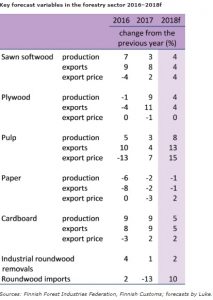
The production of sawn timber in Finland is expected to increase from the 11.7 million cubic metres last year to 12.2 million cubic metres this year. Thanks to solid market demand, the average price of sawn timber exports is also expected to increase to a slight degree. The export prices of sawn pine timber are increasing faster than the export prices of sawn spruce timber. Plywood production and exports are also growing, but the average price of exports will remain on last year’s level.
Chinese demand increases the export of pulp and prices
The rise in the global market price of pulp has continued this year due to the demand for tissue paper and paperboard in China and other Asian countries. Finland’s pulp and paperboard production and exports are growing as a result of the demand in export markets and the increased capacity of pulp mills. Average export prices are also rising.
Demand in the printing and writing paper markets has been robust, and prices have risen particularly due to the increase in the price of pulp. The earlier closures of paper machines are also contributing to the situation. Even so, there is no change in sight with regard to the long-term trend in the demand for paper. Rather, consumption in Finland’s main market, Europe, continues to decline. Paper production and exports in Finland will lag behind last year’s figures, but the average export price is expected to increase slightly.
Logging of industrial wood reaches a new record, stumpage prices are on the rise
The growth in the production of sawn timber, pulp and paperboard will increase the wood use of the forest sector this year, and the logging of industrial wood will increase from the slightly more than 62 million cubic metres last year to more than 64 million cubic metres.
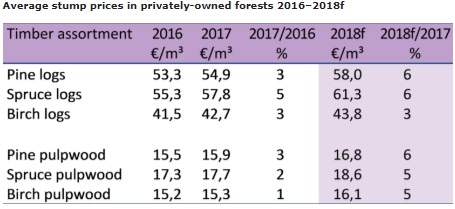
The increase in the demand for Finnish wood will increase the stumpage prices of pulpwood and logs by 3–6 per cent. Wood imports are expected to grow to approximately nine million cubic metres from last year’s 8.2 million cubic metres. The use of forest chips and their average plant prices are expected to increase slightly this year.

Finland’s lumber output forecast to rise in 2018 due to rising exports to China, N. Africa and Japan

The growth of the global economy, increasing demand for forest industry products and investments in Finland’s forest sector continue to boost pulp, sawn timber and paperboard exports.

The logging of industrial timber is breaking records, and demand for Finnish wood is increasing stumpage prices, according to the Forest Sector Economic Bulletin of the Natural Resources Institute Finland (Luke).

The materialisation of possible trade sanctions, the results of the Brexit negotiations and any possible spill-over of Italy’s debt problems and political crisis introduce an element of uncertainty to the continuance of the good market demand.

The production and export of sawn timber continue to grow

Exports of sawn timber to China took a temporary dive early in the year, but are expected to bounce back during the second half of the year after the Chinese have unloaded their warehouses.  Exports to Japan and North Africa are also on the rise. In Finland, demand for sawn timber is likewise increasing slightly, in step with an increase in the construction of detached houses.

The production of sawn timber in Finland is expected to increase from the 11.7 million cubic metres last year to 12.2 million cubic metres this year. Thanks to solid market demand, the average price of sawn timber exports is also expected to increase to a slight degree. The export prices of sawn pine timber are increasing faster than the export prices of sawn spruce timber. Plywood production and exports are also growing, but the average price of exports will remain on last year’s level.

Chinese demand increases the export of pulp and prices

The rise in the global market price of pulp has continued this year due to the demand for tissue paper and paperboard in China and other Asian countries. Finland’s pulp and paperboard production and exports are growing as a result of the demand in export markets and the increased capacity of pulp mills. Average export prices are also rising.

Demand in the printing and writing paper markets has been robust, and prices have risen particularly due to the increase in the price of pulp. The earlier closures of paper machines are also contributing to the situation. Even so, there is no change in sight with regard to the long-term trend in the demand for paper. Rather, consumption in Finland’s main market, Europe, continues to decline. Paper production and exports in Finland will lag behind last year’s figures, but the average export price is expected to increase slightly.

Logging of industrial wood reaches a new record, stumpage prices are on the rise

The growth in the production of sawn timber, pulp and paperboard will increase the wood use of the forest sector this year, and the logging of industrial wood will increase from the slightly more than 62 million cubic metres last year to more than 64 million cubic metres.

The increase in the demand for Finnish wood will increase the stumpage prices of pulpwood and logs by 3–6 per cent. Wood imports are expected to grow to approximately nine million cubic metres from last year’s 8.2 million cubic metres. The use of forest chips and their average plant prices are expected to increase slightly this year.

Finnish Ha-Sa acquires Metsä Group’s Eskola sawmill

Finnish sawmill Haapajärven Saha Ha-Sa (Ha-Sa) has acquired Metsä Fibre's Eskola Sawmill in Kannus in Finland.

Metsä Fibre is part of Finnish Metsä Group. The acquisition covers the properties and business operations of Eskola Sawmill. The sawmill's 33 employees will be transferred to Ha-Sa.

Ha-Sa estimates that the sawmill's annual production will increase to roughly 70,000 cubic metres from the current 50,000 cubic metres. After the acquisition, Ha-Sa's net sales will total around EUR 100mn and annual production volume 500,000 cubic metres.

Prices for wood pellets in Germany continue to drop in June

The price for wood pellets in Germany is still on a decreasing trend in June. Thus, the average price for ENplus A1 pellets reached EUR 237.82/t during June, which is 0.5% less than in May and 2.6% more than in June 2017.
As reported by the German Energy Wood and Pellet Association e.V. (DEPV), during the mentioned period, one kilogram of wood pellets costs 23.78 cents and one kilowatt hour (kWh) of heat from pellets costs 4.76 cents. Pellets currently have a price advantage of about 28% over heating oil and about 20% for natural gas.
Regional prices (for 6 tonnes purchases) in June 2018: Southern Germany: EUR 237.43/t, Northern and Eastern Germany: EUR 238.16 per tonne, Central Germany: EUR 237.10/ t.
Larger quantities (26 t) could be bought for the following prices: South: 221.92 EUR / t, Central: 220.08 EUR / t, North / East: 217.00 EUR / t (all incl. VAT).

Largest European wood pellet producer sees fall in production due to complicated international pellet market

Graanul Invest decreased wood pellets production at its mills by 10.6% in 2017.

According to the announcement, due to the complicated situation in the international pellet market and the extremely rainy second half of the year, the company’s pellet production totalled 1,649,486 tons vs 1,845,466 tons in 2016.

The company’s clients generated approximately 30,000,000 GJ of renewable energy from this.

Earlier, Graanul Mets announced a rebuild of its wood pellet production lines in Latvia.

About Graanul Invest:

Graanul Invest group is the biggest producer of wood pellets in Europe.  AS Graanul Invest is a privately owned company, established in  2003, and works with forestry, development of bioenergy and the production of renewable energy. The company has had fast development and grown to be the biggest producer of pellets in Europe.


Canadian lumber companies announce large capacity expansions in the US

As lumber costs remain at historically high levels, lumber companies are investing those profits into strengthening their positions and increasing production capacity. 

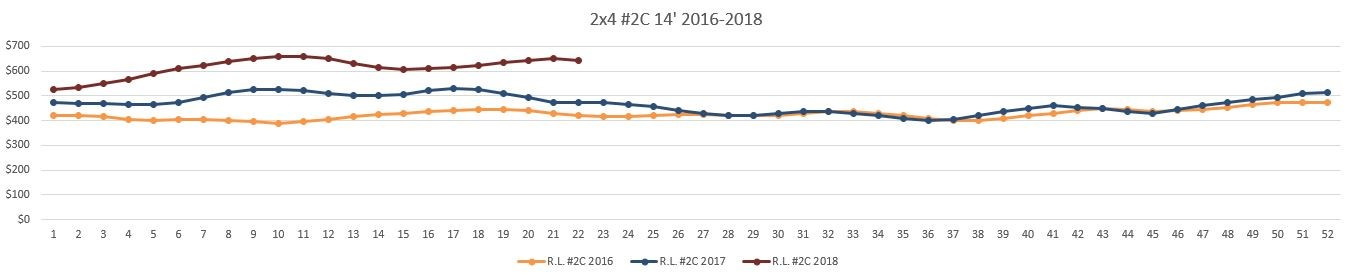
Data reported by Random Lengths for the month of May had Eastern Southern Yellow Pine 2x4 STD&Btr/#2&Btr at $687 per thousand board feet, up from $608 in April and $457 in May 2017. Western SYP 2x4 STD&Btr/#2&Btr monthly average was at $634 in May, up from $552 in April and $388 in May 2017. For 2018, the cost of SP 14’ 2x4 the first week in January sat at $525, hit $660 per thousand board feet in March, dropped in April and May and is now at $645.

Vancouver’s Conifex will triple the companies’ capacity in the southeast part of the country after spending $258 million to purchase the Suwanne sawmill in Cross City, Fla. and the Caddo River mill in Glenwood, Ark. The purchases will add an additional 50 percent more capacity and bump their total output to 1.1 billion board feet.

Canfor Corp. (a Canadian lumber company) announced in February that it was also expanding capacity in the U.S. southeast with the construction of a $155-million sawmill in Washington, Ga.

Resolute Forest Products, (another Canadian lumber company) announced in April the company’s $12.9 million investment at its La Dore facilities in Quebec to automate and expand capacity while also becoming more energy efficiency.

Meanwhile, Boise Cascade Company (a US lumber company) is expanding further into the Oregon market with plans to acquire pieces of Norman Distribution, Inc. a distributor of engineered wood products and building materials in Medford, Oregon.

In Lufkin, Texas, a new $100 million softwood lumber plant is set to be online the second quarter of 2019 after Angelina Forest Products (a US lumber company) purchased the former General Electric Buck Creek site. The new plant will generate more than 100 full-time employees, produce more than 220 million board feet a year, and push out 200 trucks of finished lumber every week.

These long-term investments indicate, at least anecdotally, the lumber industry is confident both lumber demand and lumber costs will remain strong for the foreseeable future.

Russian lumber exports grew by 19% during January-April 2018

During the first four months of 2018, the lumber exports from Russia grew in value and in volume. The country exported 5.749 million tonnes of lumber, 3.2% more than in January-April 2017.

The value of the exported Russian lumber also went up during the mentioned period and amounted to $1.378 billion, 19% more than in the same period last year.

Nevertheless, the log exports from Russia descended in volume terms, reaching to 5.78 million m3, going down 7.4% y-o-y, but increased in value terms, coming up to  $511.2 million, 6.5% more than in January-April 2017.

Bauwerk Boen Group opens new parquet factory in Croatia

The Bauwerk Boen Group inaugurated a new parquet factory in Đurđevac, Croatia on the 24th of May 2018. The site of the factory belonged to a sawmill that the company bought back in 2017 and turned it into one of the most modern parquet factories in Europe. 

The group is thus strategically positioned for the future and has ensured the sustainable and safe delivery and processing of its coveted oak wood.

Around 100 guests attended the ceremony. The tight program included visiting the 4’218 hectare large local forest Repaš. The subsequent tour through the 130'000 square meter production area and associated buildings presented a factory with the most modern machines as well as the most committed employees.

Lots of activity in Đurđevac

In the Croatian sawmill – with a capacity of 25’000 cubic meters of logs – 250 logs from the local forest are processed daily in a 2-shift model. This is equivalent to 100 cubic meters round timber per day. A surface finishing line with a length of 120 meters was put into operation after a two-month test phase. Every day approx. 4’500 square meters parquet are lacquered.

Likewise, product finishing has taken place in Croatia since April 2018. Finished parquet production for the 3-layer parquet range with click system started in May. In total the parquet factory produces 1.1 million square meters of parquet per year.

Forestry as one of the most important economic activities in Croatia

The example of the Repaš forest shows the high-quality and important role of the raw material for Croatia’s economy. Thanks to its valuable oak resources Repaš is the most valuable ecosystem in the region, including 1’106’500 cubic meters of wood. 27 employees manage this forest. The warm and mild climate with plenty of rain facilitates the growth of the valuable raw material. All Croatian forests are FSC certified since 25 years.

The Bauwerk Boen Group is a leading European developer, manufacturer and supplier in the premium parquet floors segment, and the second largest supplier of hardwood floors on the market.

Hasslacher Group to double capacity at Russian sawmill in Malaya Vishera

On the occasion of the state visit of Russian President Putin to Vienna on 5 June, Christoph Kulterer, CEO of the Hasslacher Group, signed with Andreij Nikitin as governor of the Novgorod region the letter of intent to implement a priority investment project in Russia.

The Hasslacher Group therefore intends to invest around 1.5 billion rubles (EUR 20 million) in the expansion of the sawmill and production sites at its Russian subsidiary HASSLACHERLES OOO in Malaya Vishera.

In addition to its activities in the forestry and roundwood sectors, HASSLACHERLES OOO operates the production site Malaya Vishera with a sawmill, a planing mill and a pellet production facility.

The sawing capacity of the Russian sawmill will be increased from the current 200,000 m3 to 400,000 m3. In addition, about 50,000 m³ of laminated wood products are to be produced mainly for export overseas.

Segezha Group builds CLT plant in Vologda region, Russia

Segezha Group will start the construction of a new CLT-panel plant in Sokol, Vologda region, as it has been announced during the meeting of the Governor of Vologda Region Oleg Kuvshinnikov with the management of Sistema JSFC at St. Petersburg International Economic Forum.

Oleg Kuvshinnikov stressed that at the moment the Government of the Russian Federation is taking measures to stimulate the construction of individual housing with the use of wooden structures.

With the support of the Ministry of Industry and Trade, Vologda region is ready to start creating the largest cluster of individual wooden house building in Russia, the anchor investor of which is Sokol Timber Company, the leader of the Segezha Group glued beam. The enterprise has started realization of the construction project of CLT-panel plant.

The corresponding site has already been prepared for a new production on the basis of Timber Company. Pre-project work is carried out, the necessary technological equipment is being selected. It is planned that the project will be implemented before 2020, and the total investment will be 1 billion 350 million rubles. After the plant reaches its designed capacity, it will be able to produce more than 35,400 cubic meters of CLT panels per year.

The construction will be started this year,’ the President and Chairman of Segezha Group, Mikhail Shamolin, said during the meeting. ‘We have a ready workshop at Sokol, we will order and mount the equipment within the existing plant.’

At the moment, Sokol Timber Company, which produces glued constructions, glued beams and housekits, is 100% loaded and is the leader of wooden house building in Russia.

"We plan to expand capacities aiming, first of all, at export, as there is already a ready market in Europe. In Russia, everything will depend on enactment concerning the construction of wooden public buildings and structures above three floors. This is a huge market to be opened if appropriate changes are made to the building code," Shamolin added.

Due to huge investments, hundreds of new work positions will be created, and the woodworking industry of Vologda region will reach a fundamentally different technological level. All this allows us to apply to the Ministry of Industry and Trade of the Russian Federation with an application for the creation in Sokol of an area of advanced social and economic development, the leader of which will be Sokol Timber Company. I have already given instructions on the preparation of the relevant documents,’ said Oleg Kuvshinnikov.

CLT panels are modern, environmentally friendly building materials representing cross-glued layers of pine wood that, in their strength characteristics, are as good as traditional concrete, steel and bricks, and excel them according to environmental, operational and even cost characteristics, especially construction.

By thickness, they can vary from 6 to 40 cm, and along the length - up to 24 meters. In this case, the material has high fire-resistant characteristics, the coefficient of noise and thermal insulation. Modern construction technology has proven to be good in Europe, the United States and Japan and is just appearing in Russia.

The construction of wood in the world embodies the idea of an energy-efficient life. And while in the mass consciousness the wooden house is associated with something unreliable, although modern wooden technologies are faster, cheaper, more environmentally friendly, and reliable," Segezha Group President Mikhail Shamolin stated. "I think the wooden housebuilding will receive a very wide development. Maybe not instantly. Active support of the state is important.’

Segezha Group is systematically engaged in developing competencies in wooden housing construction. In February this year in Moscow, the results of the XI All-Russian Congress of the Association of Wooden Housing were summed up. The company presented sketch designs of the first eco-quarters in Moscow and Moscow region - Wood City complex based on CLT-panels with an area of about 80 000 m2 and a frame-panel quarter Sokol Town on 100 000 m2, developed at the suggestion of the Agency for residential mortgage designed by the company for Solnechnogorsk in Moscow region.

Newsletter

Subscribe to our digital newsletter for your daily digest of essential news, views and analysis from the international wood industry delivered directly to your inbox.


0