Article archive

Giant US$1 billion pulp mill to be build in Brazil by Lenzing and Duratex

Lenzing, the Austrian cellulose fibres producer, and Duratex, the Brazilian wood panels maker, announced plan to build a dissolving wood pulp plant in Brazil. Investment raises up to $1 billion.

According to Reuters, Lenzing specialises in fibres made from wood and pulp, meeting increasing demand from the fashion industry for alternative textiles to cotton. It will hold 51 percent in a venture with Duratex that will operate the mill in the state of Minas Gerais, close to Sao Paulo.

Lenzing is currently developing a strategy of expanding its international footprint and moving its cost base closer to where it makes revenues and this plan comes in the hand with the decision for the new Brazilian plant.

We make a substantial contribution to the strategic goals of Lenzing, not only growing the company but also growing its EBITDA (core earnings),” Chief Executive Stefan Doboczky said.

In 2017, Lenzing posted earnings before interest, tax, depreciation and amortisation (EBITDA) of 503 million euros ($587 million).

Duratex, which will bring its forest assets to the joint venture, expects the project to reduce its exposure to the domestic market and civil construction, it said in a presentation on its website. The Brazilian group reported revenues of 4 billion Brazilian Real ($1.1 billion) in 2017, Reuters reported.

The conceptual work for the dissolving wood pulp (DWP) plant was already done and the approval processes are about to start. The final investment decision for the largest single line DWP plant (450,000 tons) is expected to be done during the second half of 2018, with ramp-up in 2022, Doboczky said.

An area of 43,000 hectares in Brazil’s Triângulo Mineiro region will provide biomass for production, according to Duratex. The investment of “somewhat above $1 billion” will be divided according to the joint venture split, the Austrian group’s CEO said.

About 60 percent is planned to be financed by debt and 40 percent by equity, said Lenzing finance chief Thomas Obendrauf.

Latest prices for imported Indian wood products

The price list for teak, sawnwood and plywood between 1-15 June, 2018.
Plantation teak prices

US$ per cu.m C&F
Angola logs 389-574
Belize logs 350-400
Benin logs 290-714
Benin sawn 530-872
Brazil logs 344-540
Brazil squares 333-556
Cameroon logs 405-616
Colombia logs 478-743
Congo D. R. logs 450-761
Costa Rica logs 357-780
Côte d'Ivoire logs 289-756
Ecuador squares 333-454
El-Salvador logs 320-732
Ghana logs 294-452
Guatemala logs 324-646
Guyana logs 300-450
Kenya logs 515-876
Laos logs 300-605
Liberia logs 265-460
Malaysian logs 225-516
Mexican logs 295-808
Nicaragua logs 402-505
Panama logs 335-475
PNG logs 443-575
Sudan logs 358-556
Tanzania, teak, sawn 307-613
Thailand logs 511-700
Togo logs 334-590
Trinidad and Tobago logs 603-753
Uganda logs 411-623
Uganda Teak sawn 680-900

Continue reading "Latest prices for imported Indian wood products"

New Zealand log export prices hit 25-year high

Structural log prices in New Zealand grew to the highest level for 25 years, once the local mills started to compete with the export market to secure supply for the domestic construction market amid strong demand from China.
According to AgriHQ's monthly survey of exporters, forest owners and saw millers, the average price for structural S1 logs increased to $135 a tonne this month, from $134 a tonne last month, and marking the highest level since 1993. Also, the average price for New Zealand A-grade export logs hit a four-year high of US$145/JAS from US$144/JAS last month, and US$132/JAS a year ago.
In New Zealand, sawmills are competing with the export market to source logs for local construction, at a time when demand in China has stepped up after Asia's largest economy clamped down on the harvesting of its own forests and reduced tariffs on imported logs to meet demand in its local market.
"Export markets have remained an enticing avenue for log traders and there’s little to suggest this will change in the coming months," AgriHQ analyst Reece Brick said in his report. "China’s appetite for NZ logs means it’s still the price-setter for sales into other countries."
Nearly all AgriHQ survey respondents reported steady or marginally firmer pricing across structural S1 logs in the latest market survey, Brick noted.
The winter weather had slowed harvesting in some areas but had come at an opportune time as some North Island mills were experiencing softer-than-expected local demand for structural timber due to caution across the New Zealand housing sector, he said.

 "Whether or not harvesting remains disrupted in the coming weeks is unlikely to make much difference to the medium-term direction of the domestic sales," Brick said. "The pull of the export market is still pushing forest owners to try and negotiate contracts at or near the export market level. This is a situation that is very unlikely to change in the next few months."

The volume of logs being taken from Chinese ports had slowed as a result of shorter working hours due to hot summer temperatures, however isn't uncommon at this time of year and coincides with slower harvesting in New Zealand, which should keep the market in balance in coming months, Brick said.

Lumber prices in the US kept on plummeting during last week

Prices for framing lumber in the US continued to go down, but in some cases the drops drew in buyers, during last week.
The stronger level of activity was most noticeable in Western S-P-F and Coast species, and left traders wondering whether buyers responded to prices hitting value targets or they simply needed to step in and replenish inventories.
In any case, the price trend pointed sharply downward, and the Random Lengths Framing Lumber Composite Price shed $17 for the week, a second-consecutive double-digit drop.

Week
Jun 22
Week
Jun 15
Year Ago
2017
Random Lengths Framing Lumber Composite Price* $554 $571 $397
KD Western S-P-F #2&Btr 2x4 R/L Mill Price 582 615 372
KD Eastern S-P-F #1&2 2x4 R/L, delivered Great Lakes 686 712 464
Green Douglas Fir Std&Btr 2x4 R/L (Portland) 560 575 415
Southern Pine (Westside) #2 2x4 R/L 568 588 403
KD Coast Hem-Fir #2&Btr 2x4 R/L 615 640 395
Ponderosa Pine (Inland) #2&Btr 1x12 R/L 770 770 700
* Weighted average of 15 key items

Random Lengths Panel Market Report
Structural panel prices lost ground amid another week of lackluster sales. A desire to sell quick-shipping loads ahead of quarter-end led to deep discounts in some OSB producing regions.
Most of the market’s focus was on Western Canada and delivered markets in the West. Southern Pine plywood sales were elusive and confined to limited volumes to supplement lean inventories.
Prices of rated sheathing spanned wide ranges. Western Fir plywood trading was subdued for a third consecutive week.

(f.o.b. mill prices) Week
Jun 22
Week
Jun 15
Year Ago
2017
Random Lengths Structural Panel Composite Price* $565 $573 $410
Southern (west-east) 15/32-inch 3-ply rated sheathing plywood 530-565 550-582 345-370
Southern (west-east) 15/32-inch 4-ply rated sheathing plywood 535-570 555-593 350-375
Western 1/2-inch 4-ply rated sheathing plywood 567 571 427
North Central 7/16-inch Oriented Strand Board 445 445 337
*Weighted average of 11 key items

Cautious optimism about future EU plywood demand

Looking to the future, despite recent supply issues and price hikes, EU importers say that they remain cautiously optimistic to upbeat about prospects for the rest of the year.

Demand in coming months was variously predicted to be ‘stable’ to ‘robust’ and customers are reported to be broadly accepting the reasons for price rises.

“When they see it’s across the market and effectively out of our hands, they pay the increase,” said one company.

Supply from Asia is also expected to improve as the dry season improves raw materials flows and Chinese mills complete implementation of the new environmental rules.

There is also some positive news from France’s Rougier Group, whose African operations entered creditor protection earlier this year.

Speaking at the Carrefour International du Bois exhibition at the end of May, Romain Rougier said that, while the Group is exploring various options for its troubled Cameroon operations, it is determined to stay in Africa in the form of its successful and growing Gabon business, which includes its 37,000m3 per year plywood mill.

Underscoring this commitment, Rougier used the French show to launch Mokalam, a new range of thermally modified cladding from Gabon based on okoumé and fraké, with plans to add further species.

US softwood lumber production on the rise while Canadian output falls

US sawmills produce 8.557 bbf of softwood lumber in first three months of 2018, up 2.7% year-over-year, while output by Canadian mills drops 2.4% to 7.074; production by sawmills in British Columbia in March at 1.073 bbf is down 10.4% from last year.

U.S. sawmills produced 8.557 billion board ft. (bbf) of softwood lumber in the first three months of 2018, an increase of 2.7% from 8.333 bbf in the previous year, the Western Wood Products Assn. (WWPA) reported in its latest Lumber Track report.

Of the three-month total, Western U.S. sawmills accounted for 3.688 bbf, up 7.7% from 3.424 bbf a year earlier, while Southern sawmills contributed 4.466 bbf – down 1.1% from 4.517 bbf last year.

In March alone, U.S. sawmills produced 2.915 bbf, a year-over-year drop of 2.4% from 2.987 bbf. Compared with February’s output of 2.725 bbf, production in March was up 7.0%.

Western sawmills contributed 1.262 bbf to March’s production volume, up 0.7% from 1.254 bbf in March 2017, and up 9.1% from February’s output of 1.157 bbf.

Southern sawmills produced 1.516 bbf in March, down 4.8% from 1.593 bbf a year earlier, but up 5.3% from the 1.440 bbf produced in February.

Apparent U.S. softwood lumber consumption was 11.496 bbf in the first three months of 2018, down 4.1% from 11.986 bbf in the same period last year. Consumption in March was 4.005 bbf, a drop of 5.6% from 4.242 bbf in the previous year, but up 11.4% from 3.594 bbf in February 2018.

Canadian softwood lumber production/consumption

Canadian sawmills produced 7.074 bbf in the first three months, a 2.4% decline from 7.249 bbf a year earlier. Sawmills in British Columbia accounted for 3.137 bbf of the three-month total, down 5.8% from 3.331 bbf a year earlier, while sawmills east of the Rockies contributed 3.937 bbf, a 0.5% gain from 3.918 bbf in the same period of 2017.

In March, Canadian production was 2.448 bbf, down 4.9% from 2.575 bbf in March 2017, but up 11.3% from 2.200 bbf in February 2018.

Sawmills in British Columbia contributed 1.073 bbf to March’s output, a 10.4% year-over-year drop from 1.198 bbf, but up 13.2% from 948 million board ft. (mmbf) in February.

Sawmills east of the Rockies produced 1.375 bbf in March, down 0.2% from 1.377 bbf in March 2017, but up 9.9% from the previous month’s output of 1.252 bbf.

Apparent Canadian softwood lumber consumption advanced 16.9% in the first three months of 2018 to 2.624 bbf from 2.244 bbf a year earlier. In the month of March, apparent Canadian consumption was 805 mmbf, up 9.3% from 737 mmbf in March 2017, but down 6.1% from February’s 857 mmbf.

U.S. and Canada utilization/inventories

U.S. production as a percentage of practical capacity averaged 86% in the first three months, up from 84% in the same period last year. In Canada, the percentage was 87%, down from 89% in the first three months of 2017.

U.S. inventories climbed 1.2% in March to 2.959 bbf from 2.924 bbf a year earlier, while in Canada, inventories increased by 13.8% to 3.643 bbf from 3.201 bbf.

Substantial growth in 2017 Chinese sawn softwood imports from Finland

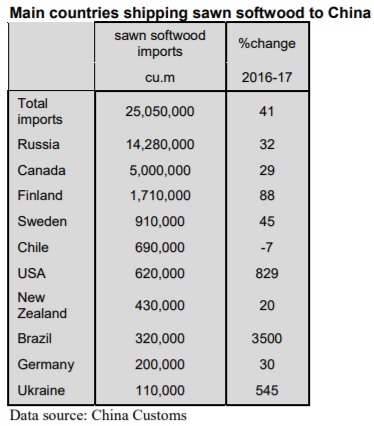
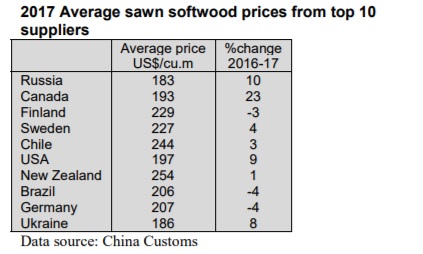
China’s 2017 sawn softwood imports surged 41% to 25.05 million cubic metres, accounting for 67% of total softwood sawnwood imports. The average price for imported sawn softwood was US$195 per cubic metre, up 10% year on year.
Russia still was the main sawn softwood supplier to China in 2017 and China’s sawn softwood imports from Russia rose 32% to 14.28 million, accounting for 57% of the national total.


Because Finnish government and Finnish Sawnmills Association have been implementing a “Wood from Finland” promotion programme sawn softwood exports to China accelerated to a year on year increase of 88%. China’s sawn softwood imports from Brazil, the US and Ukraine also surged.
The average prices for imported sawn softwood from Finland, Brazil and Germany declined 3%, 4% and 4% respectively.
Lower Chinese sawnwood hardwood imports from Canada
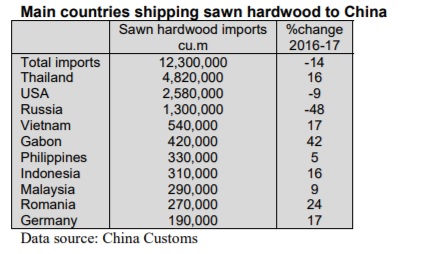
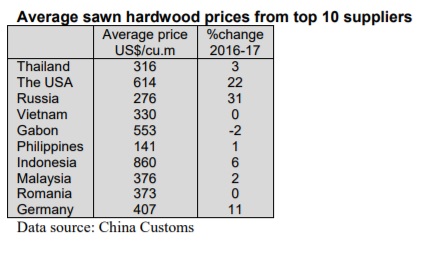
Canada disappeared from the list of main countries shipping sawn hardwoods to China because its most of sawn hardwood were exported to the US. However, China’s sawn softwood imports from Canada rose 29% to 5 million cubic meters in 2017.

Ilim Group invests US$ 1 billion in its Ust-Ilimsk mill in Russia

Ilim Group launches integrated investment project Big Ust-Ilimsk at Ilim's Mill in Ust-Ilimsk, Russia.

The Big Ust-Ilimsk project includes construction of a new line for production of kraftliner and other packaging materials with a capacity of 600 thousand tons per year. Total investments in the project will be around $1 billion with implementation to be completed by the end of 2021. The Company will also perform a large-scale upgrade of the existing operations in order to increase pulp output by 130 thousand tons per year.

Project implementation will drive the Mill capacity up to 1.5 million tons of finished products per year with an initially installed capacity of 550 thousand tons per year.

The Ust-Ilimsk Mill will thus become one of the leading pulp and paper manufacturers in the world. Ilim Group is currently preparing a set of documents required to classify the Big Ust-Ilimsk as a priority investment project in terms of forest management.

Ilim Group CEO Kseniia Sosnina said: “The Big Bratsk project drove a step change in softwood pulp output volumes while the delivery of the Big Koryazhma project resulted in higher production volumes of high-quality white papers. Delivery of the Big Ust-Ilimsk project will help us to reinforce our presence in the packaging segment, primarily in the growing Asian markets. Upon completion of the project in Ust-Ilimsk and upgrade of the Bratsk Mill, Ilim will become one of the largest manufacturers of unbleached packaging materials globally with a total board output of 1.5 million tons per year, bringing an aggregate production output of Ilim Group to over 4.3 million tons per year”.

Ilim Group is the leader of the Russian pulp and paper industry in terms of market share, output and investment volumes, and one of the industry leaders globally.

German wood products price on an upward trend in May

Since the beginning of the year German sawyers have complained about the cheap price of sawmill residues. Now the price decline is reflected in the German producer price index.

Thus in May the index posted a decline by 9% for wood chips, both compared to May 2017 as well as compared to April. Also wood pellets are 3% cheaper over the same month of last year and 5.3% compared to April.

Otherwise, the German producer price index shows a slight upward trend. In general, timber assortments are slightly more expensive than April. Only narrow boards' price has decreased.

In the wood-based materials segment, a minimum upward trend is also evident, with the exception of raw boards. Hardwood lumber also goes slightly uphill, while beech blocks are stagnant.

Year on year, the uptrend is still intact with some exceptions like chips, pellets, narrow boards and beech blocks. Significant increases compared to May 2017 were registered for wide and raw boards but also for battens.

Producer Price Index Commercial Products
(2000=100)
May
2017
April
2018
May
2018
Change
May '17
to '18
Spruce and Fir lumber (Picea abies Karst.) 112.0 115.0 115.7 3,30%
Lumber according to DIN 4074/S10 115.4 117.1 117.7 1,90%
Finger-jointed squares and beams (KVH) 101.9 103.6 104.4 2,45%
Boards, width over 16 cm 115.6 121.6 122.9 6,31%
Boards, width from 8 to 16 cm, size from 15 to 24 mm 114.9 111.5 111.1 -3,31%
Roof battens according to DIN 4074/S10 112.7 118.3 119.4 5,94%
Reserve squared timber, A/B, 10X10 - 12X12 111.1 114.1 114.1 2,70%
Softwood, size>6mm, planed, sanded, finger-jointed 110.5 112.3 112.6 1,90%
Wood chips from softwood 109.2 109.3 99.5 -8,88%
Pellets and Briquets, compressed 123.1 125.9 119.2 -3,17%
Hardwood lumber 106.7 107.3 108.9
2,06%
Beech blocks, A/B, size 50-60 mm, length 3m, damped 104.8 102.3 102.3 -2,39%
Beech frames, size 26-32 mm, length  3m, undamped 106.9 107.8 109.3 2,53%
Particle boards, raw or sanded 103.7 111.4 110.7 6,75%
Particle boards, laminated with decor 114.4 114.8 114.8 0,35%
HDF panels, size > 800 kg/m³, raw/sanded 111.8 111.6 112.5 0,63%
Laminate floorings, density > 800 kg/m³ 109.6 109.8 109.7 0,09%

The European Commission, the European Parliament and the Council reach political agreement on renewable energy

Negotiators from the European Commission, the European Parliament and the Council reached an ambitious political agreement on increasing renewable energy use in Europe on June 14, 2018.

According to the announcement, two out of the 8 legislative proposals in the Clean Energy for All Europeans package (adopted by the European Commission on November 30, 2016) have been already agreed by the co-legislators.

The new regulatory framework includes a binding renewable energy target for the EU for 2030 of 32% with an upwards revision clause by 2023. This expected to allow Europe to keep its leadership role in the fight against climate change, in the clean energy transition and in meeting the goals set by the Paris Agreement.

The rules agreed on June 14, 2018 serve also to create an enabling environment to accelerate public and private investment in innovation and modernisation in all key sectors. The EU aims at developing enabling measures that will stimulate investment, create jobs, improve the skills of people, empower and innovate industries and ensure that no citizen, worker or region is left behind in this process.

Main achievements of the regulation include:

  • A new, binding, renewable energy target for the EU for 2030 of 32%, including a review clause by 2023 for an upward revision of the EU level target.
  • The design and stability of support schemes for renewables.
  • Real streamlining and reduction of administrative procedures.
  • A clear and stable regulatory framework on self-consumption.
  • Increase of the level of ambition for the transport and heating/cooling sectors.
  • Improved the sustainability of the use of bioenergy.

Arias Cañete, Commissioner for Climate Action and Energy Miguel, commented:

“Renewables are good for Europe, and today, Europe is good at renewables. This deal is a hard-won victory in our efforts to unlock the true potential of Europe’s clean energy transition. This new ambition will help us meet our Paris Agreement goals and will translate into more jobs, lower energy bills for consumers and less energy imports. I am particularly pleased with the new European target of 32%. The binding nature of the target will also provide additional certainty to the investors. I now call on the European Parliament and the Council to continue negotiating with the same commitment and complete the rest of the proposals of the Clean Energy for All Europeans Package. This will put us on the right path towards the Long-Term Strategy that the Commission intends to present by the end of this year.”

Following this political agreement, the text of the Directive will have to be formally approved by the European Parliament and the Council. Once endorsed by both co-legislators in the coming months, the updated Renewable energy Directive will be published in the Official Journal of the Union and will enter into force 20 days after publication. Member States will have to transpose the new elements of the Directive into national law 18 months after its entry into force

Solid EU plywood demand, rising import prices

Against this background, European plywood importers variously describe demand ranging from ‘stable and sound’ and ‘at a good level’, to ‘strong and strengthening’. Most companies said sales were solid across the range, although Malaysian generally and Indonesian marine plywood were highlighted as being particularly sought after.
At the same time, all importers had issues with supply in different degrees. “There have been delays from everywhere, for various reasons,” said one leading continental operator. “Overall supply is short, making it difficult to plan,” confirmed a UK company. “Mills are also often running very late.”
The problems with Indonesian and Malaysian supplies are largely attributed by European importers to the long and severe wet season and its impact on harvesting and log transport, with mills consequently running short of logs.
The weather and raw material supply situation has since improved, but a report in the European trade press early April said that in some regions ‘logging roads are still muddy and log hauling is difficult’, adding that it could take a further month before the situation returned to normal.
Plywood prices for both Malaysia and Indonesia in the EU are reported to have increased by 30% in the last six months.
Until recently, supply from Brazil was described by European importers as ‘no better or worse than usual’, but the recent nationwide truckers strike over high fuel prices is expected to cause continuing delays in delivery of raw material to mills and finished product to port.
President Temer ultimately made concessions to the strikers and industrial action was called off end of May, but the country was left with a significant backlog of undelivered cargo and the action is now expected to dent GDP.
Increased competition from US buyers for Malaysian and Indonesian product is also said to be impacting availability and price in Europe.
“Traditionally, US buyers have sourced Asian hardwood plywood imports most heavily from China [worth $1.12 billion last year], but their requirements are now such that they’ve been exploring other sources, including Indonesia and Malaysia,” said a European importer/distributor.
“Whether US anti-dumping and countervailing duties on Chinese hardwood products, activated in December, will heighten this trend remains to be seen.”

Overview and outlook of the U.S. plywood market

The U.S. plywood market totaled 13.1M cubic metres in 2017, a decline of 3.1M cubic metres (or 19%) against the outset level. In wholesale prices, the market totaled $5.7B in 2017, remaining relatively stable against the previous year.
The market value declined sharply between 2007 and 2009, continuing with a recovery over the next six years: this was largely due to the expansion of the residential and industrial construction sector, as well as renovation of existing homes. Despite failing to reach pre-crisis figures, the trend changed in 2016 when the market declined again by 6%, stabilizing over the subsequent year.
The market is projected to reach 15.1M cubic metres
Plywood can be used for various purposes, depending on the surface treatment applied. Plywood is used in residential, commercial and industrial practice, mainly in furniture production, construction, interior decorating, and packaging, and also as coatings and wall-cladding. Continue reading "Overview and outlook of the U.S. plywood market"

Finnish roundwood prices significantly rose in April

The prices for roundwood in Finland have increased significantly during April 2018, as compared to the same period last year. The same increase can be noticed when compared to the prices in March 2017.
Pine sawlogs could be bought for EUR 58/37/m3, 6.32% more than in April 2017, while the price for spruce went up by 8.93%, to EUR 62.54/m3. At the same time, birch logs could be bought for EUR 43.80/m3, 6.02% more than in the same period last year.
The prices for pulpwood increased at the same rate as the ones for sawlogs. Thus, the price for pine pulpwood increased by 4.65%, to EUR 16.86/m3, while spruce and birch could be bought for EUR 19.01/m3 and EUR 16.23/m3, which is 6.97% and 5.25% more than in April 2017.

April 2017 March 2018 April 2018 Change in % April 2017-April 2018
Pine logs 54.90 57.62 58.37 +6.32%
Spruce logs 57.41 61.16 62.54 +8.93%
Birch logs 41.31 44.13 43.80 +6.02%
Pine pulpwood 16.11 16.60 16.86 +4.65%
Spruce pulpwood 17.77 18.64 19.01 +6.97%
Birch pulpwood 15.42 16.08 16.23 +5.25%


British companies interested in buying timber from Belarus

British companies are interested in buying Belarusian timber via commodity exchange. The possibility was discussed as a delegation of British woodworking companies visited the headquarters of OAO Belarusian Universal Commodity Exchange (BUCE).

According to BUCE Chairman of the Board Arkady Salikov, by buying timber via the commodity exchange, British companies will get access to as many suppliers as possible in addition to considerably reducing possible foreign trade risks.

The BUCE chairman of the board said: “The main purpose of the commodity exchange is to accumulate demand for and supply of products, helping shape market prices in conditions of tough competition. However, we've done more than that and offer a number of instruments to insure buyers against the breach of contracts. The number includes transactions via sub-accounts of the commodity exchange, payment deposits, and the ability to appeal to the exchange deal oversight department. As a result, the share of problem deals does not exceed 1% of the total number.

Apart from trading via the commodity exchange the sides discussed the quality of Belarusian timber, the stability of supplies and logistics. In particular, Peter Carter, Managing Director of Carter Turner Ltd, said the quality of Belarusian products is generally on par with British standards while the prices look very attractive even considering the cost of transportation.

The British businessman noted: “What we saw at the woodworking company Borisovski DOK exceeded our expectations. I believe these products will surely sell well on the British market. Besides, judging by exchange prices the competitive ability of Belarusian timber will be rather high while the schemes the commodity exchange offers will help optimize the costs involved in trading, quality control, payment, and merchandise delivery. Certainly, there are a lot of things, which are new for us, but we should definitely try.”

OAO Belarusian Universal Commodity Exchange also hosted B2B negotiations between the British delegation and Belarusian woodworking companies, which are interested in exporting timber via the commodity exchange.

A list of Belarusian timber products, which are expected to sell well in the UK, will be compiled soon and a scheme for delivering the products to the mutual satisfaction of buyers and sellers will be worked out.

Climbing prices for New Zealand radiata pine logs in May

Radiata pine log export prices from New Zealand have been rising significantly in May 2018. China has been importing radiata pine logs from New Zealand for over US$150 per cbm C&F, while the prices for Japan are also on the rise.
Present prices for China are US$151-152, about US$4 higher than last month. Log arrivals in China for March and April marked record-high levels with steady shipments. Port log inventories maintain at about five million m3. New Zealand log suppliers had held the export prices stable for some time but seeing strong demand in China, they decided to increase the prices.
Log prices for Japan have amounted to US$160 per cbm C&F, US$5-6 higher than in April. While there is a limited number of shipments to Japan, ocean freight is one of major reasons for the price increase, along with the higher crude oil price, that pushes the freight up. Moreover, the exchange rate has been weakening, which pushes yen log cost up higher
Future is hard to predict, but normally the Chinese market might slows down in June and July..

Wood pellets price in Austria higher than last year

Wood pellets prices in Austria keep stable in June, when compared to the previous month. The average retail price for wood pellets ENplus A1 quality (6t) is currently 23.28 cents/kg or 4.75 cents/kWh. This is 0.3% less than in May and 3.2% more than in June 2017.
If bought by the sack (15kg), the price for wood pellets has risen sharply in June 2018. Thus, a 15kg sack costs EUR 3.96, or 26.40 cents per kg (5.39 cents/kWh). This represents 1.1% more than in May and 1.8% more than in June 2017.
Larger quantities of commercial pellets (17 t) can be bought for 199.96 EUR/t, which is 3.2% more than in June 2017.

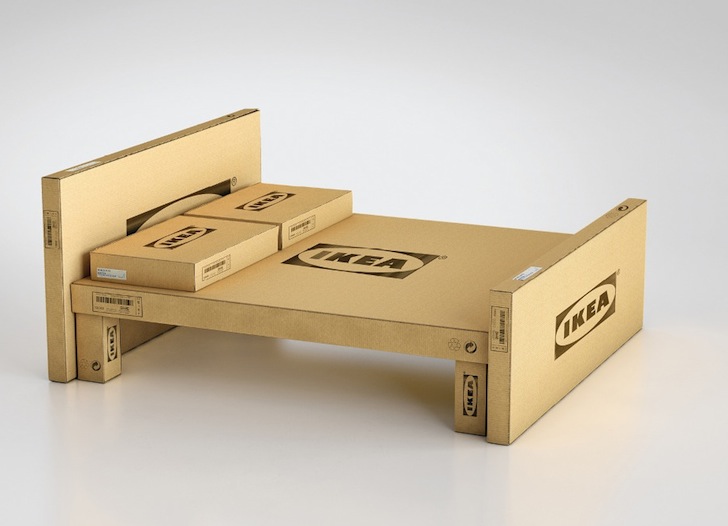
IKEA announces plan to go totally green by 2030

IKEA makes global commitment to remove all single-use plastic products in the range by 2020, as part of a new sustainability strategy.

The company, which is a massive user of medium density fiberboard that can be used to make recycled products, has been experimenting with alternative forms of construction. For the consumers, Ikea’s classics such as the “Billy” bookcase, the “Poäng” chair and the “Ektorp” couch may look slightly different in the near future.

Taking up a “Three Roads Forward” strategy to guide them in the future means that IKEA will focus on how easy people can access their products, the effect those products have on the environment, and how affordable their products are.

IKEA hopes that by placing their focus on these three guidelines, the company not only becomes entirely “circular,” avoiding waste by making all of their products out of recycled materials, but “climate positive,” as well.

The company will have to review some of its current design practices, many of which make use of screws and other metal casings and hinges. Already embarking on the task, the company unveiled a furniture line last year that, on top of being able to be assembled 80% faster, uses a “click’” technology where the builder needs no screws or wrenches.

As a result, their furniture is a lot easier to move, and thus able to be kept longer. Not to mention, recycling will be effortless with no metal on wood parts. Also, it’s a great step forward for a company that consumes 1% of the world’s wood supply.

As these new design strategies are only part of the initiative, Ikea hopes to execute all nine of them by 2022.

On a broader scale, the company is aiming to cut down its carbon footprint by 80% across the board. They will be using their 2016 carbon footprint as the benchmark, and interestingly, it was in 2016 that Ikea announced that they had already cut their carbon footprint by half from where it was in 2010.

They also plan to work on improving the availability of affordable solar solutions by 2025 and bring down emissions for home deliveries to zero by the same year.

Turkish Starwood invests in a new particleboard production mill

Starwood Orman Ürünleri Sanayi A.S., a Turkish  particleboard producer, announced an investment in a new particleboard plant in İnegöl.

According to the announcement. the company placed an order for 460,000 m3 production facility with Dieffenbacher. The new plant is scheduled to go online in the summer of 2019.

With a 4-head forming station that includes optimized windformers with additional roller screens, and a CPS+, the gold standard for efficient continuous press systems, Starwood will add a state-of-the-art, high-end production facility to its location in İnegöl.

Also included is a gluing system featuring glue preparation and dosing, a press exhaust system and the plant’s entire automation, control and quality control systems. Additionally, Starwood has ordered the raw board handling system, automated board storage system and the sanding line, all of which are to be integrated into the existing infrastructure.

Starwood Orman Urunleri Sanayi A.S. manufactures paper coated and laminated packaging. The Company offers products such as chipboard, melamined chipboard, impregnated paper, MDFLAM, colour cards, and painted MDF.

China’s plywood trade disrupted by domestic environmental controls

Chinese plywood supply is reported by EU importers to be disrupted by tough new national environmental controls, which are forcing mills to interrupt production to upgrade or replace emission and waste treatment technology. Here prices are reported to have risen 10% in the last six months.

“Inspectors have been visiting our Chinese supplier mills now for months, and we’ve seen regular stoppages as they improve their systems,” said one importer/distributor. “And recently there were more in Linyi and Pizhou.”

“Stoppages also increased in Qingdao as part of the authorities moves to improve the local environment for June’s Shanghai Cooperation Organisation meeting,” said another leading EU importer.

Some European traders maintain that one reason for the pollution crackdown is to rationalise and concentrate the plywood industry, forcing smaller producers to close.

One European importer/distributor, however, insisted this was not the prime objective. “We visit regularly and are convinced it’s motivated by a genuine desire to reduce the industry’s environmental footprint and help meet climate change targets,” he said. Importers added that they generally back China’s action as underpinning its overall environmental credibility.

As for the situation with Russian hardwood plywood supplies to the EU, an importer summed it up as ‘more or less OK’. “But there have been some issues with a lack of trucking capacity,” he said.

Steinhoff International agreed to sell Kika/Leiner

Steinhoff International has finally admitted that it is selling its loss-making Austrian furniture retailer Rudolf Leiner, popularly known as Kika/Leiner, and real estate assets to Rene Benko’s Signa Holding.

The proposed value of the transaction was not disclosed by the group. Rumours have been circulating in the past few weeks that it is considering selling its Austrian unit, but the group had been tight-lipped until Friday when it announced the sale.

Steinhoff acquired Kika/Leiner in 2013 as part of its strategy to bulk up across Europe. Kika/Leiner has 70 stores in Austria and other parts of Europe.

Steinhoff said in January that the group had taken steps to assist the Kika/Leiner business to formulate a restructuring plan with the objective of restoring its operating and financial performance and to set a course for it to continue as a going concern.

“The Kika/Leiner business is currently loss-making and placed significant cash demands on the wider group.

“Further, any turnaround plan for Kika/Leiner would have required significant new investment from the group over a number of years,” it said in explaining its decision.

In parallel with these discussions, the group’s management team have been engaging with third parties with a view to agreeing the terms of a sale of the Kika/Leiner operating companies and property holding companies.

Steinhoff said that following the discussions they had with a number of interested parties, certain group companies have accepted a conditional offer from Signa Holding, subject to the entry into final transaction documents.

International credit insurers of suppliers to the Kika/Leiner businesses decided to withdraw their credit insurance cover at the beginning of the month.

“While the group considers it has been making good pro- gress with the turnaround since the agreement of the Kika/Leiner restructuring plan, the international credit insurers of suppliers to the Kika/Leiner businesses decided to withdraw their credit insurance cover at the start of June 2018.

“This withdrawal of support from credit insurers placed significant further liquidity constraints on the Kika/Leiner businesses and, in recent days, the Kika/Leiner businesses have seen this uncertainty result in a weakening of customer confidence,” the group said.

The group added that following the withdrawal, it had held discussions with Kika/Leiner’s creditors, suppliers and credit insurers in an attempt to secure their continued support for Kika/Leiner’s operations, which had not been successful.

Steinhoff has been decimated in the past seven months. This comes after the group admitted to accounting irregularities in December. The share price has declined by more than 95percent.

Newsletter

Subscribe to our digital newsletter for your daily digest of essential news, views and analysis from the international wood industry delivered directly to your inbox.


0