Article archive

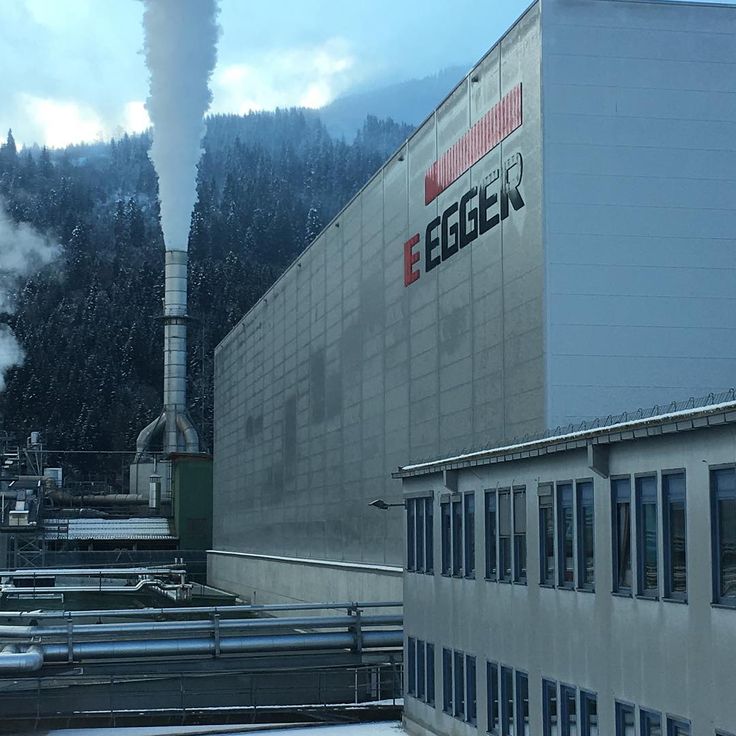
Egger plans to loan EUR 150 million for its new particleboard plant in Poland

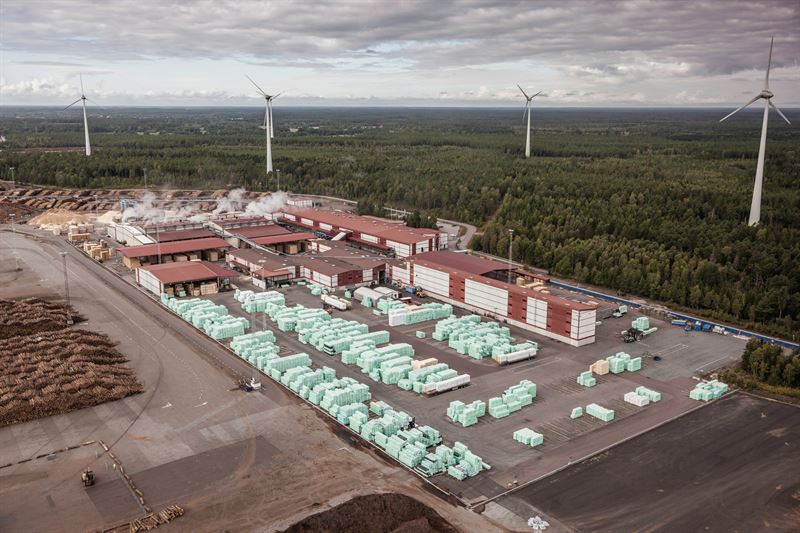
Egger Group has started talks with the European Investment Bank (EIB) regarding potential financing for the Egger Group’s realization of their greenfield advanced wood-based materials manufacturing plant in Biskupiec, Poland.

The project is eligible for EIB funding as it will have a substantial positive economic impact for the region and support the forest-based bio-economy. The application of the Egger Group for a 150 million EUR loan is currently under appraisal by EIB.

The discussions with the EIB  are about the construction and operation of Egger’s greenfield wood-based materials manufacturing in Biskupiec in the Warmia-Masuria region of north-east Poland. Due to its location, the project is potentially eligible under Article 309 (a) of the EU treaty regarding projects for less developed regions. The Egger management emphasizes that its investment in Biskupiec will contribute to the EU’s strategic goal of economic and social cohesion and support for weaker regions and greatly values the potential partnership with the EIB.

Thomas Leissing, Egger Group Management for Finance & Administration, commented: “We believe in sustainable growth through our own efforts and the plant in Biskupiec is also a long-term investment for future generations.”

The construction of the plant is already underway and main buildings shall be finalized by the end of 2018. The Biskupiec plant will have ultramodern facilities that are based on the latest available production and environmental protection technology. Already now, approx. 290 people have been employed by EGGER in Biskupiec.

Egger has 18 plants across the world, which produce an extensive product range of wood-based materials (chipboard, OSB and MDF board) as well as timber. The Egger plant in Biskupiec will be the 19th manufacturing plant of the company.

Boom in Russian lumber exports this year

In January-July 2018, Russia increased its lumber exports, both in value and in volume terms. Thus, the country exported 11.132 million tonnes of lumber, 5% more than in the same period last year.

The total value of the exported Russian lumber increased as well. In January-July, it came up to $2.638 billion, up by 17.7%,

In their turn, Russian log exports went down in volume terms, but increased in value terms. In January-July 2018, the Russian log exports came up to 10.54 million m3, up by 4.5% year-on-year.

The total value of the Russian logs exported in the mentioned period came up to $885.9 million, that is 5.7% more than during the respective period of 2017.

Also, Russia increased its plywood exports, both in value and in volume terms. Thus, the plywood export volume came up to 1.597 million m3, 9.1% more than during the respective months of 2017.

The total value of the Russian plywood exported in January-July 2018 came up to $807.7 million and grew by 27.4% year-on-year. The Russian plywood average export price came up to $505.8/m3.

EUTR’s impact on tropical wood imports

The obligation placed on importers by the EU Timber Regulation (EUTR) to gather data to demonstrate a negligible risk of illegal harvest is acting as an extra drag on EU trade in tropical timber.

Reports suggest regulatory actions are becoming more frequent and vigorous, particularly in Belgium in recent weeks. This is more significant given the important role Belgian importers play in distributing tropical hardwood products to other parts of the continent.

There appears to be a general trend in the EU for many companies that formerly imported direct from the tropics to avoid the need to implement EUTR due diligence systems by procuring through other EU companies.

This is concentrating trade in the hands of a few of the larger EU importers who, in turn, are limiting their purchases to a smaller number of tropical suppliers capable of providing the legality assurances required by EUTR.

Overall, opportunities for tropical exporters to enter the EU market are therefore becoming more restricted.

As the only country delivering products with FLEGT licenses, which are not subject to any further EUTR risk mitigation measures, unlike other non-EU countries

Indonesia may be expected to benefit from this more active enforcement of EUTR.

There is some evidence for this. The EU’s total imports of tropical wood products from Indonesia increased 7% to 175,000 MT in the first 6 months of 2018, and Indonesia’s share of total EU tropical imports increased from 15.7% to 16.6% in the same period, mainly at the expense of Cameroon and Gabon.

While EUTR may now be favouring Indonesia in the EU market, other supply side factors are also playing a role.

As noted in the last market report, supplies of African hardwood species of interest to the EU market are in long term decline, while exports from African have been seriously affected by logistical challenges at the port of Douala in Cameroon and cash flow problems of large European operators, issues brought to a head with the sale of Rougier’s subsidiaries in Cameroon and the Central African Republic in July.

Supplies of both Malaysian and Indonesian products were also restricted in the first half of 2018, largely attributed by European importers to the long and severe wet season and its impact on harvesting and log transport, with mills consequently running short of logs. This fed through into rising prices.

Plywood prices for both Malaysia and Indonesia in the EU increased by 30% in the six months between October 2017 and March 2018.

Meanwhile a larger share of African supply is now being exported to China, Vietnam and other emerging markets.

Wood pellets prices in Germany on the rise in September

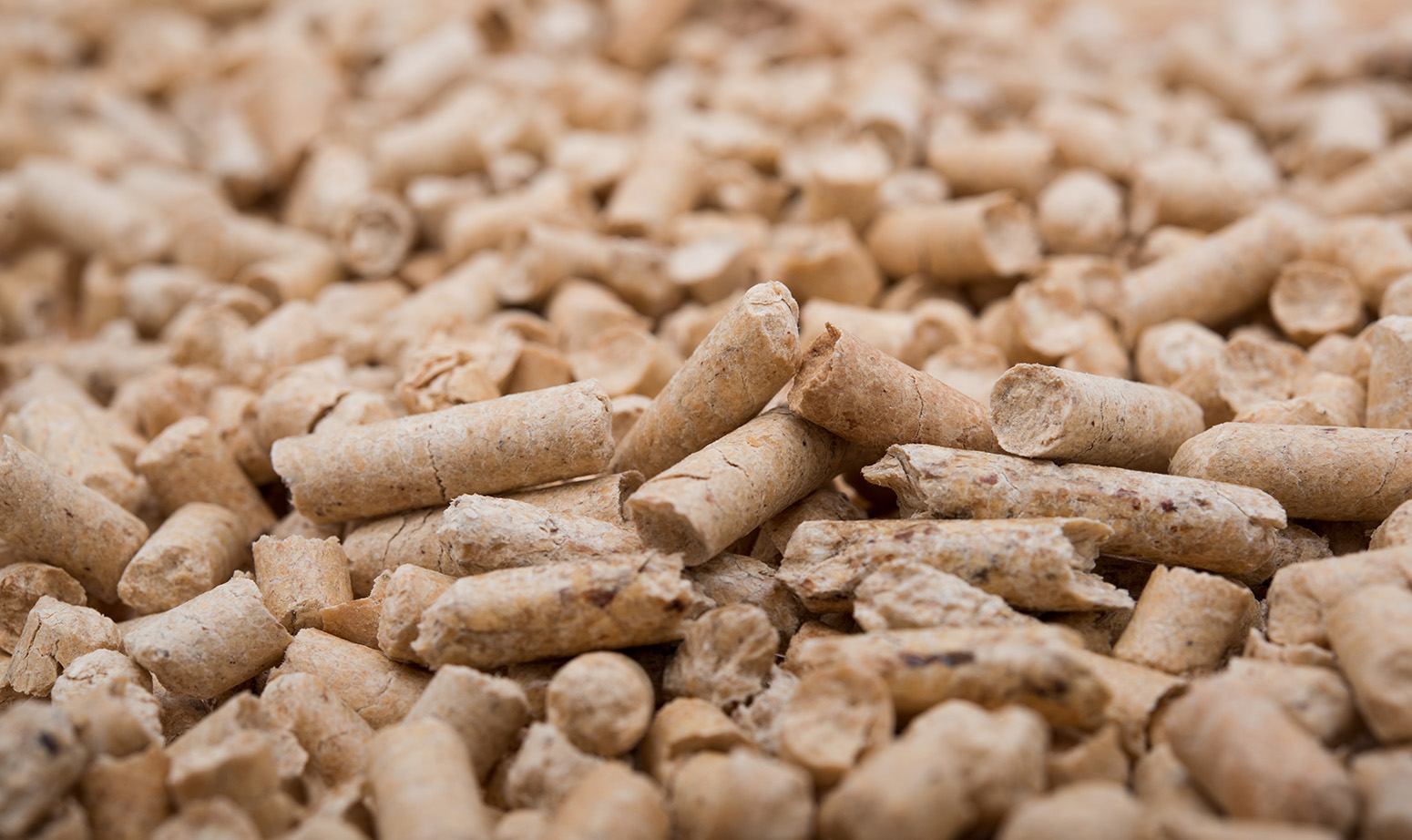
The price for wood pellets in Germany increased during September 2018. As compared to August, the price increased by 1.4%. On average, for a tonne of ENplus A1 pellets, customers now pay € 240.92 for a purchase of 6 t. 
During the mentioned period, one kilogram of wood pellets costs 24.09 cents and one kilowatt hour (kWh) of heat from pellets costs 4.82 cents. Compared to September 2017, this is an increase of 3.5%.
Pellets currently have a price advantage of about 36% over heating oil and about 20% over natural gas, as reported by the German Energy Wood and Pellet Association e.V. (DEPV).
"Wood pellets are generally cheaper in summer than in winter. Therefore, a slight price increase at the beginning of autumn does not come as a surprise, "explains DEPV Managing Director Martin Bentele. "Compared to unpredictably fluctuating oil prices, the pellet price is a prime example of stability and reliability," he continued.
Regional prices (for 6 tonnes purchases) in September 2018: Central Germany: EUR 238.36/t, Northern and Eastern Germany: EUR 241.26 per tonne, Southern Germany: EUR 241.16/ t.
Larger quantities (26 t) could be bought for the following prices: South: 227.17 EUR / t, Central: 221.64 EUR / t, North / East: 221.63 EUR / t (all incl. VAT).

Södra to increase lumber production by 100,000 m³ at Mönsterås sawmill

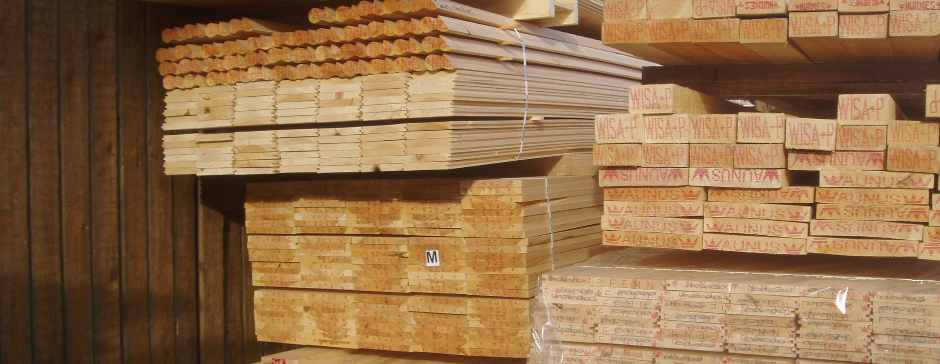
From 1 March, the annual production volume of sawn timber at the Mönsterås sawmill will increase by 100,000 m³. This will require a third shift and approximately 30 new employees.

Over the past two years, Södra has implemented structural changes in its sawmill operations to strengthen the company’s long-term competitiveness. Södra describes the market outlook as bright, while sustainable construction is driving the interest in timber as a building material. The underlying demand for sawn timber is high, Södra says in a press release.

“With our focus to grow with our customers, we need to increase production at Mönsterås to meet demand” said Jörgen Lindquist.

The proportion of timber-frame buildings is growing all over Europe. Due to the positive environmental effects, combined with construction efficiency and reduced transportation, interest in timber-frame construction is rising, Södra considers.

Lumber prices in the US fell during September

As the post-holiday week affected negatively the lumber trade in the US, deep discounting re-emerged in prices last week.
Traders noted the market looked similar to the weeks that followed the Fourth of July, as buyers sat on their hands sensing downside risk. Buyers noted ample offerings throughout the distribution system and were content to replenish on a one-for-one basis.
Double-digit cuts at the mill level were the rule, and the Random Lengths Framing Lumber Composite Price dropped $12 for the week to $441.

Week
Sep 14
Week
Sep 7
Year Ago
2017
Random Lengths Framing Lumber Composite Price* $441 $453 $421
KD Western S-P-F #2&Btr 2x4 R/L Mill Price 442 478 416
KD Eastern S-P-F #1&2 2x4 R/L, delivered Great Lakes 547 565 512
Green Douglas Fir Std&Btr 2x4 R/L (Portland) 405 440 467
Southern Pine (Westside) #2 2x4 R/L 476 465 386
KD Coast Hem-Fir #2&Btr 2x4 R/L 445 460 440
Ponderosa Pine (Inland) #2&Btr 1x12 R/L 775 775 675
* Weighted average of 15 key items

Random Lengths Panel Market Report

Hurricane Florence was a major factor in structural panel trading. Sales of OSB faded sharply in the South late in the week.

The market lacked follow-through after the storm’s approach jolted sales Monday and Tuesday. Anticipation of the storm drove Southern Pine plywood sales on the eastside in early trading and demand quickly spread to other zones, as buyers sensed tightening supplies.

Activity picked up in western Fir plywood, with many traders reporting their best week in about a month.

(f.o.b. mill prices) Week
Sep 14
Week
Sep 7
Year Ago
2017
Random Lengths Structural Panel Composite Price* $477 $471 $504
Southern (west-east) 15/32-inch 3-ply rated sheathing plywood 465-505 443-475 480-495
Southern (west-east) 15/32-inch 4-ply rated sheathing plywood 470-510 448-480 485-500
Western 1/2-inch 4-ply rated sheathing plywood 487 487 515
North Central 7/16-inch Oriented Strand Board 345 345 435
*Weighted average of 11 key items

Switzerland: Wood pellets prices higher this month

In September, the prices for ENplus A1 certified wood pellets increased in Switzerland. The current average price for pellets (delivery quantity 3-8 t) is 361.70 CHF / t. 
This is 1% more than in August and 0.3% more than in September 2017.
The prices vary depending on the delivery quantity by between 350.98 CHF / t (8t) and 373.21 CHF / t (3t). The figures are therefore at about the same level as in the previous year, with larger delivery quantities prices slightly higher.
On average, wood pellets for commercial customers (17 t) cost an average of 337.82 CHF / t, about 1% more than in August and 0.8% more than in September 2017.

European sawn hardwood sector negatively impacted by raw materials’ supply

Production in the sawn hardwood sector has not been showing any significant trends over the last few years. Demand is on the way up, with species such as oak experiencing a recovery in attractiveness. The beech market is stable in Germany (with robust demand from China) and doing well in France.

However, many countries are experiencing problems in raw materials’ supply, which is keeping production below potential. Countries such as France, Belgium and Germany are experiencing significant exports of raw materials to Asian countries like China.

Romania, due to a stringent legislation on purchasing roundwood, has an unsatisfactory availability of raw materials. Limitations on the exports of oak from Croatia are having a negative impact on Central and South European oak processors. Therefore, a more lively market is in some cases not being taken advantage of.

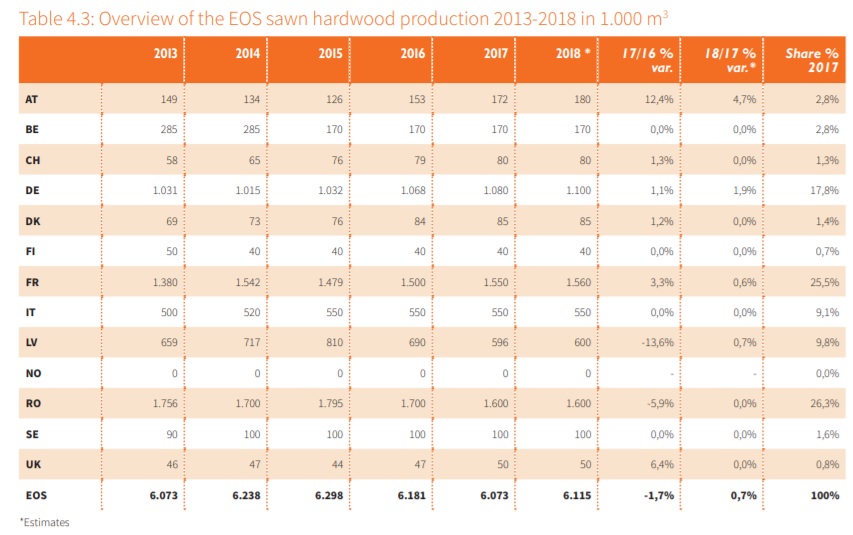
Overall production in this group of countries was about 6.1 million m3 in 2017, slightly below than in 2016. A marginal production increase will probably occur this year. We are still far from the production peak that these countries achieved back in 2007 (7.8 million m3 ).

In 2017, Romania and France remain the biggest sawn hardwood producers within the EOS community, with a production of 1.6 and 1.55 million m3 respectively. The third largest producer remains Germany, with almost 1.1 million m3 , a small increase compared to 2016.

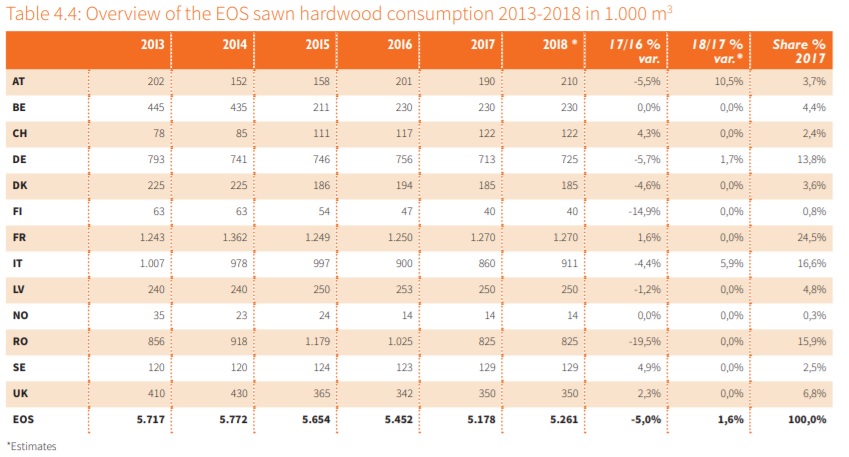
In 2017, sawn hardwood consumption in the EOS (European Organisation of the Sawmill Industry) countries was 5.1 million m3 . A noticeable decline can be observed comparing with 2016, due mainly to dropping consumption in Romania. For 2018 a slight increase is expected.

Hardwood consumption remains subdued when compared to the pre-global economic crisis period (it peaked in 2007 when it reached 9.3 million m3 ). France remains the largest consumer within the EOS community with almost 1.3 million m3 , followed by Romania with 825,000 m3 and Germany with slightly more than 700,000 m3.

German wood products more expensive in July 2018

German producer prices for commercial wood products continued to rise in July 2018. Compared to the previous year, all values ​​except laminated particleboards have increased. In comparison with the previous month of June, there are only a few negative signs.
Compared to July 2017, only the value for coated chipboard remains at the previous year's level and, as in June, is -0.17% compared to the previous year. All other reported values ​​have increased more or less. Raw particleboards leads the list, followed by narrow boards and finger-jointed lumber. The least pronounced increase was recorded in hardwood lumber and laminate flooring.
Even in the short-term comparison with June 2018, the majority of the indices have increased. Exceptions are lumber, pellets and laminate flooring, whose values ​​are declining slightly, as well as hardwood lumber. The highest increase is seen in HDF boards at + 2.44%, followed by finger-jointed lumber and narrow boards.

Producer price indices of industrial products (2000 = 100) Jul-17 Jun-18 Jul-18 Change% Jul17 - Jul18 Change % Jun18 - Jul18
Softwood, size>6mm, planed, sanded, finger-jointed 112,7 117,9 120,2 6,65% 1,95%
Spruce and Fir lumber (Picea abies Karst.) 117,4 122,1 122,9 4,68% 0,66%
Lumber according to DIN 4074/S10 114,6 120,7 119,2 4,01% -1,24%
Boards, width over 16 cm 120,8 125,4 127,3 5,38% 1,52%
Boards, width from 8 to 16 cm, size from 15 to 24 mm 110,5 116,4 118,5 7,24% 1,80%
Roof battens according to DIN 4074/S10 126,1 129,9 130,6 3,57% 0,54%
Stock squared timber, A/B, 10X10 - 12X12 115,1 118,2 119,0 3,39% 0,68%
Construction timber 102,9 107,6 108,7 5,64% 1,02%
Hardwood lumber 113,7 115,7 115,7 1,76% 0,00%
Beech blocks, A/B, size 50-60 mm, length 3m, damped 107,9 109,4 109,4 1,39% 0,00%
Beech frames, size 26-32 mm, length  3m, undamped 114,3 116,4 116,4 1,84% 0,00%
Wood chips from softwood 91,2 92,1 93,4 2,41% 1,41%
Particle boards, raw or sanded 108,1 119,0 119,5 10,55% 0,42%
Particle boards, laminated with decor 115,2 115,0 115,0 -0,17% 0,00%
HDF panels, size > 800 kg/m³, raw/sanded 112,2 114,6 117,4 4,63% 2,44%
Laminate floorings, density > 800 kg/m³ 110,5 111,5 111,2 0,63% -0,27%
Pellets and Briquets, compressed 108,0 112,2 111,4 3,15% -0,71%

U.S. softwood lumber production rises while Canadian output drops in H1/2018

U.S. sawmills produced 17.758 billion board ft. (bbf) of softwood lumber in the first half of 2018, an increase of 5.1% from 16.898 bbf in the same period last year.

Western U.S. sawmills produced 7.416 bbf of the six-month total, a gain of 7.2% from 6.915 bbf a year earlier, while southern mills produced 9.504 bbf, up 3.5% from 9.183 bbf.

In June alone, production was 2.976 bbf, up 0.5% from last year’s 2.962 bbf, but down 6.8% from 3.191 bbf in the previous month.

Of June’s total, Western U.S. sawmills accounted for 1.233 bbf, down 0.5% from 1.239 bbf a year earlier, and 4.1% lower than output in May 2018 of 1.285 bbf.

Production by sawmills in the South was up 1.3% year-over-year to 1.603 bbf from 1.583 bbf, but down 8.7% from May’s production volume of 1.756 bbf.

Apparent U.S. softwood lumber consumption in the first half was 24.372 bbf, an increase of 2.0% from 23.903 bbf in the first six months of 2017. Apparent consumption in June was 4.217 bbf, a 5.5% gain from 3.994 bbf a year earlier, but down 5.6% from 4.462 bbf in the previous month.

Canadian softwood lumber production/consumption

In the first six months, Canadian sawmills produced 14.316 bbf of softwood lumber, a decline of 1.7% from 14.560 bbf in the previous year, reported WWPA.

Sawmills in British Columbia contributed 6.423 bbf to the six-month total, down 4.2% year-over-year from 6.705 bbf, while sawmills east of the Rockies increased output by 0.5% to 7.893 bbf from 7.856 bbf.

In June, Canadian softwood production was 2.302 bbf, a drop of 3.2% from 2.378 bbf in June 2017, and down 7.2% from the previous month’s volume of 2.481 bbf.

Sawmills in British Columbia contributed 1.063 bbf to June’s total, down 2.8% from last year’s 1.093 bbf, and down 3.4% from 1.100 bbf in May 2018. Sawmills east of the Rockies produced 1.239 bbf in June, down 3.6% from 1.285 bbf in June 2017 and down 10.3% from 1.380 bbf in May this year.

Apparent Canadian softwood lumber consumption increased over the six-month period, by 8.6% to 5.325 bbf from 4.901 bbf. Consumption in June alone was 793 million board ft. (mmbf), down 17.9% year-over-year from 966 mmbf, and 18.5% lower than apparent consumption in May 2018 of 973 mmbf.

Russian-Japanese joint project to build huge wood pellet facilities in Russia’s Far East

The Russian Direct Investment Fund (RDIF), the sovereign wealth fund of Russia, the Russia-Japan Investment Fund (RJIF, launched by RDIF and the Japan Bank for International Cooperation (JBIC)), RFP Group and Japan’s Prospect Co., Ltd. have agreed to advance negotiations on a joint project to construct a pellet mill in Amursk (Khabarovsk Region). 

The investment for the project totals $35 million at the first stage with a potential further increase to up to $200 million. The project involves the construction of a fuel pellet production mill (wood pellets) with a total capacity of 135 thousand tons per year. Construction of the first facility has started from the summer of 2018, with pellet production beginning in 2019. The parties are considering to expand production capacity and construct additional plants to reach a capacity of circa 500,000 tons per year. A significant volume of the product will be exported to Japan and several agreements have already been signed with potential pellet customers. Negotiations to attract project financing from leading Japanese banks are also underway.

Kirill Dmitriev, CEO of the Russian Direct Investment Fund (RDIF), said:
"In Russia, a large quantity of timber is harvested and processed, this leads to a significant amount of waste from the Russian timber industry. The joint project of RDIF and partners uses this timber waste to produce pellets. It not only generates attractive returns but also holds significant export potential. The project also has an important environmental component, as wood pellets have several advantages compared to traditional fuels.

Russia-Japan Investment Fund was established to pursue and implement attractive investment projects to promote economic, trade and investment cooperation between Japan and Russia. Priority sectors identified for cooperation include healthcare, development of smart cities and sustainable technologies, energy, cutting-edge technologies and developing industries and export in the Russian Far Eastern District, as well as other initiatives that will strengthen the trade and economic relations between the two countries.

Prospect Co., Ltd (TSE: 3528) is a Tokyo Stock Exchange listed investment and development firm with over 200 employees and over 20 years of development experience in Japan, totaling over 2 billion USD. The company operates in five main business segments, (1) the development and sale of condominiums in the Tokyo metropolitan area; (2) the sale of built to order residential properties; (3) asset management through its SEC registered U.S. Investment Advisory subsidiary, investing in Japanese equity, (4) general civil engineering and construction, specialized in prestressed concrete (PC) works, micro-tunneling and (5) renewable energy power generation and electricity sale. The Company currently has 150 million USD in renewable energy projects under development.

Russia Forest Products (RFP Group) is the largest forestry company in the Russian Far East with 5 million m3 of annual allowable felling rights and annual felling volumes of over 2 million m3. RFP operates one of the largest wood-processing clusters with an input capacity over 1.5 million m3 of round wood with plants producing veneer, sawn wood and wood pellets.

Southwest China to see US$ 3.3 billion investment in timber ports and processing zone

A cooperation and investment agreement was recently signed between China Forestry Group Corporation and the administration in Ba’nan district of Chongqing municipality.

An investment of RMB23 billion (US$ 3.3 billion) will be used to build timber trade ports, a timber processing zone and a wood products demonstration and trading centre in Western China.

Currently in China the timber ports and industrial zones are mainly distributed in coastal areas and along the border areas and there is a gap in the southwestern regions of China.

The new infrastructure will result in large volumes of imported timber entering the southwestern regions and this will cut transportation costs for enterprises in the region and will also expand employment opportunities. It is forecast that demand for timber would expand to 100 million cubic metres in the southwestern region including Yunnan, Sichuan, Guizhou, Guangxi provinces, Xizang Autonomous Region and Chongqing municipality.

Chongqing municipality is the distribution centre in southwestern China and the technology for timber processing mills is well established and production costs are very competitive, say analysts.

Current trends in the Swedish sawmill industry

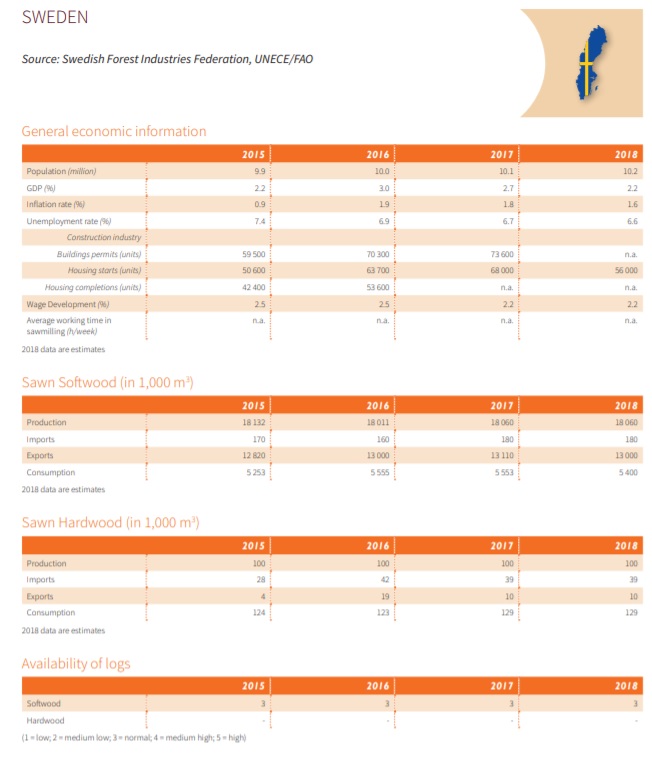
Sweden is the largest softwood exporter in Europe. 13 million cubic meters are exported of which 8 million cubic meters are shipped to Europe and 5 million cubic meters to markets outside Europe. Thus, the Swedish sawmills are highly dependent not only on the European but also on the global softwood markets. After ten years of recovery the global consumption of softwood is back on all-time high.

Today, the USA softwood market is by far largest contributor to the global increase in wood consumption, followed by China. European consumption is growing at a much lower but steady pace. The consumption in USA and Europe is driven mainly by increasing building activities, while the Chinese market is also driven to a high degree by growth in the furniture segment.

A continued good development on the two largest markets in the world - USA and China - will be crucial for how the softwood market - and thus the situation for Swedish sawmills - will develop during the coming year.

Swedish softwood production 2017

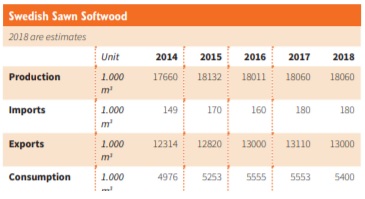
Despite the improving market conditions throughout last year Swedish softwood production remained practically unchanged at 18.06 million cubic meters.

This year has started with relatively low production. During the first quarter the production decreased by five (prel) per cent compared with the same period last year. The weather conditions and shortages in transport capacity have contributed to lower production than anticipated.

Because of low production and high demand, the stocks of softwood at sawmills have decreased to very low levels. The low production volumes during the first quarter means that the production will hardly increase during the whole year 2018. Our preliminary forecast is that the production will remain unchanged. This means that the Swedish production also this year will increase less than the global demand and that the level of production will still be well below the record from 2006. In 2006 the raw material supply was impacted by massive volumes of wind blown trees.

Exports 2017: Continued increase to East Asian markets, decrease to MENA

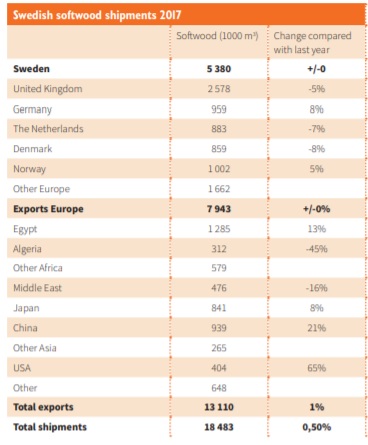
The table below shows the shipments from Swedish sawmills to different markets last year. The total export volume was 13.1 million cubic meters which was one per cent more than in 2016.

The export to United Kingdom, the largest export market, decreased slightly during 2017. The demand of Swedish softwood in UK remains healthy, even though the future has become somewhat more uncertain because of Brexit.

The European “quartet” Germany, Denmark, Norway and the Netherlands are all important markets for Swedish sawmills. All of them receive each year close to one million cubic meter of Swedish wood. These markets are all favoured by relatively healthy consumption growth driven by increasing construction activities.

Poland is the European market with the highest growth in exports from Sweden. Last year the increase amounted to 28 per cent.

Exports to the North African and Middle East region (mainly redwood markets for the Swedish sawmills) continued to decrease during last year. Algeria recorded the largest decline, with 45 per cent lower shipments. Other big markets for Swedish softwood such as Saudi Arabia, Morocco, Tunisia and Yemen all decreased in volume. On the other hand, exports to the largest African market Egypt increased by 13 per cent, after two years with declining volumes.

The East Asian markets are increasing, last year by 14 per cent. China, in particular, has had a fantastic development during the last six years, even though the volumes started to level out last year. Sweden is mainly exporting whitewood to the Chinese furniture industry.

Softwood exports to the USA increased last year by 65 percent and reached 404.000 cubic meters. That is the highest exported volume from Sweden to USA since 2006.

With a softwood consumption of 5.6 million cubic meters Sweden is the single largest market for the Swedish sawmills. Demand is driven by strong housing activity. Housing starts climbed last year to their highest level since the early nineties (even though most of the increase in building activity has been on flats) and reached 69.000 units. The repair and maintenance activity remains on a stable level.

It seems like a peak in construction was reached last year, and the activity is now decreasing slightly from a high level.

On the other hand, the share of multi storey houses built with wood is now increasing. For example, a number of investments in CLT-production is now under way in Sweden.

Estonia: Prices for roundwood way higher than last year

The prices for roundwood in Estonia stabilized in July. Most of the products are at the levels of the previous month. Only small-diameter pine price decreased.
On contrast, small-diameter spruce price has increased so that its value is now higher than that of pine.
The prices for aspen and birch veneer have fallen, but are still well above the previous year's level.
Birch pulpwood is still significantly more expensive than in July 2017, while aspen pulpwood has fallen back to around the previous year's level after two price rises.
By contrast, the upswing in coniferous wood is unbroken. After a price dip in May and June, the price of pine pulpwood rose sharply in July. Together with the spruce it is at a new all-time high of 50 EUR / m3.

Jul'17 € / m3 Jun'18 € / m3 Jul'18 € / m3 Change% July 17 to July 18 Change% June to July 18
Pine 65,21 75,05 75,21 15,34% 0,21%
Pine d<18cm 51,53 63,81 61,92 20,16% -2,96%
Spruce 65,12 77,34 77,75 19,39% 0,53%
Spruce d<18cm 51,72 62,19 63,12 22,04% 1,50%
Birch veneer 103,10 113,53 107,91 4,67% -4,95%
Birch 58,67 68,74 65,98 12,46% -4,02%
Aspen 31,76 41,82 41,66 31,17% -0,38%
Pine pulpwood 26,91 46,91 50,13 86,29% 6,86%
Spruce pulpwood 26,19 41,86 49,99 90,87% 19,42%
Birch pulpwood 24,14 44,00 41,96 73,82% -4,64%
Aspen pulpwood 19,87 29,47 21,12 6,29% -28,33%
Firewood 19,22 20,84 20,00 4,06% -4,03%


RFP Group to build a new sawmill and wood pellet plant in Russia’s Far East

The Russian timber industry holding RFP Group will build a wood processing plant in Yakutia (Russia's Far East) with a capacity of up to 150 thousand m3 per year by 2025. 

"A long-term investment project is under way - the organization of logging and timber processing operations in Yakutia. A timber processing plant will be built near the village of Tommot, "TASS quoted Dmitry Valtfogelya, general director of the RFP Goup, as saying.

The new plant will produce about 100-150 thousand m3 of sawn timber per year, as well as about 70 thousand tons of pellets. Under this production, the company will process 500 thousand m3 per year.

RFP Group is the largest timber holding company in the Far East. It  unites a group of technologically connected companies of the full cycle: timber harvesting, processing and delivery of products to the countries of the Asia-Pacific region.

Boise Cascade sells two lumber mills and particleboard operations in Northeast Oregon

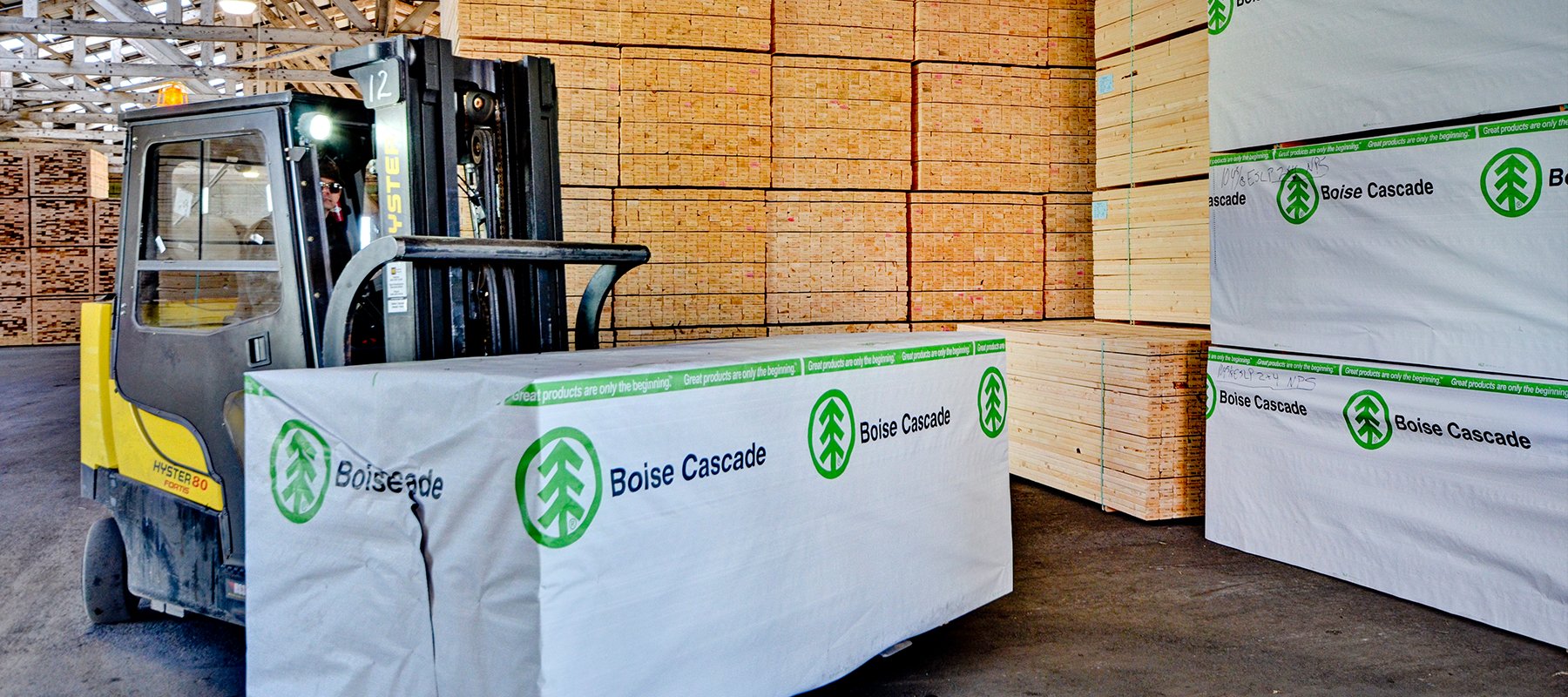
Boise Cascade has entered into an agreement with Woodgrain Millwork to sell its northeast Oregon lumber mills in Pilot Rock and La Grande and the particleboard operations in Island City. The planned transaction does not include Boise Cascade's plywood mill or the powerhouse and log utilization center, based in Elgin, OR.

Woodgrain is a manufacturer and supplier with a diverse product offering including moulding, door shop products, and window parts, headquartered in Idaho.

"The sale to Woodgrain allows us to further focus on our veneer-based engineered wood products and plywood businesses," said Mike Brown, senior vice president of operations, Boise Cascade Wood Products division. "Woodgrain is a family-owned company with a solid reputation in the industry. The products manufactured at these northeast Oregon facilities are a good fit with their business strategy."

"Being a fully integrated company in each step of our supply chain has become one of our core strengths as a company," said Kelly Dame, Woodgrain CEO. "Being able to grow the Woodgrain Lumber division is a key step in growing as a company. We are excited about the opportunity it offers."

The details of the agreement were not disclosed and the transaction is contingent upon the results of the due diligence process, which is expected to take approximately 60 days.

About Boise Cascade

Boise Cascade is one of the largest producers of engineered wood products and plywood in North America and a leading U.S. wholesale distributor of building products.

India is undergoing a major shift from plywood to MDF

India’s furniture market is undergoing a major shift with a move towards ready-made furniture and a rising preference for medium density fibre (MDF) over plywood in line with the global trends. Moreover, the culture of ready-made furniture is being accepted widely across India as we see in the case of IKEA. The growth rate of plywood today in the Indian market is about 8 to 9 per cent whereas the MDF business today is about 1700 crores, growing between 17 to 20 per cent per annum.  Continue reading "India is undergoing a major shift from plywood to MDF"

Russia to limit birch veneer logs exports from 2019

On July 17, 2018, Dmitry Medvedev, the Prime Minister of the Russian Federation, signed Regulation no. 836 "On Introduction of Temporary Quantitative Limitation on Birch Veneer Logs Export from Russia to Non-Eurasian Economic Union States." Continue reading "Russia to limit birch veneer logs exports from 2019"

Overview and recent trends of the Austrian sawmill industry

The timber markets showed a positive trend throughout 2017 and in the first half of 2018 in almost all markets. Austrian sawmills were able to react and increased sawnwood production by approx. 10% from 2015 to 2017. An approx. 3 % increase in exports was also able to be attained again compared to 2016. The investment climate is also strengthened by the positive forecasts and framework conditions. Investment is taking place both in the real net output and also in the expansion of drying capacities. Renowned architects have re-discovered wood as a building material. Spectacular buildings are currently being constructed from wood on a global scale – also using Austrian know-how.

Due to the damage events occurring without warning in Austria in the summer, it was possible to store domestic roundwood in an intensified manner for the first time in a long time in 2017.

Germany continued to be an important “driver” for the European market. However, Italy remains the largest export market – with a slightly positive trend compared to the previous year. There was a very high demand for packaging wood throughout Europe. China and the USA recorded the largest relative increase in exports. Glue-laminated and increasingly prefabricated timber products recorded Continue reading "Overview and recent trends of the Austrian sawmill industry"

Newsletter

Subscribe to our digital newsletter for your daily digest of essential news, views and analysis from the international wood industry delivered directly to your inbox.


0