Article archive

Japan targets Russia wooden houses market

Iida, a Japanese wooden house construction company, is targeting the Russian market. Setting it sight on Kazan, one of Russia's fastest growing cities due to its booming IT sector, the company is betting on its special structures to meet housing demands there, reports the NHK World-Japan.

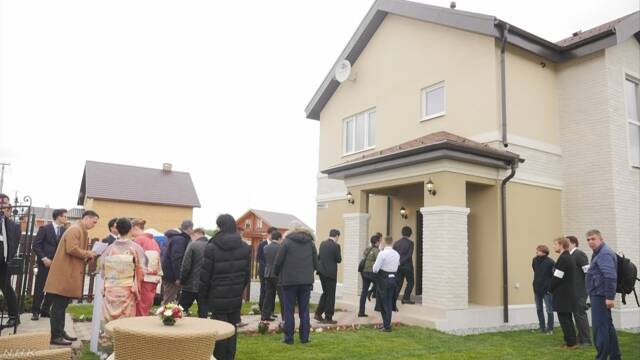
In June this year, the company launched an open house for a new model home -- a Japanese-style wooden house -- for the Kazan residents, attracting young families to visit and experience Japanese-style housing for the first time.

Iida is a major Japanese homebuilder back home, building houses using a traditional Japanese technique of putting together meticulously processed wood. The country’s dwindling population and falling housing demand in the future has prompted Iida to start looking outside of Japan and into Russia.

Iida Vice President Masashi Kanei sees unlimited demand for detached houses in Russia.

"The opportunity here is boundless,” he said.

Young people demanding bigger homes

Soviet-era concrete apartment blocks are common in Russian cities. After having their first child last year, 31-year-old Mikhail Raletin and his wife is planning to move his family to the suburbs.

They currently live in a 50 m2 one-bedroom apartment with a kitchen and dining room – considered a norm for Russian families. Mikhail is hoping to move into a bigger house soon though.

The region's economic growth sees surging demand for more spacious houses among young people in Kazan. The model Japanese home has therefore attracted 120 families within 3 days of opening.

For the Russian visitors seeing the house for the first time, the idea of a wooden house invited many questions and concerns.

" Wouldn't it get really cold here in the winter?" says a visitor. Temperatures in the region drop to minus 30 degrees Celsius in winter.

Houses in Russian suburbs are usually built out of bricks. The thickness of walls is therefore a key consideration, as many believe only bricks or blocks over 50 centimetres thick can provide the much-needed insulation.

Tatsuya Okawa, director of Iidasangyo Rus, a subsidiary of Iida, explains that wood can actually provide better insulation than concrete, giving the house double insulation. "With heating, this house will be 1.5 times warmer than the average Russian brick house," he says.

A visitor remarked, " The insulation does seem adequate, Japan's building skills are wonderful."

Adjusting to the Russian market

The biggest hurdle for Iida is the costs and pricing of the house. If built by Japanese builders using materials shipped from Japan, the house will cost about US$126,000. This is almost twice the average Russian brick house, which sells for about US$54,000.

To reduce the cost, Iida sourced materials in Russia, procuring timber from local forests and commissioned a local firm to process the wood into building materials.

Iida also demands very precise specifications,  requiring a margin of error of 0.5 millimetres or less. Russian firms working with Iida are expected to pay strict attention to measurements as wood of precise measurements are needed to build the airtight Japanese-style houses.

"Requests for such excellence inspired us to do better," Sergei Mamaev, the owner of a local timber-processing firm. "We are now working to achieve the same quality levels for our other products."

After the adjustments in sourcing and manufacturing, Iida is now able to put houses on the market for about US$90,000.

The entire package – reasonable pricing and good design -  is probably why the Raletin family ends up placing an order for a Japanese wooden house. Mikhail said that the space -- about 140 square metres -- and warmth sold him. "The house is well-designed and fits our lifestyle.”

Financing support

Financing a house in Russia is no easy task. With interest rates reaching almost 10 per cent, people rarely take out mortgages. Iida has been working with a Russian bank to cut the high interest rates for home buyers.

After talks with a local bank, it was agreed that new mortgage products will be created. SBERBANK Deputy Manager Ruslan Akhatov said, "We learned that its products are high quality. We are looking forward to doing business together."

In response, the state will provide subsidies for home purchases and other assistance.

Okawa says, "There are plenty of forests in Russia, but wooden houses are not so common. We hope to change this. We'd like the people of Russia to know how great wooden houses are."

Iida launched its subsidiary in Russia 2 years ago.

The Japanese builder now faces fierce competition from European rivals. Taking advantage of its unique skill set, it is in good form to carve out a niche in the tough Russian market.

EU demand for wood pellets to rise to 24 million tonnes this year; Italy and the UK the main consumers

The EU is the world’s largest wood pellet market, with consumption of about 22.7 MMT (million metric tonnes) of wood pellets in 2017. Based on the European Commission (EC) mandates and Member State (MS) incentives, the demand is expected to expand further to about 24 MMT in 2018. Future consumption will significantly depend on a range of market factors and EU Member State incentives and conditions.

While the EU produces about fifty percent of world production, EU demand represents about 75 percent of the market. In 2017, total EU consumption was about 22.7 MMT. In 2016, 43 percent was used residential heating, 35 percent for commercial power, 12 percent for commercial heating and 11 percent for combined heat and power (Source: AEBIOM). The major users of wood pellets in the EU are the United Kingdom, Italy, Denmark, Germany, Sweden, Belgium, France and Austria.

Residential Use of Pellets

Residential use for heating, about 45 percent of the total pellet market, fluctuates annually but is a relatively stable market compared to industrial heat and power generation. The demand depends on the winter temperatures and fossil fuel prices. The past two winters of 2016/2017 and 2017/2018 were relatively colder than the preceding four winters which is expected to have supported the use of wood pellets for residential heating. Medium-size use of pellets for energy generation by industries or public buildings such as hospitals and swimming pools is generally less dependent on weather conditions.

In Italy, Germany, France and Austria pellets are mainly used in small-scale private residential and medium-sized industrial boilers for heating. In some EU Member States, such as Sweden, Germany, Austria, France and Spain, household heating with biomass as input receives subsidies or tax deductions by the federal and local governments. In most countries, however, government funding is limited. Continue reading "EU demand for wood pellets to rise to 24 million tonnes this year; Italy and the UK the main consumers"

EU imports of tropical logs & sawnwood recover a little ground in the first half of 2018

After a downturn in 2017, the quantity of EU imports of tropical logs recovered a little ground in the first half of 2018. Imports of 53,300 MT during the first half of the year were 3% greater than the same period in 2017.

However, the value of tropical logs imported by the EU fell 3% to €27 million.

EU imports of tropical logs decreased from Congo, the leading supplier, falling 3% to 12,300 MT. There was also a large fall in EU log imports from Angola, from 3,800 MT in the first half of 2017 to negligible levels in the same period this year.

However, these losses were offset by rising imports from CAR (+59% to 10,200 MT), DRC (+19% to 10,100 MT) and Liberia (+20% to 3300 MT).

Most of the gain in EU imports of tropical logs in the first half of 2018 was concentrated in France (+21% to 20,700 MT) and Belgium (+23% to 13,200 MT). Imports of tropical logs in Portugal fell 25% to 8000 MT during the period.

5% rise in EU imports of tropical sawnwood

EU imports of tropical sawnwood increased 5% to 359,300 MT in the first half of 2018. Import value also increased, by 7% to €366 million.

Although imports continued to slide from Cameroon (-8% to 116,100 MT) and Côte d'Ivoire (-7% to 14,700 MT), this trend was offset by rising imports from Malaysia (+19% to 59,800 MT), Brazil (+4% to 47,700 MT), Gabon (+16% to 47,000 MT), Congo (+6% to 21,900 MT), Indonesia (+186% to 13,500 MT) and Ghana (+16% to 7,500 MT).

The rise in imports from Indonesia, which only allows exports of S4S lumber, may be partly due to alterations in the HS codes used to record imports from Indonesia following introduction of FLEGT licensing.

The rise in EU imports of sawnwood from Indonesia is offset by a similar decline in imports of mouldings from the country.

In the first half of 2018, tropical sawn hardwood imports declined 1% to 118,000 MT in Belgium, 18% to 24,800 MT in the UK, 27% to 16,100 tonnes in Spain, and 27% to 9,600 MT in Portugal.

China’s sawnwood imports continue to rise this year; import prices as well

China’s sawnwood imports in the first quarter of 2018 totalled 8.28 million cubic metres valued at US$2.39 billion, a year on year increase of 5% in volume and 16% in value. The average price for imported sawnwoods was US$288 per cubic metre, a year on year increase of 10%.

Of total sawnwood imports, sawn softwood imports rose 0.3% to 5.37 million cubic metres, accounting for 65% of the national total. The average price for imported sawn softwood imports was US$206 per cubic metre, up 8% on the same period of 2017.

Sawn hardwood imports grew 15% to 2.91 million cubic metres (35% of the national total sawn hardwood imports). The average price for imported sawn hardwood imports in the first quarter of 2018 was US$441 per cubic metre, up 7% on the same period of 2017.

Of total hardwood sawnwood imports, tropical sawnwood imports were 1.67 million cubic metres valued at US$662 million, up 24% in volume and 33% in value. The average price for imported tropical sawnwood was US$395 per cubic metre, up 7% on the same period of 2017.

Russian Segezha Group boosts wood pellets production

Segezha Group starts production of the wood pellets at the company’s Sokol Timber Company in Russia. According to the announcement, the pellet production ensures the full cycle process of processing the biomass of wood waste at the plant in Vologda. Continue reading "Russian Segezha Group boosts wood pellets production"

Croatia’s ban on oak lumber transport lifted

The transport restrictions for oak wood in Croatia which have the purpose of preventing the propagation of the oak lace infestation, were relaxed.

The order from June 2017 states that logs may not be transported with or without bark in Croatia or beyond, except to the nearest sawmill. Even oak seeds were only allowed to be transported within so-called seed zones.

Unofficially, the measure was meant to halt the enormous outflow of raw materials from Croatia to the EU countries.

The measure taken by the Minister of Agriculture, Tomislav Tolušić, caused a wave of positive reactions from representatives of the Croatian wood industry, as well as citizens who welcomed the ban and the halt of the long-standing export of valuable wood.

Of Croatia's total wood exports in 2016, which amounted to EUR 1.09 billion, it is estimated that almost a third relates to exports of raw materials, while the domestic wood industry had problems with the supply of raw materials for its production.

Although the Croatian forests were not selling the logs for exporters, there was unrivaled market turmoil because they did not control where the wood arrived, so false invoices were issued. Thus, oak logs went to Italy, Austria, Germany and Egypt.

Oak lumber transport was allowed with the condition of having a maximum moisture content of 20%. Saw-by-products were only allowed to be transported in closed holds.

The latter two provisions (Articles 6, 3 and 4) were canceled by an amendment to the order in May 2018 . Oak lumber may now again be transported inside and outside Croatia, regardless of the degree of drying. Sawing by-products may also be transported in open holds.

At the moment, no solution has yet been found for the actual problem, the spread of the oak lace bug and its effects on the oaks. No decision regarding the transport of oak logs has been announced. We will keep you updated about any further developments.

Overview of the current European wood pellet production capacities

With a production of about 14.3 MMT in 2017, about fifty percent of global production, the EU is the world’s biggest producer of wood pellets. In 2016, production dipped slightly mainly due to the relatively warm winter of 2015/2016. Compared to production plants in North America, plants in the EU are mainly small or medium-sized. Most of the main pellet producing countries have a sizeable domestic market for residential heating pellets. Recent growing demand for pellets has supported a further increase in domestic production. Exceptions are Latvia, Estonia and Portugal, which are producing mainly for export for use in large scale power plants abroad. Continue reading "Overview of the current European wood pellet production capacities"

Trump's tariffs on China- A big chance for Europe

The additional tariffs of the US government under President Donald Trump slow the Chinese growth by 0.1 to 0.2 percentage points, according to the German Munich-based IFO Institute. At the same time, US tariffs could improve Europe's bargaining position. "If tariffs increase from 10 to 25 percent towards the end of the year, then the braking effect is 0.3 to 0.5 percentage points. That is noticeable, but with Chinese growth of around 6.5% per year, the impact is manageable, "says the head of the Ifo Center for Foreign Trade, Gabriel Felbermayr.
"China has become much more independent of exports in recent years; that pays off now. But the trade war between the US and China significantly increases the global economic risks. "He adds appreciation to the dollar; that puts a strain on the emerging markets. And in China itself, some over-indebted companies would come under additional pressure.
At the same time, Felbermayr added: "Strategically, the US-China trade war is an opportunity for the EU to assert its own interests. Europe could become a big beneficiary, if China allows itself to be condemned within the WTO. The time in which Trump simultaneously acts against all trading partners should be over for now. As long as the spiral of trade war turns between Washington and Beijing, Europe is relatively safe. "
Competitors from China in the US and US in China will suffer more, and products from Europe could therefore gain market share, Felbermayr added. "But if European corporations produce in the US or China for the world market, then the costs rise for them too. For example, when Siemens uses electronic components from China in the USA. In addition, the new risks weigh on share prices worldwide. But for smaller European companies whose value chains are more regional, there are indeed new opportunities. "

Trump’s tariffs on China- A big chance for Europe

The additional tariffs of the US government under President Donald Trump slow the Chinese growth by 0.1 to 0.2 percentage points, according to the German Munich-based IFO Institute. At the same time, US tariffs could improve Europe's bargaining position. "If tariffs increase from 10 to 25 percent towards the end of the year, then the braking effect is 0.3 to 0.5 percentage points. That is noticeable, but with Chinese growth of around 6.5% per year, the impact is manageable, "says the head of the Ifo Center for Foreign Trade, Gabriel Felbermayr.

"China has become much more independent of exports in recent years; that pays off now. But the trade war between the US and China significantly increases the global economic risks. "He adds appreciation to the dollar; that puts a strain on the emerging markets. And in China itself, some over-indebted companies would come under additional pressure.

At the same time, Felbermayr added: "Strategically, the US-China trade war is an opportunity for the EU to assert its own interests. Europe could become a big beneficiary, if China allows itself to be condemned within the WTO. The time in which Trump simultaneously acts against all trading partners should be over for now. As long as the spiral of trade war turns between Washington and Beijing, Europe is relatively safe. "

Competitors from China in the US and US in China will suffer more, and products from Europe could therefore gain market share, Felbermayr added. "But if European corporations produce in the US or China for the world market, then the costs rise for them too. For example, when Siemens uses electronic components from China in the USA. In addition, the new risks weigh on share prices worldwide. But for smaller European companies whose value chains are more regional, there are indeed new opportunities. "

Subdued EU tropical timber imports in 2018

EU imports of tropical wood products have been subdued so far in 2018 with little sign yet of any rebound from the downturn in 2017.

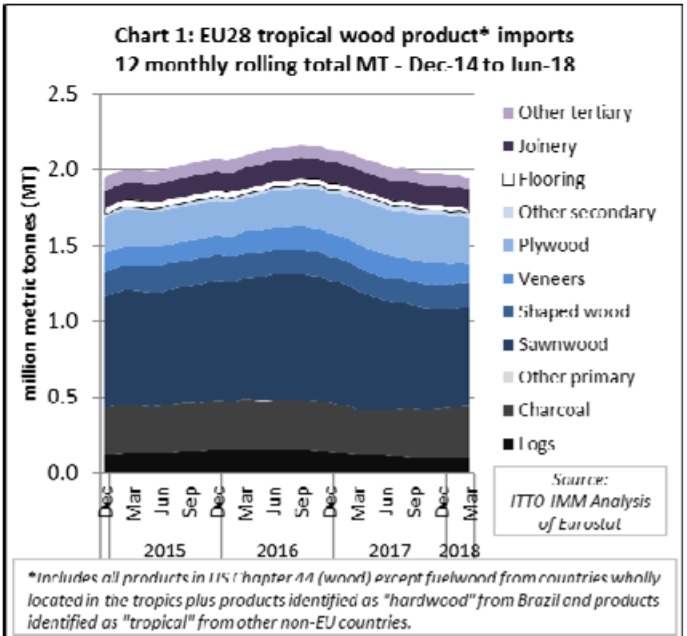
Chart 1 shows twelve monthly rolling total imports (to iron out seasonal fluctuations) into the EU of all tropical wood products listed in HS Chapter 44 (excluding fuelwood, wood waste and chips).

It shows that imports peaked at an annualised level of 2.17 million metric tonnes (MT) in September 2016, slipped to a low of 1.94 million MT in March this year and had recovered only slightly, to 1.98 million MT by June.

In total, the EU imported 1.06 million MT of tropical wood products in the first half of 2018, 1.6% more than the same period in 2017. The total value of EU imports of tropical wood products in the January to June 2018 period was €1.10 billion, 3% less than the same period in 2017.

Although there have been gains in EU imports of tropical sawnwood, charcoal, mouldings and joinery products this year, these have been offset by a large decline in imports of tropical veneers, flooring, and other tertiary products, and a more moderate decline in imports of tropical plywood.

Vietnam’s wood industry to benefit from US-China trade war

The trade war between the U.S. and China officially started on 6 July after the U.S. started imposing a 25 per cent duty on US$34 billion worth of Chinese machineries, electronics, and high-tech equipment imports. The Chinese government reacted immediately with matching tariffs on the same amount of U.S. exports to China.

The Trump administration also announced that they will slap a 10 per cent tariffs on additional US$200 billion worth of Chinese goods which could take effect after public consultations end on August 30, according to a statement from the US Trade Representative's office on July 10. The list of thousands of Chinese imports to be hit with the tariffs includes hundreds of food products, raw materials and consumer goods such as wood products and furniture.

Latest update on the trade war

The latest update on August 16, though, saw the U.S and Chinese governments announcing lower-level trade talks on the 22nd and 23rd of August to work on resolving the trade war. A nine-member delegation from Beijing, led by Vice Commerce Minister Wang Shouwen, will hold meetings with U.S. officials led by the Treasury undersecretary, David Malpass.

The list is massive and includes industrial goods and chemicals, consumer products, and wood products. If the list comes into effect, just under 50 per cent of all Chinese imports would be imposed with tariffs.

Wood products that will face duties include oak, beech, maple, ash, cherry, mouldings, rods, particleboard, various types of plywood, doors, charcoal, corks and stoppers, as well as wicker and bamboo baskets.

Furniture items include bedding, mattresses, car seats, wooden chairs, furniture designed for offices, kitchens, chandeliers and lamps. Wood pulp products and paper products are also on the list.

The proposed tariffs would be on top of the 25 per cent tariffs that the Trump administration has already implemented on US$50 billion of Chinese goods: $34 billion of which already took effect on July 6.

As Vietnam News reported, the Association of Vietnam Timber and Forest Product (Vietfores) and timber exporters said that close monitoring is necessary in order to respond and take measures actively.

Nguyễn Tôn Quyền, vice chairman of Vietfores, said that the export value of Vietnamese wood products to the U.S. market is relatively high- accounting for 30 per cent of the total forest export in the first six months of 2018, or US$4.4 billion. Quyền said right now, export numbers to the U.S. market remain stable and exporters had signed orders for this year.

Huỳnh Quang Thanh, chairman of Bình Dương Furniture Association cum chairman of Hiệp Long Furniture Company, said that trade tensions between the U.S. and China would not have an immediate impact on the export activities of Vietnam in general and particularly, the furniture industry of Bình Dương.

Economist: Vietnam can gain from the U.S.-China trade war

As reported by The Voice of Vietnam, Professor Pham Tat Thang, senior researcher at the Trade Research Institute at the Ministry of Industry and Trade, held the opinion that no one will win in the U.S.-China trade war, neither the two nations involved nor the world’s economy, but Vietnam can still benefit if it is ready to take full advantage of the situation.

The tariff war is a threat to the global economy as it goes against the global trend towards trade liberalisation while triggering escalating protectionism. It can result in a global economic slowdown, Thang explained.

Chinese products and projects will not be allowed to enter into the U.S. like before so Chinese government and enterprises are likely to find alternatives for them in neighbouring markets like Vietnam, he noted.

As Chinese exports decline, reducing its liquidity, demand for imports in China will also fall. Coupled with China’s escalation of trade barriers, it may hurt Vietnam’s exports to neighbouring countries, which have experienced a surge in recent years, explained the researcher.

However, Chinese products hit by high tariffs will lose their competitive edge in the U.S. and doors will open for similar goods from Vietnam. If Vietnam can take advantage of the situation, it can turn challenges into opportunities.

But Thang warned that Chinese exporters may find ways to disguise their origin of goods to avoid the U.S. tariffs, perhaps by faking that their products are originated in Vietnam, he said.

The economist urged Vietnamese enterprises to be aware of technical trade barriers in each foreign market, keep updated in related regulations and be ready to satisfy new requirements, as well as cooperate to help protect each other in order to survive the wave of protectionism in the global trade.

In 2017, China was the largest trade partner of Vietnam. The bilateral trade between the two sides was estimated at US$93.8 billion, of which exports to China totalled US$35.3 billion, up 60.6 per cent year-on-year, and imports from China reached US$58.5 billion, up 16.9 per cent year-on-year. Vietnam’s trade deficit with China was US$23.3 billion, down 17.4 per cent.

The U.S. was third in bilateral trade with Vietnam with US$50.7 billion, of which export values reached the highest level of US$41.5 billion, a year-on-year growth of 8 per cent, and import values stood at US$9.1 billion, up 4.9 per cent.

The German sawmill industry in a stronger position in 2018

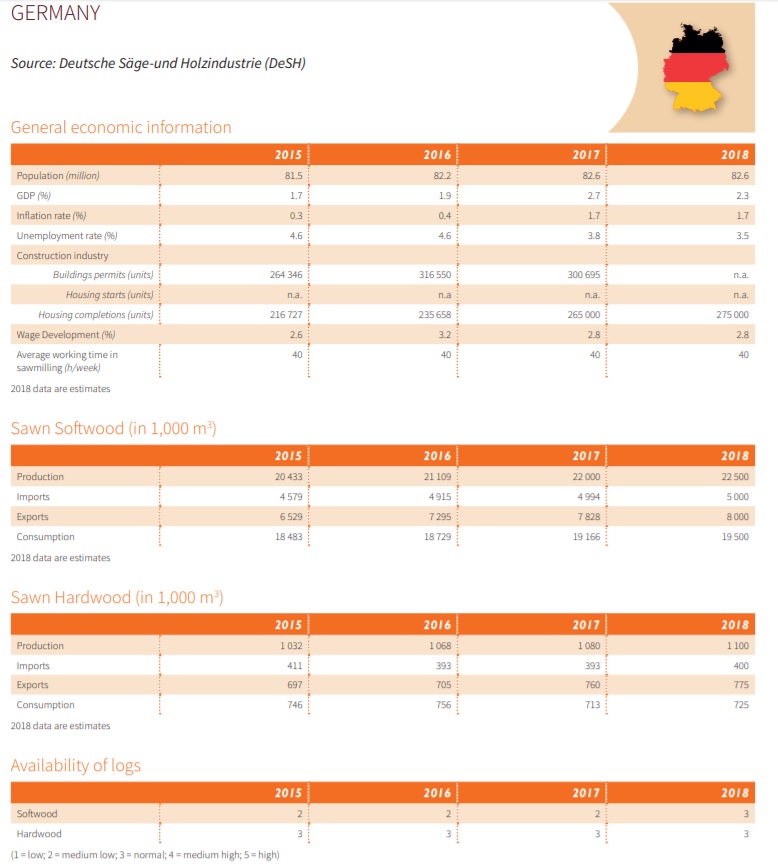
The German sawmill industry closed 2017 with a positive result. Above all the good 4th quarter dominated the annual result decisively. The overall economic environment continued to improve in 2017: gross domestic product (GDP) amounted to + 0.6 % in the fourth quarter (+ 0.9 % in the first quarter, + 0.6 % in the second quarter and + 0.7 % in the third quarter). Looking at 2017 as a whole, GDP grew by + 2.5 % over the previous year and was therefore higher than previously forecast. Europe also showed an improvement in the economy, which means that there is growth impulses from Germany and abroad.

Softwood

In Germany, demand for sawn timber from all important customer segments increased - the strongest growth was recorded in the fourth quarter. However, the development is strongly dominated by the revival of exports. Exports within Europe have risen slightly, while long-distance exports have risen strongly.

Domestic sales, like unit sales within the euro zone, were comparatively moderate at + 2.7 % and by far less dynamic than distance sales.

The increase in employment is remarkable. The number of employees rose by + 3.2 % in 2017 as a whole and by 4.4 % at the end of the year.

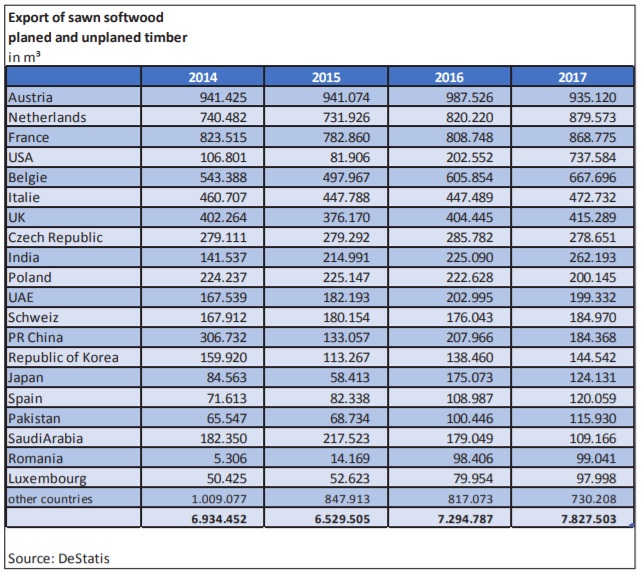
The export of sawn softwood companies has been greatly expanded in 2017. While deliveries within Europe developed very differently, i.e. were predominantly higher, Austria, the most important export partner, imported a little less in 2017.

Distance sales increased strongly, especially to India and the USA. By contrast, deliveries to the Levant region were down on the previous year.

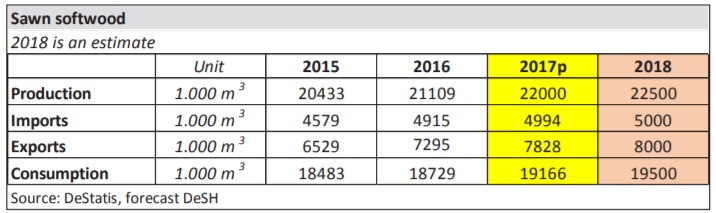
The balance for the softwood sawn timber market in 2017 will show a significant increase in sawn softwood production to 22 million m3 , an increase of 4 % over the previous year, with an above-average increase in planed timber production.

With imports remaining largely constant at approx. 5.0 million m3 , exports with an expected 7.8 million m3 (plus 7.3 %) made the significant increase in domestic production possible. In 2017, domestic consumption increased by only just over 2% to 19.1 million m3 and thus by approx. 500 thousand m3.

Raw wood market affected by storms

The raw wood market was affected by several storms (most recently the hurricane Friederike with approx. 8 million m3 of damaged timber). Processing, cutting and advancing are difficult due to soaked forest soils and have even been stopped in some cases. The persistently wet and barely passable forest soils became a real problem when supplying the sawmills.

The amount of damaged wood from the storms is taken up by the sawmill industry. In regional terms, there were slight quality-related price declines due to the volumes of storm timber, but at the same time this also entailed additional expenses for scheduling and cutting. This results in only marginal relief for the regionally affected farms.

Profit situation improved, but strongly increasing demands of customers

With increased production, a good export situation and little change in the raw materials/revenues situation, earnings improved slightly overall.

Further strongly increasing requirements come from the customers. The sawmill industry reacts with qualitative improvements and new or further developed products. The German sawmill industry benefits from the fact that the broad structure of the industry and the large product range can handle the differentiated demand in Germany.

Germany continues to be the largest consumer market for sawn softwood in Europe. This and the high standard of German companies is also a plus in exports - this is particularly important for a country that is one of the countries with the highest raw material costs worldwide.

The industry is now highly diversified, many companies are increasingly going into further processing, product refinement and are focusing on further developed products such as laminated timber and cross laminated timber. It also fulfills the increasing requirements of other customers such as packaging and pallets.

Residential construction was somewhat weaker again in 2017, but is characterised by high standards in timber construction with increasing market shares. This is strengthening sales to the construction sector.

Value added is increasing and has a positive effect on the development of the number of employees.

Outlook: Overall, a continued good overall economic development is expected for 2018 in Germany, but also in Europe. Activity in the construction sector, the most important customer of the sawmill industry, is expected to increase slightly. Significant impulses are expected from the packaging sector, especially for export packaging. Hopes are based on continued stable exports to Europe and an improvement in the Levant region. Special expectations are for exports to Asia, possibly the USA could also be a very interesting market again.

Hardwood

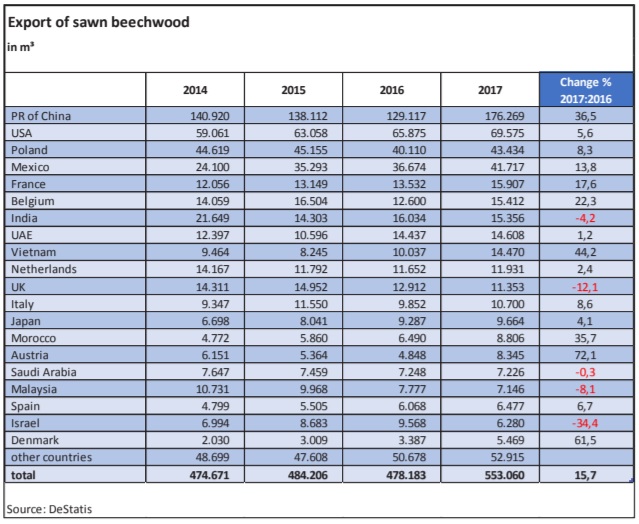
The hardwood market continues to develop steadily at a fixed level. Beech continues to have a stable domestic market. In particular, the export sector was able to achieve a significant increase in distance sales in 2017. China, by far the most important customer, again purchased significantly more beech in 2017.

The market for oak is again lively across all qualities and product ranges. Ash is currently still available in sufficient quantities, also from the necessary earlier uses caused by the ash dieback. There is a concern that in the following years considerably less ash will come onto the market.

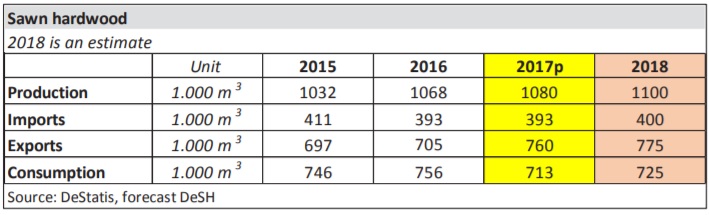
Due to the stable market trend and the good export situation, the production of hardwood lumber could be slightly expanded to 1.1 million m3 in 2018.

Continuing concern for hardwood sawmillers is the tendency in oak to increasingly offer the logs by submission.

This removes the raw material from the traditionally regionally supplying sawmillers with knowledge of the regional qualities and growth characteristics.

In beech, exports of raw beech wood again rose strongly.

Almost 800,000 cubic metres of beech logs were exported in 2017. In the meantime, a considerable proportion of the beech harvest is exported, often to distant countries. This raw material is no longer available to the domestic sawmill industry.

The bark beetle infestation is ravaging European forests

A bark beetle infestation is currently ravaging forests in Central and some Northern European countries. Reports from Germany, The Czech Republic, Austria, Switzerland and Sweden show that the volumes infested are in some countries or regions twice or even three times higher than some previous estimates for this year.  Continue reading "The bark beetle infestation is ravaging European forests"

China hits back with duties on US starting September 24; list of wood products updated

In response to US measures, China will overtax products imported from that country. The Chinese Government Customs Tariff Commission has specified it today. The taxes are valued at US $ 60 billion and include a long list of wood products. 

Initially, China had considered tiered retaliatory taxes ranging from 25% to 5% (25, 20, 10, 5). But as the US has decided for the time being only a surcharge of 10%, the Chinese have reduced their retaliatory taxes to 10 and 5%. In case the US passes 25%, China will line up.

Below, there is the list regarding the wood products imports affected by the tariffs.

Annex 1 list- tariff of 10%

  • 44012200 Non-coniferous wood chips or wood pellets
  • 44014000 Sawdust, wood waste and debris, unbonded
  • 44029000 charcoal
  • 44031100 Softwood logs treated with paints, stains, preservatives, etc.
  • 44032110 Pinus koraiensis and Pinus sylvestris var. mongolica with a cross-section of 15 cm or more
  • 44032130 Larch logs with a cross-section of 15 cm or more
  • 44032400 Other fir and spruce logs, section sizes below 15 cm
  • 44039100 Beech logs
  • 44039500 Birch logs with a cross-section of 15 cm or more
  • 44039700 poplar logs
  • 44039800 Beech logs
  • 44039980 Other unlisted temperate non-coniferous logs
  • 44039990 Other unnamed non-coniferous logs
  • 44050000 Wood and wood powder
  • 44071110 Thick boards of Pinus koraiensis and Pinus sylvestris, longitudinal sawing, slitting, and cutting, whether or not planed, sanded or Finger joint combination, thickness over 6mm
  • 44071120 Radiation-thickness sheet, longitudinal sawing, slitting, and cutting, whether or not planed, sanded or pointed Combined, thickness exceeds 6mm
  • 44071200 Thick plates of fir and spruce, longitudinally sawing, slitting, and cutting, whether or not planed, sanded or combined, thickness over 6mm
  • 44072910 Teak board, longitudinal sawing, slitting, planing, whether flattened, sanded or shackled, Thickness over 6mm
  • 44072930 Bologne sheet, longitudinal sawing, slitting, planing, whether flattened, sanded or smashed, Thickness over 6mm
  • 44072990 Other listed tropical wooden boards, longitudinally sawing, slitting, cutting, whether flat or sanded Or finger joints, thickness over 6mm
  • 44079100 Alder board, longitudinally sawed, slitted, and cut, whether or not planed, sanded or smashed, Thickness over 6mm
  • 44079200 Beech wood board, longitudinal sawing, slitting, planing, whether flattened, sanded or finger knot Combined, thickness exceeds 6mm
  • 44079600 Birch wood, longitudinal sawing, slitting, and cutting, whether or not planed, sanded or smashed, Thickness over 6mm
  • 44079910 Other mahogany sheets, whether or not flattened, sanded or finger jointed, thicker than 6mm, but tax Except for tropical mahogany plates listed in No. 4407.2940
  • 44081090 Other softwood sheets, no matter whether planed, sanded or shackled, not exceeding 6mm in thickness
  • 44083119 Crimson red willow wood, light red red willow wood and Basil red willow wooden veneer with thin plates, Whether it is planed, sanded or finger jointed, the thickness does not exceed 6mm, with plywood and many more Except for laminate
  • 44083919 Other listed tropical wooden veneer sheets, whether flattened, sanded or shackled, Thickness not exceeding 6mm, except for multi-layer boards such as plywood
  • 44083990 Other thin sheets of other tropical tropical wood, whether flattened, sanded or shackled, Thickness does not exceed 6mm
  • 44089021 Other veneer for non-coniferous wooden plywood, whether flattened, sanded or shackled, Thickness does not exceed 6mm
  • 44089091 Other temperate non-coniferous wood, whether or not flattened, sanded or fingered, not exceeding thickness Over 6mm
  • 44092990 Other non-coniferous wood of continuous shape on one side or side, whether flat or sanded Or finger joint
  • 44101100 wooden particle board
  • 44101200 Wooden Oriented Strand Board
  • 44101900 Wooden other material board
  • 44111211 Medium density wood fibreboard with a thickness not exceeding 5 mm, density exceeding 0.8 g per cubic centimeter, Unmachined or covered
  • 44111319 Medium density wood fibreboard with a thickness of more than 5 mm but not exceeding 9 mm, with a density exceeding each cubic +/- 0.8 g, machined or covered 701
  • 44111419 Medium density wood fibreboard with a thickness of more than 9 mm, density exceeding 0.8 g per cubic centimeter, Machined or covered
  • 44111421 Medium density wood fibreboard with a thickness of more than 9 mm radiated, with a density exceeding every cubic centimeter 0.5 grams, but not more than 0.8 grams per cubic centimeter
  • 44111429 Other medium-density wood fibreboards with a thickness exceeding 9 mm, density exceeding 0.5 g per cubic centimeter, But not more than 0.8 grams per cubic centimeter
  • 44111499 Other medium density wood fibreboards of more than 9 mm thickness, machined or covered
  • 44119210 Other wood fibreboards, density exceeding 0.8 g per cubic centimeter, not machined or covered
  • 44119290 Other wood fibreboards, density exceeding 0.8 g per cubic centimeter, machined or covered
  • 44119390 Other wood fibreboards, density exceeding 0.5 g per cubic centimeter, but not exceeding every cubic centimeter 0.8 grams
  • 44119410 Other wood fibreboards, density exceeding 0.35 g per cubic centimeter, but not exceeding every cubic centimeter 0.5 g
  • 44121019 Other bamboo plywood made only of thin plates
  • 44123100 Other plywood with at least one surface layer made of tropical wood veneer
  • 44123300 Other at least one surface layer is the following non-coniferous wood: eucalyptus, ash, and Cyclobalanopsis (mountain) Oak, birch, cherry, chestnut, elm, elm, pecan, horse chestnut, elm, Maple, eucalyptus (oak), sycamore, poplar, locust, gooseberry or walnut veneer Plywood
  • 44123410 Other at least one surface layer is temperate non-coniferous wood (non-coniferous wood of sub-heading 4412.3300) Outside) thin plywood
  • 44123490 Other at least one surface is a non-needle not specifically listed in subheadings 4412.3300 and 44234410 Plywood made of leaf wood veneer
  • 44123900 Other upper and lower layers are plywood made of softwood veneer
  • 44129410 Wood core plywood, side slat core plywood and slat core plywood, at least one surface is non- Coniferous wood
  • 44129910 At least one other wooden veneer with non-coniferous wood
  • 44129999 Other wooden multi-layer boards
  • 44130000 Fortified wood
  • 44151000 wooden boxes and similar packaging containers; cable reels
  • 44152090 Other wooden pallets, box pallets and other loading boards; other wooden pallets
  • 44170090 Other wooden tools, tool holders, tool handles, brooms and brushes for body and handle; wooden shoes Boots and hoes
  • 44181090 Other wooden windows, French-style (floor) windows and their frames
  • 44182000 Wooden doors and their frames and thresholds
  • 44186000 Columns and beams
  • 44187500 Other assembled multi-layer flooring
  • 44189900 Other wood products for construction
  • 44201011 Woodcut
  • 44201090 Other wooden figurines and other decorations
  • 44209090 wooden boxes and similar items; non-floor wooden furniture
  • 44211000 wooden hanger
  • 44219110 Bamboo garden sign, garden stick, ice fruit stick, tongue-pressing piece and similar disposable products
  • 44219990 Other unlisted wood products

Annex 2 list – tariff of 10%

  • 44011200 Non-coniferous wood firewood
  • 44012100 Softwood chips or wood pellets
  • 44031200 Non-coniferous logs processed with paints, stains, preservatives, etc.
  • 44032240 Douglas fir logs with a cross-section of 15 cm or less
  • 44032290 Other pine logs, with a cross-section of 15 cm or less
  • 44032300 Fir and spruce logs, with a cross-section of 15 cm or more
  • 44032600 Other softwood logs, with a cross-section of 15 cm or less
  • 44039960 North American hardwood hardwood logs
  • 44042000 Non-coniferous wood hoops, rafters, stakes, wooden sticks and the like, wood strips
  • 44071130 Douglas fir thick sheet, longitudinal sawing, slitting, cutting, whether flattened, sanded or finger knot Combined, thickness exceeds 6mm
  • 44071190 Other thick planks of pine wood, longitudinally sawing, slitting, cutting, whether or not planing, sanding or fingering Combined, thickness exceeds 6mm
  • 44071900 Other coniferous wood thick plates, longitudinal sawing, slitting, cutting, whether or not planed, sanded or combined, thickness over 6mm
  • 44079400 Cherry wood board, longitudinal sawing, slitting, planing, whether flattened, sanded or smashed, Thickness over 6mm
  • 44079500 Ash wood board, longitudinal sawing, slitting, cutting, whether flattened, sanded or smashed, Thickness over 6mm
  • 44079980 Other temperate non-coniferous wood panels, longitudinal sawing, slitting, cutting, whether flattened or sanded Or finger joints, thickness over 6mm
  • 44079990 Other wood panels, longitudinal sawing, slitting, cutting, whether or not planing, sanding or fingering, Thickness over 6mm
  • 44081019 Decorative coniferous veneer, whether or not flattened, sanded or finger-jointed, not exceeding the thickness 6mm, except for multi-layer boards such as plywood
  • 44089011 Other wooden veneer sheets made of multi-layer boards, such as plywood, whether or not planed, sanded or Finger joint, thickness not exceeding 6mm
  • 44089012 Veneer for non-coniferous wooden veneers, whether or not flattened, sanded or finger-jointed, not thick More than 6mm
  • 44089099 Other wood, whether flattened, sanded or finger jointed, not exceeding 6mm in thickness
  • 44111219 Medium density wood fibreboard with a thickness not exceeding 5 mm, density exceeding 0.8 g per cubic centimeter, Machined or covered
  • 44111229 Other medium density wood fibreboards not exceeding 5 mm, density exceeding 0.5 per cubic centimeter Gram, but not more than 0.8 grams per cubic centimeter
  • 44111311 Medium density wood fibreboard with a thickness of more than 5 mm but not exceeding 9 mm, with a density exceeding each cubic 0.8 g cm, unmachined or covered
  • 44140010 Fluffy frame, photo frame, picture frame and similar products
  • 44140090 Other wooden picture frames, photo frames, picture frames and the like
  • 44160090 Other wooden vats, buckets, pots and other wooden hoops and their parts, including buckets
  • 44187900 Other assembled floors
  • 44199090 Other wooden tableware and kitchen utensils
  • 44219190 Other unlisted bamboo products

Annex 3 list – tariff of 5%

  • No wood related products in this list.

Annex 4 list – tariff of 5%

  • 44032140 Douglas fir logs with a cross-section of 15 cm or more
  • 44032500 Other coniferous logs, with a cross-section of 15 cm or more
  • 44069100 Impregnated coniferous railway and tramway sleepers
  • 44079300 Maple (Maple) sheet, longitudinal sawing, slitting, planing, whether flattened, sanded or combined, thickness over 6mm
  • 44079700 Poplar sheet, longitudinal sawing, slitting, planing, whether flattened, sanded or smashed, Thickness over 6mm
  • 44079930 North American hardwood wood board, longitudinal sawing, slitting, planing, whether flattened, sanded or combined, thickness over 6mm
  • 44089019 Other sheets for wooden veneers, no matter whether planed, sanded or finger jointed, not exceeding the thickness 6mm, except for multi-layer boards such as plywood
  • 44092910 Other non-coniferous flooring strips
  • 44109019 Other similar wood particle board
  • 44119429 Other wood fibreboards, density not exceeding 0.35 per cubic centimeter, machined or covered
  • 44191100 Bamboo cutting boards, cutting boards and similar boards
  • 44209010 mosaic wood

Ghana’s half year wood exports show positive growth

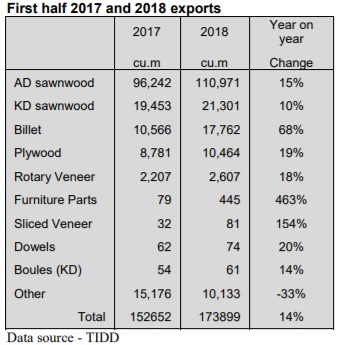
Ghana exported a total volume of 173,899 cu.m of wood products during the first half of 2018 and earned Eur 103 million according to data from the latest, but as yet unpublished, Ghana Timber Industry Development Division (TIDD) export report. For the first half 2018 the volume of exports grew almost 14% while the value of exports expanded 24%.

Nine out of the 17 wood products exported recorded positive growth in the first half of 2018 as against the 2017 figures. The table in the picture shows the details.

Exports of furniture parts registered the highest pace of increase (x 6 times) followed by sliced veneer to regional markets which more than doubled year on year.

The volume of plantation logs (billets) plus air and kilndried sawnwood accounted for 86% of total export volumes in the first half of 2018.

The TIDD report also indicates that the country’s primary product exports were 17,762 cu.m, secondary wood product exports amounted to 152,064 cu.m and tertiary wood products were 4,072 cu.m.

The species exported in terms of volume were plantation teak (47%), rosewood (10%), wawa (6%), papao/apa (5%) and ceiba (5%). The main markets were India, China, Italy, Vietnam and Germany.

Togo and Burkina Faso were the leading destinations for regional sales shipped overland (mainly plywood). Côte d'Ivoire and Burkina Faso were the only two regional countries buying sliced veneer.

Chinese Q1/2018 imports of logs up 14% in volume and 25% in value

China’s log imports in the first quarter of 2018 totalled 14.38 million cubic metres valued at US$2.753 billion, a year on year increase of 14% in volume and 25% in value.

The average price for imported logs was US$191 per cubic metre, a year on year increase of 9%.

Of total log imports, softwood log imports rose 9% to 9.45 million cubic metres, accounting for 66% of the total. The average price for imported softwood logs was US$138 per cubic metre, up 8% on the same period of 2017.

Hardwood log imports grew 25% to 4.93 million cubic metres in the first quarter (34% of the national total log imports). The average price for imported hardwood logs in the first quarter of 2018 was US$293 per cubic metre, up 5% on the same period of 2017.

Of total hardwood log imports, tropical log imports were 2.65 million cubic metres valued at US$837 million, up 22% in volume and 28% in value.

The average price for imported tropical logs was US$316 per cubic metre, up 5% on the same period of 2017.

New Zealand and Russia main sources of logs

New Zealand was the main log supplier to China in the first quarter of 2018 accounting for 25% of total log imports. Imports from New Zealand totaled 3.66 million cubic metres in the first quarter of 2018, a year on year increase of 16%.

The second ranked supplier of logs was Russia at 2.96 million cubic metres, accounting for about 21% of the national total. In the first quarter of 2018 a year on year decrease of 1% was recorded for log imports from Russia.

Average prices for imported logs from New Zealand rose 12% to US$142 per cubic metre, average prices for imported logs from Russia declined 1% to US$124 per cubic metre in the first quarter of 2018.

Indonesia to improve FLEGT licensing procedures

Indonesia has taken several measures in recent months to improve procedures relating to FLEGT licences — the export licences that attest to the legality of EU-bound timber and timber products.

The changes are part of a process of continuous improvement that is jointly overseen by the EU and Indonesia, and which is providing important lessons for other countries that aim to issue FLEGT licences.

In November 2016, Indonesia became the first country to be able to issue FLEGT licences through a Voluntary Partnership Agreement with the EU. Since then, it has issued more than 50,000 FLEGT licences to EU-bound shipments with a combined value of nearly USD 2 billion.

The FLEGT licensing system applies to a broad range of products. It is implemented by 25 independent licensing authorities and covers 109 ports, 2,123 exporters and thousands of small and medium enterprises that supply products for export. In this complex context, and given that Indonesia is the first country to ever issue FLEGT licences, some teething problems with the new licensing system were to be expected.

Some issues have related to mismatches between ‘HS codes’ — which indicate product type — on FLEGT licences and other shipping documents. Other document discrepancies were mainly caused by exporters applying for FLEGT licences before the consolidation of their shipments because of transport delays and limited time to apply to licensing authorities.

However, in the 18 months since FLEGT licensing began, Indonesia largely addressed these issues through consultation, training and outreach led by the Ministry of Environment and Forestry. Good communication between FLEGT competent authorities in EU member states and officials in Indonesia contributed to the rapid identification and step-wise resolution of issues.

Research by the EU FLEGT Facility and Indonesia’s Licensing Information Unit shows there has been significant improvement among large and medium companies in terms of FLEGT licences being issued after the consolidation of consignments. This reduces discrepancies significantly.

Small and medium exporting enterprises are also improving but more work is needed. The FLEGT licensing authorities are now more proactive and better able to accommodate licensing requests outside of normal working hours.

Despite the improvements, the paper-based FLEGT licensing system is prone to errors in data entry. Indonesia and the EU have therefore started to explore electronic licensing as a potential alternative approach.

China seeks more investments in New Zealand’s forestry and timber processing industry

The largest ever New Zealand forest industry delegation to China's showcase Global Wood Trade Conference has made the case for more investment in New Zealand forestry and timber processing industry.

Forest Owners Association President Peter Weir has told delegates at Chongqing that more timber processing in New Zealand, before export, reduced the overall energy and carbon emissions required to produce and transport the finished product.

"There's also a particular opportunity for primary processing of pruned logs in New Zealand rather than the current approach of mixing quality logs with sap-degraded logs and a subsequent loss of value by both parties," Peter Weir said.

New Zealand Forestry Minister, Shane Jones, told the conference New Zealand is heavily reliant on access to foreign capital and also has a need to substantially increase its forest reserves.

He said this is behind the government creating a more streamlined process for investment in forestry using foreign capital and this creates a special opportunity for those interested in working with New Zealand. He invited potential investors to consider connecting with the New Zealand industry representatives.

This invitation from Shane Jones comes at a time when there is increasing concern in China with the implications of the US tariffs.

Numerous Chinese speakers at the conference referred to the trade war with the US and that they anticipated this to be a long drawn-out battle. Commentators at the conference believe the impact of increased US tariffs could cost China 1.5% of its GDP.

On the positive side, potential Chinese investors acknowledged the US trade problems were an opportunity to strengthen other trading partnerships and thus welcomed the invitation from Shane Jones.

New Zealand forest growers and processors report constructive engagement with members of the China Timber and Wood Products Distribution Association (CTWPD) - the hosts of the Chongqing Conference. The CTWPD has thousands of members across China and there has been interest from the Chinese members in both the opportunities to invest in forests and processing in New Zealand, as well as securing additional wood supply. A number of the CTWPD group have expressed interest in a reciprocal visit to New Zealand later in the year to follow up on some of these options.

Stora Enso considers layoffs at Varkaus sawmill, citing competitiveness issues and rising log prices

Stora Enso starts employer-employee negotiations at its LVL Mill and Sawmill in Varkaus in Finland.

In addition to reorganisation, the employer is considering eliminating completely up to nine jobs. Also, Stora Enso is considering laying off all staff at the LVL Mill and Sawmill for a period of up to three months. The units employ 110 people in total.

According to a company's announcement, additional pressures on the competitiveness of the units was caused by the rapidly rising log prices this year. The plants have done a number of measures to improve cost and production efficiency, which will continue according to the company.

Negotiations will begin next Thursday and will last for at least two weeks.

The Varkaus LVL plant and sawmill belong to Stora Enso's Wood Products division. The plant produces LVL as well as planed and sawn timber. The annual capacity is 150,000 cubic meters of sawn timber, 10,000 cubic meters of planed products and 70,000 cubic meters of veneer.

Vietnam’s wood products exports expected to rise by US$ 1 billion this year

Forestry sector in Vietnam is expected to reach its export target of US$9 billion a month ahead of schedule, due to the large shipments during the first eight months of the year.

About $696 million worth of timber and wood products were shipped abroad in August, raising the eight-month figure to $5.6 billion – up 12.6 per cent year-on-year, according to the Vietnam Administration of Forestry (VNForest).

As reported by Vietnam News, the US, China, Japan and the Republic of Korea were the main markets of the Vietnamese wood sector during the period. Timber and wood product exports are hoped to earn $9 billion in 2018, up $1 billion from last year, giving the sector a good chance to achieve the target a full month early.

The sharp fall in wood imports from Laos and Cambodia was thanks to a prohibition of exporting wood from planted forests, along with efforts by the Vietnamese Government and businesses to control wood imports from the two neighbouring countries.

Meanwhile, exports to some countries with strong wood industry laws like Brazil, Chile and the US have grown well.

In the short term, the country will press ahead with diversifying wood import sources, while in the long term, it will develop timber forests to ensure supply for domestic production.

Newsletter

Subscribe to our digital newsletter for your daily digest of essential news, views and analysis from the international wood industry delivered directly to your inbox.


0