
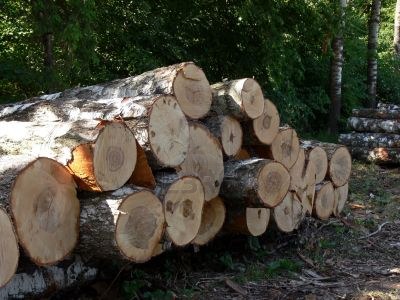
On July 17, 2018, Dmitry Medvedev, the Prime Minister of the Russian Federation, signed Regulation no. 836 "On Introduction of Temporary Quantitative Limitation on Birch Veneer Logs Export from Russia to Non-Eurasian Economic Union States." Continue reading "Russia to limit birch veneer logs exports from 2019"
Article archive
Prices for Brazilian logs, sawnwood and plywood during August

Latest prices for Brazilian logs, sawnwood and plywood prices as of 16-31 August, 2018. Continue reading "Prices for Brazilian logs, sawnwood and plywood during August"
Overview and recent trends of the Austrian sawmill industry

The timber markets showed a positive trend throughout 2017 and in the first half of 2018 in almost all markets. Austrian sawmills were able to react and increased sawnwood production by approx. 10% from 2015 to 2017. An approx. 3 % increase in exports was also able to be attained again compared to 2016. The investment climate is also strengthened by the positive forecasts and framework conditions. Investment is taking place both in the real net output and also in the expansion of drying capacities. Renowned architects have re-discovered wood as a building material. Spectacular buildings are currently being constructed from wood on a global scale – also using Austrian know-how.
Due to the damage events occurring without warning in Austria in the summer, it was possible to store domestic roundwood in an intensified manner for the first time in a long time in 2017.
Germany continued to be an important “driver” for the European market. However, Italy remains the largest export market – with a slightly positive trend compared to the previous year. There was a very high demand for packaging wood throughout Europe. China and the USA recorded the largest relative increase in exports. Glue-laminated and increasingly prefabricated timber products recorded Continue reading "Overview and recent trends of the Austrian sawmill industry"
Stable lumber prices in the US
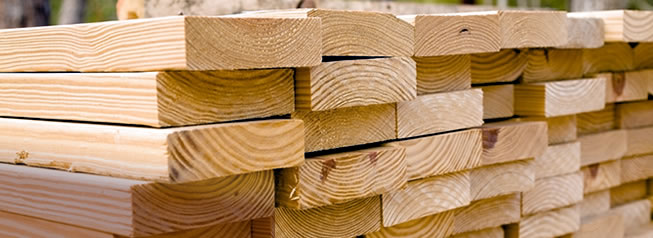
US framing lumber traders who had anticipated a stronger pace of sales coming out of the Labor Day holiday were disappointed. Sales of dimension and studs were slow across North America, and many prices softened.
In a number of markets, what little demand that emerged was focused on upper grades. Sales to truss manufacturers were steady, and prices were mostly firm to higher. However, the overall pace was lackadaisical. The Random Lengths Framing Lumber Composite Price was unchanged.
| This Week Sep 7 |
Last Week Aug 31 |
Year Ago 2017 |
|
| Random Lengths Framing Lumber Composite Price* | $453 | $453 | $410 |
| KD Western S-P-F #2&Btr 2x4 R/L Mill Price | 478 | 480 | 406 |
| KD Eastern S-P-F #1&2 2x4 R/L, delivered Great Lakes | 565 | 574 | 496 |
| Green Douglas Fir Std&Btr 2x4 R/L (Portland) | 440 | 445 | 460 |
| Southern Pine (Westside) #2 2x4 R/L | 465 | 453 | 370 |
| KD Coast Hem-Fir #2&Btr 2x4 R/L | 460 | 460 | 430 |
| Ponderosa Pine (Inland) #2&Btr 1x12 R/L | 775 | 775 | 675 |
| * Weighted average of 15 key items | |||
Random Lengths Panel Market Report
Structural panel prices fluctuated mildly amid lackadaisical trading. OSB sales were lackluster in all producing regions following the Labor Day holiday. Most traders cited extended vacations and back-to-school distractions for the market’s quiet tone. Southern Pine plywood sales were steady, but slower than many traders anticipated. Mills fell back on order files and resisted counters. Activity in western Fir plywood was slow coming out of the long weekend, surprising traders who expected an active start to September.
| (f.o.b. mill prices) | This Week Sep 7 |
Last Week Aug 31 |
Year Ago 2017 |
| Random Lengths Structural Panel Composite Price* | $471 | $471 | $483 |
| Southern (west-east) 15/32-inch 3-ply rated sheathing plywood | 443-475 | 440-475 | 450-475 |
| Southern (west-east) 15/32-inch 4-ply rated sheathing plywood | 448-480 | 445-480 | 455-480 |
| Western 1/2-inch 4-ply rated sheathing plywood | 487 | 492 | 509 |
| North Central 7/16-inch Oriented Strand Board | 345 | 345 | 419 |
| *Weighted average of 11 key items | |||
One of Russia’s largest MDF plant almost completed

Altailes, one of Russia’s largest woodworking enterprises, is finishing construction of large-scale woodworking combine in Pavlovsk. Pavlovsk is a rural locality in the Russian Altai Krai and Altailes' new project will specialise in the production of MDF and HDF, creating one of Russia's largest MDF mills. Continue reading "One of Russia’s largest MDF plant almost completed"
Canadian Pinnacle buys large stake in Alabama wood pellet plant
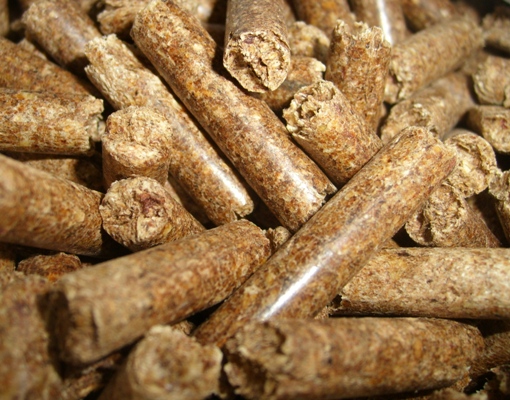
Canadian industrial wood pellet manufacturer Pinnacle Renewable Holdings Inc announced last week it has agreed to buy a 70% stake in a production facility in the US state of Alabama.
British Columbia-based Pinnacle will buy the majority stake from diversified land resources firm The Westervelt Company, which will retain a 30% interest in this industrial wood pellet production facility, located in Aliceville. The buyer did not say how much it will pay for the controlling interest, but noted it will fund the purchase through a draw on its credit line and cash on hand.
The agreed acquisition is expected to help set up a platform for Pinnacle's future growth in the US Southeast, according to CEO Robert McCurdy. "Geographic diversification of our asset base provides us with enhanced flexibility to cost-effectively allocate supply to our customers in Europe and Asia," he added.
The Aliceville plant has the capacity to produce about 270,000 tonnes of industrial wood pellets a year, with 210,000 tonnes of that committed to “a major European utility” under a long-term off-take contract. The remaining production volume will be sold through the company's contracted backlog of long-term, take-or-pay deals.
The facility has now entered into long-term wood fibre supply deals for residuals with a number of large local sawmills. Westervelt's Moundville sawmill in Alabama will continue to be an anchor supplier.
Westervelt is as of now ensuring the increase in production at the facility, and the two companies are partnering to optimise asset configuration, distribution logistics and fibre supply.
Run-rate earnings before interest, tax, depreciation and amortisation (EBITDA) per metric ton is expected to match the parameters of Pinnacle's other production facilities. The capital cost of the plant will also be within the company’s target range of 4.0x to 5.5x run-rate EBITDA.
The asset purchase transaction is seen to close in early October 2018 and is expected to provide accretive free cash flow per share on an annualised basis.
World’s tallest timber building completed in Norway

Norway has completed the frame of the world's tallest timber building, which is being lauded for being environmentally friendly and fire resistant.
The Mjos Tower, which is situated near and named after a lake located about 100km north of Oslo, saw its last beam hoisted by a crane this week.
At 85.4 m, it has 18 floors.
Promoters say that using wood, a renewable material, makes it possible to reduce carbon dioxide (CO2) emissions compared to concrete, which is the primary material of residential buildings in cities.
"Building with wood is helping us breathe in a better world," said businessman Arthur Buchardt, who added he began the project after being inspired by the Paris agreement on climate change.
Constructors say the building is fire resistant as it uses glue laminated timber that will only burn when continuously exposed to flames.
When it opens in March 2019, the tower will surpass its 49m counterpart Treet (tree in Norwegian), which previously held the record of the world's tallest wooden building and is located in the western city of Bergen.
The Mjos Tower is to hold apartments, an indoor swimming pool, a hotel, offices, a restaurant and common areas.
It was originally supposed to be 81m high, but a roof-top pergola added another 4.4m.
This addition makes it slightly higher than the HoHo tower (84m), currently being constructed in Vienna.
This Austrian building has a hybrid structure combining wood (76 per cent) and other materials, unlike the Mjos Tower.
Other, even more ambitious timber projects have been proposed, including the Baobab tower in Paris (120m), though the municipal authorities have turned that one down.
Chinese retaliatory tariffs might hit hard the US hardwood industry

The Chinese tariffs on US hardwood exports might have a major impact on the hardwood sector in the US. On August 3rd, the Chinese Ministry of Commerce released a proposal for tariffs ranging from 5% to 25% on various goods including hardwood lumber and logs.
The duties would equally cover both low-grade and grade hardwood logs and lumber. However, the impact would be far greater on the grade side since the vast majority of U.S. hardwood exports to China is grade material. Continue reading "Chinese retaliatory tariffs might hit hard the US hardwood industry"
Latest prices for Indian imported wood products

Demand for Indian imported logs has risen on the back of firmer domestic demand.
However, over the past months the US dollar has strengthened against the rupee which has pushed up landed costs. To maintain a viable business prices in the local market have risen 8-10 %. Importers are still struggling to maintain trade without the full backing of the banks which are still not offering full credit facilities.
Continue reading "Latest prices for Indian imported wood products"
UK softwood lumber imports drop sharply in H1/2018

UK's softwood lumber imports from the European Union countries seem to start being affected by Brexit, as shown in the results for the first half of 2018.
During January-June 2018, the imports reached 2,484 million m3 of softwood lumber, down from 2,457 million m3 in the same period of 2017.
While Latvian shipments to the UK grew by 5%, to 448 thousand m3 in the mentioned period, Sweden and Finland sent -14% and -8%, respectively, less softwood lumber. Also, exports from Ireland to the UK went down by -1%, to 164 thousand m3.
|
January-June 2017 | January-June 2018 | Change in % | |||
| EUROPEAN Union Total in m3 | 2,661,104 | 2,457,744 | -8 % | |||
|
1,374,585 | 1,187,600 | -14 % | |||
|
428,344 | 448,762 | 5 % | |||
|
383,547 | 352,489 | -8 % | |||
|
165,765 | 164,223 | -1 % | |||
|
135,902 | 164,013 | 21 % | |||
|
172,961 | 140,657 | -19 % |
Roundwood prices continue to rise in Finland
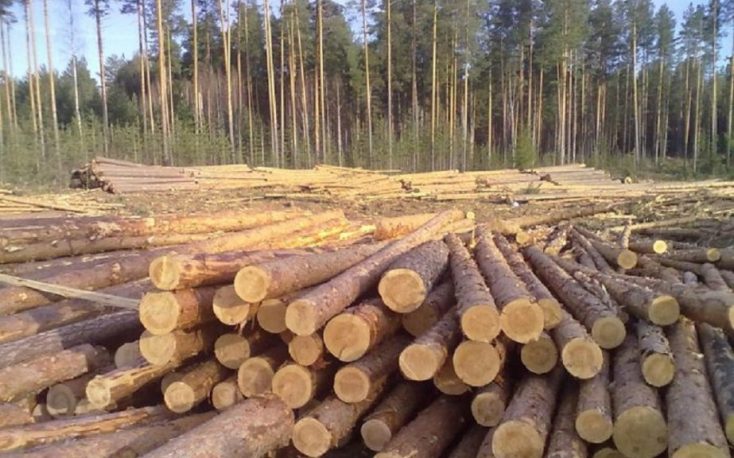
The stumpage price level continued to rise in June. Compared to the previous month, the real stumpage price level rose a little more than one per cent.
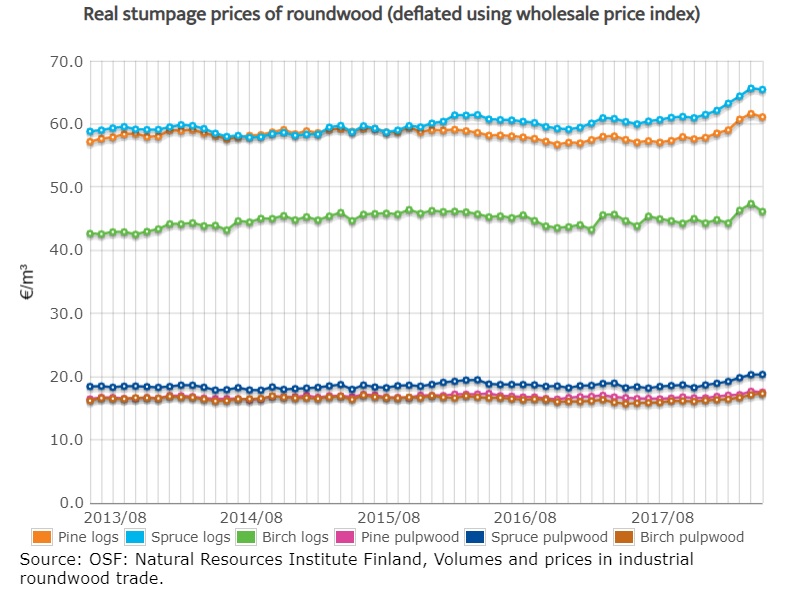 In June, the price paid in standing sales for pine logs was EUR 61.6 per cubic metre, while spruce logs fetched EUR 65.7 per cubic metre. The stumpage price for pine pulpwood was EUR 17.7 per cubic metre, and the price for spruce pulpwood was EUR 20.3 per cubic metre. Standing sales accounted for 91 per cent of roundwood purchased from private forests.
Roundwood purchases from non-industrial private forests included in the statistics amounted to 4.6 million cubic metres in June. In the first half of the year the roundwood trade ended up being 24.6 million cubic metres. In January–June the roundwood trade has been brisker than the year before.
| Average roadside prices of sales from non-industrial private forests in Finland (in EUR/m3) | ||||
| June 2017 | May 2018 | June 2018 | Change in % June 2017/June 2018 | |
| Logs | ||||
| Pine | 58.10 | 60.70 | 61.60 | +5.16% |
| Spruce | 60.80 | 64.40 | 65.70 | +8.05% |
| Pulpwood | ||||
| Pine | 17.20 | 17.10 | 17.70 | +2.90% |
| Spruce | 16.70 | 19.80 | 20.30 | +21.55% |
Välinge’s owner acquires Croatian veneer producer

Välinge's mother Pervanovo has bought the Croatian veneer producer Furnir Otok doo from its owner Jozo Jovic. Woodura is a multi-layer flooring based on veneer, wood dust and polymer, which is pressed under high pressure.
Furnir Otok is located in the eponymous village in north-eastern Croatia, and thus in the Spacva forest, one of the most important oak-growing areas in Europe. The company has a long-term contract with the Croatian State Forests Hrvatske Šume.
Furnir Otok started veneer production in 2011. At present, 7.5 million square meters of veneer are produced each year. The main customer is the European furniture industry. The production capacity is twice as high, at 15 million square meters. The company employs 130 people and generates a turnover of 10 million euros.
Following the acquisition, the company will be renamed "Bjelin Otok" and will continue to produce for existing customers. First of all, production is to be raised to the level of 15 million square meters of capacity. Another line will then increase capacity to 20 million square meters. The additional veneer quantities flow into the Woodura production.
In 2016 Pervanovo acquired the Croatian company Bjelin d.o.o. with production sites in Ogulin and Bjelovar. Bjelin d.o.o. has long-term supply contracts with Croatian forest comprising large quantities of oak. The Ogulin parquet plant has been restructured and the capacity has been increased from 0.4 to 2.0 million m2. New equipment has been installed in new buildings and the product range has been extended to oiled and lacquered conventional parquet planks and strips for herringbone installations. The industrial land area in Ogulin has been extended from 140,000 to 470,000 m2 and land works for a new major Woodura factory in Ogulin have started.
In Bjelovar a new factory building will be completed at the end of this year and new equipment will be installed for production of top layer lamellas based on fresh cutting technology. The oak lamellas are supplied to the Ogulin parquet factory but also to several wood flooring producers in Europe.
The Bjelovar and Otok plants will be coordinated.
French wood pellet producer orders second ClassiSizer from Dieffenbacher

Biosyl, which operates in the field of renewable energy from biomass and the production of wood pellets in France, has accepted its second ClassiSizer from Dieffenbacher. Biosyl owns one of the country’s largest pellet plants in Cosne-Cours-sur-Loire, about 200 kilometres south of Paris.
Ordered in 2017, the newly accepted ClassiSizer provides Biosyl with a capacity of more than 10 t/h b.d. The unit can handle heterogeneous raw materials, various chips dimensions and different wood species. Depending on the machine configuration, either dry, wet or both materials can be processed. The flakes produced by the ClassiSizer can be dried by a drum or a belt dryer in the downstream production process. Biosyl began operating its first ClassiSizer from Dieffenbacher in 2013.
“We were very satisfied with the performance of the first machine and therefore ordered the second one in 2017,” said Biosyl owner Antoine De Cockborne. “Our expectations were met. The new ClassiSizer works exactly like it should and together they make for twice the fun.”
In total, Dieffenbacher has delivered four ClassiSizer units to France in the last five years.
Softwood lumber cheaper in Austria

Softwood lumber prices in Austria have overall dropped slightly in July. Compared with June, only the upper price limits of edged boards and boards with 28mm+ thickness have moved upwards.
All other prices have remained stable or decreased by one euro.
Compared to the previous month of last year, the prices of squared timber I / II and 28mm+ boards have increased. All other lumber assortments are being traded cheaper by between EUR 1-3.
| Softwood Lumber Spruce/Fir | Jul. 2017 | Jun. 2018 | Jul. 2018 | Change Jul. '17 to '18 € / cbm EXW |
| Edged Boards, 0-IIIa, 23 mm + | 244-253 | 242-252 | 241-253 | -3/- |
| Rough boards in fixed dimensions, 18-22 mm | 240-252 | 240-250 | 240-250 | 0/-2 |
| Squared timber, standard dimensions, I/II, 4-6 m | 220-227 | 224-228 | 223-228 | +3/+1 |
| Stock squared timber, II/III | 165-171 | 163-171 | 163-171 | -2/- |
| Boards, III-IV, 8-16 cm, 4-6 m | 157-163 | 154-162 | 154-162 | -3/-1 |
| Boards, III-IV, 8-16 cm, just 4 m | 159-166 | 158-165 | 157-164 | -2/-2 |
| Boards, III/IV, 23 mm, 4-6 m | 160-166 | 158-165 | 157-165 | -3/-1 |
| Boards, III/IV, 28 mm +, 3-6 m | 164-174 | 168-175 | 167-176 | +3/+2 |
Global exports of lumber to China enter a slower phase

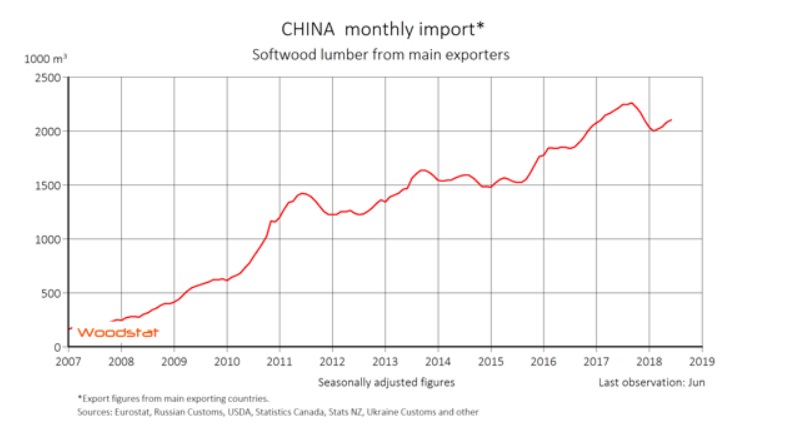 The export of softwood lumber to China from leading exporting countries worldwide amounted to approximately 2.31 million m³ in June (-2% compared to 2017).
The export totaled 12.7 million m³ during January-June (-3% compared to 2017). The trend line for the softwood lumber import in 2018 is below the corresponding period in 2017.
During January-June Russia exported 8.43 million m³ of softwood lumber to China (+5%) and Canada exported 2.26 million m³ (-20%).
The Russian market share in the Chinese lumber market is increasing at a record high level. The 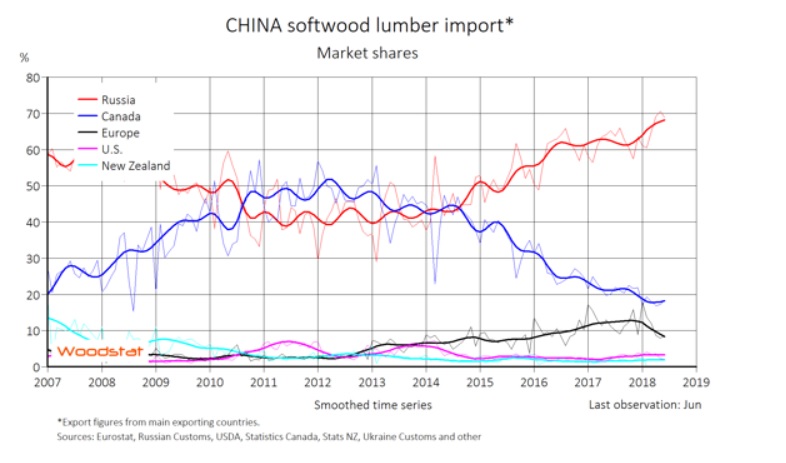 smoothed line for the Canadian market share is at a very low level for the country. As shown in the chart, there is a strong correlation between the Russian and Canadian market share. The market share trend for the leading exporters in Europe is decreasing. Note that these are smoothed series that result in lagging trend lines that do not reflect major changes in individual months.
Overview and potential of the Polish sawmill industry

Poland is one of the European countries with a high forest potential. In terms of forest area it is sixth in the European Union, in terms of raw material resources fourth, and in terms of wood removals fifth. This has a strong influence on the wood processing industries, closely related to forestry, in terms of their development and competitiveness not only on domestic market, but also on international markets.
The wood processing industries are important for the development of the entire Polish economy. The wood industry and its branches generate 0.6% of gross domestic product in Poland (2016), manufacture 2.8% of total production of industry (3.3% of manufacturing) and create 2.7% of industry’s gross added value (3.6% of manufacturing). Those branches are made up of more than 32 thou. companies (2017), of which almost 93% employ less than 10 persons, and little more than 1% 50 and more persons. The wood industry accounts for 2.8% of sold production of the entire Polish industry and for 3.2% of sold production of manufacturing. Continue reading "Overview and potential of the Polish sawmill industry"
Timberlink plans massive upgrades at its Australian sawmills

Timberlink has approved a AUD 100 million (71,8 million USD) upgrade program to its Australian sawmills. This investment will see the total processing capacity of the Australasian sawmilling company increase by over 15%.
According to the announcement, the investment will secure over 1,350 direct and indirect jobs in regional Australia for years to come while supporting the residential housing sector with increased timber supply.
In Tarpeena, South Australia, the investment will lead to the installation of a completely new saw line, stacker and edger, all with the latest leading-edge technology, coupled with additional contraflow and batch kilns for drying timber. Major site infrastructure changes including upgrades to roads and storage facilities will also be undertaken.
At Timberlink’s Bell Bay site in Tasmania, new planer mill equipment will be installed along with a state-of-the-art contraflow kiln. Site infrastructure will be improved, including a new internal road system designed to improve safety outcomes and support the increase in site activity.
The AUD 100 million investment program will take place in stages over the next 3 years and will build on
previous capex investments that have taken place in both mills over the past 5 years.
David Brand, Timberlink’s Chairman and CEO of investment management firm New Forests, commented:
“This is a substantial re-investment in the Timberlink mill facilities and continues to demonstrate the strong recovery of the Australian forestry sector under institutional investor ownership. Timberlink has become a leading wood products business, and I expect it will continue to innovate and grow, creating new manufacturing jobs in regional areas, while increasing the supply of timber in Australia.”
A total of 290 additional jobs are anticipated during the construction phase of the AUD 100 million program.
Timberlink will continue discussions with the Tasmanian, South Australian, and Federal Governments, seeking their funding support for further enhancements related to these business expansion programs.
About Timberlink:
The company is a leading Australasian timber products manufacturing business. The business has three sawmills at Bell Bay (Tasmania), Blenheim (New Zealand) and Tarpeena (South Australia) that manufacture plantation structural pine products. The business is owned by investment funds managed by New Forests, a sustainable real assets investment manager headquartered in Sydney.
Trends and developments of the European sawmill industry in 2018

During the third EOS Board Meeting of 2017 held in October 2017, the Board Members expressed an interest in defining the European Sawmill Industry structure. There was a feeling that the industry is undergoing change and that old assumptions could be dispelled as a result of structural changes in the market. That hunch proved correct: sawmilling in 2018 is not was it was twenty or ten years ago. Many sawmills are more and more involved in value-adding activities and many larger sawmills are getting more export-oriented.
The EOS Secretariat was tasked to survey the EOS Members by submitting a set of questions which have been answered either in written form or in a phone call.
The countries which participated in this information collection are Austria, Belgium, Denmark, Finland, France, Germany, Latvia, Norway, Romania, Sweden, Switzerland.
Key data
There were almost 34,000 sawmills in the EU28 in 2016 (plus around 250 in Switzerland, and 700 in Norway) – down from around 40,000 in 2010. According to Eurostat, out of 34,000 sawmills around 29,250 are classifiable as micro enterprises, around 4,250 are classifiable as small enterprises, around 630 are classifiable as medium enterprises, and around 60 are classifiable as larger enterprises.
Sawmilling in 2018: first evidence
While there are some sawmills which process both hardwood and softwood logs, most are specialized in the processing of either softwood or hardwood species. Based on the latest available data (2017), the EOS members produced around 80 million m3 of sawn softwood and 5.5 million m3 of sawn hardwood. Thus, sawn softwood production accounts for around 93.5% of the total EOS production, while sawn hardwood production accounts for the remaining 6.5%. In general, hardwood sawmills tend to be smaller than softwood sawmills. Continue reading "Trends and developments of the European sawmill industry in 2018"
Efforts in Europe to increase use of lesser-known timber species

Efforts to increase uptake of lesser-known species have come not just from the industry, but also from NGOs and the FSC, notably FSC Denmark and Netherlands.
One importer acknowledged that ekki and greenheart’s all round durability and technical characteristics, notably their resistance to abrasion and marine borers and promise of service life up to 60 years in salt and fresh water, made them difficult to beat. However, said an importer, often these species are specified through tradition or for convenience in associated works alongside ekki and greenheart projects where their properties are not needed.
“Specifying timber more in ‘fit-for-purpose’ terms, with mixed species allowed, would lead to development of a more diverse timber trade, in turn supporting sustainable forestry, improving prices and fully utilising sawmills’ capacity in producer countries,” said a company spokesperson.
Among species importers said they were highlighting for marine construction included basralocus, opepe, okan, eveuss and massaranduba.
Since launching its STTC-backed lesser-known timber species website in 2016, FSC Denmark also reports increased visitor traffic. Prominent on the site are case studies of marine applications of such varieties as bilinga, massaranduba and basralocus.
In the UK there is also a 25-year public/private partnership project, the Pevensey Bay Sea Defence scheme, to evaluate a range of tropical species, including purpleheart and eveuss, alongside plastic composite.
Specialist in the field, Dr John Williams, principal consultant (materials and structures) at international environmental consultancy RSK, believes there is considerably more scope for developing the range of tropical hardwoods used in marine applications to the benefit of the timber industry and the forest.
“As the STTC concluded in its report on Suriname and the potential of its lesser used species, if we can use more of this material, responsibly sourced, it adds to the value of the forest and will provide an incentive for sustainable management,” he said.
What is needed to achieve this, however, is more testing and performance data, especially strength testing of timber for sea defences. Dr Williams has worked with Portsmouth University on accelerated trials for marine timber abrasion and shipworm resistance. He is also involved in research in developing alternative proofs, to the European standard D class system for timber structural strength, with a paper set for industry consultation once complete.
Research requires funding, however, and Dr Williams suggested that more should come from the timber industry.
He also maintained that now is the time to act, particularly, due to growing concerns about marine plastic pollution, with one competitor potentially disadvantaged.
“The industry has to provide the data to make it straightforward for specifiers, such as local government, to choose timber for this work. If it isn’t and given the level of competition in the market, there may come a point where they lose patience with wood and, for instance, order Norwegian granite for rock armour instead,” he said.
“Timber has a huge opportunity here, but it needs a joined up, collective effort to be realised.”
Japan: New power plants to skyrocket imports of wood pellets after 2020

Demand of wood pellet in Japan is sharply increasing. Import of wood pellets is about six times higher than in 2013 and domestic production is 9% more than 2013. The reason is the large biomass power generation facilities, which use wood pellet as a fuel.
Import of wood pellet in 2017 reached 510,000 tons, 46% more than 2016 while domestic production was about 120,000 tons, 0.5% more.
In 2013, total supply of wood pellets was about 190,000 tons in which the share of imports was 43%. In 2015, the share of imports surpassed domestic supply, while in 2017 the share of imports is of 80%. Continue reading "Japan: New power plants to skyrocket imports of wood pellets after 2020"

