Article archive

Canfor to acquire Elliott Sawmilling in Estill, South Carolina for US$110 million

Canfor Corporation has entered into an agreement to purchase Elliott Sawmilling Co., Inc. located in Estill, South Carolina for a purchase price of US$110 million, which includes normalized working capital, company announced.

The purchase price represents a 4.3 times EBITDA multiple based on Elliott’s twelve months trailing EBITDA.

The transaction will be completed in two phases with 49% being acquired on closing and 51% being acquired one year later. Elliott has a production capacity in excess of 210 million board feet and the sawmill consists of both large and small log lines.

“We are thrilled to welcome the employees of Elliott to the Canfor team. Elliott has an excellent management team and produces high quality products that will align well with Canfor’s high-value product mix. Nash Elliott will continue as the General Manager after the transaction is completed,” said Don Kayne, President and Chief Executive Officer of Canfor. “The purchase of Elliott will further expand our production capacity to meet the growing demand of our customers.”

The transaction is expected to close in the first half of 2019 and is subject to confirmatory due diligence, completion of certain transaction documents and other customary closing conditions.
Lower sawlog prices in Russia, Brazil and Eastern Europe in the 2Q/18

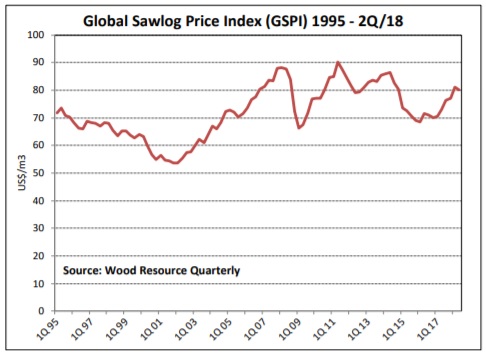
The Global Sawlog Price Index (GSPI) fell by 1.4% from the 1Q/18 to the 2Q/18. This was the first quarter-over-quarter decline since the 4Q/16. Sawlog prices fell on all continents (in US dollar terms) except for North America, where prices in the 2Q/18 were 3.0% higher than the previous quarter and up 13.5% from the 2Q/17.
Most of the price increases in North America over the past year have occurred in Western US and Western Canada, while log prices in Eastern Canada and the US South have stayed quite stable during the same time period.
In the Western US, sawlogs prices rose sharply during 2017 and early 2018 but came to a halt in late spring when prices slightly declined. With limited interruptions in harvesting operations and declining log exports in the first half of the year, log supply was sufficient in the summer, which eased the consistently upward price pressure seen over the past two years. Prices are likely to continue downward from their high levels seen the second half of 2018 because of the weakening demand for softwood lumber in the US.
The biggest price declines for sawlogs from the 1Q/18 to the 2Q/18 occurred in Russia, Brazil and Eastern Europe. In the Baltic States, sawlog prices fell about three percent quarter-over-quarter in the 2Q/18 after having increased by more than 20% over the past two years, reports the Wood Resource Quarterly.
Although Russian softwood sawlog prices continued their four-year upward trend in Rouble terms in the 2Q/18, the country had their largest quarter-to-quarter decline in US dollar terms in two years because of the strengthening dollar. In the 2Q/18, average prices in both the Northwestern provinces and in Siberia were down to the same level seen in the 2Q/17.

US softwood lumber prices dropped by 21% since June

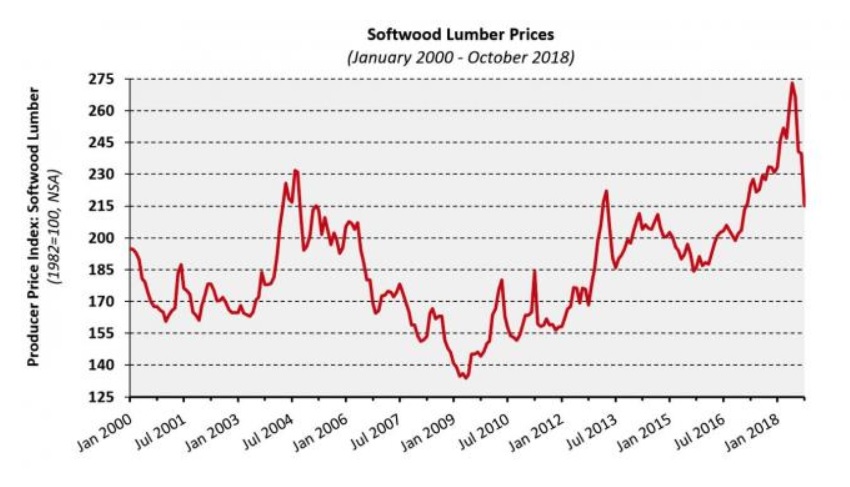
In October, prices for softwood lumber in the U.S. dropped 10.3% - the largest decline since May 2011.
The producer price index for softwood lumber has fallen 21.2% since setting the cycle and all-time high in June. Even after the decrease, however, the index currently sits just 4.7% lower than the prior-cycle high set in 2004, reported the National Association of Home Builders (NAHB).
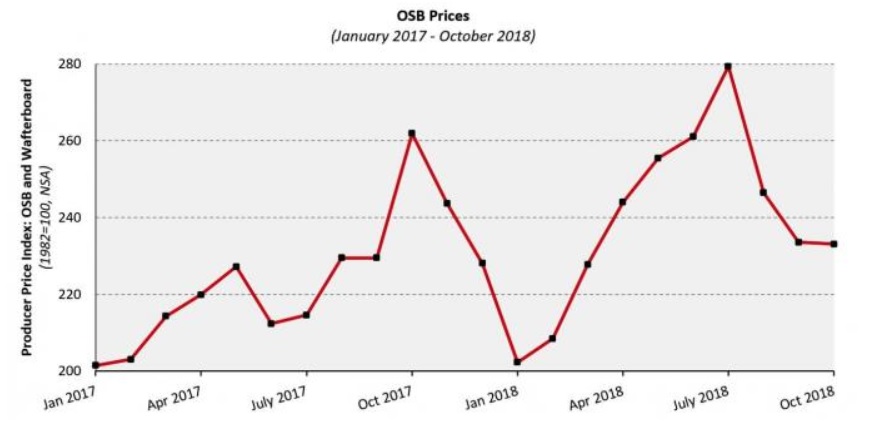
The final demand price index for OSB has followed a path similar to that of softwood lumber over the last three months.
Since climbing 38.1% in the first seven months of 2018, OSB prices have fallen 16.6%. The price index for OSB is now 15.2% and 15.7% higher than it was to start 2018 and 2017, respectively.
Residential construction goods input prices increased 0.4% in October and have now risen 7.5% over the last twelve months. The index decreased only twice during that period, by 0.1% and 0.5% in December 2017 and August 2018, respectively. Year-to-date residential construction goods input price increases in 2018 (+5.6) continue to outpace the increase during the same period in 2017 (+2.9%).

Pinnacle posts record wood pellet volumes in Q3 report

Canadian wood pellet producer Pinnacle Renewable Energy increased its third-quarter revenues 6.4 per cent compared to 2017 numbers, and shipped a record 421,000 metric tons thanks to a 4.7 per cent same-facility production volume increase, the company stated in its Q3 report.

"Our 4.7 per cent same-facility production volume increase in Q3 2018 compared to the same period last year, reflects strong production performance despite a challenging environment. Our operations in the quarter were impacted by the record level of forest fires in B.C., rail disruptions and Entwistle facility commissioning issues. With the fire season now over, and our Entwistle storage silo now complete, we expect to realize higher production volumes and lower costs in the fourth quarter," CEO Robert McCurdy said.

"The fourth quarter will also be highlighted by initial production volumes from our new Smithers, B.C. facility and our recently acquired production facility in Aliceville, Alabama, in the important Southeast U.S. fibre basket. During 2018, we will have added 795,000 metric tons of run-rate capacity and we will be well positioned in 2019 to deliver from our nine production facilities," he said.

Here is a snapshot of Pinnacle's outlook from the report:

On Oct. 15, Pinnacle closed the acquisition of a 70 per cent interest in an operating industrial wood pellet production facility located in Aliceville, Ala., from The Westervelt Company, a diversified land resources company, at a purchase price of approximately U.S. US$37.1 million. Westervelt retained a 30 per cent interest in the Aliceville Facility. Run-rate EBITDA per MT is expected to be in line with Pinnacle's other production facilities and the capital cost of the Aliceville Facility, inclusive of the capital spending program, will be within the Company's target range of 4.0x to 5.5x run-rate EBITDA. Pinnacle and Westervelt are currently undertaking a US$10 million capital spending program to improve safety, product quality and plant efficiencies, with 70 per cent of such costs being attributable to Pinnacle.

Pinnacle expects initial pellet production at the Smithers Facility to commence in the middle of November 2018 as the company completes construction.

As a result of the impact on production volumes and costs of CN rail disruptions, record B.C. forest fires, and the Entwistle Facility commissioning issues outlined above, Pinnacle has revised its estimated Adjusted EBITDA range for Fiscal 2018 from $61 to $65 million to $57 to $60 million. The company has now completed the storage silo, improved the quality of the inbound fibre, and advanced the commissioning curve of the Entwistle Facility. The company expects improved performance at the Entwistle Facility in November and December of 2018.

China cuts import tariffs on wood products to 5.4% from 6.6%; trade war with US continues to impact markets

A recent government announcement effective November 1st, 2018 states that China has reduced import tariffs on more than 1,500 products to lower the average import tariff to around 7.8%. Import tariffs on wood and paper products will be decreased to 5.4% from 6.6% which will help wood-based panels and other related imports to grow in China.

China-US Trade dispute update

The trade war between China and United States continues to impact markets.

During the first half of 2018 U.S. wood products made up:

  • 13% of China’s softwood log imports; was 54% in 2017
  • 2% of China’s softwood lumber imports; was 38% in 2017
  • 7% of China’s hardwood log imports;
  • 21% of China’s hardwood lumber imports.

China wood imports overview

Chinese imports of Russian softwood lumber have been rising steadily since this February when imports hit the highest in May (1,590,000 m3) and maintained at the level of 1,500,000 m3 in August; Imports of Canadian softwood lumber on the other hand maintained 350,000 m3 each month from June to August but decreased 29% in August to (327,000 m3) compared to the same month last year.

Logs and lumber inventory at Taicang, Wanfang and Meijing ports hit a new low in August (802,000 m3) which decreased consistently since this March, but winter and Chinese New Year inventory volume at all ports will be on the rise based on previous trends. Import volumes of total logs and lumber fluctuated at reasonable curves and achieved 8,814,000 m3 in August, the second highest month so far in 2018.

Sharp rise in EU imports of Russian and Brazilian plywood

The output of plywood imports to Europe showed an important improvement in the first nine months of 2018. In value, imports grew by 5%, from the same period of 2017, with the top three sources of plywood showing mixed results: imports from Russia rose sharply by 13% (see table below); those from China only slightly by 3%, while those from Brazil went up by 28%. Indonesia and Chile were on the 4th and 5th place in the top 5 EU plywood imports countries. 

It seems that the European appetite for Russian plywood is continuing its growing pace as in last years, mostly due to the weakness of the Russian rouble against the euro and other EU currencies. A third of the Russian birch plywood goes to Germany, Latvia and Italy.

Continue reading "Sharp rise in EU imports of Russian and Brazilian plywood"

Russia might temporarily ban the export of roundwood to China

Russia can temporarily restrict roundwood exports to China due to the issues of forest reproduction and destruction, Minister of Natural Resources and Environment Dmitry Kobylkin said during the ‘government hour’ at the Federation Council (upper house of parliament) on Wednesday.

"China is the main market of roundwood exports (from Russia). I told the (Chinese) minister that if we do not bring matters under control in the near future, particularly from the Chinese side, we will completely suspend lumber exports to China," he said. "I am not saying that it should be done but it probably has to be done for a certain period of time," Kobylkin told Russian Federation Council Speaker Valentina Matviyenko answering the question when the problem of illegal logging and export would be solved in Russia.

According to the minister, the construction of seed-production facilities in Russia at China’s expense is one of the ways to solve the problem. "I told Chinese colleagues - let’s build 10-20 seed-production facilities on the Russian territory using your money. If you need forest, make sure it is reproduced," he explained.

"The answer is not accepted," Matviyenko said. "We are expecting a program, any program of strict, serious measures. Believe me, neither China nor anyone will help us if we do not bring matters under control," she stressed.

Belgium: Average price list for standing timber in autumn – winter 2018

Average price list for standing hardwood and softwood species in Belgium's forests for this autumn and winter.

List of prices for standing timber set by National Federation of Forestry Experts A.S.B.L.

Preliminary remarks.
The arrows next to each price range indicate the price evolution against the prices set in the previous period of time.
These prices are suggested:
1. For normal harvesting conditions (flat ground or inclinated slightly, easily accessible, without any harvesting process related complications).

2. For the normal market conditions (payment deadlines, sale charges, caution, harvesting period).

3. For the lots of sufficient volume
Softwood :
- prices are based on the wood volume calculated over bark.
- wood must be of good quality, few knots, straight, with the acceptable degree of tapering, exempt of decay etc
- For fir, the prices are ginve for les prix sont présentés pour des
Thinning for the categories 20-39, 40-59, 60-69, 70-89
add 10% to the prices of wood from final felling areas, for the categories 60-69, 70-89
Final felling, for the categories 90-119, 120-149, 150-179, 180 and +

- For other softwood the prices are preserved for the wood harvested from the thinning areas. For final felling wood add 10 %

- Major lots(> 1000 m³) are respectively sold at a higher prices than smaller volumes

- For the windfall, it is indicated to apply discounts. The amount of discount is quite variable and depends on the circumstances.
Hardwood :
- the prices are given for the entire logs.
- the price intervals are given for a particular lot depending on the percentage of the special quality wood (for example,colour, sawing, peeling, redwood goods, etc...). For the precious/rare species (oak, cherry, walnut...) the prices can be be determined only by means of thorough analysis of each separate butt log.
Firewood
Upper price range limit concerns smaller lots sold to private actors
Important : prices widely vary depending on the regions, conditions (proximity to major agglomerations, accessibility, relief, wild vegetation, forest scattering, ...) and cutting quality (tree crowns – coppice wood - saplings- hardwood proportions).

AVERAGE PRICE FOR STANDING TIMBER (euro/m³) Autumn-Winter 2017

HARDWOOD
Circum. to 1.5m. 100-119 120-149 150-179 180-199 200-219 220-249 250 and +
High-quality oak 50 € / 80 € ⇒ 80 € / 120 € ⇒ 120 € / 150 € ⇒ 150 € / 190 € ⇒ 200 € / 250 € ⇒ 200 € / 250 € ⇒ 200 € / 250 € ⇒
Industrial oak 35 € / 55 € ⇒ 60 € / 80 € ⇒ 80 € / 120 € ⇒ 100 € / 140 € ⇒ 110 € / 150 € ⇒ 110 € / 150 € ⇒ 110 € / 150 € ⇒
American oak 30 € / 40 € ⇒ 60 € / 80 € ⇒ 80 € / 120 € ⇒ 100 € / 140 € ⇒ 110 € / 150 € ⇒ 110 € / 150 € ⇒ 110 € / 150 € ⇒
White beech 25 € / 30 € ⇒ 40 € / 50 € ⇒ 40 € / 60 € ⇒ 60 € / 80 € ⇒ 70 € / 90 € ⇒ 70 € / 90 € ⇒ 70 € / 90 € ⇒
Red beech/industrial beech 25 € / 30 € ⇒ 25 € / 30 € ⇒ 30 € / 35 € ⇒ 40 € / 50 € ⇒ 40 € / 50 € ⇒ 40 € / 50 € ⇒ 40 € / 50 € ⇒
High-quality ash 25 € / 30 € ⇒ 50 € / 70 € ⇒ 60 € / 80 € ⇒ 70 € / 90 € ⇒ 70 € / 90 € ⇒ 70 € / 90 € ⇒ 70 € / 90 € ⇒
Industrial ash 25 € / 30 € ⇒ 30 € / 35 € ⇒ 40 € / 55 € ⇒ 45 € / 55 € ⇒ 45 € / 55 € ⇒ 45 € / 55 € ⇒ 45 € / 55 € ⇒
Shaped poplar 15 € / 20 € ⇒ 25 € / 30 € ⇒ 30 € / 40 € ⇒ 35 € / 45 € ⇒ 35 € / 45 € ⇒ 35 € / 45 € ⇒ 35 € / 45 € ⇒
Non-shaped poplar 15 € / 20 € ⇒ 20 € / 30 € ⇒ 25 € / 30 € ⇒ 25 € / 30 € ⇒ 25 € / 30 € ⇒ 25 € / 30 € ⇒ 25 € / 30 € ⇒
Mapple 25 € / 30 € ⇒ 25 € / 30 € ⇒ 40 € / 60 € ⇒ 60 € / 80 € ⇒ 60 € / 80 € ⇒ 60 € / 80 € ⇒ 60 € / 80 € ⇒
Cherry 25 € / 30 € ⇒ 25 € / 30 € ⇒ 40 € / 60 € ⇒ 60 € / 80 € ⇒ 60 € / 80 € ⇒ 60 € / 80 € ⇒ 60 € / 80 € ⇒
Firewood: 6 to 13 euros/m³ apparent (Wallonne)⇒  7 to 20 euros/m³ apparent (Flamande)⇒Saplings (70 - 100 cm circumference) : 15 to 20 €/m³⇒
Pulpwood (hardwood) : 5 to 8 euros/tonne ⇒
FIR
Circum. to 1.5m. 20-39 40-59 60-69 70-89 90-119 120-149 150-179 180 et +
thinning for final felling : + 10 % Final felling
Fir (Ardenne) 1 € / 5 € ⇒ 15 € / 20 € ⇒ 30 € / 40 € ⇓ 40 € / 50 € ⇓ 50 € / 65 € ⇓ 55 € / 65 € ⇓ 55 € / 65 € ⇓ 55 € / 65 € ⇓
Fir (Moyenne Belgique) 1 € / 5 € ⇒ 12 € / 20 € ⇒ 25 € / 35 € ⇓ 35 € / 45 € ⇓ 40 € / 55 € ⇓ 40 € / 55 € ⇓ 40 € 55 €⇓ 40 € / 55 €⇓
OTHER SOFTWOOD SPECIES - for final felling: + 10 %
Circum. to 1.5m. 20-39 40-59 60-69 70-89 90-119 120-149 150-179 180 et +
Japanese Larch & Abies grandis 0 € 3 € ⇒ 7 € / 12 € ⇒ 15 € / 30 € ⇒ 30 € / 35 € ⇒ 35 € / 45 € ⇒ 50 € / 60 € ⇒ 55 € / 65 € ⇒ 55 € / 65 € ⇒
Scots pine 0 € 3 € ⇒ 7 € / 12 € ⇒ 15 € / 30 € ⇒ 25 € / 30 € ⇒ 30 € / 40 € ⇒ 30 € / 40 € ⇒ 30 € / 40 € ⇒ 30 € / 40 € ⇒
Corsican pine 0 € 3 € ⇒ 7 € / 12 € ⇒ 15 € / 30 € ⇒ 25 € / 30 € ⇒ 30 € / 40 € ⇒ 30 € / 40 € ⇒ 30 € / 40 € ⇒ 30 € / 40 € ⇒
European Douglas & Larch 1 € 5 € ⇒ 9 € / 15 € ⇒ 25 € / 35 €⇒ 40 € / 50 €⇒ 55 € / 65 € ⇒ 60 € / 70 €  ⇒ 65 € / 75 €⇒ 60 € / 70 €⇒

Russian timber industry exports expected to reach $12 billion in 2018

The 9th International Forest and Man Forum was launched at the Expocentre Central Exhibition Complex in Moscow on October 22nd. 

The working program of the forum was opened by the Panel Discussion “The Russian Forest Sector in the World”, devoted to the discussion and the search for new “growth points” of the Russian timber industry complex. Evgeny Ryzhov, Director of the Department of Light Industry and Timber Industry of the Ministry of Industry and Trade of Russia, moderated the discussion.

Thanks to the Strategy for the Development of the Forest Complex until 2030, approved by the Government of the Russian Federation, a number of key issues have been identified in our industry that require work in the near future. It can be noted that in terms of 2018, we are moving ahead of the schedule. For eight months, the growth in wood processing amounted to 8.4%, furniture production - 6.6%, in the pulp and paper industry - 10.6%. According to the results of this year, the volume of export of products of the timber industry complex of Russia is expected to reach $ 12 billion. LPK is one of the leading industries in Russia, along with metallurgy and the chemical industry, ”said Yevgeny Ryzhov.

Also, Nikolay Nikolayev, Chairman of the State Duma Committee on Natural Resources, Property and Land Relations, stated that it is necessary to establish a national Russian system of voluntary forest certification which would be recognized internationally and would also cooperate with other forest certification organizations.

He explained that, by creating a national certification system, Russia would define its own standards and would also be independent when making decisions on the development of the industry and export policy.

There have already been some attempts to elaborate a national forest certification system in Russia. Also, the Federal Forestry Agency started creating its own system of voluntary forest certification.

Finnish softwood lumber exports drop sharply this year; exports to Asia and the Middle East collapse

The Finnish softwood lumber exports to the world decreased by -4% during January - September 2018, as compared to the same period of 2017. The softwood lumber volumes exported were over 5 million m3 during the mentioned period.

The softwood lumber exports to the European Union were slightly up at 2,04 million m3 during January-September 2018. As usual, the United Kingdom was the biggest European softwood lumber importer from Finland, despite the -2% drop in purchases, down to a volume of 529 thousand m3.

Moreover, despite expectations and despite the booming trend in recent years, Finnish softwood lumber exports to China dropped yoy by -36% (or almost half a million m3), down to only 695 thousand m3. Despite the sharp drop, China is the second destination for Finnish exports, after Egypt.

A downward trend in Finnish softwood lumber exports could be noticed in the Near and the Middle East. Here, exports dropped by -27%, with a sharp drop in exports to Israel. Deliveries to Saudi Arabia nearly halved.

A positive tendency can be noticed in deliveries to North Africa, with exports rising to Morocco and Algeria, by 15% and 21% respectively.

Finland exports of softwood lumber to the world (in cubic meters); HS Codes: 440710,440711,440712,440719.

Destination Jan.-Sep. 2017 Jan.-Sep. 2018 Change in %
EUROPEAN Union
2,005,821 2,045,195 2 %
United Kingdom
540,820 529,241 -2 %
Germany
307,081 306,702 0 %
France
299,901 302,877 1 %
Estonia
199,695 231,310 16 %
Netherlands
163,326 166,629 2 %
Others
494,998 508,436 3 %
OTHER European Countries
75,860 66,641 -12 %
Switzerland
25,301 24,225 -4 %
Turkey
26,612 23,251 -13 %
Norway
16,257 12,280 -24 %
Cyprus
3,399 3,153 -7 %
Iceland
1,619 2,229 38 %
Others
2,672 1,503 -44 %
NORTH Africa
1,056,433 1,331,583 26 %
Egypt
697,857 792,480 14 %
Algeria
151,041 349,425 131 %
Morocco
153,699 136,851 -11 %
Tunisia
53,836 52,827 -2 %
OTHER African Countries
9,933 9,052 -9 %
Sudan
8,936 8,329 -7 %
Cape Verde
571 573 0 %
South Africa
335 105 -69 %
Mauritius
48 45 -6 %
Gambia
43 - -100 %
NORTH America
7,808 9,864 26 %
USA
7,748 9,667 25 %
Canada
60 197 228 %
CENTRAL America
88 - -100 %
SOUTH America
172 1 -99 %
Colombia
89 1 -99 %
Ecuador
83 - -100 %
NEAR and MIDDLE East
562,299 407,893 -27 %
Israel
273,663 254,503 -7 %
Saudi Arabia
248,223 125,856 -49 %
Jordan
28,232 23,847 -16 %
Iran
3,033 1,340 -56 %
Lebanon
1,574 1,071 -32 %
Others
7,574 1,276 -83 %
OTHER Asian countries
1,781,457 1,380,144 -23 %
China
1,083,008 695,095 -36 %
Japan
562,572 549,225 -2 %
South Korea
55,741 39,587 -29 %
Vietnam
24,639 29,028 18 %
Philippines
18,165 24,533 35 %
Others
37,332 42,676 14 %
OCEANIA and Polar region
13,595 31,362 131 %
Australia
13,554 31,362 131 %
New Zealand
41 - -100 %
REST of the world
931 699 -25 %
Kuwait
931 699 -25 %
TOTAL 5,514,397 5,282,434 -4 %

Boise Cascade ceases LVL production at Roxboro; completes sale of two lumber mills

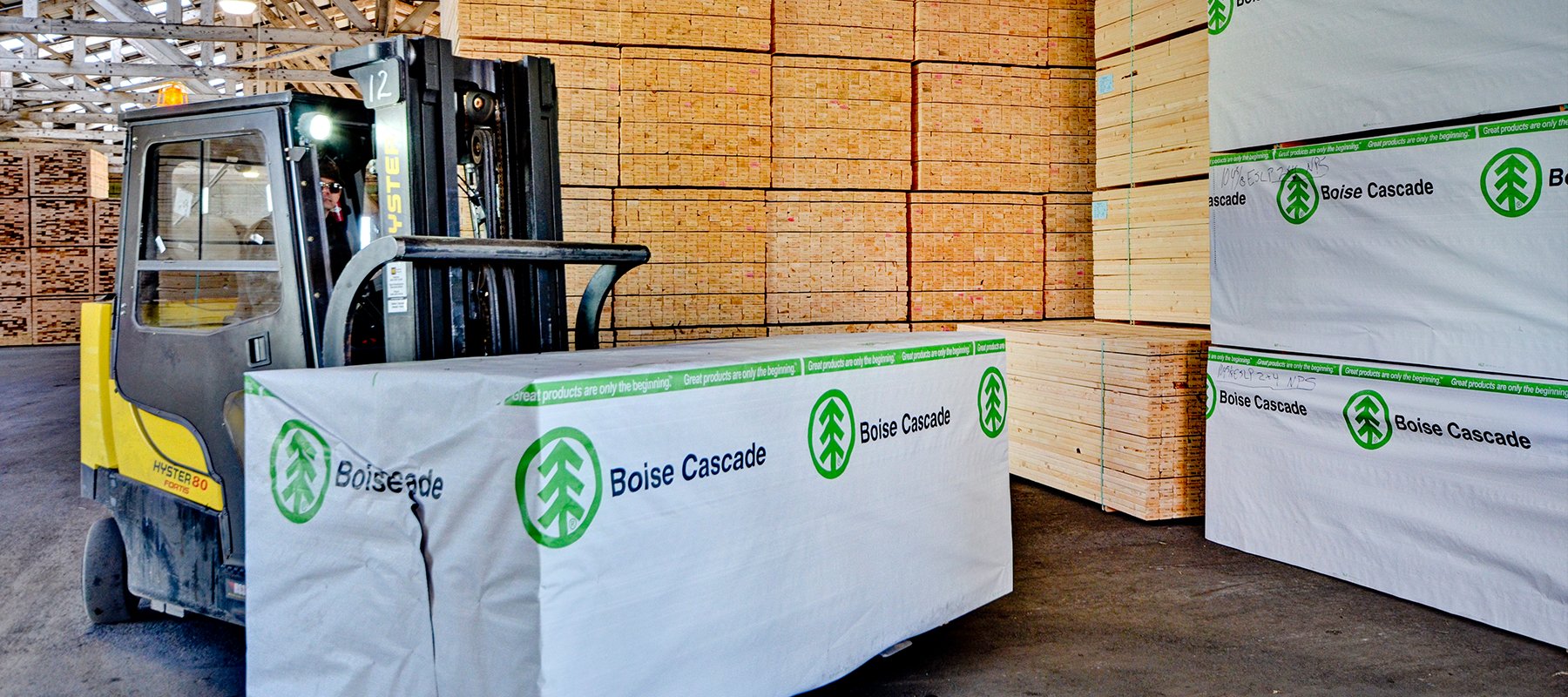
Boise Cascade Company announced the 60-day notice of a permanent curtailment of its laminated veneer lumber (LVL) production at the Roxboro, North Carolina, facility. The Roxboro facility will continue to produce I-joists.

The curtailment will affect approximately 56 employees, and the company anticipates ceasing LVL operations by December 31, 2018.

“Unfortunately, despite great effort by the team, we have been unable to reduce manufacturing costs to an acceptable level,” said Boise Cascade CEO Tom Corrick. “We understand the effect this shutdown has on our employees, their families, and the community. We will work to place employees or make them aware of job opportunities at our other facilities, as well as share available employee assistance resources.”

In related news, Boise Cascade completed the sale of its northeast Oregon lumber mills in Pilot Rock and La Grande and the particleboard operations in Island City to Woodgrain Millwork.The sale officially closed on November 2, 2018.

Boise Cascade is one of the largest producers of engineered wood products and plywood in North America and a leading U.S. wholesale distributor of building products.

Stora-Enso plans investments of EUR 550-600 million in 2019

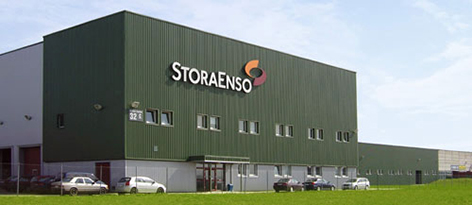
In the run-up to tomorrow's Capital Markets Day, CEO of Finnish Stora Enso Karl-Henrik Sundström announced that the Group's investment volume for 2019 would be at the level of its forecast annual depreciation.. In 2019, the estimated capital expenditure will be EUR 550–600 million, including EUR 100 million for biological assets.

The forecasted annual depreciation is EUR 490–510 million and operational decrease in the value of biological assets EUR 50–70 million. Capital expenditure amounts do not include potential acquisitions or divestments and are excluding the impact of IFRS 16 Leases.

Stora Enso's Capital Markets Day takes place in Helsinki on Wednesday 7 November. The theme of the day is "Creating value in the bioeconomy".

"I am pleased how Stora Enso demonstrates ability to create value in the bioeconomy and successfully delivers sustainable profitable growth. We are perfectly positioned to benefit from the global megatrends, as we see many new opportunities for our renewable products to replace fossil-based materials," says CEO Karl-Henrik Sundström.

During the day, Stora Enso will present its strategy and all five business divisions.


Huge storms ravage Italian forests; almost 15 million m3 damages

In the past week, the storm Vaia in northeastern Italy has ravaged some forests, especially in the Dolomites. The hardest hit is apparently in the north of Veneto, in the province of Belluno. Similarly, from the west of Belluno in South Tyrol and Trentino to the eastern Friuli-Venezia Giulia, heavy wind throws were reported.

The daily Südtirol News quotes Italian director of civil protection Angelo Borrelli in its online edition. According to him, 14 million trees on a total of 100,000 hectares of forest have fallen victim to the storm. Assuming an average mass of one cubic meter per tree, the number of trees should correspond to the amount of wood in fixed meters. The estimates are preliminary and will surely increase over time.

The Forestry Administration of South Tyrol reports about 1-1.5 million m3 of storm wood with a focus on the Latemar massif, east of Bolzano. Here, according to the forestry administration, particularly valuable trees have been destroyed by the storm. About the same amount of storm wood is reported inTrentino. Most of the wood will not be processed until 2019 and probably will be devalued.

There have also been wind throws in southern Austria, Switzerland and Slovenia, albeit to a lesser extent.

After the devastating storm Vaia, which has caused severe damage to the forest in north-eastern Italy, the Italian federation of the wood industry, FederlegnoArredo, estimates the damages to around 15 million m3. This coincides with the estimates of the civil defense, which speaks of 14 million m3 thrown and broken trees.

Emanuele Orsini, president of FederlegnoArredo, sees the serious damage as putting the economic of the affected areas at risk. He therefore calls for state support through a forest action plan, which must be passed as soon as possible by the parliament. In addition, the so-called "Decreto Dignità", a regulation on labor law, should be suspended for the wood sector in order to maintain its competitiveness.

Challenges of the European tropical timber market discussed at conference

The EU’s Sustainable Tropical Timber Coalition held its annual conference in Paris on 26 September. The conference highlighted the ongoing work to promote tropical timber in Europe by STTC participants and raised questions about the role of targets for procurement of “certified sustainable” products that are central to STTC activities.

Generally, the mood of the STTC conference was positive, with participants displaying considerable enthusiasm for the messages promoted by STTC and the promotional activities of likes of ATIBT and LCB. This is itself was an achievement given that the conference was held against a background of continuing stasis in Europe’s tropical wood trade, and the well-publicised financial difficulties of Rougier and other European-owned certified operations in tropical African countries.

To some extent the positive mood could be attributed to the strong focus on FSC and PEFC certification which, in the context of the European private sector, is often perceived as an essential pre-requisite for successful longterm market development of tropical wood.

The STTC focus on increased procurement of FSC and PEFC certified timber has played an important role to encourage European distributors, contractors, retailers and NGOs to actively encourage greater use of tropical timber, something rarely contemplated only a decade ago.

From the perspective of results on the ground in tropical countries, questions need to be raised about the relevance and value of a metric of market “share” that focuses primarily on the proportion of FSC or PEFC certified relative to uncertified tropical products, without also considering the impact on total European imports of tropical timber products.

Is a procurement policy that leads to 100% certified share of tropical timber imports, but is accompanied by, say, a 70% decline in total European imports from the tropics really a “success”?

This is debateable, particularly when it is also considered that under the terms of the EUTR, there must be a negligible risk of any timber product imported into the EU, irrespective of origin or of certification status, being derived from an illegal source.

Another closely related issue is the extent to which there is equitable access to certification in tropical developing countries, or between large and small operators in timbersupplying countries.

Data on the implementation of certification globally (see next section) strongly implies that FSC and PEFC certification tends to favour operators in richer industrialised countries compared to those in developing countries, and that there is a strong bias in favour of larger operators in all regions.

The need for procurement policies that avoid rigid demands for specific forms of certification, that are built on partnerships and co-operation with tropical suppliers and that reward progress within realistic timescales, remains as strong as ever.

New thinking on certification

On a more positive note, there is evidence of rising awareness of these threats within the certification movement, and growing recognition that there is a need for new thinking to significantly reduce the costs of certification and enhance the level of access.

For example, landscape approaches to certification are gaining attention, partly in response to policy developments such as REDD+ and FLEGT-related due diligence and governance and partly because of growing corporate-sector interest in deforestation-free procurement.

There is also increasing recognition that approaches at the scale of individual enterprises or management units are often ineffective and inefficient. Landscape approaches seek measurable indicators that are applicable across landscapes and which give an indication of the general progress being made.

An indication that this thinking is becoming more mainstream came from the final presentation at the STTC Conference in Paris. Speaking on behalf of the Alliance for Preservation of Forests, Jean-Manuel Bluet, Head of Sustainable Development at Nestle, France, focused a large part of his presentation on the potential role of landscape-based certification in the tropics.

Belarus has become a major supplier of softwood lumber to EU countries

As Belarus decided to ban exports of unprocessed wood starting January 1st, 2016, logs deliveries to Europe have stopped. The move was a decision of the Belarusian president, Aleksandr Lukashenko  which was meant to raise the volumes of wood processed inside the country.
The trend has been upward since this decision and it seems that it's set to continue this year. Accordingly, the softwood lumber (HS code: 440710) exports from Belarus to the European Union countries have jumped in the first 9 months of 2016, by 50%, to a total of 1,5 million m3, and well over EUR 200 million.

Germany was the top European importer, with EUR 60 million worth of Belarusian softwood timber (and 446,881 m3). Latvian imports increased by 50% and those of Lithuania by 46%, reaching volumes of 348,492 m3 and 307,777 m3, respectively.

EU softwood lumber imported from Belarus by... (in m3 )
Importing Country 2017 2018 Change in %
EUROPEAN Union
1,052,306 1,581,598 50 %
Germany
336,280 446,881 33 %
Latvia
232,299 348,492 50 %
Lithuania
211,528 307,777 46 %
Poland
71,907 125,930 75 %
Netherlands
71,788 112,143 56 %
Others
128,504 240,375 87 %
TOTAL 1,052,306 1,581,598 50 %
The statistics are based on the numbers published by Eurostat. The product Softwood Timber consists of following HS Codes: 440710,440711,440712,440719.

Vietnam wood products exports to the EU expected to hit $1 billion

More than 400 Vietnamese firms are exporting timber products to Europe, which is the 4th biggest market for Vietnam’s wood exports, accounting for over 10 percent of the country’s total export of the products.

Vietnam’s export of wood products to the EU is expected to get a boost with the signing of the Forest Law Enforcement, Governance and Trade Voluntary Partnership Agreement (FLEGT-VPA) between the two sides in Brussels, Belgium, on October 19.

According to Vice Chairman and General Secretary of Vietnam Timber and Forest Product Association (VIFORES) Nguyen Ton Quyen, EU is considered a very important market for Vietnamese timber products. FLEGT-VPA will help Vietnam export directly to 28 European countries without having to go through intermediary countries.

Quyen said the market would grow. In a few years, wood export value to the EU would grow from 700 million USD today to more than 1 billion USD.

To fulfill criteria set by the European market, Vietnamese firms have to obtain certificates and carry out paperwork to clarify the legal origin of their timber products.

In response to the requirement, a number of localities have developed wood material zones meeting Forest Stewardship Council (FSC) standards.

The northern province of Tuyen Quang has 19,700 ha of FSC-certificated forests to date and is striving to have another 4,500 – 5,000ha certified in 2019. Meanwhile, central Quang Tri province ranks first in the country with more than 25,000 ha of certified forests.

Vietnam is one of the world’s leading wood processing and exporting countries with an export turnover of 8 billion USD in 2017. The figure is expected to hit 9 billion USD this year.

The country earned more than 7.61 billion USD from exports of forestry products between January and October, 84 percent of the yearly target. Timber and wood products contributed 7.23 billion USD to the revenue.

The nation sets a target of 20 billion USD in wood exports by 2025.

Chinese furniture industry investing heavily in European woodworking machinery

China is home to the world’s biggest woodworking and furniture manufacturing industry, much of which is concentrated in the country’s south, particularly in the provinces of Guangxi, Guangdong and Fujian. Guangdong is China’s main center of furniture manufacturing.

Figures published by the German Woodworking Machinery Manufacturers’ Association show that exports of woodworking machinery to China have increased markedly as Chinese manufacturers invest in new equipment to keep pace with the booming local real estate market. As well as growing in terms of sheer volume, this market is becoming increasingly sensitive to quality and environmental considerations – factors that play into the hands of European machinery manufacturers in particular. Germany, for instance, grew its exports to China from 165.3 to 288.3 million euros over the period from 2016 to 2017. Italy, Austria and Switzerland likewise increased their exports to China over this period.

While much of China’s furniture industry output is sold domestically, a good deal of it is exported. In fact, China is the world’s biggest exporter of furniture, a position it has held since 2004. According to a report published by Germany Trade & Invest (GTAI) in April 2017, China ranks second only to Poland as Germany’s biggest supplier of furniture. The report anticipates that China’s furniture exports will decline and that domestic demand will grow on the back of an increasingly affluent middle class.

China is busy laying the groundwork for a digital future. Its plans include colossal investment in communications infrastructure, sweeping legislative changes, and financial support programs for automation and robotics.

The country is virtually without parallel in its pursuit of a concerted campaign spanning government, research, business and venture capital and aimed at pushing ahead with the digitization of its industrial base, economy and society as a whole. It is engaged in a lightning-paced restructuring process that is arguably the cornerstone of its plan to modernize its industrial base and thereby become the world’s No. 1 industrial power. The aim of the Chinese government’s “Made in China 2025” industrial modernization program is to move China up among the global frontrunners by 2025 and take the outright lead by 2049 (in time for the 100th anniversary of the founding of the People’s Republic).

The crisis of the Canadian lumber market might be over, says Resolute CEO

The decline of lumber prices in Canada is, most likely, over. Even if prices won’t rebound to this year’s highs, the market is close to its bottom.
According to Resolute Forest Products Inc. chief executive officer Yves Laflamme, lumber prices have fallen 50% from the May records, while the lumber futures tumbled to a 28-month low. This situation caused Interfor Corp.  to announce plans to reduce output by 20% at its British Columbia sawmills.
Moreover, Canfor Corp. on Thursday said it will to cut production 10% in British Columbia in the fourth quarter.
At the moment, Resolute reduced shifts at some mills in Thunder Bay, Ontario, and Quebec to adjust log inventory. Also, the company will pay about $88 million in import duties to the U.S. by the end of the year, and neither side appears to have “any interest” in a deal, Laflamme added.
Earlier this year, the tight supplies, trade disputes and transport bottlenecks sent lumber futures higher. This caused the the outlook for U.S. housing to start and trail some expectation.
Yet, the results for the fourth quarter of 2018 won't be that good, given the persistent dispute between Canada and the U.S. over softwood lumber.

On the outlook for lumber prices, “I’m not expecting to go back to where we were because that was the exception,” though the market will be “better in the next few months,” Laflamme said.
On Thursday, lumber futures in Chicago rose by the $15 exchange limit to $326 per 1,000 board feet. On May 18, the price surged to a record $648.50.
Resolute’s shares in Toronto soared 20 per cent, the most in a year, after the company reported adjusted per-share profit in the third quarter that topped the highest estimate by analysts.

Newsletter

Subscribe to our digital newsletter for your daily digest of essential news, views and analysis from the international wood industry delivered directly to your inbox.


0