

New Zealand export log prices increased in May due to the higher shipping costs caused by the weaker currency offsets.
The average wharf gate price for New Zealand A-grade logs edged up to $120 a tonne in May, from $119 a tonne in April, according to AgriHQ's monthly survey of exporters, forest owners and saw millers.
As reported by the Business Desk, the in-market price of A-grade logs in China, New Zealand's largest market, advanced to US$113/JAS from US$111/JAS last month as inventory levels on Chinese ports remain moderate, following a relatively low buildup of stock on ports during the Chinese New Year holiday period.
Continue reading "NZ: Export log prices grow due to increasing demand"
Article archive
US, EU and Australia step up efforts to enforce laws to fight illegal timber trade

Australia, the United States and the European Union governments are making huge efforts in enforce laws as to stop the illegal timber from entering their countries.
According to the EU's Forest Law Enforcement, Governance and Trade (FLEGT), starting October 2015 to March 2016, 14 Members States (Bulgaria, Czech Republic, Denmark, Finland, France, Germany, Ireland, Latvia, Luxemburg, Malta, the Netherlands, Sweden, the UK, and one Member State that preferred not to be identified), together with Australia officials already checked 495 company sites, while reviewing 955 due diligence systems.
During the mentioned period, 396 corrective action requirements were issued, while 4 injunctions and 55 sanctions were applied. Timber products from 15 sources or processing countries (among which China, Brazil, Cameroon, Myanmar, and the Republic of Congo) created the main issues for which the sanction were applied.
“I hope that over time more European agencies will be able to report in the same way so that we can build up a detailed picture of the sanctions that are facing illegal operators, and the way that the sector is changing,” said Jade Saunders, a Senior Policy Analyst at Forest Trends.
The enforcement agencies also checked the timber importers, pulp and paper importers, furniture importers and domestic forest producers, according to FLEGT. 50% of all the inspections and corrective actions were related to timber importers.
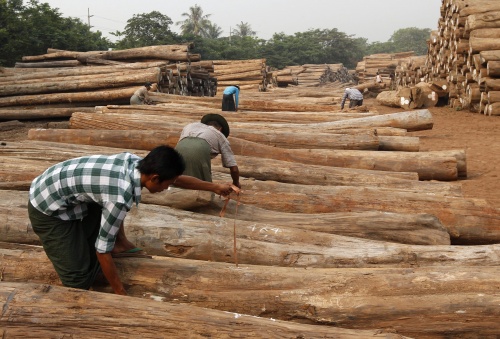
Myanmar to stop teak wood production
Production in construction drops in euro area

In March 2016 compared with February 2016, seasonally adjusted production in the construction sector fell by 0.9% in the euro area (EA19) and by 1.4% in the EU28, according to first estimates from Eurostat, the statistical office of the European Union. In February 2016, production in construction fell by 0.6% in both zones.
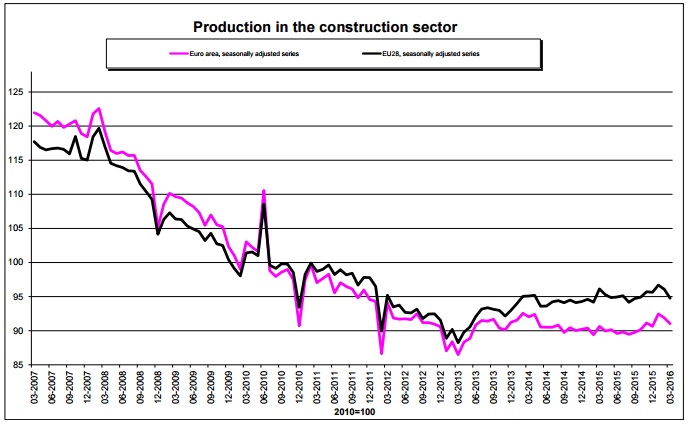 In March 2016 compared with March 2015, production in construction fell by 0.5% in the euro area and by 1.4% in the EU28.
Monthly comparison by construction sector and by Member State
The decrease of 0.9% in production in construction in the euro area in March 2016, compared with February 2016, is due to civil engineering falling by 2.0% and building construction by 0.8%.
In the EU28, the decrease of 1.4% is due to civil engineering falling by 2.9% and building construction by 1.1%.
Among Member States for which data are available, the largest decreases in production in construction were recorded in Slovenia (-8.5%), Hungary (-6.3%) and the Czech Republic (-5.1%), while increases were observed in Sweden (+3.5%), France (+1.2%) and the Netherlands (+0.9%).
Annual comparison by construction sector and by Member State
The decrease of 0.5% in production in construction in the euro area in March 2016, compared with March 2015, is due to civil engineering falling by 2.9%, while building construction grew by 0.1%. In the EU28, the decrease of 1.4% is due to civil engineering falling by 7.5%, while building construction grew by 0.1%.
Among Member States for which data are available, the largest decreases in production in construction were recorded in Slovenia (-36.7%), Hungary (-33.9%), Poland (-14.9%) and the Czech Republic (-11.5%), while increases were observed in Sweden (+16.4%), the Netherlands (+6.3%), Germany (+1.0%) and Spain (+0.4%).
ULK Sawmill to install two progressive kilns from Finnish Heinola

ULK Sawmill in Arkangelsk district, Russia, has ordered eight 2-zone progressive kilns type HFB from Heinola Sawmill Machinery Inc. with annual capacity of ca. 400,000 cubic metres when drying spruce and pine timber to 11 % final moisture content.
The kilns are delivered in two modules during year 2016 and 2017. Continue reading "ULK Sawmill to install two progressive kilns from Finnish Heinola"
LIGNA Conference: The woodworking community on its way to Industry 4.0

On 3 and 4 Mai 2016 the first LIGNA Conference was held in the Robotation Academy at the Hannover Exhibition Center (in Hannover, Germany). This event attracted 140 participants and was sold out weeks in advance.
The unanimous conclusion: “Industry 4.0 is not a revolution – it is an evolution which has already begun in the furniture industry.”
During two action-packed days, 13 speakers from diverse sectors of the woodworking industry reported on their visions and experiences in relation to digitalization, its practical deployment in manufacturing processes and its impact on development, production and distribution.
Day one of the conference began with an interactive presentation by Timothy Kaufmann, Business Development Internet of Things at SAP Deutschland SE & Co. KG, who examined the opportunities opened up by Industry 4.0.
In the course of the day the visitors found out more about the positive impact of Industry 4.0 on our everyday lives. Per Berggren, Manager Industrial Strategies at IKEA, demonstrated that integrated manufacturing techniques can be tailored to mass production applications – as evidenced in IKEA’s PAX wardrobe range.
The second day of the conference was devoted to examples of best practice. Olaf Katzer, Head of International Job Family Development at Volkswagen AG, talked about the qualification of professionals in an Industry 4.0 environment. In his view it is essential to bear the human factor in mind, despite all the euphoria about efficiency gains, cost-cutting and sustainability. The customer remains the focus of attention and is an essential factor in the overall production picture. It goes without saying that Industry 4.0 will impact the production in terms of its means, data flows and the workforce involved. He emphasized the importance of taking the necessary preparatory steps.
The LIGNA Conference arrived at the clear conclusion that Industry 4.0 is also directly relevant to small and medium-sized enterprises. However, it is essential that SMEs create areas of specialization and build new networks as a prerequisite for efficient and profitable production.
A major highlight at the conference was the panel discussion on the implications of Industry 4.0 for the woodworking sector. Significant progress has already been made with the implementation of Industry 4.0. At the beginning of the discussion the audience was confronted with controversial assertions such as “Industry 4.0 is the logical continuation of what we’ve been doing for the past 20 years”.
The panel consisted of Gregor Baumbusch (Michael WEINIG AG), Stefan Sieber (Beckhoff Automation), Andreas Bischoff (IMA Klessmann GmbH), Jürgen Köppel (HOMAG Group AG), Bernd Kressmann (JELD-WEN Deutschland GmbH & Co. KG), Federico Broccoli (BIESSE Group), Dr. Frank Prekwinkel (imos AG), Dieter Rezbach (LIGNUM Consulting GmbH), Christoph Rieke (Steelcase Werndl AG), Frank Westermann (WESTERMANN GmbH & Co. KG) and Luigi De Vito (SCM Group). The wide-ranging discussion culminated in the conclusion that “Industry 4.0 is not a revolution – it is an evolution which has already begun in the furniture industry.”


“Thanks to its sharp focus on integrated production the premiere of the LIGNA Conference was a resounding success. The concentrated, intrigued looks on the faces of the 140 visitors testified to the major appeal of integrated production as the key to Industry 4.0. This opens up huge opportunities for furniture factories and members of the woodworking trades. It is up to each individual to shape this process within his or her own enterprise,” said Dr. Jochen Köckler, Member of the Managing Board at Deutsche Messe.
On each of the two-day LIGNA Conference, presentations were given by Biesse Group, HOMAG Group AG, IMA Klessmann GmbH, imos AG, SCM Group, 20-20 Technologies GmbH, abaco Informationssysteme GmbH, Beckhoff Automation GmbH & Co. KG, dmaic software GmbH & Co. KG, Leitz GmbH & Co. KG, LEUCO Ledermann GmbH & Co. KG, Michael WEINIG AG and SDI Project Automation GmbH. The visitors took this opportunity to swap ideas and build new networks.
“Given the high-caliber program and the lineup of speakers, I had high hopes for the LIGNA Conference. For me the most important realization was that integrated production is not only a matter of adapting technology and organization, but also entails the unified interplay of all corporate departments. Industry 4.0 directly involves customers and the entire supply chain. The conference was extremely helpful and more than met my expectations,” summarized Frank Heuer, Purchasing Manager at the bathroom furniture manufacturer W. SCHILDMEYER GmbH & Co. KG in Bad Oeynhausen.
The first LIGNA Conference was supported by VDMA German Woodworking Machinery Association, LIGNUM Consulting GmbH and Ostwestfalen-Lippe University of Applied Sciences. The program and speakers are listed at www.ligna.de/en/news-trends/ligna-conference-2016/<http://www.ligna.de/en/news-trends/ligna-conference-2016/>.
Pellet plant in Belarus doubles its capacity

A pellet plant with 30 thousand tonnes annual capacity from Borisov (Belarus), owned by Swoods Export, will double its capacity. The plant was put into operation at the beginning of 2015 and ts equipment was delivered and started-up by Hekotek.
Continue reading "Pellet plant in Belarus doubles its capacity"
Ta Ann revenues drop on very low plywood prices in Japan

Plywood prices in Japan seem to fell short, as Ta Ann Holdings Bhd. said in a quarterly review when releasing its January-March 2016 financial results.
Continue reading "Ta Ann revenues drop on very low plywood prices in Japan"
UPM Pellos mills exceeded 10 million cubic meters in total softwood plywood production

UPM Plywood's Pellos mills have crossed a significant milestone of 10 million cubic meters in all-time total production. The operation that began in 1964 as a small chipboard factory has expanded over the decades to comprise three plywood mills.
"Pellos mills are clearly one of our main production units. They account for about half of our total production capacity, and practically all of the spruce plywood production", says Mika Kekki, Vice President, Production & Operations at UPM Plywood.
UPM mills Pellos production efficiency has improved significantly over the past two decades. For example, the volume of production per hour worked has more than doubled.
More than 90% of the Pellos mills' production is exported. Pellos products compete in the international market, where the most serious competitors come from clearly lower-cost countries, especially from South America.
The debut of 2016, was not so good for UPM Plywood. The division reported 20% drop in EBITDA for the first quarter of 2016. EBITDA for Q1/2016 was €20million, against €25 million in Q1/2015. UPM's Plywood delivery volumes were lower than the high level last year and sales prices decreased slightly.
See more here
Austria: Wood pellets' price keeps dropping

Wood pellets’ price in Austria continued to decline this month, compared to April 2016. Moreover, the price was also lower than the previous year.
May 2016 recorded an average price of EUR Continue reading "Austria: Wood pellets' price keeps dropping"
Austria: Wood pellets’ price keeps dropping

Wood pellets’ price in Austria continued to decline this month, compared to April 2016. Moreover, the price was also lower than the previous year.
May 2016 recorded an average price of EUR Continue reading "Austria: Wood pellets’ price keeps dropping"
Ottawa negotiations bring no progress on a new Softwood Lumber Agreement

The Canadian softwood lumber negotiators met with the US officials last week in Ottawa. Yet, there is no sign of progress toward solving any of the issues caused by the softwood trade between the two countries.
Continue reading "Ottawa negotiations bring no progress on a new Softwood Lumber Agreement"
Biesse buys Italian Uniteam

Biesse S.p.A. has this week signed a contract for the acquisition of 100% of the Italian Uniteam S.p.A. - Thiene (VI).
Continue reading "Biesse buys Italian Uniteam"
US demand for decking expected to climb in the upcoming years
US demand for decking is forecast to increase 1.8 percent per year through 2020 to 3.6 billion lineal feet, valued at $7.1 billion. Rising consumer confidence will promote gains in the large residential improvement and repair market, as homeowners who postponed decking projects in the aftermath of the 2007-2009 recession undertake them going forward. Increasing market share for wood-plastic composite and plastic decking materials will boost value gains, as these products are sold at a higher price point than wood decking. The residential market accounted for the largest share of decking demand in 2015, with nearly three-fifths of the total.
Continue reading "US demand for decking expected to climb in the upcoming years"
Holmen to invest in a new wood treatment plant at Braviken Sawmill

Holmen is investing in a pressure treatment plant and a distribution warehouse at Braviken sawmill outside Norrköping, Sweden. The investment is estimated to amount to SEK 50 million.
Opened in 2011, Braviken sawmill now manufactures sawn and planed wood products in spruce and pine. Over the years, the mill has expanded in size and gained a new warehouse for its finished products. Having started out only sawing spruce, in summer 2015 a strategic investment began with a view to broadening production to include pine joinery timber, as well as enabling the manufacture of decking and joists for outdoor purposes.
“In autumn 2015, Braviken sawmill began sawing both spruce and pine. We want to offer our customers a broader range and the wood treatment plant is a natural next step. The plant will be highly automated, with scope for further development in the future,” says Johan Padel, CEO of Holmen Timber.
Making up a large part of what builders’ merchants sell in Sweden, treated wood is used for projects such as terraces, jetties and fencing. Pressure treatment gives the wood a longer life and minimizes the risk of attack from wood-decaying fungi and insects.
Holmen’s bio co-location in Braviken makes full use of the whole tree. Wood chips from the sawmill serve as a raw material in pulp production and by-products such as bark and wood shavings are used as biofuel to produce energy and district heating. The circle is closed when the surplus heat from the paper mill is used in the drying process at the sawmill.
Holmen is a forest industry group that manufactures consumer board, paper and wood products and runs forestry and energy production operations. In 2015 Holmen’s net sales were SEK 16 billion and the group has approx. 3,300 employees.
Linden Lumber to close hardwood flooring business
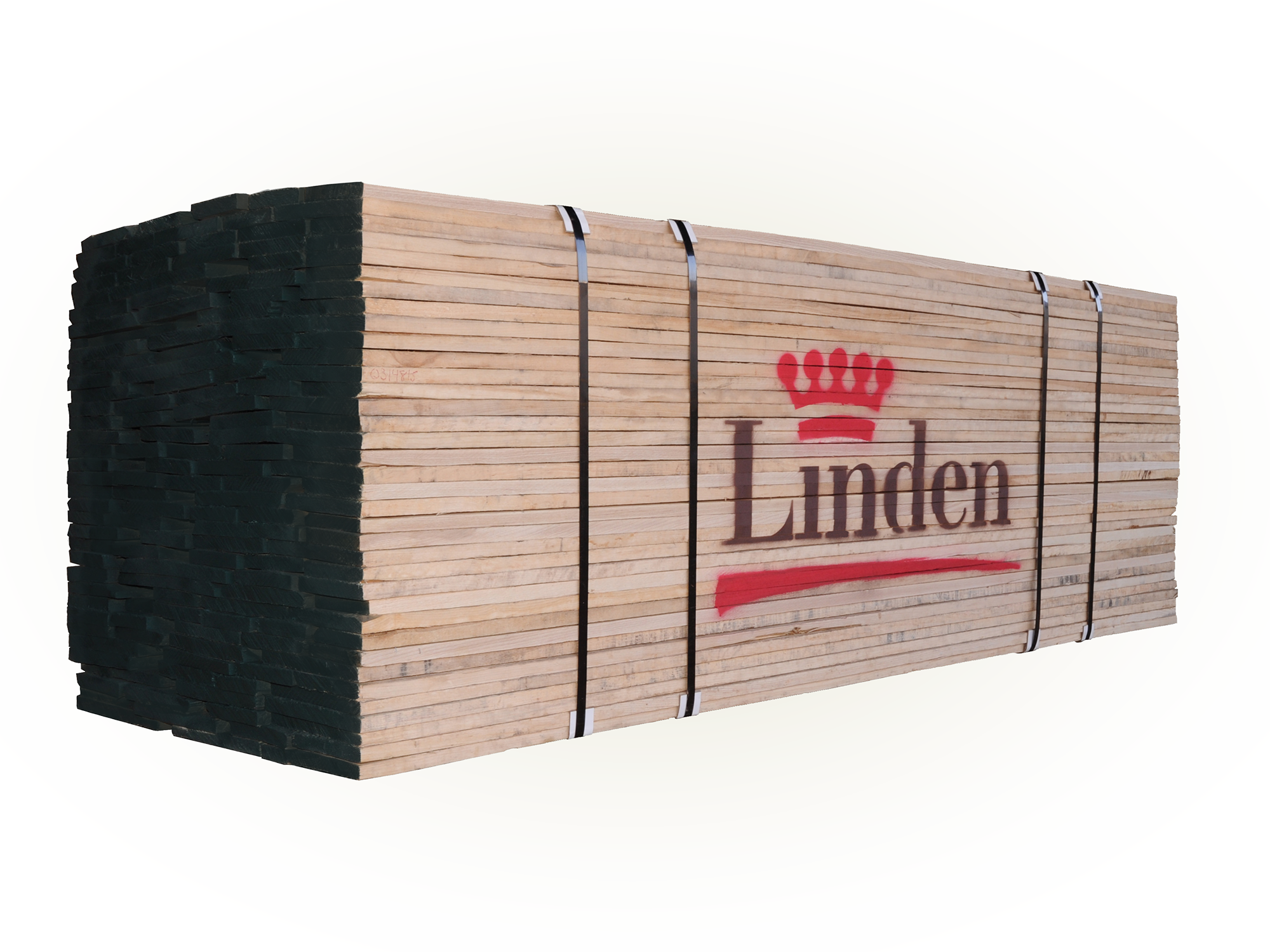
Linden Lumber, LLC has closed its hardwood flooring division effective May 17. As a result, its work force will be reduced by 37 employees. “This has been an incredibly difficult decision to make, but we believe it is the right decision given the ongoing depressed state of the solid flooring industry. Any time business decisions such as this negatively impact employees, it is very emotionally difficult for everyone,” says Hugh Overmyer, Linden Lumber’s President.
According to the company, the solid flooring market across the United States has been in a slump for the past year, and Linden Lumbers’ flooring sales have been no different. Nationwide, solid wood flooring mills have struggled on and off the last few years dealing with volatile price swings, while engineered flooring mills seem to be quite healthy and growing at a robust pace. Industry insiders believe that solid wood flooring is losing market share to its nearest relative—engineered flooring, says Linden Lumber.
The company says its decision to exit the flooring business in no way affects the ongoing operation and manufacturing of its lumber and industrial wood products. Linden Lumber has invested heavily in recent years in new machinery, and has outpaced many of its competitors through the investment of the latest optimization technology for sawing lumber.
The 150-acre site where Linden Lumber operates at the moment has been producing lumber since 1963—some 53 years. Company management looks forward to producing quality hardwoods for another 53 years or more, Linden Lumber said.
Jamey Hurst, Linden Lumber’s Director of Sales & Marketing said, “This will simplify our business model and will help us be more focused on growing our hardwood lumber sales both domestically and worldwide. We’ll continue to push the bounds of our industry, with the goal of Redefining Southern Lumber.”
Greenpeace shows how illegally logged African wood arrives to Europe

Africa’s rainforests are being illegally deforested and the wood is likely to be exported to the European Union countries too.
Greenpeace has started an investigation in the region and the latest disclosures about the issue came after The Netherlands has sanctioned a Dutch company for violating the European Timber Regulation. Yet, there are many other countries at risk of importing illegally logged wood from Africa.
According to the Energydesk Greenpeace investigations, the illegally logged wood from Cameroon, especially, makes for 10-30% of the global wood trade. Thus, the forests in Cameroon are suffering from a massive deforestation because of the illegal and unsustainable logging.
The rainforests that are being harmed are very important for the global biodiversity and for the climate also, as the Congo basin is the second largest area of tropical rainforest, after the Amazon.
Despite all the evidence, the government in Cameroon denies the accusations according to which the officials in the country fail to prevent the illegal logging. At the moment, the country is also negotiating with the EU as to receive preferential treatment on timber exports, as Greenpeace reported.
The evidence found in January 2016 shows that La Socamba, a very important supplier, is cutting trees out of its agreed boundaries. The logs are then sold to the Compagnie De Transport Et De Commerce (CCT), which sells them all around the world, including China and the EU. Greenpeace researchers have then found logs and sawnwood with the CCT logo all around China, Belgium, The Netherlands and Spain.
Also, the wood exported to China is then sold to the EU countries.
“On the request of Greenpeace, MINFOF has ordered an audit of the activities of CCT and its suppliers. The expected report will establish the responsibilities of anyone involved in illegal activities as well as trace the resulting timber,” CCT reports stated.
According to Greenpeace, the main issue is that the illegal logging might harm the local communities and create deforestation, as the Cameroon rainforests offer a very important habitat for many endangered gorillas, chimpanzees and forest elephants.
Also, as Greenpeace shows, the chaotic logging operations in Cameroon are also a common cause of social conflicts, as they frequently occur without the consent of forest-dependent communities, who see their resource base destroyed with rarely any benefit in return.
Latvia: Forest industry exports increase by 6.9% during Q1

The forest industry exports in Latvia have slightly grown during the Q1 of this year. Thus, the sales have gone up by 6.9% by the end of March, reaching EUR 537.527 million, compared to the same period of 2015 (EUR 502.781 million).
Continue reading "Latvia: Forest industry exports increase by 6.9% during Q1"
IKEA to open second store in India

IKEA Group has recently bought land in Mumbai, India’s financial capital, to build a 37,000 m2 store. This would be the second store to open in the country and is part of the furniture retailer's plans to open 25 stores in India by 2025.
Continue reading "IKEA to open second store in India"
Continuous drop in Russian lumber shipments; export prices down 36%
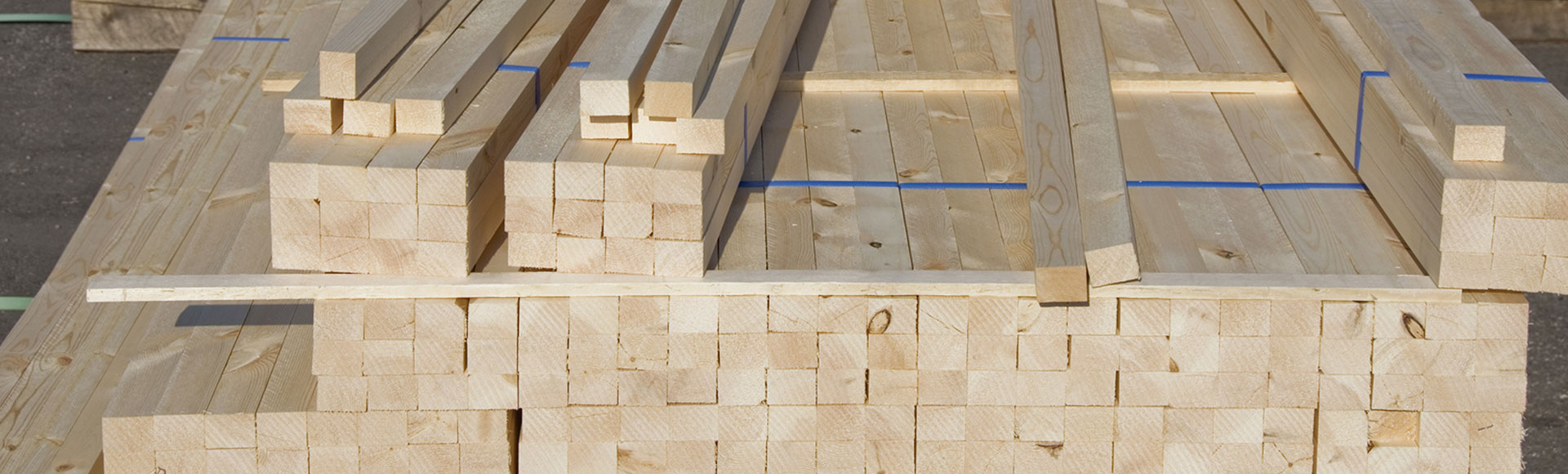
Lumber exports from Russia have fallen for two consecutive quarters, with the 1Q/16 shipments being almost ten percent lower than in the 3Q/15. Most of the decline has been in shipments to the CIS countries, including Uzbekistan, Azerbaijan and Tajikistan, but trade with Egypt and some European countries were also down. Of the major trading partners, it was only Japan (+33%) and China (+10%) that increased their importation of Russian lumber. However, the first quarter shipments this year were higher than they were in the 1Q/15.
Continue reading "Continuous drop in Russian lumber shipments; export prices down 36%"

