Article archive

Northeastern US mills reach 10-year record for lumber shipments

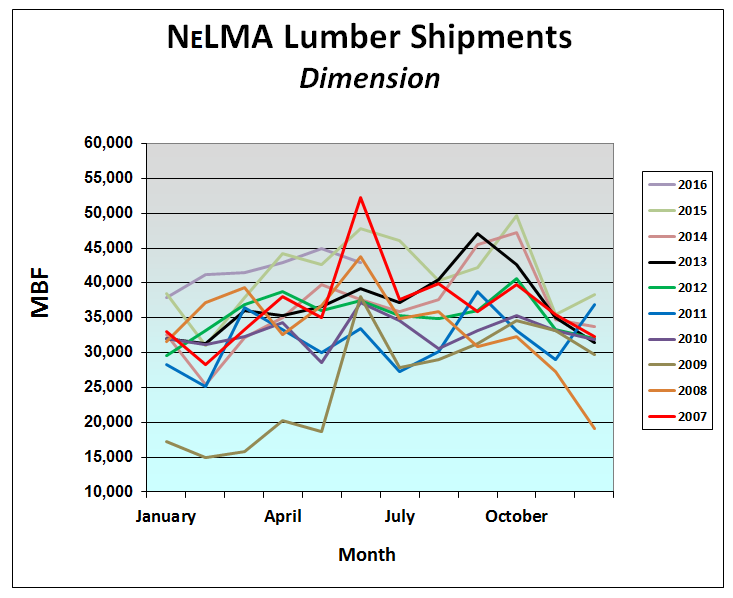
Eastern White Pine and Dimension lumber shipments from NELMA (Northeastern Lumber Manufacturers Association) mills amounted to a 10-year record level for the first half of 2016, as compared to data from 2007.

According to NELMA.org, a total of 471.7 million board feet of lumber was sent to the marketplace from January to June of this year, which included 251.3 million board feet of dimension lumber (primarily stamped Spruce-Pine-Fir south) and 220.4 million board feet of Eastern White Pine.

Dimension was up 3.9% and Eastern White Pine increased by 8.4%, as compared to 2015.
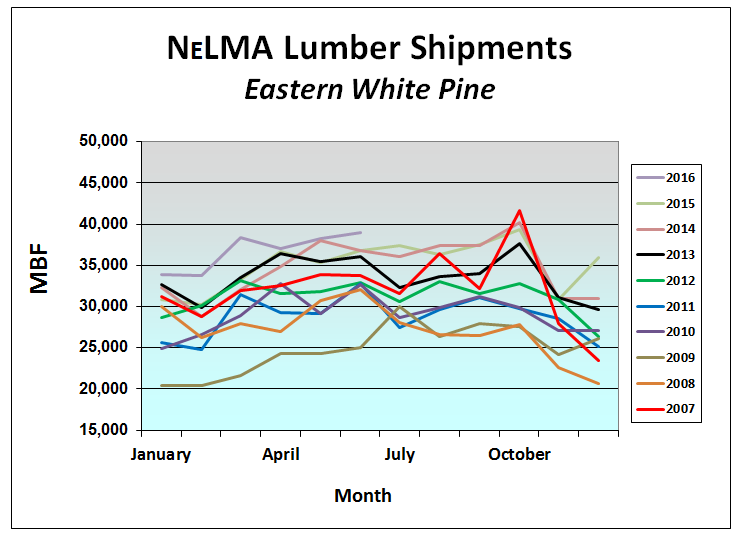
q2-ewp-graph

q2-dimension-graph

EU beech log exports to China drop by 8%

The beech log exports from Europe to China have decreased significantly during the first half of 2016.

The exports from France and Belgium decreased the most, by 69% and -67% respectively. Compared to the same period of 2015, only 9,286 cbm (2015: 29,956 cbm) of beech logs have went from France to China. As for Belgium, the amount of beech logs decreased from 26,559 cbm in the first half of 2015 to 8,805 cbm in the same period of 2016.

Against the first half of 2015, exports from Germany and Denmark were the only ones to increase, by 13% and 2%, respectively. The amount of beech logs going from Germany to China reached 233,308 cbm, while the beech logs from Denmark amounted to 32,707 cbm.

Overall, the beech logs exports from the European Union to China decreased by -8%, reaching 295,315 cbm.

TOP 10 Exporting Countries

- Beech Sawlogs exported to China from... (in cbm )

H1/2015 H1/2016 Change in %
EUROPEAN Union
321,277 295,315 -8 %
Germany
207,196 233,308 13 %
Denmark
32,026 32,707 2 %
France
29,956 9,286 -69 %
Belgium
26,559 8,805 -67 %
Czech Republic
11,296 7,896 -30 %
Others
14,244 3,313 -77 %
OTHER European Countries
229 163 -29 %
TOTAL 321,506 295,478 -8 %

HS Code: 44039210

UK softwood timber imports grew by 5% in 1H/2016

During this year to date, the British softwood timber imports increased by 5%, compared to the same period of 2015. According to the latest figures provided by Eurostat, the total volume of imports went beyond the 2,515,478 cbm from the first half of 2015 and reached a total volume of 2,637,124 cbm in the same period of 2016.

Imports from the European countries, which represent more than 90% of Continue reading "UK softwood timber imports grew by 5% in 1H/2016"

Switzerland: Price of wood pellets rises in September, but still lower yoy

At the debut of the autumn, the average retail price for wood pellets in Switzerland went up to 364.60 CHF / t (332.74 EUR/t). That's 1.7% more than in August, but 2.8% less than in September, 2015. Continue reading "Switzerland: Price of wood pellets rises in September, but still lower yoy"

Finnish sawn timber to fuel China’s hunger for furniture

China’s furniture industry has started to grow in recent years, once with the strict birth control allowing couples to legally have two children. In particular, the manufacture of children’s beds increased the need for Finnish spruce. Continue reading "Finnish sawn timber to fuel China’s hunger for furniture"

German sawn beech lumber exports to China dropped sharply

During the first five months of 2016, Germany’s sawn beech lumber exports decreased by -3%, compared to the same period of 2015. German beech lumber exports to the EU decreased by -22%, reaching 48,649 m3 compared to 62,386 m3 during January-May 2015.
Exports to Germany's most important customer, China, decreased by -11%, or more Continue reading "German sawn beech lumber exports to China dropped sharply"

Forestry technology sector at the center of LIGNA 2017

LIGNA, the world’s leading trade fair for machinery, plant and tools for the woodworking and timber processing industry, is gearing up for its 2017 season (22 to 26 May) with a new, more visitor-centric layout of themes.
“LIGNA is the technology trade show for the forestry and wood energy industries. It is where users of woodworking and timber processing technology meet suppliers. As such, it is the only show where users will find technology for the entire wood value chain at one convenient location,” commented Christian Pfeiffer, the Director in charge of LIGNA at Deutsche Messe.
“The upcoming LIGNA will feature forestry technology more prominently than ever. We’ve partnered closely with our exhibitors to come up with a new thematic layout that will make it quicker and easier for solution-seekers to find what they are looking for,” said Pfeiffer.
Ligna10The significance of the new layout for the primary timber industry is that the Forestry Technology displays will be located immediately adjacent to the Sawmill Technology, Energy from Wood, and Wood Based Panel Production offerings. They will also be bordered by the new Tools and Machinery for Custom and Mass Production showcase, which includes Hall 27, where the providers of solutions for solid wood processing will be clustered. This new distribution of content in the halls bordering the open-air site will generate powerful synergies for visitors from the primary timber industry and put forestry technology on center stage.
The Forestry Technology section will sport a number of new features. The open-air site will sport various “avenues” addressing key aspects of the production chain. Plus there will be a demonstration site at the heart of the area and an activity zone in front of Pavilion 33.
The themed avenues will be located to the north and south of the demonstration site and will address the following five topics: mobile sawmills - logistics - logistics and transport - large-scale forestry machinery plus forestry tools and energy from wood - firewood production lines and tools. Meanwhile, the demonstration site will showcase solutions across the entire primary timber process chain – everything from felling and transport solutions to chainsaw protective apparel, cable harvesting systems and chippers. All kinds of equipment and machinery, large and small, will be on display on each day of the fair. The demonstration site will be flanked by a grandstand, so visitors will have a clear view of each day’s live demonstrations. Organized in partnership with the German Forestry Council (KWF), the site will feature a mix of moderated demonstrations and static displays by participating exhibitors.
The other big highlight of the open-air site is the activity zone in front of Pavilion 33 beneath the EXPO canopy. There, visitors can experience “Forestry from the air – using aircraft to support forestry work” in a series of daily live demonstrations. As the theme suggests, the focus here is on the use of unmanned aerial vehicles, or drones, in forestry. Drone technology offers many exciting applications. For example, multicopters are now widely used both in forestry operations and in forest management. Equipped with high-resolution cameras or sensors, they are an excellent alternative to labor-intensive ground-based inspections and aerial inspections using manned helicopters or fixed-wing aircraft. Other examples of cutting-edge aerial applications in forestry include the use of specialized helicopters in heli-logging, forest liming and forest firefighting. Of course, the demonstrations will also feature plenty of non-helicopter firefighting and fire management technologies. The event area will also feature live demonstrations of cable hauler tests using the latest inspection and testing systems. Regular inspections of cable hauler equipment are vital to workplace safety in the forestry industry. The daily lineup of demonstrations and action in the activity zone is staged in collaboration with the German Forestry Council (KWF).
Another of the big attractions on the open-air site is Pavilion 33, which offers a program of practically oriented forums organized jointly by the KWF, the Lower Saxony School of Forestry and the German Association of Forestry Contractors (AFL). Keynote themes in Pavilion 33 include logistics in all areas of forestry, from harvesting to road haulage, not to mention education and training, and current issues facing forestry companies.
The Wood Industry Summit premiered at LIGNA 2015 and was a major success right from day one. Both exhibitors and trade visitors used the forum – which attracted international participants from industry, research and government – as a valuable source of leads for primary-industry project work in the high growth markets of the world. The Wood Industry Summit at LIGNA 2017 is themed “Access to Resources and Technology”. Located in Hall 26, the Summit is closely aligned – both thematically and physically – with the Wood Based Panel Production display area, also in Hall 26. Exhibitor highlights there include the German plant manufacturers Siempelkamp and Dieffenbacher. The Wood Industry Summit is a combined dialogue and exhibition event that attracts large forestry companies and international players from multiple sectors, including the pulp and paper industries. Comprising discussion rounds and speed presentations, a supporting exhibition and showcases by the timber-rich regions of Eastern Europe, Russia and Asia, next year’s Wood Industry Summit promises to be another bumper showcase for the primary wood processing industry. Organized by Deutsche Messe in partnership with the German Forestry Council (KWF), the Summit will once again foster business dialogue between manufacturers of large-scale equipment and visiting delegations from around the globe. This was certainly true of last year’s Summit, which yielded valuable contacts with delegations from key markets, particularly Ukraine, Russia, China, Malaysia and Brazil.
LIGNA 2015 featured 1,552 exhibitors – including 56 percent from outside Germany – and occupied 121,195 square meters (1,304,530 sq. ft.) of net display space. The top exhibiting nations included Germany, Italy, Austria, China, Sweden and the USA. The show attracted over 93,000 visitors, 40 percent of them from outside Germany. They leveraged the show to survey the latest innovations in their industry and initiate extensive investment in new technology.


First Indonesian FLEGT-licensed timber to be shipped in November

Indonesia’s Ministry of Environment and Forestry announced that the Forest Law Enforcement, Governance and Trade-Voluntary Partnership Agreement with 28 Uni European countries will be issued starting November 15, 2016.
As reported by Antara News, the Director General of Sustainable Forest Management at the ministry, Ida Bagus Putera Parthama, stated that the FLEGT-VPA is a license that aims to reduce illegal logging by strengthening sustainable forest management, improving governance and promoting legal timber trade. Also, the FLEGT certificate would certainly increase the competitiveness of the timber products from Indonesia on the international market.

"Effective November 15, 2016, Indonesia's timbers will be allowed to enter 28 Uni European countries without passing fit and proper tests. The license applies not only to the European market but also other markets that impose conditions for legality of wood products, such as Australia which bans illegal logging,” Putera added.

A statement from the European Forest Institute (EFI) as a representative of the European Union (EU) says that Indonesia has met all the requirements for the submission of FLEGT-VAP.
According to Antara News, in the two months' period, the EU Parliament and Council submitted no objection to Indonesias proposal statement and rebuttal submission period ended on August 10. Indonesia has the right to issue FLEGT license effective November 15, 2016.
Moreover, the regulation from the European Union offers 90 days, after the parliament passed Indonesia’s licensing request, for the member states to prepare for receiving certified timber from the country. About 200,000 primary and advanced timber exporters in Indonesia have Timber Legality Verification System. They process raw materials from around 24 million hectares of Indonesia’s forests.

India: Price list for teak logs, sawnwood and plywood

Plantation teak prices
The current pace of deliveries of imported plantation teak match demand levels in the domestic markets and as such there have been no reports of price changes.

US$ per m3
Angola logs 459-574
Belize logs 350-400
Benin logs 290-614
Benin sawn 530-872
Brazil logs 321-665
Brazil squares 370-556
Cameroon logs 405-616
Colombia logs 426-775
Congo D. R. logs 450-761
Costa Rica logs 320-780
Côte d'Ivoire logs 289-756
Ecuador squares 254-564
El-Salvador logs 399-732
Ghana logs 276-434
Guatemala logs 360-451
Guyana logs 300-450
Kenya logs 515-876
Laos logs 300-605
Liberia logs 265-460
Malaysian logs 225-516
Mexican logs 515
Nicaragua logs 402-505
Panama logs 368-430
PNG logs 443-575
Sudan logs 488-857
Tanzania, teak, sawn 307-613
Thailand logs 511-700
Togo logs 354-590
Trinidad and Tobago logs 557-680
Uganda logs 411-576
Uganda Teak sawn 680-900

Price range depends on quality, length and average girth of logs.
Prices for locally sawn hardwoods Continue reading "India: Price list for teak logs, sawnwood and plywood"

Former Tembec CEO buys Hornepayne mill in Ontario

Frank Dottori, founder and former CEO of Tembec Inc., says he is taking a calculated risk in buying the former Olav Haavaldsrud Timber sawmill in Hornepayne, Ontario, in a deal he finalized on Aug. 30, according to a report by Northern Ontario Business.

Dottori believes that the lumber markets will stay strong in the next five years, despite the uncertainty involved by the softwood lumber talks between Canada and the US. He also believes that there won’t be reached any deal by October 15 and if the agreement is very oppressive, the start-up of the mill might be prevented.

Dottori is CEO of White River Forest Products, which is around 100 km south of Hornepayne. Ownership of that mill is shared between Dottori, the town of White River and the Pic Mobert First Nation. He is also the sole owner of the Hornepayne dimensional lumber mill.

Dottori's bid was one of 14 for the Haavaldsrud mill, which had been in receivership since its Nov. 27, 2015 shutdown that put 146 employees out of work. Lack of a long-term wood supply had been a chronic problem, said Dottori, which he hoped was now rectified with an assurance that 460,000 m3 of Crown wood supply would be made available, as reported by Northern Ontario Business.

The mill in Hornepayne needs a C$ 5 million upgrade and might be able to start production by January or April, depending on the shifts number. Yet, there are great expectations from the mill’s C$66 million, 15 megawatt cogeneration plant, so Dottori hopes that the plant’s contract with the Ontario Power Authority to supply eight megawatts until 2024 can would allow it to run full capacity.

Austrian Binderholz to focus on UK timber market

Binderholz Group plans to make greater inroads in the UK’s sawn and planed softwood market. This comes after a new UK division was formed.

The Austrain-based timber company wants to sell its products from two Finnish mills it acquired from Vapo Oy earlier this year - the Lieksa and Nurmes mills which have a combined 500,000m3 sawn timber capacity. There is also the possibility of further products from its other European mills being targeted at the UK market, as reported by TTJ Online.

Binderholz is best known for selling glulam and cross-laminated timber and the newly-registered Binderholz UK has joined the the Timber Trade Federation (TTF) and London Softwood Club.

"I am proud that the Binderholz family has taken steps to make the UK and Irish markets key to their growth plans, and I believe joining the TTF is key to those plans," said Wayne Probert, Binderholz's head of sales for UK and Ireland.

The company has 1,350 employees in Austria, Germany and Finland and produces a variety of solid timber products, including sawn timber, profiled timber, single-layer and multi-layer solid wood panels, glulam and Binderholz CLT BBS.

IKEA opens largest furniture factory in Russia, worth EUR 55.1 million

IKEA has launched its largest furniture factory in Russia, worth EUR 55.1 million, on the 7th of September 2016.

The Swedish furniture manufacturer has commissioned a chipboard plant back in 2013, next to the new factory. Since then, IKEA accomplished the first stage of the plant project and is now supplying the domestic market and the CIS-countries, but also to Italy, Slovakia, Poland, Israel, China or Canada.

The factory is located not far from Moscow and Saint Petersburg, key markets in Russia, which wil also help reduce transportation costs and СО2 emissions.

"This investment is crucial for ensuring the optimal supply chain and represents an inevitable condition for IKEA's further growth on the Russian market," commented Leif Hultman, IKEA Industry's CEO.

The maximum capacity of the factory amounts to 7 million product items per year, while it will also manufacture PAX wardrobe frames and METOD kitchen frames. There are 500 jobs positions offered by IKEA's particleboard plant and furniture factory.

Lithuania: Sawlog prices down in July

The roundwood prices in Lithuania mostly decreased during July 2016, as compared to the same period of time of last year. The prices for sawlogs went all down, except for spruce, whose price remained the same.
Thus, the pine sawlogs price decreased by -6,89%, from EUR 58/m3 to EUR 54/m3 in July 2016. Also, birch sawlogs were bought for EUR 69/m3, as compared to EUR 73/m3 a year ago, decreasing by -5.47%. Continue reading "Lithuania: Sawlog prices down in July"

IKEA posts record sales as e-commerce segment booms

IKEA reported on Tuesday that the group had record annual sales, besides a 30% jump in online revenues. IKEA’s sales grew after the company improved their e-commerce platforms.

IKEA Group which owns most IKEA stores worldwide, said sales in the 12 months through August rose 7% from the year before to EUR 34.2 billion ($38.4 billion). Comparable store sales were up 5%.

The Swedish furniture giant retailer has been expecting its customers to shop directly from their huge stores located out of town and also to carry the products home by themselves. Now, IKEA has started to invest in online shopping, besides new pick-up points and smaller shops. The company will thus compete with other online retailers, as Amazon, Argos or Conforama. Continue reading "IKEA posts record sales as e-commerce segment booms"

Malayasian timber companies experience drop in log production

Most of Sarawak-based timber companies are affected by a shrinking in the log production. The production of the companies will be shortened because of the new rules regarding the timber/forest certification and sustainable forest management.
Jaya Tiasa Holdings Bhd and Subur Tiasa Holdings Bhd, under the Rimbunan Hijau group, announced a 17% drop in the log production during the first half of 2016. Jaya Tiasa harvested 302,691 cu m of logs in the first half of this year, down from 361,946 cu m or a decline of 59,255 cu m from the first half of 2015, according to The Star Online. Continue reading "Malayasian timber companies experience drop in log production"

Pöyry challenges forestry sector to unlock benefits of forest carbon

A new Pöyry Point of View explores market based forest carbon solutions that are emerging to help mitigate climate change. The article, Unlocking the benefits of forest carbon’, outlines how the Paris climate agreement has been a catalyst for companies to increase climate change mitigation and sustainability initiatives. New solutions are found in forest carbon by combining climate benefits with sustainable forest management and material solutions.
Petteri Pihlajamaki, Head of Forestry and Biomass Consulting at Pöyry, states,

The era of climate consciousness has set a precedent for new, more ambitious, climate actions. Forest carbon is set to play an important and exciting role in the effort to combat climate change by contributing to sustainable forest management and providing wood-based material solutions which are generally more sustainable. Companies in the forestry sector and wider value chain can therefore make a critical contribution towards climate change mitigation.”

The article argues that enhancements can be achieved in existing forests often with minimal changes and without the need for significant investment. The optimisation process relies on a variety of considerations such as the forest type, desired time frame, and carbon impact but all forest growers stand to make improvements in this area.
Afforestation and reforestation are also opportunities identified by the article for carbon mitigation with an estimated 300 million hectares of land that could be used for wood and biomass production without threatening food security. The article uses the hypothetical scenario that each EU citizen would need to plant one thousand trees to compensate for their annual CO2 emissions to highlight why replanting forests must be a priority.
Pihlajamaki continues,

Forest carbon is not just a consideration for forest owners. Further down the value chain, brands that are keen to improve their sustainability performance can look to new forest carbon solutions in addition to materials substitution to help mitigate climate change. The use of sustainable biomass in energy to displace fossil fuels is another well known opportunity.”

The article outlines how, traditionally, climate change has not been a key criteria for decision making in the private sector, as companies have chosen to place a higher focus on consumer preferences, brand management, cost efficiency, performance, safety and regulations. However, climate benefits and sustainability are becoming integral parts of these aspects and the private sector is adapting to include them. Consumers are also becoming increasingly conscious of climate change, and many of them are seeking sustainable products and services.

Download the article (PDF format)

Central Africa: Logs&sawnwood prices start to move as new buying season begins quietly in Europe

As European companies get back to business after the summer vacation season some notable price changes for major species are beginning to emerge. This, say analysts, is most likely due to re-stocking and fluctuations in demand rather than any underlying strengthening of the market.
Continuing weak demand for padouk in India and Belgium has resulted in falling FOB prices. At the same time demand in Europe for sapelli and sipo was depressed and this is reflected in the decline reported in FOB prices. The volume traded in both timbers generally declines mid-year and if past patterns can be relied upon then demand will pick up in readiness for 4th quarter sales.
Prospects for the construction sector in most European countries have improved in the past year and there is a particular emphasis on the need for new house building in UK.
Uncertain demand prospects especially in the UK Continue reading "Central Africa: Logs&sawnwood prices start to move as new buying season begins quietly in Europe"

Newsletter

Subscribe to our digital newsletter for your daily digest of essential news, views and analysis from the international wood industry delivered directly to your inbox.


0