Article archive

Russian Segezha Group in search for CLT production equipment supply in Europe

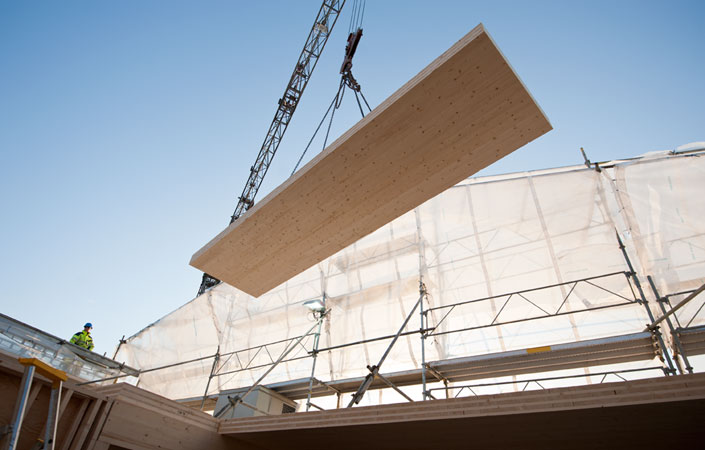
Segezha Group (affiliated to Sistema JSFC) and Sokol Timber Company JSC, Russian leader of housebuilding, have recently visited major European companies which manufacture equipment for the production of glued beams, bars and CLT-panels in Germany, Austria and Switzerland.

Sokol is negotiating the purchase of equipment for the creation of the first plant for the production of CLT-panels for multi-storey wooden house construction in Russia, against the backdrop of the European wooden house construction market boom. The company structures plans to start the construction of the workshop for the CLT production in 2018, with an investment of about 1.5 billion rubles.

Plant representatives held a series of working meetings with the manufacturers of modern industrial equipment Weinig AG and Minda Industrieanlagen GMbH.

We are working in a close contact with the leading European manufacturers of equipment for wooden house construction for about 1.5 years. Designing the plant, an innovative one, is a difficult and very interesting task,” said Segezha Group Vice President, Head of the Housebuilding Division Dmitry Rudenko. “I am sure we will soon launch a new production of cross laminated timber panels, with strengthening the leadership position of the Sokol Timber Company in the market of wooden house construction.”

Wooden house construction was named in Russia in 2018 as one of the priority areas of the Forestry Development Strategy until 2030.

For more info:

Segezha Group builds CLT plant in Vologda region, Russia

Bergs Timber’s Vika Wood to expand production capacity at sawmill in Latvia

The Latvian wood-processing company Vika Wood has been recently granted a long-term loan of EUR 7.5 million by SEB Banka.

Vika Wood will use the loan and own funds to purchase an automated sawn timber sorting line. The investment in the new laser-based equipment will significantly improve efficiency of the sorting process, as reported by LETA Latvian News Agency.

With the help of the loan, Vika Wood will also build a new production building to house the automated sorting line which is to be put into operation by the end of this year.

"Well-timed investments in modern technologies will enable us to further improve production efficiency, to expand the range of products and to strengthen the company's position with a view to continuing business growth," said Haralds Kronbergs, CEO of Vika Wood.

SEB Banka's Board Member Ints Krasts said that Vika Wood would become the first Latvian company to use this type of automated sorting line and that the new equipment would boost the saw mill's productivity and competitiveness not only in Latvia but also in a broader region.

In 2017, Vika Wood generated EUR 58.657 million in turnover, which was by 1.7 percent less than in 2016, but its profit rose 80.1 percent year-on-year to EUR 5.346 million.

At the end of March this year, SEB Banka was the third largest bank in Latvia in terms of assets, according to the Latvian Association of Commercial Banks.

EU aims to achieve a 32% share for renewable energy by 2030

On 27 June 2018, EU ambassadors endorsed the provisional agreement reached by the Bulgarian Presidency on the revision of the renewable energy directive.

Negotiators of the Bulgarian Presidency reached a deal with the European Parliament at the fifth trilogue meeting, in the early morning of 14 June. The endorsement means that the Council has approved the deal.

This new regulatory framework will pave the way for Europe's transition towards clean energy sources such as wind, solar, hydro, tidal, geothermal, and biomass energy. It will also allow Europe to maintain its leadership role in the fight against climate change and in meeting the goals set by the Paris Agreement.

The agreement sets a headline target of 32% energy from renewable sources at EU level for 2030. There is a clause to review this target in the event of changes in demand of energy consumption and to take account of the EU's international obligations.

A range of sustainability criteria are set for both agricultural biomass and for forest biomass based on a risk-based approach:

a) Sustainability criteria are in place and enforced at national level;

b) If not, sustainability criteria have to be ensured at sourcing level.

Biofuels, bioliquids and biomass fuels used for compliance with the Union target laid down in this Directive, and those which benefit from support schemes, should therefore be required to fulfil sustainability and greenhouse gas emissions savings criteria. In order to minimise the risk of using unsustainable forest biomass for the production of bioenergy operators should put in place a risk-based approach (the Commission will develop correlated operational guidance on the verification of compliance with the risk-based approach).

Art 26 states “Biofuels, bioliquids and biomass fuels produced from waste and residues, other than agricultural, aquaculture, fisheries and forestry residues, need only fulfil the greenhouse gas emissions saving criteria."

No further amendments are expected. As reported in the Council document, “if the EU Parliament will Parliament adopt its position at first reading, in the form set out in the compromise package, the Council would then approve the European Parliament’s position and the act shall be adopted in the wording which corresponds to the European Parliament’s position”.

The German sawmill industry reports good results for the beginning of 2018; outlook for the rest of the year very positive

The German sawmill industry was able to conclude the year 2017 positively, while during the course of the year the business situation of the companies had improved significantly. In particular, a good fourth quarter was recorded.

As the German Sawmill and Timber Industry Federation (DeSH) reports, the positive development in the sawmill industry has been helped by the further improvement in the macroeconomic environment. The German gross domestic product (GDP) was + 0.6% in the 4th quarter (after + 0.9% in the first quarter, + 0.6% in the second quarter and + 0.7% in the third quarter). Looking at 2017 as a whole, GDP grew + 2.5% yoy, ahead of the forecasts of the economics institutes.

There is also an improvement in the economy in Europe. There are impulses for growth from home and abroad, according to the DeSH. Overall, in the opinion of the association in the reporting period, the previously very tense earnings situation is likely to have slightly improved - with clear differences from sawmill to sawmill, depending on the regional conditions, the supply of raw wood and the price trend.

According to the German Federal Statistical Office, the sawmills with more than 50 employees, a total of 94 units, achieved a turnover of more than € 4 billion in 2017. Taking the smaller sawmills with more than 10 employees, the industry turnover for the last year 2016 stands at 5.06 billion euros and the number of companies at 334. These employed just under 17,400 people.

The SME statistics show that 1,800 small sawmills with a total of around 8,000 employees and 800 million euros turnover are not covered by the first two statistics.

Good start to the year 2018

After the good fourth quarter of 2017, theGerman  sawmills started well into the new year. The continued good overall economic development in Germany, but also in Europe, also favors the sawmill market. A further positive development of the construction industry due to the high demand for housing, especially in the metropolitan areas, and also due to the high level of immigration suggest that demand for construction products will continue to be good. The packaging sector, as an important customer, is also satisfactorily utilized so that further demand impulses can be expected here as well.

The hopes rest on a continued stable export to European countries and an improvement in exports to the Levant. Special expectations are placed on the remote export to Asia. The current domestic development in timber product ranges in the US could also make the North American market interesting again. Technically and economically, the German companies are well positioned and strive intensively for the sales markets.

Good prospects for 2018

The outlook for the sawmill and wood industry for 2018 continues to be very positive for DeSH. The German sawmill industry has already started from a high level in the year 2018 and was able to maintain the pace in the first months of 2018. The continued good overall economic condition of the German economy and the ongoing stabilization of the economy, even within Europe, suggest that both the domestic market and exports will remain a fixed component for the German sawmills.

Opportunities continue to result from the stable to rising housing construction activity in Europe. For example, EUROCONSTRUCT expects housing construction output in the European region to continue to increase until 2020, even though momentum will slow in the medium term.

Currently, about 22 million cubic meters of sawn timber are produced annually in Germany. Of these, 21 million cubic meters of softwood and 1 million cubic meters of hardwood lumber. The main customer for sawn timber is the construction sector in the widest sense, with a share of around two-thirds, followed by the packaging industry. A considerable proportion of lumber is also exported. An independent market segment are the sawmill by-products (sawdust, wood chips) that are an important raw material for other products of the pulp and paper industry, the wood-based materials and board industry as well as the pellet mill.

Stora Enso might convert Oulu mill in Finland

Stora Enso has started a feasibility study and an environmental impact assessment (EIA) for a possible investment in Oulu mill in Finland. The feasibility study and the EIA evaluate a potential conversion of the Oulu paper mill into packaging board production.

The feasibility study is expected to be concluded by the end of 2018, and the EIA process is expected to take a minimum of 6 months.

Currently, Oulu woodfree paper mill has a production capacity of 360,000 tons of chemical softwood pulp and 1 million tons of woodfree coated papers on two paper machines. The potential investment would include a new chemi-thermomechanical pulp (CTMP) plant, a brown-based cartonboard line with a capacity of 450,000 t/a and a kraftliner line with a capacity of 400,000 t/a.

The potential conversion of Oulu mill would enable Stora Enso to further improve its position in the growing consumer board and packaging solutions businesses and take a major step in its transformation. The other option is to continue the current fine paper production.

The production on the potential new lines would start during 2020. Paper production at Oulu Mill will continue at least until early 2020.

Shortage of Vietnamese eucalyptus plywood

Supply of Vietnamese eucalyptus plywood for crating is getting tight so the distribution volume in Japan is dropping considerably, reports the International Tropical Timber Organization (ITTO).

In Vietnam, construction of large plywood mills by the Chinese capital has started one after another. In April a plywood plant with monthly production of 25,000m3 has started operation near Hanoi and another one with monthly production of 12,000m3 is to start up near Hanoi.

These plants purchase eucalyptus veneer in large volumes as raw material so smaller plants manufacturing for the Japanese market are not able to have enough veneer, says ITTO.

The large plants use both eucalyptus and acacia veneer but a majority use eucalyptus. Manufactured products are interior materials for trailer and base materials for floor heating for the US and Korea. These items are much higher priced so the large plants are unlikely to manufacture low priced crating plywood for the Japanese market.

Purchase competition of raw material veneer pushes plywood prices up as high as US$310 per m3 cost & freight, and further increases are expected.

This level of price is way too much for the Japanese market, says ITTO, and importers in Japan think that this is not a temporarily price increase but governed by structural change so future supply is very uneasy.

CIFF Shanghai 2018 promises to be the biggest ever

The 42nd edition of CIFF Shanghai will be held at the National Exhibition & Convention Center (Shanghai), "NECC" Hongqiao from 10th to 13th September 2018 and will be conducted jointly by CFTE (China Foreign Trade Guangzhou Exhibition General Corporation) and Red Star Macalline.

Red Star Macalline is the undisputed leader in the Chinese furniture distribution sector. The Red Star Macalline has impressive statistics: bolstered by a domestic home furnishing market worth 4 trillion RMB, it manages 260 shopping centres scattered all over China, providing a total display surface area of more than 15 million square metres and annual sales of more than 78 billion RMB.

The records and figures of CIFF, the world’s largest furniture exhibition covering a total annual surface area of 1.15 million square metres is proof of its leading market position.

This year’s edition will tackle the topic of “an Example of the Global Home Life” and will be a real leap forward in terms of quality, services and events; the attendance of new high-end exhibitors, designers and major retailers from 29 provinces and 182 cities from all over China will help identify the real design trends in relation to consumer requests.

The Import & Design Hall and Trendy Furniture will feature an incredible display. As Chinese products are now ready to compete internationally, the two pavilions dedicated to imports and design will be combined, and will host companies of calibre such as Wei Mo, Kinetic Amber, Xiqi, Jade House, Glory Casa, Thomasville, Medea, Roche Bobois, Roberto Cavalli, Muuto, Lexington, Boconcept, ToninCasa, Rossini, La vie, Art De Vie and ELM Home.

At the pavilion dedicated to Trendy Furniture, visitors will be able to see brands such as: HC28, City.W, Roling, Artpeak, Juzhuo, Tesoro, Yupo, Western Art, Debrah, Beson, Zhongzhixin, LS, Apollo T, Jiudian, Heng Ju, HYO, Fuyuan, Youzun, Meiyaobang, Zhenzhimei and Fairytale, which will show the local design trends in both Chinese and non-Chinese in style.

Held in conjunction with the upcoming edition of CIFF Shanghai will be the first edition of the China International Furniture Machinery & Woodworking Machinery Fair (Shanghai). It is the outcome of the new partnership between CIFF and WMF, and will therefore cover the entire production chain of the sector, including all the main manufacturing technologies and processing machine types, wood-base panels and first-stage wood-processing equipment.

Numerous exhibitors will attend, the most significant of whom include: Homag, SCM Group, Weinig, Biesse, Jinan Restar, Nanxing, Foma Group, SWPM, Yalian, Siempelkamp, Wemhoener, LMT, Ruiwudi, Leke, Huajian, Yuantian, Lianrou, Hengkang, Fuyi and Xinqunli.

Now in its fourth edition, the EAST Design Show is unquestionably the essential Asian design promotion event, where the finest products take shape and amaze. The spirit of Asian artisanship is celebrated by the selection of leading companies and workshops. This year’s theme is “Difference Makes Products Meaningful”; a fascinating topic which can never explored sufficiently and is still relevant in this time of globalisation.

Held in China since 2017, the Pinnacle Awards Asia-Pacific, promoted by CIFF, American Society of Furniture Designers (ASFD) and High Point Market, is the only international furniture and home-furnishing prize in the Asia-Pacific region. Part of the Pinnacle Awards, Pinnacle Awards Asia-Pacific and CIFF work together in order to improve quality and design in China and Asia as a whole. Many events are scheduled to take place during CIFF Shanghai, including the Pinnacle Awards Asia-Pacific 2018 ceremony, when the winners of the 16 competition categories will be announced, and awards will be given to selected works by internationally renowned designers.

CIFF Shanghai will also mark the debut of The C Foundation Forum, an event that will group together professional operators from various sectors, such as design, art, and culture, providing a stimulating platform where ideas can be discussed. Established in 2014 by 10 interior designers from China, Hong Kong and Taiwan, (Qiu Deguang, Lin Xueming, Liang Jinghua, Liang Zhitian, Liang Jianguo, Chen Yaoguang, Jiang Feng, Dai Kun, Sun Jianhua and Ju Bin), the C Foundation Forum is the first volunteer charitable design foundation in China. The C Foundation Forum has continuously developed the "Seek Innovation, Boost Entrepreneurship and Jointly Create a Better Future" project, thus contributing to the development of educational programmes in cultural art design, architecture and interior design.

Another important debut is that of the Design Dream Show, an event created jointly by Red Star Macalline and Innovation Design Alliance, with the aim of expressing the concepts and trends in contemporary home furnishing.

Two different events, but both symbolise the development of Chinese design, mirroring a world that is changing rapidly; the fact that they are being held at CIFF Shanghai demonstrates the influence exerted by this fair in the design, culture and media spheres.

CIFF, together with Shanghai Promotion Center for City of Design, is also planning to launch design events in the two creative cities par excellence, Shanghai and Milan, thus fully exploiting the cultural and creative resources of Shanghai.

Angelina Forest Products plans to build $100 million sawmill in 2019

Angelina Forest Products announces plan to build a $100 million sawmill in Lufkin, Texas, US. This is part of a trend to save the town's economy, after the closure of Lufkin Industries.

"We think we're filling a need for the southern yellow pine lumber business, and being able to do it here in Lufkin, Texas is a great thing," said Stephen Raley, Angelina Forest Products Executive VP of Marketing and Sales. "We also feel there's a lot of talented labor in this area that we will be able to tap in to."

The decision to put a sawmill in, or near, Lufkin came after some research from the Texas A&M Forest Service.

"Our primary role is to determine is there enough wood out there for the mill," said Ed Dougal, Texas A&M Forest Service Wood Utilization Marketing specialist. "And most importantly is it sustainable into the futureWe have an abundance of forest in East Texas, as you know, and right now our growth and projected growth into the future exceeds our removals or usage of it in sawmills. So we certainly found...that there would still be enough saw log to supply the proposed mill."

The new sawmill will be built at Lufkin Industry's Buck Creek facility on Highway 69 just south of the city of Lufkin. Also, the sawmill will boost the local economy by not only creating 100 new jobs but it will also create a trickle down effect.

The sawmill is expected to be completed around March or April 2019, and production is expected start soon after.

EPA implements new regulation for composite wood products

The Environmental Protection Agency has determined that as of June 1, 2018, all imported and domestically-produced composite wood panels and products made with these panels must now be third-party certified as compliant with mandatory national formaldehyde emissions requirements under the Environmental Protection Agency’s (EPA) TSCA Title VI.

The Composite Panel Association (CPA) provided the following statement in support of these important regulations.

CPA and its North American member companies have been staunch advocates for EPA to finalize and implement these regulations as soon as possible and to establish strong enforcement that ensures a level playing field for all manufacturers producing or using composite wood, whether made in the U.S. or imported.

The day marked a major milestone in this effort to ensure consumers benefit from what is widely considered the most stringent formaldehyde emissions regulation in the world today. This is a great outcome for consumers and should mark the beginning of a ‘new generation’ of safer wood products in the U.S.

It should be remembered that recently the issue of formaldehyde emission from laminate flooring received a lot of media attention, alerting the general public as well as consumer protection organizations.

The topic became mainstream as a result of an investigation carried out by renowned journalist Anderson Cooper regarding the harmful concentrations of formaldehyde in laminated floors from China and imported mainly by Lumber Liquidators, the largest distributor of laminate flooring on the west coast of the United States.

US housing starts at the highest level since 2007

New residential construction in the US reported a significant rise in May, according to data released by the US Commerce Department.

Housing starts increased by 5% to an annual rate of 1.350 million in May, after dropping 3.1% to a revised rate of 1.286 million in April.

US housing starts reached their highest annual rate since hitting 1.354 million in July 2007.

The high rise in housing starts reflected significant increases in both single-family and multi-family starts. Single-family starts wentup by 3.9 percent to a rate of 936,000, while multi-family starts surged up by 7.5 percent to a rate of 414,000.

However, building permits, an indicator of future housing demand, dropped by 4.6 percent to an annual rate of 1.301 million in May after falling by 0.9 percent to a revised rate of 1.364 million in April.

EU plywood importers comment on FLEGT licensing

Asked about FLEGT licensed Indonesian plywood, many European importers say it had not had significant impact on their purchasing or sales.

One commented that this was related to lack of supply from Indonesia generally. Another said that they had recently seen an upturn in demand for marine ply from Indonesia. “But that’s been due primarily to the excellent quality from our suppliers,” he said.

Importers also cited customer’s preference for FSC and PEFC certification, with FLEGT licensing regarded as a ‘bonus form of legality verification’. “We still don’t believe that enough is known about FLEGT licensing or the wider FLEGT Voluntary Partnership Agreement initiative in the marketplace, particularly in terms of itson the ground impacts in the supplier country,” said an importer.

“We still need more communication on FLEGT generally, with awareness greater among our customers of Indonesia’s long-established SVLK timber legality assurance system, which became the TLAS of its FLEGT VPA, than FLEGT itself. Certainly, little is known of the sustainability aspects of FLEGT licensing.”

UK TTF Managing Director David Hopkins took up the themes of awareness and market impact of FLEGT licensing at the recent FLEGT Independent Market Monitoring Trade Consultation in Nantes, France at the end of May. He urged the EU industry to press their national governments to accept a FLEGT licence as evidence of full compliance with their timber purchasing policy, which currently only those of the UK and Luxembourg do.

“We actively promote the fact to the market that the UK government accepts a FLEGT licence as ‘Category A’ proof of legality and sustainability on a level with what we regard as branded certification businesses, FSC and PEFC,” he said.

The UK TTF has also taken steps to ensure Chinese plywood satisfies standards claimed in documentation and labelling. After a year-long review of the market, it has now established a new ‘plywood framework’ within its compulsory Responsible Purchasing Policy.

This demands that UK TTF members ensure third-party testing of glue bonds and obtain all relevant paperwork on suppliers’ factory production controls. The TTF stipulates too that all packs should be marked with product technical class and timber species used. It has also started a market education programme to tackle ‘ignorance about plywood classes and their application’.

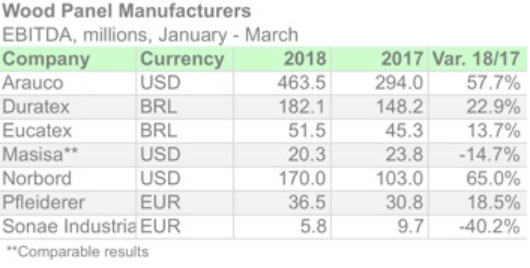
Norbord was the best wood-based panel manufacturer in the world for Q1/2018

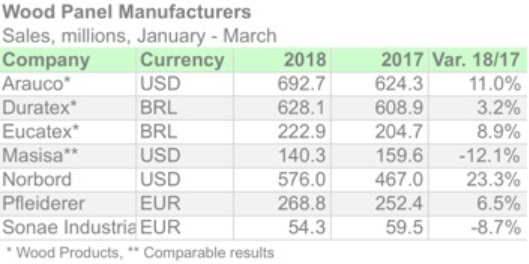
Canadian panel manufacturer Norbord stood out once again among its peers recording the best performance figures for Q1/2018 period.

This index is the product of the evaluation of the seven main international manufacturers of wood panels that publish comparable results: Arauco, Duratex, Eucatex, Masisa, Norbord, Pfleiderer and Sonae.

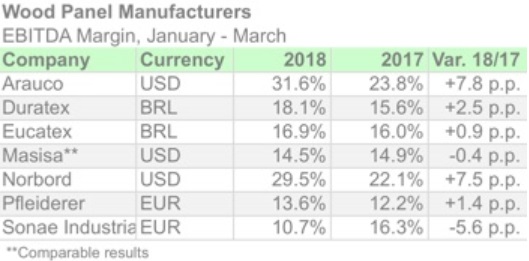
Compared to 1Q -2017 Norbord stood out in terms of sales growth (+23.3%) and EBITDA growth (+65.0%). Arauco had the greatest improvement in the EBITDA margin (+7.8 percentage points), slightly outperforming Norbord (+7.5 percentage points).

In sales growth Norbord was followed by Chile's Arauco and Brazil's Eucatex, with improvements of 11.0% and 8.9% each. Chilean Masisa recorded the largest drop in sales in 1Q-2018 (-12.1%), followed by the Portuguese Sonae Industria (-8.7%).

In 1Q-2018 Brazilian Duratex was third in terms of EBITDA growth (+22.9%), above Pfleiderer (+18.5 %%) and Eucatex (+13.7%). Whereas Sonae Industria had the biggest drop in EBITDA growth compared to the same period in 2017.

As for the EBITDA margin, after Arauco and Norbord, Duratex was third with an improvement of 2.5 percentage points. While Sonae Industria and Masisa saw their EBITDA margin drop by 5.6 and 0.4 percentage points respectively.


SCA starts production at the expanded Östrand pulp mill in Sweden

SCA began production at the expanded Östrand pulp mill in Sweden. The company will investing SEK 7.8 billion ($881 million) in the operation and the project is on budget and schedule.  

SCA decided in 2015 to invest in an increased production capacity at the Östrand pulp mill – from 430,000 tonnes to about 900,000 tonnes of bleached softwood kraft pulp (NBSK). Following an extended maintenance stop, which began in April of this year, the expanded pulp mill is now in operation.

Production capacity in the expanded pulp mill is expected to increase successively during 2018 and 2019. 2020 is therefore expected to be the first year with full production, corresponding to 900,000 tonnes.

Just over 1,000 days after starting the project on August 28, 2015, after a great effort from all involved to deliver the project according to the plan, the new plant is in operation,” says Project Director Ingela Ekebro. “Our focus now is on calibrating the plant to quickly achieve full production and high product quality.

Based in Sweden, SCA produces solid-wood products, pulp, kraftliner, publication papers and renewable energy.

Homag to boost production capacity in Germany

The Homag Group has expanded the production capacity of the Schopfloch, Germany site by commissioning a hall in neighboring Horb.

The hall with a usable area of more than 5,000 square meters was rebuilt in just under three months to meet the needs of Homag. The company uses the hall for final assembly and commissioning of large plants. For this, pre-assembled machine components are delivered from Schopfloch.

In order to minimize the throughput time, the machines and systems are already put into virtual operation on the computer in a parallel pre-process. At the so-called “digital twin” the function as well as the interfaces between the machine components are tested before the construction of the real machine. Around 30 employees work on a project-related and temporary basis in the hall.

In particular, the assembly of our large systems requires a lot of space,” explains Dr. Michael Merz, Plant and Site Manager in Schopfloch. “To relieve our plant in Schopfloch, we have found the perfect solution with the hall in Horb. The machines and systems can be retracted here and accepted by the customers.

The technical infrastructure of the hall, which was initially leased for three years by Immo Horb GmbH, is comparable to the plant in Schopfloch. There will be a total of eight cranes in the hall and a 100 megabit broadband connection will be available from July.

Hasslacher Group expands its presence in Slovenia

With effect from June 22, 2018, the Hasslacher Group has strengthened its involvement in neighboring Slovenia. The strategic partnership that has existed since 2009, with an initial 35% stake in the formwork panel plant LIP BOHINJ doo, had already been increased to 75% in 2015.

Hasslacher has now expanded its stake to 100%, thereby completely taking over the work. Bojan Resman, who has been managing the business of LIP BOHINJ doo since March 2018, has been confirmed as Managing Director.

After the takeover, Hasslacher intends to expand further in Bohinjska Bistrica and develop the location in order to expand its market activities in Southeastern Europe, explains Christoph Kulterer, CEO of the Hasslacher Group.

Alojz Burja, director of door manufacturer LIP BLED doo, who previously held the remaining 25% in LIP BOHINJ doo, said the company could not invest on two fronts. Therefore, they want to focus clearly on the area of ​​the interior doors and invest there.

LIP BOHINJ has been producing shuttering panels at the Bohinjska Bistrica site since 1961. The annual capacity is around 1.5 million m² of formwork panels, the incision amounting to around 80,000 fm of roundwood per year. The LIP BOHINJ site employs around 230 people.

The Hasslacher Group employs more than 1,500 people at eight production sites in Austria, Germany, Slovenia and Russia.

EU plywood imports negatively impacted by supply constraints

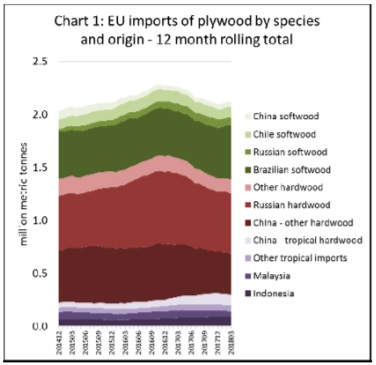
Analysis of latest trade figures for plywood supply to the EU tally with importers’ comments. Total EU plywood imports have picked up a little this year, hitting 686,000 cu.m in the first quarter, nearly 5% more than the same period in 2017. However, supply constraints have meant that imports are still well below levels prevailing two years ago in 2016. 

Lack of supply has been a significant drag on EU imports of tropical hardwood plywood this year. Imports from all the EU’s leading tropical suppliers except Indonesia declined in the first quarter of 2018.

The volume of EU plywood imports from Indonesia increased only slightly, by 0.3% to 23,000 tonnes, in the first quarter of 2018. However, import value from Indonesia fell 10.9% to euro23.9 million during the period.

In the first quarter of 2018, EU imports of tropical hardwood plywood from China contracted 16.5% by value to euro16.5 million and 5% in volume to 26,900 tonnes, and Malaysia’s were down 40% to euro8.4 million and 36% to 11,350 tonnes.

Imports from Gabon were 37% lower by value at euro4.6 million and 37.5% by volume to 3,250 tonnes, and from Morocco down 29% by both value and volume to euro1.9 million and 1,137 tonnes.

Together with other sources, this meant total first quarter EU tropical plywood imports were 23% lower by value at euro61.9 million and 15% by volume to 74,029 tonnes.

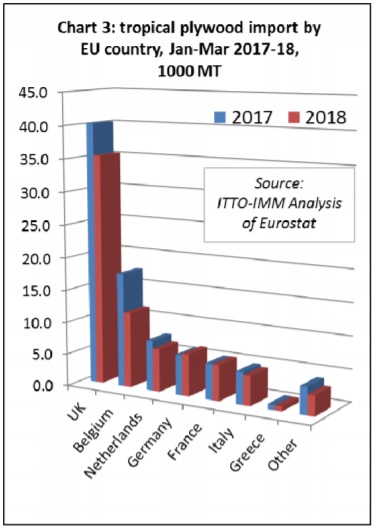
By individual EU country, in the first quarter of 2018, imports of tropical plywood declined in the UK by 12% to 35,331 tonnes, Belgium by 34% to 11,630 tonnes, Netherlands by 15% to 6,601 tonnes, Italy by 8% to 4,592 tonnes and Greece by 7% to 723 tonnes.

In contrast, German imports increased 5% to 6,480 tonnes and French imports were up 32% to 5,530 tonnes in the first quarter of 2018. (Chart 3).

Amazon likely to become no.1 furniture retailer in the United States

Wayfair, the largest specialized online furniture retailer in the U.S., redoubled its efforts in search and TV advertising last year in order to dominate the Google results page – but Wayfair’s biggest competitor is not brick-and-mortar chains, it’s Amazon.

According to a report released by One Click Retail, Amazon already holds the largest market share in this space, having tripled its sales in the category since 2015. In 2017, the e-commerce giant grew its U.S. furniture business 51% from the year before to USD 4 billion.

Last year, Amazon invested in Furniture with a brand new comprehensive marketing site – Amazon Home – the building of four new warehouses focused on delivering large furniture and appliances, and the release of two private furniture brands, Rivet and Stone & Beam. As a result, the YoY growth rate continued to climb, reaching 51%.

For some perspective, that USD 4 billion figure would likely make Amazon No. 2 in the nation. Ashley HomeStore was the No. 1 retailer on Furniture Today’s Top 25 ranking last year with 2016 furniture estimated at USD 3.7 billion. The 2017 Furniture Today sales ranking won’t be released until August.

It’s clear that the furniture market is a valuable investment for Amazon, and it’s equally true that Amazon is a valuable investment for furniture brands. The retailer’s large and loyal base of Prime members are not likely to shop at another online retailer if they don’t have to, and Amazon’s investments in logistics, private brands and new technologies are growing this base. The company already holds the largest market share of online furniture sales and is likely to capture the bulk of future growth in the long term. Furniture brands looking to compete in eCommerce, the industry’s fastest-growing space, need to begin at Amazon.

Moody’s upgrades global paper and forest products industry outlook to ‘positive’

Moody’s Corporation, bond credit rating business Moody’s Investors Service, has released a report which has changed the outlook for the global paper and forest products industry to ‘positive’ from ‘stable’, reflecting higher prices and lower recycled fibre costs across most subsectors of the industry in most regions.

The outlook report has projected consolidated operating income growth in the mid-single digits in the next 12 to 18 months.

Among regions, the ratings agency has changed the outlooks for the North American, European and Latin American paper and forest products industries to positive from stable.

Other subsectors which outlooks have been upgraded to positive are the North American and European paper packaging subsectors, the North American, European and Latin American pulp subsectors, and the North American printing and writing paper subsector.

However, the agency did not alter the outlook for the North American timber and wood products, which remains stable.

Moody’s senior vice-president Ed Sustar said: “Our positive outlook for the global paper and forest products industry reflects higher-than-expected market pulp, paper packaging and printing and writing paper prices.

“As a result, the 42 paper and forest products companies we rate globally should see consolidated operating income growth of 4%-6% over the next year or so, while G-20 GDP growth of just over 3% through 2019 will support demand and resulting higher prices.”

According to Moody’s, the consolidated operating income for the 26 rated North American paper and forest product companies is estimated to increase 4%-6% over the next 12-18 months, driven by stronger earnings from paper packaging, market pulp and timberland.

These companies rated by Moody’s contribute around 60% of the operating income of the global rated industry.

Likewise, the ratings agency is also forecasting a 4-6% growth in operating income for the 11 rated European paper and forest product firms, which account for nearly a quarter of the global rated industry’s operating income, over the next 12 months.

The projected growth has been attributed to several factors such as higher prices for specialty paper, paper packaging, pulp, tissue and wood products, as well as increased volume across all subsectors except graphic paper.

European paper packaging firms Smurfit Kappa Group, Metsa Board and Mondi are projected to benefit from ongoing productivity improvements and slightly stronger demand and prices, the report noted.

In Latin America, the anticipated growth rate for the five rated producers in terms of operating earnings is 6%-8%, supported by strong BEK pulp prices and higher volumes from Fibria Celulose’s 1.95 million tonne pulp mill recent expansion.

Meanwhile, Brazilian pulp and paper company Suzano Papel e Celulose is expected to witness growth in its earnings due to rising output at its two new tissue production lines.

Wood pellet production in the US on the rise

Pellet production in the US amounted to 406,380 tonnes of pellets for the heating market and 1,431m tonnes of industrial pellets during January-March 2018.
Also, the pellet production totaled 1.837m tonnes, according to surveys by the U.S. Energy Information Administration (EIA) at the U.S. Department of Energy.
This represents a 12.1% increase of production of pellets for the heating market and a 4.9% growth for the production of industrial pellets. Overall, pellet production rose by 6.4%, as compared to the Q1/2017.
During the mentioned period, there were 12% less pellets sold on the domestic market, amounting to 495,149 tonnes. Moreover, the sales prices declined by 1%, to $152.36/tonne.
The sales volumes of industrial pellets rose to 1.256m tonnes, almost at the same level as in the Q1/2017, while the average selling prices rose significantly by 20.2% to $169.51 per ton.

Newsletter

Subscribe to our digital newsletter for your daily digest of essential news, views and analysis from the international wood industry delivered directly to your inbox.


0