Article archive

Sweden plans 31 CLT towers in Stockholm

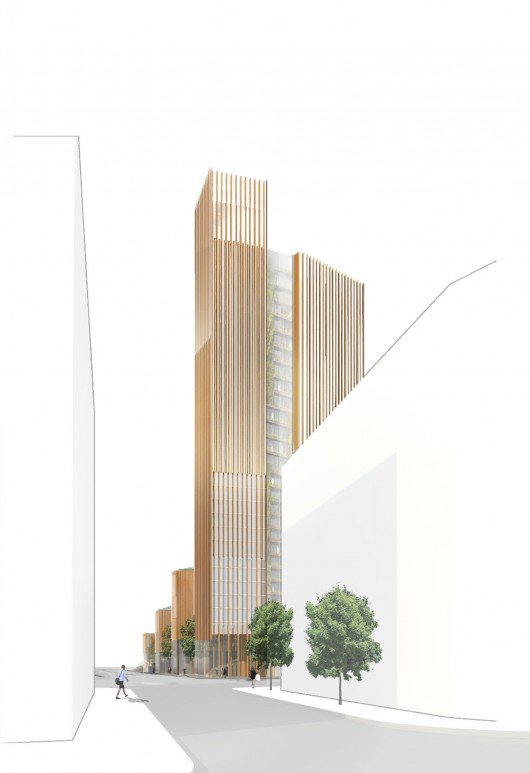
Swedish architects are planning a housing development on Stockholm's waterfront featuring 31 cross-laminated timber (CLT) towers.

Designers Anders Berensson Architects were commissioned by the political group Stockholm Centre Party to conceive a sustainable district for the Swedish city. The development is a collection of towers and sky bridges built on top of the existing waterfront neighborhood of Masthamnen. The plan would leave the buildings below relatively untouched but would cap them with a public park and walkway level over which the new towers would rise.

The designers embraced wood as a building material because it “releases the least carbon dioxide.” Renderings show interiors and exteriors clad with wood finishes, and the architects describe the buildings using mass timber technologies like cross-laminated timber (CLT).

Made of the CLT, the 31 towers will be between 25 and 35 stories and spread across an area of 19 blocks. In addition to homes, the buildings will contain more than 90 shops and restaurants.

The imaginative scheme is meant to provide additional housing close to the center of Stockholm, where the housing market is tight and space is expensive. There are no apparent plans to enact the proposal. The Center Party has worked with Berensson before on speculative designs for the city, many of which have included timber high-rises. The party has relatively little power to realize these ideas as they are the opposition party in the city’s government, which is controlled by the Social Democrats.

Timber has received a lot of attention in Sweden as a structural material for high-rises, although it’s not clear what the country has been able to realize so far. Globally, mass timber is starting to make inroads as a standard building technique, but it faces a long road to widespread adoption in the U.S.
Softwood lumber prices in US continue to drop sharply

Downward momentum eased in some framing lumber species in US. But even with quarter-end pressure to sell behind them, producers in the West continued to open to steep counters to draw in orders. Deep cuts were more spotty, but a few remained in the $30-50 range.

The Random Lengths Framing Lumber Composite Price fell an additional $16 for the week. Traders noted that the downturn was the most severe they have seen in their careers, and an analysis of the plummet backed that up.

This Week
Oct 5
Last Week
Sep 28
Year Ago
2017
Random Lengths Framing Lumber Composite Price* $389 $405 $440
KD Western S-P-F #2&Btr 2x4 R/L Mill Price 342 350 436
KD Eastern S-P-F #1&2 2x4 R/L, delivered Great Lakes 445 470 546
Green Douglas Fir Std&Btr 2x4 R/L (Portland) 310 340 472
Southern Pine (Westside) #2 2x4 R/L 487 492 427
KD Coast Hem-Fir #2&Btr 2x4 R/L 355 375 465
Ponderosa Pine (Inland) #2&Btr 1x12 R/L 775 775 690
* Weighted average of 15 key items

Random Lengths Panel Market Report

Structural panel prices plunged amid weak demand and abundant supplies. Downward price pressure accelerated in OSB, and thin order files prompted producers to lower quotes sharply or open to steep counters. Another week of slow sales intensified downward price pressure in Southern Pine plywood. Mills struggled to compete for the few orders that circulated. Western Fir plywood producers and secondaries struggled to find trading levels, and reported one of the lightest weeks of sales in memory.

(f.o.b. mill prices) This Week
Oct 5
Last Week
Sep 28
Year Ago
2017
Random Lengths Structural Panel Composite Price* $448 $467 $536
Southern (west-east) 15/32-inch 3-ply rated sheathing plywood 445-490 465-510 507-528
Southern (west-east) 15/32-inch 4-ply rated sheathing plywood 450-495 470-515 512-530
Western 1/2-inch 4-ply rated sheathing plywood 447 461 525
North Central 7/16-inch Oriented Strand Board 310 335 452
*Weighted average of 11 key items


Demand from China pushes up Russia’s exports of softwood lumber

Increased exports of softwood lumber from Russia to China the past decade have resulted in higher timber harvests in Eastern Russia. In 2017, Russia’s total harvest reached an estimated 190 million m3, six percent higher than the previous year. Practically all of the increase was in Russia’s eastern provinces. Continue reading "Demand from China pushes up Russia’s exports of softwood lumber"

Forecast: Finland's softwood lumber exports to drop this year due to slow Chinese demand

The production volume of sawn goods will increase 1–2 percent in 2018. Export of pine timber will increase, but that of spruce will fall. The decline is due to a significant fall in exports to China early this year. The overall export demand for sawn goods is supported by the favourable economic situations and growth of construction investments in practically all key export countries.
Around 77 percent of Finnish sawn goods production will go to export in 2018. Export prices of sawn goods will be boosted by strong demand and inflation this year and the next. Continue reading "Forecast: Finland's softwood lumber exports to drop this year due to slow Chinese demand"

Forecast: Finland’s softwood lumber exports to drop this year due to slow Chinese demand

The production volume of sawn goods will increase 1–2 percent in 2018. Export of pine timber will increase, but that of spruce will fall. The decline is due to a significant fall in exports to China early this year. The overall export demand for sawn goods is supported by the favourable economic situations and growth of construction investments in practically all key export countries.

Around 77 percent of Finnish sawn goods production will go to export in 2018. Export prices of sawn goods will be boosted by strong demand and inflation this year and the next. Continue reading "Forecast: Finland’s softwood lumber exports to drop this year due to slow Chinese demand"

Overview of China’s first half 2018 wood products trade

Data from China Customs shows that in the first half of 2018 the value of China’s wood products trade totalled US$80.97 billion, up 9% from the same period of 2017 but this was a slower growth than in the first half of 2017.

Of the total, the value of exports in the first half rose 6% to US$39.1 billion. China’s traders accelerated their wood product exports to beat the introduction of tariffs by the US.

The value of imports of wood products rose 13% to US$41.9 billion in the first half of 2017, down 9% year on year. Overall the pace of China’s wood products imports was slower in the first half of 2018.

Main wood product imports

Logs: In the first half of 2018 the volume of China’s log imports totalled 30.32 million cubic metres valued at US$5.8 billion, a year on year increase of 17% and 28% respectively.

Sawnwood: In the first half of 2018 the volume of China’s sawnwood imports totalled 18.15 million cubic metres valued at US$5.2 billion, a year on year increase of 0.1% and 9% respectively.

Wood pulp: In the first half of 2018 the volume of China’s wood pulp imports totalled 12.35 million tonnes valued at US$9.8 billion, a year on year increase of 2% and 33% respectively.

Main wood product exports

Wooden furniture: The value of China’s wooden furniture exports fell slightly to US$10.8 billion in the first half of 2018.

Plywood: In the first half of 2018 the volume of China’s plywood exports was 5.6 million cubic metres valued at US$2.7 billion, a year on year increase of 0.6% and 7% respectively.

Fibreboard: In the first half of 2018 the volume of China’s fibreboard exports amounted to 893 000 tonnes valued at US$557 million, a year on year decrease of 19% and 4%.

Russia: Birch logs export restriction to help domestic plywood industry

On July 17, 2018, the Chairman of the Government of the Russian Federation, Dmitry Medvedev, signed Resolution No. 836 “On the introduction of a temporary quantitative restriction on the export of logs from birch outside the territory of the Russian Federation to states that are not members of the Eurasian Economic Union”.

In accordance with the Federal Law “On the Basics of State Regulation of Foreign Trade Activity” from January 1, 2019 to June 30, 2019, a quantitative restriction (quota) on the export outside of Russia of plywood raw materials with a diameter of at least 15 cm and a length of at least 1 m (code 4403 95 000 1 TN EED EEU) was set.

Export quotas were introduced to overcome the shortage of raw materials on the basis of analyzing the market for birch plywood raw materials and monitoring the supply of raw materials to Russian plywood enterprises, which resulted in a negative trend in providing plywood raw materials for processing industries and an increase in exports of these raw materials to China.

“The regulatory legal act was adopted very timely,” stated Yevgeny Batalov, Vice-President of the Segezha Group, Head of the Forest Resources and Woodworking Division.

The tendency of development of production capacity in the plywood industry in Russia in recent years has shown a decrease in raw materials. The highest quality raw materials were exported abroad, and Russian factories reduced the output of high-quality plywood, replacing it with low, less marginal varieties. In the face of fierce competition with exports, the cost of plywood in the domestic market of the Russian Federation has reached the level of export prices.

“The rise in prices for plywood raw materials is far ahead of the growth in prices for plywood, which reduces the competitiveness of Russian enterprises on the world market,” commented Segezha Group's Director for Government Relations, Nikolai Ivanov.

Segezha Group also supports restrictive measures due to the fact that the available reserves of plywood raw materials in the European part of the country are constantly decreasing. Also increases the distance of delivery of raw materials to the plants. For the production of plywood a company requires the highest quality and largest raw materials, which are found in planted forests only in limited quantities.

Russia, Germany and the Nordic countries boost lumber exports; high demand in Asia and Europe

Worldwide trade of lumber inched up again in early 2018, hinting that this may be another record year. Six of the ten largest lumber-exporting countries in the world have increased their shipments in 2018, with exports from Russia, Germany, Ukraine and Austria increasing the most year-over-year.

The biggest decline in exports y-o-y has been from Canada, with shipments in 2018 on pace to be the lowest in five years. Canadian shipments to China and the US during the 1H/18 were down 19% and 6% respectively, as compared to the same period in 2017.

Lumber markets – North America

Lumber prices in the US have been on a roller coaster ride the past year, with sharp increases during the 2H/17 and early 2018 followed by plunging prices during the summer months of 2018. The dramatic price fluctuations are mostly a reflection of changes in the strength of the US housing market.

US lumber production was up 5.5% in the first four months of 2018 as compared to the same period in 2017. The biggest increase came in the US West (+10%), while the rise in the US South was more modest (+2.1%). Canadian lumber production was down 1.2% for the first four months, with British Columbia’s sawmills running 4.3% below last year’s production levels.

Lumber markets – Northern Europe

From 2016 to 2017, lumber exports from Finland increased 8.7%. However, export volumes were 3.5% lower in the first four months of 2018 than in the same period in 2017. So far this year, Saudi Arabia (-49%), China (-25%) and the United Kingdom (-6.7%) have seen the biggest declines in volumes shipped.

The annual export volume of softwood lumber from Sweden in 2017 was 13 million m3, practically unchanged from 2016, and the pattern held true in early 2018 (year-over-year). The biggest changes in exports from 2017 and 2018 have been declines in shipments to Egypt and Japan and increased exports to European customers.

Lumber markets – China

Russia supplied China with record volumes of softwood lumber in the 2Q/18, while imports from the US and Europe were down from the 1Q/18. Lumber producers in Siberia and Russia Far East have continuously increased their market share of total lumber imports to China over the past few years, increasing from about 36% in 2011 to 56% in 2018. The rise in shipments of softwood lumber from Russia to China in the past seven years has come at the expense of log exports. Import prices for lumber plateaued in the 2Q/18 after steadily increasing since early 2016.

Lumber market – Japan

Softwood lumber import volumes to Japan were up 6.7% q-o-q, reaching almost 1.6 million m3 in the 2Q/18. This was the second highest quarterly import volume in four years. During the 1H/18 there have been only minor changes in the sourcing of lumber. Prices (in Yen terms) for both domestic and imported softwood lumber have remained practically unchanged in Japan in 2018, but with the weakening domestic currency, costs for lumber in US dollar terms have fallen.

Metsä Wood inaugurates birch plywood mill in Estonia

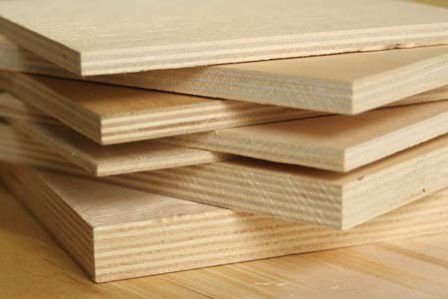
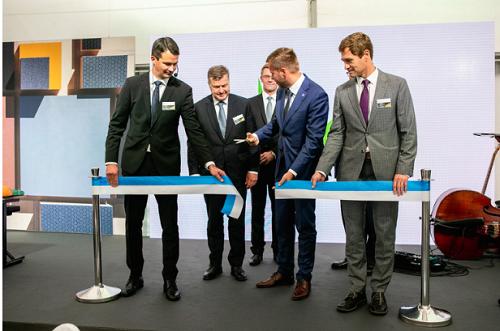
Metsä Wood’s new birch plywood mill inaugurated in Pärnu, Estonia. The investment in the birch plywood mill in Pärnu is worth Euro 55 million. Once the mill is operating at full capacity, it will employ around 200 people.

As Metsä Wood says, the Pärnu mill is a strategically important investment in birch plywood speciality products. The most important applications for birch plywood include construction and transport industry, which are increasing globally as a result of enhanced urbanisation.

“Metsä Wood has been implementing its industrial efficiency strategy for five years, to great effect. The inauguration of the birch plywood mill in Pärnu is the culmination of the company’s Euro 100 million investment programme, which improves production excellence and competitiveness in the market. Today, we are witnessing another new beginning for Metsä Group’s strong growth,” said President and CEO Ilkka Hämälä.

The annual production capacity of the Pärnu birch plywood mill is 50,000 cubic metres. This increases Metsä Wood’s total net production capacity by around 30,000 cubic metres.

The birch plywood mill in Pärnu uses birch veneers as a raw material. The veneers are produced in Äänekoski in central Finland. The wood is acquired from Finland, mainly from the forests of Metsä Group’s owner-members.

The Pärnu mill is expected to reach its full capacity during 2019.

Falling trend in EU imports of Chinese wood furniture

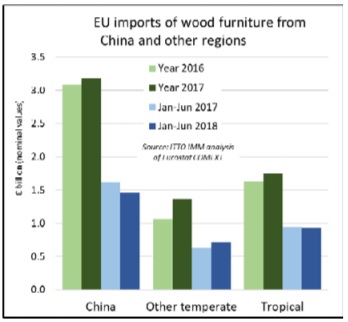
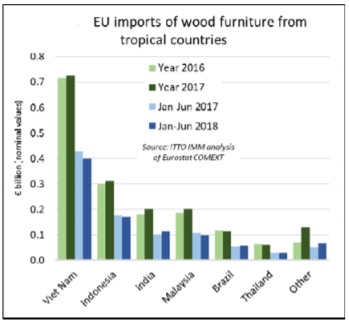
After making gains last year, EU wood furniture imports from tropical countries and China fell in the first 6 months of 2018. EU imports from tropical countries decreased 2% to €940 million, while imports from China fell nearly 10% to €1.46 billion.

In recent years China’s competitiveness in the EU wood furniture market has been impeded as prices have risen on the back of growing domestic demand and new laws for pollution control pollution in China. EU furniture importers also continue to question the variable quality of product imported from China and some have struggled to obtain the legality assurances required for EUTR conformance when dealing with complex wood supply chains in China.

Meanwhile EU imports of wood furniture have continued to rise from other temperate countries, mainly bordering the EU. EU imports from these countries increased 14% to €720 million in the first 6 months of 2018, building on a 28% gain recorded the previous year. The biggest gains are being made by Ukraine, Bosnia and Serbia.

The main South East Asian supply countries have all followed a similar trajectory in the EU wood furniture market in the last 18 months. A rise in EU imports last year was followed by a decline in the first six months of 2018.

After increasing 1% to €730 million in 2017, EU imports from Viet Nam fell 6% to €400 million in the first six months of 2018. Imports from Indonesia increased 4% to €311 million in 2017 but fell back 4% to €171 million in the first six months of 2018. Imports from Malaysia increased 10% to €203 million in 2017 and were 8% down at €99 million in the first 6 months of 2018.

In contrast, EU wood furniture imports from India have continued to rise, up 12% to €103 million in the first six months of 2018 after a 12% increase to €202 million for whole of 2017. Imports from Brazil bounced back in the first half of 2018, rising 4% to €57 million, after declining 5% to €112 million for the whole year 2017.

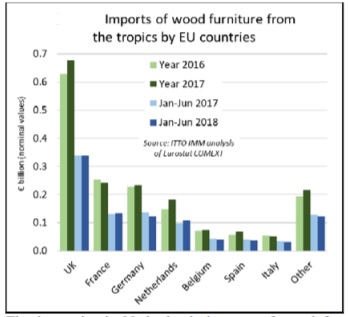
There were also shifts in the destinations for wood furniture imported into the EU from tropical countries in the first half of 2018. Imports in the UK, the largest market, were €339 million between January and June 2018, unchanged from the same period in 2017.

However, in the first half of 2018 there was a sharp fall in imports of wood furniture from the tropics by Germany (- 11% to €123 million), Belgium (-8% to €39 million), Spain (-12% to €37 million), and Italy (-4% to €31 million). These losses were partly offset by rising imports in France (+1% to €134 million) and Netherlands (+12% to €109 million).

The large rise in Netherlands imports of wood furniture from tropical countries in the first half of 2018 may be related to the wider trend, mentioned earlier, to centralise procurement functions within the EU, contributing to a greater share of wood furniture trade passing through Dutch ports.

European parquet market continues to grow; worries on US-China trade war

The Board of Directors of the European Federation of the Parquet Industry (FEP) met on 20 September 2018 and discussed amongst others the parquet situation and recent economic developments on the European markets.

When compared to the same period last year, the provisional results for the first semester of 2018 point to a continuation of the moderately positive parquet consumption trends, with a stable development or a slight growth. Exceptions are Germany, Norway and Switzerland which are reporting decreases in sales. Nevertheless, the situation is meanwhile already improving on the German market and in Norway as well. Furthermore, Eastern Europe is at present also showing encouraging trends.

Despite the growing competition from the furniture sector wood is still available, though costs are increasing and small strips are lacking. Due to the climatic conditions, oak is becoming increasingly rustic and first shortages of fine grades are felt.

The Board of Directors of FEP underlines the potential threat for the EU as a consequence of the current “trade war” on tariffs between the US and China. In this context, one could imagine a growing pressure as regards imports of foreign products on the European markets.

Market overview

Austria The Austrian parquet consumption progresses further during the first semester of 2018 compared to the same period last year.

Belgium The information available point towards a stabilisation of the parquet sales during the first six months of 2018.

Denmark Compiled data show that the Danish parquet market is flat to slightly negative.

Finland Parquet sales slightly rise on the Finnish market, reflecting the influence of projects and the improvement of the general economic context. On the other hand, retail is experiencing less positive developments.

France The French market continues to develop slightly positively during the first half of 2018, with the exception of solid parquet.

Germany Although the situation has now started to improve, the German parquet consumption fell during the first six months of 2018 compared to the same period last year.

Italy The increase in Italian parquet sales has been somewhat slowed down by the elections, except in the region of Milan. A recovery is expected by the end of the year

Netherlands The information received point to a stabilisation on the Dutch market during the first half of 2018.

Norway Compiled data indicate that the Norwegian market decreased significantly during the first six months of 2018. However, the situation has meanwhile already improved.

Poland A moderate improvement of the Polish consumption of parquet during the first half of 2018 is reported.

Russia Board members consider that the market remains weak in Russia, where cheaper flooring solutions have more success than parquet.

Spain The Spanish parquet consumption remains flat for the whole first semester of 2018. While the year has started well, the market is now decreasing due to the preference for “low ends” projects and the slowing down in retail and residential sectors.

Sweden In Sweden, parquet consumption rises further during the first half of 2018. Small positive developments are observed despite the subdued activity for residential buildings and the decrease in “high ends”. The positive developments reflect the growth in new buildings.

Switzerland Parquet consumption declines in Switzerland during the first six months of 2018.


Swiss Krono to expand plant in Barnwell, US

A $200+ million, 250,000 square-foot expansion of the Swiss Krono plant in Barnwell, South Carolina has been enabled by National New Markets Fund, The Innovate Fund, Dakotas America and SunTrust Community Capital, which allocated $17 million, $11.25 million, $10 million and $7 million, respectively, in New Markets Tax Credits.

The project includes the construction of a new multi-density fiberboard manufacturing line, ancillary wood yard, energy plant and waste treatment facilities, and the installation of a fourth laminate flooring line.

Since establishing operations in Barnwell County in 2005, the company has purchased 100% of the high and medium density fiberboard it uses from out of state sources. The addition of a multi-density fiberboard manufacturing line will allow Swiss Krono to vertically integrate its business, resulting in substantial operational cost savings. In addition, Swiss Krono will source its wood products locally.

Brazilian Ipe in short supply; prices up by 20%

Some of the largest exotic lumber companies in the United States ran out of much of their Ipe inventory. What people do not always understand about Ipe is that there is different times of year that the lumber is heavily purchased and brought out of the forest.
The climate, rain, and rivers do not allow for its exportation easily year round. A lot of people are unaware that there are these seasons to purchasing Ipe hardwood is based on these factors. The cruel irony is that while Ipe is the most highly sought wood in the United States for decking, the season that it is historically cheapest to purchase and most available is the exact opposite in Brazil. This has little to do with the demand and everything to do with the availability in Brazil.
Importers have to determine supply and demand in advance to ensure a successful year. This year the price of Ipe rose in most circumstances over 20%. The demand every year is higher but the availability does not seem to be increasing. Making Ipe more and more valuable than ever before.
We are seeing in Brazil that while historically the prices decline in 4th Quarter and 1st Quarters of the years this year may be very different. For a wood that lasts 3 times longer than most any other wood, it is no wonder that the demand is so high. Early this year Ipe Woods USA, President issued an email to be disseminated to its customers warning them of this price hike. Some companies did heed these warnings and bought before the prices went up, while others thought perhaps it was a ploy to make a faster sale. Regardless, the prices did go up and it left some contractors and projects in jeopardy or looking for a cheaper alternative to Ipe.
Ipe Woods USA also issued a warning on their site. Telling people to watch out for quotes from companies that had no inventory. It doesn't matter how much they are quoting on lumber they don't have. Shortly after this warning was made public one of the competitors started adding a disclaimer to their quotes.
What will be in store for 2019? Time will tell, but no matter what happens Ipe is still king. People that want the best find it worth it to pay the extra and ensure a deck that can last a lifetime. After reviewing many of the competitors online we see that some companies have left their pricing to appear low, these are the same companies that have no inventory also. So it will be interesting to see what happens when they finally get stock back.

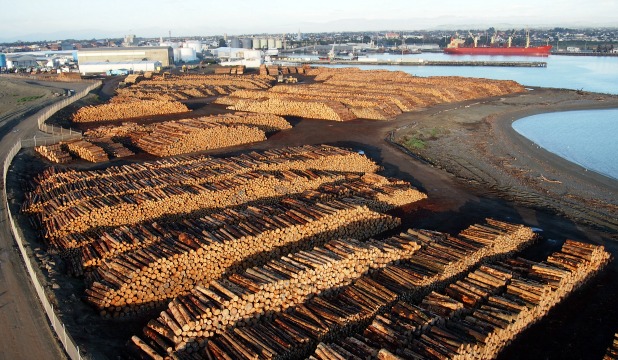
New Zealand log prices continue to fall

New Zealand's export log market took a hit from the trade dispute between the US and China as the declining value of the yuan crimps the buying power of the country's largest log market.
The average price for New Zealand A-grade export logs dropped to US$133/JAS from US$141/JAS in August, and US$145/JAS in July, and is now the lowest since June 2017, according to AgriHQ's Forestry Market Report for September.
"The Chinese log market has again dominated talk in the NZ forestry industry amid its sudden depreciation these past two months. Purely from a data perspective August and early September don’t make for pretty reading," AgriHQ analyst Reece Brick said in his report. "All of this weakness is directly related to the reduction in Chinese buying power, itself due to the depreciation of the CNY:USD."
The yuan has depreciated 7.5 percent since mid-June, recently trading at 6.8763 per US dollar.
Still, Brick said that despite the fall, market sentiment has stayed "quite positive" as factors such as port-level inventories, offtake rates and shipping rates otherwise point towards healthy fundamentals for New Zealand log trading in China.
"Consensus among the majority of traders is that we’ve settled at the bottom of the market for at least the time being," he said.
Chinese demand for New Zealand logs has been strong over recent years after Asia's largest economy clamped down on the harvesting of its own forests and reduced tariffs on imported logs to meet demand in its local market. However, trade tensions between the US and China have dented the value of the Chinese currency and traders fear rising tariffs will hurt economic growth and dampen demand.
"What the future looks like will largely be dictated by the actions of the Trump administration," Brick said. "The latest round of 10 percent tariffs covering US$200 billion of Chinese products is yet to be felt within the log industry. The main headache, however, is that there’s no end in sight for the trade war. It’s expected the latest tariffs will be lifted to 25 percent by Christmas, while Trump has threatened to extend these tariffs to another US$267 billion worth of Chinese products.
"Given log demand is so closely tied to economic growth, we can only hope these two power-houses can settle their differences sooner rather than later. Just don’t count on it," he said.
Brick noted that neither India nor South Korea, New Zealand's other major log markets, have provided any significant relief for exporters either.
However, he noted the weaker New Zealand exchange rate against the US dollar had offered some protection for local export traders against the depreciation within China.

Slowdown in wood products trade between China and the US

China’s Customs data shows that in the first half of 2018 the value of wood products trade between China and the US totalled US$14.591 billion, up 7% from the same period of 2017 which is a slow pace of growth compared to a year earlier. Imports of wood products from the US accounted for 18% of the national total, the same proportion as in the first half of 2017.

Of the total, the value of China’s exports to the US rose 10% to US$9.746 billion. The value of China’s imports from the US rose just 3% to US$4.845 billion. Overall the pace of growth in trade between the US and China is slowing.

Although the volume of log, paper, paperboard and paper products, sawnwood, imports rose 18%, 9% and 3% to 3.26 million cubic metres, 0.44 million tones and 1.52 million cubic metres respectively in the first half of 2018, the pace of growth fell compared to the same period in 2017.

Exports of major forest products between China and the United States have been hit hard in the first half of 2018.

The pace of growth in China’s major wood products exports to the US are slowing. First half 2018 plywood exports (412 000 cubic metres) fell over 50% year on year and fibreboard exports fell 10% to and 148 000 tonnes. There has also been a decline in the value of wooden furniture exports to the US.

Exports of French softwood logs to China rise by more than six times

The European softwood logs exports to China have went up by 560% during January-June 2018, as compared to the same period last year.

Thus, the European Union countries sent 1,37 million m3 of softwood logs to China during the mentioned period, as compared to the 207,589 m3 sent in 2017.

France's softwood logs exports to China went up by 5,018%, from 20,948 m3 in 2017, to 1,072 million m3 which were sent during January-June 2018. Also, Poland increased its exports to China by 627%, to 68,699 m3.

TOP 10 Exporting Countries

Softwood logs exported to China from... (in cbm )

Exporting Country Jan-June 2017 Jan-June 2018 Change in %
European Union 207,589 1,369,622 560 %
France
20,948 1,072,144 5,018 %
Poland
9,446 68,699 627 %
Estonia
53,250 47,077 -12 %
Lithuania
46,709 43,975 -6 %
Czech Republic
4,630 34,002 634 %
Others 72,606 103,725 43 %
TOTAL 207,589 1,369,622 560 %

BSW Timber’s EUR 41 million investment in Slovenia goes as planned

BSW Timber is currently waiting for all permits to proceed with the construction of a EUR 41 million facility in Gomilsko, near Celje, Slovenia. The Scottish sawmiller will have all the authorizations in the coming months so the company will launch production in 2020, as scheduled.

Alex Brownlie, the commercial director of the company, said that the original timeline factored the chance of administrative delays too. "Within the set timetable we always allow a certain degree of flexibility of individual processes," he explained.

A public examination of the municipal spatial plan is under way and when it is completed "we will need a detailed spatial plan and a building permit, and we need to know what will be in the facilities so that we can properly design them," he said.

BSW, which is using the extra time to work on the detailed technical design of the equipment, still has "May 2020 as the target for the first log to be cut" in Gomilsko.

A planned pellet facility in Šoštanj is scheduled to follow a month later with a chance to speed it up.

The EUR 41 million investment comes from BSW's own funds, an already approved loan by the Royal Bank of Scotland and loans from Slovenia.

Once with the up and running of the new sawmill, the processes which will be put in place will allow the company to buy raw products from existing Slovenian sawmills to add value to them and then send them to the international market.

Brownlie explained that BSW was already engaged with sawmills around the county and noted that "while we recognise their concerns, there is also still a large amount of value being left in Slovenian forests".

Commenting on BSW's business results, Brownlie said "the picture has improved" after three difficult years, with the sector, cyclical in nature, having gone "through some tough times globally".

He added that the general outlook for the wood processing industry is very good, timber being a sustainable material with excellent properties. Also, Slovenia has a strong hand to play due to its large quantities of quality timber and knowledge of how to manage it sustainably.

Overview of the wood processing industry in Guangdong Province, China

During the last few years, once with the increase in demand for wood processing products in Guangdong Province, Southeast China, the output of wood furniture, wood-based panels, solid wood flooring and paper products has also went up. Moreover, the industrial wood consumption has continued to grow.

Thus, the total annual output of logs in Guangdong Province has exceeded 10 million cubic meters.

The stock of standing timber in Guangdong Province increased by 60.83% in 11 years, from 360 million cubic meters in 2006 to 579 million cubic meters in 2016. The wood processing industry in Guangdong Province not only drove the development of the forestry sector, but also led to the growth of timber imports and the recycling rate of waste wood products. While Guangdong Province insists on vigorously developing forestry and continuously improving the recycling level of waste forest products, imported timber is still the only way in the future.

Demand drives the bulk of the wood industry

As the most developed area of ​​China's wood processing industry, Guangdong Province's forestry industry output value reached 802.3 billion yuan in 2017, an increase of 4.25% year-on-year, accounting for about 12% of the national forestry industry output value.

According to statistics, in 2017, there were more than 20,000 wood processing enterprises in Guangdong Province, and more than 3 million employees were employed in production.

In recent years, Guangdong Province has formed a relatively complete developed wood processing system such as wood-based panels, paper products, wood products and wooden furniture. The output value of the products has been greatly improved.

In 2017, the output of paper industry, wood furniture and wood products in Guangdong Province increased overall. Plywood production reached 3.579 million cubic meters, down 7.9% year-on-year; medium and high-density fiberboard production reached 4.205 million cubic meters, up 7.8% year-on-year; particleboard production reached 2.0177 million cubic meters, up 8.1% year-on-year; solid wood flooring production reached 153,100 square meters, year-on-year growth 1.1%; solid wood composite flooring production reached 18.8141 million square meters, an increase of 17.8%; solid wood furniture production reached 57.345 million pieces, down 0.8% year-on-year; paper and cardboard production reached 2,177.7 million tons, an increase of 2.9%.

In terms of output value, in 2017, Guangdong's paper industry reached 261.199 billion yuan, up 15.23% year-on-year; wood furniture reached 124.973 billion yuan, up 4.94% year-on-year; wood-based panels reached 46.226 billion yuan, down 9.71% year-on-year; wood products reached 20.772 billion yuan, a year-on-year growth of 7.2%.

The output value of five products of paper products, wood bamboo furniture, wood-based panels, wood processing and wood products in Guangdong Province has reached 464.868 billion yuan, an increase of 4.96% over 2016. In addition to the output value of wood processing enterprises below the scale, the output value of the wood processing industry in Guangdong Province has exceeded 500 billion yuan.

Woodworking industry consumption continues to grow

Paper products, wood-based panels, solid wood flooring and solid wood furniture are the main consumption products in the  wood processing industry in Guangdong.

In 2017, the paper output of Guangdong Province was 2,177.7 thousand tons, with a consumption of 90,625,100 cubic meters. The wood consumption of wood-based panels was about 13.291 million cubic meters, a year-on-year increase of 22.57%, waste materials such as small wood, twigs and scraps, and the consumption of raw wood was about 7,904,200 cubic meters, accounting for 48.52%, up 22.57% year-on-year; solid wood flooring production was 150.332 million square meters, and consumption wood was 289,100 cubic meters. Solid wood furniture consumption of wood was about 7.178 million cubic meters of wood, of which imported wood accounts for 98.9%, about 7.1 million cubic meters.

Guangdong Province has always taken timber production, timber imports and wood recycling as important tasks, and achieved certain results. The wood processing industry in Guangdong Province has abundant timber resources.

In 2017, timber consumption in Guangdong Province totaled 114 million cubic meters, an increase of 0.71% over the previous year. Among them, the consumption of logs was about 3,397,500 cubic meters, accounting for 29.7%; the consumption of waste wood products and small materials was about 80,400,900 cubic meters, accounting for 70.3%.

Guangdong's planned timber production was 796.67 million cubic meters, plus an unplanned harvest of about 10 million cubic meters, accounting for 8.77% of the total consumption.

Imported timber has always been the most important source of raw materials for wood processing in Guangdong Province. In 2017, Guangdong directly imported timber and its products were 62.685 million cubic meters, accounting for 54.99% of total consumption, plus from Heilongjiang, Inner Mongolia and Jiangsu. Indirectly imported wood and wood products, Guangdong imported wood (including waste paper) accounting for 69.46% of the province's wood consumption.

In 2017, the recycling and utilization of waste paper and waste wood in Guangdong Province was remarkable. Among them, about 3.72 million tons of waste paper was recycled in China, which was about 12.65 million cubic meters of logs, which slowed down the dependence of Guangdong paper industry on imported raw materials.

In addition, it also recycled and utilized waste materials, such as small materials and scraps. The original wood products reached 7,904,200 cubic meters, which considerably eased the shortage of raw materials for the production of MDF and particleboard in Guangdong Province, accounting for 18.03% of the total consumption.


EU wood furniture manufacturers reassert home market dominance

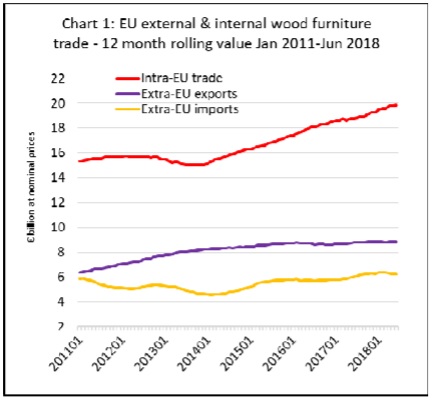
The latest Eurostat trade data shows that the EU’s wood furniture industry, having lost a little ground to imports in 2017, is struggling to increase sales outside the EU as global trade slows. However, the sector is once again reinforcing its dominance in the home market this year.

The EU wood furniture sector recorded only slow growth in 2017. The value of EU wood furniture production was €40.3 billion in 2017, no change from the previous year. Total imports from outside the region increased 9% to €6.29 billion.

In 2017, EU wood furniture imports increased 7% from the tropics, to €1.75 billion, and 3% from China, to €3.18 billion. However, most of the gains were made by other non-EU temperate countries, such as Ukraine, Bosnia and Serbia. Total imports from these countries increased 28% to €1.36 billion.

EU consumption of wood furniture was €37.6 billion in 2017, a gain of 2% compared to 2016. Despite the rise in imports in 2017 the share of domestic manufacturers in total EU furniture supply declined only slightly last year.

In 2017, domestic manufacturers accounted for 86.7% of the total value of wood furniture supplied into the EU market, down from 87.5% in 2016.

EU wood furniture production data is published only annually, so it is too early to assess how consumption is developing in 2018. However, EU monthly data on internal and external trade provides insights into the changing share of the various wood furniture supply countries to the EU, alongside changes in internal distribution patterns in 2018 which may have long term implications.

Eurostat trade data reveals that internal EU trade in wood furniture, which increased 4% to €19.2 billion in 2017, increased a further 6% in the first half of 2018.

Meanwhile the pace of EU wood furniture exports to nonEU countries, which were flat at €8.7 billion in 2016 and 2017, have continued at the same rate in the first half of 2018. Wood furniture imports into the EU from outside the region were rising in the second half of 2017, but began to dip in the first half of this year.

Tariffs on Chinese wood products imports could be catastrophic for some US companies

The US has announced that it had finalized the list of approximately US$200 billion worth of imports from China that will be subject to additional 10% tariffs. Items included in the list, including a wide variety of wood products, are subject to an additional 10% tariff as of September 24.

The tariff rate will be raised to 25% on January 1, 2019 if the US and China cannot reach an agreement to address the ongoing trade tensions.

In response to this action, International Wood Products Association Executive Director Cindy Squires stated: "These new tariffs represent higher taxes paid by the American people.

Tariffs hurt US consumers and put US manufacturers that utilize imported wood products at a competitive disadvantage. It's time for the Administration and its counterparts in China to end the cycle of tit-for-tat escalations that harm both countries and negotiate a longterm deal that provides economic certainty to U.S. businesses."

At a series of hearings held last month, scores of US companies and groups representing various industries implored the Trump administration not to go forward with additional tariffs.

The administration received more than 6,000 written comments and heard testimony from more than 350 witnesses, many of whom argued that new tariffs would be catastrophic for their businesses.

Newsletter

Subscribe to our digital newsletter for your daily digest of essential news, views and analysis from the international wood industry delivered directly to your inbox.


0