
Article archive

UPM to invest US$2.7 billion in a new pulp mill in Uruguay; company’s pulp capacity to rise by 50%

UPM has made the investment decision to construct a 2,1 million tonne greenfield eucalyptus pulp mill near Paso de los Toros in central Uruguay.

The mill investment of USD 2,7 billion will grow UPM’s current pulp capacity by more than 50%, resulting in a step change in the scale of UPM’s pulp business as well as in UPM’s future earnings. Additionally, UPM will invest USD 350 million in port operations in Montevideo and local facilities in Paso de los Toros. The mill is scheduled to start up in the second half of 2022.

According to UPM, the mill is expected to reach a highly competitive cash cost level, approximately USD 280 per delivered tonne of pulp. This figure includes the variable and fixed costs of plantation operations, wood sourcing, mill operations and logistics delivered to the main markets.

The company said that the long-term demand outlook of pulp is promising, especially in Asia. The annual growth of pulp demand in the global market is estimated to be around 3 percent.

The construction of the mill is expected to exert a significant impact on the economy of Uruguay. It is estimated to increase the country's gross national product by about 2 percent, according to UPM.

July wood pellet prices in Austria

The July price of pellets in Austria reached 229.6 € per tonne or 4.71 Cent per kWh.
• Compared to previous year -1.3%
• Compared to previous month +0.5%
Ordinarily the prices for wood pellets in Austria vary throughout the year with particularly favorable prices being offered in spring when local pellet producers advertise so-called „storage offers“. On average, the wood pellet prices during the special storage offers in the months of April and May are nearly 10% lower than prices in winter.
More info on the wood pellet industry (for registered users):

  1. Rising prices for Russian pellets delivered to the EU this year
  2. Growth of global wood pellets demand expected to be driven by Asia in the next decade
  3. Global trade of wood pellets jumps more than 21%; US, Canada, Vietnam as major suppliers
  4. Poland: Wood pellets prices evolution in 2018
  5. Japan’s huge demand for wood pellets to be satisfied with North American supplies
  6. Overview of the current trends in the European residential wood pellet market
  7. Business potential of the South American wood pellet market
  8. Sharp rise in EU wood pellet production

 
Cost advantage to fuel oil
Wood pellets in Austria currently offer a price advantage of
• 68.3% as opposed to extra light heating oil and
• 71.8% as opposed to natural gas
It has repeatedly been claimed that the prices for wood pellets are somehow bound to the prices for mineral oil and therefore "follow" them. However, the development in recent years has shown that this is not the case. While the costs for heating oil are subject to extreme price fluctuations, the costs for wood pellets are largely stable. The average wood pellet price in 2012, after adjusting for inflation, was lower than the wood pellet price in 2002. One brief price peak in 2006 occured as a consequence of the particularly cold and snowy winter, which caused problems with timber transport as well as of the rapidly increasing demand. In the meantime over 400 wood pellet plants have been built all over Europe. Production capacities in Austria nearly doubled. Furthermore, the standardization of European quality standards (ENplus) has increased the permeability of the markets. Today, a high degree of supply security and price stability exists.
Price for wood pellets in bags
Austrian wood pellets in bags cost an average of € 3.98 per 15 kg bag (when ordered by the pallet).
• Compared to the previous year: +1.3%
• Compared to the previous month: +0.3%

New Zealand exports more logs, despite falling log prices overseas

New Zealand exported more logs and wood in June 2019, despite falling log prices overseas. In June 2019, the value of all goods exports rose $136 million (2.8 percent) from June 2018 to reach $5.0 billion.

Exports of logs and wood led the rise in exports, up $65 million (16 percent) from June 2018 to $472 million in June 2019. These commodities are the third-largest goods export group.

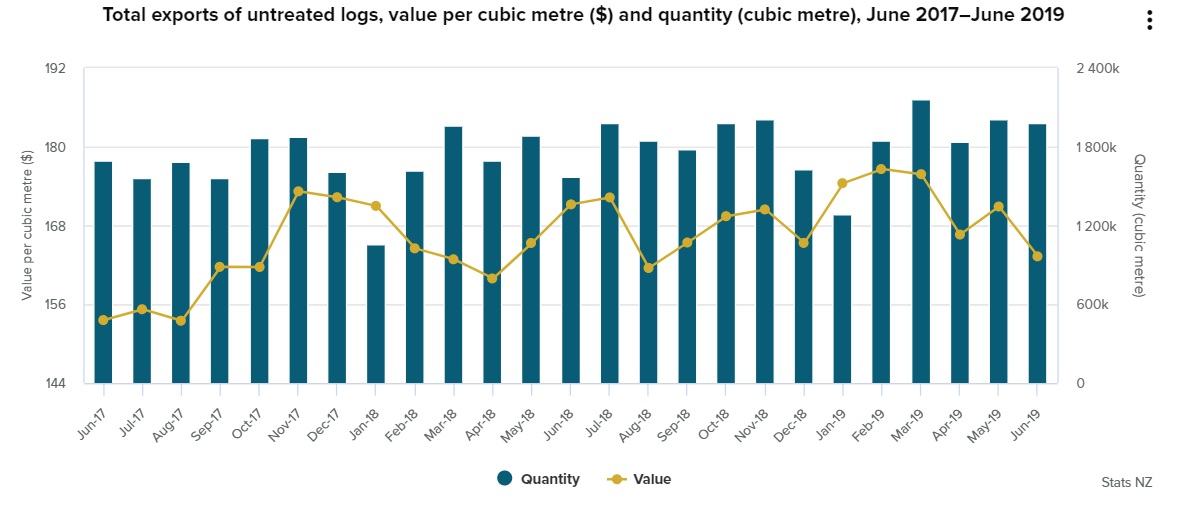
The rise in logs and wood was led by untreated logs, up $55 million (20 percent) on a year earlier. The quantity rose 26 percent and unit values fell 4.6 percent.

“The average value of untreated log exports fell to $163 a cubic metre in June, down from a recent high of $177 in February,” international statistics manager Geraldine Duoba said.
New Zealand exports of untreated logs to China were worth about $3.0 billion in the past year, or 80 percent of the $3.8 billion in total untreated log exports.

Total exports of untreated logs, value per cubic metre ($) and quantity (cubic metre), June 2017–June 2019

Month Quantity Value
Jun-17 1696691 153.59
Jul-17 1565899 155.24
Aug-17 1688301 153.49
Sep-17 1561369 161.7
Oct-17 1868388 161.68
Nov-17 1878083 173.21
Dec-17 1605155 172.31
Jan-18 1054065 170.99
Feb-18 1621376 164.52
Mar-18 1963386 162.85
Apr-18 1696611 159.93
May-18 1888757 165.34
Jun-18 1573998 171.22
Jul-18 1984379 172.28
Aug-18 1852292 161.53
Sep-18 1781015 165.41
Oct-18 1976962 169.42
Nov-18 2011086 170.45
Dec-18 1631326 165.35
Jan-19 1288811 174.45
Feb-19 1843428 176.6
Mar-19 2160116 175.82
Apr-19 1839934 166.62
May-19 2009784 170.89
Jun-19 1985046 163.3

Overview of the current trends in the European residential wood pellet market

Residential use for heating, about 40 percent of the total pellet market, fluctuates annually but is relatively stable compared to industrial heat and power generation. The demand depends on winter temperatures and fossil fuel prices, although medium-sized pellets for energy generation by industries or public buildings such as hospitals and swimming pools is generally less dependent on weather conditions.

In Italy, Germany, France and Austria pellets are mainly used in small-scale private residential and medium-sized industrial boilers for heating. In some EU Member States, such as Sweden, Germany, Austria, France, Spain and the Czech Republic household heating with biomass as input receives subsidies or tax deductions by the federal and local governments. In most countries, however, government funding is limited.

Italy is the largest European market for the household use of pellets. According to the National Renewable Energy Action Plan statement, the use of pellets will increase further to 5 mmt in 2020 from about 3.8 mmt in 2018. However, only 15 percent of the demand is met by domestic production, with the remaining 85 percent being covered by increasing imports. Bagged pellets represents almost the total market. Continue reading "Overview of the current trends in the European residential wood pellet market"

West Fraser expects a 600 million board feet drop in lumber production for 2019

The Canadian company reported lumber inventories reduced by approximately 150 million board feet in Q2/2019, and expects a 600 million board feet drop in lumber production for the whole 2019.

West Fraser Timber Co. Ltd. recently reported its second quarter 2019 results. Continue reading "West Fraser expects a 600 million board feet drop in lumber production for 2019"

Conifex to curtail Mackenzie sawmill

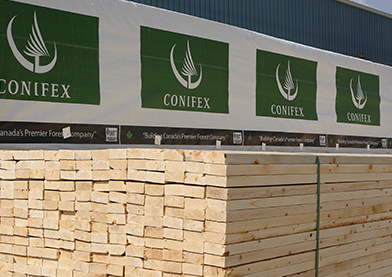
Conifex Timber Inc. announced that it will temporarily curtail its Mackenzie, British Columbia sawmill operations for two weeks commencing July 29, 2019, due to continued high log costs and lumber market conditions.

Back in June, Conifex Timber Inc. also announced that it has entered into a definitive purchase agreement with Hampton Lumber for the sale of its Fort St. James sawmill and associated forest license for the purchase price of $39 million.

About Conifex

Conifex and its subsidiaries' primary business currently includes timber harvesting, reforestation, forest management, sawmilling logs into lumber and wood chips, and value added lumber finishing and distribution. Conifex's lumber products are sold in the United States, Chinese, Canadian and Japanese markets. Conifex has expanded its operations to include bioenergy production following the commencement of commercial operations of its power generation facility at Mackenzie, BC.

Homag negatively revises earnings forecast for 2019

German woodworking machinery giant Homag announced that it will negatively revise its earnings forecast for 2019 as a result of a market downturn with the furniture industry, and a decline in sales in China. 

Homag Group AG adjusted its earnings forecast for the 2019 financial year. From today's perspective, earnings after taxes and before profit transfer are expected to be between EUR 42 and 46 million.

Previously, Homag Group AG had forecast earnings after taxes and before profit transfer for 2019 above the previous year's figure (EUR 54 million).

Due to its function as a holding company, Homag Group AG's earnings depend on the earnings of its subsidiaries. These are determined by income from investments and profit and loss transfer agreements.

The main reason for the reassessment is that the subsidiaries of Homag Group AG are recording a market downturn in business with the furniture industry. Their results are burdened by declining margins due to the declining market volume. In addition, there will be a significant decline in sales in the higher-margin Chinese business and a disproportionate increase in material and personnel costs compared with sales. In the second half of the year, sales at HOMAG Group AG should be lower than previously expected.

Business potential of the South American wood pellet market

South America is one of the continents in which wood pellet production is yet to reach its full potential because the continent has favorable strategies that promote the exploitation of both forest covers and cultivated land. The climate in the region also favors the large scale production of wood. As the exploitation of the forest reserves increases, so is the demand for energy likely to improve because of the vast potential from wastes and residues from agricultural products.

Wood pellet production market In South America

Below is the evaluation of the biomass pellets manufacturing market in South America looking into the potential each country has: Continue reading "Business potential of the South American wood pellet market"

Chinese woodworking companies plan to explore business opportunities in the U.S. market

Many Chinese woodworking companies expressed their expectations to further explore business opportunities in the U.S. market, as they participated in an international woodworking trade show in Las Vegas last week.

Suzhou Far-East Abrasives Co. Ltd., a woodworking company based in east China's Jiangsu Province, drew quite a lot American clients.  Continue reading "Chinese woodworking companies plan to explore business opportunities in the U.S. market"

Slowing pace of EU wood furniture imports

The generally slow development of the EU wood furniture market in 2018 is also apparent in the import data. After rising 7% in 2017, the value of EU imports of wood furniture from non-EU countries fell 1% to €6.21 billion in 2018.

Imports from China, by far the largest external supplier, fell 4% to €3.1 billion in 2018 and imports from tropical countries fell 0.5% to €1.69 billion. However, there was a 7% rise in import value from non-EU temperate countries, to €1.46 billion, notably Ukraine, Belarus and Turkey .

While the total value of EU wood furniture imports fell in 2018, import tonnage increased indicating a decline in the price and/or a change in the mix of products. Total import tonnage increased 5% in 2018, to 2.26 million metric tonnes (MT).

Import tonnage increased by 1% from China to 1.12 million MT, and by 4% from tropical countries to 609,000 MT. However, continuing the trend of recent years, there was a sharper increase in imports from countries bordering the EU, including Ukraine (+30% to 97,000 MT), Belarus (+22% to 85,000 MT) and Turkey (+16% to 82,000 MT).

These broad trends have continued in 2019. In the first quarter of this year compared to the same period in 2018, EU wood furniture imports from tropical countries increased by only 1% to 171,000 MT and imports from China were up 2% to 302,000 MT.

Meanwhile, imports from non-EU temperate countries increased 16% to 148,000 MT, with imports rising 35%, 23% and 16% respectively from Ukraine, Belarus and Turkey.

While China remains the largest external supplier of wood furniture to the EU, the overall decline in EU imports from China between 2015 and 2018 is notable. In recent years China’s competitiveness in the EU wood furniture market has been impeded as prices have risen on the back of growing domestic demand and new laws for pollution control pollution in China.

EU furniture importers also continue to question the variable quality of product imported from China and some have struggled to obtain the legality assurances required for EUTR conformance when dealing with complex wood supply chains in China.

Of tropical countries, Vietnam is the leading supplier of wood furniture to the EU. EU imports from Vietnam increased 6% to 233,000 MT in 2018, but were slow in the first quarter of 2019, falling back 6% compared to the same period last year, to 70,000 MT.

The trends are different in euro value terms. EU import value from Vietnam was flat in 2018, at €723 million, but increased 2% to €230 million in the first quarter of 2019.

In the EU, the Vietnamese furniture sector has gained a reputation for supply of large volume mid-range products, both for exteriors and, increasingly, for interior use.

The Vietnamese furniture industry is regarded by EU importers as technically more evolved than most other Asian producer countries and increasingly able to supply products to high European quality standards.

EU imports of wood furniture from Indonesia declined 3% in tonnage terms to 99,000 MT in 2018 but increased 2% to 27,000 MT in the first quarter of 2019 compared to the same period last year. In value terms, imports from Indonesia declined 2% to €301 million in 2018 and increased 7% to €89 million in the first quarter of 2019.

The relative lack of growth in EU furniture imports from Indonesia since the start of FLEGT licensing in November 2016 may seem disappointing, but the trend is influenced by wider stagnation in EU furniture market growth and by intense competition in the sectors targeted by Indonesian manufacturers.

Indonesia’s furniture exports to the EU are dominated by outdoor products, particularly due to relatively abundant plantation teak supplies.

However, there is now intense competition in this sector from a wide range of modified temperate wood and nonwood products which are taking share from tropical hardwoods.

Indonesia's long woodworking tradition has also meant it has gained a reputation for supply of good quality specialist hand-made furniture, a niche market in the EU where it competes most directly with India.

In 2018, EU imports of wood furniture from India increased 21% to 81,000 MT, and the rising trend continued in the first quarter of 2019 with a further increase of 10% to 23,000 MT. In value terms, EU imports from India increased 18% to €238 million in 2018, and by 15% to €66 million in the first quarter of 2019.

Imports of wood furniture from Malaysia increased 5% to 101,000 MT in 2018 and by a further 20% to 29,000 MT in the first quarter of 2019. In value terms the trend was slightly different, with imports from Malaysia falling 1% to €197 million in 2018 but recovering 19% to €57 million in the first quarter of this year.

Malaysia is supplying the EU market with high quality furniture products but a much smaller range than Vietnam with a heavy focus on rubberwood and other plantation species.

France: Heatwave expected to bring bark beetle infestation; softwood prices already down sharply

Long waves of heat, dry weather have brought the worst bark beetle infestation in two decades to eastern France, ruining conifer forests and causing timber prices to plummet as forestry firms fell trees before they are damaged. Quality softwood prices have fallen to 60 to 80 euros per cubic metre.

Timber industry organisation Fibois Grand Est estimates that three to four million cubic metres of French public forests will be infected this year, equivalent to half the annual supply of spruce wood. Continue reading "France: Heatwave expected to bring bark beetle infestation; softwood prices already down sharply"

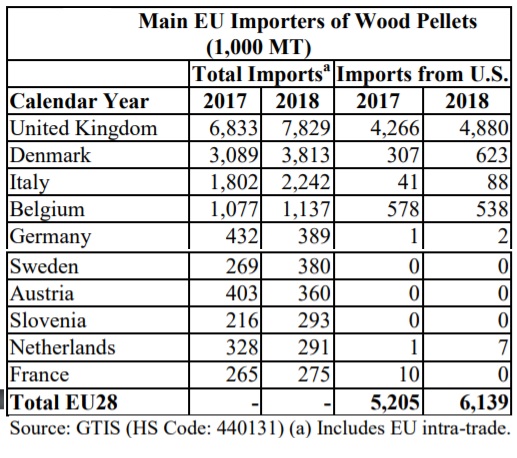
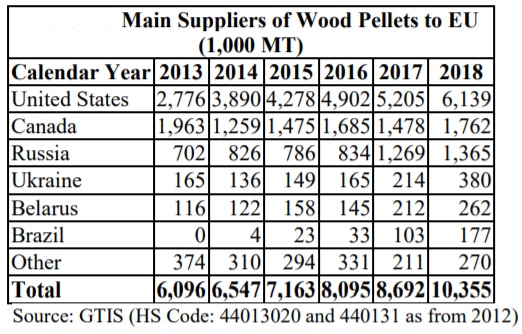
US to cover 65% of EU wood pellet imports by 2020

The US has the potential to supply 65 percent of the EU wood pellet import demand, at an expected trade value of US$ 1.6 billion in 2020.

The EU is the world’s largest wood pellet market, with a consumption of about 27.4 mmt in 2018. Based on the EC mandates and incentives, demand is expected to expand further to about 30 mmt in 2019. Future consumption will significantly depend on a range of market factors and incentives and conditions.

EU demand for pellets has significantly outpaced domestic production for the past ten years.

This has resulted in increased imports from the United States. In 2018, U.S. exports to the EU totaled 6.1 mmt, representing a value of $1,160 million. If EU demand and trade flows remain consistent with current patterns, the United States has the potential to supply 65 percent of the import demand, which would represent a trade value of potentially US$1.6 billion in 2020. Other significant exporters of pellets to the EU are Canada and Russia.

In response to the EU demand for industrial pellets, capacity has expanded in the supplying regions. These third country imports could, however, be affected by the implementation of sustainability requirements from the individual EU Member State governments. Due to their location at seaports and limited domestic production, the large power utilities in the United Kingdom and Belgium are sourcing over 75 percent of their pellet demand from non-EU suppliers.

Despite their significant domestic production, the Scandinavian countries, mainly Denmark and Sweden, partly depend on imports from the Baltic Region and Russia. The port restrictions in Scandinavia are favoring the Baltic Sea supply, which generally ship with smaller vessels than used in the Atlantic trade.

In Denmark, one plant is located at a deep seaport and is supplied from North America. Improved flexibility in infrastructure is expected to further increase sourcing from North America. The pellet markets in Germany, Austria and to a lesser extent France and Italy are more isolated and depend mostly on local production.

US lumber prices fell after 5 weeks of consecutive growth

After several weeks of consistent growth, the US lumber prices fell quite considerably last week. On average, lumber prices fell by $5. 

Framing lumber traded quietly at a limited-volume pace similar to the prior week. The lack of activity weighed on producers, who pressed more urgently to move production. Price trends were mixed, but downward pressure was clearly evident in some species, particularly Western and Eastern S-P-F. Prices of key random dimension and stud items posted deep double-digit drops. Weakness in these species drove a $5 drop in the Random Lengths Framing Lumber Composite Price, ending a five-week string of gains.

Week
Jul 19
Last Week
Jul 12
Year Ago
2018
Random Lengths Framing Lumber Composite Price* $356 $361 $515
KD Western S-P-F #2&Btr 2x4 R/L Mill Price 338 372 587
KD Eastern S-P-F #1&2 2x4 R/L, delivered Great Lakes 435 457 660
Green Douglas Fir Std&Btr 2x4 R/L (Portland) 350 345 555
Southern Pine (Westside) #2 2x4 R/L 379 374 504
KD Coast Hem-Fir #2&Btr 2x4 R/L 375 385 585
Ponderosa Pine (Inland) #2&Btr 1x12 R/L 850 850 775
* Weighted average of 15 key items

Random Lengths Panel Market Report

Structural panel sales were steady enough to minimize downward price pressure, but buyers lacked urgency and replenished sparingly. Demand for OSB was limited to small volumes that mills sold at or near quotes. Sales were difficult to secure in Southern Pine plywood. Occasional discounts surfaced on carloads. Dull trading persisted in Western Fir plywood, which led to few price changes. Canadian plywood buyers held out as long as possible before replenishing. Mills leaned on order files, but prices slipped modestly.

(f.o.b. mill prices) Week
Jul 19
Last Week
Jul 12
Year Ago
2018
Random Lengths Structural Panel Composite Price* $345 $345 $502
Southern (west-east) 15/32-inch 3-ply rated sheathing plywood 340-375 340-380 475-515
Southern (west-east) 15/32-inch 4-ply rated sheathing plywood 345-380 345-385 480-520
Western 1/2-inch 4-ply rated sheathing plywood 360 360 522
North Central 7/16-inch Oriented Strand Board 214 210 415
*Weighted average of 11 key items


Russian Sveza to set up its own logging company

Russian plywood manufacturer Sveza has set up its own logging company, Sveza Resource LLC. The company is currently conducting pilot projects for logging purposes in the Totemsky and Tarnogsky districts of the Vologda region. In addition, the company will increase plywood production in the Vologda region by 52,000 m3 per year.

With the start of the logging, Sveza becomes a vertically integrated company with a complete production chain from logging to commercialization of the finished products, aiming for higher profit margins. In addition, backward integration will increase security of supply. Continue reading "Russian Sveza to set up its own logging company"

Stora Enso plans major investments in its Wood products segment

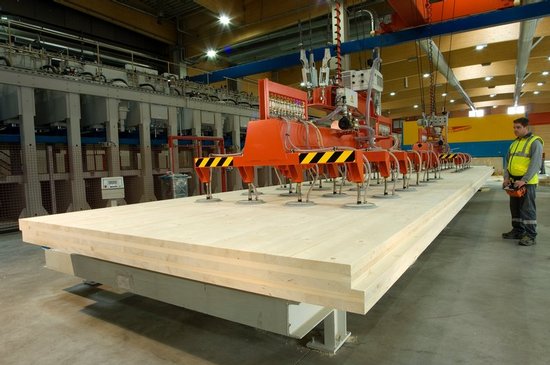
Stora Enso has initiated feasibility studies for a possible cross laminated timber (CLT) unit in connection with its Ždírec mill in the Czech Republic and a new construction beam unit to be located at the Ybbs mill in Austria. Stora Enso also plans to consolidate production to increase focus on efficiency and to streamline the asset base.

The proposed expansion in Ždírec would add a total annual capacity of approximately 120 000 m3of CLT. It would be Stora Enso’s fourth CLT unit, following the inauguration of the Gruvön CLT Continue reading "Stora Enso plans major investments in its Wood products segment"

Sharp rise in EU wood pellet production

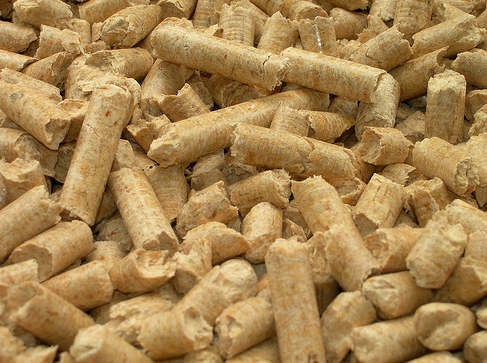
With a production of about 16.9 mmt in 2018, about fifty percent of global production, the EU is the world’s biggest producer of wood pellets. Compared to production plants in North America, plants in the EU are mainly small or medium-sized. Most of the main pellet producing countries have a sizeable domestic market for residential heating pellets. Recent demand for pellets has supported a further increase in domestic production. 

Germany is the third largest wood pellet producer in the world after the United States and Canada. It has currently about seventy production facilities for wood pellets with a total annual production capacity of 3.8 million mt. In 2018, production amounted to 2.4 million mt, 95 percent of which were produced from residues of the timber industry. The vast majority of the wood pellets produced in Germany are used for heating. The use for electricity production is negligible. Germany is a net-exporter of wood pellets. The vast majority of trade occurs with neighboring EU member states and Switzerland. Italy is the main market. Continue reading "Sharp rise in EU wood pellet production"

Canfor to further reduce production in BC

The curtailments will reduce Canfor’s annual production output by approximately 400 million board feet.

Canfor Corporation announced further capacity reductions at two of its British Columbia sawmills with an indefinite curtailment at its Mackenzie sawmill and the permanent elimination of one shift at its Isle Pierre sawmill.

The indefinite curtailment at Mackenzie, which is effective immediately, is due to the high cost of fibre, continued poor lumber markets and challenging operating conditions that have combined to make the mill uneconomic under these conditions.

The Isle Pierre sawmill will be permanently reduced from two shifts to one shift effective September 20, 2019. The capacity reduction, which is due to insufficient timber supply as a result of the mountain pine beetle epidemic and associated decline in the annual allowable cut, will enable the mill to better align its production capacity with the sustainable fibre supply in the region.

“We deeply regret the impacts that these capacity reductions will have on our Mackenzie and Isle Pierre employees, contractors, their families and the local communities,” said Stephen Mackie, Senior Vice President of Canadian Operations, Canfor. “The BC forest industry is continuing to face very significant challenges. None of our temporary or permanent curtailment decisions have been made lightly, nor are they a reflection on the hard work and dedication of our employees.”

In combination, these curtailments will reduce Canfor’s annual production output by approximately 400 million board feet, which is in addition to previously announced reductions.

Africa a growth market for furniture

Several African countries have good potential to develop their furniture industry, both for expanding internal consumption and for export markets. Total furniture consumption in Africa is expected to rise 2.4% in real terms during 2020 and significant consumption growth is expected longer term.

These are key conclusions of the latest edition of the Africa Furniture Outlook report by CSIL, the furniture research organisation based in Milan, Italy. Continue reading "Africa a growth market for furniture"

Malaysia: Plywood production threatened by declining log supplies and rising costs

The media in Sarawak recently highlighted the impact declining log production and rising production costs are having on the plywood industry in Sarawak.

Hashim Bojet, General Manager of the Sarawak Timber Industry Development Corporation, (STIDC) said he is concerned that, because of the log Continue reading "Malaysia: Plywood production threatened by declining log supplies and rising costs"

Newsletter

Subscribe to our digital newsletter for your daily digest of essential news, views and analysis from the international wood industry delivered directly to your inbox.


0