
Article archive

Japan’s furniture import trends

Production and sales have been shrinking in Japan’s domestic wooden furniture manufacturing sector for more than a decade. Most of the decline is due to competition from imports and the inability of local manufacturers to upgrade their processing methods and raise productivity.
Wooden furniture imports continue to gain market share; it has been estimated that imports of bedroom, kitchen and dining-room furniture accounted for around 60% of the market in 2015. The growth in imports from China and Southeast Asian countries continues to hollow out domestic wooden furniture manufacturing.
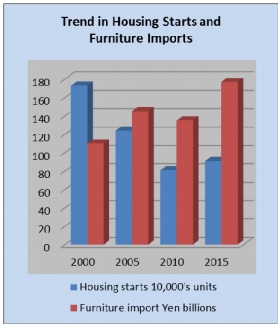
The figure shows trends in housing starts and imports of wooden office, kitchen and bedroom furniture. At first sight there appears to be a contradictory inverse relationship between trends in housing (falling) and imports (rising). Rather than a statistical anomaly, however, this reflects the rapid growth in the market share captured by imports.
The Japanese furniture market was worth around yen 900 billion in 2005, and imports of wooden office, kitchen and bedroom furniture accounted for about 16% of all domestic sales. By 2015, the size of the market had fallen to around yen 700 billion, and imports accounted for over 25% of the market.
Data from Japan’s Ministry of Internal Affairs and Communications show that purchases of wooden chests of drawers, a main item in the traditional “bridal furniture set”, have dropped dramatically over the past 15 years. On the other hand, household spending on dining-room furniture has been fairly stable—although relatively small compared with spending on bedroom items.
In the past, the bridal market was a main driver of growth in Japan’s furniture sector. It was usual for the bride’s family to buy a three-piece furniture set consisting of a wardrobe, a Japanese-style chest of drawers, and a dressing table.
Today, the traditional dressing-table has been replaced by western-style chests of drawers and, because many newly built houses and apartment have built-in closets, demand for free-standing wardrobes has faded. This, combined with the decline in the number of marriages, has upended the established demand patterns for wooden furniture in Japan.

Bedroom furniture
China’s exports of bedroom furniture to Japan accounted for 57% (by value) of all wooden bedroom furniture imports in 2015. The second-ranked supplier last year was Viet Nam, with 28% of all imports, and other Southeast Asian countries made up around 8%. The combined market share of these three suppliers in 2015 was over 90%, the balance coming mainly from Europe and North America.
Kitchen furniture
Fitted kitchens are now a standard feature of newly constructed houses and apartments, and the replacement kitchen market is growing strongly as owners of existing homes embrace renovation to avoid the cost of demolition and rebuilding (once a feature of the Japanese housing sector).
In the early days of kitchen modernization, European and North American makers of kitchen units and cabinets found a ready market in Japan. It took suppliers in Asia only a short time to grasp the opportunity, however, and they began growing their market share.
Manufacturers of kitchen furniture in Viet Nam have secured a significant part of the market (41% in 2015), as have shippers in Indonesia, Malaysia and Thailand. Demand for European kitchen furniture tends to focus on German and Italian lines in the up-market housing sector.
Hollowing out the furniture manufacturing base Japan’s domestic furniture manufacturing sector has declined as Japanese companies—even small and medium-sized companies—have shifted production outside Japan to countries where production costs are lower, populations are growing and there is good infrastructure and communications. In Japan’s wooden furniture market, relocated Japanese companies are responsible for much of the export trade from China and Southeast Asia to Japan.
China was once the preferred destination for relocating Japanese companies—it is close to Japan and has good shipping connections. Moreover, wages and energy costs have been much lower than in Japan, and domestic demand has grown rapidly. This has now changed, however: rising wages, labour disputes, and the reemergence of bitter historical issues are causing many Japanese companies to look elsewhere for their investments.
Viet Nam has attracted Japanese companies, and the trade relationship between the two countries is very close. Viet Nam’s overall exports to Japan are now almost 10% of all its exports, ranking second after North America. The main products exported to Japan are garments, seafood, wood products and electronics. In 2015, around 1000 Japanese companies had production capacity in Viet Nam.
Expansion of single person homes creates opportunities
Trends in Japan’s housing sector are central to the future of the furniture manufacturing sector (whether domestic or off-shore). Japan’s population is aging and shrinking due to a low birth rate. The population peaked in 2005; the number of households is increasing for now but is projected to decline after 2019. The number of people aged over 65 years is expected to level off in 2025 and decline from 2040.
Superimposed on these trends is the expectation that the population of greater Tokyo, which is rising, will begin to fall in about ten years, when the number of households will also begin to fall.
The other major force to influence furniture demand is the current upward trend in one-person households, driven by changes in culture and lifestyles, which should peak in 2030. Young professionals are shying away from early marriage in order to focus on their careers. Since 1973 there has been a 33% decline in the number of people getting married; moreover, the divorce rate is rising fast.
As the numbers of divorcees and never-married adults increase, single-person households are the fastest-growing household group and will eventually become the largest such group in Japan. Singles need less space and can therefore save on rent and house-building costs. When space is limited, furniture needs to be both pleasing and practical. Storage cabinets are popular among singles in small homes, and many guides to living in small spaces—with a focus on storage techniques—are available.
Demolish and rebuild or renovate
Typically in Japan, detached wood-frame homes around 30 years old are considered worthless by lenders and by those looking to buy. This rapid depreciation is more a reflection of tradition than the soundness of residences, however—homeowners in Japan were raised to believe that wood-frame homes do not last and must be demolished and replaced.
Understanding the extravagant waste of resources such a tradition has created, the Japanese government has introduced measures to encourage lenders to place a value on renovated homes and apartments and extend the depreciation of homes to around 50 years. The house and apartment renovation market is booming as small, medium-sized and even major developers are realizing its potential.
Room for innovation and creativity
There is potential for segments of the Japanese furniture market to grow, especially for competitively priced items designed for singles in small spaces, such as drawers, cabinets, fold-away dining tables and dining chairs. Manufacturers offering a range of styles—from traditional Japanese to Scandinavian—will find an ideal market base if the focus is on the tasteful use of colour and simple designs at reasonable prices.
Japanese consumers have always been rather predictable and generally looked on low-priced goods with disdain, preferring to shop in recognized national-brand stores and outlets and prepared to pay for quality.
Now, however, they have started behaving like their overseas counterparts, who for years have enjoyed discount stores (including, in recent years, online stores) finding low priced, serviceable items that will last until individual tastes or fashion dictate replacement.
This fundamental shift in the attitudes and behaviour of Japanese consumers has been reinforced by the current state of the national economy and the impact this is having on incomes and job security. It is likely to continue, even when the country’s economic prospects eventually improve.
 
[gravityform id="1" title="true" description="true"]
 
[gravityform id="2" title="true" description="true"]
 
Source:ITTO

US and Canada start SLA talks

Ottawa and Washington are debating about renewing the Softwood Lumber Agreement, regarding the export of Canadian lumber to US markets, according to the Wall Street Journal. As Chrystia Freeland, Canada’s trade minister said, the Canadian negotiators met in Washington with their US counterparts to discuss an agreement regarding the lumber-trade.
The first SLA was signed in 2006 and expired in October 2015. The deal was made to resolve the dispute regarding the sale of Canadian wood products in the U.S. markets. 12 months after the agreement expires, Canadian softwood lumber producers are kept away from new tariffs levied by Washington. Still, if the SLA isn’t renewed by October this year, new tariffs will be imposed on the Canadian wood products.

 “We are working very hard on this deal. The forestry industry is incredibly important across this country, and we are very aware of the significance of the softwood-lumber agreement and we are working very hard on it,” said Freeland.

Also, Canada’s Prime Minister Justin Trudeau discussed with USA President, Barack Obama, about the SLA during the Asia-Pacific Economic Cooperation summit in Manila. The discussions are to continue in March, when Trudeau visits Washington.
In 2015, exports of forest products from Canada reached 9.2% from 2014, to CA $3.47 billion. The forest products reach 8% of the total Canadian exports.
 
[gravityform id="1" title="true" description="true"]
 
[gravityform id="2" title="true" description="true"]
 

Italian woodworking machinery: 23% increase in orders

Orders for Italian woodworking machinery in 4Q/2015 rose 23.3% compared to the same period in 2014, reflecting a positive market sentiment amongst the industry’s members.
Domestic sales went up nearly 30% while international exports reflected a slower growth at 17%, according to figures released by Acimall, Italy’s woodworking association. Quarter-on-quarter growth reached 30%, or 7% with seasonal adjustment.
Order books have generally filled up to 2.8 months (versus 2.5 months at the end of 2014), with a one percent variation in prices since January 1 (1.3% in 2014).
According to an Acimall survey, market sentiment is positive with 42% woodworking machinery businesses in Italy expecting more demand from the international market while another 47% expects orders to be stable.
However, domestic sales are expected to take a hit as only 21% of those surveyed are confident of growth in the short term. 16% expect their orders to decrease while 63% expect business to remain stable.
 
[gravityform id="1" title="true" description="true"]
 
[gravityform id="2" title="true" description="true"]

Södra reports considerable rise in operating profit

Södra's operating profit for 2015 increased to SEK 2,162 million (2014: SEK 1,516 million). Net sales for 2015 increased to SEK 18.3 billion (2014: SEK 17.3 billion), of which SEK 6.1 billion (2014: SEK 5.9 billion) was generated in the last four months of the year. Operating profit in the same period totalled SEK 502 million (2014: SEK 504 million).

"2015 was another good year for Södra and it is pleasing to report an historically strong result of SEK 2,162 million (1,516) and that the Board can therefore propose such substantial dividends. The forest economy was stable, our production volumes were high, exchange rates were favourable and our operations became more efficient. However, 2016 will prove a challenging year with the start-up of a virtually new pulp mill, the continuation of a change programme for sawn and planed timber, and a fragile global market," says Lars Idermark, President and CEO.

Södra already has an ongoing investment programme of about SEK 5 billion, most of which pertains to the expansion of the Värö pulp mill. The Board of Södra has now decided to invest a further SEK 1 billion in the mill at Mörrum.
This investment will include a new evaporator and modernisation of the brown stock washing system in the dissolving pulp line, where pulp for the textile industry is produced. A new evaporator will make it possible to increase the production rate, as well as deliveries of energy products, such as electricity, district heating and biofuels. The new investment will increase production capacity by 45,000 tonnes, bringing the total production of paper and dissolving pulp at the Mörrum mill to 470,000 tonnes.
Following the expansion, capacity at the Värö mill will amount to 700,000 tonnes. Capacity at Mönsterås will be 750,000 tonnes.
 
[gravityform id="1" title="true" description="true"]
 
[gravityform id="2" title="true" description="true"]

Canfor reports surge in net sales

Canfor Corporation reached net sales of CA$1.053 million, compared to the CA$989.9 million in the Q3 of the same year and the CA$860.4 million net sales of the Q4 in 2014. The whole year sales summed CA$3,925.3 million, up from CA$3,347.6 million of the same period in 2014.
The company reported operating income of CA$94.9 million in their Q4/2015, increasing from the CA$80.5 million earned in the Q3, but decreasing from the CA$108.9 million gained in the Q4 of 2014. The whole year operating income summed up to CA$378.2 million.
The sales grew especially due to the company's acquisition of Anthony Forest Products Company, which completed on October 30, 2015, as well as the benefits of a weaker Canadian dollar.
Lumber demand in North America remained relatively stable during the fourth quarter of 2015, with builders capitalizing on mild weather in many parts of the US and Canada. The lumber market in China improved somewhat through the fourth quarter of 2015, with inventory levels ending the year well down from the previous quarter. Lumber demand in other offshore markets, such as Japan and Korea, remained solid.

“Our lumber business continued to see solid progress at our Western Canadian and US South operations, and the integration of our most recent acquisition, Anthony Forest Products, has gone very well.  In 2015 we invested over CA$500 million in our lumber, pulp and paper businesses, including CA$263 million in strategic acquisitions and $240 million in capital expenditures," said Don Kayne, Canfor's President and CEO.

Canfor's lumber production was up with about 6%, reflecting productivity improvements, particularly at the company's Western Canadian operations, additional operating days in the quarter and the addition of Anthony Forest Products, all of which more than offset the impact of the Canal Flats sawmill permanent closure in November.
Canfor's pulp shipments were up 16% from the previous quarter and the pulp production was up approximately 4%, as improved operating rates and additional operating days more than offset the impact of the Northwood pulp mill scheduled maintenance outage which reduced market pulp production by 20,000 tonnes in the current quarter (compared to 6,000 tonnes in the third quarter).
The company is projected to benefit from the weaker Canadian dollar and its recent growth in the US South. North American lumber demand is forecast to improve with steady demand in both residential construction and the repair and remodeling sectors. Offshore lumber shipments are projected to be stable with relatively steady volume forecast to both China and Japan in the first quarter of 2016.
 
[gravityform id="1" title="true" description="true"]
 
[gravityform id="2" title="true" description="true"]


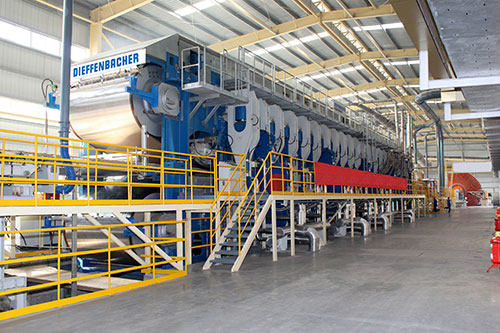
Dieffenbacher delivers full MDF line in India

Indian wood-based panel manufacturer Greenply Industries Limited has choosen to order its second MDF line from Dieffenbacher in December 2015. Greenply has been operating an MDF line from Dieffenbacher since 2009. The new line, which has a capacity of 1300 m³ per day, is being set up in the Chittoor district in the state of Andhra Pradesh in southeast India.

The line will be used to manufacture HDF/MDF boards with a thickness ranging from 2.5 mm to 40 mm and a variable width of 1830 mm to 2440 mm. Fast-growing types of wood such as eucalyptus are generally used as the raw material. Production with the new line is scheduled to begin in autumn 2017.

"In our opinion, Dieffenbacher offers the best technology for processing eucalyptus wood. And due to our positive experience with the first project, selecting anyone other than Dieffenbacher to supply a modern and efficient machine was out of the question", says Shobhan Mittal, Joint Managing Director and CEO of Greenply Industries Limited about the company's decision.

ilman Helmer, Area Sales Manager for Dieffenbacher and Shobhan Mittal, Joint Managing Director and CEO of Greenply Industries Limited during the signing of the contractTilman Helmer, Area Sales Manager for Dieffenbacher and Shobhan Mittal, Joint Managing Director and CEO of Greenply Industries Limited during the signing of the contract

The delivery scope includes a fiber dryer and two SGF sifters, a gluing system, a forming station that includes a scalper with a correction module and a forming line, a CPS 265 – 56 continuous press, a finishing line with two Lukki storage systems, diagonal, trimming and splitting saws, a sanding line and an exhaust system. At 56 meters long, this CPS is the longest continuous press ever sold in Asia.
 
[gravityform id="1" title="true" description="true"]
 
[gravityform id="2" title="true" description="true"]

EC reviews first two years of EUTR

This week the European Commission released a report on the effectiveness of the EU Timber Regulation during its first three years of implementation. The report finds that the EU is on track to achieve its objectives to combat illegal logging and associated trade in illegal timber, but challenges remain.
Some positive trends are visible, namely that EU operators are gradually taking steps to ensure the legality of their suppliers and that there is more awareness of the problem of illegal logging amongst EU consumers.
The EUTR has also encouraged producer countries to develop systems assessing compliance with the requirements of the legislation. However, more effort is needed from both the Member States and the private sector to ensure its effective and efficient application.
Since 2014 there has been significant progress in the implementation of timber regulation across the EU. While in July 2014 there were 18 non-compliant Member States, in June 2015 the number was reduced to four (Greece, Hungary, Romania and Spain).
The Commission launched infringement procedures against these Member States in 2015. It was also widely recognised that the EUTR adds significant value to the international efforts to halt deforestation and forest degradation, conserve biodiversity and address climate change.

See the full report here

 
[gravityform id="1" title="true" description="true"]
 
[gravityform id="2" title="true" description="true"]

Drax proposes biomass subsidies for £2 billion savings for UK consumers

Drax Group Plc. suggested that the British consumers might save up to £2 billion if the Government approves the change from coal to wood pellets to create greener energy. According to a report released by the company, a wider mix of technologies should be added to the Government’s planned renewable energy auctions as to reach the mentioned savings.
Drax implies that the renewables reliant on the sun and wind have hidden costs, which are billed for every consumer. This means that other forms of power generation need to kick in, and flex up and down to meet electricity demand, as the report, published Tuesday by NERA Economic Consulting and London’s Imperial College, states.

“Intermittent renewables like wind and solar are vital as we continue to clean up energy generation, but they need to be backed up by a constant supply of electricity that can be flexed up and down to make sure the UK’s businesses and households always have power on demand,” said Dorothy Thompson, Drax Group CEO.

Technologies based on biomass generate more than a quarter of UK’s renewable electricity, which reaches up to 5Gwatt.
Currently, UK’s Government is planning three auctions for new renewable energy contracts – Contracts for Difference (CfDs) - planned over the next four years, and all are focused on offshore wind. The new research shows significant differences in the true costs of renewables once these additional costs are recognised. Offshore wind could require a CfD of £127 per MWh, onshore wind £92-97 per MWh, solar £96 per MWh, and biomass £84 per MWh.
According to the Department of Energy and Climate Change (DECC), Drax won’t participate in the first auction and the government hasn’t decided yet if the company would be able to compete in the following two auctions.
 
[gravityform id="1" title="true" description="true"]
 
[gravityform id="2" title="true" description="true"]


Contrasting 2015 tropical plywood market trends between EU member states

EU markets for tropical hardwood plywood showed contrasting trends in 2015. The relatively large UK market was flat and the Netherlands was buoyant, but most other markets were declining.

The UK imported 142,600 cu.m of tropical plywood in the first eleven months of last year, 1% more than the previous year. The latest data suggests a small surge in UK imports in the last quarter of 2015. After the first three quarters, UK imports of tropical plywood were 4% lower than the year before.

Overall market conditions in the UK were not as buoyant in 2015 as they were in 2014. The UK Timber Trade Federation reports an overall reduction in wood product imports by 3.1% for the period from January to November 2015, blaming a slow-down in UK construction as a main factor behind this trend.

In relation to hardwood plywood, including both temperate and tropical, the TTF records a 10.8% increase in imports during the period.

This is mainly due to a rise in imports from China. UK imports from Indonesia also increased slightly, from a small base, but Malaysia suffered a significant loss of share in the UK plywood market last year.

The frequently mentioned recovery in the Dutch economy and building sector is reflected in a 23% jump in imports of tropical plywood to 59,548 cu.m in the first 11 months of 2016. As in the UK, there was an uptick in plywood imports into the Netherlands in the last quarter of 2015.

Last year, the Netherlands overtook Belgium to become the second largest EU importer of tropical plywood.

Other EU markets for tropical plywood were declining last year. Imports fell into Belgium (-11% to 59,466 cu.m), France (-1% to 42,034 cu.m), Germany (-17% to 21,859 cu.m) and Italy (-7% to 20,396 cu.m).

German importers interviewed at the timber trade federation GD Holz’s Branchentag trade show in November reported weakness in tropical plywood sales last year. Raw plywood from Indonesia and Malaysia, in particular, was replaced with more competitively priced hardwood plywood from Russia and Eastern Europe.

The only grade from South-East Asia mentioned as selling well in Germany was film-faced 4 mm panels from Indonesia.


[gravityform id="1" title="true" description="true"]


[gravityform id="2" title="true" description="true"]

Montréal Wood Convention- from March 22 to 24, 2016

The Montréal Wood Convention, the prime event for the wood products trade in North America, will be held from March 22 to 24, 2016 at the Fairmont The Queen Elizabeth in Montréal, Canada. With 650 participants from the wood products industry and over80 exhibitors in 2015, and even more in 2016, it is the event that no serious wood products company wants to miss!
At the 2016 Convention, two half-days are dedicated to the trade show. It is the perfect occasion to meet North American suppliers of lumber, engineered wood products, wood construction components, hardwood and flooring. The seminar on the economy, markets and marketing gives you the chance to learn about the market development for wood products and how social media can be used to market products and brands.
In addition, as a new feature, there will be a seminar dedicated to the hardwood lumber markets. A technical seminar, where leading suppliers of equipment and services for the wood products industry present examples of successful technical solutions, is also scheduled.
Visit www.montrealwoodconvention.com for more details.

India: Plywood industry sourcing alternatives to gurjan

Indian consumers are accustomed to red colored face and back veneers, mostly imported gurjan, for the panel products. Plywood manufacturers depended on imports of gurjan from Myanmar since domestic sources of suitable Dipterocarpus timbers were insufficient to meet the requirements of the plywood sector, ITTO reported.
Now that Myanmar has banned log exports Indian manufacturers are facing a problem in securing peeler logs of a colour to satisfy consumer preferences.
There are two ways to overcome this problem; encourage consumers to accept domestic and imported timbers of another colour with properties similar to gurjan or identify alternative large sized, red coloured timbers suitable for peeling.
Trials have been conducted with okoume and sapelli and a measure of market acceptance has been reported. In addition some timbers from Malaysia, Papua and New Guinea and Solomon Islands have been found acceptable.
The timbers being assessed include amoora antiaris, calophyllum, campnosperma, erima, grey canarium, hoop pine, klinki pine, labula litsea, lophopetalum, mersawa, pink satinwood, red cedar, planchonella, silkwood, maple, silver ash and sloanea.
Currently alternatives to gurjan account for around 40% of the timbers used for peeling.
 
[gravityform id="1" title="true" description="true"]
 
[gravityform id="1" title="true" description="true"]

Stora Enso's sales drop in Q4 and full 2015

Stora Enso released their 4Q sales for 2015. Compared to Q4/2014, the sales decreased by 2.5%, reaching EUR 2.487 million. Sales, excluding the structurally declining paper business and divested Corenso and Barcelona mill, increased 5.4%, primarily due to the Montes del Plata pulp mill and Varkaus Mill kraftliner volumes.
Due to strong performance in Biomaterials, lower variable costs, and favorable FX, the operational EBIT increased 15.8% to EUR 242 million, compared to the EUR 209 million reached in Q4/2014. Also, the cash flow from operations amounted to EUR 412 million, 30 million lower than the same period last year.
Compared to Q3/2015, sales remained unchanged, excluding the structurally declining paper business and the divested Barcelona Mill, which increased 2.2%. Since the Q3, the operational EBIT decreased in the Q4 with EUR 4 million, due to seasonally increased fixed costs, lower hardwood pulp prices, and unfavorable FX.

“Stora Enso has shown its ability to transform into a renewable materials growth company. In the fourth quarter, sales excluding the structurally declining paper business and divestments increased 5.4%. This was mainly driven by the Montes del Plata pulp mill and kraftliner from Varkaus Mill. We also continued to generate strong cash flow during the quarter,” said Karl-Henrik Sundström, Stora Enso’s CEO.

For the full year 2015, the sales amounted 10.040 million, decreasing 1.7% compared with 2014. The operational EBIT reached 915 million, increasing by 13.0%, mainly due to strong performance in Biomaterials, favorable FX, and lower variable costs. The cash flow was strong, amounting to EUR 1.556 million, compared to the 1.139 million in 2014. Thus, the Board of Directors proposes dividend to increase from EUR 0.30 to EUR 0.33.
At the moment, Stora Enso proceeds with its Varkaus mill, as full production is expected in early 2017. Also, the Beihai consumer board mill in China is expected to be operational in the Q2 of 2016.
Q1/2016 sales are estimated to be similar to the amount of EUR 2 487 million and operational EBIT is expected to be in line with the EUR 242 million recorded in Q4/2015. There are no major scheduled annual maintenance shutdowns during Q1/2016.
 
[gravityform id="1" title="true" description="true"]
 
[gravityform id="2" title="true" description="true"]


Stora Enso’s sales drop in Q4 and full 2015

Stora Enso released their 4Q sales for 2015. Compared to Q4/2014, the sales decreased by 2.5%, reaching EUR 2.487 million. Sales, excluding the structurally declining paper business and divested Corenso and Barcelona mill, increased 5.4%, primarily due to the Montes del Plata pulp mill and Varkaus Mill kraftliner volumes.

Due to strong performance in Biomaterials, lower variable costs, and favorable FX, the operational EBIT increased 15.8% to EUR 242 million, compared to the EUR 209 million reached in Q4/2014. Also, the cash flow from operations amounted to EUR 412 million, 30 million lower than the same period last year.

Compared to Q3/2015, sales remained unchanged, excluding the structurally declining paper business and the divested Barcelona Mill, which increased 2.2%. Since the Q3, the operational EBIT decreased in the Q4 with EUR 4 million, due to seasonally increased fixed costs, lower hardwood pulp prices, and unfavorable FX.

“Stora Enso has shown its ability to transform into a renewable materials growth company. In the fourth quarter, sales excluding the structurally declining paper business and divestments increased 5.4%. This was mainly driven by the Montes del Plata pulp mill and kraftliner from Varkaus Mill. We also continued to generate strong cash flow during the quarter,” said Karl-Henrik Sundström, Stora Enso’s CEO.

For the full year 2015, the sales amounted 10.040 million, decreasing 1.7% compared with 2014. The operational EBIT reached 915 million, increasing by 13.0%, mainly due to strong performance in Biomaterials, favorable FX, and lower variable costs. The cash flow was strong, amounting to EUR 1.556 million, compared to the 1.139 million in 2014. Thus, the Board of Directors proposes dividend to increase from EUR 0.30 to EUR 0.33.

At the moment, Stora Enso proceeds with its Varkaus mill, as full production is expected in early 2017. Also, the Beihai consumer board mill in China is expected to be operational in the Q2 of 2016.

Q1/2016 sales are estimated to be similar to the amount of EUR 2 487 million and operational EBIT is expected to be in line with the EUR 242 million recorded in Q4/2015. There are no major scheduled annual maintenance shutdowns during Q1/2016.


[gravityform id="1" title="true" description="true"]


[gravityform id="2" title="true" description="true"]


Södra makes major investment at Mörrum mill

On 16 February, the Board of Directors of Södra decided to invest SEK 1 billion (EUR 105,5 million) in the pulp mill at Mörrum. The investment is the second stage of a long-term initiative at Södra Cell Mörrum, and will increase the mill's capacity by 45,000 tonnes.
This particular investment includes a new evaporator, and a modernisation of the brown stock washing system in the dissolving pulp line, where pulp for textile uses is produced. A new evaporator will make it possible to increase the production rate, as well as deliveries of energy products, such as electricity, district heating and biofuels. The new investment will increase production capacity by 45,000 tonnes, bringing the total production of paper and dissolving pulp to 470,000 tonnes.
"The investment will allow us to meet customer demands for both paper and dissolving pulp. Our facility at Mörrum produces high-grade pulp with unique properties. We will now be able to offer higher volumes of these sought-after products to the market. In addition, dissolving pulp and paper pulp based on a renewable source are highly interesting from a climate perspective. More and more people are beginning to see the significance of finding materials that facilitate the transition toward a fossil-free society," says Stefan Sandberg.
The project will commence in spring 2016 and is scheduled for completion by November 2017.
 
[gravityform id="1" title="true" description="true"]
 
[gravityform id="2" title="true" description="true"]

Canfor employs option to take Conifex subsidiary in BC

Conifex Timber informed that Canfor has exercised its option to convert the company’s senior secured note to acquire a Conifex subsidiary, which held a forest licence in British Columbia.
The option was agreed by the companies in the mid-2015, when Canfor loaned CAD 30 million to Conifex. The loan was represented by a senior secured note, which had a term of 5 years and was secured by a forest licence with 200,000 cubic metres of annual cut held by a subsidiary of Conifex. Canfor had the option, exercisable after one year, to convert the loan into an ownership interest in the forest licence.
As a result of the exercise, Conifex will record a net gain of approximately CAD 29 million on the sale of assets, representing a gain of approximately CAD 1.37 per share, in the first quarter of 2016 in connection with the conversion, and will decrease its indebtedness by CAD 30 million.
Earlier Conifex Timber extended its credit line by CAD 10 million.
Conifex is a publicly listed softwood forest products company operating in the Northern Interior region of British Columbia, Canada. Its primary business is the manufacture of structural grade SPF dimension lumber. Conifex’s operations include timber harvesting, reforestation, forest management, sawmilling logs into lumber and wood chips, and value added lumber finishing. Conifex’s lumber products are sold in the United States, Chinese, Canadian and Japanese markets.
 
[gravityform id="1" title="true" description="true"]
 
[gravityform id="2" title="true" description="true"]
 

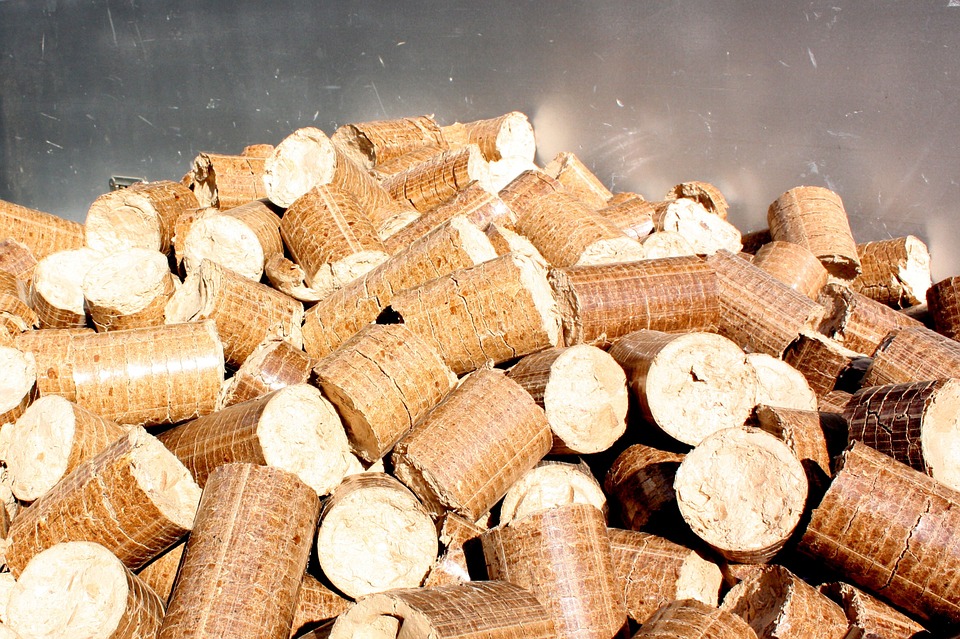
The price of wood pellets in Germany lagging

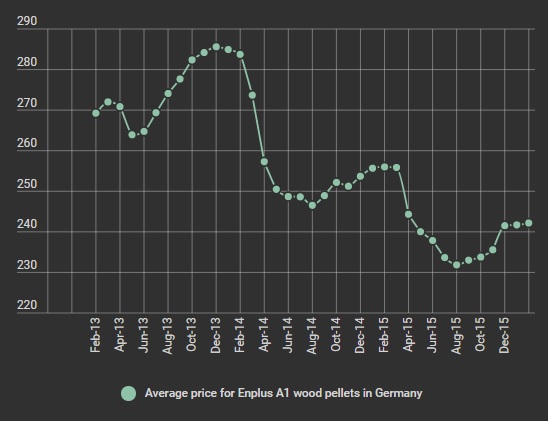
The price of wood pellets in Germany has slightly increased in February 2016 with 0.2%, compared to January. Thus, the price reached EUR 242.18/t, as the German Energy Wood and Pellet Association (DEPV) reports.
Still, compared to February 2015, the wood pellets price decreased by 5.6%. Currently, one kilogram of pellets costs 24.22 cents, and a kilowatt-hour (kWh) of heat from pellets costs 4.84 cents.
Wood pellets offer a price advantage over natural gas of almost 25%. At the same time, due to the crash in oil prices, fuel oil has become more price advantageous than wood pellets by 22%.
Southern Germany recorded a price of EUR 239.62/t, the lowest in the country, for purchases of 6 tonnes. In the central Germany, the same amount of pellets costs EUR 243.12/t, while in northern and eastern Germany, the price reaches EUR 247.46/t.
For 26 tonnes purchases, the prices change accordingly: South: EUR 225.98/t, Center: EUR 227.45/t, North and East: EUR 227.62 EUR/ t (VAT included).

Infographic (Price evolution of wood pellets in Germany)

Price of wood pellets in Germany
Create your own infographics


[gravityform id="1" title="true" description="true"]
 
[gravityform id="2" title="true" description="true"]

Wood biomass booming in Japan

Japan returns to wood as the source of clean energy and has established lower tariffs to power producers who burn leftover wood, according to Bloomberg Business (BB). This way, with 70% of their land covered by forests, Japan wants to quit the imported fossil fuels. The demand is already very high and there is also a chance to not having enough raw materials to finish the planned projects, as researchers said.

Norichika Ando, an economist at the Norinchukin Research Institute Co. in Tokyo, advised that “there are already regions that have been unable to retain the same suppliers because of new projects being planned. Some are trying so hard that they offer higher prices and seek subsidies to transport fuel material from other regions.”

The trade ministry has already approved more than 2,000 megawatts of new woody biomass projects and operators of coal-power plants seek to a new mixture of wood pellets with the most-polluting fossil fuel. The new capacity requires about 40 million cubic meters of wood material a year, as BB reported. Still, Japan produces only 23 million cubic meters every year.
In addition, there is a greater demand for raw supplies and a bigger competition due to this. As Minoru Kumazaki, chairman of the Japan Woody Bioenergy Association in Tokyo, said, the lack of good forest roads is a cause for Japan producers not to be able to ship resources efficiently.
For plants 2 megawatts or larger in capacity, the power producers receive 32 yen (26 cents) per kilowatt hour for burning timber from forest thinning. The larger biomass power stations receive supply from imports. Thus, the wood pellet import doubled last year to a record 232,425 tons.
 
[gravityform id="1" title="true" description="true"]
 
[gravityform id="2" title="true" description="true"]


CLT could change US lumber industry

A new wood product project that is currently under testing at the University of Maine in the US. It is a kind of engineered lumber that can rival concrete, steel and other construction materials, according to WCSH6 Portland.
The new cross laminated timber is made with various types of wood from the forests in Maine. To make building material out of it, the CLT is pressed into a strong construction material.

Steve Shaler, director of the School of Forest Resources at UMaine, said that "it would be a new market, it would be a new factory, sort of like making furniture, except its really big pieces.”
"They come out as large panels, solid panels with windows and door openings pre-cut, maybe utility locations pre-cut, and they're swung into place and connected together and they go up very very quickly with very little cutting on site very little waste on site," said Bill Davids, professor and chair of the Department of Civil and Environmental Engineering.

He added that the CLT will be used for taller structures, up to 10 stories.
The test of the new engineered plywood consists of breaking the blocks of spruce, pine and fir under 10,000 pounds of force. Even if it still weighs littler than steel and concrete it’s stronger than normal lumber. Moreover, it’s more fire resistant than steel, and also better for the environment.

"Because this weighs less than steel and concrete, the size of those foundations has been shown to be smaller, and that saves money in the cost of a building," said Shaler.

The testing is now undergoing the strength of the CTL, as to make as strongest it can be. If the material proves to be working for structures in the northeast, then Maine’s forests would become very valuable.
At the moment, Oregon in the United States is the only CLT manufacturer, where they use local fir trees to use them for building commercial structures.
 
[gravityform id="1" title="true" description="true"]
 
[gravityform id="2" title="true" description="true"]


EU tropical plywood imports static in 2015

EUtropicalplywoodimportsThe EU imported 367,000 m3 of tropical plywood in the first 11 month of 2015, the same as in the previous year. However there was growth in EU import value of plywood (+8.7% to €194.1 million) during the period as import prices were higher in 2015 due to the weak euro. The euro was on average 16% down on the dollar in 2015 compared to 2014.
EU imports of plywood in the first 11 months of 2015 were down from both Malaysia and Indonesia, the two largest suppliers. Imports from Malaysia were 7% less at 101,200m3 during the period.
EU imports from Malaysia were nearly matched by those from Indonesia which, at 98,900 cu.m, were only 2% less than the previous year.
China supplied 85,000 cu.m of plywood with a tropical wood face to the EU in the first 11 months of 2015, 3% more than the same period the previous year. There was also a 16% rise in imports from Brazil but, at only 16,100 cu.m, the volume remains low.
 
[gravityform id="1" title="true" description="true"]
 
[gravityform id="2" title="true" description="true"]

Söderhamn Eriksson to deliver a debarking and saw line to AS Textuur in Estonia

AS Textuur invests in a debarking and saw line in Estonia. The company placed an order for a Cambio debarking line, a bandsaw group with merry-go-round conveyors, a Eurosaw resaw and a Catech edger optimizer line with Söderhamn Eriksson. The technology provider informs that the processing line is designed for a capacity of 75,000 m3 of logs per year and shift.

The equipment will be delivered by the second half of 2016.
AS Textuur is a medium scale timber company in Viljandi County, South Estonia. Its main product is a high quality pine gluelam board.
Söderhamn Eriksson operates five facilities in Sweden. The company is known around the world for its quality log lines and edger systems, and for the Cambio debarker, which was invented by Söderhamns Verkstäder in the 1950s and subsequently sold many thousands of machines around the world. Söderhamn Eriksson was bought by American USNR in 2015.
[gravityform id="1" title="true" description="true"]
[gravityform id="2" title="true" description="true"]

Newsletter

Subscribe to our digital newsletter for your daily digest of essential news, views and analysis from the international wood industry delivered directly to your inbox.


0