

In June 2016 Brazilian exports of wood-products (except pulp and paper) increased 4.1% in value compared to June 2015, from US$231.7 million to US$241.1 million.
The value of Brazil's pine sawnwood exports fell 3.9% over the same period from US$30.9 million to US$ 29.7 million but, in terms of volume June 2016 exports increased 15.7% year on year from 134,800 cu.m to 156,000 cu.m, as ITTO reported.
Brazilian tropical sawnwood exports increased 22.4% in volume, from 26,300 cu.m in June 2015 to 32,200 cu.m in June this year and the value of exports increased 12.3% (US$13 million to US$14.6 million).
June 2016 pine plywood exports increased 2.6% in value year on year from US$34.1 million to US$35.0 million and export volumes also increased from 99,600 cu.m to 134,200 cu.m.
A similar trend was seen for Brazil's tropical plywood exports. Year on year June exports were up 22.4% in volume from 9,800 cu.m in June 2015 to 12,000 cu.m in June 2016. The value of exports increased 4.3% from US$4.7 million to US$4.9 milion over the same period.
Brazil’s wooden furniture exports performed well in June 2106 rising US$35.2 million a year earlier to US$39.5 million.
Article archive
Roundwood prices in Lithuania go down in June

During June 2016, most of the roundwood prices in Lithuania kept on decreasing, as compared to 2015. The pulpwood prices were the only ones that registered an increase, with the pine price growing by 4.34% and spruce price going up by 4.54%. Continue reading "Roundwood prices in Lithuania go down in June"
Interfor's Q2/2016: increased earnings and lumber production
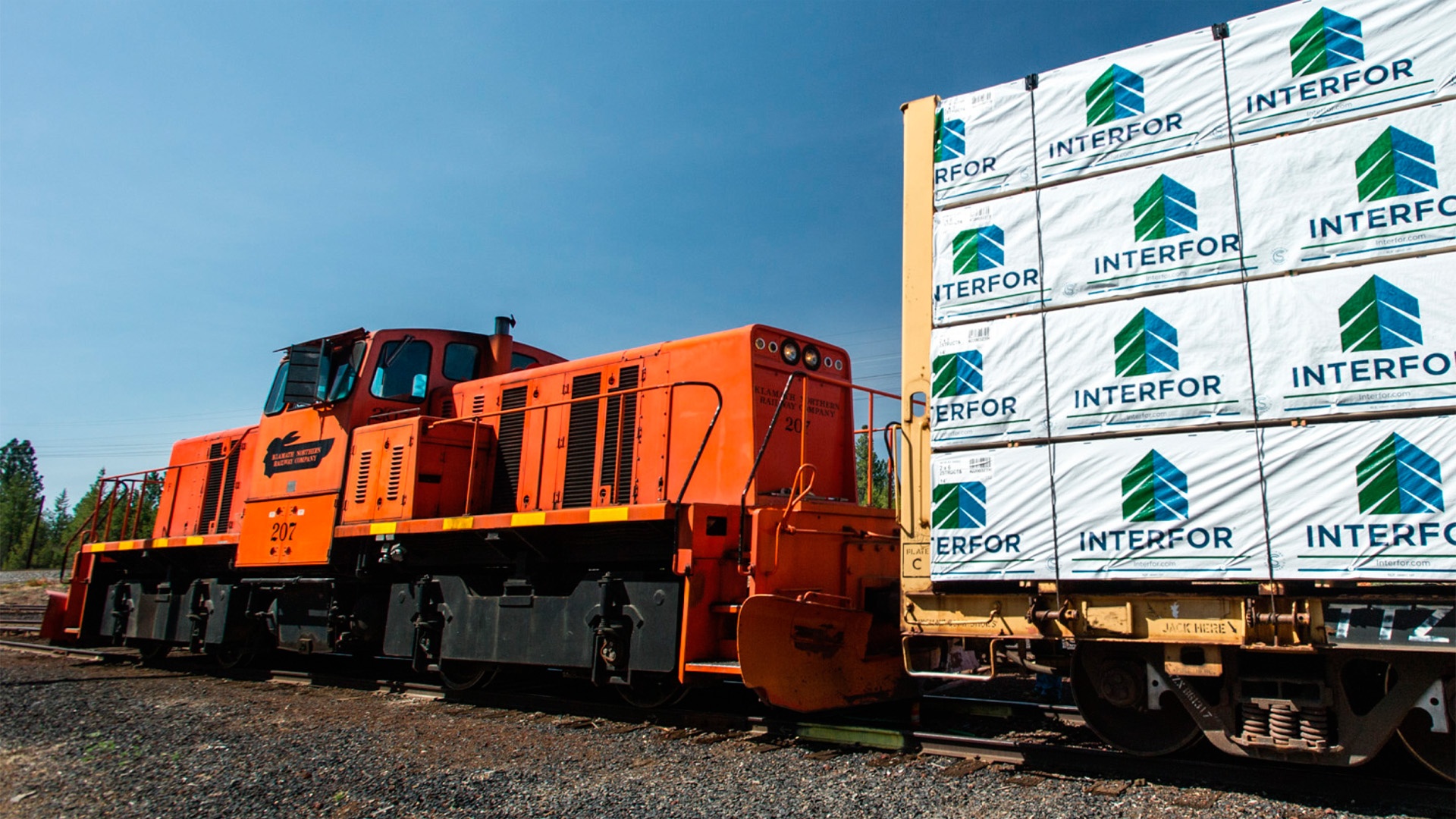
Interfor has recently published their financial results for Q2/2016. The Canadian company registered net earnings of CAD $23.2 million in the mentioned period, as compared to the CAD $0.8 million in Q1/2016.
Adjusted net earnings in Q2/2016 were CAD $20.9 million, compared to CAD $2.6 million in the Q1/2016. The company's adjusted EBITDA1 was $56.9 million on sales of $458.8 million in Q2/2016, compared to the adjusted EBITDA1 of $33.4 million on sales of $433.9 million in Q1/2016.
For the quarter, the product prices were higher in Q2/2016 versus Q1/2016, with the Western SPF Composite and the Southern Pine ("SP") Composite up over the prior quarter by US$38 and US$27 per mfbm, respectively.
Interfor produced an additional 19 million board feet in Q2/2016 versus Q1/2016, mostly reflective of productivity gains at several operations as ongoing improvement initiatives take effect.
In particular, Interfor has achieved strong productivity, cost and product mix gains at its Gilchrist, Oregon operation, which resulted in a significant margin improvement over Q1/2016. In addition, a number of margin improvement projects are underway across the U.S. South platform, with early stage results being realized.
Also, the monetization process for Interfor's Tacoma sawmill property is proceeding on track, with the sale expected to close in the second half of 2016.
Interfor generated CAD $62.6 million of cash from operations, with a reduction in working capital contributing $6.3 million. Capital spending amounted to $15.8 million during the quarter.
Production
Interfor's lumber production in Q2/2016 was 637 million board feet versus 618 million board feet in Q1/2016.
Production from Interfor's Canadian operations totaled 218 million board feet in the mentioned period, up 8 million board feet compared to Q1/2016. Production increased most significantly at Castlegar mill, which produced an additional 4 million board feet as productivity gains have continued following the resumption of operations at that mill in Q4/2015.
Production from the company's nine U.S. South sawmills totaled 270 million board feet, up 5 million board feet compared to Q1'16 as a result of a modest increase in total productivity. Production from U.S. Northwest operations totaled 149 million board feet in Q2/2016, an increase of 6 million board feet over the preceding quarter.
Lumber markets were relatively strong in the second quarter on increased demand, as reflected by improvements in all three of Interfor's key price benchmarks over the first quarter. The Western SPF Composite improved by US$38 to US$300 per mfbm, the SP Composite increased by US$27 to US$390 per mfbm and the KD HF Stud 2x4 9' benchmark rose by US$23 to US$355 per mfbm.
Interfor’s Q2/2016: increased earnings and lumber production
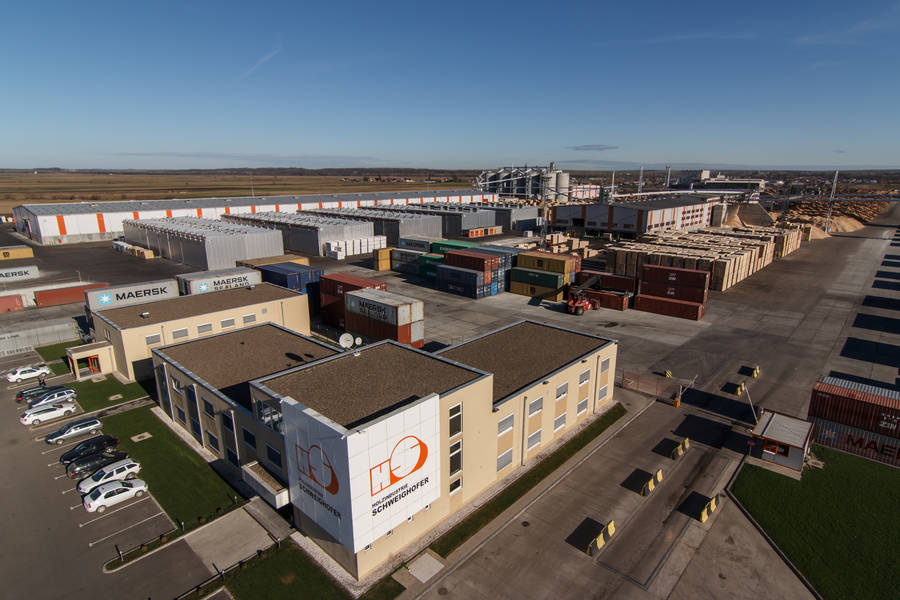
Interfor has recently published their financial results for Q2/2016. The Canadian company registered net earnings of CAD $23.2 million in the mentioned period, as compared to the CAD $0.8 million in Q1/2016.
Adjusted net earnings in Q2/2016 were CAD $20.9 million, compared to CAD $2.6 million in the Q1/2016. The company's adjusted EBITDA1 was $56.9 million on sales of $458.8 million in Q2/2016, compared to the adjusted EBITDA1 of $33.4 million on sales of $433.9 million in Q1/2016.
For the quarter, the product prices were higher in Q2/2016 versus Q1/2016, with the Western SPF Composite and the Southern Pine ("SP") Composite up over the prior quarter by US$38 and US$27 per mfbm, respectively.
Interfor produced an additional 19 million board feet in Q2/2016 versus Q1/2016, mostly reflective of productivity gains at several operations as ongoing improvement initiatives take effect.
In particular, Interfor has achieved strong productivity, cost and product mix gains at its Gilchrist, Oregon operation, which resulted in a significant margin improvement over Q1/2016. In addition, a number of margin improvement projects are underway across the U.S. South platform, with early stage results being realized.
Also, the monetization process for Interfor's Tacoma sawmill property is proceeding on track, with the sale expected to close in the second half of 2016.
Interfor generated CAD $62.6 million of cash from operations, with a reduction in working capital contributing $6.3 million. Capital spending amounted to $15.8 million during the quarter.
Production
Interfor's lumber production in Q2/2016 was 637 million board feet versus 618 million board feet in Q1/2016.
Production from Interfor's Canadian operations totaled 218 million board feet in the mentioned period, up 8 million board feet compared to Q1/2016. Production increased most significantly at Castlegar mill, which produced an additional 4 million board feet as productivity gains have continued following the resumption of operations at that mill in Q4/2015.
Production from the company's nine U.S. South sawmills totaled 270 million board feet, up 5 million board feet compared to Q1'16 as a result of a modest increase in total productivity. Production from U.S. Northwest operations totaled 149 million board feet in Q2/2016, an increase of 6 million board feet over the preceding quarter.
Lumber markets were relatively strong in the second quarter on increased demand, as reflected by improvements in all three of Interfor's key price benchmarks over the first quarter. The Western SPF Composite improved by US$38 to US$300 per mfbm, the SP Composite increased by US$27 to US$390 per mfbm and the KD HF Stud 2x4 9' benchmark rose by US$23 to US$355 per mfbm.
UPM and Blue Energy Europe enter into agreement on renewable energy supply

UPM has entered into a conditional agreement with Blue Energy Europe (BEE) for the supply of heat for its Hürth mill in the Cologne area in Germany. The deal is expected to be finalized during the first half of 2017 at the latest.
As part of the deal BEE will acquire a biomass boiler, turbine and generator from UPM's closed Myllykoski site in Finland. BEE will transfer the power plant components to the vicinity of UPM's Hürth mill, and provide steam for the mill.
"This opportunity is both economically and environmentally attractive. BEE's heat supply will be biomass-based and thus, its fossil CO2 emissions are zero. Additionally, it will decrease the energy costs of the Hürth mill," says Anu Ahola, Senior Vice President, Newspaper Publishing, UPM Paper ENA.
UPM continually looks to reduce its carbon footprint through the use of renewable energy. "Also, a reuse of the existing renewable energy plant is a good example of our corporate responsibility," added Anu Ahola.
UPM has been actively seeking alternatives for use of the Myllykoski site and its equipment after closing the mill in 2011.
Strong growth in US wooden furniture imports

US residential window and door demand to grow 6% by 2020

Demand for residential windows and doors in the US might grow by 6% through 2020 and reach $25.6 billion.
According to a report made by Freedonia Group, the housing construction began to recover in 2012. Rising home values and existing home sales will boost remodeling demand for windows and doors.
The most rapid growth through 2020 will be for plastic windows and doors, while wood will continue to account for the largest share of the US residential window and door market.
Demand for wood products saw the best growth between 2010 and 2015, supported by demand for interior doors in new housing units as housing completions rebounded.
Yet, although wood will continue to exhibit significant usage in window and exterior door applications in higher end residences, where consumers prefer its aesthetics, it will lose market share to plastic products, as wood is more costly and more vulnerable to damage from exposure to the elements.
As reported in the study, doors make up the largest share of the residential market, approaching three-fifths of the total, as most residential structures use more doors than windows. Interior doors make up a large share of demand for doors in the new market, but a smaller share of the improvement and repair market, as they are less likely to require replacement because of damage or poor energy performance.
Russian log, lumber, plywood and pulp exports grew during January-May 2016

During January-May 2016, Russia's exports of log, lumber, plywood and pulp have grown, compared to the same period of 2015. Plywood, in particular, the most productive woodworking industry in Russia, has kept on gaining interest of the international market. Continue reading "Russian log, lumber, plywood and pulp exports grew during January-May 2016"
US: Keene Lumber Company acquired by LBM Holdings

U.S. LBM Holdings, LLC acquires Muskegon, Michigan- based Keene Lumber Company. Keene will join U.S. LBM’s Standard Companies, becoming a division of Standard Supply & Lumber.
A leading distributor and manufacturer of building materials in Western Michigan, Standard is headquartered in Grand Rapids. All employees will remain with Keene Lumber Company, which will continue to be led by General Manager Kevin Kooi.
Keene’s products include cabinetry and hardware, decking, flooring, roofing, siding and windows, with services ranging from home remodeling and kitchen and bath design to roof truss design and engineering.
“We’re excited to join the team at U.S. LBM and Standard and are already looking forward to the new opportunities this partnership brings,” said Keene Lumber Company General Manager Kevin Kooi.
U.S. LBM is one of the largest specialty building materials distributor in the United States.
A leading distributor and manufacturer of building materials in Western Michigan, Standard is headquartered in Grand Rapids. All employees will remain with Keene Lumber Company, which will continue to be led by General Manager Kevin Kooi.
Keene’s products include cabinetry and hardware, decking, flooring, roofing, siding and windows, with services ranging from home remodeling and kitchen and bath design to roof truss design and engineering.
“We’re excited to join the team at U.S. LBM and Standard and are already looking forward to the new opportunities this partnership brings,” said Keene Lumber Company General Manager Kevin Kooi.
U.S. LBM is one of the largest specialty building materials distributor in the United States.
UK: Drax doubles electricity generation from biomass; EBITDA drops 42% in H1/2016

UK's Drax power group has recently published its 1H/2016 results, announcing a doubling of its electricity generation from biomass. Also, the company reported an "operationally strong" business, even if its profits fell by £ 50 million.
Drax's EBITDA (earnings before interest, taxes, depreciation and amortization) in the mentioned period of the year decreased by 42% at £70 million, compare to the £ 120 million from the 1H/2015. Continue reading "UK: Drax doubles electricity generation from biomass; EBITDA drops 42% in H1/2016"
EGGER Group reports increased turnover for the 2015/2016 financial year

The Austrian wood-based materials manufacturer, EGGER, was able to profit from slightly positive economic developments, the recovering demand for construction services in Europe, as well as the stable raw material prices.
During the 2015/2016 financial year (30th of April 2016) turnover increased to 2.34 billion Euro (+3.4%), the EBITDA to 349.6 million Euro (+9.8%). The EBITDA margin exceeded previous years’ levels at 14.9%. Continue reading "EGGER Group reports increased turnover for the 2015/2016 financial year"
US housing boom increases Canada's softwood exports

The wood used in home buildings is getting more and more expensive once with the Americans investing in new homes has reached highest level since the recession.
Lumber prices got to their 19-month high last week due to the builders' increased demand. In this situation, Canada provides almost a third of all the wood used for the homes in the US.
According to Herald Net, Continue reading "US housing boom increases Canada's softwood exports"
US housing boom increases Canada’s softwood exports

The wood used in home buildings is getting more and more expensive once with the Americans investing in new homes has reached highest level since the recession.
Lumber prices got to their 19-month high last week due to the builders' increased demand. In this situation, Canada provides almost a third of all the wood used for the homes in the US.
According to Herald Net, Continue reading "US housing boom increases Canada’s softwood exports"
Wood pellet mills database for North America
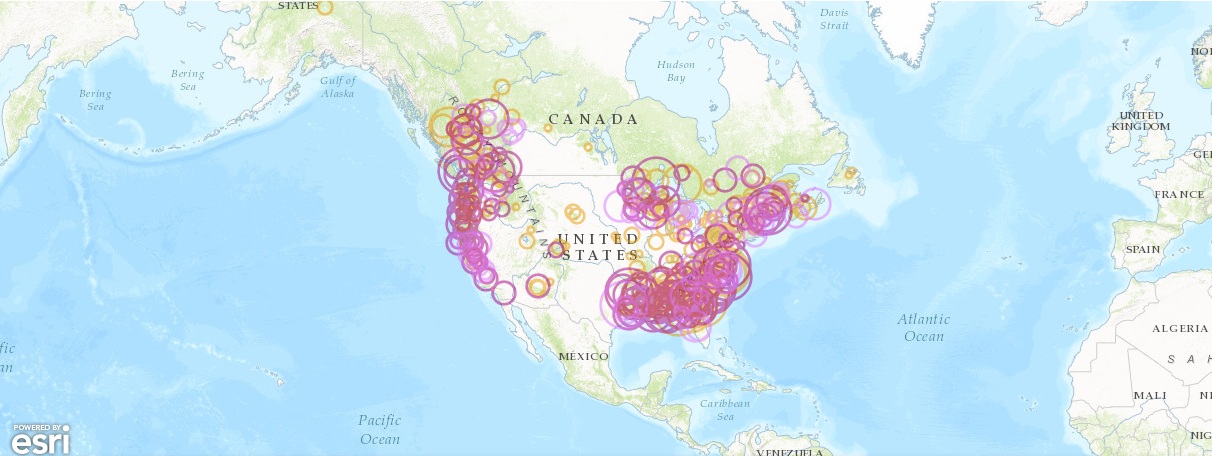
Working with Ecostrat and other partners, the U.S. Endowment for Forestry and Communities has developed this comprehensive database of wood to energy conversion facilitates in the United States and Canada. It covers power plants as well as wood pellet mills.
Originally developed and hosted by the University of Tennessee, this is the third edition of the web tool.
Video presentation
Access database here
About
The US Endowment works collaboratively with partners in the public and private sectors to advance systemic, transformative and sustainable change for the health and vitality of the nation’s working forests and forest-reliant communities.
Ecostrat is the developer of the new Wood2Energy database and a leading North American biomass feedstock supply chain solutions company. With over 20 years and 5,000,000 tons of biomass supply experience, the largest database of biomass suppliers and buyers in North America and advanced predictive analytics, we are a reliable partner at any stage in the bioenergy project life-cycle, from early stage supply chain development through to ongoing operations.
Ecostrat is the developer of the new Wood2Energy database and a leading North American biomass feedstock supply chain solutions company. With over 20 years and 5,000,000 tons of biomass supply experience, the largest database of biomass suppliers and buyers in North America and advanced predictive analytics, we are a reliable partner at any stage in the bioenergy project life-cycle, from early stage supply chain development through to ongoing operations.
Slowing pace of EU tropical timber imports

Latest trade data shows that the rising trend in EU import value of tropical wood products that began in the second half of 2014 leveled off in the first five months of this year. No trade data is yet available for the period after May when the effects of the UK vote to leave the EU might become clearer.
According to ITTO, the early indications are that it will lead to a significant slowdown in European tropical wood imports in the second half of 2016 in response to currency movements and economic uncertainty in the UK, currently the largest European market for tropical wood products.
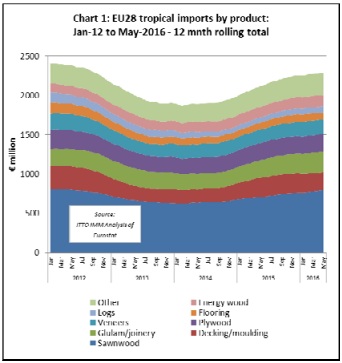 Charts 1 to 3 below show the monthly trends in imports of tropical wood products into the EU to May 2016 using 12 month rolling totals. This is calculated for each month as the total import of the previous 12 months. The data removes short-term fluctuations due to seasonal changes in supply and shipping schedules and provides a clear indication of the underlying trade trend.
Chart 1 shows total EU euro import value of all wood products listed in Chapter 44 of the HS codes sourced from tropical countries. Total imports in the 12 months to May 2016 were euro2.29 billion, only slightly above euro2.26 billion recorded for the 12 months of 2015.
The sharp increase in imports of tropical decking and mouldings recorded in 2015, notably from Brazil and into the UK and France, has slowed dramatically in 2016. Imports of tropical flooring products have also slowed this year.
However, European imports of tropical sawnwood, veneer, logs, energy wood and joinery products such as LVL continued to rise between January and May 2016. After recovering in 2014, European imports of tropical plywood remained static between January 2015 and May 2016.
Chart 2 shows how European imports from the major tropical supply countries developed 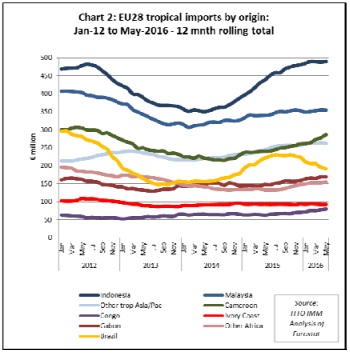 between 2012 and May 2016. After rapid growth in 2015 and the first quarter of 2016, European imports from Indonesia (dominated by decking, doors, plywood and LVL) stabilised at the higher level in April and May this year.
Imports from Malaysia (mainly sawnwood, plywood, doors, and LVL) remained static at a relatively low level between mid-2015 and May 2016. Imports from Cameroon (almost all sawnwood) were rising sharply in the year to May. However, imports from Brazil (mainly sawnwood and decking) fell rapidly between September 2015 and May 2016.
Chart 3 shows the recent trend in tropical wood imports into the main EU consuming countries. 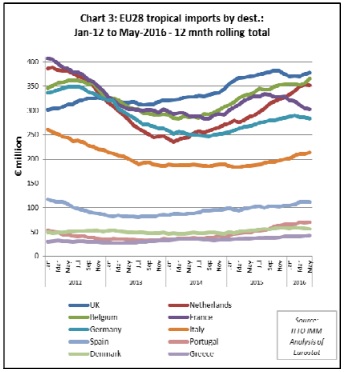 The pace of growth in imports into the UK (the leading EU market which takes mainly doors, plywood and sawnwood) was already slowing in the early months of 2016 before the Brexit vote.
Imports into Belgium (mainly sawnwood and decking) and the Netherlands (mainly sawnwood, LVL and decking) continued to rise in the first five months of 2016, narrowing the gap with the UK. Imports have also continued to rise this year into Italy (mainly sawnwood and veneer), Spain (mainly sawnwood and veneer) and Portugal (mainly sawnwood, logs and chips).
In contrast, imports into France (mainly sawnwood, decking and veneer) were declining during the first five months of 2016, due to weakening imports from Brazil.
Imports into Germany (mainly decking and sawnwood) also dipped a little in April and May this year.
Siempelkamp delivers a ContiRoll® press to Action Group in India
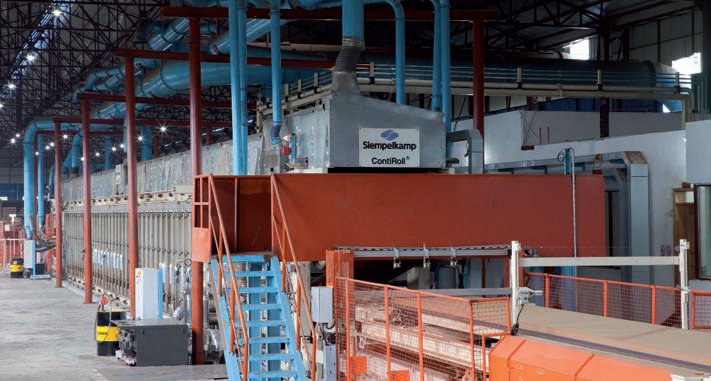
Siempelkamp received an order from Action Tesa in India. Action Tesa ordered a forming and press line including a 8’ x 27.1m ContiRoll® press as well as other components, such as the sifter, cooling and stacking line, and a high-stack storage system, for an MDF-/HDF plant.
The contracting party is Belaji Action Buildwell in New Delhi, a company of the Action Group which has already applied several innovations in the area of wood-based material production in Continue reading "Siempelkamp delivers a ContiRoll® press to Action Group in India"
US roundwood prices kept downward trend in 1H/2016

Roundwood prices in Finland reach higher level in June
Roundwood prices in Finland have increased in June 2016, as compared to the same period of 2015. Continue reading "Roundwood prices in Finland reach higher level in June"
Disappointing first 5 months of US tropical imports

The US imported 127,068 cu.m. of sawn temperate and tropical hardwood in May, up 60% from April. However the value of these imports increased by just 5% to US$43.9 million. The volume growth was mainly in imports of temperate species.
May tropical sawn hardwood imports grew 5% from April to Continue reading "Disappointing first 5 months of US tropical imports"
BVRio to use Ethereum against illegal timber trade
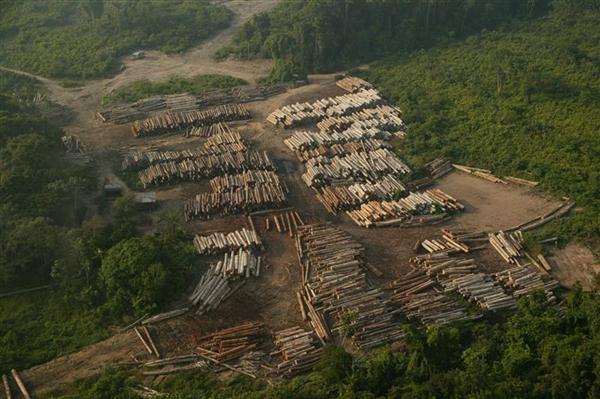
BVRio together with ConsenSys have recently formed a partnership to use Regis, an application running on top of Ethereum as a secure ledger.
Regis was developed by ConsenSys, the venture production studio focused on Ethereum Dapps, and BVRio, the Brazilian organization promoting green markets, is the first client using decentralized online registry system built on top of Ethereum. BVRio is also promoting the use of market mechanism to facilitate compliance with environmental laws.
According to The Merkle, Ethereum is a cryptocurrency and Blockchain platform supporting Smart Contract applications and Distributed programs.
BVRio represents a strong presence in the timber trading sector and, since illegal timber trading is a global issue, particularly in Brazil, transparency is mandatory. In order to improve the organization’s process for trading overview, Regis will provide transparent records of the reports that each timber shipment is given, as reported by The Merkle.
Thus, the shipments of timber are rated based on very large number of variables. These variables include the source of the timber, the way it was produced, and even how it was delivered. At the end, the score is very important on the timber’s market valuation and the process must be as transparent as possible.
Timber producers are often contacting BVRio because the score given to the timber shipment faces discrepancies with the Brazilian organization and their own numbers. Thus, producers are often unsure of why the score for a given shipment changed and doubt that the score wasn’t altered internally.

