

Weyerhaeuser Company commences the shutdown of its lumber and plywood mills in Columbia Falls next week. Continue reading "Weyerhaeuser closes its lumber and plywood mills in Columbia Falls next week"
Article archive
Austria: Softwood lumber prices stable in August

Softwood lumber prices in Austria were stable in August, with the levels of July mostly maintained. Edged boards and squared timber have softened slightly. The upper price limit for rough boards is EUR 1/m3 lower than July, while width boards are a bit more expensive.
Compared with August 2015, prices are EUR 2-3/cbm higher. Only rough boards and squared timber I/II are cheaper than in the previous year. The price of boards has registered increases of up to EUR 4/m3.
| Softwood Lumber Spruce/Fir | Aug. '15 | Jul. '16 | Aug. '16 | Change Aug '15 to '16 €/cbm EXW |
| Edged Boards, 0-IIIa, 23 mm + | 231-245 | 234-243 | 233-242 | +2 / +3 |
| Rough boards in fixed dimensions, 18-22 mm | 230-239 | 229-242 | 229-241 | -1 / +2 |
| Squared timber, standard dimensions, I/II, 4-6 m | 210-218 | 212-218 | 211-217 | +1 / -1 |
| Reserve squared timber, II/III | 154-161 | 157-162 | 157-162 | +3 / +1 |
| Boards, III-IV, 8-16 cm, 4-6 m | 146-153 | 150-155 | 150-155 | +4 / +2 |
| Boards, III-IV, 8-16 cm, just 4 m | 148-154 | 151-157 | 151-157 | +3 / +3 |
| Boards, III/IV, 23 mm, 4-6 m | 149-155 | 152-157 | 151-157 | +2 / +2 |
| Boards, III/IV, 28 mm +, 3-6 m | 155-162 | 157-165 | 158-166 | +3 / +4 |
Metsä Board closes wallpaper base machine in Kyro, Finland

Metsä Board, part of Metsä Group, is planning to close down its wallpaper base machine PM3 and discontinue its loss-making wallpaper base manufacturing at the Kyro mill in Hämeenkyrö, Finland.
The demand for wallpaper base is decreasing globally, and Metsä Board is focusing on paperboard, meaning that wallpaper base production is not included in the company’s core business operations. In 2015, sales from Kyro’s paper business operations totalled EUR 50 million, and the operating result was EUR -5 million.
In addition to the planned close down of the wallpaper base machine PM3, Metsä Board has a need to adjust and improve operations at the Kyro mill in order to increase its competitiveness. Therefore the company will commence related statutory labour negotiations covering all employees at the mill. According to the plan, the estimated personnel effect is up to 100 employees. All in all approximately 250 employees currently work at the Kyro mill.
After implementing possible changes, the folding boxboard machine, with an annual capacity of 190,000 tonnes, will still continue operating at the Kyro mill. In addition, Hämeenkyrön Voima’s biopower plant, producing heat and electricity, is located in the mill area.
Sweden: Softwood lumber exports drop sharply in January-May 2016

In the first five months of 2016, Sweden has exported about 5 million cubic meters of softwood lumber. This represents a -10% decrease over the same period of 2015. Most of the exports to the world decreased dramatically compared to 2015.
Main export markets for the Swedish softwood lumber were the United Kingdom and Egypt, followed by Norway and Germany. Continue reading "Sweden: Softwood lumber exports drop sharply in January-May 2016"
Sawn softwood production rising in Finland

Finland's sawn softwood production increased by 5 percent in the first half of the year, jumping to a total of 5.8 million cubic meters. New investments in the Finnish forest industry were higher in this period, as well as paperboard and pulp production.
Finland's forest industry produced in the first half of the year 1.6 million tons of pulp 3.4 million tons of paper, which is 6.7 percent less than in January-June 2015. Continue reading "Sawn softwood production rising in Finland"
Metsä Wood increased its profits during first half of 2016

Finnish Metsä Wood increased its profits in January-June of 2016, compared to the same period last year.
According to Metsä Wood’s financial report for the first half of the year, the wood products division recorded first half sales of €437.9 million, compared to the €452.2 million in the first half of 2015. The operating profit excluding non-recurring items was €20.2 million, up from the €18 million during January-June 2015. Continue reading "Metsä Wood increased its profits during first half of 2016"
Disappointing first 5 months of US tropical sawnwood imports

The US imported 127,068 cu.m. of sawn temperate and tropical hardwood in May, up 60% from April. However the value of these imports increased by just 5% to US$43.9 million. The volume growth was mainly in imports of temperate species. Continue reading "Disappointing first 5 months of US tropical sawnwood imports"
India's forests worth $1.7 trillion
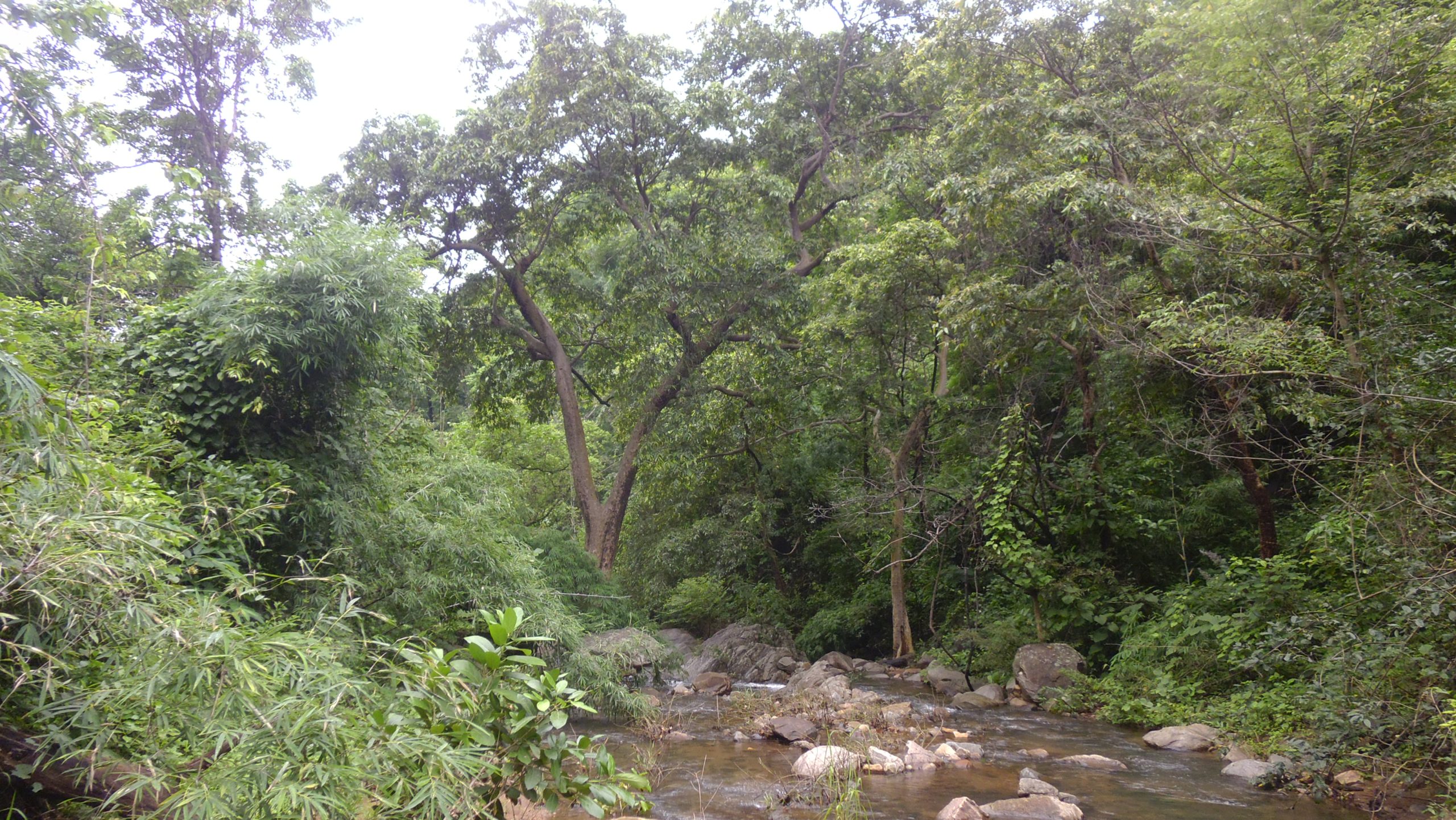
India’s forests value is approximated at $1.7 trillion, lower than its $2.1 trillion GDP, but higher than the GDP of countries such as Korea, Russia, Canada or Mexico.
The Indian government has set an expert panel back in 2013 as to evaluate the forests at the net present value (NPV). The evaluation of the forest land has been asked in the case it had to be diverted for industrial or construction purposes, according to Quartz India.
“The numbers are definitely shocking. The moment you put a value to these forestlands is when people take these concerns (regarding diverting forest land) seriously,” said Madhu Verma, a professor at the Indian Institute of Forest Management (IIFM), and one of the two lead authors of the report.
The Indian Ministry of Environment has recently approved the report released by the committee.
As reported by Quartz India, the Indian government has approved the diversion of 1.29 million hectares of forestland for non-forest purposes since 1980. India has a total forest area of seven lakh square kilometres, which grew by 0.54% over the past two years.
The report used 14 forests type groups and 4 forest canopy cover classes, which formed 56 classification units for the estimation of the economic value of forests.
India’s forests worth $1.7 trillion
India’s forests value is approximated at $1.7 trillion, lower than its $2.1 trillion GDP, but higher than the GDP of countries such as Korea, Russia, Canada or Mexico.
The Indian government has set an expert panel back in 2013 as to evaluate the forests at the net present value (NPV). The evaluation of the forest land has been asked in the case it had to be diverted for industrial or construction purposes, according to Quartz India.
“The numbers are definitely shocking. The moment you put a value to these forestlands is when people take these concerns (regarding diverting forest land) seriously,” said Madhu Verma, a professor at the Indian Institute of Forest Management (IIFM), and one of the two lead authors of the report.
The Indian Ministry of Environment has recently approved the report released by the committee.
As reported by Quartz India, the Indian government has approved the diversion of 1.29 million hectares of forestland for non-forest purposes since 1980. India has a total forest area of seven lakh square kilometres, which grew by 0.54% over the past two years.
The report used 14 forests type groups and 4 forest canopy cover classes, which formed 56 classification units for the estimation of the economic value of forests.
UK's forest resources at expiry point; sustainable practices required
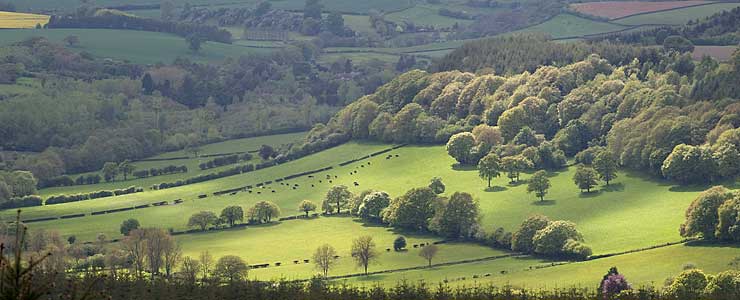
UK businesses have to invest in a sustainable forest management as to assure the timber access their businesses rely on.
The forest resources of the main countries that supply timber to the UK are at an expiry point because they are used without adequate provision for sustainable timber supply, Continue reading "UK's forest resources at expiry point; sustainable practices required"
UK’s forest resources at expiry point; sustainable practices required

UK businesses have to invest in a sustainable forest management as to assure the timber access their businesses rely on.
The forest resources of the main countries that supply timber to the UK are at an expiry point because they are used without adequate provision for sustainable timber supply, Continue reading "UK’s forest resources at expiry point; sustainable practices required"
US & Canada with increased lumber production in first five months of 2016

U.S. softwood lumber production reached 13.369 billion board ft. (bbf) in the first five months of 2016, up 1.8% from 13.127 bbf in the same period last year, according to the Western Wood Products Assn.’s latest Lumber Track report.
Western U.S. sawmills accounted for 5.825 bbf of the five-month total, up 0.5% from 5.795 bbf a year earlier, while production at southern U.S. sawmills rose by 3.0% to 6.932 bbf from 6.731 bbf.
According to Lumber Track, in the month of May, U.S. sawmills produced 2.605 bbf, up 4.1% from 2.502 bbf a year earlier, and down 3.8% from 2.709 bbf in April 2016.
Western U.S. sawmills accounted for 1.173 bbf of production in May, up 10.9% year-over-year from 1.058 bbf, and up 1.3% from 1.157 bbf in April 2016.
Southern U.S. sawmills in May contributed 1.313 bbf, down 1.3% compared with May 2015 production of 1.330 bbf, and down 8.1% from 1.428 in April of this year.
Apparent U.S. softwood lumber consumption was 20.388 bbf in the five months through May, a 14.3% increase from 17.834 bbf for the same period a year earlier. In May 2016, consumption was 4.118 bbf – up 16.8% from 3.525 bbf in May 2015, and up 0.9% compared with consumption in April 2016 of 4.082 bbf.
Canadian softwood lumber production/consumption
In the first five months of this year, Canadian sawmills produced 11.874 bbf of softwood lumber, up 9.2% from 10.878 bbf for the same period in 2015. Of the five-month total, British Columbia sawmills accounted for 5.732 bbf, up 5.6% from 5.428 bbf a year earlier, while sawmills east of the Rockies produced 6.142 bbf – an increase of 12.7% compared with 5.450 bbf a year ago.
Canadian sawmill output in the month of May was 2.378 bbf, up 8.7% year-over-year from 2.189 bbf in May 2015, but down 2.1% from production in April 2016 of 2.428 bbf, as Lumber Track reported.
Of the May 2016 totals, sawmills in British Columbia contributed 1.145 bbf, up 8.5% from 1.055 bbf in May 2015, but down 0.9% from output in April 2016 of 1.155 bbf. Sawmills east of the Rockies in May produced 1.233 bbf, up 8.8% from 1.133 bbf in May 2015, and down 3.1% from 1.273 bbf in April 2016.
Canadian softwood lumber consumption for the five months through May dropped 15.0% to 3.026 bbf from 3.560 bbf in the corresponding period of 2015. In the month of May, Canadian consumption was 734 million board ft. (mmbf), down 8.4% from 802 mmbf in May 2015, but up 24.8% compared with April 2016 consumption of 588 mmbf.
U.S. and Canada utilization/inventories
U.S. production as a percentage of practical capacity averaged 84% in the first five months of this year, up from 82% in the same period of 2015, while Canada’s production as a percentage of practical capacity averaged 91% in the year through May, compared with 86% a year earlier.
U.S. inventories for the year through May fell 2.9% year-over year to 3.038 bbf from 3.128 bbf a year earlier, while Canadian inventories increased by 0.8% to 3.092 bbf from 3.067 bbf.
US & Canada with increased lumber production in first five months of 2016
U.S. softwood lumber production reached 13.369 billion board ft. (bbf) in the first five months of 2016, up 1.8% from 13.127 bbf in the same period last year, according to the Western Wood Products Assn.’s latest Lumber Track report.
Western U.S. sawmills accounted for 5.825 bbf of the five-month total, up 0.5% from 5.795 bbf a year earlier, while production at southern U.S. sawmills rose by 3.0% to 6.932 bbf from 6.731 bbf.
According to Lumber Track, in the month of May, U.S. sawmills produced 2.605 bbf, up 4.1% from 2.502 bbf a year earlier, and down 3.8% from 2.709 bbf in April 2016.
Western U.S. sawmills accounted for 1.173 bbf of production in May, up 10.9% year-over-year from 1.058 bbf, and up 1.3% from 1.157 bbf in April 2016.
Southern U.S. sawmills in May contributed 1.313 bbf, down 1.3% compared with May 2015 production of 1.330 bbf, and down 8.1% from 1.428 in April of this year.
Apparent U.S. softwood lumber consumption was 20.388 bbf in the five months through May, a 14.3% increase from 17.834 bbf for the same period a year earlier. In May 2016, consumption was 4.118 bbf – up 16.8% from 3.525 bbf in May 2015, and up 0.9% compared with consumption in April 2016 of 4.082 bbf.
Canadian softwood lumber production/consumption
In the first five months of this year, Canadian sawmills produced 11.874 bbf of softwood lumber, up 9.2% from 10.878 bbf for the same period in 2015. Of the five-month total, British Columbia sawmills accounted for 5.732 bbf, up 5.6% from 5.428 bbf a year earlier, while sawmills east of the Rockies produced 6.142 bbf – an increase of 12.7% compared with 5.450 bbf a year ago.
Canadian sawmill output in the month of May was 2.378 bbf, up 8.7% year-over-year from 2.189 bbf in May 2015, but down 2.1% from production in April 2016 of 2.428 bbf, as Lumber Track reported.
Of the May 2016 totals, sawmills in British Columbia contributed 1.145 bbf, up 8.5% from 1.055 bbf in May 2015, but down 0.9% from output in April 2016 of 1.155 bbf. Sawmills east of the Rockies in May produced 1.233 bbf, up 8.8% from 1.133 bbf in May 2015, and down 3.1% from 1.273 bbf in April 2016.
Canadian softwood lumber consumption for the five months through May dropped 15.0% to 3.026 bbf from 3.560 bbf in the corresponding period of 2015. In the month of May, Canadian consumption was 734 million board ft. (mmbf), down 8.4% from 802 mmbf in May 2015, but up 24.8% compared with April 2016 consumption of 588 mmbf.
U.S. and Canada utilization/inventories
U.S. production as a percentage of practical capacity averaged 84% in the first five months of this year, up from 82% in the same period of 2015, while Canada’s production as a percentage of practical capacity averaged 91% in the year through May, compared with 86% a year earlier.
U.S. inventories for the year through May fell 2.9% year-over year to 3.038 bbf from 3.128 bbf a year earlier, while Canadian inventories increased by 0.8% to 3.092 bbf from 3.067 bbf.
AHEC European conference on 20th – 21st October in Copenhagen

This year’s American Hardwood European Conference (20th – 21st October at the Marriott Hotel, Copenhagen) will provide a platform for American hardwood exporters and the European trade to discuss and debate the challenges and opportunities both industries face, by addressing current issues and future developments.
On Thursday 20th October, the conference will open with an overview of how AHEC Europe is working to create a bright and promising future for U.S. hardwoods by inspiring decision makers and creating new products for the built environment. This will include a session on the globalisation of the hardwood trade focussing on the U.S. domestic market, Europe, and of course China.
The AHEC Europe team led by David Venables, AHEC European Director, will look to the future markets for American hardwoods and showcase AHEC Europe’s creation of promotional tools and messages aimed at accessing these markets. This includes the promotion of underutilised species, targeting of specific markets and increasing species options and new applications as well as the redeveloped website, new publications and a refreshed format of the American Hardwood Environmental Profile (AHEP).
AHEC Europe and Andrew Lawrence, Arup Engineers, will discuss new markets for American hardwoods in construction. This will include the story behind “The Smile” project, the impressive timber installation created for the London Design Festival using for the first time, industrial sized panels of American tulipwood cross-laminated timber (CLT), a project that will represent a huge step forward for the use of hardwood in structural applications. The installation is due to be unveiled to the public outside Chelsea College of Arts, London on Saturday 17th September and will be open until 10th October.
The focus on Friday 21st October will be an educational seminar for buyers and users of American hardwood. Rupert Oliver will start by presenting an overview of the American hardwood resource: where it grows, how it’s managed and why it is both a legal and sustainable resource. He will also tackle the challenge buyers face in satisfying EUTR due diligence requirements.
The focus will then switch to market developments driving new demand. Neil Summers, Timber Dimension, will share the latest information on the growing markets for thermally modified hardwoods and the opportunities they present for U.S. hardwoods.
AHEC European Conference 2016 Programme & Registration
Hekotek to deliver wood pellet plant in Siberia to Boguchansky LPK
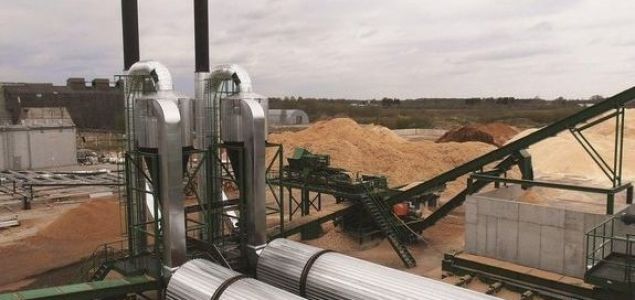
At the beginning of June, Hekotek signed an agreement with Boguchansky LPK to deliver a complex pellet plant equipment.
The new pellet plant will reach a 60 th. capacity per year and will be built for the process of sawmilling wastes, including sawdust and wood chips. In the Irkutsk region, Russia, the wood chips processing is hard for many sawmillers, so pellet plant construction seems to be a very reasonable solution for wastes utilization.
Boguchansky LPK had the idea of constructing a pellet plant for wood waste half an year ago, but it took some time to find the financial support for it.
The pellet plant complex equipment will include 2 pellet presses delivered by the Dutch producer CPM Europe and 2 drum dryers, as well as the rest units, delivered by Hekotek. The pellets will be packed both in big-bag containers and smaller bags with the latter being used for exporting pellets of premium class.
The equipment is to be ready for shipment to Siberia by the end of March 2017, with assembling works to start in the beginning of the summer, while the commissioning is expected in October 2017.
China and EU working together to combat illegal timber trade

The EU and China established a Bilateral Coordination Mechanism (BCM) on Forest Law Enforcement and Governance (FLEG) in 2009, following an EU-China Forest Law Enforcement and Governance conference in Beijing in 2007.
Through the BCM, the EU and China work together to stop illegal logging and the associated trade in illegal timber. The BCM is a forum for policy dialogue and a mechanism for sharing information on policies and legal frameworks and for coordinating initiatives end illegal logging.
The EU FLEGT Facility has released an update on the BCM which can be found at www.euflegt.efi.int/eu-china.
The update says “Under the BCM, China and the EU are exploring approaches to recognise legality verification schemes for timber and timber products managed by timber-exporting countries, including those from countries participating in FLEGT VPAs. This includes a trilateral dialogue between China, Indonesia and the EU.
The two parties to the BCM are also supporting the further development of the Chinese Timber Legality Verification System (CTLVS), taking into consideration EU experiences with the EU Timber Regulation (EUTR) and in countries that are negotiating, or have signed, VPAs.”
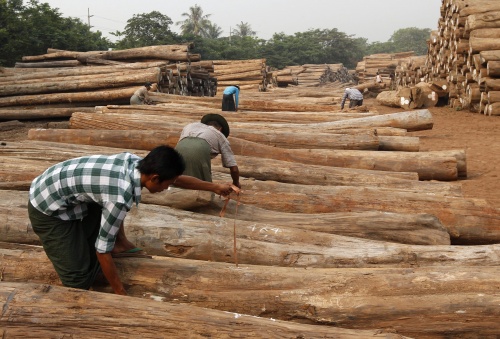
Logging ban in Myamar until March 2017
US hardwood sawmiller lays off more than 40 due to log supply shortage

Northwest Hardwoods is now struggling to keep a steady supply of raw materials. Because of this, the company laid off more than 40 employees at the mill in Longview, U.S.
Due to the raw material shortage, Northwest Hardwoods can’t support the second shift of employees. Moreover, the company isn’t able to sell more than it produces at the moment because of the limited raw material supply, according to Tdn.com. Continue reading "US hardwood sawmiller lays off more than 40 due to log supply shortage"
Brexit to cause downturn in European timber imports

The fall-out from the Brexit vote on 23 June, combined with challenging economic conditions in other parts of the Europe, particularly Italy, is likely to lead to a downturn in European timber imports in the second half of 2016.
Feedback from UK timber importers in the aftermath of the Brexit referendum vote on 23 June is that their most immediate concern is the exchange rate.
The value of the British pound, which increased from 1.41 to 1.50 against the US dollar in the days leading up to the referendum on the expectation that “Remain” would win, fell sharply to a 30-year low of $1.29 on 6 July after the result. By 22 July it had recovered only slightly to $1.31.
The euro, already low against the US dollar after a dramatic fall in late 2014 and early 2015, also weakened following the referendum from $1.14 on 22 June to euro1.10 on 22 July (see chart). Continue reading "Brexit to cause downturn in European timber imports"
US lumber prices up another $4 at the beginning August
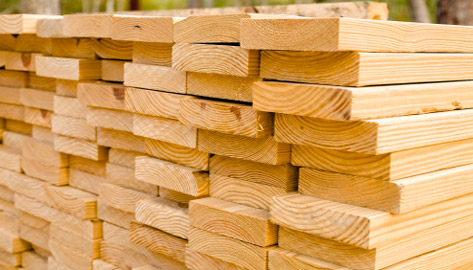
Framing lumber sales reached a level at which the sawmills in the US hold to established levels or push quotes higher. Nevertheless, the fear of rising prices kept the buyers cautious, while they also avoided to raise their inventory volumes. Gains in most key species pushed the Random Lengths Framing Lumber Composite Price up another $4.
| Week Aug 5 |
Week Jul 29 |
Year Ago 2015 |
|
| Random Lengths Framing Lumber Composite Price* | $367 | $363 | $332 |
| KD Western S-P-F #2&Btr 2x4 R/L Mill Price | 329 | 329 | 278 |
| KD Eastern S-P-F #1&2 2x4 R/L, delivered Great Lakes | 431 | 431 | 375 |
| Green Douglas Fir Std&Btr 2x4 R/L (Portland) | 353 | 353 | 340 |
| Southern Pine (Westside) #2 2x4 R/L | 419 | 410 | 330 |
| KD Coast Hem-Fir #2&Btr 2x4 R/L | 350 | 350 | 325 |
| Ponderosa Pine (Inland) #2&Btr 1x12 R/L | 705 | 705 | 665 |
| * Weighted average of 15 key items | |||
Random Lengths Panel Market Report
Structural panel sales remained unchanged, while OSB sales were mixed by region. The North Central region went through a conversion phase, while some of the mills in the South sold at discounts as to keep order files extended. Southern Pine plywood mills discounted offerings of rated sheathing early in the week to push order files out. Those discounts pulled in buyers who were looking for downside price protection. Trading in western Fir plywood was measured.
| (f.o.b. mill prices) | Week Aug 5 |
Week Jul 29 |
Year Ago 2015 |
| Random Lengths Structural Panel Composite Price* | $395 | $397 | $341 |
| Southern (west-east) 15/32-inch 3-ply rated sheathing plywood | 365-390 | 372-400 | 370-412 |
| Southern (west-east) 15/32-inch 4-ply rated sheathing plywood | 365-390 | 370-405 | 370-412 |
| Western 1/2-inch 4-ply rated sheathing plywood | 420 | 421 | 379 |
| North Central 7/16-inch Oriented Strand Board | 310 | 310 | 184 |
| *Weighted average of 11 key items | |||

