Article archive

Stora Enso to build new cross laminated timber (CLT) production plant in Sweden

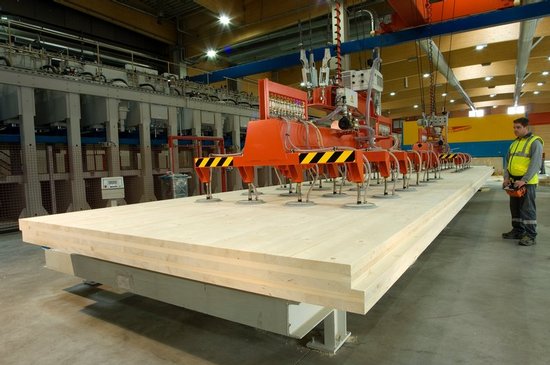
Stora Enso has decided to invest EUR 45 million in a new production unit for cross laminated timber (CLT) in connection with its Gruvön Mill in Sweden. 

The production is scheduled to begin during the first quarter of 2019. The estimated yearly capacity of the production line will be approximately 100 000 m³ after ramp-up, subject to required approvals being in place. The investment is expected to generate annual sales of approximately EUR 50 million when run at full capacity and over time significantly exceed the Wood Products division’s profitability target, operational return on operating capital (ROOC) of 18%.

The green field investment is made as an extension of the existing Gruvön sawmill. The construction is expected to start by the end of Q4 2017. Stora Enso invests in advanced technology, which together with completely integrated production, will ensure cost efficient solutions for customers and premium products to the market.

“This investment supports our strategy to grow in the construction industry and increase the use of wood as a building material. We target to increase our cost competitive CLT capacity located favourably in relation to target markets. We see extensive potential for CLT in the Nordic market. The demand for this premium product, our well proven concepts, and massive building components and systems is constantly increasing,” says Jari Suominen, Executive Vice President, Stora Enso’s Wood Products division.
Austria: Softwood lumber prices remain stable

Austrian softwood lumber prices have remained largely stable in June. They vary in part from the values of May. Only the lower price limit for 28mm thickness boards has significantly lowered.

Compared to the same month last year the price level for all ranges has increased significantly. The exception is squared timber (Class I-II) which is only minimally more expensive than last year.

Softwood Lumber Spruce/Fir June 2016 May 2017 June 2017 Change Jun. '16 to '17
€/cbm EXW
Edged Boards, 0-IIIa, 23 mm + 229-243 233-245 234-243 +5 / -
Rough boards in fixed dimensions, 18-22 mm 228-239 230-240 230-242 +1 / +3
Squared timber, standard dimensions, I/II, 4-6 m 210-218 210-218 210-217 - / -1
Stock squared timber, II/III 152-160 156-162 155-161 +3 / +1
Boards, III-IV, 8-16 cm, 4-6 m 145-151 147-153 147-153 +2 / +2
Boards, III-IV, 8-16 cm, just 4 m 147-152 149-156 149-156 +2 / +4
Boards, III/IV, 23 mm, 4-6 m 148-153 150-156 150-156 +2 / +3
Boards, III/IV, 28 mm +, 3-6 m 153-160 157-165 154-164 +1 / +4


Europe boosts flooring shipments to US

US Hardwood flooring imports declined 5% in April to US$2.5 million but imports of assembled flooring panels increased 4% to US$10.4 million.

Imports of both types of wood flooring were up year-to-date imports compared to April 2016. Hardwood flooring imports from most suppliers, except Canada, declined in April. Imports from Indonesia fell one third in April to US$588,798.

Normally a small hardwood flooring supplier to the US market, Denmark shipped US$315,044 worth of flooring in April.

Imports of assembled flooring panels (including engineered hardwood flooring) from China, Canada and Europe increased in April, while imports from Indonesia, Thailand and Brazil declined.

At US$2.7 million, Europe was the third-largest supplier in April after Canada and China.

Surge in EU tropical plywood imports in 2017

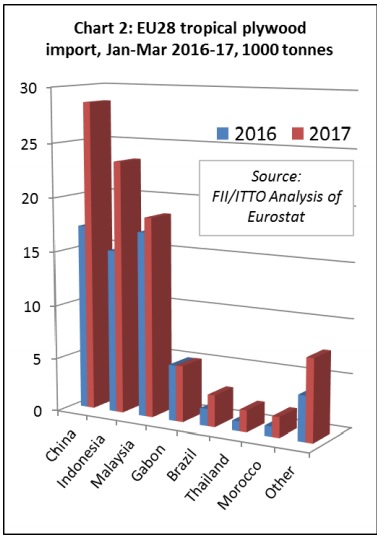
Surge in EU tropical plywood imports in 2017 Following a 15% rise during 2016, EU imports of tropical plywood increased a further 45% to 89,900 MT in the first quarter of 2017.

Much of the increase comprised plywood faced with tropical hardwood veneers manufactured in China and destined for the UK and Belgium. Imports of this product from China increased 66% to 28,600 MT in the opening 3 months of this year.

However, there were also gains in direct EU imports from all the major tropical suppliers during the same period. Imports increased from Indonesia by 54% to 23,400 MT, Malaysia by 8% to 18,500 MT, Brazil by 84% to 2,900 MT, Thailand by 123% to 2,000 MT, and Morocco by 106% to 1,900 MT. Imports from Gabon were stable at 5,200 MT during the period.

The changing composition of EU plywood imports may be partly related to enforcement of EUTR and CE marking requirements. This is encouraging a shift from Chinese mixed light hardwood products to plywood containing more clearly identified species of known tropical origin and technical performance.

It also provides new opportunities for plywood imported directly from tropical countries, particularly Indonesia following issue of the first FLEGT licenses in November 2016.

Chinese expanding overseas investment in the timber sector, with Russia as main target

According to a report on China’s Wood Products Trade and Investment (2016) there were 167 Chinese enterprises with overseas operations at the end of 2014. Of the total, over 90% were private enterprises.

Private enterprises have become the main players in overseas forestry investment and have taken a long-term view to these investment and have the advantage of being able to adopt quickly to changing production and trade conditions.

The origin of the 167 enterprises identified in 2016 was in 17 provinces, autonomous regions and municipalities. Enterprises in 5 provinces; Heilongjiang, Inner Mongolia, Jilin, Shandong and Jiangsu p dominated the overseas investors namely;.

Enterprises investing in overseas forestry and timber operations are mainly from three areas, Heilongjiang province, Jilin province and Inner Mongolia Autonomous Region which is adjacent to Russia.

Enterprises from the Inner Mongolia Autonomous Region invest mainly in forestry operations in Russia. The others, mainly from the regions in China that account for much of the country’s wood product manufacturing such as Jiangsu and Shandong provinces, invest in developing countries mainly in raw material sourcing.

There are two main patterns of Chinese overseas investment, one is direct purchase or lease of forest land the other is joint venture cooperative arrangements.

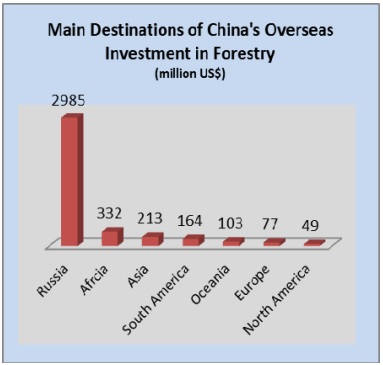
Chinese enterprises invest mainly in Russia, with smaller investments in Gabon, Brazil, Papua New Guinea, Australia and New Zealand and operations include logging, primary processing and downstream manufacturing. The distribution of investment in 2014 is illustrated below.

Chinese enterprises say while trading is relatively low risk the risks increase significantly with overseas investment largely due to long term pay-back period, the complexity of the international business environment, financial risks, host government regulations and supervision and environment risks.

Overseas investment by Chinese enterprises has been increasing in recent years and the value of foreign direct investment for Chinese forestry products industry is expected to rise given the Chinese government’s “Go Out” policy.

As the go-out policy takes affect it is expected that China’s investment in forestry and wood processing will become more diversified. It is anticipated that multinational companies will emerge in the future. It is further anticipated that the patterns of investment and cooperation will become more diversified from traditional direct purchasing or renting to mergers and acquisitions, joint ventures, capital operation, strategic alliances, stock exchange and this will lead to greater integration of logging, intensive processing, logistics and trade.

Oak sawlog prices in France keep on rising

Oak log prices have been going up in France since 2013 and sawyers around the country are wondering about the highest level the prices might get to.
The demand doesn't go down because the oak products are getting sold out nowadays. Beams, wooden structures, squared edged timber for parquet, selected boards and prepared timber for furniture, boule for fine joinery, barrel staves and every goods find their owner. Oak is specifically used for decoration and high end goods. Continue reading "Oak sawlog prices in France keep on rising"

Klausner second US sawmill expected to start production this month

Klausner Trading USA's new mill in Enfield, N.C., is expected to begin producing Southern Pine lumber some time this month, company management confirmed recently.

Although the Klausner Lumber Two mill was supposed to be operational by the end of the first quarter in Enfield, the company’s president personally announced the mill will be up and running about July.

President Thomas Mende flew in and met with the Halifax County Board of Commissioners on Monday at its meeting to share the news.

“As you’ve noticed, it’s taken a bit longer than we had hoped for,” Mende told the Board.

He said some contractors Klausner worked with were close to bankruptcy, so the company had to work something out. This pushed the target date for real operations to the summer. But once the mill begins work, Klausner will hire about 90-100 people to run a full 8-hour shift. From that point, Klausner could ramp up production, increasing to four shifts, running 24 hours a day.

But Mende said Klausner wants to start slow because of difficulties the company has had at its Florida site. Production ramped up too quickly, leading to cut backs, he said.

“We will, again, try to learn from our experience in Florida and not try to push the facility too hard in the very beginning,” Mende said. “We’ll start with a one-shift operation. Make sure that runs very well. Our general expectation for various reasons is that we will have an easier time here in North Carolina partly because we learned some machinery lessons in Florida that we have already taken care of in this construction.”

The first step in getting the Enfield site fully operational is setting up the log yard. The yard is where Klausner will cut and debark the logs before sorting the pieces in about 70 different diameters. Running the log yard well is important because it is the bottleneck for production, Mende said.

Wood fiber costs for pulpmills throughout the US fell during 2016

Wood fiber costs for pulpmills in the US Northwest have fallen faster than in other region of the US the past year, resulting in a more competitive industry sector. Despite the recent price reductions in Washington and Oregon, pulp manufacturers in the southern states continued to have lower wood fiber costs than pulpmills in the Northwest, Northeast and the Lake States in the 1Q/17.
“Volatile” could best describe many of the North American regional market conditions in the first quarter of 2017! The volatility came in many different areas; adverse weather events, operation breakdowns, plant explosions, and idling, as well as uncertainties over looming trade policy decisions. Wood flows across Canada and the U.S. northern tier of states as well as through the Pacific Northwaest were impacted by weather–either too much snow (leading to transportation difficulties), or mild temperatures followed by early breakup.
The declining price trend for chips and pulplogs in the Northwest that occurred during 2015 and 2016 came to a halt in early 2017 because of uncertainty about fiber availability as a result of slowdowns in harvest operations. Over the past two years, fiber costs have declined by 13% in the Northwest and pulpmills in the region have become more competitive. In the 1Q/17, pulpmills had only slightly higher wood fiber costs than pulpmills in the historically low-cost US South. Pulpmills in the Lake States and the Northeastern states continue to have the highest wood costs in the US.
Wood fiber costs for pulpmills in the US South have also fallen over the past year, with average softwood pulplog prices being five percent lower in the 1Q/17 than in the 2Q/16.
Prices for both softwood and hardwood pulplogs have slowly declined over the past four quarters to reach their lowest levels in three years. With several planned pulpmill maintenance outages anticipated in the 2Q/17, fiber demand will remain muted in the coming months. Increased lumber production across the South will continue to generate additional volumes of residual chips resulting in downward price pressure on both chips and pulplogs in late spring and summer.

Metsä Group’s bioproduct mill finished its logistics chain

The new logistics solution designed specifically for Metsä Group’s bioproduct mill at Äänekoski is ready to serve the mill's wood and pulp transport. Continue reading "Metsä Group’s bioproduct mill finished its logistics chain"

Lumber prices in the US on steady level at the end of June

Trading in framing lumber in the US started to recover during the middle of last week. This included Southern Pine, although with some downward pressure — this week amid month- and quarter-end discounting — was unabated. Continue reading "Lumber prices in the US on steady level at the end of June"

Iran- an emerging destination for wood exports

When many of the economic sanctions against Iran were lifted over a year ago, doors were opened for international investments. Among those, one of the most obvious opportunities can be found in the forest products sector. Continue reading "Iran- an emerging destination for wood exports"

Production of wood pellets in Russia expected to rise by 10% in 2017, mainly driven by Asian demand

Russia produced 1.013 MMT of wood pellets in 2016, a 3.5 percent increase from CY 2015. Sources report that production statistics for wood pellets are not accurate.

The statistics primarily capture large-capacity factories, and mid-sized and smaller facilities which operate as part of larger wood processing plants, do not report their production. Inaccuracy of statistics for production of wood pellets also contributes to the high difference in production in CY2013 and CY 2014. As a result, Post believes the actual wood pellet production is underreported by Rosstat.

Post estimates production of wood pellets in Russia in CY 2016 at 1.33 MMT, or five percent increase over production in CY 2015. Production is forecast to increase by 10 percent in CY2017, primarily driven by continued strong demand from European Union as well as Asian countries, specifically South Korea.

Construction of new smaller and middle-sized wood pellets facilities oriented for export coupled with strong dollar will support and motivate local producers.

In addition competitive export prices, increasing local production, new processing capacity, as well as the Russian government’s call for increased efficiency in the forestry sector will contribute to an increase.

However, the lack of a domestic standard for pellets, poor transport infrastructure, a lack of warehouses, and the product’s seasonality will all negatively impact the development of the wood pellet sector in Russia.

Industry sources believe that Russia will require large investments in order to upgrade its facilities and expand its production capacity. Domestic demand can also absorb some of the increased, nearterm production, however, at a very moderate pace.

Södra to boost production capacity at its Orrefors sawmill

At its small-diameter timber sawmill in Orrefors, Södra is investing about SEK 35 million (EUR 3,6 million) in a new boiler and drying facility, which will enable production increases in the future. The supplier is Fröseke Industriservice AB.

“This investment is necessary for profitability. Currently, there is insufficient boiler capacity, which means we must sell some goods undried. The investment will enable us to increase production and also dry the entire sawn volume,” said Jörgen Lindquist, President of the Södra Wood business area.

The limiting factors for the sawmill’s capacity are the boilers and wood dryers. The two existing biofuel boilers that currently serve the sawmill are to be replaced by a new, larger biofuel boiler of 6 MW instead of todays 2.5 MW.

“The change of boiler will also enable the simultaneous expansion of wood drying through the addition of six chamber dryers. Following the investment, the sawmill will go from a drying capacity of about 60,000 cubic metres to approximately 105,000 cubic metres,” says Jörgen Lindquist.

The new facility will be put into operation in 2018.

Over the past year, Södra has worked intensively to increase the profitability of its sawmill operations by optimising the flows of raw materials to customers and reviewing the sawmill structure. The restructuring programme, which was presented in June last year, includes a SEK 200 million (EUR 20,5 million) investment package at the sawmills in Långasjö, Värö and Orrefors.

US tropical sawnwood imports up 17%

US imports of all sawn hardwood increased 9% in April to 82,091 cu.m. The growth in tropical sawnwood imports was greater than for temperate species.

Tropical sawnwood imports increased for the second consecutive month in April to 22,279 cu.m. Year-to-date imports were up 17% from April 2016. The value of imports grew 18% from March to US$24.7 million. Balsa, keruing and virola imports were down month-over-month, but imports of most other species increased in April.

Ipe sawnwood imports were 2,912 cu.m. in April, up 9% year-to-date from April 2016. The value of ipe imports was US$6.5 million, making ipe the highest value of all tropical sawnwood imported and Brazil the largest supplier to the US market based on value. Brazil accounted for almost all ipe imports (2,707 cu.m.) valued at over US$6 million.

Imports of sapelli sawnwood more than doubled from March to 4,073 cu.m, Year-to-date imports increased 17% from April 2016. Cameroon exported 2,363 cu.m. of sapelli sawnwood to the US, significantly more than the 922 cu.m. in March.

Congo/Brazzaville also more than doubled sapelli shipments (1,454 cu.m.) to the US in April.

Acajou d’Afrique imports grew by nearly one third in April to 1,764 cu.m., but year-to-date imports were lower than in April 2016. Cameroon accounted for the majority of acajou d’Afrique (989 cu.m.), followed by Ghana (401 cu.m.), Congo/Kinshasa and Congo/Brazzaville.

Balsa dominates Canadian tropical imports

Canadian imports of tropical sawnwood were unchanged in April at USUS$1.94 million. The value of year-to-date imports was up 4% from April 2016.

While the overall value of imports was unchanged, virola, imbuia and balsa (combined) and sapelli imports grew from March. Imports of mahogany and other tropical species fell in April.

Even more so than in the US market, balsa sawnwood imports for industrial use dominate Canadian tropical imports.

In April, balsa imports from Ecuador increased 39% to just under USUS$0.6 million. More balsa sawnwood may be imported via the US. Balsa is grouped with virola and imbuia in the Canadian trade classification. Canada imported USUS$351,502 worth of virola, imbuia and balsa from the US in April.

Ligna 2017 hosted 93,000 attendees

Ligna has reported 93,000 attendees from over 100 countries for the world's largest trade fair for woodworking and wood processing plants, machinery and tools.

There were more than 2.8 million business contacts, and five continents represented.

"Ligna 2017 will go down as a milestone in the digitalization of the wood industry,” said Dr. Andreas Gruchow, member of the managing board, Deutsche Messe. “The show's international pulling power has also shot up considerably, thus underscoring the show's reputation as the industry's No. 1 event worldwide."

Significant growth in total space booked was also reported, with more than 1,500 exhibitors from 50 countries. The exhibition has more than 1.3 million square feet of display space in 10 halls and an open-air site to showcase new technology and innovative ideas.

Ligna also featured an optimized thematic layout shaped to mirror the latest market shifts, spotlight on a huge array of smart, digitally integrated manufacturing systems, and the Wood Industry Summit, an International forum for primary industry

Ligna 2019 will be held May 27-31.

Newsletter

Subscribe to our digital newsletter for your daily digest of essential news, views and analysis from the international wood industry delivered directly to your inbox.


0