Article archive

Siempelkamp to supply MDF panel production line in China

Linyi Huan Ge Co., LTD, Chinese manufacturer of MDF panels ordered a complete forming and press line with ContiRoll® for the production of MDF panels. The scope of supply includes a 28.8 m x 9’ ContiRoll® press. This order is already the third order this year for Siempelkamp from China.

The scope of supply for the order for Linyi Huan Ge includes the complete press line – from the mat-forming equipment and the forming line to the press line with the continuous ContiRoll® press to the finishing line with the connected, fully automated, storage system. With this line Siempelkamp delivers the second line for the production of thin MDF with a thickness of 1 mm to China, whereby the plant is designed for a board thickness range of up to 9 mm. Production will be carried out on a 28.8 m x 9’ ContiRoll® press.

The delivery of the order for Linyi Huan Ge will take place in June of 2019; the startup is scheduled to take place approximately five months later in November. The plant is designed for a production capacity of 315,000 cubic metres of MDF annually.

Linyi Huan Ge Co., LTD, founded in March of 2017, is a subsidiary of Linyi Fu Da Wood Co., LTD, one of the leading plywood manufacturers in China. Linyi Huan Ge was founded for the production of high-quality MDF panels for interior construction.

Segezha Group orders a new finger jointing line

Segezha Group has signed a preliminary agreement to order a finger jointing line with the equipment manufacturer Ledinek (Slovenia-Austria).

According to the announcement, the preliminary agreement was signed by Felix Voglhofer, Board Member of Ledinek, and Konstantin Pastukhov, Director General of JSC S-DOK. It is expected that the contract will be signed within the next few weeks.

Dmitry Rudenko, the Housing Construction division leader and Vice President of Segezha Group, commented:

“The line designed by Ledinek company is a fast and effective system of wood cogging for the manufacture of laminated building wood and glued laminated timber. This is a technically and strategically optimal solution for us. Such technologies are distinguished by precision processing and clogging of elements glued with the help of an ecologically perfect assembly adhesive. Pressed lamellae for glued laminated timber and laminated wood constructions can be manufactured in the range of width from 75 to 300 mm with the thickness between 20 and 80 mm. Structural timber of different length can be produced, according to the individual customer’s requirements. This is a big advantage for usю”

Ledinek is a company specialized in manufacturing the equipment for the wood processing and furniture industry.

About Segezha Group:

The company is one of the largest Russian forest industry holdings with the vertically integrated structure and a full cycle of logging and added-value wood processing. The holding comprises Russian and European enterprises in the forest, wood processing and pulp and paper industries, as well as paper packaging.

Finland: Rising roundwood prices this autumn

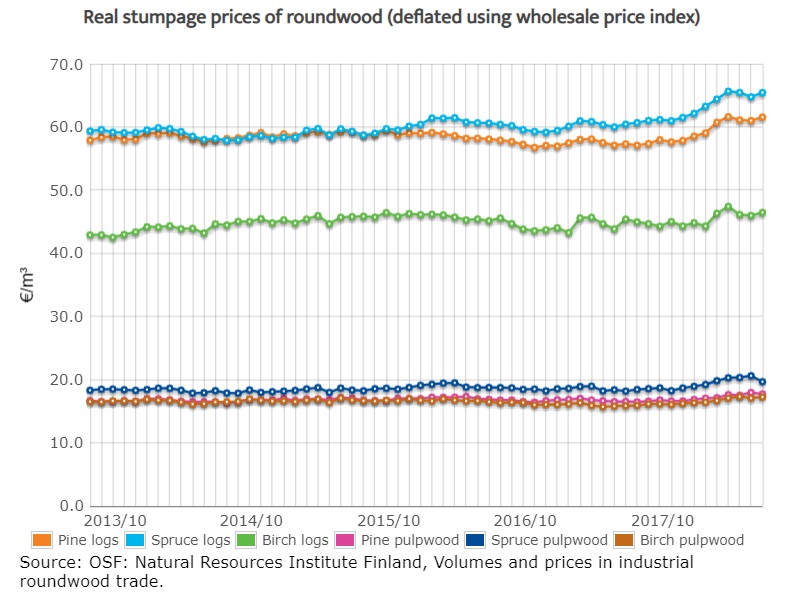
In September, the stumpage price for pine logs in Finland was EUR 61.6 per cubic metre,  and the price for spruce logs was EUR 65.4 per cubic metre. The real stumpage price level of logs was six percent higher compared to the previous years average.
The stumpage price for pine pulpwood in Finland was EUR 17.7 per cubic metre, while the price for spruce pulpwood was EUR 19.7 per cubic metre. In September, the real stumpage price level of pulpwood was five percent higher than the average in year 2017.
The method of felling affects the stumpage price paid for the wood. The price of logs harvested from regeneration fellings was three percent higher than the average stumpage price paid for logs (thinnings 16% below the average price). In the case of pulpwood, the stumpage price differences from the average by felling method were as follows: pine pulpwood from regeneration fellings +13%, from thinnings –8%, and from first thinnings –27%.
Delivery sales are typically dominated by pulpwood. The roadside price for pine pulpwood was  EUR 31.5 per cubic metre. The price for spruce pulpwood was EUR 34.3 per cubic metre and for birch pulpwood 32.2 EUR per cubic metre.
The roundwood trade statistics are based on the wood prices written into wood trade contracts between buyers and sellers. Other additional pricing components and forest services connected to wood trade are not included in the wood price statistics.
In September, the Finnish forest industry procured 3.85  million cubic metres roundwood from non-industrial, private forests.

San Group to build a new sawmill in Canada

Canadian San Group has signed an agreement to purchase land on the Port Alberni Catalyst Paper mill site in order to build a new sawmill. This month San Group also announced an additional third shift at its Coulson Mill near Port Alberni, Sao Observer reported. 

According to the agreement, San Group will acquire 25-acres of the Catalyst Paper mill site in Port Alberni, with the deal providing additional supply of wood chips to supplement production for Catalyst’s operations in B.C., according to Sao Observer.

The agreement represents a total investment of between $60-$70 million dollars by the family-owned San Group Inc. for the construction of a new sawmill that will ensure smaller diameter logs can be utilized for manufacturing in B.C. It is anticipated construction will begin next spring.

San Group is a Canadian-based producer of forest products with its roots in the industry since 1979. The company has evolved from a small lumber remanufacturing facility to a multi-level forest products corporation with more than 30-years of exporting experience to a global community.

Holmen boosts production at Brakiven sawmill

Holmen has decided to invest SEK 170 million to increase the production of wood products at Braviken Sawmill in Sweden. At the same time, a rail-based solution is being set up to transport raw material from Holmen's own forest in northern Sweden to the industrial facilities in Norrköping.

Braviken Sawmill was opened in 2011 and has since been expanded in several stages, most recently with the addition of a new wood treatment plant which was taken into use in spring 2018. The next step in the mill's development is now being taken with an investment in dryers and a new trimming saw for sorting.

The new dryers and trimming saw are expected to come into operation in 2020. After the investment, Holmen's total production of wood products will increase to just over 1 million cubic metres. The raw material for the increase in production will come from Holmen's own forest holdings in northern Sweden and will be transported by rail.

"We are already in a strong position in the wood products market and we have constantly strengthened our range for builders' merchants. It makes sense now to use a larger proportion of our saw capacity by increasing production by 150,000 cubic metres. The fact that we are able to do this using logs from our own forest in northern Sweden and with only marginally higher staffing levels, was crucial in reaching this decision," says Johan Padel, Senior Vice President Wood Products.

Current trends in the French sawmill industry

The year 2017 in France is characterized by a return of confidence and growth. France has experienced a big political change with the unexpected election of President Macron and a complete reshuffle of the political landscape.

Growth of 2% on average was unexpected and accelerated in the 2nd half of 2017. It was initially forecasted at 1.7%.

This political environment favored the return of construction projects first in the public and then in the private sector.

After falling to nearly 300,000 units, housing starts accelerated to more than 400,000 dwellings. In 2018 the progression is less strong but remains at a good level.

In these conditions, the recovery in real estate led to a sharp rise in demand, to which mills were not fully prepared due to the poor economic climate that had prevailed for six years. Demand for wood has therefore picked up and to cope with national demand the sawmills have moderated their exports as imports stagnate. Since September 2017, softwood sawmills have been operating at a good pace in a context where log supplies have been satisfactory in both volume and price throughout the year.

In the packaging sector, as well as in the pallets one, the demand is very strong and reflects a European recovery in industrial activity.

The pulp sector and the energy sectors are the least dynamic. In the energy sector, rising oil prices have limited new projects and encouraged utilities to use more gas. This leads to difficulties in selling certain products and price decreases.

The emergence of new projects would be necessary to better balance the uses. More generally, the economic situation remains well oriented and wood is politically supported.

France imported 2 million m3 of sawn softwood in 2017 which corresponds to the same volumes as in 2016. This situation is not contradictory with the overall recovery of consumption and the recovery observed in 2017 in the building sector. The building sector has in fact experienced a further increase in 2017 with 497 000 units allowed and 418 900 started new dwellings. Nevertheless, after a good first quarter 2018, the second quarter was quieter, but the first semester remains overall satisfactory.

Increase in prices

This economic situation has been accompanied by a regular increase in timber prices. Started at the last quarter of 2016, the increase continued in 2017 in 2018. It is also the result of a strong demand in Asian countries bringing about more tension on the contracts in the consumer countries in Europe. There is no prospect for change by the end of the year.

Geographic analysis - sawn softwood imports

After exporting 531 000 m3 (+ 2%) in 2016, the year 2017 was marked for the main supplier, namely Germany, by a fall in volumes that were set at 433 000 m3. Finland exported 390 000 m3 (-2.73%) and Russia has increased its exports at a level of 327 000 m3 (+5 %). Among the main exporters to France, Swedish imports have also bounced again at 310 000 m3 (+12%). In June 2018 (January to June compared with the same period of previous year), the situation is slightly different: Finland (210 000 m3, similar compared to June 2017), Germany 270 000 m3 (+33%), Sweden 138 982 m3 (-21%), Russia 124 723 m3 (-26%) due to the mild winter, in the process of being caught up. Overall, the first half of 2018 experienced a sharp increase in imports of sawn softwood (+22 %) with strong regional disparities.

The success of technical products

It is not possible to deal with the softwood lumber market without referring to technical products such as glued laminates, I-beams, finished solid wood (KVH) or structural multi -ply panels (CLT). In a crude lumber market that is stabilizing, these products continue to grow and come in replacement of joists. This trend is found in wood trades. The production of CLT should continue to grow, judging by the new investments made by the major Scandinavian groups and recently by a French company.

Competition with domestic output

It is clear that French sawmills continue to gain market share against imported products. In fact, imports of sawn softwood tend to stabilize, where French production increases, thus responding to the increase in consumption.

Environmental issues

Since the beginning of 2015, LCB has been recognized as a Monitoring Organization according to the EUTR. LCB has set up its specific process of Due Diligence to any economic operators interested in it. 39 companies have already adopted our DD process (17 achieved certification so far).

Prospects

There is a general perception among politicians and economic actors that France is out of the crisis. 1,8% is expected for the growth rate this year. The French forest timber sector awaits a lot of impact from the new generic communication campaign claiming “Pour moi, c’est le bois”.

This campaign began last year with an overall budget of 10 million Euros. Its objective is clearly to gain market share for timber at the expense of other building materials. The communication is mainly focused on the decision makers and end users, with as main markets, construction and packaging.

Stakeholders in the sector are also gathered around a project demonstrators of buildings to live in wood carried by the association ADIVBOIS.

Sveza plans to expand production by 43% at its Tyumen plywood plant

Sveza plans investment projects with a total value of more than 800 million rubles at Sveza Tyumen plywood plant. The investments will increase production by 43% until 2030.

Sveza completed the acquisition of Tyumen plywood plant back in March 2018

The company's management expects to increase capitalization and market share in the domestic and global markets at the expense of the new asset. Thanks to the acquisition of the plant, the company not only increased its production capacity and the list of new customers, but also expanded its product portfolio with plywood made with bakelite lacquer.

“The acquisition of a new enterprise is an opportunity to get additional business opportunities due to the synergy effect. The growth of production capacities will allow increasing the number of products produced, applying joint experience and best practices to improve the quality and range of products, as well as reduce production costs, ”commented Anatoly Frishman, CEO of SVEZA group.

Tyumen Plywood Plant is one of the most modern wood processing companies in Russia – most of the production facilities were commissioned in 2008. It produces around 92 thousand m3 of plywood per year. The company is specialized in a large-format birch plywood.

Sveza plans to further expand production of Tyumen Plywood Plant  to 120,000 m3 in the next years.

ULK Group plans to build Russia’s largest wood processing complex in Arkhangelsk

Within five years, ULK Group of Companies will build from scratch the largest in Russia complex for deep processing of wood in the village of Karpogory, Pinezhsky District of the Arkhangelsk Region. 

ULK’s plans to build on the territory of a powerful timber-processing complex ULK Director General Vladimir Butorin. According to him, currently, a terminal for receiving and shipping roundwood is being built in Karpogory. In addition to production facilities, the territory will be equipped with all the necessary modern infrastructure.

“The year 2019 will be spent on site preparation, in the 2020 we will start building, and I plan that on December 31, 2023 we will hand it over to operation. We will build- railway, a terminal for receiving and shipping roundwood, processing, pellet production, offices, a cafe, a large hostel - a huge single complex. It will be much more modern than the Ustya,  ”commented Vladimir Butorin. “  We are planning to build in Pinezhsky district capacities for processing 2 million m3 of logs per year, including small-sized wood. About 2,5 thousand jobs will be created. ”

China planted a huge forest the size of France

China recently confirmed that it had successfully planted and nurtured a man-made forest so massive it is as big as the size of France. What is even more interesting about this history feat is that China was able to achieve this in one of the most isolated places on Earth, the Qinghai Tibet Plateau.

For hundreds of years, scientists believe that the Qinghai Tibet Plateau is a barren and desolate desert. The area is constantly bombarded by severe sand stores caused by outflows of dust from the desert nearby. Reports even claim that town as far as 70 kilometers is still affected by such storms.

While these factors alone is enough to deter anyone from planting trees, let alone grow it to become a forest, the Chinese Ministry of Forestry saw this is a noble undertaking, and it paid off handsomely in the end.

Now, the Qinghai Tibet Plateau is the area of a forest that covers around 30,000 hectares of trees. This was in part due to China's aggressive forestation program which dates back to about 30 years back. A spokesperson for the Ministry of Forestry said that the country is now reaping the efforts which began way back in 1949. The spokesperson added that the results are impressive.

The Qinghai Tibet Plateau now stands not only as the world's largest man-made forest but also the world's biggest forestation accomplishment. The project helped increase China's forest coverage from 10.6 percent in 10.6 percent in 1949 to 15 percent recently. In total, this represents about 25 percent of the world's total afforested area.

Historians and scientists believe that China was once a highly forested area. However, due to recurrent wars, land reclamation projects, fires, and indiscriminate logging have severely affected the country's forested area. As a consequence, China's overall desert area including wastelands and denuded hills reached 240 million hectares in 1949. This represents about a fourth of the country's total land area.

In order to mitigate and prevent the total deforestation of the country, the government instituted a massive afforestation project. According to analysts, in order for China to maintain the 15 percent coverage of trees of its total land area, the country has to afforest 5.6 million hectares each year within the next 15 years. As such, it will take the country 25 to 30 years to completely plant all possible forested areas of the country.

The German sawmill industry in difficulty due to massive amounts of beetle and storm wood

After the high amount of damaged timber from various windthrows and the subsequent problem of beetle wood, the sawmills focus on the rapid pick-up and processing of the wood produced, in order to avoid further devaluation of the wood. In close cooperation with the forest owners, the storm wood and beetle wood is collected and processed.

However, the supply of high-quality fresh wood, which is still needed by sawmills, is becoming increasingly critical. Continue reading "The German sawmill industry in difficulty due to massive amounts of beetle and storm wood"

New housing sales and starts rebound in US

Sales of newly built, single-family homes rose 3.5% in August to a seasonally adjusted annual rate of 629,000 units after being revised down June and July reports, according to the US Department of Housing and Urban Development and the US. Census Bureau.

These downward revisions suggest softness in new home sales activity this summer. However, on a year-to-date basis, sales are up 6.9% from this time in 2017. The National Association of Home Builders credits the rise to the overall strength of the economy but is cautious about future sales.

The NAHB says “Housing affordability has taken a toll on new home sales over the summer, and there could be market volatility in the months ahead as communities grapple with the after effects of Hurricane Florence,” Moody Analytics estimates the hurricane caused between US$17 billion and US$22 billion in flood damage in the Atlantic coast states of North and South Carolina.

Privately-owned housing starts in August were at a seasonally adjusted annual rate of 1,282,000. This is 9.2% above the revised July estimate of 1,174,000 and is 9.4% above the August 2017 rate of 1,172,000. Single-family housing starts in August were at a rate of 876,000 -- up 1.9% from the revised July figure.

Russia: Titan Group boosts sawnwood and wood pellets production

Group of companies “Titan” informed that its subsidiary Lesozavod 25 in January-September 2018 increased sawing volume to 1,188 thousand m3 (by 20.8% y-o-y).

At the same time production of the sawnwood for exports increased by 19,7% reaching 503 thousand m3.

Moreover, Titan Group informed that its subsidiary Lesozavod 25 in January-September 2018 increased wood pellets production by 57.3% to 138,000 tonnes .

Also,Titan Group increased shipping of timber in Russia by 29,4% in January-September 2018.

About Titan:

The company is a diversified holding, which unites around 20 companies, located in Arkhangelsk and other regions of Russia. It is mostly focused on wood production and processing. Titan is a general contractor for timber supplies to Arkhangelsk Pulp and Paper Mill.

Vietnam’s timber industry plays a crucial role in the US-China trade war

Starting from mid-September 2018, the US decided to impose 10 percent tariffs with the total cost of $189 billion on Chinese goods, including wood products. The tariff will be increased to 25 percent on January 1, 2019 and possibly reach 44 percent if the two countries do not resolve the trade war.

According to To Xuan Phuc, senior policy analyst from Forest Trends (a non-profit organisation based in Washington, DC whose mission is to conserve forests and other ecosystems), the US-China trade war will definitely affect the Vietnamese wood processing industry, as VietnamNet reported.

In its report on the Vietnam-China import and export turnover of wood and timber products, Forest Trends indicated that in the first half of 2018, Vietnam’s total sawn timber exports to China were only 88,800 cubic metres (cu.m), much lower than the 178,200 cu.min the same period of 2017. Regarding sawn rubber wood exports to China alone, the figure in the first six months was 2,500 cu.m, equivalent to 1 per cent of the total export volume in 2017.

This drop, in the view of specialists, seems to be the response of Chinese manufacturers to counterbalance difficulties in the US.

Huynh Quang Thanh, general director of Hiep Long Fine Furniture Company, said, “Via the conversation with the president of China Timber and Wood Products Distribution Association, we can see that Chinese wood processing firms are facing great difficulties in maintaining their operations due to increasing labour costs and tariffs imposed by the US. In this situation, enterprises have to build plans to replace their manufacturing facilities.”

Unable to export timber and wood products directly to the US, manufacturers in China need to figure out a solution to evade the raised tariffs, by exporting timber and wood products to Southeast Asia, including Vietnam, or to change the origin of their products and exporting them to the US subject to lower tax.

It would be acceptable if Chinese enterprises shifted to Vietnam inch by inch, gradually raising Vietnam’s timber exports. However, if they flock to Vietnam in droves and then start exporting to the US, enterprises in the US will submit a petition against Vietnam. “This will result in Vietnam being charged with a similar anti-dumping tax as China,” he added.

In line with Thanh’s warning, the US has introduced a new anti-avoidance to prevent this. If the US detect Vietnamese enterprises lending a hand to China, a 10 percent or higher anti-avoidance tax will be imposed on timber and wood products from Vietnam. Subsequently, Vietnam’s wood manufacturing industry would face serious losses.

Setting up value chain model to make most use of the opportunity

Dien Quang Hiep, president of the Binh Duong Furniture Association (BIFA), expressed concern that the Vietnamese wood industry does not have a closed chain of processing firms and material suppliers, as raw materials account for 45 percent of the product price.

“The lack of connection between material suppliers and manufacturers reduces opportunities to export timber and wood to the US,” he added.

Hoang Ich Tuan, purchasing director of Tekcom Corporation, emphasised that despite the towering purchasing prices, the company still does not have a stable supply of raw materials.

“Foreign partners often place orders at least six months in advance, however, due to the erratic supply and purchase price of wood, no companies dare to sign long-term contracts,” he said.

He also explained that the reason why wood suppliers seem unwilling to deal with domestic manufacturers is probably that wood exporters benefit not only from the export revenue but also from tax reductions.

To support timber processing firms to export to the US, Tuan suggested several solutions, namely conducting investigations into the prices of wood exporters to discover commercial fraud or setting the minimum export price equal to the domestic purchasing price.

In the long term, related bodies should increase the export tax of raw material or ban exporting raw wood.

To ensure wood export supply, Tran Minh, head of Industry Department of Vietnam Rubber Group (the unit contributing 90 per cent of the rubber wood supply) says the group is planning to supply customised sawn timber instead of wood logs to ensure quality. He also wishes that wood manufacturers could acquire 5-10 percent in suppliers to create a solid value chain for sustainable growth of the Vietnamese wood industry.

Shifts in European furniture sector problematic

The UNECE Committee on Forests and the Forest Industry (COFFI) released their Annual Market Review 2017-2018, together with several market statements by national governments in the UNECE region (which includes the sub-regions of Europe, North America and the CIS), in advance of their 76th session to be held in Vancouver on 5-9 November.

The COFFI review also highlights several trends in the European furniture sector with significant potential to impact on European trade in both hardwoods and finished wood furniture products.

The long-term shift in global furniture production away from the UNECE region to Asia, particularly China, is noted in response to lower production costs and rising demand in emerging markets. However, COFFI suggest this shift is now slowing “due to increased automation, demand by customers for shorter delivery times and increasing costs in previously low-cost regions.” Continue reading "Shifts in European furniture sector problematic"

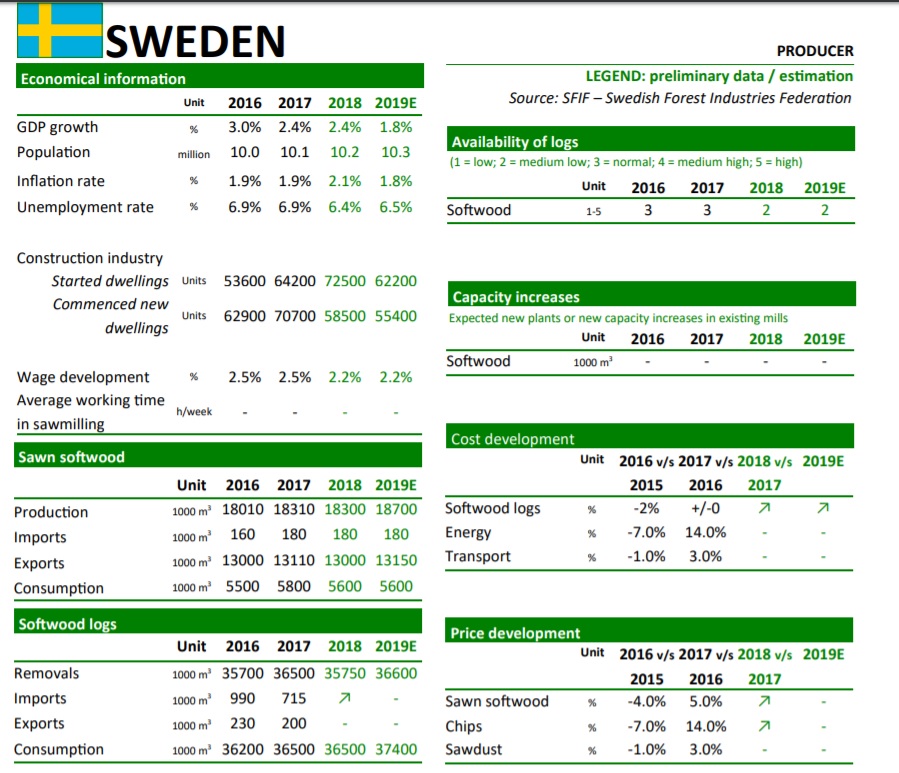
Swedish sawmill industry in difficulty because of bad weather conditions and raw material supply

During the last year, raw material supply in Sweden has been restricted somewhat by different factors. After a rainy autumn, more snow than normally hampered the supply during the winter. Dry conditions this summer will probably also restrict the raw material supply somewhat during the fall. Increased competition with the expanding pulp industry has also influenced the supply negatively, as well as shortages in transport capacity.

Therefore, the first seven months of 2018 the Swedish production was only unchanged compared with the same period last year. During the rest of the year, the production activity will continue at about the same pace as last year. Thus, the total production is forecast to be 18.3 million m3, or unchanged compared to last year. Given relatively unchanged market conditions it is reasonable to believe the production will increase marginally to 18.7 million m3 in 2019.

Since October last year, the Swedish Krona has depreciated against most currencies.

The Swedish domestic market

With a softwood consumption of 5.6 million cubic meters Sweden is the single largest market for the Swedish sawmills. Demand has been driven by strong housing activity for a couple of years. Housing starts climbed last year to its highest level since the early nineties (even though most of the increase in building activity has been on flats) and reached 71.000 units. The repair and maintenance activity remain on a stable level.

It seems like a peak in housing starts was reached last year, and the activity is now decreasing from a high level. On the other hand, the share of multi storey houses build with wood is now increasing. For example, several investments in CLT-production is now under way in Sweden.

The Swedish export markets

The total exported volume of sawn and planed softwood decreased two per cent during the first half of 2018 compared with last year.

The development differs quite much from one market to another. Volumes have increased on important European markets such as The Netherlands (+8% January-June), Denmark (+5%) and Poland (+9%). The Norwegian and German markets have shown a more modest development with slightly lower volumes. Exports to UK, Sweden’s largest export market, decreased by 3% during the first half year. Total export volumes to European markets were unchanged up to June.

Swedish exports to non-European markets have decreased somewhat. China decreased 14% and Japan 11%. Egypt decreased as much as 30% during January to June, compared with last year.

Poland’s largest furniture manufacturer is for sale

Black Red White SA (BRW), the largest Polish furniture manufacturer and retailer with annual sales of EUR 414 million and owned by the Chmiel family, is in sales negotiations with a Chinese investor.

Dieter Hilpert, CEO of Bega Group, the general importer of all BRW products for Germany, Austria, Switzerland and Benelux, released the information.

BRW furniture is produced in 21 plants in Poland and abroad. The company founded in 1991 by Tadeusz Chmiel has 22 subsidiaries, including 11 foreign companies in Ukraine, Belarus, Slovakia, Hungary, Russia and Bosnia-Herzegovina. In Poland BRW has a market share of 20% and exports approximately 40% of its production. The distribution takes place via 76 own retail outlets as well as over 800 sales outlets of external trading partners. Overall, the furniture is sold in over 40 countries.

We are informed about the ongoing negotiations of the Chmiel family with Chinese investors,” said Hilpert. “We expect the BRW Group to be strengthened by the entry of new investors and support for the further expansion of the Bega Group,” Hilpert continues. For its part Bega Group, with annual sales of more than € 360 million, is one of the largest suppliers of disassembled furniture in Germany.

Malaysia: Rising prices for Sarawak logs due to increased demand

Logs prices in Sarawak significantly increased due to higher demand from neighbouring Sabah, which banned timber exports since May this year.
Sarawak log prices have surged due to higher demand, thanks to neighbouring Sabah, which banned timber exports since May this year.
Recently, Japan relied on Sabah logs. Actually, over 10,000 cubic metres (cu m) of Sabah logs were imported in January, February and May, and the total of Sabah logs were 30% more than 2017. There have been no logs from Sabah since June, The Star reported.
Thus, the Japanese timber market now relies of logs from Sarawak. Also, as an alternative source of tropical timber, Japanese buyers shifted to Papua New Guinea (PNG).
"Meranti regular log prices in Sarawak had been about US$300 per cu m FOB (free on board) but now the prices climbed to US$320 per cu m after Sabah logs became unavailable,” according to the Japanese Lumber Reports.
Meranti is Sarawak’s top export species,which accounted for 58,940 cu m out of the state’s total log export of 2.24 million cu m last year. The report said the Japanese plywood mills intend to continue buying mersawa species from PNG although the prices are higher than meranti. Prices of mersawa from PNG shot up temporarily but levelled off after China (PNG’s main log buyer) slowed down the purchase after general economy peaked off, as The Star reported.
At the moment, the buyers in Japan keep buying lumber from South East Asian countries but the supply is unstable.
According to JLR, imported volume of Sarawak logs is limited due to the state’s harvest restrictions because of environmental reasons and increased duty.
In July 2017, Sarawak raised the premium for hill timber to RM50 per cu m from 80sen in its first review after more than 30 years The premium is chargeable on all species of logs harvested from hill forests and logs of hill species from agri-conversion areas.
Sarawak has drastically cut log production in recent years in line with its sustainable forest management policy. State Forest Department’s figures revealed that last year’s log output was 7.11 million cu m, down from 8.67 million cu m in 2016. In the first eight months this year,production stood at 4.23 million cu m.
As reported by The Star, last year, the state authorities further reduced log export quota to 20% from 30% to enable more logs to be reserved for the local downstream processing mills. A tighter log supply situation due to reduced annual production from natural forest has kept Sarawak logs prices robust for several years.
Tropical log prices in the international market were pushed up after Myanmar banned logs exports in 2014 to curb smuggling activities and conserve its forest.Myanmar was reported to be the world’s fifth largest tropical log producer (5.59 million cu m in 2012) and exported some 42% of its total production.
According to JLR, Japan importers purchased large volume of Sarawak logs when India slowed down the imports from Sarawak after that country’s raised the goods and services tax (GST) in July last year.
Ahead of the GST, India bought large volume of logs from Sarawak. As the Japan’s orders from Sarawak were delivered early this year,this pushed the country’s imports of tropical logs by 31.1% to 80,657 cu m in the first six months as compared to the same period in 2017.
 
Last month, Japan,Malaysia and Indonesia plywood manufacturers discussed raw material problem,trend of trade and related matters during a plywood conference in Tokyo. Japan explained that majority of raw material of plywood is now domestic wood and 52% of plywood supply is domestic but 48% is imports,which is indispensable materials for such items,like floor base and concrete forming panel.
Domestic manufacturers mainly produce structural panel but they are now trying to produce non-structural products,like floor base and concrete forming panel with softwood. But the volume is limited and it is far from replacing imports,” added JLR.
Japan is Sarawak’s key plywood buyers. Also, some 3,000 plywood mills in China were closed last year following the country’s massive restructuring efforts to eliminate outdated and polluting wood processing mills. Besides, 621 fibreboard production lines were dismantled, eliminating over 20 million cu m of production capacity.
Also affected were over 900 particleboard production lines which were either closed or relocated, resulting in a reduction in installed production capacity of 17 million cu m.

Rising plywood production in Finland and Russia

The UNECE Committee on Forests and the Forest Industry (COFFI) released their Annual Market Review 2017-2018, together with several market statements by national governments in the UNECE region (which includes the sub-regions of Europe, North America and the CIS), in advance of their 76th session to be held in Vancouver on 5-9 November.

On plywood, COFFI report that overall consumption in Europe was 8.7 million cu.m in 2017, up by 3.4% over 2016. Market expectations are generally positive, with plywood consumption in Europe expected to grow by 0.2% in 2018.

Drawing on data from the European Panel Federation, COFFI note that the main plywood applications in Europe are construction (39%) and furniture (30%) followed by transport (13%), packaging (8%) and other uses (10%).

European plywood production increased by 5.1% in 2017, to 5.1 million cu.m. Finland – the most important producer in the subregion, accounting for more than 24% of total production – recorded a 9% increase in production volume in 2017. Europe’s UNECE members forecast another increase in plywood production in 2018, but at much slower pace of only 0.5%.

While COFFI report that plywood production in Russia declined 0.8% to 3.7 million cu.m due to a shortage of raw materials new investment looks set to increase Russia’s production capacity dramatically in the next two years. Drawing on a review of eight large plywood investment projects by the WhatWood consultancy agency in Russia, COFFI suggest that Russia’s plywood production capacity will increase by at least 700,000 cu.m between 2017 and 2021.

China: Price overview for imported logs and sawnwood in October

The report below contains the latest prices of logs and sawnwood from main timber markets in China, between 1-15 October 2018.

1 Yuan=0.13 EUR
1 Yuan=0.14 US$
Guangzhou Yuzhu International Timber Market

Logs yuan/cu.m.
Merbau Dia. 100 cm+ 4-6000
Bangkirai Dia. 100 cm+ 3200-4200
Kapur Dia. 80 cm+ 2700-3000
Ulin All grades 6500
Lauan Dia. 60 cm+ -
Kempas Dia. 60 cm+ 2000-3000
Teak Dia. 30-60 cm+ 8500-8600


Logs yuan/cu.m.
Greenheart Dia. 40 cm+ 2300-2400
Purpleheart Dia. 60 cm+ 3000-4500
Pau Rosa Dia. 60 cm+ 2800-3000
Ipe Dia. 40 cm+ 2800-3000
Yuan per tonne
Cocobolo All grades 40-70000

 
Sawnwood

Sawnwood yuan/cu.m
Makore Grade A 9800-11800
Zebrano Grade A 9500-12500
Walnut Grade A 9500-15000
Sapelli Grade A 5000-7500
Okoume Grade A 3700-4700
Padauk Grade A 15000-18000
Mahogany Grade A 6500-7500


Sawnwood yuan/cu.m
Ulin All grade 9000-10000
Merbau Special grade 7500-9500
Lauan Special grade 4300-4700
Kapur Special grade 5000-6000
Teak Special grade 14000-22000


Sawnwood yuan/cu.m
Maple Grade A 9000-9500
Beech no knot 9000-9500
Ash no knot 5600-6300
Basswood no knot 2800-3300
Oak no knot 5300-5700
Scots pine no knot 2100


Sawnwood yuan/cu.m
Cherry Fas 2 inch 9000-11000
Black walnut Fas 2 inch 15000-18000
Maple Fas 8200-10000
White Oak Fas 7500-13000
Red Oak Fas 6500-8300
Finnish pine Grade A 2600-2900

Zhangjiagang Timber Market Wholesale Prices

Logs, all grades  yuan/tonne
Sapelli 3000-4000
Kevazingo 8000-32000
Padouk de africa 2400-3100
Okoume 1400-1800
Okan 2400-2800
Dibetou 2200-2500
Afrormosia 5500-6500
Wenge 4700-5500
Zingana 3400-4800
Acajou de Africa 3000-3500
Ovengkol 3100-3600
Pao rosa 5900-6600


Logs, all grades  yuan/tonne
Merbau 3500-5800
Lauan 1800-2020
Kapur 2020-2500
Keruing 1700-2200
Geronggang 1600
Kauri 1700-1850


Logs, all grades  yuan/tonne
Amoora 1900-2080
Calophyllum 2150-2350
Red Ganarium 1300-1400

(Source: ITTO)

Newsletter

Subscribe to our digital newsletter for your daily digest of essential news, views and analysis from the international wood industry delivered directly to your inbox.


0