
Article archive

Estonian sawlog prices below the level of last year

Prices for sawlog and pulpwood in Estonia have evolved disparately in February. Except small diameter spruce, prices for Estonian sawlogs range well below the levels of February 2015. For industrial logs, it is the other way around, except birch pulpwood, all prices have trended upwards as compared to the same month of last year. 
The sharpest decline yoy in sawlog assortments was for small diameter pine, while for pulpwood assortments, the highest increase was recorded for pine pulpwood. In comparison with January, the price for birch sawlogs has increased the most, while the largest decrease was for aspen pulpwood.
Firewood and wood chips are more expensive yoy by 4 and 5 percent respectively. However, in the short term, both have lost over 3% in price as compared to January.

Feb 15 €/m3 Jan 16 €/m3 Feb 16 €/m3 Change in % Feb 15; Feb 16
Pine

66,75

65,44

65,75

-1,50%

Pine d<18cm

56,85

53,63

54,16

-4,73%

Spruce

64,11

63,58

63,67

-0,69%

Spruce d<18cm

49,95

49,81

50,11

0,32%

Birch veneer

103,44

96,76

99,32

-3,98%

Birch

59,73

56,66

58,70

-1,72%

Aspen

33,35

31,11

30,86

-7,47%

Pine pulpwood

24,38

24,53

24,81

1,76%

Spruce pulpwood

24,17

24,53

24,26

0,37%

Birch pulpwood

27,80

25,59

25,33

-8,88%

Aspen pulpwood 

21,53

22,50

21,66

0,60%

Firewood

19,35

20,69

20,11

3,93%

Wood chips

27,52

29,84

29,00

5,38%

 
[gravityform id="1" title="true" description="true"]
 
[gravityform id="2" title="true" description="true"]

World's tallest wood building, proposed for Paris

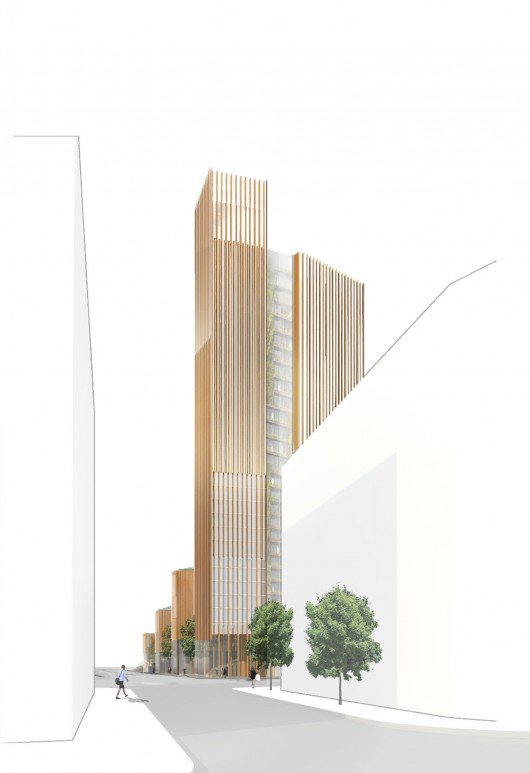
Paris’ urban housing difficulties might be overcome once with the erection of the world’s tallest wood building. Part of the Réinventer Paris competition, the carbon-neutral project was designed by Michael Green Architecture (MGA) and DVVD, which made a team with REI France developments, according to International Housing Concepts.
The project was made up focusing on community and includes a 35-storey tower named “Baobab”. The tower is a mix of social housing, together with a student hotel, a bus station, urban agriculture, e-car hub and other facilities, which aim to create some kind of vibrant metropolis and to reach the next era of building.
“Our goal is that through innovation, youthful social contact and overall community building, we have created a design that becomes uniquely important to Paris. Just as Gustave Eiffel shattered our conception of what was possible a century and a half ago, this project can push the envelope of wood innovation with France in the forefront”, said Michael Green, Principal of MGA.
As the MGA stated, buildings out of wood are the best because is the only carbon-neutral building material, which can reduce greenhouse gas emissions. Thus, as for the Baobab, the wood products which will be used in its construction, would store around 3,700 metric tons of carbon dioxide.


Photo source: International Housing Concepts
[gravityform id="1" title="true" description="true"]
 
[gravityform id="2" title="true" description="true"]


World’s tallest wood building, proposed for Paris

Paris’ urban housing difficulties might be overcome once with the erection of the world’s tallest wood building. Part of the Réinventer Paris competition, the carbon-neutral project was designed by Michael Green Architecture (MGA) and DVVD, which made a team with REI France developments, according to International Housing Concepts.

The project was made up focusing on community and includes a 35-storey tower named “Baobab”. The tower is a mix of social housing, together with a student hotel, a bus station, urban agriculture, e-car hub and other facilities, which aim to create some kind of vibrant metropolis and to reach the next era of building.

“Our goal is that through innovation, youthful social contact and overall community building, we have created a design that becomes uniquely important to Paris. Just as Gustave Eiffel shattered our conception of what was possible a century and a half ago, this project can push the envelope of wood innovation with France in the forefront”, said Michael Green, Principal of MGA.

As the MGA stated, buildings out of wood are the best because is the only carbon-neutral building material, which can reduce greenhouse gas emissions. Thus, as for the Baobab, the wood products which will be used in its construction, would store around 3,700 metric tons of carbon dioxide.

Photo source: International Housing Concepts

[gravityform id="1" title="true" description="true"]


[gravityform id="2" title="true" description="true"]


Gabon introduces restrictions on air dry sawnwood export

The private sector in Gabon is reporting that the government will go ahead with the introduction of regulations limiting the export of air dry sawnwood. It is understood that by mid-April a list of species will be issued detailing those included in the new regulations.
Reports say that okoume is to be included in the new regulation and that, for export, 60% must be kiln dried the balance 40% may be exported air dry.
It is also understood that ozingo has been removed from the list of timbers that can be traded but the felling ban on douka and kevazingo (bubinga) remains. It appears the government intends to propose kevazingo for CITES listing. Cameroon continues to enforce the ban on felling and processing of bubinga.
In related news, the government has decided to establish a new timber marketing organisation but it is not known when this is likely.
 
[gravityform id="1" title="true" description="true"]
 
[gravityform id="2" title="true" description="true"]
 

RONA shareholders approve to be taken over by Lowe's

In February 2016, Lowe’s Companies, the world’s second-largest home improvement retail chain, have agreed to acquire RONA, Canada’s largest home improvement retailer. This month, Rona shareholders have voted in favor of the company to be taken over by Lowe’s Home Improvement.
All of the issued and outstanding common shares of RONA will be bought for C$24 per share in cash and all of the issued and outstanding preferred shares of RONA for C$20 per share in cash, bringing up a total of C$2.3 billion.
The arrangement was approved by 99.92% of votes cast, representing 70.22% of total shares outstanding.
“The transaction is expected to accelerate Lowe’s growth strategy by significantly expanding our presence in the Canadian market through the addition of RONA’s attractive business and excellent store locations across the country,” said Lowe’s Chairman, President and CEO Robert A. Niblock, back in February.
With this purchase, both companies will develop the the leading home improvement retailer from Canada. The deal represents a premium of 104% over RONA’s share price in February 2, 2016 and a 38% premium on RONA’s 52-week high.
 
[gravityform id="1" title="true" description="true"]
 
[gravityform id="2" title="true" description="true"]


RONA shareholders approve to be taken over by Lowe’s

In February 2016, Lowe’s Companies, the world’s second-largest home improvement retail chain, have agreed to acquire RONA, Canada’s largest home improvement retailer. This month, Rona shareholders have voted in favor of the company to be taken over by Lowe’s Home Improvement.

All of the issued and outstanding common shares of RONA will be bought for C$24 per share in cash and all of the issued and outstanding preferred shares of RONA for C$20 per share in cash, bringing up a total of C$2.3 billion.

The arrangement was approved by 99.92% of votes cast, representing 70.22% of total shares outstanding.

“The transaction is expected to accelerate Lowe’s growth strategy by significantly expanding our presence in the Canadian market through the addition of RONA’s attractive business and excellent store locations across the country,” said Lowe’s Chairman, President and CEO Robert A. Niblock, back in February.

With this purchase, both companies will develop the the leading home improvement retailer from Canada. The deal represents a premium of 104% over RONA’s share price in February 2, 2016 and a 38% premium on RONA’s 52-week high.


[gravityform id="1" title="true" description="true"]


[gravityform id="2" title="true" description="true"]


Substantial EU trade surplus in wooden furniture

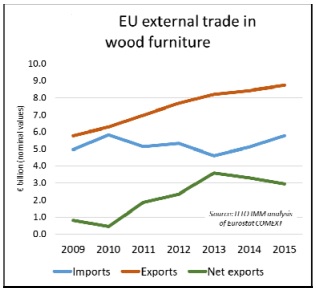
EU countries imported wood furniture worth €5.78 billion from outside the EU in 2015, 13% more than in 2014 and 16% more than in 2009, when the financial crisis had reached its climax. At the same time, EU exports of wood furniture rose to €8.73 billion in 2015, up only 3.5% from 2014 but 51% more than in 2009 (see the chart).
As such, EU exports of wood furniture are now around 51% higher than imports. Back in 2009, EUwoodfurnituretradeimport and export values were more closely aligned: exports were worth €5.77 billion, 16% more than imports, which stood at €4.97 billion.
However, EU exports of wood furniture subsequently increased constantly over the last six years, with growth rates ranging between around 3% and 11% per annum.
Imports of wood furniture, on the other hand, have experienced a less consistent development: an increase in 2010 was followed by a fall in 2011, which again was followed by growth in 2012 and decline in 2013. 2014 and 2015 were the only two successive years to show growth since 2009.
 
[gravityform id="1" title="true" description="true"]
 
[gravityform id="2" title="true" description="true"]
Homag Group reaches EUR 1 billion turnover in 2015

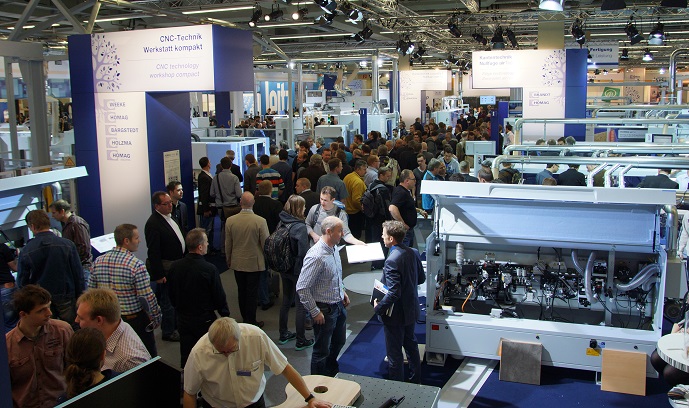
Jürgen Köppel, the CEO of Homag, introduced the 2015 financial results of the company during a press conference at the Fensterbau-Frontale 2016. Thus, Homag’s sales increased by 14% during the full year 2015, while the order intake was up by 15%.
KoppelMoreover, both the order intake and the sales reached over one billion euros. While the order intake summed EUR 1.058 billion, the sales reached EUR 1.036 billion. The employees’ number went up by 4%.
As Köppel (in the picture) stated, Europe is the main market for Homag. Most of the orders come from Germany. 21% of the orders comes from Central Europe and 18% from Western Europe. Also, markets such as Portugal, Spain or Italy, from Southern Europe, have started to recover. Of al Homag’s new orders, 17% of them came from Eastern Europe, especially from Poland.
Because of the swiss franc fluctuations, orders from Switzerland were very low. Also, the strong devaluation of the ruble made decreased the orders from Russia. All in all, 56% of the company orders came from Europe.
Another 22% of Homag’s orders came from North America, where there’s an increased demand for equipment. While 19% of orders came from the Asia-Pacific area, Africa has 2% share and the lowest amount of orders came from South America.
 
[gravityform id="1" title="true" description="true"]
 
[gravityform id="2" title="true" description="true"]

 

German Pellets' Woodox subsidiary files for insolvency

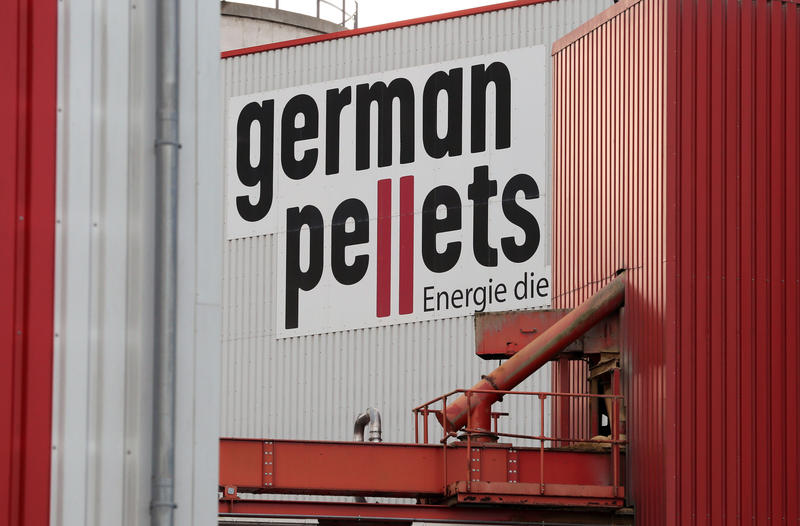
Woodox, a German Pellets GmbH subsidiary in Leipzig, filed for insolvency on 30th of March, at a local court. Woodox owned the following pellet production plants in Germany: Sachsen GmbH in Löbau; Sachsen-Anhalt Nord in Oranienbaum-Wörlitz and Sachsen-Anhalt Süd GmbH in Osterfeld.
Prof. Dr. Lucas F. Flöther from Flöther & Wissing has been appointed provisional insolvency administrator for all three plants. The three pellet production plants have a 75,000 tons production capacity and are operated by German Pellets. Also, back in December 2015, the German Pellet Vertriebs GmbH (MPV) adopted the exclusive distribution of all three plants.
At the moment, there are 11 companies owned by the German Pellets group that filed for insolvency.
German Pellets GmbH filed for insolvency on the 10th of February at the regional court of Amtsgericht Schwerin, Germany and lawyer Bettina Schmudde from Kanzlei White & Case law firm was appointed as provisional insolvency administrator in the insolvency proceedings.
 
[gravityform id="1" title="true" description="true"]
 
[gravityform id="2" title="true" description="true"]


German Pellets’ Woodox subsidiary files for insolvency

Woodox, a German Pellets GmbH subsidiary in Leipzig, filed for insolvency on 30th of March, at a local court. Woodox owned the following pellet production plants in Germany: Sachsen GmbH in Löbau; Sachsen-Anhalt Nord in Oranienbaum-Wörlitz and Sachsen-Anhalt Süd GmbH in Osterfeld.

Prof. Dr. Lucas F. Flöther from Flöther & Wissing has been appointed provisional insolvency administrator for all three plants. The three pellet production plants have a 75,000 tons production capacity and are operated by German Pellets. Also, back in December 2015, the German Pellet Vertriebs GmbH (MPV) adopted the exclusive distribution of all three plants.

At the moment, there are 11 companies owned by the German Pellets group that filed for insolvency.

German Pellets GmbH filed for insolvency on the 10th of February at the regional court of Amtsgericht Schwerin, Germany and lawyer Bettina Schmudde from Kanzlei White & Case law firm was appointed as provisional insolvency administrator in the insolvency proceedings.


[gravityform id="1" title="true" description="true"]


[gravityform id="2" title="true" description="true"]



Japan: Targets for the use of domestic wood revised downwards

The Japanese Forest Agency has reviewed and revised Japan's degree of self-sufficiency rate for domestic wood. Since the domestic supply in 2015 does not seem to achieve an initial target of 28,000,000 cbms, the annual target imposed for 2020 is now reduced from 39,000,000 cbms down to 32,000,000 cbms. Moreover, the target set for 2020, to achieve a degree of self-sufficiency of 50%, is now postponed for another 5 years. This means that Japan will continue to rely on imports of wood, rather than own domestic resources.
Every five years, the Japanese forest industry is reviewed and the agency suggests targets for the use of wood for five, ten and twenty years in the future.
The plan made in July 2011 aimed for a degree of self-sufficiency of 50% with a target for domestic wood supply of 28,000,000 cbms by 2015 and 39,000,000 cbms by 2020. However, due to the fact that supply was only 24,000,000 cbms, far from the target proposed, this revision of the Forest Agency tries to get closer to reality.
Japan is increasingly relying on own domestic lumber production and less on imports. Japan's lumber self-sufficiency rate (or the proportion of domestic product to total lumber supply in the country) has reached a new high in 2014 of 30 percent. This was the highest level in 27 years.
The recovery reflects increasing demand for Japanese lumber and yen's weakness, which has lifted prices for imports.
There is also an upward trend noticed in biomass power generation. Japan has witnessed a surge in biomass power plants after the FIT (feed in tariff) system was introduced in July 2012. As many as 33 plants are expected to start operations in 2016.
Japan's lumber self-sufficiency rate has dropped to a record low of 18.15 percent in 2000 from 94.51 percent in 1955. This was due to falling, prices, rising costs for domestic production and rising imports. However, this rate has been moderately improving in recent years.
As the Japanese Forestry Agency has set a target of lifting the self-sufficiency rate to 50 percent by 2020, and thus to ensure a stable supply, the agency also plans ways of promoting and boosting domestic lumber production such as: construction of multi-storey buildings using Japanese cross-laminated timber; support for wooden biomass power generation as a new source of revenue for mountainous villages.
 
[gravityform id="1" title="true" description="true"]
 
[gravityform id="2" title="true" description="true"]

Latvian forestry industry exports increased by 1.2% in January

The Latvian forestry industry exports increased in January 2016, reaching EUR 158.86 million worth of products in the forestry industry, which were exported in the first months of 2016, compared to January 2015 (EUR 158.19 million), according to the Baltic Course.
Thus, in January, Latvia exported timber and timber products of EUR 136.61 million, reaching a 1.2% year-on-year increase.
The majority of the forestry products were exported to the UK (18.5%), during the first months of 2016, followed by Sweden (11.1%) and Germany (10.6%). From the UK, the exports reached EUR 29.38 million, and Sweden and Germany exports brought Latvia EUR 16.84 million and EUR 16.84, respectively.
Nevertheless, the Latvian imports of forestry industry products decreased in January 2016, for the first time in a long period of time. The Imports of forestry products declined by 8% compared to January 2015, reaching EUR 49.097 million.
 
[gravityform id="1" title="true" description="true"]
 
[gravityform id="2" title="true" description="true"]


Astec Industries receives $122.5 million pellet plant order from Highland Pellets

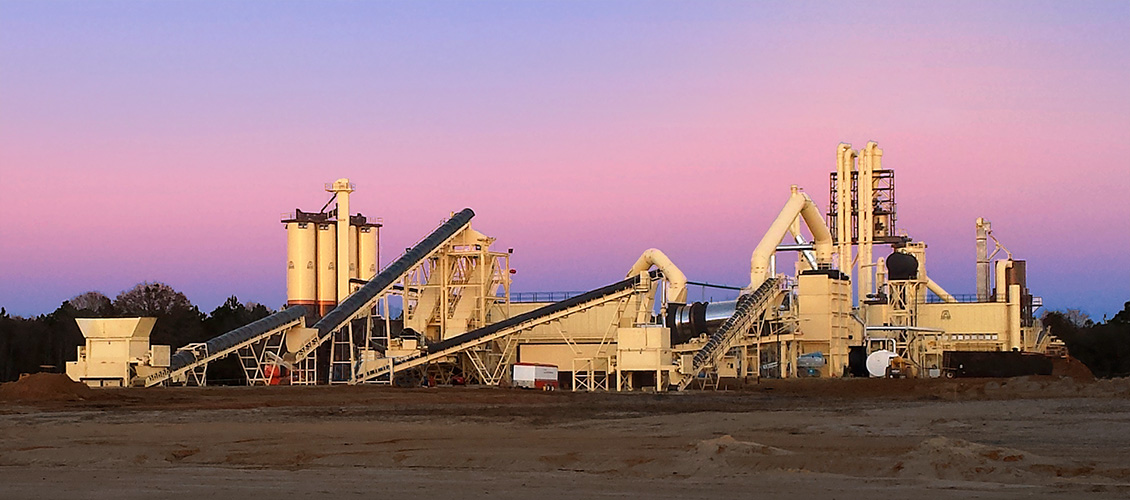
Astec Industries, Inc., recently received a $122.5 million of a pellet plant order for Highland Pellets along with a related deposit. Also, the company received the rest of the contracted payment on the first $30 million order, which they announced in August 2015.
With the new contract, Astec Industries will build additional equipment for the first production line of this multi-line wood pellet plant facility. The details of the entire order will be discussed in the company’s first-quarter earnings release.
As for other opportunities from pellets plants, the Hazlehurst wood pellet plant, lines one and two are now running at full capacity and met the production target in the startup phase. Line three is near the testing phase and nearly installed. The order for all three lines totaled $60 million.
As the company reported, backlogs recorded $348 million at the end of January 2016, going 11% up compared to December 2015. The 2016 revenues will be supported by group sales activities and new product development in all groups.
 
[gravityform id="1" title="true" description="true"]
 
[gravityform id="2" title="true" description="true"]


Global pulpwood prices at lowest level in 10 years

Pulpwood costs have fallen substantially worldwide with the softwood and hardwood pulpwood price indices in the 4Q/15 being at their lowest levels in over ten years, reports the Wood Resource Quarterly.
The largest cost component when manufacturing wood pulp is the cost of wood fiber.
This cost has declined substantially in US dollar terms the past few years with the Global Price Indices being down almost ten percent in 12 months, according to the Wood Resource Quarterly.
Wood cost is the factor that often determines the competitiveness of a pulp manufacturing plant or region, because it is the largest cost component when producing wood pulp. During the past few years, this cost has varied between 45% and 70% of the total cash cost, depending on product grade and the costs of other components such as chemicals, energy and labor.
Hardwood fiber prices continued to fall in most of the major pulp-producing countries in the world in the 4Q/15. The biggest declines were seen in Brazil, Chile, Russia, France, Germany and Indonesia. In most regions, the price adjustments occurred in both in the local currencies and in US dollar terms. The hardwood price index (HFPI) fell over two percent from the 3Q/15 to a level that was almost 10% lower than in the 4Q/14.
Russian pulp mills have substantially lower wood fiber costs than most competitors around the world thanks to the weak Ruble. Prices for hardwood pulplogs were less than half of the average prices in Brazil and Chile in the 4Q/15. In US dollar terms, current price levels are also half of what they were two years ago. Pulplog prices throughout Europe have also fallen quite substantially the past few years but remain among the highest in the world.
With the exception of the US South and New Zealand, softwood fiber prices were also down throughout the world in the 4Q/15. The declines ranged between two to ten percent from the previous quarter. The softwood price index (SFPI) was US$88.46/odmt, a reduction of 1.4% from the previous quarter and 7.5% lower than the same quarter in 2014. Both the SFPI and HFPI are currently at the lowest levels in over ten years.
 
[gravityform id="1" title="true" description="true"]
 
[gravityform id="2" title="true" description="true"]

SLA dispute: NAHB forms coalition calling for free trade in lumber

The National Association of Home Builders (NAHB) has formed an alliance as to provide the American consumers with a stable and reliable supply of lumber and building materials, once the Softwood Lumber Agreement expired in October 2015, according to LBM Journal.
In addition to the NAHB, founder members of the American Alliance of Lumber Consumers (AALC) include the National Retail Federation and the National Lumber & Building Material Dealers Association.
The U.S. and Canada are currently in a one-year cooling-off period following the agreement's expiry, during which no trade disputes relating to softwood lumber imports can be filed by either country. The two nations are also exploring options for a long-term agreement and are committed to submit a report within the next 100 days.
The AALC supports free trade in lumber and building materials, backing NAHB's position that any new agreement should be mindful of the U.S. housing market and provide American consumers with a stable, dependable and affordable supply of lumber. The group also believes that any deal should also allow home builders to provide safe, decent, affordable housing at competitive prices, LBM Journal reported.
According to the NAHB, the current share of Canadian imported lumber in the U.S. market is 28% on a three-year average basis, and the AALC believes that any restrictive trade agreements imposing, quotas, tariffs and other border tax measures could create large and unpredictable swings in the cost and supply of lumber and other building materials, which could impact housing affordability.
The AALC is calling on the U.S. government to  allow home builders, other downstream industries and consumers to participate in the formulation of trade policies and acknowledge the important role that they play in the U.S. economy, LBM Journal reported.
 
[gravityform id="1" title="true" description="true"]
 
[gravityform id="2" title="true" description="true"]


Södra acquires British Crown Timber

On 31 March, Södra acquired the remaining shares in Crown Timber Group Plc. Södra previously held approximately 20 percent of the shares in the company.
Crown Timber is a market-leading distributor of structural timber products to the UK and Irish timber engineering sector and to timber and builders' merchants. The company reported sales of nearly GBP 120 million in 2015.

"The UK is our principal export market. This acquisition gives us valuable control over the entire supply chain - from the forest to the end users - and provides potential for growth," says Jörgen Lindquist, Interim President at Södra Wood.

Crown Timber will become part of the Södra Wood business area within the Södra Group. It will incorporate all of Södra's activities in the UK and Irish markets, including those to be conducted by the sales company that Södra was planning to launch in the UK in the first quarter of 2016.
"We will gain an organization in the UK and Ireland that we already have in a number of our other markets, with control over the entire supply chain - from the forest to the customer. We also want to develop the business by adding the remainder of our range, meaning interior wood products, solid and parquet flooring and energy products, such as wood pellets," says Jörgen Lindquist.
Crown Timber operates four distribution terminals and timber treatment centres at Dundee in Scotland, Wicklow in Ireland, and Sheerness and New Holland, both in England. The company also owns a sawmill in Hamina, Finland, which produces 150,000 cubic meters of sawn timber annually. The company has 41 employees in the UK and Ireland and 40 employees at the sawmill in Hamina.
"Crown Timber has been operated as a very successful business for many years and our intention is to continue using the same business model, while also being firmly integrated with Södra. In other words, it's business as usual," says Jörgen Lindquist.
Crown Timber Group's chief executive and largest shareholder Stuart McIntyre, who will be leaving the company, commented "We have been a customer of Södra for close to thirty years and we know the company well. We believe that Södra is well placed to take this company forward, and it is inheriting a great workforce and management team who can help it move from strength to strength in the period ahead."
Södra already has sales offices in China, Germany, the Netherlands, the US, Norway and Denmark.
The acquisition will take immediate effect and Christer Thörn, HR Director at Södra, will serve as Interim President until a permanent replacement has been found.
 

[gravityform id="1" title="true" description="true"]

 
[gravityform id="2" title="true" description="true"]


First cross laminated timber hotel in the US is completed

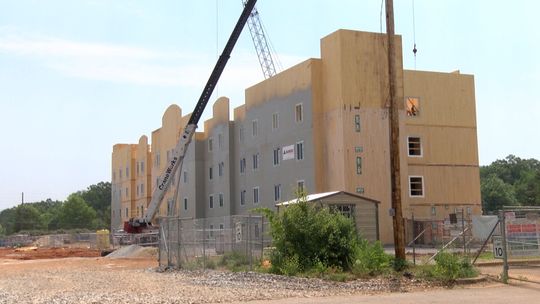
The first hotel completely made of Cross Laminated Timber (CLT) is due to be opened in Alabama, US. The Candlewood Suites on Redstone Arsenal was built by Lendlease and is celebrating the partnership between the United States Army, Lendlease and IHG Army Hotels, according to For Construction Pros.
The building is made of several layers of pressed lumber board stacked in alternating directions. Using CLT makes the building strong and durable, along with adding sustainability and conservative benefits. The material is certified by FSC and may achieve 31% energy savings, in comparison with the same size and same climate buildings.
"The use of CLT and other integrated methodologies has made it possible to 'do more with less' by constructing projects faster, with less labor and safer than conventional materials and methods," said Denis Hickey, CEO for Lendlease Americas.
The Candlewood Suites include 92 guest rooms and totals a 62,688-square-foot structure. 1,200 CLT wall panels were used for the completion of the hotel, along with and 200,000 CLT fasteners. The erection of the building lasted 10 weeks and was completed by 11 workers, reaching a 40% reduction in crew size and man hours.
 
[gravityform id="1" title="true" description="true"]
 
[gravityform id="2" title="true" description="true"]


BSW Timber invested £3.6 million in the UK fencing market

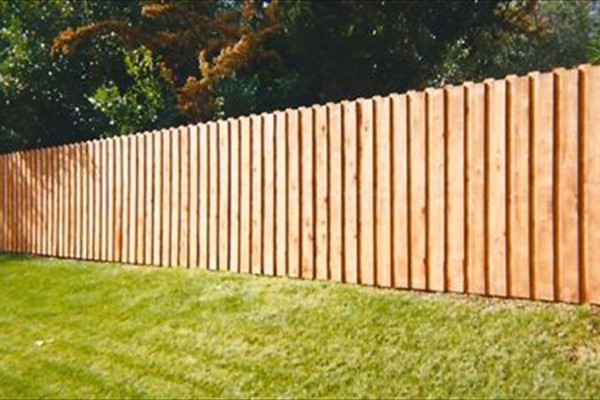
BSW Timber has recently invested approximately £3.6 million in the UK fencing market, which is rapidly filling with opportunities. In the last 2 years, the UK sawmilling company invested in infrastructure projects at 5 of its mills in the UK, alongside with a multi-pound acquisition of Southampton-based fencing specialists RF Giddings back in 2014, according to Builders’ Merchants News.

“This significant multi-million investment in fencing technology, combined with our acquisition and development of our Southampton operation, demonstrates BSW's commitment to the UK fencing sector,” said Tony Hackney, chief executive BSW Group.

Hackney added that the fast growing market is helping their products in the commercial and domestic sectors, especially in the incised and acoustic fencing solutions. This growth has increased their sales by nearly 50% in 2015. £2.7 million will be invested in installing multi-head machine lines at mills in Fort William, Dalbeattie, Carlisle and Boat-of-Garten, as to develop a wider range of products, such as weather topped and pointed posts, as well as increased feather-edge capacity.
As BMN reported, another £500,000 were invested in incising machinery in Carlisle, Dalbeattie, Newbridge-on-Wye and Fort William, for improved preservative penetration and retention, to better treatment for the timber end product. The company is also investing in acoustic panel manufacturing, using the Soundshield techonolgy, as to stop the wanted noise on the commercial and domestic markets.
 
[gravityform id="1" title="true" description="true"]
 
[gravityform id="2" title="true" description="true"]


RusForest reports increased sawmilling and harvesting production

RusForest AB announced its year-end report 2015, with increased sawmilling and harvesting production in Q4 2015. Also, the Swedish forestry company with operations in Russia got their first annual net profit in 2015.
With the new pellet mill in Magistralny and the new harvesting operations in Ust-Ilimsk that started production in the Q4 2015, RusForest is working on ramp up their production. Except for Japan, all the sawnwood markets were very challenging in the Q4 2015, with a year-on-year decline in average price received as a consequence.
In Q4 2015, RusForest harvested 117,101 m3 of sawlogs, compared with 105,038 m3 in Q4 2014 (+11%), which included 14,420 m3 of recently developed own harvesting in Ust-Ilimsk. For the mentioned period, the company produced 22,488 m3 of sawnwood, compared with 21,368 m3 in Q4 2014 (+5%). Also, RusForest started production of pellets in Magistralny and managed to produce a total of 1,847 tonnes in Q4 2015.
For the full year 2015, the company harvested 287,865 m3 of sawlogs in Magistralny, compared to the 278,896 m3 harvested in 2015. For the Ust-Ilimsk forest lease areas, RusForest harvested 615,166 m3 of sawlogs in the mentioned period, compared to the 320,210 m3 in 2014. Also, sawnwood production reached 85,645 m3 in Magistralny, compared to 78,826 m3 in 2014.
The Swedish company generated revenue of USD 22.0 million in 2015, 19.7% lower than the revenue in 2014, when the company summed USD 27.4 million. The adjusted EBITDA reached USD 4.6 million in 2015, in comparison to the 2014’s EBITDA of 1.5 million. Adjusted EBITDA margin of 21% for full year 2015 compared with 6% in 2014.
“The Company still showed much improved operational profitability in Q4 2015 compared with same period in 2014, largely due to the successful efforts to reduce overhead costs and eliminate losses in Ust-Ilimsk through increased cooperation with key subcontractors,” said Anton Bogdanov, CEO of RusForest Management Company.
RusForest recorded a net profit of USD 3.2 million for full year 2015, compared to the 2014 net loss of USD 14.5 million.
 
[gravityform id="1" title="true" description="true"]
 
[gravityform id="2" title="true" description="true"]

Heinola receives progressive kilns orders from UPM and JPJ-Wood Oy

UPM Kaukas Sawmill has ordered three automatic 2-zone progressive kilns type HTC from the Finnish Heinola Sawmill Machinery Inc.
UPM announced in the summer of last year that it will invest EUR 50 million in its Kaukas mill in Lappeenranta, Finland, to further strengthen the mill’s efficiency, competitiveness and optimisation.
The investment will go towards modernising both pulp drying machines and installing a new baling line. Assembly will take place during a planned shutdown in autumn 2016 and start-up is scheduled for the end of 2016. The investment will benefit the entire Kaukas biorefining mill integrate through increased resource efficiency and operational flexibility.
UPM’s Kaukas mill is located on the shore of Lake Saimaa in Lappeenranta in Southeast Finland. The Kaukas integrate consists of pulp mill and paper mill, which produces magazine paper. In addition Kaukas sawmill and UPM's research centre are also located at the same site. The pulp mill has two production lines, with an annual production of 740,000 tonnes of hardwood and softwood pulp.
Moreover, Heinola has received an order from another Finnish customer. JPJ-Wood Oy in Korkeakoski, Finland has ordered one automatic progressive kiln type HFB from Heinola Sawmill Machinery Inc. with annual capacity of ca. 50 000 m3 when drying sideboards to 18 % final moisture content.
Existing two automatic progressive kilns will be also connected to Heinola Drying Kiln Control System. The new progressive kiln will be taken into production in September 2016.
 
[gravityform id="1" title="true" description="true"]
 
[gravityform id="2" title="true" description="true"]

Newsletter

Subscribe to our digital newsletter for your daily digest of essential news, views and analysis from the international wood industry delivered directly to your inbox.


0