
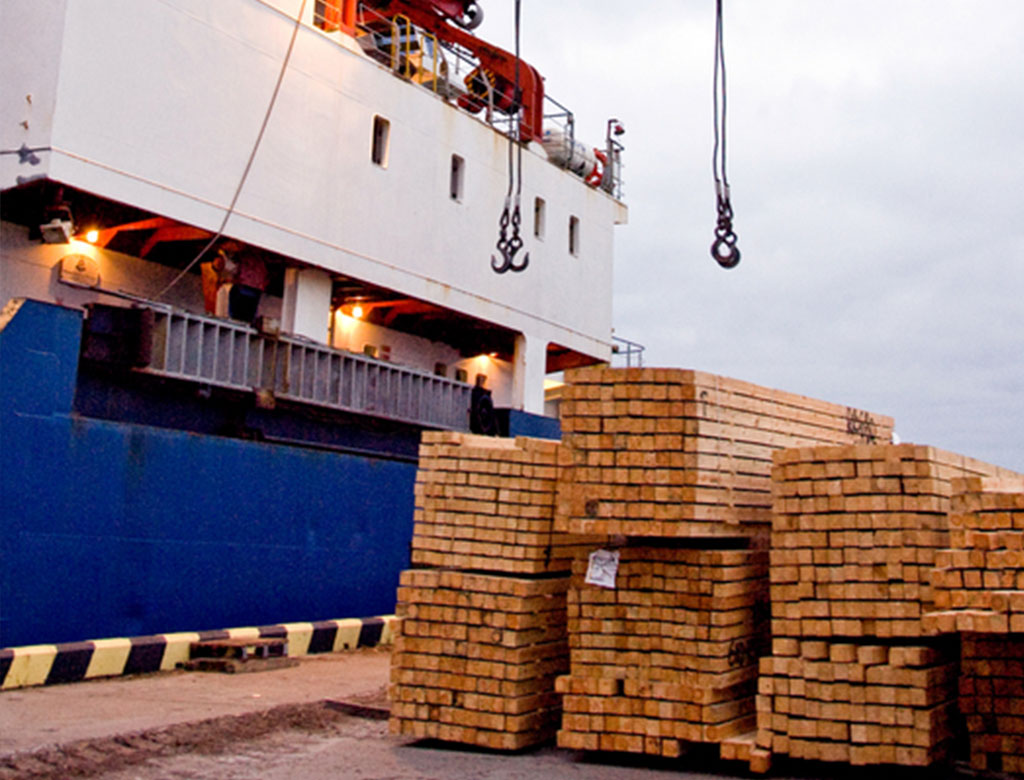
The wood demand in Japan reached 25,092,000 m2 in 2015. This represents a 1.9% decrease compared to 2014, according to the Japanese Ministry of Agriculture, Forestry and Fisheries.
As ITTO reported, this is a two consecutive years’ decline, even if the new housing starts were 1.9% in 2015 than in 2014. Also, the imported wood products from foreign countries decreased.
Yet, the domestic wood demand keeps on growing in the domestic consumption of materials. In 2015, it reached a total material supply of 20,049,000 m2, which is 0.7% more than in 2014. Meanwhile, the imported materials were 5,045,000 m2, 11.0% less compared to 2014.
The share of domestic wood was 79.9%, 2.1% more than in 2014. The log demand for lumber decreased by 2.9% in 2015, reaching 16,182,000 m2. Out of this, the domestic logs were 12,004,000, 1.7% less than the previous year.
The decline of imported logs was larger than this, as it only reached 4,178,000 m2 in 2015, going down 6.1% compared to 2014.
Japanese exports of lumber went down by 3.8%, reaching 923,000 m2 in 2015. Imported lumber also declined. Thus, the softwood lumber imported from North America decreased by 0.6%, compared to the previous year and the European softwood lumber went down by 4.6%. Also, the structural laminated lumber was down by 3.1% in 2015, compared to 2014, according to ITTO reports.
Moreover, the log imports from North America decreased by 3.2%, reaching 3.259,000 m2. Yet, the demand for North American logs decreased. The log supply was low due to the forest fires, labor dispute at the West Coast ports and the strong dollar.
The logs for plywood manufacturing reached 4,218,000 m2, 4.2% less than in 2014. Out of this, the domestic logs were 3,356,000 m2, 5.2% up compared to the previous year, while the imported logs reached 864,000 m2, 28.8% less than 2014. Thus, the domestic logs’ share was 80%.
As ITTO reported, the standard plywood production was 2,756,000 m2, 2.0% less than the previous year and the imported plywood was down by 17%.
Article archive
Biesse doubles sales at this year's Xylexpo

At the close of the 2015 financial year, Biesse announced outstanding results. This year, at Xylexpo, the biennial trade fair dedicated to technologies for processing wood and components for the furniture industry, the company provided further confirmation of its astounding growth for 2016.
The orders received by the group have grown by 103% since the 2014 edition of the same event - a statistic that is even more impressive when translated into sales, equating to 20.6 million euros, according to a company’s press release. Continue reading "Biesse doubles sales at this year's Xylexpo"
Biesse doubles sales at this year’s Xylexpo

At the close of the 2015 financial year, Biesse announced outstanding results. This year, at Xylexpo, the biennial trade fair dedicated to technologies for processing wood and components for the furniture industry, the company provided further confirmation of its astounding growth for 2016.
The orders received by the group have grown by 103% since the 2014 edition of the same event - a statistic that is even more impressive when translated into sales, equating to 20.6 million euros, according to a company’s press release. Continue reading "Biesse doubles sales at this year’s Xylexpo"
Södra reports sales record for construction timber
Södra broke its record for construction timber sales in the Swedish market during both April and May. The figures for May also hit an all-time high - Södra's largest delivery to the Swedish building materials market in a single month.
The increase has remained stable since 2015, which was a record year for sales to the Swedish building trade. Almost 275,000 cubic metres of construction timber were delivered. As one of the largest construction timber and interior wood operators in Sweden, Södra's growth reflects an important social trend:
"This is a clear signal that the use of wood in building construction is increasing, which is positive for the whole of Sweden," said Jörgen Lindquist, President of the Södra Wood business area. "It promotes the transition to a fossil-free society."
The year-on-year sales growth ranges from 12-15 percent. The Swedish market accounts for 35 percent of the total market and is the largest single market for Södra's sales of construction timber to industry and the building trade.
"Wood is 'in' - there's no doubt about it, especially for the younger generation. Young people are becoming increasingly aware of long-term sustainability," added Fredrik Gustavson, Sales Director of Södra Wood in Sweden and Denmark. "We predict continued healthy sales throughout the year due to strong market conditions with low interest rates, a continuation of the tax rebate for home improvements and the major need for new homes."
Norway becomes the first country in the world to pledge for zero deforestation

Norway has become the first country in the world to commit to zero deforestation, with MPs introducing rules ensuring procurement supply chains do not contribute to rainforest depletion.
The regulatory changes follow the country's pledge at the 2014 UN Climate Summit to “promote national commitments that encourage deforestation-free supply chains, including through public procurement policies to sustainably source commidities such as palm oil, soy, beef and timber”.
The Rainforest Foundation welcomed the news, saying it was "an important victory in the fight to protect the rainforest." It urged Germany and the UK, which had also signed the 2014 pledge, to follow suit.
Although a number of private firms have committed themselves to ensuring their supply chains do not contribute to deforestation, Norway is the first government to make such a pledge.
The United Nations' Food and Agricultural Organisation estimates that some 129 million hectares of forest - an area the size of South Africa - have been lost to deforestation since 1990.
The regulatory changes follow the country's pledge at the 2014 UN Climate Summit to “promote national commitments that encourage deforestation-free supply chains, including through public procurement policies to sustainably source commidities such as palm oil, soy, beef and timber”.
The Rainforest Foundation welcomed the news, saying it was "an important victory in the fight to protect the rainforest." It urged Germany and the UK, which had also signed the 2014 pledge, to follow suit.
Although a number of private firms have committed themselves to ensuring their supply chains do not contribute to deforestation, Norway is the first government to make such a pledge.
The United Nations' Food and Agricultural Organisation estimates that some 129 million hectares of forest - an area the size of South Africa - have been lost to deforestation since 1990.
Continue reading "Norway becomes the first country in the world to pledge for zero deforestation"
US: Drop in plywood imports from China

US hardwood plywood imports declined again month-overmonth in March (-9%). A total of 234,473 cu.m. were imported in March, worth US$133.2 million, ITTO reported in its latest MIS.
Year-to-date import volumes were 2% higher than in March 2015, but the value in current US dollars was down 5%. The drop in imports was almost entirely in shipments from China, which fell by 29% to 112,275 cu.m. in March.
Imports from Indonesia, Malaysia and Russia increased from February. Plywood imports from Indonesia grew 22% from the previous month to 37,325 cu.m. Year-to-date import volumes from Indonesia were down 5% from March last year, but the value of imports grew 7% year-to-date.
Imports from smaller plywood suppliers to the US market expanded significantly in March, most notably from Spain (4,056 cu.m.), Uruguay (3,885 cu.m.) and Brazil (2,948 cu.m.).
Indonesian timber to get free EU access by the end of the year

The first licensed Indonesian timber shipments to the EU will happen at the end of 2016, even if the country’s timber products have already met the legality standards.
The EU must first organize internal discussions and preparation, a process called “democratic scrutiny” in the European Parliament and the European Council, before considering the Indonesian timber products eligible for the EU’s Forest Law Enforcement, Governance and Trade (FLEGT) licensing scheme, according to The Jakarta Post.
The discussions will start in June and will last for two months. Then, the timber industry operator in the EU will have 90 days to prepare.
“So that’s our internal decision-making procedure [...] Hopefully Indonesia can ship its first FLEGT-licensed timber products before the end of the year,” said Brunei Darussalam Vincent Guerend.
The timber industry in Indonesia has been long accused for vast deforestation, illegal logging and burning of forests, so after a long time of negotiations, the EU has finally given Indonesia a full implementation of its timber legality system (SLVK). This means that the timber in the country will be produced with FLEGT license.
As The Jakarta Post reported, strengthening sustainable and legal forest management, improving governance and promoting trade in legally produced timber will reduce illegal logging practices.
Yet, most EU countries aren’t ready for the first FLEGT-licensed shipment from Indonesia, as Environment and Forestry Ministry senior ministerial advisor Agus Justianto said after a roadshow to 5 EU countries to inform the local timber importers.
“Each country only has one competent authority to handle FLEGT licenses, while there are several seaports in each country through which our products will enter. The authorities also lack communication procedures between seaports, so these are the challenges the EU has to prepare for,” Agus added.
Indonesian timber exports are now expected to grow by 10%, once that the country has secured the SLVK certification and FLEGT license, which offers the European countries trust in Indonesian timber.
In 2015, Indonesia exported just under US$1 billion worth of timber products to EU countries, according to data from the Central Statistics Agency ( BPS ). Of this total, furniture exports accounted for $319 million, followed by processed wood at $282.47 million and paper at $192.31 million, as Jakarta Post reported.
Finland: Log prices in March 2016

Prices for roundwood in Finland have registered some mixed developments in March 2016. Pine logs price has decreased by around 1 percent, while spruce has gained some 2.43% price increase as compared to last year.
Birch logs can be bought at a slightly cheaper price over last year.
Pulpwood assortments have registered some discordant price movements: pine and birch pulwood price is lower than last year, while spruce has become more expensive by over 2.5%. Continue reading "Finland: Log prices in March 2016"
US: Lumber prices fell by $2 at the beginning of June

Framing lumber prices declined slightly last week in the US. Still, southern pine has shown a little increase despite the weather conditions and the heavy raining in the key markets in Texas.
Thus, the Random Lengths Framing Lumber Composite Price slipped $2, reaching $355. Continue reading "US: Lumber prices fell by $2 at the beginning of June"
China: Forest products trade reaches US$140 billion in 2015, down 1% yoy

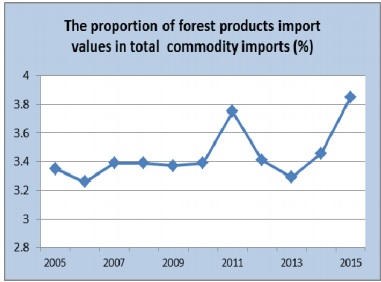
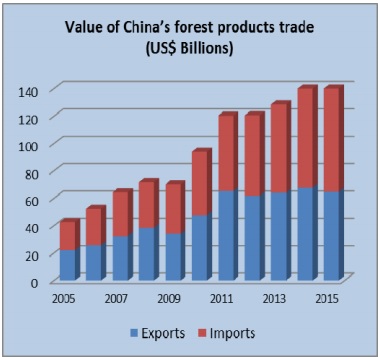
According to China Customs the total value of China’s forest products trade in 2015 was US$140 billion, a year on year decline of 1%, accounting for 3.1% of the total national commodity trade value, ITTO reported in its latest MIS.
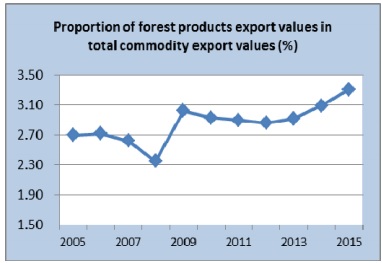
The value of Chinese forest product exports amounted to US$75.3 billion, a year on year increase of 4%, making up 3.3% of the total national commodity trade value.
The value of Chinese forest products imports came to US$64.7 billion, a year on year decline of 6%, accounting for 3.85% of total national commodity trade value.
The trade surplus in forest products in 2015 soared over 200% to US$10.6 billion. The balance of trade surplus for forest products trade in 2014 was US$3.4 billion.
The output value of China’s wood products sector in 2015 fell 2% to US$104.7 billion, accounting for 75% of the total value of national forest products trade.
Of the total, the value of wood product exports rose 3% to US$61.4 billion, making up 82% of the value of national forest products export, unchanged from last year.
In 2015 the value of wood product imports declined 8% to US$43.3 billion, accounting for 67% of the value of national forest product imports. The trade balance for China’s wood products was US$18.1 billion, a year on year increase of 57%.
The output of China’s non-wood forest products in 2015 rose 2% to US$35.3 billion, accounting for 25% of the total value of national forest products trade.
Of the total, the value of non-wood forest products exports rose 9% to US$13.9 billion, making up 18% of the value of national forest products export.
The value of non-wood forest product imports declined 2% to US$21.4 billion, accounting for 33% of the value of national forest product imports. The negative balance of China’s non-wood forest products trade was US$7.5 billion, a year on year decline of 18%.
Finnish sawmills plan to double sawn timber exports to China

Finnish sawmills are seeking for ways to increase their sales in international markets over the next three years. Supporting the internationalization of Finnish companies, Finpro launched a cooperation with the Finnish Sawmills Association regarding an export program, with the aim to double exports of Finnish sawn goods to China.
''Wood from Finland'' was funded by the Finnish Ministry of Employment and Economy, as well as by part of the Finnish sawmill industry. At the moment, there are 20 Finnish sawmills taking part in the program, among which Koskisen Oy too.
Two local experts where already hired, that will help in finding market opportunities and the creation of first contacts. Currently, the Ministry is committed to fund the growth of the program with approximately EUR 700,000. By the end of 2017, the funding may reach EUR 1.3-1.4 million.
''China is a potential target because it is the world's largest furniture manufacturer and exporter. In addition, there is now a new program of the Chinese government, which focuses on the development of environmentally friendly construction,'' says program manager Jyrki Mantere.
Last year, Finland exported to China more than 630,000 cubic meters of sawn timber, and the number is projected to continue to grow rapidly. The total value of sawn timber exports is estimated at EUR 1.5 billion, which makes it Finland’s fourth largest export product.
“Traditionally, spruce sawn timber is shipped to South China and the Shanghai area. Hopefully, with the new export programme, new market areas in China will be found. New export markets for pine sawn timber will also be targeted,” says Jukka Tamminen, Koskisen’s export manager for spruce sawn timber.
With China’s rising standard of living and showing a greater interest in high-quality imported timber, the Finnish timber has managed to have a good reputation in the country, boosting the demand.
Overall, the objective of the program is to increase the export of Finnish sawn timber by 500,000 cubic meters in the coming years.
The global forest industry in the first quarter of 2016

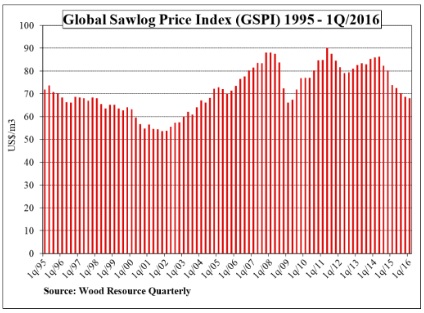
Relatively small adjustments in both exchange rates and in log prices in local currencies, resulted in the smallest quarter-to-quarter decline of the Global Sawlog Price Index (GSPI) seen in five quarters.
The European Sawlog Price Index (ESPI) did not change much quarter-overquarter and was $90.87/m3 in the 1Q/16. Before this last quarter, the ESPI had been in steady decline for two years and in the first quarter of this year was 27% below the 1Q/14 level.
 Global Pulpwood Prices
Softwood fiber prices fell in a number of countries in both local currencies and in US dollar terms in the 1Q/16. The downward price trend that started in Europe in early 2014 has continued, although in some markets, prices are starting to level out and the bottom might have been reached.
The Softwood Wood Fiber Price Index (SFPI), dropped one percent to US$87.62/odmt in the 1Q/16, which was its lowest level since the 1Q/06.
The Hardwood Wood Fiber Price Index (HFPI) fell 0.6% in the 1Q/16 mainly because of lower prices for hardwood pulplogs in Russia, Eastern Canada, France and Germany. The HFPI has been on a consistent decline the past five years. Global Pulp Markets
Global production of market pulp increased by over three percent in 2015. This increase in production continued in early 2016 with data for the first two months showing a healthy 3.0% growth as compared to the same period in 2015.
A majority of the major pulp-exporting countries have expanded shipments in 2016 with Brazil, Russia, Canada, Chile and Finland shipping around 10% more in the 1Q/16 than they did in the 1Q/15.
An excess of Eucalyptus market pulp (BEKP), particularly in Europe and North America, has  continued to push hardwood pulp prices downward during the first four months of 2016.
Global Lumber Markets
Global softwood lumber trade reached an all-time high in 2015 when, according to estimates by the WRI, 118 million m3 was traded internationally. This year has started out with even higher volumes being traded around the world; the 1Q/16 shipments were approximately 20% more than in the 1Q/15.
There was mostly upbeat news about the US lumber market in the first few months of 2016; housing starts were the highest since 2007, lumber consumption was 14% higher than the same period in 2015, lumber exports were up 13% from 2015, importation of lumber increased 47%, and lumber prices reached their highest levels in over a year.
The Nordic countries increased lumber export volumes in both 2014 and 2015 and the trend continued in early 2016.
Importation of softwood lumber to China from the two largest supplying countries, Russia and Canada, were 33% and 4% higher, respectively during the first four months of 2016 as compared to the same period in 2015.
Russian lumber export prices have fallen 36% in two years in US dollar terms. In Ruble terms, prices were close to record high levels in the 1Q/16.
Global Biomass Markets
North American overseas pellet exports increased for the third consecutive quarter in the 4Q/15, rising seven percent from the previous quarter to just over 1.7 million tons. The total for the year was 6.1 million tons, which was two percent higher than in 2014 and almost four times as much as in 2010.
Pellet prices in the three major markets in Europe, Germany, Austria and Sweden, were stable or in decline in the local currencies.
Sonae-Arauco is now the second wood-based panel producer worldwide

Arauco has completed the share agreement for the purchase of 50% stake of the Sonae Indústria’s subsidiary Tableros de Fibras, S.A. (Tafisa), which will be renamed as Sonae-Arauco, S.A.
This is an important step for Arauco, as the company will begin its operations in Europe and South Africa.
With this $150 million USD investment the newly formed company will manufacture and sell OSB, MDF and particleboard panels, as well as sawn timber. This equates to an additional 12 production facilities operating in Spain, Portugal, Germany and South Africa, as reported in a press release of Arauco. Continue reading "Sonae-Arauco is now the second wood-based panel producer worldwide"
SCM, Homag and Biesse increase their businesses in the US market
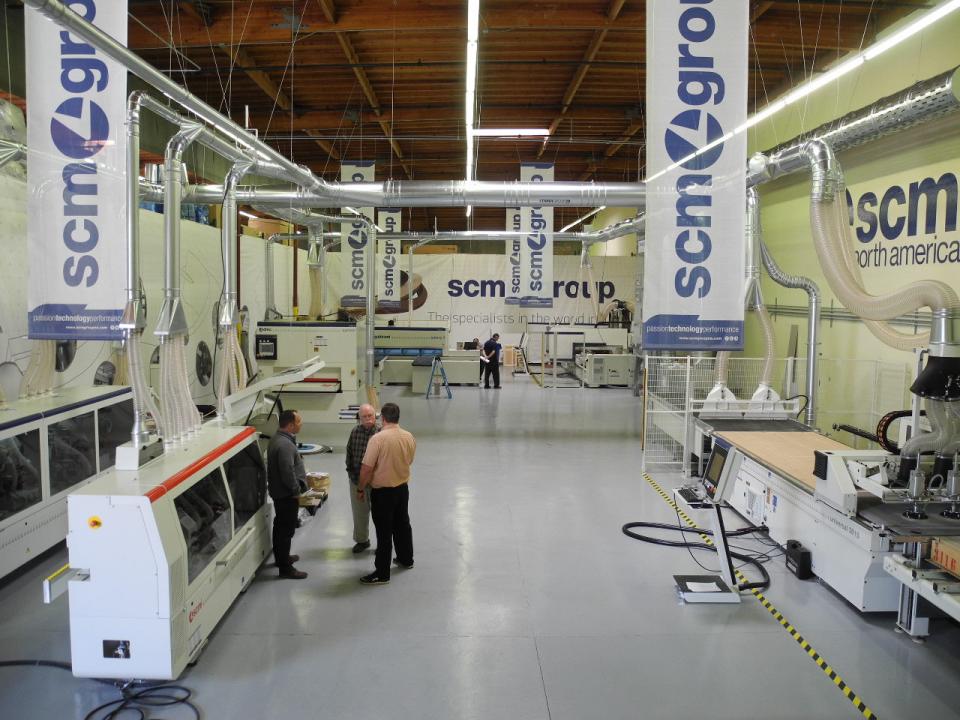
Three of the most important woodworking machinery manufacturers, Scm, Homag and Biesse have finished important expansions at their US affiliates in the last year.
In 2015, SCM Group North America opened a 20,000 m2 location in Carson, California. Continue reading "SCM, Homag and Biesse increase their businesses in the US market"
Global record levels for renewable energy investments
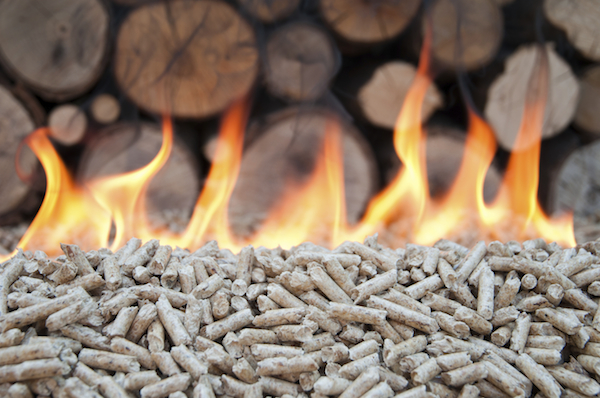
Investments in renewable energy are spreading around the world, as a new report shows that there was more money spent on green sources than on coal or gas-fired power plants in 2015.
As Renewables 2016 Global Status report concluded, around 147 GW of renewable power generation was invested in during 2015. This is a significant increase, as it’s more than the global fossil fuel capacity.
The total investment went to $286 billion, which represents the spending on renewable power and fuels, without the funding for large hydropower schemes. During 2015, the global investment in new renewable power capacity reached $265 billion, excluding the facilities with hydropower lower than 50 MW. At the same time, there were only $130 billion invested in new coal and natural gas-fired generation capacity.
Bioenergy production went on increasing during 2015, meeting the environmental objectives, as the research shows.
Yet, the low oil prices and policy uncertainty in some markets made the sector face some serious challenges. The bio-heat production increased very slowly in 2015, rising only 3% compared to 2014, but, as the report shows, the use of biomass for district heating grew in the Baltic and Eastern European regions.
Bio-power use grew quickly, by 8% a year, notably in China, Japan, Germany and the United Kingdom, while bio-diesel global production decreased because of constrained production in some Asian markets.
According to the same report, the development of biofuels continued to grow, increasing both in the capacity and production of fuel by thermal and biological routes. There are approximately 8.1 million employees worldwide in the renewable energy sector.
“What is truly remarkable about these results is that they were achieved at a time when fossil fuel prices were at historic lows, and renewables remained at a significant disadvantage in terms of government subsidies,” said Christine Lins, executive secretary of REN21, an international body backed by the UN, that published the report.
As the study concluded, to make the change from fossil fuels, there have to be great amounts of renewables integrated into the grid, policy and political instability
Estonian wood products exports stable in the first quarter

Estonia's exports of wood products were stable in the first quarter of 2016. Exports totaled 462.7 million euros, only 1 percent higher as compared to the same time frame of 2015.
The overall reduction in Estonia's export volumes is reflected also in the wood industry, where a decline has taken place in all categories of products. Speaking of the most important categories, the export of paper and cardboard fell almost 20% and the export of wooden furniture almost 10% year over year, the wood industry body, Estonian Timber, said.
Growth continued in the export of wood pellets, which surged by 37.1% over the first quarter of 2015, and in the export of mechanical wood pulp, which climbed almost 8%.
The main categories of exports were sawn timber, which accounted for 20.4% of total exports, construction components made from wood, with 14.5%, and wooden furniture and parts thereof, with 14.4%. Prefabricated wooden houses accounted for 13.9% and wood pellets for 10.5%.
The biggest amounts of sawn spruce are exported from Estonia to the Netherlands, Australia ad Latvia, and the biggest amounts of sawn pine to Latvia, Australia and Finland. Prefab houses are exported mainly to Norway, Germany and France.
Imports of wood products in the first three months of the year totaled 142.1 million euros, marking a year-on-year reduction of 6.4%. Sawn timber made up 35.5% of the imports and the leading country of origin was Russia.
Growth continued in the export of wood pellets, which surged by 37.1% over the first quarter of 2015, and in the export of mechanical wood pulp, which climbed almost 8%.
The main categories of exports were sawn timber, which accounted for 20.4% of total exports, construction components made from wood, with 14.5%, and wooden furniture and parts thereof, with 14.4%. Prefabricated wooden houses accounted for 13.9% and wood pellets for 10.5%.
The biggest amounts of sawn spruce are exported from Estonia to the Netherlands, Australia ad Latvia, and the biggest amounts of sawn pine to Latvia, Australia and Finland. Prefab houses are exported mainly to Norway, Germany and France.
Imports of wood products in the first three months of the year totaled 142.1 million euros, marking a year-on-year reduction of 6.4%. Sawn timber made up 35.5% of the imports and the leading country of origin was Russia.
Enviva will supply wood pellets to UK's Lynemouth power plant

US biomass producer Enviva has recently signed a take-or-pay off-take contract as to supply wood pellets to Lynemouth Power Limited, an Energetický a prumyslový holding (EPH) subsidiary, acquired from RWE in January 2016.
By the end of 2017, Lynemouth Power wants to Continue reading "Enviva will supply wood pellets to UK's Lynemouth power plant"
Enviva will supply wood pellets to UK’s Lynemouth power plant

US biomass producer Enviva has recently signed a take-or-pay off-take contract as to supply wood pellets to Lynemouth Power Limited, an Energetický a prumyslový holding (EPH) subsidiary, acquired from RWE in January 2016.
By the end of 2017, Lynemouth Power wants to Continue reading "Enviva will supply wood pellets to UK’s Lynemouth power plant"
Kronospan: US$88 million in the expansion of Alabama fiberboard facility

Austrian wood-based panel giant Kronospan has begun working on an expansion at the company's fiberboard plant in Eastaboga, Alabama. The expansion is worth $88 million, $16 million of which will be used for construction of a new building.
The permit for $88 million worth of work was sold by Continue reading "Kronospan: US$88 million in the expansion of Alabama fiberboard facility"
Tropical plywood share falls to all time low in EU

Latest EU import data shows that tropical plywood has continued to lose share in the EU plywood market over the last two years, ITTO reported in its latest MIS review.
While EU imports of plywood from all sources increased sharply between 2013 and 2015, from 3.38 million cu.m to 3.92 million cu.m, a level not seen since before the financial crises, imports from the tropics have remained stubbornly low (Chart 1), ITTO says.
 After increasing 4% to 324,000 cu.m in 2014, EU imports of plywood from tropical countries fell back 6% to 305,000 cu.m in 2015. The share of tropical countries in EU plywood imports fell from 9.2% in 2013 to only 7.8% in 2015, the lowest level for at least the last 20 years, and probably much longer.
According to ITTO, the share of imports of tropical hardwood faced plywood from China also fell in the last two years, from 3.0% in 2013 to 2.4% in 2015.
Tropical hardwood faced plywood has lost share mainly to Chinese plywood faced with temperate hardwood (including poplar, eucalyptus and birch), and to Russian birch plywood.
EU imports of temperate hardwood plywood from China increased from 986,000 cu.m in 2014 to 1.07 million cu.m in 2015 and share of imports increased from 26.1% to 27.2%. Over the same period, EU imports of Russian birch plywood increased from 782,000 cu.m to 863,000 cu.m and share increased from 20.7% to 22.0%, ITTO reported.
Further gains by Russia and China in the EU market in the last two years are likely due to the combined effects of the weak Russian rouble, declining value of the Chinese yuan and falling domestic demand in China, and rising availability of plantation wood from China.
Weakness of the euro against the dollar during 2015 will also have reduced sales of South East Asian plywood in the EU.
According to ITTO, early indications are that the share of tropical countries in EU plywood supply has continued to erode during 2016. EU imports of plywood faced with tropical hardwood were up 3.7% in the first three months of 2016 compared to the same period last year.
However, this was largely due to a 38% rise in EU imports of tropical hardwood plywood from China, from 23,700 cu.m in the first quarter of 2015 to 32,600 cu.m during the same period in 2016.
So far this year, China has been the EU’s largest supplier of tropical hardwood plywood (Chart 2).
Imports from Malaysia were down 5.4% at 29,000 cu.m in the first quarter of 2016 and imports from Indonesia remained static at 28,400 cu.m.
Of significant suppliers in the tropics, only Gabon registered an increase in exports to the EU in the first three months of 2016, with a gain of 37% to 10,000 cu.m compared to the same period in 2015. The latter is a trend worth watching as perhaps signalling the first sign of growth in the EU market for African okoume plywood after many years of recession, ITTO says.
The gain in EU imports of plywood from Gabon in 2016 has been concentrated in Italy and the Netherlands, with a much smaller gain in France where trade in this product is still very limited.
 The increase in EU imports of tropical hardwood faced plywood from China this year has been concentrated mainly in the UK and Netherlands (Chart 3). This is notable from the perspective of EUTR and forest certification, since importers and EUTR authorities in both countries are renowned for their relatively rigorous efforts to ensure wood is risk-free from an illegal logging perspective.
This implies that a significant proportion of this material is faced with certified tropical hardwood, or at least that Chinese manufacturers are now successfully reassuring customers of the legality of their tropical veneer supplies by other means.
Another notable trend in the first quarter of 2016 was the low level of import of tropical hardwood plywood into Belgium, at 9,400 cu.m, less than half the same period in 2015. Belgian imports of plywood from Indonesia have been much slower in 2016 than in 2015, although the fall in Belgium has been offset by rising Indonesian exports to the UK, Netherlands, Italy and Germany in 2016.
Source: ITTO

