Article archive

EIB announces multi-million backing for new investments in Irish forestry

The European Investment Bank and Ireland Strategic Investment Fund (ISIF) have agreed to back a new initiative expected to support EUR 112 million of new investment in privately owned forests across Ireland. This new engagement with Dasos represents the first Irish agricultural project and the first forest project in Europe to be supported by the Investment Plan for Europe that seeks to unlock EUR 315 billion of new investment.

The project will see the EIB and the Ireland Strategic Investment Fund work together for the first time in the agriculture sector and support a EUR 112 million investment by Dasos, a specialist forestry investment fund. The Ireland Strategic Investment Fund will provide EUR 55 million and the EIB EUR 28.5 million for this scheme. Additional support is expected from other investors as the initiative progresses. The EIB support is backed by the European Fund for Strategic Investments (EFSI).

Pan-European forest investment fund Dasos will seek to address issues faced by small scale forests across the country by working to improve forest management and strengthen the supply of wood for commercial use. The investment will support crucial upgrades to Ireland's forestry infrastructure through the consolidation of its management.

The initiative was announced in County Wicklow earlier today by Minister Andrew Doyle, European Investment Bank Vice President Andrew McDowell, European Commissioner Phil Hogan, Director of the ISIF Eugene O’Callaghan and Chief Executive of Dasos Olli Haltia.

Speaking at the event Minister Andrew Doyle highlighted that “This significant investment in Ireland’s forestry sector will underpin continued expansion and development of the industry. The most recent forecast of timber production on the island of Ireland highlights the maturing nature of this sector where much of the States investment in past decades is now ready to be harvested. This announcement today will help ensure that this economic potential is realised by consolidating smaller forests under a single management plan. The mobilisation of timber from privately owned forests is a key objective of my Department and this investment fund will make a significant contribution towards achieving this goal.”

“Over the coming years the Dasos Ireland forestry fund intends to help overcome diverse challenges faced by a fragmented industry and revitalise forestry in rural communities. Working with both Irish and European partners I am pleased to launch the first operations in Ireland by Finnish-based pan-European forest investment fund Dasos.” confirmed Dr Olli Haltia, Chief Executive Officer of Dasos.

By supporting direct land acquisition, lease contracts, afforestation and other forms of land management the Dasos initiative intends to develop into a professionally managed portfolio of around 10,000 hectares of forests across Ireland in the coming years. New forest management investment by Dasos across the country seeks to ensure a more predictable supply of wood including from previously subsidised forests where subsidies are coming to an end.

ISIF will provide up to EUR 55 million and the European Investment Bank up to EUR 28.5 million for this scheme.

“Forestry is a natural asset class for long-term, patient capital investors like ISIF and we are pleased to invest alongside Dasos and EIB in this initiative which is very consistent with our mandate and with Government policy. It will create a better structure to support availability of timber from Ireland’s private Forestry estate and will seek to support greater afforestation levels” said Eugene O’Callaghan, Director of ISIF.

There are an estimated 19,500 private owners of small forests across Ireland. Many of these plantations were originally supported by land based grants that are now expiring as the plantations reach an age that requires more scale efficient forest management.

European Commissioner for Agriculture and Rural Development Phil Hogan said: "Forests help to keep our rural areas vibrant and sustainable, providing over three million jobs in the EU. They also play a major role in the protection of EU biodiversity and represent a key sector in the transition towards a low-carbon and climate friendly economy. Continued investment in the sector is therefore a win-win for our economy, for our local communities, and our environment. This strategic partnership with the European Investment Bank will help to achieve these objectives, deliver the Investment Plan for Europe and support jobs and growth in rural Ireland."

The new initiative was one of two Irish forest initiatives announced in County Wicklow earlier today representing the EIB’s first support for agriculture in Ireland for 20 years.

“Dasos have proven experience improving forests across northern and southern Europe, and their exciting plans have the potential to transform some of the world’s best forests here in Ireland.  The European Investment Bank is pleased to work with Dasos and in further partnership with ISIF on an initiative that can strengthen the Irish forest industry and boost rural employment and economic growth.” highlighted Andrew McDowell, European Investment Bank Vice President.

The European Investment Bank also confirmed that additional support for agriculture in Ireland was expected to be confirmed in the coming months.

Since 1973 the European Investment Bank has provided more than EUR 15 billion for investment to improve public services, key infrastructure and unlock new opportunities for companies across Ireland.

The EIB is one of the world’s largest financiers for forests and has invested EUR 4.5 billion in forest related projects across Europe and worldwide over the last five years.

China plans 6 national timber reserves with around 95 million m3 of logs logging capacity

As part of China’s National Forest Reserve Construction Planning for 2016 to 2050, six new large forest reserves will be created. Reserves will be created in the southeast coastal regions, in the middle and lower reaches of the Yangtze River, on the Huang Huai Hai plain and in the southwest, Beijing, Tianjin and Hebei Provinces. A further reserve will be created in the Northeast. Continue reading "China plans 6 national timber reserves with around 95 million m3 of logs logging capacity"

Norbord triples EBITDA in 2016 on recovery of US housing starts and higher OSB prices

Wood-based panel giant Norbord  has reported 2016 adjusted earnings before interest, tax, depreciation and amortisation (EBITDA) of $383m – a more than triple increase over 2015. Norbord reported annual production records at seven mills during 2016 and said the modernisation and expansion of its Inverness mill in Scotland was on track for start-up in the second half of 2017. Continue reading "Norbord triples EBITDA in 2016 on recovery of US housing starts and higher OSB prices"

Russia might impose export duties on lumber with a low degree of processing

At the end of January, the Russian President, Vladimir Putin, approved a list of instructions following an audit conducted by the Presidential Control Directorate on the use, protection and regeneration of forests, and timber turnover.  Continue reading "Russia might impose export duties on lumber with a low degree of processing"

Resolute CEO claims to be able to persuade US in softwood lumber dispute

Eastern Canada deserves free and unencumbered access to the U.S. market because the forestry sectors of Ontario and Quebec are similar to the market-based systems in the U.S. Continue reading "Resolute CEO claims to be able to persuade US in softwood lumber dispute"

Sweden’s sawn and planed timber exports and delivery prices rose sharply

The Swedish exports of softwood timber (sawn and planed) rose slightly in November, both compared to the previous month and to the period January-November.  Continue reading "Sweden’s sawn and planed timber exports and delivery prices rose sharply"

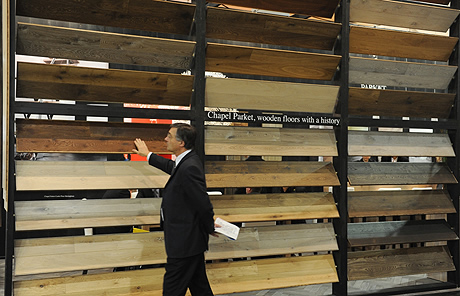
Shades of grey and textured service- new trends in wood flooring

The intense and rising competitiveness of the European flooring sector is immediately apparent from the DOMOTEX 2017 show numbers which hosted 1409 exhibitors from more than 60 countries.

The show was notable for considerable growth in the number of exhibitors this year and the total amount of space booked, and with an even higher percentage of exhibitors and visitors from abroad compared to previous shows.

Around 70% of DOMOTEX visitors this year were from outside Germany, with the majority (43%) coming from other EU countries. Total visitor numbers were slightly down on previous years, but there was a significant increase in visitors from the Near and Middle East (up 9%) as well as East and Central Asia (up 16%). Appreciably more visitors also came from the U.S. and the UK.

An insight into potentially significant innovations in the European flooring sector was provided by the prestigious Innovations@DOMOTEX display selected from products on show by a jury of experts from the fields of design, architecture, the media and interior design. Their choices implied strong interest in sustainable design and a preference for products with a natural look and feel, whose textures, materials, motifs and surfaces take their cues from nature.

Trend-spotters believe that grey or blends of grey and beige – "greige" – will remain the top sellers, while dark floorings are less popular with buyers. Textured surfaces are seen as “the next big thing” in wood and parquet flooring. There were a lot of "used" and grainy patterns and finishes on display - floorings designed to look brushed and often made from of reclaimed materials.

Vintage-look materials remain in fashion, along with knot holes, core splits and even traces of the saw blade or flakes of cement. This is true both of natural wood flooring and laminated wood flooring sector, the latter now exploiting increasingly sophisticated digital printing technology.

Various innovations were on display to improve service life of wood flooring in rooms such as kitchens and bathrooms where wood has not traditionally been widely used.

For example French manufacturer Design Parquet was promoting their patented Navylam+ system comprising strips of tropical wood, favoured both for its look and natural durability, which are pre-oiled and with an integrated jointing system.

Another highly innovative product designed to extend wood’s range of applications even further was "Lambdafloor" by Poland's Prestige which boasts an aluminum layer between the wooden surface and the water-repellent base material, in this way augmenting the thermal conductivity for use with underfloor heating systems. D

DOMOTEX 2017 highlighted that increasingly flexible and modular wood flooring products continue to be developed that are easier and less time-consuming to install and maintain, solvent free, better for indoor air quality and personal health and hygiene, and which offer other benefits in terms of durability and improved footfall dampening.

Prices for lumber in the US went $11 up at the beginning of February

Lumber trading in the US remained constant through the middle of last week, but started to increase on Thursday and pushed prices sharply higher. Continue reading "Prices for lumber in the US went $11 up at the beginning of February"

Housing starts in US expected to increase by 10% in 2017

Residential home construction increased 5% in 2016 from the previous year. An estimated 1,166,400 housing units were started in 2016. Single-family starts were up 9% in 2016, while multi-family declined slightly from the previous year.

In December housing starts grew 11% at a seasonally adjusted annual rate, according to the US Department of Housing and Urban Development and the Commerce Department.

Builders’ confidence in the market for new single-family homes was almost unchanged in January. According to the National Home Builder Association’s Chairman, builders expect that a new federal government will help create a better business climate for small businesses.

The National Home Builder Association expects a 10% growth in single-family construction in 2017.

The number of building permits issues, which indicates future building activity, were unchanged in December from the previous month. Single-family permits increased, while permits for multi-family construction declined in December.

Sales of existing homes sales declined in December, but 2016 as a whole was the best year in a decade, according to the National Association of Realtors. December sales were down because of low supply levels and affordability issues for first-time home buyers. The average rate on a 30- year mortgage was 4.30% in late December, the highest rate since April 2014 according to Freddie Mac, the Federal Home Loan Mortgage Corporation.

Growth in laminate flooring sales higher in Eastern Europe than in Western E.

In 2016, producers belonging to the EPLF reported worldwide sales of 476 million m2 of laminate flooring manufactured in Europe (2015: 452 million m2). This equates to an increase of 5.6% when compared to the same period in the previous year. The EPLF’s “home market” of Western Europe remained broadly stable during 2016. Both North America and Asia once again registered significant, double-digit growth rates in 2016, and in Eastern Europe, impressive increases were predominantly seen in the relatively large markets such as Russia, Poland and Romania. EPLF laminate flooring sales in South America remained broadly stable in 2016.  Continue reading "Growth in laminate flooring sales higher in Eastern Europe than in Western E."

Germany: Slowing softwood timber market

During the third quarter of 2016, the German softwood sawmills experienced a weakly positive outcome.

The results were published in the survey issued by the German sawmill and timber industry federation (DeSH) and show that 22% estimate their operational situation positively, 16% negative and 62% sufficient or satisfactory. Yet, the export situation is rather difficult. Continue reading "Germany: Slowing softwood timber market"

Multilayer modular flooring reports rising success in the EU market

Modular multilayer flooring has been a success in the market, which has resulted in an increase in membership for the Multilayer Modular Flooring Association (MMFA).

In the beginning of 2017, a total of 40 European producers, suppliers and institutes were working together towards the worldwide implementation of high quality standards for these innovative products. The MMFA anticipates that the recently-formed North American MFA Association will provide positive impetus for the interests of the industry. Continue reading "Multilayer modular flooring reports rising success in the EU market"

Tallest timber building in Amsterdam shows pattern of the buildings in the future

PATCH22, a 30m wooden high-rise, in an industrial part of Amsterdam strikes one as an ordinary residential apartment but its spacious interior shows what the future of buildings will look like. The Netherlands' tallest wood-framed building has a great deal of flexibility; it gives tenants the option to switch between commercial or residential use.

Architect Tom Frantzen and building manager Claus Oussoren wanted to achieve something they had never done before: An outsized wooden building that can be adapted into a commercial space—if the new owners so wish—in the future without pulling down the entire structure.


To avoid complications in change of use in future, a new kind of land-lease contract was drawn up in cooperation with the city. It appears to have become an attractive “selling point” that will contribute to stimulating development in the area.

The 4-metre floor-to-ceiling height allows in a generous amount of light and space as apartment units are sold unfinished and empty. A raised floor system allows owners to install wiring and plumbing as they wish.

The highly sustainable building was one of the successful plans in the Buiksloterham Sustainability Tender in 2009. Other energy-saving and environmentally-friendly features include rooftop solar panels and a biomass heating system. However architects point out that the building is not entirely made of wood—the floors are a steel-concrete-wood composite, designed to take twice the normal load.

PATCH22 won the WAN Residential Award 2016, for which the jury panel called it “spectacular.”

There’s a lovely story in terms of flexibility… the interiors are ‘super cool’. It feels like they’ve made a warehouse and converted it which creates wonderful light, space. It is striking and is a beacon for new generations.”

Segezha Group upscaled sawn timber sales to China

As of the year-end 2016, the global reach of Segezha Group sawn timber sales (part of Sistema JFSC) has grown from 11 to 14 countries. Export sales have reached 33%, driven by overall ramp up and economic backdrop. Continue reading "Segezha Group upscaled sawn timber sales to China"

EU flooring manufacturers increase market share

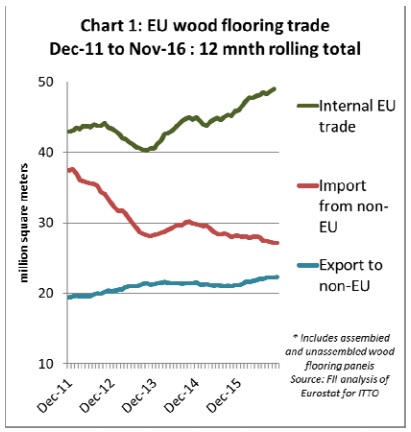
The trade background to the Domotex 2017 flooring show held in Hanover between 12 and 15 January is shown in Chart 1 which indicates that internal EU trade in wood flooring has been rising continuously since December 2013.

This is due partly to improving consumption of wood flooring products manufactured in the EU, and to the increasing role of manufacturing facilities in lower cost Eastern European countries to supply wood flooring to other parts of the EU.

Meanwhile, the EU’s large trade deficit in wood flooring that opened up before the financial crises, driven by the housing bubble and a flood of product from Asia, has narrowed sharply in recent years.

Efforts by European manufacturers to improve competitiveness through innovation in products and marketing, aided by the relative weakness of the euro and other European currencies compared to the US dollar, contributed to rising EU exports of wood flooring products to other parts of the world last year.

At the same time imports from outside the EU continued to decline in 2016. Much of the decline in EU wood flooring imports is due to falling trade with China, by far the largest external supplier accounting for around 60% of total EU imports.

EU imports of wood flooring from China were around 16 million sq.m in the 12 months to end November 2016, compared to 17.4 million sq.m a year earlier and over 21 million sq.m in 2012.

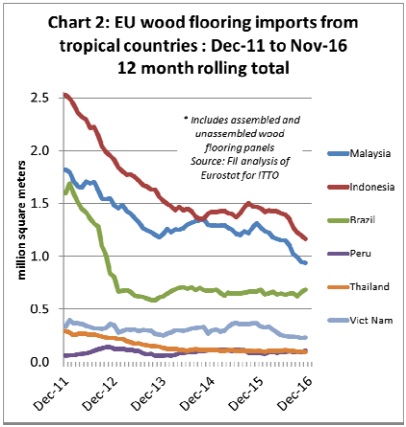
EU imports of wood flooring from tropical countries have also been declining in recent years (Chart 2). Imports from Indonesia in the 12 months to November 2016 were 1.16 million sq.m compared to 1.45 million sq.m a year earlier.

Imports from Malaysia fell from 1.31 million sq.m to 0.94 million sq.m during the same period.

The data is particularly significant from an Indonesian perspective. The figures to the end of November represent the real baseline against which the immediate impact of the FLEGT licensing system can be judged.

The first FLEGT licenses were issued in the middle of November and it will be interesting to monitor whether the recent slide in EU wood flooring imports from Indonesia can be reversed.

Global wood panels surfacing market: re-positioning for growth

The decoration of wood based panels with a variety of surfacing materials is a key value adding step in the value chain. As the global demand for wood based panels grows, mainly at the expense of solid wood and veneer based products, surfacing materials benefit.

Over 70% of surfaced wood based panels are used for furniture, while the remaining 30% are construction related products, including flooring and doors. Many consumers prefer lightweight, ready-to-assemble and low maintenance furniture at affordable prices and the analysed surfacing materials for wood-based panels meet these requirements much better than materials for traditional furniture. Continue reading "Global wood panels surfacing market: re-positioning for growth"

Austria: Softwood timber more expensive in January 2017

In January, prices of softwood timber in Austria have increased for almost all assortments as compared to December. However, if compared to January 2016, there are some mixed results. 
From December 2016 to January 2017, the price increase of 1 EUR/cbm is distributed uniformly.
Year-on-year, especially wide boards (3-6m length) have become more expensive. In other boards' assortments, the lower price limit has shifted down.
Also, the price of edged boards and reserve squared timber is higher. The price of rough boards and squared timber remained stable.

Softwood Lumber Spruce/Fir Jan. '16 Dec. '16 Jan. '17 Change Jan. '16 to '17
€ / cbm EXW
Edged Boards, 0-IIIa, 23 mm + 230-241 231-241 232-242 +2 / +1
Rough boards in fixed dimensions, 18-22 mm 230-240 228-239 229-240 -1 / -
Squared timber, standard dimensions, I/II, 4-6 m 210-217 208-216 210-217 - / -
Reserve squared timber, II/III 154-161 154-161 155-162 +1 / +1
Boards, III-IV, 8-16 cm, 4-6 m 147-154 146-154 147-155 - / +1
Boards, III-IV, 8-16 cm, just 4 m 149-155 147-155 148-157 -1 / +2
Boards, III/IV, 23 mm, 4-6 m 150-155 148-156 148-157 -2 / +2
Boards, III/IV, 28 mm +, 3-6 m 155-163 157-165 158-166 +3 / +3

Newsletter

Subscribe to our digital newsletter for your daily digest of essential news, views and analysis from the international wood industry delivered directly to your inbox.


0